TSEEC - TS/TDMA based Energy Efficient
Congestion Control in Mobile Wireless Sensor
Network
Sohail Jabbar, Awais Ahmad, Ataul Aziz Ikram, Murad Khan
Abstract—In past few years, a remarkable change has been faced in the field of wireless sensor network – mobile sensor nodes. Congestion in the network and limited energy causes delay in the network. Due to this very reason, it has been now an obligatory to ensure the appropriate use of the given resources. Saving the battery life, sagacitic time allocation, minimizing the communication delay, effective congestion control and in some aspect managing the entrance and exit of nodes in a specific cluster is the key issue to be satisfied in an algorithm claiming to be efficient congestion control protocol for a mobile wireless sensor network. To deal with the said confront, we proposed Congestion Control Protocol (CCP) for Mobile Wireless Sensor Network. It uses the existing TDMA technique with combination of Statistical Time Division Multiplexing (STDMA), with enhanced newly proposed technique of Time-Sharing TDMA (TS-TDMA) to avoid congestion, saves energy and provides efficiency. Simultaneous effort of approaching the target not only causes the data loss due to congestion issue but also results in squeezing the energy which ultimately comes up with reducing the network life time.
We have implemented our work on Network Simulator (NS-2.27). The simulation results shows that TSEEC performs well to avoid congestion, saves energy and reduces delay in the network.
Key Words: TS/TDMA, Congestion Control, CCP, STDMA
I. INTRODUCTION
ireless Sensor Network uses a shared medium and the sensor nodes send data to their neighboring nodes as well as to the cluster head at the same time. Hence there are chances of creating congestion resulting in energy wastage on the nodes as well as on the cluster head of the WSN. Sensors are the monitoring and surveillance devices mainly consisting of sensing, processing, storage and power subsystems, deployed over a large geographical area depending upon the application requirements. This idiosyncratic technology of
wireless sensor network has its application in Glacier monitoring [1], volcano monitoring and tunnel monitoring and rescue, sniper localization, ocean water and
bed monitoring, rescue of avalanche victims, tracking vehicles, wildlife monitoring, cattle herding, vital sign monitoring and cold chain monitoring [2].
Energy is an important resource for WSNs and it plays an important role in communicating information packets between different nodes in the network. Congestion in WSN is either “Node Level” or “Link Level”. Former is caused by the overflow of node buffer due to the lack of capacity to store further packets. Later is due to too much information packets being sent on the channel by various neighboring nodes. The innovative technique of „TS-TDMA hybrid-protocol‟ is a useful remedy for controlling both these traffic congestions, which is discussed in subsequent sections:
The STDMA uses a technique of statistical measurement of the data load and energy requirements on each mobile node, thereby helping the mobile nodes send data to the receiver without NLC. The mobile nodes share information about their respective unique ID, packet load, energy level and location with the static Cluster Head;
Using the feedback from the nodes and the TDMA technique, the Cluster Head assigns time slot to different mobile nodes; TS-TDMA (Time-Sharing TDMA) is our new innovative technique that helps the mobile nodes share their allotted time-slots among themselves depending on whether a mobile node has sensed any data or not. Cluster Head remains the coordinator. There are several deficiencies in the wireless sensor network where mobile nodes are ultimate in the situation. Different nodes move in zigzag direction. Joining and leaving clusters and communicate with Cluster Head and neighboring nodes is a difficult task. It causes dilemma of acquiring the channels as well as time slots to avoid congestion on sink node. In such conditions, many-to-one node communication establishes which causes collision of packets [3]. Collision of packets leads consuming of extra energy for retransmitting of same packets. While working on MAC layer, energy scheming is an immense issue. Huge amount of energy wasted when a node receive many packets from different resources. So the destination node will drop extra packets and the source node will waste its energy by sending extra packets.
We need such algorithm, which prevail over the limitations of the mentioned algorithm. The proposed
W
Manuscript received Jul 15, 2011; revised August 14, 2011. Corresponding authors:
Sohail Jabbar is PhD Scholar under supervision of Dr. Abid Ali Minhas at Department of Applied Sciences and Graduate Studies, Bahria University Islamabad Pakistan ([email protected]) Awais Ahmad is with Department of Applied Sciences and Graduate Studies, Bahria University Islamabad Pakistan (Email: [email protected])
Ataul Aziz Ikram is Head Of Department, Dept. of Computing and Technology (Email: [email protected])
algorithm, TSEEC minimizes delay, avoid congestion and improve efficiency of the network. The algorithm is tested with different traffic load in the network and showed our result in section IV. Section II comprises Literature Survey, Section III includes our proposed Network Model, and Section IV is specified for our proposed algorithm results.
II. LITERATURE SURVEY
There is always a room for improvement. A commodity that is once considered as 100% in its demand is devalued to nothing later. Existing protocol to control conservation of energy, delay in the network and congestion in mobile wireless sensor network are so in addressing this problem. Congestion at cluster head creates overhead which entails considerable amount of energy, packet loss and delay in the network. A network that is free from these ills must be able to assign time slots to different mobile nodes in the zone, and in each time slot a particular node should be active for communication and performing the assigned task.
There are various protocols to avoid congestion in wireless networks like CSMA/CA in IEEE 802.15.4 protocol for CR-WPAN which is used to cover beacon enable mode in [3]. Cross layers terminology is used in order to share information between different protocol layers which helps in increasing interlayer interactions. In this scenario one major issue has been found i.e. interaction of MAC and transport layer operation results in collision as well as congestion are the major problems in the source packet loss. Packet collision due to many-to-one traffic pattern under heavy traffic loads is discussed in [4]. Energy efficient MAC protocol has been proposed, where, there are full sleep cycle at different leaf nodes which helps in minimizing the load on leaf nodes in heavy traffic. In such environment, the leaf node goes in to full sleep state for one complete cycle, this leads to reduction of packet collision as well as reduce the consumption of energy which saves at low depth nodes.
Robust Routing Algorithm with Fair Congestion Control (RRA-FCC) is presented in [5]. This algorithm is used for minimizing the congestion at the sink node. Sink is a node to which two or more devices send data at a time, the challenge is the congestion. RRA-FCC is used to control congestion and thereby reserve energy for the network.
A typical wireless sensor network consists of one or two sink nodes, but new research techniques now enable to deploy tens to thousands of sink nodes in a region. If we compare this with Ad- Hoc Network, the following characteristics have been noticed.
Limited resources: limited resources include energy processing capacity as well as memory to store sensed data.
Low mobility: the general scenario of WSN includes static nodes however; there can be very few nodes which can move in the environment.
Data centric: data sensing is an important feature of WSN. The data has been sensed without knowing the IDs of which the nodes set the data [5].
SeveralMAC protocols for wireless sensor network are discussed and evaluated in [6]. It has been noticed that by sensing and sending data from one node to another node or from one node to the cluster head consumes considerable energy as compared to the computation of data by sensor nodes or cluster head. Demikol et al. have also discussed the factors that results in energy wastage at MAC layer. The important factor is congestion on sink node, where more than one node sends data at time, which results in dropping of the packet. After that, source needs to resend that amount of data again. This retransmission needs extra energy consumption. Overhearing is a process when one node receives extra packets that are not required. It means that the data has been broadcast over the network for one specific node but other nodes also receive the same data as „unwanted‟ or extra packet. Idle listening is the process when the node is listening to a channel when idle that results in increase of traffic in the network. The last reason is “over meting”. This can be done by sending packet to that node which is not ready for intake of the packet. To avoid such circumstances, a MAC layer protocol is required preserver extra energy. Therefore, the proposed protocol named „TSEEC‟ which deals with the above mentioned drawbacks of the network.
Various protocols and algorithms regarding delay and congestion in the wireless sensor network in [7]. It identifies limited battery power as the main issue in wireless sensor network functioning. As already discussed, wireless nodes have limited battery power. If deployed in an environment where recharging of these batteries is difficult or impossible, the WSN could fail. In TDMA based MAC protocol, time slots have been arranged in sequence and assigned to each frame. TRAMA is the most important protocol used for energy efficiency and avoid collision in channel [8]. TRAMA is the TDMA based approach which splits the time into two parts i.e. random access protocols and scheduled access period. While deploying wireless sensor nodes in any physical environment, the assignment of cluster head is an important task.
III. PROPOSED SOLUTION
It is a difficult job to control congestion on the sink node in WSN due to always broadcast transmission nature. Although transmission is broadcast yet decoding can be unicast. Therefore, it is required to design MAC protocol with special focusing on congestion control. This ultimately results prolong network lifetime. In particular, our proposed solution deals with the energy conservation, delay and efficiency of the network. Time Sharing-Time Division Multiple Access Protocol is presented as the improved version of TDMA, which also having the working features of STDA
a. Overview
join the cluster are authenticated by the cluster head using distance ratio between their neighboring cluster heads. Joining nodes are then assigned the timeslots through Statistical Time Division Multiple Access (STDMA) technique. Memory status (load of sensed data) and criticality of location of the respective mobile node are the time slots‟ assignment parameters. ST/TDMA based Energy Efficient Congestion Control in Mobile Wireless Sensor Network (TSEEC) specifically targets the issues like delay, energy wastage, congestion and inefficient network. Two main strategies are there under the umbrella of TSEEC to cope up with the delay introduced due to freeing up of allocated Timeslots and above mentioned issues: Load Based Allocation (LBA) strategy and Time Allocation Leister (TAL) strategy. LBA is purely based on STDMA method of time slot allocation. The three fold nature of Time Allocation Leister (TAL) manipulates the free time slots arise due to mobile nodes joining and leaving the zone. Three modules in the paradigm of TAL assist this working that are, i) Extricated Time Allocation (ETA) ii) Shift Back Time Allocation (SBTA) iii) eScaped Time Allocation (STA).
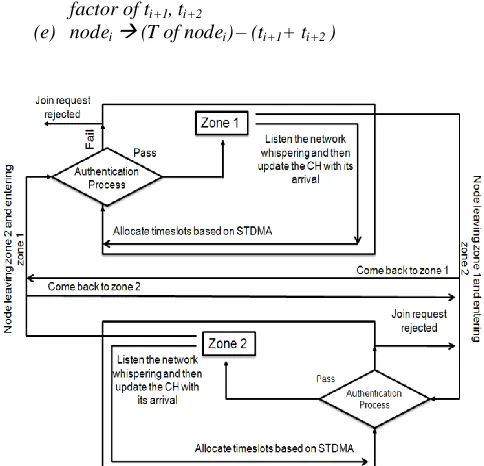
TAL has been used in order to provide efficiency and to overcome the issue of delay introduced caused by different mobile sensor nodes due to congestion on cluster head. The synergistic mating of STDMA and TAL strategies come up with the reduced energy consumption, effectively and efficiently time allocation, lessening the communication delay between node and the cluster head and sagacitic congestion control between the node and cluster/zone head. Overview of TSEEC working is also depicted in Figure 1`
b. Cluster Head Election
Exploiting the self organizing capability of sensor nodes, each node may know its neighboring nodes as well as its Cluster Head (CH). As the deployment is deterministic, so at initial stage, selection of CH is on hand. Due to the homogenous nature of nodes, the node having the more neighbors is designated as Cluster Head (CH). Cluster Head is the main head of the cluster. Each node attaches itself to the CH on the basis of received signal strength (RSSI). If a node receives invitation from more than one Cluster Heads then the following criteria is followed:
SweightiSweightj j
Where Sweight is weight or strength of received signal of the invitee CH.
If SweightiSweightj j
Then the selection is on the basis of
EweightiEweightj j
Where Eweightis the weight of energy level of invitee VH. If
EweightiEweightj j
Then a random selection is made.
c. Load Based Allocation
Load Based Allocation is implemented on the true essence of statistical time division multiple access (STDMA) technique. Status of memory and location is shared by the member nodes to the Cluster Head (CH). The node having less memory (more data to be transmitted/more sensed data) and of more critical location is assigned the time slots relatively. This assignment procedure is followed in the start and on the entrance of node to the zone. Although Mobility of the nodes makes this time slots assignment process somewhat more burdensome to the cluster head, yet it is properly managed by the LBA in collaboration with TAL. TAL keep control of the free time slots and assign accordingly from the CH end.
d. TS/TDMA
Time Sharing-Time Division Multiple Access is a technique of „Hybrid‟ nature. LBA is purely based on STDMA method of time slot allocation. Assignment of time slots to the cluster members is assigned by considering the load of. After the cluster head formation, the mobile nodes send their location, memory and energy values to CH. Assigned time slots are based on priority precedence order of i) memory ii) battery and iii) location.
e. TAL Strategies
The three-fold nature of TAL strategy manipulates the effects arising out of mobile nodes joining and leaving the zone. The three prongs of TAL are: Extricated Time Allocation (ETA), Shift Back Time Allocation (SBTA) and Escaped Time Allocation (STA).
(i) ETA: ETA handles the situation when there is no sensed data to be transmitted by non-cluster head and the assigned time slot is considered free. Time freeing up by the sensor due to the absence of sensing considers two scenarios for its utilization:
a. Assigning the free time slots by the CH to the new entrant of the zone to participate in the communication process
b. Assigning the free time slots by the CH to the existing neighbor node of the free node.
This technique will occur when mobile sensor node has no data to sense. Sometimes, it can also happen that when mobile node senses the same data, so it is required not to send the redundant data. Then it broadcast the message for its neighbor to shift back time slot as per empty time slot which has been left over due to no sensing or redundant data. At the same time, when newly arrived mobile node joins the cluster, so it will also broadcast its arrival to the cluster head, the remaining time slot will be allotted to newly arrived mobile node.
So basically, time freeing up by the sensor node due to the absence of sensing in a scenario or redundant data, where a mobile entering the zone and there is no mobile entering the zone is handled by ETA.
time slot to its cluster head, and will enters to its neighboring cluster. The neighboring cluster head will a lot time slot as it were left over due to ETA. So SBTA conduces the time released due to the node leaving the zone in the same scenario as of ETA.
(iii) STA: The incoming node whispers the link and updates the CH2 about its status of new entrant. CH2 manages the time in the following way:
a. Wait for completing the duty cycle of assigned time slot to the cluster member nodes. And then assign the time slot to the new entrant based on the same criteria as was followed in the start of working of algorithm.
b. Assign the saved time slot taken from the unused to the new entrant. This strategy assists in time saving as well as energy conservation. Free time slots are available due to i) Leave of node ii) Death of node iii) No sensed data to be transmitted
Hence the assigned time slot become free from their re-arranging by the insertion to the cycle for the new entrant or to the neighboring node by shifting their starting time of arranged time slot back.
General working of SBTA is as follows.
(a) If (a node has no data) (b) Then
(c) ti alert to cluster head
(d) Cluster head shiftback T of other nodes by a factor of ti+1, ti+2
(e) nodei (T of nodei)– (ti+1+ ti+2 )
Figure1: Mobile node leaving its zone and entering to neighboring zone
IV. SIMULATION AND RESULT DISCUSSION
For performance evaluation of our proposed algorithm, TSEEC, Network Simulator (NS-2.27) is used. In our simulation, we have calculated energy consumption per node, Delay in Low Traffic Load (LTR) and High Traffic
Load (HTR) and a Hybrid Protocol of SMAC and 802.11n, which influence overall network efficiency and avoid congestion. In our simulation on NS2.27, we have considered simulation time of 50 seconds with simulation area of 1000m*1000m and deployed 50 mobile sensor nodes. The maximum packet size for transmission is 100 bytes. In our simulation, we have used two ray ground propagation model which considers the direct path as well as reflected path. There are two clusters in our scenario; each cluster has 25 mobile nodes with static cluster head. Each sensor node has 15J of energy. Different mobile nodes communicate through wireless channel.
We have considered MAC type 802.11 and 802.11n in our scenario in order to accomplish better results. 802.11n has typically used for energy reservation and congestion control. Wireless sensor nodes operate on batteries. One of the common applications of wireless sensor network is environment monitoring. We have deployed mobile sensor nodes in adhoc manner. Due to its limited power, periodic and aperiodic has been considered of awake and sleep state, which is based on our said protocol of TSEEC. The main application of MAC that we can differentiate it from customary Wireless MAC i-e 802.11 has the energy conservation and congestion control which are the primary goals. The use of 802.11n has been implemented on cluster head so that it may communicate with all sensor nodes without any congestion and also saving its energy. All mobile sensor node communicate through their antenna. In our simulation, we have used Omni-directional antenna, because it has to propagate signals in all direction in equal power.
4.1. Deployment of Mobile Sensor Nodes
[image:4.612.48.290.398.631.2]In Figure 2, all the mobile sensor nodes arranged themselves into cluster. Before sensing any data, the nodes send their location information, battery life time to cluster head to form appropriate cluster for requirement of time slots with the help of STDMA. In this Figure there are 2 clusters, each with 25 mobile sensor nodes. Here, all the mobile sensor nodes busy in sensing data. TDMA technique will be applied with the help of cluster head. The mobile sensor nodes first sense data and then forward it to cluster head as shown as in Figure 2.
We performed simulation in three aspects with the same simulation parameters as discussed in first part of section IV and in table 1.
Experiment 1 shows the energy consumption in (Joules) by each mobile sensor node. The comparison of periodic and aperiodic sleep schedule has been considered
Experiment 2 gives us the result of energy consumption by the cluster head with the implementation of 802.11n. The energy consumption has been acquired from different states i-e transmitting state, receiving state, listening state, sleep state and idle state.
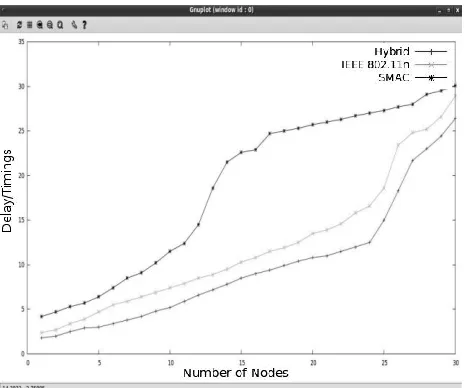
Experiment 3 shows the comparison of two protocols embedding in our proposed algorithm of TSEEC i-e SMAC and 802.11n
EXPERIMENT 1:
[image:5.612.323.565.166.390.2]The graph in Figure 3 illustrates that with simultaneous employment of periodic-sleep-state and TS-TDMA techniques (as against the traditional TDMA technique) individual nodes consume much less energy. Energy problem in sensor nodes is critical. It also saves the energy. The said algorithm deals with the above mentioned problem in the best way. It is cleared from the graph that the deployment of sensor nodes in periodic state gives us half good results as compared to a periodic state. In a periodic state, the sensor nodes are alive for long period of time and this provides productive results. Energy remained balanced due to periodic state and we have followed this algorithm in our proposed model of TSEEC. However with aperiodic state, very limited amount of energy as well as sensor node is in residual.
Figure 3: Energy Consumption in each sensor node
EXPERIMENT 2:
We have implemented 802.11n at back end i.e. on cluster head in order to calculate its energy level. All the nodes have 15 Joule energy; within that energy they have to communicate throughout the entire session. From the graph in Figure 4, Cluster Head consumes less energy on
[image:5.612.49.287.433.648.2]communicating with one particular sensor node. (Transmitting to one particular sensor node), although CH consumes average energy whilst listening to all nodes as well as newly arrived node in that cluster. On the other hand, in receiving state,it shows that CH consumes much higher energy due to receiving of maximum number of data from different nodes, newly arrived node in the cluster, processing of data and assigning of time slots to newly arrived timeslots in STA case.
Figure 4: Energy status of IEEE 802.11n
Consumed energy = Total Energy - Sum of energy in all states.
Ce = TE – TS
Ce = 15J – 9.2J
Ce =5.8J
Ceis the level of energy consumption of our entire scenario.
EXPERIMENT 3:
Figure 5: Delay/Timings in Hybrid Network
From the above three experiments, it is concluded that deployment of mobile sensor nodes in any area with the implementation of our proposed TSEEC protocol shows better results while calculating energy level by comparing different attributes as well as implementation of 802.11n and SMAC in our scenario. The resultant hybrid protocol on its implementation in clustered based sensor network topology gives efficient results with respect to above mentioned performance parameters in part paragraph of section IV
V. CONCLUSION
In this paper, we have discussed various available techniques regarding congestion control, latency, delay and energy consumption in WSN. We have also implemented the innovative technique of TS-TDMA hybrid-protocol to avoid congestion, reduce both delay and the resultant energy deficiency. Secondly, allocation of time slots and sharing of time slots amongst different mobile nodes and load balancing technique helps in minimizing memory as well as extra energy wastage. The synergistic mating of TDMA with Time Sharing algorithm and STDMA results in energy consumption, effective and efficient time allocation, lessening communication delay between node and the cluster head, and sagacious congestion control. We have implemented our work on mobile sensor nodes with static cluster head. We have seen its results after implementation on NS-2.27 and for deriving graphs using GNUPLOT function has been made use of. TS-TDMA has been found to be the most suited solution to deal with major bottlenecks in WSN communication i.e. congestion, latency, energy consumption, delay on mobile nodes and cluster heads and overall efficiency of the network.
REFERENCES
[1]. H. K. Martinez and J. Stefanov,“Glacsweb: A sensor web for glaciers.” Berlin Germany: EWSN 2004,
January 2004.
[2]. R. Riem-Vis, “Cold chain management using an ultra low power wireless sensor network.” Boston, USA: WAMES 2004, June 2004.
[3]. Radosveta Sokullu, Cagdas Donertas ”Combined effects of mobility, congestion and contention on network performance for IEEE 802.15.4 Based Networks”. Computer and Information Science, 2008, ISCIS „08‟, 23rd
International Symposium on Digital Object Identifier: 10.1109/ISCIS.2008.4717944 Publication Year 2008, Page(s): 1-5.
[4]. Kyoungseok Oh, Seok Woo, Seokjin and Kiseon Kim “Improved energy efficiency of DMAC wit periodic full sleep cycle for WSN with heavy traffics” Intelligent Sensors, Sensors Networks and Information, 2007, ISSNIP 2007, 3rd International Conference on Digital Object Identifier 10.1109/ISSNIP.2007.4496824 Publication year: 2007, Page(s): 85-89.
[5]. Yunlu Liu, Yuheng Liu, Juhua Pu and Zhang Xiong “A robust routing algorithm with fair congestion control in WSN”. Computer Communication and Networks, 2008, ICCCN „08‟. Proceedings of 17th
International Conference on Digital Object Identifier: 10.1109/ICCCN.2008.ECP.167. Publication year: 2008, Page(s): 1-4.
[6]. Ilker Demikol, Cem Ersoy and Fatih Alagoz “MAC protocols for WSN: A Survey. Network Research Laboratory (NETLAB) of Computer Engineering Department of Bogazici University, Bebek, Istanbul, Turkey.
[7]. Giuseppe Anastasi, Marco Conti, Mario Di Francesco and Andrea Passarekka “Energy conservation in WSN: A Survey”. AdHoc Networks 7 (2009) 537- 568. Journal
[8]. V.Rajendran, J.Garcia-Luna Aceves, “Energy-efficient collision-free medium access control for wireless sensor networks” in: proc. ACM SenSys 2003, Los