Original Article
Status quo and needs analysis
of health services among elderly urban
residents in the developing and ageing Chongqing
Rongrong Zhao*, Houxiu Zhou*, Jingci Zhu
Department of Nursing, Army Medical University (Third Military Medical University), Chongqing 400038, China. *Co-first authors.
Received May 13, 2019; Accepted August 6, 2019; Epub October 15, 2019; Published October 30, 2019
Abstract: Objective: Based on the scientific analysis and research of home and home care systems in China and abroad, this paper discussed the needs, impact factors, home care problems, development methods, solutions of urban elderly community systems and urban community elderly care in Chongqing. This may provide some policy advice for effective/economic/equal service delivery to promote the development of China's long-term elderly care. Methods: With multistage stratified cluster random sampling, we classified all the districts in Chongqing according to the economic level and then 2 or 3 districts in each level were selected to conduct an on-site survey in order to understand the utilization situation and demands on home-based care service. According to the principle of free will, a total of 1635 elderly citizens aged above 65 fulfilled the self-designated questionnaire, including general information, health condition and demand of elder care service. The statistical methods included descriptive statis-tics analysis, chi-square test, univariate and logistic regression analysis by SPSS 21.0. Results: A total of 1553 valid questionnaires were collected with an effective recovery of 94.98%. Investigation revealed that there were 55.9% interviewees that selected home-based care, 29.5% selected combination of home-based care and community-based care. Gender, health condition, literacy, health-payment systems, number of children, distance from their children and monthly income were the impact factors. We report that 50.7% of the population used community seniors’ services, and 63% of them expressed satisfaction or satisfaction with the service; while 42.7% hoped to receive long-term service, 40.8% required emergency service, and 16.3% needed short-term service. The first three types of services required were health guidance (63.6%), life care (53.8%), and dietary guidance (40.5%). In total, 33.1% expressed a willingness to purchase home-based service and health payment systems, in which monthly income and health conditions were influencing factors. Conclusion: The home-based service for seniors is impacted by a number of factors, which presents as multi-level and diversified. The most pressing need is to provide health support. Socialization of home-based care service should be strengthened. In order to attract more professionals, the service content and supply methods should be optimized.
Keywords: Home care systems, for seniors, long-term service, short-term service
Introduction
Chongqing is a major city in southwest China. Administratively, it is one of the four municipali-ties directly under the Central Government of China and is the only one far from the coast. The Chongqing population as of 2015 was just over 30 million with an urban population of 18.38 million [1, 2]. In terms of age distribution, 6.4 million (20.88%) were of 0-14 years, 20.7 million (67.69%) of 15-64 years and 3.5 million (11.46%) were 65 years and over. It is estimat-ed that the population ageing in Chongqing will reach its peak in 2036. In the next 10 to 20
years, the Chongqing aging population will grad-ually evolve into a serious area [3]. This will pose a major challenge to the social develop-ment of Chongqing.
the seniors [6], can avoid causing unnecessary social unrest and to ensure that Chongqing transitions smoothly through the period of social transformation.
Methods
Subjects and samples
The subjects involved in this study include se- niors in urban communities living in Chongqing. Inclusion criteria were ① age ≥ 65; ② have the ability to express their wills clearly. Exclusion criteria were ① being cognitive disabled; ②
functional and organic psychosis; ③ living in the surveyed communities less than a year; ④
unwilling to be investigated. This study used a multi-stage stratified random sampling me- thod.
According to the economic level of each region in Chongqing city (according to the urban core area of city functions, development zone, City Development Zone, the development of eco-logical conservation area northeast, northeast of Chongqing ecological protection zone five functional areas), 2 areas in each of the 10 areas in these districts were chosen. The choice did not contain a high-grade residential, low rent housing nor affordable housing in accordance with the community standard site investigation. This questionnaire had 35 variables.
Implementation method
Before the investigation, the relevant staff and the respondents meet and understand the pur-pose of the investigation, meaning, content, time, place and methods of investigation were discussed. The relevant staff were considered as investigators after given related training. The time of the questionnaire was arranged by community staff according to the actual situa-tion. The location of the survey was where the senior often gathered. After obtaining the per-mission from the elderly participants, seniors answered the questionnaire under the guid-ance or assistguid-ance of investigators. The aver-age completion time of each questionnaire was about 10-20 minutes, and all the question-naires were collected on site.
Questionnaire recovery
This study gave out 1700 questionnaires in the Shapingba District of Chongqing City, Jiangbei
District, Yubei District, Beibei District, Hechuan District, Dazu District, Wulong District, Zhong- xian, Shizhu County, Wanzhou (10 areas), and 1635 copies were returned, in which 82 copies were invalid. The effective recovery rate was 94.98%.
Statistical analysis
The data were recorded and checked by Epidata, and SPSS statistical software (21.0) was used to analyze the data. General social demographic information, disease data and demand intention of the elderly were descript-ed by frequency and percentage. The elderly care service utilization and demand in different groups were analyzed by chi-square test. Univariate and multivariable logistic regression analyses were performed to analyze influencing factors. P<0.05 was considered statistically significant.
Results
General information of subjects
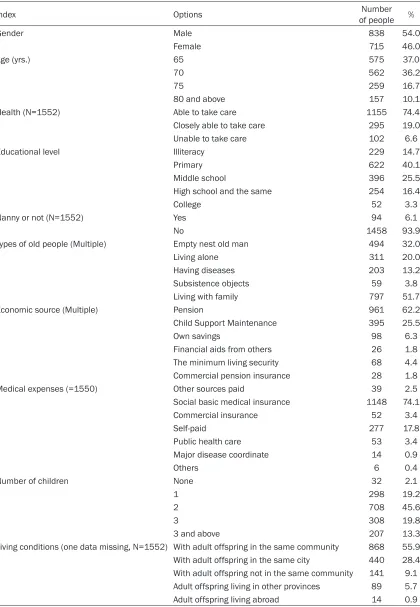
The general information on the subjects of investigation was shown in Table 1. In this sur-vey, there were 1553 elderly people surveyed over 65 years old in Chongqing city community. The sex ratio of men and women was 1:0.85, which showed men than women. The propor-tion of the elderly under 70 years old was more than 1/3, and 157 people were over 80 years old, accounting for 10.1%. In terms of health, the elderly who are have self-care and are unable to take care of themselves account for 25.6%. Most respondents did not have high-er education, junior high school and below accounted for 80.3%.
total survey, and 21.3% of the elderly do not
[image:3.612.97.517.83.690.2]live with adult offspring. Today, the first genera- tion of parents of single-child families has entered the old age. Nowadays, in the social
Table 1. The general information of all subjects in study (n=1553)
Index Options of peopleNumber %
Gender Male 838 54.0
Female 715 46.0
Age (yrs.) 65 575 37.0
70 562 36.2
75 259 16.7
80 and above 157 10.1 Health (N=1552) Able to take care 1155 74.4 Closely able to take care 295 19.0 Unable to take care 102 6.6 Educational level Illiteracy 229 14.7
Primary 622 40.1
Middle school 396 25.5 High school and the same 254 16.4
College 52 3.3
Nanny or not (N=1552) Yes 94 6.1
No 1458 93.9
Types of old people (Multiple) Empty nest old man 494 32.0 Living alone 311 20.0 Having diseases 203 13.2 Subsistence objects 59 3.8 Living with family 797 51.7 Economic source (Multiple) Pension 961 62.2 Child Support Maintenance 395 25.5
Own savings 98 6.3
Financial aids from others 26 1.8 The minimum living security 68 4.4 Commercial pension insurance 28 1.8 Medical expenses (=1550) Other sources paid 39 2.5 Social basic medical insurance 1148 74.1 Commercial insurance 52 3.4
Self-paid 277 17.8
Public health care 53 3.4 Major disease coordinate 14 0.9
Others 6 0.4
Number of children None 32 2.1
1 298 19.2
2 708 45.6
3 308 19.8
3 and above 207 13.3
environment where social life is fast-paced and work pressure is high, the pension of this part of the elderly cannot fully support the family. These elderly shape future government policies underpinning and are the social assistance focus.
According to the statistical results, 440 elderly people lived with their adult offspring or lived in the same community as their adult offspring, and 868 elderly and adult offspring lived in the same area of the city. It showed that 84.3% of the elderly live with or are close to each other, thus providing geographical convenience for home care.
The top 20 basic chronic diseases
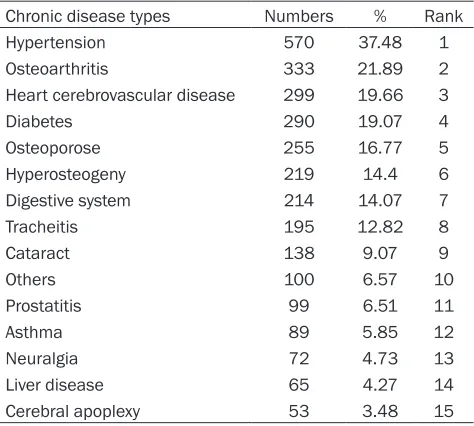
The results of the survey showed that only 6.1% of the older people aged 65 or above did not have any diseases. The prevalence of chronic diseases is an important indicator of the health status of the elderly, the burden of disease and the demand for health services. The top 3 prev-alence of chronic diseases was hypertension, arthritis and cardiovascular- cerebrovascular diseases, with a proportion of 37.5%, 21.9% and 19.7%, respectively. In addition, diabetes was also at 19.07% in fourth place. Diabetes and high blood pressure remain two important diseases for the prevention and control of the elderly (Table 2). In addition, the survey found that the incidence of arthritis ranked second, suggesting that in the elderly care services, we
should strengthen the services of these patients, and provide the convenient con-ditions and preventive disease care for arthritis patients.
Health service needs
The top three health care services pro-vided for the elderly were regular physical examination (59%), regular health lec-tures (45.9%), and health records (43.8%). Most of the elderly (83.7%) are not in urgent need of nursing programs. The top three health care services for elderly people were ranked as follows: establishment of health records (43%), regular physical examination (35.6%) and regular health lectures (28.5%).
Table 3 showed that the current health service institutions in Chongqing were functioning well and met the needs of residents, but regular physical examina-tion and regular health lectures can be further conducted.
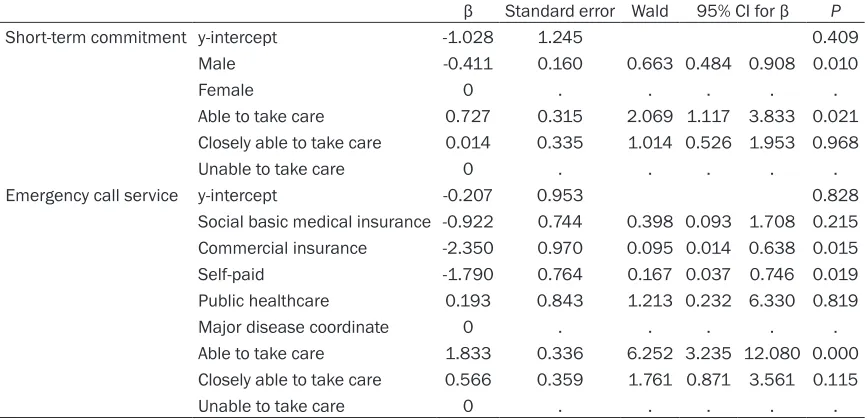
Table 4 showed the results of multi-category logistic regression analysis. Taking long-term care services as a reference, men were less likely to choose short-term care services com-pared to women with an OR value of 0.663, indicating that men were more likely to choose long-term care services. The elderly with com-mercial medical insurance and self-paid medi-cal care were less likely to choose emergency call service than those with serious illness coordination, with OR values of 0.095 and 0.167, respectively. Compared with the elderly who can’t take care of themselves, the elderly who can take care of themselves were more inclined to choose short-term entrusted servic-es (OR value is 2.069), and were more willing to choose emergency call service (OR value 6.252).
Discussion
[image:4.612.90.327.96.309.2]In China’s pension policy 90% of the elderly are at home, 7% of the elderly are in the communi-ty, 3% of the elderly are in Old-age care institu-tions [7]. According to the survey results, the choice of old-age service mode was relatively close to this policy (55.9% of the elderly choose home care, and 29.5% of the elderly choose home care and community service). It can be seen that home care for the elderly is comply-ing with the desire and demand of the majority
Table 2. The top 15 basic chronic diseases of elderly people in Chongqing
Chronic disease types Numbers % Rank Hypertension 570 37.48 1 Osteoarthritis 333 21.89 2 Heart cerebrovascular disease 299 19.66 3 Diabetes 290 19.07 4 Osteoporose 255 16.77 5 Hyperosteogeny 219 14.4 6 Digestive system 214 14.07 7 Tracheitis 195 12.82 8 Cataract 138 9.07 9
Others 100 6.57 10
Prostatitis 99 6.51 11
Asthma 89 5.85 12
of the elderly in China, complying with the cul-tural customs and social development trends of the Chinese nation for thousands of years. In total, 74.9% of the elderly in this study think they are capable of self-care or the family has enough time and energy to take care of them, but they will need external help in a few years.
Table 3. The health services the elderly wanted
Index Options Number of people %
The health care services you wish to receive Health records 680 43.8
(Multiple) Regular health lectures 712 45.9
Home care services 508 32.8
Rehabilitation service 283 18.2
Regular physical examination 915 59.0
Common disease prevention 473 30.5
Day care 165 10.6
Others 45 2.9
The health care services you have received Establishing resident health records 611 43.0
(Multiple) Regular public health lectures 405 28.5
On-site care 179 12.6
Rehabilitation services 122 8.6
Regular physical examinations 506 35.6
Prevention and treatment of common diseases 215 15.1
Day Care 118 8.3
Others 56 3.9
Not getting any service 161 11.3
Urgent care Nothing 1293 83.7
Exist 251 16.3
Where most want to get your health care program Hospital 808 52.1
Community healthcare center 440 28.4
Home visiting service 273 17.6
Others 31 2.0
Table 4. Logistic regression analysis of influencing factors
β Standard error Wald 95% CI for β P
Short-term commitment y-intercept -1.028 1.245 0.409 Male -0.411 0.160 0.663 0.484 0.908 0.010
Female 0 . . . . .
Able to take care 0.727 0.315 2.069 1.117 3.833 0.021 Closely able to take care 0.014 0.335 1.014 0.526 1.953 0.968 Unable to take care 0 . . . . . Emergency call service y-intercept -0.207 0.953 0.828
Social basic medical insurance -0.922 0.744 0.398 0.093 1.708 0.215 Commercial insurance -2.350 0.970 0.095 0.014 0.638 0.015 Self-paid -1.790 0.764 0.167 0.037 0.746 0.019 Public healthcare 0.193 0.843 1.213 0.232 6.330 0.819 Major disease coordinate 0 . . . . . Able to take care 1.833 0.336 6.252 3.235 12.080 0.000 Closely able to take care 0.566 0.359 1.761 0.871 3.561 0.115 Unable to take care 0 . . . . .
Only 15.1% of older people think they need out-side help now. In the future, there should be more and more social support to participate in home care for the health of the elderly.
[image:5.612.90.524.419.629.2]6.1%. Osteoarthritis rose from fourth to second compared with a few years ago. Hypertension and diabetes are the most important risk fac-tors for stroke/coronary heart disease/other diseases. Stroke and coronary heart disease are also the most dangerous factors that affect the function of daily life. The high incidence of hypertension/diabetes and hypertension has become or will become a potential social bur-den. As representatives of managing chronic diseases, we need to provide more effective services for the prevention and management of hypertension for the elderly. Osteoarthritis (OA) is a common disease and frequently occurring disease among middle-aged and elderly people [8]. It is a major reason that the elderly to lose their ability to work and self-care abilities. With the development of Chinese ageing population, the incidence of OA has increased year by year, an epidemiological survey showed the inci-dence of OA over 60 years old [9-11] is 37.9%-67.4%, and about 80% of people over 75 years old [10] suffer from OA. OA not only affects the quality of life of patients, but also brings great pressure and heavy economic burden to fami-lies and society. Research found that [9] the elderly people generally lack knowledge of OA prevention and health care, treatment and rehabilitation and other related resources, and the lack of awareness of its harmfulness. Due to the characteristics of the humid geographi-cal environment in Chongqing, the prevalence of arthritis is also high. It is necessary to carry out OA health education and health manage-ment to improve the understanding of the nature, harm, prevention and prognosis of OA, and reduce or avoid the risk factors associated with osteoarthritis.
Activity of daily living [12] is an important index to evaluate the functioning of the elderly. It is an important factor that affects the quality of life of the elderly [13], which is the risk factor of the daily life self-care ability of the elderly. Age factors are irreversible, but noninfectious chronic disease can be managed by interven-tion. Therefore, measures that are more effec-tive should be taken to prevent and manage chronic diseases in the elderly population. In the course of this survey, only 19.2% of the elderly were willing to visit the community health service center. Zhu et al showed that more than 90% of the elderly lack health care resources, medical services and having inade-quate medical funds in the community are all
common problems [14]. It is necessary to guide people to change the behavior of medical treat-ment by adjusting the distribution of medical resources and to change the concept of medi-cal treatment. At present, the medimedi-cal and health workers are in short supply and cannot meet the increased demand of aging health and health care for the people. Therefore, how to liberate and develop the supply of health care is also a problem worth studying. In this regard, several provinces and municipalities, including Guangdong, Tianjin and Beijing have opened up the practice of multi-point nurses. YOUHU mobile software (Application, APP) also have on-line to availability to provide a new channel for medical service. In order to meet the actual needs of more and more elderly people, we should appropriately increase the access to home care and health resources, professionalize medical and health services, and further improve the community home care model [15, 16].
The key mode for the successful development of home care is to integrate resources and communication methods, which can effectively fill the shortage of resources caused by the weakening of family functions [17], which will bring favorable competitive incentives for com-munity health. Better health support for the aging community is now the most pressing need in home care.
Acknowledgements
Social Science Planning and cultivation Pro- ject of Chongqing (2015PY37); The Humanities and Social science foundation of Third Military Medical University (2016XRW07).
Disclosure of conflict of interest
None.
Address correspondence to: Jingci Zhu, Depart- ment of Nursing, Army Medical University (Third Military Medical University), Gaotanyan Road 30th, Shapingba District, Chongqing 400038, China. Tel: 023-68771818; E-mail: [email protected] References
[2] Zhenglong C. Chongqing, the only municipality which directly reports to the central govern-ment in midwest China. The World & Chongq-ing 2016; 72-73.
[3] Yuangang C, Lei Q and Yuan Z. Study on advancing the development of the aging in- dustrialization in Chongqing city. Journal of Chongqing Institute of Technology 2006; 20: 21-25.
[4] Sujuan R, Shunong M, Qi Z and Xiaoxi F. Re-search on the current situations, characteris-tics and the old-age security system of China. Medicine & Philosophy 2017; 38: 37-39. [5] Jie Y and Jing W. Review on the effects of
popu-lation ageing on medical security and counter-measures. Medicine & Philosophy 2015; 61-63.
[6] Ping G. A study of sampling and weighting pro-cedures for sample survey of the aged popula-tion in urban/rural China (2000, 2006 & 2010). POPULATION & DEVELOPMENT 2013; 19: 77-84.
[7] Li H and Liang Z. The current situation of com-munity health service for the eldly people in Chongqing. Chongqing Medical Journal 2010; 39: 1362-1364.
[8] Fuchun S. Study on the mode and practice path of community home-based elderly care in small and medium sized cities. China Devel-opment 2016; 16: 25-30.
[9] Xuanqiu T, Kaijin M, Lijuan L, Zhenyu J and Li L. Research progress on risk factors of osteoar-thritis. Chinese community physician 2016; 32: 14-15.
[10] Rujun L and Jianhao L. Review the epidemiol-ogy of osteoarthritis in China. Chinese Journal for Clinicians 2010; 38: 6-10.
[11] Xiaojia T, Rugeng Z, Meng Z, Yajun H, Hongli-ang G, Zhizhou W and Guoju M. Prevalence of knee osteoarthritis in the middle-aged and el-derly in China: a meta-analysis. Chinese Jour-nal of Tissue Engineering Research 2014; 18: 1129-1134.
[12] Yuxia L, Fenglan W and Fengmei X. Study on the quality of life and its influencing factors of elderly people in pension institution. Chinese Journal of Coal Industry Medicine 2015; 1226-1229.
[13] Soldato M, Liperoti R, Landi F, Carpenter IG, Bernabei R and Onder G. Patient depression and caregiver attitudes: results from the aged in home care study. J Affect Disord 2008; 106: 107-115.
[14] Feiyin Z, Guixing P, Yating M, Xiao W, Zhiwu G and Qingling Z. The status of community home care model, and its role and impact on man-agement of chronic diseases in the elderly. China Modern Medicine 2017; 24: 134-136+143.
[15] Junyu C and Guihua X. Analysis on status quo and countermeasures of community home en-dowment mode in China. CHINESE NURSING RESEARCH 2015; 528-530.
[16] Peng L, MEihua G, Lixia G, Yonghua M and Cail-ing Z. Epidemiological studies of osteoarthritis in the elderly. JILIN Medical Journal 2012; 2576.