A Study on Performance Appraisal System
M. Madhavi1, D. Santosh Kumar2 1
Assistant Professor, 2Student, School of Business Management, Anurag Group of Institutions, Venkatapur (V), Ghatkesar (M), Medchal (Dist.), Hyderabad-500088
Abstract: The study‘s main objectives pertained to establishing the moderating role of performance appraisal as a motivation tool as well as potential challenges. The study findings show the presence of significant positive outcomes when the organization uses performance appraisal as a motivation tool. Further, the study finds that the use of more than one appraisal techniques helps yield greater satisfaction and consequently higher motivational levels. The specific aspects of performance appraisal systems (PAS) that help improve motivation include the linking of performance to rewards; using the PAS to help set objectives and benchmarks; as well as the use of PA to help identify employee‘s strength and weaknesses.
Keywords: Performance Appraisal, Methods of Performance Appraisal, Motivation
I. INTRODUCTION
Performance appraisal refers to all the formal procedures used to evaluate an individual, his contributions and potential. In other words, it is to plan and measure the performance of an individual in terms of the requirement of the job or it is a process of finding out how effective the organization has been at hiring and placing an employee. Performance appraisal is a formal system of review and evaluation of individual or team task performance. While evaluation of team performance is critical when teams exist in an organization, the focus of performance appraisal in most firms remains on the individual employees. Regardless of the emphasis, an effective appraisal evaluates accomplishments and initiates plans for development, goals and objectives.
Performance appraisal is a method of evaluating the behavior of employees in the work spot, normally including both the quantitative and qualitative aspects of job performance.
II. OBJECTIVES OF THE STUDY
A. To know whether the employees are satisfied with the assessment of performance appraisal followed in the organization.
B. To know whether the performance appraisal improves the motivation and job satisfaction of employees.
C. To know and study about the various opinions of the employees on the evaluation methods.
D. To know the various parameters considered for evaluating the performance.
III. RESEARCH METHODOLOGY
The study entailed collection of information based on primary data method. Sample size: 80
Statistical tools: Graphs –pie chart
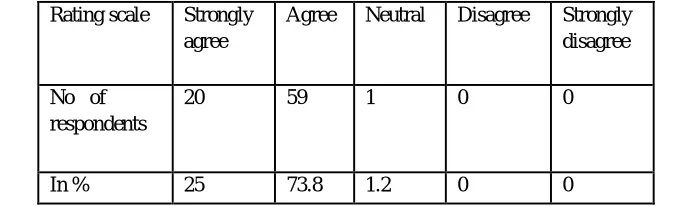
[image:1.612.133.470.606.709.2]IV. DATA ANALYSIS 1) Q1. Is Performance Appraisal helps in the assessment of individual potential? a. Strongly Agree b. Agree c. Neutral d. disagree e. strongly disagree
Table no:1 particulars of performance appraisal helps in the assessment of individual potential. Rating scale Strongly
agree
Agree Neutral Disagree Strongly disagree
No of respondents
20 59 1 0 0
Fig no:1 Graphical representation of performance appraisal helps in the assessment of individual potential.
Interpretation
a) From the above table it can be known that 25% of respondents have strongly agreed that performance appraisal helps in the assessment of individual potential.
b) About majority of the respondents have agreed that it helps in the assessment of individual potential i.e 73.8%
c) About 1.2% of the respondents are in a neutral stage.
[image:2.612.154.461.359.460.2]2) Are you satisfied with the evaluation methods of performance followed by the organization? a. highly satisfied b. satisfied c. neutral d. dissatisfied e. highly dissatisfied
Table no:2 Particulars of evaluation method of performance followed in the org Rating scale Strongly
agree
agree Neutral disagree Strongly disagree No of
respondents
25 49 6 0 0
In % 31.3 61.3 7.5 0 0
Fig no:2 Graphical representation of satisfaction of evaluation method of performance followed in the org
Interpretation
a) From the above table we can observe that 31.3% of respondents highly satisfied and 61.3% of respondents are satisfied with the evaluation methods of performance followed by the organization.
20
59
1 0 0
0 20 40 60 80
No of respondents
28 45
7
0 0
0 5 10 15 20 25 30 35 40 45 50
[image:2.612.151.469.486.668.2]3) Do you think performance appraisal give constructive criticism in a friendly and positive manner? a. yes b. no c. sometimes
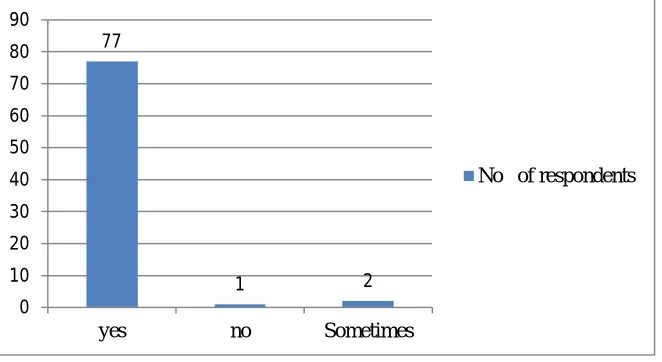
Table no:3 Particulars of performance appraisal give constructive criticism in a friendly and positive manner Rating
scale
yes no Sometimes
No of respondents
77 1 2
[image:3.612.143.474.240.421.2]In % 96.3 1.2 2.5
Fig no:3 Graphical representation of performance appraisal gives criticism in a friendly and positive manner
Interpretation
a) From the above table it can be observed that 96.3% of the respondents think that performance appraisal give constructive criticism in a friendly and positive manner.
b) About 1.2% of the respondents feel that performance appraisal doesn’t give constructive criticism in a friendly and positive manner.
c) About 2.5% of the respondents feels that performance appraisal sometimes give constructive criticism in a friendly and positive manner.
4) Does any change varies after appraising the performance of employees? a. Yes b. No
Table no:4 Particulars of change varies after appraisal the performance of employees Rating scale yes No
No of respondents
80 0
In % 100 0
77
1 2
0 10 20 30 40 50 60 70 80 90
yes no Sometimes
Fig no: 4 Graphical representation of any change varies after appraisal the performance of employees
Interpretation
a) From the above analysis it can be observed that about 100% of respondents says that a change occurs after appraising their performance.
b) None of respondents says that no change happens after appraising their performance.
5) Performance appraisal system improves motivation and job satisfaction of employees. a. often b. rarely c. very rarely d. never
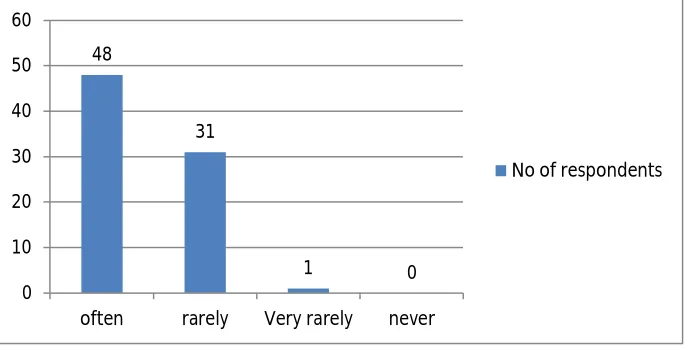
Table no: 5 Particulars of performance appraisal system improves motivation and job satisfaction of employees Rating
scale
often rarely Very rarely
never
No of respondents
48 31 1 0
[image:4.612.135.481.461.636.2]In % 60 38.8 1.2 0
Fig no:5 Graphical representation of performance appraisal system improves motivation and job satisfaction of employees
Interpretation
a) From the above table it can be observed that about 60% of respondents feels that performance appraisal system often improves motivation and job satisfaction of employees.
b) About 46.3% of respondents rarely feels and 38.8% of respondents very rarely feel that performance appraisal improves motivation and job satisfaction.
c) About 1.2% of respondents feels that it never improves motivation and job satisfaction of employees.
80
0 0
20 40 60 80 100
yes No
No of respondents
48
31
1 0
0 10 20 30 40 50 60
often rarely Very rarely never
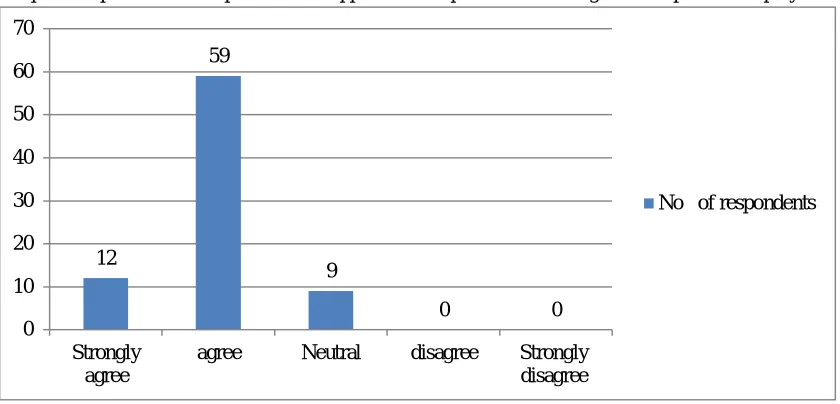
6) The performance rating is helpful for the management to provide employee counseling? a. strongly agree b. agree c. neutral d. disagree e. strongly disagree
Table no: 6 Particulars of performance appraisal is helpful for the management to provide employee counseling Rating scale Strongly
agree
agree Neutral disagree Strongly disagree
No of respondents
12 59 9 0 0
[image:5.612.97.517.244.446.2]In % 15 73.8 11.3 0 0
Fig no:6 Graphical representation of performance appraisal is helpful for the management to provide employee counseling
Interpretation
a) From the above table it can be observed that 12% of respondents strongly agree that the performance rating is helpful for the management to provide employee counseling.
b) About 73.8% of respondents agree and 11.3% of respondents are in neutral position.
[image:5.612.152.459.573.721.2]7) Does the Advises and suggestions are given to the employees during the appraisal process? a. strongly agree b. agree c. neutral d. disagree e. strongly disagree
Table no: 7 Particulars of advises and suggestions given to employees during the appraisal process Rating scale Strongly
agree
agree Neutral disagree Strongly disagree
No of respondents
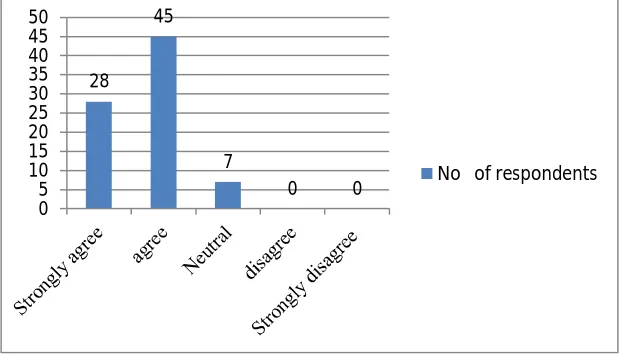
28 45 7 0 0
In % 35 56.3 8.8 0 0
12
59
9
0 0
0 10 20 30 40 50 60 70
Strongly agree
agree Neutral disagree Strongly disagree
Fig no:7 Graphical representation of advises and suggestions given to employees during the appraisal process
Interpretation
a) From the above analysis we can observe that 35% of respondents strongly agree that advises and suggestions are given to the employees during the appraisal process.
b) About 56.3% of respondents agree and 8.8% of respondents are in a neutral position.
8) In your Opinion Performance Appraisal is?
a. Evaluation of employees b. performance of employees c. job satisfaction of employees d. motivation
Table no: 8 Particulars of opinion of performance appraisal Rating scale Evaluation of
employees
Performance of employees
Job
satisfaction of employees
Motivation
No of respondents
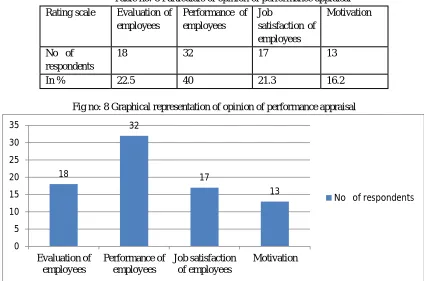
18 32 17 13
In % 22.5 40 21.3 16.2
Fig no: 8 Graphical representation of opinion of performance appraisal
Interpretation
a) From the above table we can observe that 22.5% of the respondents opinioned that performance appraisal is about evaluation of employees.
b) About 40% of respondents opinioned that performance appraisal is about performance of employees.
c) About 21.3% feel that performance appraisal is about job satisfaction of employees.
d) About 16.2% feel that performance appraisal is about motivation.
28 45
7
0 0
0 10 20 30 40 50
No of respondents
18
32
17
13
0 5 10 15 20 25 30 35
Evaluation of employees
Performance of employees
Job satisfaction of employees
Motivation
[image:6.612.92.516.348.629.2]9) Your job description clearly defines (key result areas) KRA’S on which your performance is rated? a. strongly agree b. agree c. neutral d. disagree e. strongly disagree
Table no:9 Particulars of KRA’S on which performance is rated Rating scale Strongly
agree
agree Neutral disagree Strongly disagree
No of respondents
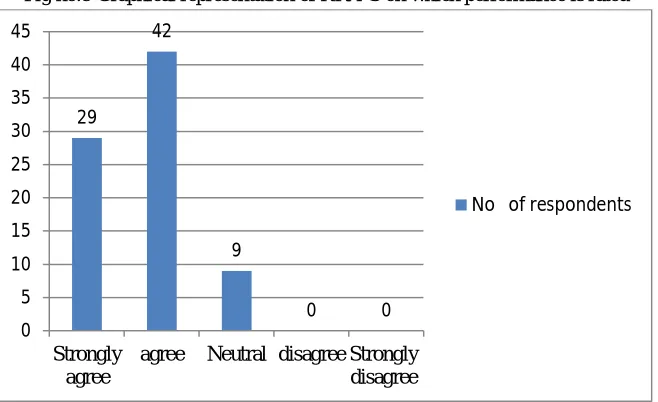
29 42 9 0 0
[image:7.612.143.472.291.492.2]In % 36.3 52.5 11.3 0 0
Fig no:9 Graphical representation of KRA’S on which performance is rated
Interpretation
a) From the above analysis we can see that 36.3% of respondents strongly agreed that their job description clearly defines KRA’s on which their performance is rated.
b) 52.5% of respondents agree that their job description clearly defines KRA’S on which their performance is rated.
c) About 11.3% of respondents are in a neutral stage.
10) Q10. In your opinion who should be the appraiser?
a. Superior b. Subordinate c. HOD d. Peer group
Table no:10 Particulars of who should be the appraiser Rating scale superior subordinate HOD Peer
group
No of respondents
50 15 9 6
In % 62.5 8.8 11.3 7.5
29
42
9
0 0
0 5 10 15 20 25 30 35 40 45
Strongly agree
agree Neutral disagree Strongly disagree
Fig no:10 Graphical representation of who should be the appraiser
Interpretation
a) From the above analysis it can be observed that 62.5% of respondents opinioned that appraiser should be superior.
b) About 8.8% of respondents opinioned that appraiser should be subordinate.
c) About 11.3% of the respondents opinioned that their appraiser should be HOD.
d) About 7.5% of the respondents opinioned that their appraiser should be peer group.
V. FINDINGS
A. In MSR INDIA Pvt ltd almost all the employees are satisfied with the performance appraisal followed in the organization.
B. The existing appraisal system helps the management to identify potentiality of employees as well as useful for maintaining efficiency of the individual and organization.
C. Most of the employees feel that appraisal system followed in the organization is rational and fair.
D. The performance appraisal supports to experiment with new ideas as basis for promotion.
E. Their job description clearly defines key result areas on which their performance is rated.
F. The feedback on performance communicated after assessment of the performance.
G. The performance appraisal followed in the organization helps to assess the training and development needs of employees.
VI. SUGGESTIONS
A. The company should give some advises and suggestions to the employees during the process and should get there feedbacks about the process.
B. The job expectations are to be informed to each and every employee.
C. The feedback should be given in a such a way that none of the employee should get dissatisfied or demotivated.
D. There should be no errors or problems that have impact on performance rating in the organization.
E. As the Performance Appraisal is helpful to the employees by the assignment of superiors task by training and development which should be more effective so that the other employees will also be attracted.
VII. CONCLUSION
Every organization to sustain in the industry has to satisfy some of the basic needs and demands of its workers. Satisfied and motivated workers are the source of achieving the organizational goals and objectives. The aim was to find the how performance appraisal system works in the organization and up to what level it impacts the employee interest and productivity. It was found that most of the employees are satisfied with the appraisal system followed in the organization.
REFERENCES
[1] Donald L. Kirkpatrick, 2006, Improving Employee Performance through Appraisal and Coaching. [2] Richard Rudman, 2003, Performance Planning and Review.
[3] P. SubbaRao, 2006, Essentials of Human Resource Management and Industrial Relations, Himalaya Publishing House.
50
15
9 6
0 10 20 30 40 50 60