Abstract— Web applications that offer entertainment rarely support knowledge sharing. Likewise, applications that are intended for knowledge sharing rarely offer entertainment. The intent of this paper is therefore to propose an idea that could coalesce knowledge sharing and entertainment within a Web application. Specifically, the objectives of this paper are twofold. One, as a part of a larger project, it seeks to introduce a conceptual prototype called Rendezvous, which serves as a knowledge sharing cum entertainment platform. Two, it seeks to perform a preliminary evaluation of Rendezvous by identifying factors that may drive behavioral intention to adopt. Additionally, it also seeks to solicit feedback on the general appeal of the prototype. The preliminary evaluation was carried out on a group of 38 participants through focus groups. Based on the results, the following findings can be culled. On the whole, the behavioral intention to adopt Rendezvous seems promising. Compelling factors that seemed to influence behavioral intention to adopt could be categorized into knowledge sharing motivators and gaming characteristics. The knowledge sharing motivators were found to be altruism, commitment to group, and social reputation. Three game characteristics that seemed to compel behavioral intention to adopt were rewards, feedback, and challenge.
Index Terms—knowledge sharing, entertainment, game, social web-based application, online communities
I. INTRODUCTION
Quite distinctly, the Web has been transformed from a repository of largely static knowledge into a platform that engenders the co-creation and sharing of knowledge. Users engage in knowledge sharing via online communities and social networks to exchange new ideas and information [1]. Moreover, knowledge sharing contributes to a shared knowledge base among participating users, which enables group decision making or collective action processes [2].
Manuscript received November 11, 2011; revised December 21, 2011. This work is supported by NTU Grant Number M58060012.
Alton Y.K. Chua is with Wee Kim Wee School of Communication and Information, Nanyang Technological University, Singapore 638817 (corresponding author, phone: +65-6790-5810; e-mail: [email protected]).
Radhika Shenoy Balkunje is with Wee Kim Wee School of Communication and Information, Nanyang Technological University, Singapore 638817 (corresponding author, phone: +65-6316-2917; e-mail: [email protected]).
Kuiyu Chang is with the School of Computer Engineering, Nanyang Technological University, Singapore 638817 (phone: +65-6790-4293; e-mail: [email protected]).
In parallel, improvements to Internet technologies have also widened the spectrum of online games, ranging from Flash-based ones to sophisticated forms such as Massively Multiplayer Online Games (MMOG) where players can interact, cooperate with, and compete against thousands of other players in a virtual world [3]. Nonetheless, it appears that Web applications that offer entertainment rarely support knowledge sharing. Likewise, applications that are intended for knowledge sharing rarely offer entertainment.
This paper thus embarks on a timely endeavor to coalesce knowledge sharing objectives with entertainment by designing a social web-based application. Specifically, the objectives of this paper are twofold. One, as a part of a larger project, it seeks to introduce a conceptual prototype called Rendezvous, which serves as a knowledge sharing cum entertainment platform. Two, it seeks to perform a preliminary evaluation of Rendezvous by identifying factors that may drive behavioral intention to adopt. Additionally, it also seeks to solicit feedback on the general appeal of the prototype.
The rest of this paper is structured as follows. Section 2 offers a literature review on knowledge sharing, entertainment and behavioral intention to adopt. Section 3 describes the design overview and the features incorporated in the prototype. Section 4 presents the evaluation of the prototype. The evaluation is carried out through a focus group study of 38 participants to garner qualitative inputs on their behavioral intention to adopt Rendezvous and to solicit further opinions on the prototype. Thereafter, in sections 5 and 6, results and discussion follow. Finally, section 7 concludes the paper with a note on future enhancements.
II. LITERATURE REVIEW A. Knowledge Sharing
Knowledge sharing is defined as a process of mutual exchange of knowledge among a group of participating individuals, thereby transforming individual knowledge into group knowledge [1]. The situated nature of knowledge is thus overcome through its dissemination among the participants [4]. Knowledge sharing in online communities is posited by the Socio-constructivist theory. The theory states that knowledge sharing through social interaction is central to collaborative knowledge building [5]. Specifically, participants share knowledge they currently hold while negotiating on new knowledge acquired from
Rendezvous- A Social Web-based Application
for Knowledge Sharing and Entertainment
Alton Y.K. Chua, Radhika Shenoy Balkunje and Kuiyu Chang
others through conversation. This leads to new-found knowledge in the community, which in turn fosters knowledge co-creation [6].
Knowledge sharing in online environments is engendered through at least six motivational factors, namely personal gain, altruism, reciprocity, ease of technology use, commitment to the group and external goals [7]. One, personal gain is the most essential motivator to enhance one’s own welfare. The numerous ways to incorporate personal gain include currency rewards, prizes, and social recognition [8]. Two, altruism is a key motivator for users to share knowledge for the benefit of others. The most common source of altruism is found to be empathetic emotion [9]. Three, reciprocity, on the other hand, suggests that the willingness to share arises within individuals usually when they have received help from other members of the community [10]. Four, commitment to group motivates collectivism, which refers to the desire to share knowledge for the benefit of the community’s purpose in its entirety [11]. Five, ease of technology is an essential motivator for individuals to interact effectively. Individuals would be less likely to use a technology that is technically demanding, confusing, and difficult to use [12]. Finally, having specific external goals such as achieving fixed targets motivate individuals to share knowledge to a greater extent than having non-specific “do your best” goals [13].
B. Entertainment through Games
Games can be designed for various purposes such as serving as a tool for individual entertainment, a means for social interaction, a strategy for publicity campaigns, a platform for experimenting new design concepts and technologies, and as a pedagogical medium for teaching and learning [14]. However, their most immediate motive is to entertain [15]. They primarily offer a recreational environment where players can enjoy mental stimuli by solving riddles or performing tasks, accepting challenges, and expecting specific victory or defeat conditions [16], [17]. By definition, a game is a “fictitious or artificial situation governed by rules that structure their actions in view of an objective, which is to win or to overcome an obstacle” [18].
There are at least five characteristics of games that contribute to players’ engagement, namely goals and rules, feedback, challenge, social interaction, and rewards [19]. One, goals define the objective to be achieved while rules organize the game and specify how the goals can be accomplished [20]. Two, feedback measures players’ current performance and map their progress against the goals [21]. Three, challenge outlined progressively within the game encourages players to surpass themselves by improving their previous performance [22]. Four, social interaction allows players to socialize and combine their efforts in achieving specific goals [16]. Finally, provision of rewards is essential to create a positive gaming experience [23].
C. Behavioral Intention to Adopt
Behavioral intention is defined as an individual’s
probability of adopting or accepting a new technology, service, or application [3]. Several models have been devised to examine the behavioral intention to adopt specific technology, services, or applications such as the theory of reasoned action (TRA), the theory of planned behavior (TPB), and technology acceptance models (TAM). These models are deeply rooted in cognitive psychology and propose distinct causal factors that influence acceptance behaviors [24].
Based on these models, at least four factors that determine a player’s behavioral intention to adopt a game-based application can be identified, namely perceived usefulness, perceived ease of use, perceived enjoyment, and user competence [3]. One, perceived usefulness is the extent to which individuals believe in the significance of an application (in the context of this paper) in fulfilling its intended purpose. Two, perceived ease of use denotes the extent to which individuals believe that the application is user-friendly and that it can be used with minimal effort [25]. Three, perceived enjoyment is the extent to which individuals can derive fun and perceive an enjoyable experience from the application [26]. Finally, user competence refers to a user achieving a match between individual skills and the outlined challenge so that he or she is neither too bored nor too stressed [27].
III. RENDEZVOUS – DESIGN OVERVIEW
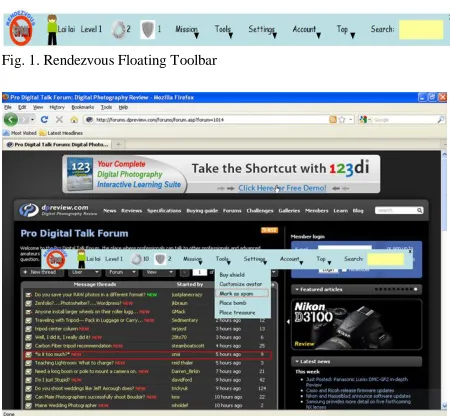
Rendezvous is a social web-based prototype with features that combine knowledge sharing and entertainment. As shown in Figure 1, it is displayed as a floating toolbar that runs on top of Mozilla Firefox and can be accessed unobtrusively by users surfing the Internet. Due to its fairly simple appearance and mechanism, it addresses the ease of technology use motivator for knowledge sharing.
There are four prominent features in Rendezvous, namely spam-marking, mission-creating, profile building, and leader board. One, users can mark out relevant portion on screen and designate content as spam if they suspect its credibility; the selected area will be marked grey. When sufficient numbers of users have marked out the same area on the screen, that portion will be removed completely from the screen. Knowledge sharing motivators like reciprocity and commitment to the group encourage users to weed out spam collaboratively. Furthermore, in order to induce a feeling of personal gain and rewards, users earn a coin each time they mark a spam. On the other hand, users who frivolously mark arbitrary areas as spam can be reported to the game administrator. A penalty will be subsequently meted out. Figure 2 shows a screen shot of the user interface for marking spam.
instrumental in encouraging users to create missions. Again, users will earn coins by creating and accepting missions. Figure 3 shows a screen shot of the user interface for creating missions.
Three, users can create their own profiles citing their accomplishments in weeding out spams, coins earned, as well as creating and accepting missions. In addition, users can view the reviews of all missions accepted by other users through their profiles. Moreover, users can also create a friend list. When any friend on the list is online, a synchronous chat feature is supported. Social interaction through games is thus supported by this feature.
Four, the prototype also has a leader board listing users with the most number of (1) missions created, (2) missions completed, (3) most spam marked, (4) most coins collected. The leader board will be updated weekly. Friends of users who appear on the leader board will be notified. The leader board will serve as a feedback and challenge to others to perform better. Moreover, the desire of leading the leader board to leverage one’s social reputation offers external goals to users.
[image:3.612.315.541.47.197.2]Additional features that are purely meant to increase fun include avatar-customizing, bomb planting, and treasure-laying, and shield buying. To interact with each of these features however, users must have sufficient number of coins. Users can also customize the look of their avatars. As they surf the internet, they can also plant a bomb or place a treasure chest on any URL. To minimize the damage of any potential bomb, users can buy shields to protect themselves against bombs. With a shield, users who stumble on a URL planted with a bomb will not lose any coins. On the other hand, users who encounter a treasure will be rewarded with coins.
Fig. 1. Rendezvous Floating Toolbar
Fig. 2. Marking out spam.
Fig. 3. Creating a mission.
IV. EVALUATING RENDEZVOUS A. Participants
A total of 38 post-graduate students (19 males and 19 females), with an average age of 26 years participated in the evaluation study. Of these, 26 were working professionals, the vast majority of whom hails from the IT industry. A demographic study of the participants revealed that all of them surfs the Internet quite frequently. On average, 11 participants play games on the Internet often whereas 31 participants actively read and post comments on discussion forums and social media like Facebook and Youtube.
B. Methodology
The data collection procedure was conducted in two stages. In the first stage, the concept of Rendezvous was introduced to the participants. To help them understand the features of the prototype, four possible usage scenarios were presented. The scenarios included the use of Rendezvous for a) marking out a spam, b) creating a mission to recommend websites to other users, c) planting bombs and laying treasures, d) customizing avatars.
Subsequently, in the second stage, focus groups were conducted to solicit qualitative feedback as well as to invite suggestions for improvements. In particular, six focus groups, each consisting of six participants on average, lasting for some 25 minutes were carried. Participants were asked open-ended questions specific to behavioral intentions to adopt Rendezvous. In addition, certain generic questions were also asked pertaining to the general appeal of the prototype as well as its drawbacks. Table 1 illustrates the data collection instrument.
TABLEI
DATA COLLECTION INSTRUMENT Questionnaire
1. To what extent do you think the prototype will be useful for knowledge sharing?
2. To what extent do you think the prototype is easy to use? 3. To what extent do you think the prototype offers entertainment
to you?
4. Do you feel the prototype offers gaming features that can complement your gaming skills?
5. What do you like most about the prototype? 6. What do you dislike most about the prototype?
7. If such a prototype were to be developed, will you be keen to register as a user?
8. Can you suggest a few improvements to the features/interface of the prototype?
[image:3.612.69.294.450.658.2]V. RESULTS
The majority of the participants perceived Rendezvous to be a useful prototype. In particular, its perceived usefulness stems from its simple and novel concept. For instance, participant 35 expressed that the prototype “could be effective to fight spam” while participant 30 liked the concept of an “active community that collectively shares web page links”. Some participants also suggested that the prototype could be useful for education purposes. Through its simple gaming, spam weeding, and social sharing concept, it could endear students as well as inspire them to search for the right information on the web. For example, participants 7 and 10 related that the prototype can “encourage young students” to “filter” correct information and also “instill community building”.
Moreover, on the survey question of perceived ease of use it was unanimously agreed that the prototype bore a relatively simple interface, and that it was easy to learn and use. In particular, participant 12 shared that “the prototype is quite user-friendly with features and tools that can be easily understood”. Participants also felt that the navigation was unambiguous. For example, participant 32 complemented that “It is pretty easy to navigate Rendezvous and one requires maximum of 2-3 clicks to reach a tool.”
On perceived enjoyment, most users felt that the prototype offered adequate entertainment along with the opportunity to build a social community. For instance, participants 38 and 21 related that earning coins after accomplishing missions and fighting spams “felt rewarding” and “encouraged the feeling of sharing with others”. However, other participants, mostly non-gamers, were more inclined towards the utilitarian aspects of the prototype and felt that the concept of bombs and treasures to be incoherent. For example, participant 31 noted that “planting bombs or laying treasure does not lead to any objective of the prototype”.
In addition, most participants feel Rendezvous afforded a suitable level of user competence. Specifically, quite a few participants were delighted that the prototype offered a light-hearted gaming environment to novice and intermediate players alike, who generally do not like to play complicated graphic games. For instance, participant 1 expressed that the prototype “seems pretty easy for novice users” and participant 20 shared that it “is a calm game with no pressure of time and speed as in fighting games”. Moreover, participants increasingly felt that the leader board feature introduced the challenge to compete with others and achieve social recognition. However, a number of participants thought that Rendezvous could add a few more progressive levels of challenge to offer self-competition for sustained interest in the gameplay.
Subsequently, feedback from participants about the general appeal of Rendezvous revealed features that they liked or disliked. In particular, the majority of the participants liked the spam-marking, mission creating, and coin rewarding features the most. One, the spam-marking feature endeared participants with its concept of filtering
out irrelevant information. For instance, participants 23, 12, and 18 related that “fighting spams” over a period of time may result in a “spam-free” environment. This may in turn enhance the “browsing experience”. Two, creating missions to suggest web pages seemed an innovative and fun way to share information with other users. For example, participants 27 and 32 related that creating missions offers an opportunity to “connect with people of similar interests” with “some level of entertainment”. Moreover, both spam-marking and mission-creating seemed to offer a way to help and socialize with others in the community, thus serving the altruistic inclination of participants. For instance, participant 17 related that “it feels satisfying when we can help others either by making them aware of spam or by providing information that can benefit them”. Three, rewarding through coins instilled a sense of personal gain and was thus perceived by participants as a motivating feature of the Rendezvous system.
However, among the most common dislikes include the simplistic and unattractive interface and concern for time-spent. One, participants increasingly felt that the interface was basic. They also suggested the use of latest graphics and animation to enhance its look and feel. For example, participant 5 insisted to “work on the presentation” of prototype. Moreover, the majority of the participants did not like the registration feature as they felt it would be too time-consuming. Two, some participants expressed that Rendezvous could be used only when they are not busy, .e.g, during casual surfing. For instance, participant 26 related that “marking spam and creating missions, though interesting, are time crunching and I may not be inclined to use it when I am busy surfing for important information”.
VI. DISCUSSION
Arising from the results, the following findings can be culled. On the whole, the behavioral intention to adopt Rendezvous seems promising. In particular, emerging from the study, two crucial determinants of behavioral intention seem affirmative. They are performance expectancy and effort expectancy. Specifically, performance expectancy is the degree to which users feel the usefulness of an application to achieve a desired performance. This determinant is pre-dominantly derived from the perceived usefulness of an application. Furthermore, effort expectancy, which is the degree of ease to use an application, is significantly driven by perceived ease of use and user competence [28]. Fair responses received from participants on perceived usefulness, perceived ease of use, and user competence therefore testifies performance and effort expectancy. Lastly, perceived enjoyment, which has been deemed an essential intrinsic motivation for the adoption of new applications [26], also seemed to bolster the behavioral intention to adopt Rendezvous.
sharing motivators that seemed to emerge as compelling factors. They include altruism, commitment to group and social reputation (as an external goal). Altruistic behavior seemed quite evident among the participants who exhibited desire to socialize, share, and help each other by means of sharing similar interests through mission-creating. Commitment to group also surfaced as an essential motivation for participants who demonstrated the intention to fight spam collaboratively as a group, and to generate a spam-free environment over a period of time. Both altruism and commitment to group can be explained by the principle of collectivism where users share knowledge either to help others to improve their situation or help to enhance and build their community [7]. Influencing these social aspects is a self-motivational external goal of social reputation. It drives users to participate actively with an individual motive of earning recognition. Rendezvous affords this by featuring the best participants on the leader board.
Additionally, there are three game characteristics that seemed to compel behavioral intention to adopt. They are rewards, feedback, and challenge. One, participants liked the feature of coin rewards and felt that it not only encouraged knowledge sharing but also motivated them to compete with others. As such, tangible awards are known to reinforce challenge and excitement within players by seeking adjustments in their gaming behavior [29]. Two, feedback in the form of profile views and leader boards offered participants a review of their accomplishments, thereby allowing them to measure their performance. Feedback is therefore essential to evaluate players’ performance and help them reduce the discrepancy between goals and performance [21]. Finally, the optimal challenge to compete with others on fighting the most amount of spam, creating the most number of missions, and earning the most number of coins seemed to thrill participants. An optimal challenge is thus paramount in fostering players’ efforts and improving their performance [30].
VII. CONCLUSION
This paper proposes a social-web based prototype called Rendezvous that underpins knowledge sharing and entertainment into a single application. The preliminary user evaluation was carried out on a group of 38 participants through focus groups. Through the study, the paper identifies factors that may drive behavioral intentions to adopt. In addition, it also seeks to solicit feedback on the general appeal of the prototype. Based on the results, the following findings can be culled. On the whole, the behavioral intention to adopt Rendezvous seems promising. The compelling factors that seemed to influence an optimistic behavioral intention to adopt Rendezvous could be categorized into knowledge sharing motivators and gaming characteristics. The knowledge sharing motivators were found to be altruism, commitment to group, and social reputation. The three game characteristics that seemed popular among participants were rewards, feedback, and challenge.
The paper is significant on two counts. One, it illustrates
the feasibility of designing and developing applications that incorporate both knowledge sharing and entertainment, thus providing new venues for web designers to explore. Two, it redefines online collaboration by introducing pervasive web-applications that blend with any online community and offer a new perspective in knowledge sharing.
However, two limitations must be acknowledged. One, the application was a conceptual prototype and therefore a fully functional version was not available to participants during evaluation. Two, for similar reasons, and due to the small cohort of participants, a quantitative analysis was not carried out to avoid steep variations.
Nevertheless, observing optimism in the behavioral intention to adopt Rendezvous, future work will consider the development of the prototype into a fully functional version. Additional features such as allowing users to rate a marked spam with a thumbs-up or thumbs-down button can be incorporated, effectively shifting the role of policing frivolous users onto the community itself. Suggestions provided during the evaluation will be incorporated into the design. In particular, the graphics of the interface will be suitably modified to enhance its look and feel. Thereafter, subsequent evaluations will be conducted with a larger cohort of participants who will then test the application by actually using it.
REFERENCES
[1] B.van den Hooff and J. A. de Ridder, "Knowledge sharing in context: the influence of organizational commitment, communication climate and CMC use on knowledge sharing," Journal of Knowledge Management, vol. 8, no. 6, pp.117 – 130, 2004.
[2] J. Godara, P. Isenhour and A. Kavanaugh, “The Efficacy of Knowledge Sharing in Centralized and Self-Organizing Online Communities: Weblog Networks vs. Discussion Forums,” in Proceedings of the 42nd Hawaii International Conference on System Sciences, pp. 1-10, 2009. [3] Y. Guo and S. Barnes, “Why people buy virtual items in virtual worlds with real money,” The Data Base for Advances in Information Systems, vol. 38, no. 4, pp. 70-76, 2007.
[4] J. S. Brown, A. Collins and P. Duguid, “Situated cognition and the culture of learning,” Educational researcher, vol. 18, no.1, pp. 32-42, 1989.
[5] H. Mitchell and F. Myles, Second language learning theories, London: Arnold, 1988.
[6] V. P. Dennen and T. M. Paulus, “Researching “collaborative knowledge building” in formal distance learning environments,” Proceedings of CSCL 2005, Taipei: International Society of the Learning Sciences, 2005.
[7] K. F. Hew and N. Hara, “Knowledge sharing in online environments: a qualitative case study,” Journal Of The American Society For Information Science And Technology, vol. 58, no. 14, pp. 2310–2324, 2007.
[8] M.M. Wasko and S. Faraj, “Why should I share? Examining social capital and knowledge contribution in electronic networks of practice,” MIS Quarterly, vol. 29, no. 1, pp.35–57, 2005.
[9] A. Hars and S. Ou, “Working for free? Motivations for participating in open-source projects,” International Journal of Electronic Commerce, vol. 6, no. 3, pp. 25–39, 2002.
[10] M.M. Wasko and S. Faraj, “It is what one does: Why people participate and help others in electronic communities of practice,” Journal of Strategic Information Systems, vol. 9, pp. 155–173, 2000.
[11] C.D. Batson, N. Ahmad and J.A. Tsang, “Four motives for community involvement”, Journal of Social Issues, vol. 58, no.3, 429–445, 2002. [12] Y. Wang and D.R. Fesenmaier, “Assessing motivation of contribution in
online communities: An empirical investigation of an online travel community” Electronic Markets, vol. 13, no. 1, pp. 33–45, 2003.
[13] G. Beenen, K. Ling, X. Wang, K. Chang, and D. Frankowski, “Using social psychology to motivate contributions to online communities,” Paper presented at the Computer Supported Cooperative Work (CSCW), Chicago: Illinois, 2004.
[14] T. H. Laine, S. C. A. Islas, M. Joy and E. Sutinen, “Critical factors for technology integration in game-based pervasive learning spaces,” IEEE Transactions on Learning Technologies, 2010, 3(4), 294-306. [15] D. Perry and R. DeMaria, David Perry on game design (1st ed.),
Hingham Massachusetts: Charles River Media, 2009.
[16] S. Hinske, M. Lampe, C. Magerkurth and C. Röcker, “Classifying pervasive games: on pervasive computing and mixed reality,” In: Concepts and Technologies for Pervasive Games - A Reader for Pervasive Gaming Research, vol. 1. Shaker Verlag, Aachen, 2007. [17] M. D. Dickey, “Murder on Grimm Isle: The impact of game narrative
design in an educational game-based learning environment,” British Journal of Educational Technology, vol. 42, no. 3, pp. 456– 469, 2011.
[18] L. Sauvé, L. Renaud, D. Kaufman, J.S. Marquis, “Distinguishing between games and simulations: A Systematic review,” Educational Technology & Society, vol. 10, no.3, pp.247–256, 2007.
[19] M. Prensky, Digital Game-Based Learning, McGraw- Hill, New York, 2001.
[20] R. Garris, R. Ahlers and J.E. Driskell, “Games, motivation, and learning: a research and practice model,” Simulation & Gaming, vol. 33, no. 4, pp. 441–467, 2002.
[21] E. D. Wagner, “In support of a functional definition of interaction,” American Journal of Distance Education, vol. 8, no. 2, pp. 6–29, 1994.
[22] K. Squire, “Video games in education,” International Journal of Intelligent Simulations and Gaming, vol. 2, no. 1, pp. 49-62, 2003. [23] C.Lopez-Nicolas, F. J. Molina-Castillo, H. Bouwman “An assessment of
advanced mobile services acceptance: Contributions from TAM and diffusion theory models,” Information & Management, vol. 45, pp. 359–364, 2008.
[24] F.D. Davis, “Perceived usefulness, perceived ease of use, and user acceptance of Information Technology,” MIS Quarterly, vol. 13, no.3, pp. 319-339, 1989.
[25] F.D. Davis, R.P. Bagozzi, and P.R. Warshaw, “Extrinsic and Intrinsic Motivation to Use Computers in the Workplace,” Journal of Applied Social Psychology, vol. 22, no.14, pp. 1111-1132, 1992.
[26] Y. Kim, S. Oh, and H. Lee, “What makes people experience flow? social characteristics of online games,” International Journal of Advanced Media &Communication, vol. 1, no.1, pp. 76-92, (2005). [27] V. Venkatesh, M.G. Morris, G.B. Davis and F.D. Davis, “User
Acceptance of Information Technology: Toward a Unified View,” MIS Quarterly, vol. 27, no.3, pp. 425-478, 2003.
[28] Charles, D., Charles, T., McNeill, M., Bustard, D., Black, M.: Game-based feedback for educational multi-user virtual environments, British Journal of Educational Technology, 2011, 42(4), 638–654.