Abstract— This study investigated methods of intensifying the leaching of zinc oxide ore using sulphuric acid for the improvement of zinc recovery. The factors that were investigated in this study were agitation speed, acid concentration and the feeding mechanism of reactants into the reactor (batch and semi-batch processes). Analysis of the elemental composition of the ore was performed using XRF prior to leaching and an Atomic Absorption Spectrometer (AAS) was used to determine the amount of zinc recovered. The results obtained, showed that increasing the acid concentration results in a significant increase zinc recovery. The highest recovery of 91.2% was obtained at 6% H2SO4 concentration. Increasing the
mixing speed form 140 rpm to 530 rpm increased the recovery by 4.5% while further increasing it to 730 rpm the recovery only increased by 1.0%. Thus, the increase in agitating speed from 530 to 730 rpm resulted in an insignificant increase in zinc recovery. Thus, it was concluded that agitation does not have a significant effect on Zn recovery above 530 rpm. The semi-batch process proved to be better than the batch process in terms of the amount of Zn recovered.
Keywords— leaching, process intensification zinc oxide ore
I. INTRODUCTION
Zinc in ores occurs mainly as sulphide which is known as sphalerite (ZnS). The suphide is roasted to produce an oxide. Zinc oxide ores are the main source of zinc after zinc sulphide ores. With escalating depletion of zinc sulphide ores, zinc oxide ores including willemite [Zn2SiO4], hermimophite [Zn4Si2O7 (OH)2 . H2O] and smithosnite [ZnCO3] are becoming an important source of zinc [1].
Zinc oxide (ZnO) is usually leached by using sulphuric acid, although there are number of other leaching agents (also called lixiviants) [2]. Leaching can be done by acids, bases, water and chelating agents.
Manuscript received June 20, 2011; revised July 30, 2011. This work was supported by the Department of Chemical Engineering, University of Johannesburg.
D. Napo is with the Department of Chemical Engineering, University of Johannesburg, Doornfontein, Johannesburg, South Africa, 2028 (email: [email protected]).
F. Ntuli is with the Department of Chemical Engineering, University of Johannesburg, Doornfontein, Johannesburg, South Africa, 2028 (corresponding author phone: +27 11 5596003; fax: +27 11 5596430; email: fntuli@ uj.ac.za).
E. Muzenda is with the Department of Chemical Engineering, University of Johannesburg, Doornfontein, Johannesburg 2028 (email: emuzenda@ uj.ac.za).
M. Mollagee is with the Department of Chemical Engineering, University of Johannesburg, Doornfontein, Johannesburg, South Africa, 2028 (email: mmollagee@ uj.ac.za).
However, since acidic conditions are favourable for the dissolution of metals, acids are commonly used for the leaching of heavy metals. Sulphuric acid is the most common leaching agent because of its chemical properties and also its relatively low cost. The acid is usually used in its dilute state to leach copper oxides, zinc ores, phosphate ores among many others [3, 4]. The leaching rate depends on various parameters such as temperature, time, pH, particle size, concentration of lixiviant, slurry density and agitation speed [2]. Due to the depletion of high grade ores, there has been a move towards the intensification of leaching processes to improve recovery in low grade ores. Techniques that have been investigated include the use of impinging jet reactors to intensify mass transfer by inducing micro-cracking of the ore [5, 6].
The dissolution of ZnO in sulphuric acid is represented as (1).
O
H
ZnSO
SO
H
ZnO
2 4
4
2 (1)ZnS is generally insoluble in acids. However, direct oxidative
leaching of zinc sulphide in sulphuric acid has been employed industrially. The merits of the process are that high zinc recoveries are achieved and iron is rejected in its insoluble form and sulphur produced in its non-pollution elemental form.
II. EXPERIMENTAL PROCEDURE
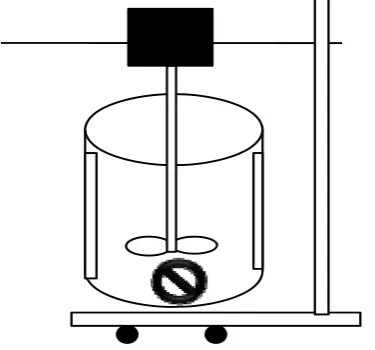
[image:1.595.311.499.541.716.2]Experiments were conducted using two different reactors; a batch reactor and a leaching cell, Figs. 1 and 2 respectively.
Fig. 1 Batch reactor equipment set up
Process Intensification of Zinc Oxide Leaching
Process Using Sulphuric Acid
Fig. 2 Leaching cell equipment
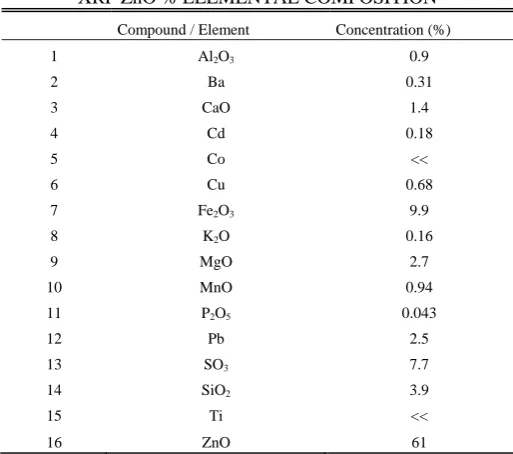
[image:2.595.321.526.408.567.2] [image:2.595.39.296.433.660.2]Zinc oxide ore and sulphuric acid were used for the study. The analysis of the ore by X-ray Fluorescence (XRF) showed that the ore contained 61% of zinc oxide and the remaining percentage is constituted by other oxides as outlined in Table 1.
TABLE I
XRF ZnO % ELEMENTAL COMPOSITION
Compound / Element Concentration (%)
1 Al2O3 0.9
2 Ba 0.31
3 CaO 1.4
4 Cd 0.18
5 Co <<
6 Cu 0.68
7 Fe2O3 9.9
8 K2O 0.16
9 MgO 2.7
10 MnO 0.94
11 P2O5 0.043
12 Pb 2.5
13 SO3 7.7
14 SiO2 3.9
15 Ti <<
16 ZnO 61
III. RESULTS AND DISCUSSION
A.
The Effect of Reactants Feeding Mechanisms
Fig. 3 compares Zinc recovery results obtained from two different reactants feeding mechanisms (batch versus semi batch process). The results showed that the recovery for the semi batch process was 3% higher than the recovery from a batch process, even though in the latter case the residence time was more by 30 minutes due to the heating stage to reach the reaction temperature. However, it was expected that the recovery would be better for the case in which continuous heating of both reactants was used since the total residence time was 30 min more than that in the semi-batch process. Moreover, in the first 30 min leaching had already started before the required temperature of 70oC was reached.
The extent of leaching is known to be increased with increasing residence time of the ore in the reactor, however, the results obtained by comparing the batch and semi-batch process seems to contradict this finding. It is proposed that the temperature of the acid solution at the point of contact with the ore does have an influence on zinc dissolution. The temperature during contact of the two raw materials was higher in the semi-batch than in the batch system which explains the higher Zn recovery in the former despite shorter residence time. Thus, it can be concluded that the way the process is operated can influence zinc recovery.
50.00 60.00 70.00 80.00 90.00 100.00
0 20 40 60 80 100 120 140 160 180 200
Z
n
reco
v
ery
(
%
)
Time (minutes)
3 % acid conc (semi-batch) 3% acid conc (batch)
Fig. 3 Effect of reactants feeding mechanisms
B.
Effect of Acid Concentration
50 60 70 80 90 100
0 20 40 60 80 100 120 140 160 180 200
Z
n
rec
o
v
ery
(
%
)
Time (minutes)
3 % acid conc 4% acid conc 6% acid conc
(a)
77.26
82.31 91.24
0 10 20 30 40 50 60 70 80 90 100
3% 4% 6%
Z
n
re
co
v
e
ry
(
%
)
Acid concentration (w/v%)
[image:3.595.323.530.101.240.2]
(b)
Fig. 4 Zinc recovery with varying acid
C.
Effect of Agitating Speed
Fig. 5 illustrates the effect of increasing the agitation speed on zinc recovery. The sulfuric acid concentration used was 4%. The stirring speeds investigated were 140, 530 and 730 rpm. The zinc recoveries obtained for 140, 530 and 730 rpm were 82.31%, 86.83, and 87.83% respectively. It is apparent that operating at 530 rpm is recommended as further increases in the agitation speed did not significantly increase recovery. However, the leaching rate at 530 rpm was slightly slower during the first hour but increased after an hour. In contrast the leaching rate at 730 rpm was high and nearly constant within the first leaching hour and gradually increased with leaching time though the increase in recovery was not significant.
It is however, evident that an increase in speed does have an effect on the recovery of zinc. Both speeds of 530 rpm and 730 rpm resulted in better mixing of the reactants and thus improved mass transfer and contact between the reactants. Improved mass transfer translates to improved diffusion of the solution into the particles and thus better extraction.
50 60 70 80 90 100
0 20 40 60 80 100 120 140 160 180 200
Z
n
re
co
v
er
y
(
%
)
Time (minutes)
140 rpm 530 rpm 730 rpm
Fig. 5 Effect of agitating speed on zinc recovery
D.
Particle Size Analysis
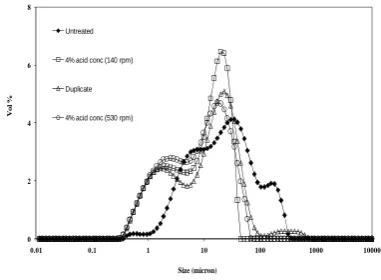
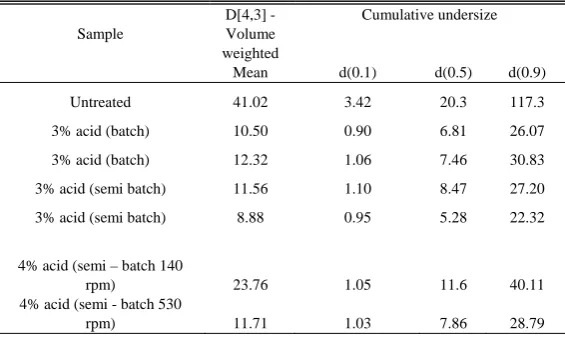
The results obtained from the laser diffraction particle analyzer (Malvern Mastersizer 2000) are presented in Figs. 6 and 7as well as in Table 2. The unleached (untreated) ore contained more coarser particles as compared to the leached ore under varying conditions. The modal size of the volume distribution shifted to the left indicating the generation of smaller particles, which can be attributed to either attrition or dissolution of particles to smaller sizes as result of leaching.
0 2 4 6 8
0.01 0.1 1 10 100 1000 10000
Vo
l %
Size (micron)
Untreated
4% acid conc (140 rpm)
Duplicate 4% acid conc (530 rpm)
Fig. 6 Evolution of the PSD at different agitation levels
[image:3.595.331.522.418.558.2]0 2 4 6
0.01 0.1 1 10 100 1000 10000
Vol
%
Size (micron) Untreated
3% acid conc (Semi-batch)
Duplicate
(a)
[image:4.595.51.257.91.462.2](b)
Fig. 7 The evolution of the PSD after leaching with 3% acid (a) Batch (b) Semi-batch
The volume mean diameter, D(4, 3), was used to determine how the particle size evolves during leaching. The D(4, 3)
values are tabulated in Table 2, the value of the D(4, 3) for the untreated ore was found to be 41.02 µm, which is a representative size for the larger size fraction of the PSD. The
D(4, 3) for the leached ore was found to be in the range of
8.8-12.4 µm. This reduction may be attributed to either attrition as a result of mechanical agitation or dissolution during the reaction. However, during leaching the particles become porous as the reaction progresses (time increases) allowing the solution to penetrate into the inner core of the particles to extract any available zinc.
The leaching of zinc from the ore matrix weakens the crystalline structure of the ore, making it more prone to fragmentation under intensive mixing. This results in more small particles being generated. A decrease in the D(4, 3), is an indication that the proportion of large sized particles is being reduced which consequently result in an increase in the small sized particles. This correlates to the volume
[image:4.595.286.569.264.434.2]distribution data shown in Fig. 6, which showed a modal shift towards the left indicating that more small particles are being generated. Furthermore the proportion of small sized particles increased with increasing mixing intensity, Table 2. The generation of the smaller particles in the leaching process is beneficial since it increases the surface area available for leaching and reduces the diffusion time of the lixiviant into the particles. The significant decrease in the cumulative undersize distribution at 10 and 90% (Table 2) indicates a major shift to smaller sizes as a result of ore leaching.
TABLE II
CUMULATIVE UNDERSIZE DISTRIBUTION AND WEIGHTED MEAN SIZES
Sample
D[4,3] - Volume
Cumulative undersize
weighted
Mean d(0.1) d(0.5) d(0.9)
Untreated 41.02 3.42 20.3 117.3
3% acid (batch) 10.50 0.90 6.81 26.07
3% acid (batch) 12.32 1.06 7.46 30.83
3% acid (semi batch) 11.56 1.10 8.47 27.20
3% acid (semi batch) 8.88 0.95 5.28 22.32
4% acid (semi – batch 140
rpm) 23.76 1.05 11.6 40.11
4% acid (semi - batch 530
rpm) 11.71 1.03 7.86 28.79
IV. CONCLUSION
The method through which the leaching process was operated proved to have an effect on the zinc recovery. The recovery from the semi batch operation was predominant to that from the batch operated process by 2%.
The results obtained from the study demonstrated that the increase in acid concentration had a pronounced effect on the dissolution of the zinc metal hence the improvement in the zinc recovery.
The mixing speed affected the recovery by increasing the solid-liquid interaction. As a result, sufficient solution impregnation through the particle pores is improved for effective dissolution.
Particle size distribution results and data showed that there was a generation of smaller particles as a result of particle attrition.
Alternative ways of process intensification such ore pre-treatment by microwave treatment should be investigated and the use of impinging jet reactors to induce micro-cracking of particles.
0 2 4 6
0.01 0.1 1 10 100 1000 10000
Vo
l %
Size (micron)
Untreated
3% batch
ACKNOWLEDGEMENT
The authors acknowledge financial support from the University Research Committee and the Department of Chemical Engineering, University of Johannesburg.
REFERENCES
[1] Q. Wen – Qing, L. Zhuo – Yue, and L. Wei Zhong, “Recovery of zinc from low-grade zinc oxide ores by solvent extraction, Journal of South Central University of Technology, vol.10, no.2, pp. 98 – 102, 2003. [2] C. K. Gupta and T. K. Mukherjee, Hydrometallurgy in extraction
processes, CRC Press, 1990, vo. 2, pp.39-78.
[3] P.A. Olumbabi, “Sulphuric acid leaching of zinc and copper from Nigerian Complex Sulphide Ore in the prescence of hydrogen peroxide,” The Journal of the South African Institute of Mining and Metallurgy, vol. 106, pp. 765-770, 2006
[4] Z. Rajko, N.V. Vracar and Z. Kamberovic, “Leaching of copper (I) sulphide by sulphuric acid solution with the addition of sodium nitrate,” Hydrometallurgy, vol. 70, pp 143-151, 2003
[5] L. Lorenzen, B.M. Loftus, J.S.J. van Deventer, and K.R.P. Petersen, “The effect of jet reactors on the Leaching of Gold from Ores,” Mineral Engineering, vol.10, No.9, pp.909-917, 1997
[6] L. Lorenzen, and A.W. Kleingeld, “ New generation leaching reactors for effective mass transfer in mineral processing operations,” Minerals Engineering, vol. 13, No.10-11, pp 1107-1115, 2000