Lexical Cohesion C o m p u t e d by Thesaural
Relations as an Indicator of the Structure
of Text
Jane Morris*
York UniversityGraeme Hirstt
University of TorontoIn text, lexical cohesion is the result of chains of related words that contribute to the continuity of lexical meaning. These lexical chains are a direct result of units of text being "about the same thing," and finding text structure involves finding units of text that are about the same thing. Hence, computing the chains is useful, since they will have a correspondence to the structure of the text. Determining the structure of text is an essential step in determining the deep meaning of the text. In this paper, a thesaurus is used as the major knowledge base for computing lexical chains. Correspondences between lexical chains and structural elements are shown to exist. Since the lexical chains are computable, and exist in non-domain-specific text, they provide a valuable indicator of text structure. The lexical chains also provide a semantic context for interpreting words, concepts, and sentences.
1. Lexical Cohesion
A text or discourse is not just a set of sentences, each on some r a n d o m topic. Rather, the sentences a n d phrases of a n y sensible text will each tend to be a b o u t the same things - - that is, the text will h a v e a quality of unity. This is the p r o p e r t y of cohesion - - the sentences "stick t o g e t h e r " to function as a whole. Cohesion is achieved t h r o u g h back-reference, conjunction, and semantic w o r d relations. Cohesion is not a guarantee of u n i t y in text b u t rather a device for creating it. As aptly stated b y H a l l i d a y a n d H a s a n (1976), it is a w a y of getting text to " h a n g together as a whole." Their w o r k on cohesion has u n d e r s c o r e d its i m p o r t a n c e as an indicator of text unity.
Lexical cohesion is the cohesion that arises from semantic relationships b e t w e e n words. All that is required is that there be some recognizable relation b e t w e e n the words.
Halliday and H a s a n have p r o v i d e d a classification of lexical cohesion based on the t y p e of d e p e n d e n c y relationship that exists b e t w e e n words. There are five basic classes:
1. Reiteration with identity of reference:
Example 1
1. M a r y bit into a peach.
2. U n f o r t u n a t e l y the peach w a s n ' t ripe.
Computational Linguistics Volume 17, Number 1
2. Reiteration without identity of reference:
Example 2
1. Mary ate some
peaches.
2. She likespeaches
very much.3. Reiteration by means of superordinate:
Example 3
1. Mary ate a
peach.
2. She likesfruit.
4. Systematic semantic relation (systematically classifiable):
Example 4
1. Mary likes
green
apples. 2. She does not likered
ones.5. Nonsystematic semantic relation (not systematically classifiable):
Example 5
1. Mary spent three hours in the
garden
yesterday. 2. She wasdigging
potatoes.Examples 1, 2, and 3 fall into the class of
reiteration.
Note that reiteration includes not only identity of reference or repetition of the same word, but also the use of superordinates, subordinates, and synonyms.Examples 4 and 5 fall into the class of
collocation,
that is, semantic relationships between words that often co-occur. They can be further divided into two categories of relationship:systematic semantic,
andnonsystematic semantic.
Systematic semantic relationships can be
classified
in a fairly straightforward way. This type of relation includes antonyms, members of an ordered set such as{one, two,
three},
members of an unordered set such as{white, black, red},
and part-to-whole re- lationships like{eyes, mouth, face}.
Example 5 is an illustration of collocation where the word relationship,{garden, digging},
is nonsystematic. This type of relationship is the most problematic, especially from a knowledge representation point of view. Such collocation relationships exist between words that tend to occur in similar lexical environments. Words tend to occur in similar lexical environments because they de- scribe things that tend to occur in similar situations or contexts in the world. Hence, context-specific examples such as{post office, service, stamps, pay, leave}
are included in the class. (This example is from Ventola (1987), who analyzed the patterns of lex- ical cohesion specific to the context of service encounters.) Another example of this type is{car, lights, turning},
taken from example 14 in Section 4.2. These words are related in the situation of driving a car, but taken out of that situation, they are not related in a systematic way. Also contained in the class of collocation areword associa-
tions.
Examples from Postman and Keppel (1970) are{priest, church}, {citizen, U.S.A.},
and{whistle, stop}.
Again, the exact relationship between these words can be hard to classify, but there does exist a recognizable relationship.1.1 Lexical Chains
Morris and Hirst Lexical Cohesion
sequences of related words will be called
lexical chains.
There is adistance
relation be- tween each word in the chain, and the words co-occur within a givenspan.
Lexical chains do not stop at sentence boundaries. They can connect a pair of adjacent words or range over an entire text.Lexical chains tend to delineate portions of text that have a strong unity of mean- ing. Consider this example (sentences 31-33 from the long example given in Sec- tion 4.2):
Example 6
In front of me lay a virgin crescent cut out of pine bush. A dozen houses were going up, in various stages of construction, surrounded by hummocks of dry earth and stands of precariously tall trees nude halfway up their trunks. They were the kind of trees you might see in the mountains.
A lexical chain spanning these three sentences is
{virgin, pine, bush, trees, trunks, trees}.
Section 3 will explain how such chains are formed. Section 4 is an analysis of the correspondence between lexical chains and the structure of the text.
1.2 W h y Lexical Cohesion Is Important
There are two major reasons w h y lexical cohesion is important for computational text understanding systems:
. Lexical chains provide an easy-to-determine context to aid in the resolution of ambiguity and in the narrowing to a specific meaning of a word.
2. Lexical chains provide a clue for the determination of coherence and discourse structure, and hence the larger meaning of the text.
1.2.1 Word Interpretation in Context. Word meanings do not exist in isolation. Each word must be interpreted in its context. For example, in the context
{gin, alcohol, sober,
drinks},
the meaning of the noundrinks
is narrowed d o w n to alcoholicdrinks.
In thecontext
{hair, curl, comb, wave}
(Halliday and Hasan 1976),wave
means a hair wave, not a water wave, a physics wave, or a friendly hand wave. In these examples, lexical chains can be used as a contextual aid to interpreting word meanings.In earlier work, Hirst (1987) used a system called "Polaroid Words" to provide for intrasentential lexical disambiguation. Polaroid Words relied on a variety of cues, including syntax, selectional restrictions, case frames, and - - most relevant here - - a notion of semantic distance or relatedness to other words in the sentences; a sense that had such a relationship was preferred over one that didn't. Relationships were determined by marker passing along the arcs in a knowledge base. The intuition was that semantically related concepts will be physically close in the knowledge base, and can thus be found by traversing the arcs for a limited distance. But Polaroid Words looked only for possible relatedness between words in the same sentence; trying to find connections with all the words in preceding sentences was too complicated and too likely to be led astray. The idea of lexical chains, however, can address this weakness in Polaroid Words; lexical chains provide a constrained easy-to-determine representation of context for consideration of semantic distance.
Computational Linguistics Volume 17, Number 1
When a chunk of text forms a unit within a discourse, there is a tendency for related words to be used. It follows that if lexical chains can be determined, they will tend to indicate the structure of the text.
We will describe the application of lexical cohesion to the determination of the discourse structure that was proposed by Grosz and Sidner (1986). Grosz and Sidner propose a structure common to all discourse, which could be used along with a struc- turally dependent focus of attention to delineate and constrain referring expressions. In this theory there are three interacting components: linguistic structure, intentional structure, and attentional state.
Linguistic structure is the segmentation of discourse into groups of sentences, each fulfilling a distinct role in the discourse. Boundaries of segments can be fuzzy, but some factors aiding in their determination are clue words, changes in intonation (not helpful in written text), and changes in aspect and tense. When found, these segments indicate changes in the topics or ideas being discussed, and hence will have an effect on potential referents.
The second major component of the theory is the intentional structure. It is based on the idea that people have definite purposes for engaging in discourse. There is an overall discourse purpose, and also a discourse segment purpose for each of the segments in the linguistic structure described above. Each segment purpose specifies how the segment contributes to the overall discourse purpose. There are two structural relationships between these segments. The first is called a dominance relation, which occurs when the satisfaction (i.e., successful completion) of one segment's intention contributes to the satisfaction of another segment's intention. The second relation is called satisfaction precedence, which occurs when the satisfaction of one discourse seg- ment purpose must occur before the satisfaction of another discourse segment purpose can occur.
The third component of this theory is the attentional state. This is a stack-based model of the set of things that attention is focused on at any given point in the dis- course. It is "parasitic" on the intentional and linguistic structures, since for each discourse segment there exists a separate focus space. The dominance relations and satisfaction precedence relations determine the pushes and pops of this stack space. When a discourse segment purpose contributes to a discourse segment purpose of the immediately preceding discourse segment, the new focus space is pushed onto the stack. If the new discourse segment purpose contributes to a discourse segment pur- pose earlier in the discourse, focus spaces are popped off the stack until the discourse segment that the new one contributes to is on the top of the stack.
It is crucial to this theory that the linguistic segments be identified, and as stated by Grosz and Sidner, this is a problem area. This paper will show that lexical chains are a good indication of the linguistic segmentation. When a lexical chain ends, there is a tendency for a linguistic segment to end, as the lexical chains tend to indicate the topicality of segments. If a new lexical chain begins, this is an indication or clue that a new segment has begun. If an old chain is referred to again (a chain return), it is a strong indication that a previous segment is being returned to. We will demonstrate this in Section 4.
1.3 C o h e s i o n and C o h e r e n c e
Morris and Hirst Lexical Cohesion
Ultimately, the difference between cohesion and coherence is this:
cohesion
is a term for sticking together; it means that the text all hangs together.Coherence
is a term for m a k i n g sense; it means that there is sense in the text. Hence the termcoherence relations
refers to the relations between sentences that contribute to their m a k i n g sense. Cohesion and coherence relations m a y be distinguished in the following way. A coherence relation is a relation a m o n g clauses or sentences, such as
elaboration, sup-
port, cause,
orexemplification.
There have been various attempts to classify all possiblecoherence relations, but there is as yet no widespread agreement. There does not exist a general computationally feasible mechanism for identifying coherence relations. In contrast, cohesion relations are relations a m o n g elements in a text:
reference, ellipsis,
substitution, conjunction,
andlexical cohesion.
Since cohesion is well'defined, one might expect that it w o u l d be computationally easier to identify, because the identification of ellipsis, reference, substitution, conjunc- tion, and lexical cohesion is a straightforward task for people. We will s h o w below that
lexical
cohesion is computationally feasible to identify. In contrast, the identification ofa specific coherence relation from a given set is not a straightforward task, even for people. Consider this example from Hobbs (1978):
Example 7
1. John can open Bill's safe. 2. He k n o w s the combination.
Hobbs identifies the coherence relation as
elaboration.
But it could just as easily beexplanation.
This distinction depends on context, knowledge, and beliefs. For example,if y o u questioned John's ability to open Bill's safe, y o u w o u l d probably identify the relation as explanation. Otherwise y o u could identify it as elaboration. Here is another example:
Example 8
1. John b o u g h t a raincoat.
2. He w e n t shopping yesterday on Queen Street and it rained.
The coherence relation here could be elaboration (on the buying), or explanation (of when, how, or why), or cause (he bought the raincoat because it was raining out).
The point is that the identity of coherence relations is "interpretative," whereas the identity of cohesion relations is not. At a general level, even if the precise coherence relation is not known, the relation "is about the same thing" exists if coherence exists. In the example from Hobbs above,
safe
andcombination
are lexically related, which in a general sense means they "are about the same thing in some way." In example 8,bought
andshopping
are lexically related, as areraincoat
andrained.
This shows h o wcohesion can be useful in identifying sentences that are coherently related.
Cohesion and coherence are independent, in that cohesion can exist in sentences that are not related coherently:
Example 9
Computational Linguistics Volume 17, Number 1
Similarly, coherence can exist without textual cohesion:
Example 10
I came home from work at 6:00 p.m. Dinner consisted of two chicken breasts and a bowl of rice.
Of course, most sentences that relate coherently do exhibit cohesion as well. 1
1.4 The Importance of Both Cohesion and Coherence
Halliday and Hasan (1976) give two examples of lexical cohesion involving identity of reference:
Example 11
1. Wash and core six cooking
apples.
2. Put
them
into a fireproof dish.Example 12
1. Wash and core six cooking
apples.
2. Put the
apples
into a fireproof dish.Reichman (1985, p. 180) writes "It is not the use of a pronoun that gives
cohesion
to the wash-and-core-apples text. These utterances form a
coherent
piece of text not because the pronounthem
is used but because they jointly describe a set of cooking instructions" (emphasis added). This is an example of lumping cohesion and coherence together as one phenomenon. Pronominal reference is defined as a type of cohesion (Halliday and Hasan 1976). Therefore thethem
in example 11 is an instance of it. The important point is thatboth
cohesion and coherence are distinct phenomena creating unity in text.Reichman also writes (1985, p. 1179) "that similar words
(apples, them, apples)
appear in a given stretch of discourse is an artifact of the content of discussion." It follows that if content is related in a stretch of discourse, there will be coherence. Lexical cohesion is a computationally feasible clue to identifying a coherent stretch of text. In example 12, it is computationally trivial to get the word relationship betweenapples
andapples,
and this relation fits the definition of lexical cohesion. Surely this simple indicator of coherence is useful, since as stated above, there does not exist a computationally feasible method of identifying coherence in non-domain-specific text. Cohesion is a useful indicator of coherence regardless of whether it is used intentionally by writers to create coherence, or is a result of the coherence of text.
Hobbs (1978) sees the resolution of coreference (which is a form of cohesion) as being subsumed by the identification of coherence. He uses a formal definition of coherence relations, an extensive knowledge base of assertions and properties of objects and actions, and a mechanism that searches this knowledge source and makes simple inferences. Also, certain elements must be assumed to be coreferential.
He shows how, in example (7), an assumption of coherence allows the
combination
to be identified as the combination of
Bill's safe
andJohn
andhe
to be found to be coreferential.Morris and Hirst Lexical Cohesion
But lexical cohesion would also indicate that
safe
andcombination
can be assumed to be coreferential. And more importantly, one should not be misled by chicken-and- egg questions when dealing with cohesion and coherence. Rather, one should use each where applicable. Since the lexical cohesion betweencombination
andsafe
is easy to compute, we argue that it makes sense to use this information as an indicator of coherence.2. The Thesaurus and Lexical C o h e s i o n
The thesaurus was conceived by Peter Mark Roget, who described it as being the "converse" of a dictionary. A dictionary explains the meaning of words, whereas a thesaurus aids in finding the words that best express an idea or meaning. In Section 3, we will show how a thesaurus can be used to find lexical chains in text.
2.1 The Structure of the Thesaurus
Roget's International Thesaurus, 4th Edition
(1977) is composed of 1042 sequentially num-bered basic categories. There is a hierarchical structure both above and below this level (see Figure 1). Three structure levels are above the category level. The topmost level consists of eight major
classes
developed by Roget in 1852: abstract relations, space, physics, matter, sensation, intellect, volition, and affections. Each class is di- vided into (roman-numbered)subclasses,
and under each subclass there is a (capital- letter-sequenced)sub-subclass.
These in turn are divided into the basic categories.Where applicable, categories are organized into
antonym pairs.
For example, cate- gory 407 isLife,
and category 408 isDeath.
Each category contains a series of numbered paragraphs to group closely related words. Within each paragraph, still finer groups are marked by semicolons. In addition, a semicolon group m a y have cross-references or pointers to other related categories or paragraphs. A paragraph contains words of only one syntactic category. The noun paragraphs are grouped at the start of a category, followed by the paragraphs for
Class 1 . . .
Class 4: Matter I " "
III Organic Matter A ...
B Vitality
407 Life
1. NOUNS life, living, vitality, being alive, having life, animation, ani- mate existence; liveliaess, animal spirits, vivacity, spriteliness; long llfe, longevity; viability; lifetime 110.5; immortality 112.3; birth 167; exis- tence 1; bio-, organ-; -biosis.
2 . . . .
408 D e a t h . . .
i
i
Figure 1
Computational Linguistics Volume 17, Number 1
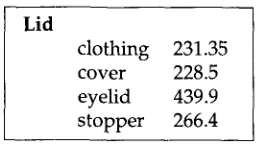
Figure 2
Index entry for the word lid
Lid
clothing 231.35 cover 228.5 eyelid 439.9 stopper 266.4
verbs, adjectives, and so on.
The thesaurus has an index, which allows for retrieval of words related to a given one. For each entry, a list of words suggesting its various distinct subsenses is given, and a category or paragraph number for each of these. Figure 2 shows the index entry for lid. To find words related to lid in its sense of cover, one would turn to paragraph 5 of category 228. An index entry may be a pointer to a category or paragraph if there are no subsenses to be distinguished.
2.2 Differences from Traditional K n o w l e d g e Bases
In the structure of traditional artificial intelligence knowledge bases, such as frames or semantic networks, words or ideas that are related are actually "physically close" in the representation. In a thesaurus this need not be true. Physical closeness has some importance, as can be seen clearly from the hierarchy, but words in the index of the thesaurus often have widely scattered categories, and each category often points to a widely scattered selection of categories.
The thesaurus simply groups words by idea. It does not have to name or classify the idea or relationship. In traditional knowledge bases, the relationships must be named. For example, in a semantic net, a relationship might be isa or color-of, and in a frame database, there might be a slot for color or location.
[image:8.468.179.307.60.132.2]Morris and Hirst Lexical Cohesion
3. Finding Lexical Chains
3.1 General Methodology
We now describe a method of building lexical chains for use as an aid in determining the structure of text. This section details how these lexical chains are formed, using a thesaurus as the main knowledge base. The method is intended to be useful for text in any general domain. Unlike methods that depend on a full understanding of text, our method is the basis of a computationally feasible approach to determining discourse structure.
We developed our method in the following way. First, we took five texts, total- ing 183 sentences, from general-interest magazines
(Reader's Digest, Equinox, The New
Yorker, Toronto,
andThe Toronto Star).
Using our intuition (i.e., common sense and aknowledge of English), we identified the lexical chains in each text. We then formal- ized our intuitions into an algorithm, using our experience with the texts to set values for the following parameters (to be discussed below).
• thesaural relations
• transitivity of word relations
• distance (in sentences) allowable between words in a chain
The aim was to find efficient, plausible methods that will cover enough cases to ensure the production of meaningful results.
3.2 Forming Lexical Chains
3.2.1 Candidate Words. The first decision in lexical chain formation is which words in the text are candidates for inclusion in chains. As pointed out by Halliday and Hasan (1976), repetitive occurrences of closed-class words such as pronouns, prepositions, and verbal auxiliaries are obviously not considered. Also, high-frequency words like
good, do,
andtaking
do not normally enter into lexical chains (with some exceptionssuch as
takings
used in the sense ofearnings).
For example, in (13) only the italicized words should be considered as lexical chain candidates:Example 13
My
maternal grandfather lived
to be111. Zayde
waslucid
to theend,
but a fewyears
before
hedied
thefamily assigned
me thetask
oftalking
to him about hisproblem
withalcohol.
It should be noted that morphological analysis on candidate words was done intu- itively, and would actually have to be formally implemented in an automated system.
3.2.2 Building Chains. Once the candidate words are chosen, the lexical chains can be formed. For this work an abridged version of
Roget's Thesaurus
(1977) was used. The chains were built by hand. Automation was not possible, for lack of a machine-readable copy of the thesaurus. Given a copy, implementation would clearly be straightforward. It is expected that research with an automated system and a large sample space of text would give valuable information on the fine-tuning of the parameter settings used in the general algorithm.Computational Linguistics Volume 17, Number 1
over 90% of the lexical relationships. The relationships are the following:
1. Two words have a category common in their index entries. For example,
residentialness and apartment both have category 189 in their index entries
(see Figure 3.1).
2. One word has a category in its index entry that contains a pointer to a category of the other word. For example car has category 273 in its index entry, and that contains a pointer to category 276, which is a category of the word driving (see Figure 3.2).
3. A word is either a label in the other word's index entry (see Figure 3.3b), or is in a category of the other word. For example, blind has category 442 in its index entry, which contains the word see (see Figure 3.3a).
4. Two words are in the same group, and hence are semantically related. For example, blind has category 442, blindness, in its index entry and see
has category 441, vision, in its index entry (see Figure 3.4).
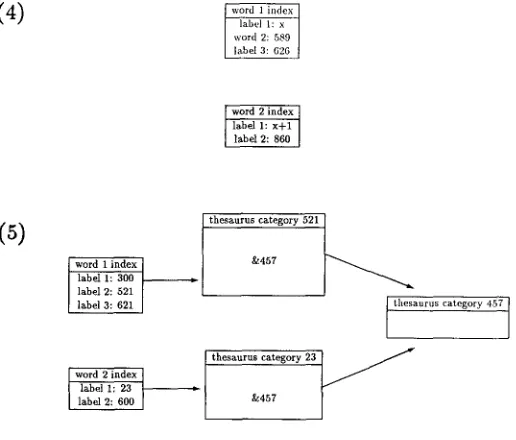
5. The two words have categories in their index entries that both point to a common category. For example, brutal has category 851, which in turn
(i)
(2)
word 1 index ] label 1:521 l label 2:589 J label 3:626 J
word 2 index I / I label 1:860
7 -
I label 2:521
word 1 index ] label 2:589
label 3: 6 2 6 ~
thesaurus category 521
thesaurus category 521
~r860
thesaurus category 860
thesaurus category 521
word 2
word 2 index ~ . ~ label 1:300 label 2:860
(3)
(a)
word 1 index
label 1:521 label 2:589 label 3:626
word 1 index
label h 521 ( b ) word 2:589 label 3:626
Figure 3
[image:10.468.49.287.303.647.2]Morris and Hirst Lexical Cohesion
(4)
(5)
thesaurus category 521~
&457
thesaurus category 23
&457
I thesaurus category 457 I
Figure 3
Continued. Thesaural Relations, parts (4)-(5)
h a s a p o i n t e r to c a t e g o r y 830.
Terrified
h a s c a t e g o r y 860 that likewise has a p o i n t e r to c a t e g o r y 830 (see Figure 3.5).O n e m u s t consider h o w m u c h transitivity to use w h e n c o m p u t i n g lexical chains. Specifically, if w o r d a is related to w o r d b, w o r d b is related to w o r d c, a n d w o r d c is related to w o r d d t h e n is w o r d a related to w o r d s c a n d d?
C o n s i d e r this chain:
{cow, sheep, wool, scarf, boots, hat, snow}.
If u n l i m i t e d transitivity w e r e allowed, thencow
a n dsnow
w o u l d be considered related, w h i c h is definitely c o u n t e r intuitive. O u r intuition w a s to allow o n e transitive link: w o r d a is related to w o r d c b u t not to w o r d d. It s e e m e d that t w o or m o r e transitive links w o u l d so severely w e a k e n the w o r d relationship as to cause it to be nonintuitive. O u r analysis of o u r s a m p l e texts s u p p o r t e d this. To s u m m a r i z e , a transitivity of o n e link is sufficient to successfully c o m p u t e the intuitive chains. A n a u t o m a t e d s y s t e m could be u s e d to test this o u t extensively, v a r y i n g the n u m b e r of transitive links a n d calculating the consequences. It is likely that it varies slightly w i t h respect to style, author, or t y p e of text.There are t w o w a y s in w h i c h a transitive relation i n v o l v i n g o n e link can cause t w o w o r d s to be related. In the first way, if w o r d a is related to w o r d b, a n d w o r d b is related to w o r d c, then w o r d a is related to w o r d c. In the second way, if w o r d a is related to w o r d b, a n d w o r d a is related to w o r d c, t h e n w o r d b is related to w o r d c. But lexical chains are calculated o n l y w i t h respect to the text r e a d so far. For e x a m p l e , if w o r d c is related to w o r d a a n d to w o r d b, t h e n w o r d a a n d w o r d b are not related, since at the t i m e of processing, t h e y w e r e n o t relatable. S y m m e t r y w a s n o t f o u n d to be n e c e s s a r y for c o m p u t i n g the lexical chains.
[image:11.468.36.294.59.279.2]Computational Linguistics Volume 17, Number 1
to existing chains often correspond to intentional boundaries, as they occur after di- gressions or subintentions, thereby signalling a resumption of some structural text entity.
Intuitively, the distance between words in a chain is a factor in chain formation. The distance will not be "large," because words in a chain co-relate d u e to recognizable relations, a n d large distances w o u l d interfere w i t h the recognition of relations.
The five texts were analyzed with respect to distance between clearly related words. The analysis s h o w e d that there can be u p to t w o or three intermediary sen- tences between a w o r d a n d the preceding element of a chain segment w i t h which it can be linked. At distances of four or more intermediary sentences, the w o r d is only able to signal a return to an existing chain. Returns h a p p e n e d after between 4 a n d 19 intermediary sentences in the sample texts. One significant fact emerged from this analysis: returns consisting of one word only were always m a d e with a repetition of one of the words in the returned-to chain. Returns consisting of more than one w o r d d i d not necessarily use repetition - - in fact in most cases, the first w o r d in the return was not a repetition.
The question of chain returns a n d w h e n they can occur requires further research. W h e n distances between relatable words are not tightly b o u n d (as in the case of returns), the chances of incorrect chain linkages increase. It is anticipated that chain return analysis w o u l d become integrated w i t h other text processing tools in order to prevent this. Also, we believe that chain
strength
analysis will be required for this purpose. Intuitively, some lexical chains are "stronger" t h a n others, a n d possibly only strong chains can be returned to. There are three factors contributing to chain strength.1. Reiteration - - the more repetitions, the stronger the chain.
2. Density - - the denser the chain, the stronger it is.
3. Length - - the longer the chain, the stronger it is.
Ideally, some combination of values reflecting these three factors should result in a chain strength value that can be useful in determining whether a chain is strong e n o u g h to be returned to. Also, a strong chain should be more likely to have a struc- tural correspondence than a w e a k one. It seems likely that chains could contain par- ticularly strong portions w i t h special implications for structure. These issues will not be addressed here.
3.2.3 N o t a t i o n and Data Structures. In the computation of lexical chains, the following information is kept for each w o r d in a chain:
A w o r d number, which is a sequential, chain-based n u m b e r for each w o r d so that it can be uniquely identified.
The sentence n u m b e r in which the w o r d occurs.
The chain created so far.
Each lexical relationship in a chain is represented as (u,v)~ where:
• u is the current w o r d number,
• v is the w o r d n u m b e r of the related word,
Morris and Hirst Lexical Cohesion
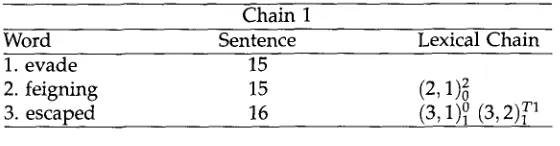
Chain 1
Word Sentence Lexical Chain
1. evade 15
2. feigning 15 (2~ 1) 2
3. escaped 16 (3, 1) o /3~ 2)~ 1
Figure 4
Lexical chain notation
- - 0 means no transitive link was used to form the word relationship
1 means one transitive link was used to form the word relationship
y is either
- - the number of the thesaural relationship between the two words
(as given in Section 3.2.2)
Tq
whereT stands for transitively related
q is the word number through which the transitive relation is formed.
A full example of this notation is shown in Figure 4.
Figure 5 shows the generalized algorithm for computing lexical chains. The pa- rameter values that we used are shown for the following:
• candidate words
• thesaural relations
• transitivity of word relations
• distance between words in a chain.
The only parameter not addressed in this work is which (if any) chains should be eliminated from the chain-finding process.
3.3 P r o b l e m s and C o n c e r n s
This section is a discussion of problems encountered during the computation of the lexical chains contained in our corpus of texts. The text example used in this paper is in Section 4.2, and the chains found in the example are in Appendix A.
3.3.1 W h e r e the T h e s a u r u s Failed to Find Lexical R e l a t i o n s . The algorithm found
[image:13.468.85.365.50.123.2]Computational Linguistics Volume 17, Number 1
REPEAT
READ next word
IF word is suitable for lexical analysis (see section 3.2.1) THEN CHECK for chains within a suitable span
(up to 3 intermediary sentences, and no limitation on returns):
CHECK thesaurus for relationships (section 3.2.2). CHECK other knowledge sources
(situational, general words, proper names). IF chain relationship is found THEN
INCLUDE word in chain. CALCULATE chain so far (allow one transitive link). END IF
IF there are words that have not formed a chain for a suitable number of sentences (up to 3) THEN
ELIMINATE words from the span. END IF
CHECK new word for relevance to existing chains that are suitable for checking.
ELIMINATE chains that are not suitable for checking. END IF
END REPEAT
Figure 5
Algorithm for Finding Lexical Chains
not in the thesaurus, and while it seems as though
environment
andsurrounding
should be thesaurally connected, they were not.Place names, street names, and people's names are generally not to be found in
Roget's Thesaurus
(1977). However, they are certainly contained in one's "mental thesaurus." Chain 1, which contains several major Toronto street names, is a good example of this. These names were certainly related to the rest of chain 1 in the authors' mental thesaurus, since we are residents of Toronto (and indeed the article assumed a knowledge of the geography of the city). In chain 5, the thesaurus did not connect the wordspine
andtrunk
with the rest of the chain{virgin, bush, trees, trees}.
In a general thesaurus, specific information on, and classification of, plants, animals, minerals, etc., is not available.To summarize, there were few cases in which the thesaurus failed to confirm an intuitive lexical chain. For those cases in which the thesaurus did fail, three missing knowledge sources became apparent.
1. General semantic relations between words of similar "feeling."
2. Situational knowledge.
3. Specific proper names.
Morris and Hirst Lexical Cohesion
separate. We found the following intuitively separate chain beginning in sentence 38:
{people, Metropolitan Toronto, people, urban, population, people, population, popula-
tion, people}.
However, the algorithm linked this chain with chain 1, which runs through the entire example and consists of these words and others:{city, suburbs,
traffic, community}.
Fortunately, this was a rare occurrence. But note that there will be cases in which lexical chains should be merged as a result of the intentional merging of ideas or concepts in the text.Conversely, there were a few cases of unfortunate chain returns occurring where they were definitely counter intuitive. In chain 3, word 4,
wife,
was taken as a one- word return to the chain{married, wife, wife}.
However, there is no intuitive reason for this.4. Using Lexical Chains to Determine Text Structure
This section describes how lexical chains formed by the algorithm given in Section 3.2.3 can be used as a tool.
4.1 Lexical Chains and Text Structure
Any structural theory of text must be concerned with identifying units of text that are about the same thing. When a unit of text is about the same thing there is a strong tendency for semantically related words to be used within that unit. By definition, lexical chains are chains of semantically related words. Therefore it makes sense to use them as clues to the structure of the text.
This section will concentrate on analyzing correspondences between lexical chains and structural units of text, including:
• the correspondence of chain boundaries to structural unit boundaries;
• returns to existing chains and what they indicate about structural units;
• lexical chain strength and reliability of predicting correspondences between chains and structural units;
• an analysis of problems encountered, and when extra textual information is required to validate the correspondences between lexical chains and structural components.
The text structure theory chosen for this analysis was that of Grosz and Sidner (1986). it was chosen because it is an attempt at a general domain-independent theory of text structure that has gained a significant acceptance in the field as a good standard approach.
The methodology we used in our analyses was as follows:
1. We determined the lexical chain structure of the text using the algorithm given in Section 3.2.3. (In certain rare cases where the algorithm did not form intuitive lexical chains properly, it is noted, both in Section 3.4 and in the analysis in this section. The intuitive chain was used for the analysis; however the lexical chain data given in Appendix A show the rare mismatches between intuition and the algorithm.)
Computational Linguistics Volume 17, Number 1
. We compared the lexical structure formed in step 1 with the intentional structure formed in step 2, and looked for correspondences between them.
4.2 An Example
Example 14 shows one of the five texts that we analyzed. It is the first section of an article in Toronto magazine, December 1987, by Jay Teitel, entitled "Outland. "2 The tables in Appendix A show the lexical chains for the text. (The other four texts and their analyses are given in Morris 1988.)
Example 14
1. ¶I spent the first 19 years of m y life in the suburbs, the initial 14 or so relatively contented, the last four or five wanting mainly to be elsewhere.
2. The final two I remember vividly: I passed them driving to and from the University of Toronto in a red 1962 Volkswagen 1500 afflicted with night blindness.
3. The car's lights never worked - - every dusk turned into a kind of medieval race against darkness, a panicky, mounfful rush north, away from everything I knew was exciting, toward everything I knew was deadly.
4. I remember looking through the windows at the commuters mired in traffic beside me and actively hating them for their passivity.
5. I actually punched holes in the white vinyl ceiling of the Volks and then, by way of penance, wrote beside them the names and phone numbers of the girls I would call when I had m y own apartment in the city.
6. One thing I swore to myself: I would never live in the suburbs again.
7. ¶My aversion was as much a matter of environment as it was traffic - - one particular piece of the suburban setting: the "cruel sun."
8. Growing up in the suburbs you can get used to a surprising number of things - - the relentless "residentialness" of your surroundings, the weird certainty you have that everything will stay vaguely new-looking and immune to historic soul no matter how m a n y years pass.
9. You don't notice the eerie silence that descends each weekday when every sound is drained out of your neighbourhood along with all the people who've gone to work. 10. I got used to pizza, and cars, and the fact that the cultural hub of my community was the collective TV set.
11. But once a week I would step outside as dusk was about to fall and be absolutely bowled over by the setting sun, slanting huge and cold across the untreed front lawns, reminding me not just how barren and sterile, but how undefended life could be. 12. As much as I hated the suburban drive to school, I wanted to get away from the cruel suburban sun.
13. ¶When I was married a few years later, m y attitude hadn't changed.
14. My wife was a city girl herself, and although her reaction to the suburbs was less intense than mine, we lived in a series of apartments safely straddling Bloor Street. 15. But four years ago, we had a second child, and simultaneously the school m y wife taught at moved to Bathurst Street north of Finch Avenue.
Morris and Hirst Lexical Cohesion
16. She was now driving 45 minutes north to work every morning, along a route that was perversely identical to the one I'd driven in college.
17. ¶We started looking for a house.
18. Our first limit was St. Clair - - we would go no farther north.
19. When we took a closer look at the price tags in the area though, we conceded that maybe we'd have to go to Eglinton - - but that was definitely it.
20. But the streets whose names had once been magical barriers, latitudes of tolerance, quickly changed to something else as the Sundays passed.
21. Eglinton became Lawrence, which became Wilson, which became Sheppard. 22. One wind-swept day in May I found myself sitting in a town-house development north of Steeles Avenue called Shakespeare Estates.
23. It wasn't until we stepped outside, and the sun, blazing unopposed over a country club, smacked me in the eyes, that I came to.
24. It was the cruel sun.
25. We got into the car and drove back to the Danforth and porches as fast as we could, grateful to have been reprieved.
26. ¶And then one Sunday in June I drove north alone.
27. This time I drove up Bathurst past my wife's new school, hit Steeles, and kept going, beyond Centre Street and past Highway 7 as well.
28. I passed farms, a man selling lobsters out of his trunk on the shoulder of the road, a chronic care hospital, a country club and what looked like a mosque.
29. I reached a light and turned right.
30. I saw a sign that said Houses and turned right again. 31. ¶In front of me lay a virgin crescent cut out of pine bush.
32. A dozen houses were going up, in various stages of construction, surrounded by hummocks of dry earth and stands of precariously tall trees nude halfway up their trunks.
33. They were the kind of trees you might see in the mountains.
34. A couple was walking hand-in-hand up the dusty dirt roadway, wearing matching blue track suits.
35. On a "front lawn" beyond them, several little girls with hair exactly the same colour of blond as m y daughter's were whispering and laughing together.
36. The air smelled of sawdust and sun.
37. ¶It was a suburb, but somehow different from any suburb I knew. 38. It felt warm.
39. ¶It was Casa Drive.
40. ¶In 1976 there were 2,124,291 people in Metropolitan Toronto, an area bordered by Steeles Avenue to the north, Etobicoke Creek on the west, and the Rouge River to the east.
41. In 1986, the same area contained 2,192,721 people, an increase of 3 percent, all but negligible on an urban scale.
42. In the same span of time the three outlying regions stretching across the top of Metro - - Peel, Durham, and York - - increased in population by 55 percent, from 814,000 to some 1,262,000.
43. Half a million people had poured into the crescent north of Toronto in the space of a decade, during which time the population of the City of Toronto actually declined as did the populations of the "old" suburbs with the exception of Etobicoke and Scarborough.
Computational Linguistics Volume 17, Number 1
4.3 The Correspondences between Lexical and Intentional Structures
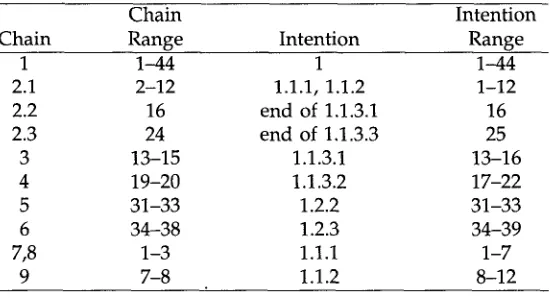
In Figure 6 w e s h o w the intentional structure of the text of Section 4.2, a n d in Figure 7 w e s h o w the c o r r e s p o n d e n c e s b e t w e e n the lexical chains a n d intentions of the example. There is a clear correspondenc.e b e t w e e n chain 1, { . . . .
driving, car's
. . . . }, a n d intention I (changing attitudes to s u b u r b a n life). The continuity of the subject m a t t e r is reflected b y the c o n t i n u o u s lexical chain. From sentence 40 to sentence 44, t w o words,population
a n dpeople
are used repetitively in the chain.Population
is r e p e a t e d three times, a n dpeople
is r e p e a t e d five times. If chain strength (indicated b y the reiteration) were used to delineate "strong" portions of a chain, this strength i n f o r m a t i o n could also be used to indicate structural attributes of the text. Specifically, sentences 40 to 44 f o r m intention 1.3 ( w h y n e w suburbs exist), and hence a strong p o r t i o n of the1 (1-44)
Changing attitudes to suburban life. 1.1 (1-25)
Earlier aversion to suburban life. 1.1.1 (1-~)
Hatred of commuting. 1.1.2 (8-12)
The hated suburb environment.
1.1.3 (13-25)
How this old aversion to suburbs held, when a recent attempt was made to
b u y a new house in the ~uburbs. 1.1.3.1 (13-16)
How life changed, giving author re~son to look for a new house.
1.1.3.2 (17-22)
Houses are too expensive in Metro Toronto, hence one must look in the suburbs to buy a house.
1.1.3.3 (23-25)
T h e old familiar aversion to suburbs c a m e back. 1.2 (26-39)
A n e w suburb that seems livable in and nice.
1.2.1 (26-30)
T h e drive to the n e w suburb. 1.2.2 (31-33)
T h e forested area.
1.2.3 (34-39)
The pleasant environment. 1.3 (40-~4)
W h y the n e w suburbs exist.
Figure 6
The Intentional Structure of Example 14 (showing topics the writer intends to discuss)
Chain Intention
Chain Range Intention Range
1 1-44 1 1-44
2.1 2-12 1.1.1, 1.1.2 1-12
2.2 16 end of 1.1.3.1 16
2.3 24 end of 1.1.3.3 25
3 13-15 1.1.3.1 13-16
4 19-20 1.1.3.2 17-22
5 31-33 1.2.2 31-33
6 34-38 1.2.3 34-39
7,8 1-3 1.1.1 1-7
9 7-8 1.1.2 8-12
Figure 7
[image:18.468.50.301.232.452.2] [image:18.468.101.376.488.637.2]Morris and Hirst Lexical Cohesion
chain would correspond exactly to a structural unit. In addition,
drive
was repeated eight times between sentence 2 and sentence 26, corresponding to intention 1.1 (earlier aversion to suburban life).Suburb
was repeated eleven times throughout the entire example, indicating the continuity in structure between sentences 1-44.Chain 2.1,
{afflicted, darkness
. . . . }, from sentence 2 to sentence 12, corresponds to intentions 1.1.1 (hatred of commuting) and 1.1.2 (hatred of suburbs). More textual information is needed to separate intentions 1.1.1 and 1.1.2. There is a one-word return to chain 2 at sentences 16 and 24, strongly indicating that chain 2 corresponds to intention 1.1, which runs from sentence 1 to sentence 25. Also, segment 2.2 coincides with the end of intention 1.1.3.1 (how life changed), and segment 2.3 coincides with the end of intention 1.1.3.3 (old familiar aversion to suburbs). This situation illustrates how chain returns help indicate the structure of the text. If chain returns were not considered, chain 2 would end at sentence 12, and the structural implications of the two single-word returns would be lost. It is intuitive that the two wordsperverse
andcruel
indicate links back to the rest of intention 1.1. The link provided by the last return,cruel,
is especially strong, since it occurs after the diversion describing the attempt to find a nice house in the suburbs.Cruel
is the third reiteration of the word in chain 2. Chain 3,{married, wife
. . . . }, corresponds to intention 1.1.3.1 (if the unfortunate chain return mentioned in section 3.4.2 is ignored) and chain 4{conceded, tolerance},
corresponds to intention 1.1.3.2 (expensive houses in Metro Toronto). The boundaries of chain 4 are two sentences inside the boundaries of the intention. The existence of a lexical chain is a clue to the existence of a separate intention, and boundaries within one or two sentences of the intention boundaries are considered to be close matches.Chain 5,
{virgin, pine
. . . . }, corresponds closely to intention 1.2.2 (forested area). Chain6, {hand-in-hand, matching
. . . . }, corresponds closely to intention 1.2.3 (pleasant environment). Chains 7,{first, initial, final},
and 8,{night, dusk, darkness},
are a couple of short chains (three words long) that overlap. They collectively correspond to intention 1.1.1 (hatred of commuting). The fact that they are short and overlapping suggests that they could be taken together as a whole.Chain 9,
{environment, setting, surrounding},
corresponds to intention 1.1.2 (hated suburbs). Even though the chain is a lot shorter in length than the intention, its pres- ence is a clue to the existence of a separate intention in its textual vicinity. Since the lexical chain b o u n d a r y is more than two sentences away from the intention boundary, other textual information would be required to confirm the structure.Overall, the lexical chains found in this example provide a good clue for the determination of the intentional structure. In some cases, the chains correspond exactly to an intention. It should also be stressed, however, that the lexical structures cannot be used on their own to predict an exact structural partitioning of the text. This of course was never expected. As a good example of the limitations of the tool, intention 1.2 (nice new suburb) starts in sentence 26, but there are no new lexical chains starting there. The only clue to the start of the new intention would be the ending of chain 2
{afflicted, darkness . . . . }.
This example also provides a good illustration (chain 2) of the importance of chain returns being used to indicate a high-level intention spanning the length of the entire chain (including all segments). Also, the returns coincided with intentional boundaries.
5. C o n c l u s i o n s
Computational Linguistics Volume 17, Number 1
analysis involves finding the units of text that are about the same topic, one should have something to say about the other. This was found to be true. The lexical chains computed by the algorithm given in Section 3.2.3 correspond closely to the intentional structure produced from the structural analysis method of Grosz and Sidner (1986). This is important, since Grosz and Sidner give no method for computing the intentions or linguistic segments that make up the structure that they propose.
Hence the concept of lexical cohesion, defined originally by Halliday and Hasan (1976) and expanded in this work, has a definite use in an automated text under- standing system. Lexical chains are shown to be almost entirely computable with the relations defined in Section 3.2.2. The computer implementation of this type of thesaurus access would be a straightforward task involving traditional database tech- niques. The program to implement the algorithm given in Section 3.2.3 would also be straightforward. However, automated testing could help fine-tune the parameters, and would help to indicate any unfortunate chain linkages. Although straightforward from an engineering point of view, the automation would require a significant effort. A machine-readable thesaurus with automated index searching and lookup is required. The texts we have analyzed, here and elsewhere (Morris 1988) are general-interest articles taken from magazines. They were chosen specifically to illustrate that lexical cohesion, and hence this tool, is not domain-specific.
5.1 I m p r o v e m e n t s o n Earlier R e s e a r c h
The methods used in this work improve on those from Halliday and Hasan (1976). Halliday and Hasan related words back to the first word to which they are tied, rather than forming explicit lexical chains that include the relationships to intermediate words in the chain. They had no notions of transitivity, distance between words in a chain, or chain returns. Their intent was not a computational means of finding lexical chains, and they did not suggest a thesaurus for this purpose.
Ventola (1987) analyzed lexical cohesion and text structure within the framework of systemic linguistics and the specific domain of service encounters such as the exchange of words between a client at a post office and a postal worker. Ventola's chain-building rule was that each lexical item is "taken back once to the nearest preceding lexically cohesive item regardless of distance" (p. 131). In our work the related words in a chain are seen as indicating structural units of text, and hence distance between words is relevant. Ventola did not have the concept of chain returns, and transitivity was allowed up to any level. Her research was specific to the domain used. She does not discuss a computational method of determining the lexical chains.
Hahn (1985) developed a text parsing system that considers lexical cohesion. Nouns in the text are mapped directly to the underlying model of the domain, which was implemented as a frame-structured knowledge base. Hahn viewed lexical cohe- sion as a local phenomenon between words in a sentence and the preceding one. There was also an extended recognizer that worked for cohesion contained within paragraph boundaries. Recognizing lexical cohesion was a matter of searching for ways of relat- ing frames and slots in the database that are activated by words in the text. Heavy reliance is put on the "formally clear cut model of the underlying domain" (Hahn 1985, p. 3). However, general-interest articles such as we analyzed do not have domains that can be a priori formally represented as frames with slot values in such a manner that lexical cohesion will correspond directly to them. Our work uses lexical cohesion as it naturally occurs in domain-independent text as an indicator of unity, rather than fitting a domain model to the lexical cohesion. Hahn does not use the concept of chain returns or transitivity.
Morris and Hirst Lexical Cohesion
on the thesaurus as a knowledge source for use in a natural language understanding system. They have been interested in the application of clustering patterns in the the- saurus. Their student Bryan (1973) proposed a graph-theoretic model of the thesaurus. A boolean matrix is created with words on one axis and categories on the other. A cell is marked as true if a word associated with a cell intersects with the category associated with a cell. Paths or chains in this model are formed by traveling along rows or columns to other true cells. Semantic "neighborhoods" are grown, consisting of the set of chains emanating from an entry. It was found that without some concept of chain strength, the semantic relatedness of these neighborhoods decays, partly due to homographs. Strong links are defined in terms of the degree of overlap between categories and words. A strong link exists where at least two categories contain more than one word in common, or at least two words contain more than one category in common. The use of strong links was found to enable the growth of strong semantic chains with homograph disambiguation.
This concept is different from that used in our work. Here, by virtue of words co- occurring in a text and then also containing at least one category in common or being in the same category, they are considered lexically related and no further strength is needed. We use the thesaurus as a validator of lexical relations that are possible due to the semantic relations among words in a text.
5.2 Further Research
It has already been mentioned that the concept of chain strength needs much fur- ther work. The intuition is that the stronger a chain, the more likely it is to have a corresponding structural component.
The integration of this tool with other text understanding tools is an area that will require a lot of work. Lexical chains do not always correspond exactly to intentional structure, and when they do not, other textual information is needed to obtain the correct correspondences. In the example given, there were cases where a lexical chain did correspond to an intention, but the sentences spanned by the lexical chain and the intention differed by more than two. In these cases, verification of the possible correspondence must be accomplished through the use of other textual information such as semantics or pragmatics. Cue words would be interesting to address, since such information seems to be more computationally accessible than underlying intentions. It would be useful to automate this tool and run a large corpus of text through it. We suspect that the chain-forming parameter settings (regarding transitivity and distances between words) will be shown to vary slightly according to author's style and the type of text. As it is impossible to do a complete and error-free lexical analysis of large text examples in a limited time-frame, automation is desirable. It could help shed some light on possible unfortunate chain linkages. Do they become problematic, and if so, when does this tend to happen? Research into limiting unfortunate linkages and detecting when the method is likely to produce incorrect results should be done (cf. Charniak 1986).
Analysis using different theories of text structure was not done, but could prove insightful. The independence of different people's intuitive chains and structure as- signments was also not addressed by this paper.
Computational Linguistics Volume 17, Number 1
of Africa or q u a n t u m mechanics. Therefore, further w o r k n e e d s to be d o n e on identi- fying other sources of w o r d k n o w l e d g e , such as domain-specific thesauri, dictionaries, and statistical w o r d usage information, that s h o u l d be integrated with this work. As an a n o n y m o u s referee p o i n t e d out to us, Volks a n d Volkswagen were not included in the chain containing driving a n d car. These w o r d s were not in a general thesaurus, and were also missed b y the authors!
Section 1 m e n t i o n e d that lexical chains w o u l d be also useful in p r o v i d i n g a con- text for w o r d sense d i s a m b i g u a t i o n and in n a r r o w i n g to specific w o r d meanings. As an example of a chain p r o v i d i n g useful i n f o r m a t i o n for w o r d sense disambiguation, consider w o r d s I to 15 of chain 2.1 of the example: {afflicted, darkness, panicky, mournful, exciting, deadly, hating, aversion, cruel, relentless, weird, eerie, cold, barren, sterile . . . . }. In the context of all of these words, it is clear that barren a n d sterile d o not refer to an inability to reproduce, b u t to a cruel coldness. The use of lexical chains for a m b i g u i t y resolution is a p r o m i s i n g area for f u r t h e r research.
Acknowledgments
Thanks to Robin Cohen, Jerry Hobbs, Eduard Hovy, Ian Lancashire, and
anonymous referees for valuable discussions of the ideas in this paper. Thanks to Chrysanne DiMarco, Mark Ryan, and John Morris for commenting on earlier drafts. This work was financially assisted by the Government of Ontario, the Department of Computer Science of the University of Toronto, and the Natural Sciences and Engineering Research Council of Canada. We are grateful to Jay Teitel for allowing us to reprint text from his article "Outland."
References
Bryan, Robert M. (1973). "Abstract thesauri and graph theory applications to thesaurus research," in Automated language analysis, edited by Sally Yeates Sedelow, University of Kansas.
Carroll, Lewis (1872). Through the Looking Glass.
Charniak, Eugene (1986). "A neat theory of marker parsing." In Proceedings, 5th National Conference on Artificial Intelligence, Philadelphia, August 1986, 584-588. Grosz, Barbara and Sidner, Candance (1986).
"Attention, intentions and the structure of discourse." Computational Linguistics, 12(3), 175-204.
Hahn, Udo (1985). "On lexically distributed text parsing. A computational model for the analysis of textuality on the level of text cohesion and text coherence." In Linking in text, edited by Ferenc Kiefer, Universit/it Konstanz.
Halliday, Michael and Hasan, Ruqaiya (1976). Cohesion in English. Longman Group.
Hirst, Graeme (1987). Semantic Interpretation and the Resolution of Ambiguity. Studies in
Natural Language Processing. Cambridge University Press.
Hirst, G. (1981). Anaphora in Natural
Language Understanding: A Survey. Lecture Notes in Computer Science. Springer Verlag.
Hobbs, Jerry (1978). "Coherence and coreference." Technical note 168, SRI International.
McKeown, K. (1985). Text Generation: Using Discourse Strategies and Focus Constraints to Generate Natural Language Text. Studies in Natural Language Processing. Cambridge University Press.
Morris, Jane (1988). "Lexical cohesion, the thesaurus, and the structure of text." Technical report CSRI-219, Department of Computer Science, University of Toronto. Postman, Leo and Keppel, Geoffrey, editors
(1970). Norms of Word Association. Academic Press.
Reichman, Rachel (1985). Getting Computers to Talk Like You and Me: Discourse Context, Focus, and Semantics (An ATN Model). The MIT Press.
Roget, P. (1977). Roget's International Thesaurus, Fourth Edition. Harper and Row Publishers Inc.
Sedelow, Sally and Sedelow, Walter (1987). "Semantic space." Computers and translation, 2, 235-245.
Sedelow, Sally and Sedelow, Walter (1986). "Thesaural knowledge representation." In Proceedings, 2nd Annual Conference of the
University of Waterloo Centre for the New Oxford English Dictionary: Advances in Lexicology. University of Waterloo. Ventola, E. (1987). The Structure of Social
Morris and Hirst Lexical Cohesion
Appendix A
Chain 1
Word Sentence Lexical Chain
1. suburbs 2. driving 3. Volkswagen 4. car's 5. lights 6. c o m m u t e r s 7. traffic 8. Volks 9. apartment 10. city 11. suburbs 12. traffic 13. suburban 14. suburbs 15. residentialness 16. neighbourhood 17. c o m m u n i t y 18. suburban 19. drive
20. suburban 21. city
22. suburbs
23. apartments
24. Bloor St. 25. Bathurst St. 26. Finch St. 27. driving
28. route
29. driven
30. house
31. St. Clair 32. Eglinton
1 2 2 3 3 4 4 5 5 5 6 7 7 8 8 9 10 12 12 12 14 14 14 14 15 15 16 16 16 17 18 19
(4, 2)~
(7, 2) 2 (7, 4)I
(9, 1)~
(10, 1)I (10, 2)~ (10, 4)o T2 (10, 7)I (10, 9)I (11, 1) 0 (11, 9-10)I (11, 2-7)1" 1°
(12, 2) 2 (12, 4-10)I (12, 7) 0 (12, 11)~ "1° (13, 1-11) ° (13, 9-10) 1 (13, 2-12)( I° (14, 1-11-13) o (14, 9-10-13)I (14, 2-12)1 :"1° (15, 1-9-10-13-14)I (15, 2-7-12)1 "1°
(16, 1-11-13-14)I (16, 9-10-13)1" 14
(18, 1-11-13-14) 0 (18, 9-10-16) 1 (18, 2-12)1" l° (19, 2) 0 (19, 7-10-12)I (19, 4) 2 (19, 1-9-11-13-14- 15-16-18)~ 1° (20, 9-10-16) 1 (20, 2-12-19)2 Tl° (20, 1-11-13-14-18)o o (20, 9-10-16) 1 (20, 2-12-19)1 :"1 (21, 10) 0 (21, 1-2-7-9-13-14-15-16-19)1Tl° (21, 4-12)1" 19
(22, 1-11-13-14-18-20) 0 (22, 9-10-16-21)I (22~ 2- 12-19)1" 1°
(23, 9)0 o (23, 1-10-11-13-14-15-16-18-20-21-22)I (23, 2-4-7-12-19)1TM
(27, 2-19)0 (27, 7-10-12-21) 1 (27, 4) 2 (27, 1-9-11- 13-14-15-16-18-20-22-23)~ lo
(28, 1-2-9-10-11-13-14-15-16-18-19-20-21-22-23-27) 2 (28, 4-7-12)1T27
(29, 2-19-27-29) o (29, 7-10-12-21) 1 (29, 4-28) 2 (29, 1-9-11-13-14-15-16-18-20-22-23)1 :"1°