Oosting, W.M.H.
January 2009
Thesis - Design of a
Community of
Practice at Centric
Design and evaluation of a Community of Practice to
support IT implementation/migration processes
A Case Study about the design of a CoP within the Suite4Basisgegevens migration
Author:
W.M.H. Oosting (Wesley), student Master Business Information Technology at the University of Twente, e-mail: [email protected], studentnumber: 0014710.
Supervisors:
Dr. N. Sikkel (Klaas), 1st supervisor and assistant professor at the Information Systems group, Faculty of Electrical Engineering, Mathematics and Computer Science,
University of Twente.
Dr. R.M. Müller (Roland), 2nd supervisor and assistant professor of Knowledge Management and Information Services at the Information Systems & Change Management group, School of Management and Governance, University of Twente.
Dr. T.F.J. Reterink (Thomas), 1st supervisor and manager at Centric IT Solutions, Woerden.
Abstract
Centric IT Solutions is currently in the middle of a migration of its tax software for local governments. In order to support this migration it was opted to implement a Community of Practice to facilitate the knowledge management. Communities of Practice (CoPs) are groups of people who come together to share and to learn from one another.
In this thesis a design is proposed for Centric to implement a Community of Practice based on the formulated C5PE framework. This framework is based around the fundamental building elements which need to be supported to facilitate knowledge sharing: Content, Conversation, Connections, Context, Control, Purpose and Environment. Central to our design is the implementation process of Centric’s software. This is the common denominator that links the members. This has lead to what we coin a Process Enhancing Community of Practice. In order to recruit members for the community we recommend using an invitation model. The recommended design of the invitation model uses the hierarchy of responsibility to guarantee the coverage of the whole process. In order to provide context to each implementation process step several features will need to be implemented.
The most important features of the design are:
- Focus on establishing connections between members - Process-centred
- Tree-like growing pattern
- Invitation model with hierarchy of responsibility to enrol members - Easy editing
Table of Contents
ABSTRACT ... 5
TABLE OF CONTENTS... 6
1 INTRODUCTION ... 8
2 THEORETICAL FRAMEWORK ... 10
3 GOAL STATEMENT... 14
4 BACKGROUND... 15
4.1 LEARNING... 15
4.2 COMMUNITIES OF PRACTICE... 18
4.2.1 Community Development ... 20
4.2.2 Inter-Organizational Communities ... 21
4.3 THE DOMAIN –BASE REGISTRATIONS... 21
4.3.1 Base Registrations for Addresses and Buildings (BAG)... 22
4.4 THE PRACTICE –THE IMPLEMENTATION PROCESS OF THE BAG... 24
4.5 THE COMMUNITY –DESCRIPTION BY MEANS OF A TYPOLOGY... 24
4.5.1 Demographics... 24
4.5.2 Organizational context... 25
4.5.3 Membership characteristics ... 25
4.5.4 Technological context ... 26
5 VISION OF A SUCCESSFUL COP... 27
6 DESIGN ... 28
6.1 DESIGN FOCUS... 29
6.2 TECHNOLOGICAL FEATURES... 31
6.2.1 General Look and Feel of the Web Application... 32
6.2.2 Details on some specific features... 33
6.3 OBJECT OVERVIEW... 35
6.4 OVERALL IMPLEMENTATION GUIDE... 36
7 CONCLUSION ... 38
8 DISCUSSION ... 40
LITERATURE... 42
APPENDIX A. IMPLEMENTATION PROCESS OF THE BAG... 45
APPENDIX B. TYPOLOGY OF A VIRTUAL COMMUNITY OF PRACTICE... 46
APPENDIX C. SUCCESS ELEMENTS AND THEIR TECHNOLOGY IMPLICATIONS ... 48
APPENDIX D CHALLENGING CHARACTERISTICS OF THE COMMUNITY... 52
1
Introduction
Centric IT Solutions (see Appendix E for more information about the organization) is currently in the middle of a migration of its tax software for local governments. This migration stems from the government-wide change and standardization in data structure and storage in order to increase the quality of the public services. The Dutch government aims for a service and customer-orientation within the municipalities. Furthermore, these services will be provided more and more via the internet. This will lead to what is called ‘the other government’. A fundamental role within this vision of ‘the other government’ is played by the ‘base registrations’. In short, base registrations entail the nation-wide standardized storage of the data which is used in numerous business processes within governmental organizations. This way, these data only needs to be stored once and is consistent across all processes.
The migration will introduce a more process-oriented thinking, the new software architecture of Centric (which is based on Service Oriented Architecture), and Centric’s new interface standard. Questions arised at Centric concerning the support that needs to be given to its clients to cope with these changes. The implementation of new organization-wide software is a challenge to say the least. A critical success factor of a good implementation is the acceptance of the software by the employees. Training and education are the most important means to reach this (Nah, Lau, & Kuang, 2001). During the interview with Adrie van Duren (Van Duren, 2008), member of the projecteam i-teams as coach e-advisors, it became clear that there is a need for knowledge and education on almost every aspect of the migration towards ‘the other government’.
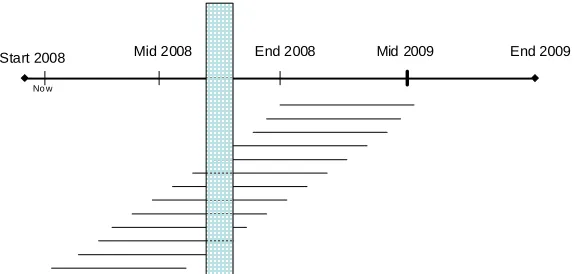
Currently the consultants of Centric provide this support by giving presentations, either in-house at the client or in classrooms at Centric. However, the municipalities need to have their data BAG-compliant mid-2009. Centric estimates to reckon about half of the municipalities will use the new software of Centric (around 200). Given that the planned run time of the implementation track is 22 weeks (Conversieproces B&V, 2005), time is short. Building the reference file, a key component of the migration, for instance took the municipality of Helmond around 7,5 months (Van Tiggelen, 2007). This concurs with the estimations of VROM (2007), which reckon another 6-8 months for the phase they defined as ‘5: Extending the reference file to BRA and BGR’.
r:
In
tr
o
d
u
c
ti
o
n
End 2009 Mid 2009
End 2008 Mid 2008
Start 2008
[image:9.612.165.454.68.205.2]No w
Figure 1. Timeframe of the migration with an indication of the municipalities doing the implementation in parallel.
During this implementation period a lot of information and knowledge is created and exchanged between the different actors. This knowledge however, is generally not stored or captured in a structured way. It is often only stored locally or even worse, only in the minds of the actors. The available knowledge is therefore more difficult to share and acquire. The current presentations only give a ‘knowledge-update’ every now and then. A more structured and real-time way of maintaining the knowledge base will help to offer more support during the implementation process.
Because of the geographical dispersion of the clients and the sparse time and the results of a previous study (Floor, 2006)), Centric came with the idea of designing an e-learning system. Following the development of learning in general and e-learning in particular, the orientation of this thesis became more focused around the creation and sharing of knowledge and experience.
2
Theoretical framework
Communities of practice are complex and success is not guaranteed. The reasons why some efforts succeed while others fail are complex and varied (Schlager, Fusco, & Schank, 2002). This is especially true for intentionally created communities. Several authors have tried to find the elements that determine the success of a community (Gannon-Leary & Fontainha, 2007). In their C4P framework Hoadley & Kilner (2005) describe the elements of a CoP that are at the core of the activities that take place within the community. Knowledge is shared and created because of these activities. The greater these elements are present, “the more likely and effective the knowledge generation and transfer will be” (p. 33). The elements are content, conversation, connections, (information) context, and purpose. These elements can be considered the basic building blocks or key concepts of a CoP.
Content refers to explicit, static knowledge objects. Conversation refers to face-to-face or online discussions. The key distinction between content and conversation is that content involves a one-way communication of information, whereas conversation includes at least a two-way exchange. Connections refer to the interpersonal contacts between community members that involve some level of relationship. Information context is the who, what, where, when, why, and how that enables community members to assess whether and how information is relevant to them. Finally, purpose is the reason for which the members come together (Hoadley & Kilner, 2005). Purpose includes the motivation of people to share their knowledge with others.
Reasons to share
There are several motivators and barriers that influence whether people do or do not share. The most important reasons found in the study of Wasko & Faraj (2000) on to why people share are: the provision of tangible useful-valuable information, the learning aspect and the interaction with a peer group, reciprocity, and altruism. The study of Ardichvili, Page & Wentling (2003) adds a feeling of moral obligation to this list. Furthermore, the comprehensive study of Draaijer (2008) revealed that, when separating motivation factors in intrinsic and extrinsic benefits, intrinsic benefits have a stronger effect on knowledge sharing. More specifically, enjoyment in helping others and perceived identity verification have a significant positive effect on the knowledge contribution which corresponds to the altruism factor mentioned by Wasko & Faraj (2000).
The major barriers are group related and consist mainly of a mismatch between the norms and values of the individual and the group (Wasko & Faraj, 2000). Also the fear to lose face and to led down colleagues is a barrier to share knowledge (Ardichvili et al., 2003), although the latter can also be seen as an incentive to share. A major extrinsic ‘benefit’ for sharing which had a significant negative effect on knowledge contribution is the anticipated reciprocal relationship, “people contribute more knowledge when they expect not to develop reciprocal relationships” (Draaijer, 2008).
An interesting finding of the study of Draaijer (2008) is the significant moderation effect of offline activities. Although in recent developments around CoPs the internet and computers in general play a prevalent role, it is important to stress the importance of the offline ‘foundation’. It positively affects the effects of several benefit factors.
r:
T
h
e
o
re
ti
c
a
l
fr
a
m
e
w
o
rk
possibilities. Control is defined as the applied management activities to influence the environment which in turn influences how well the core elements flourish.
The fact that a control element is important for the success of a community is supported by various other studies (Dubé et al. 2004;2005;2006; Brazelton & Gorry, 2003; McDermott, 2000). “In addition to appropriate technology, experts in knowledge management cite leadership, alignment with business priorities, supportive organizational policies and practices, and measurement of benefits as critical to a successful effort” (Brazelton, & Gorry, 2003). “Communities are held together by people who care about the community. In most natural communities, an individual or small group takes on the job of holding the community together, keeping people informed of what others are doing and creating opportunities for people to get together to share ideas. In intentional communities, this role (called the community coordinator) is also critical to the community’s survival.” (McDermott, 2000).
The characteristics environment and relevance were of upmost importance to increase the likelihood of a VCoP to succeed (Dubé et al, 2005). In case this environment is obstructive management and sponsors can apply operational leadership management practices to positively influence the negative impacts (Dubé et al., 2005). “Selecting the person with the right set of skills and abilities to be the leader is a necessary ingredient to success. In addition, monitoring and taking action with regards to the leadership structure if a person leaves or does not perform is also highly necessary. A second important decision pertains to the allocation of necessary resources to the acquisition of a fulltime leader (Dubé et al. 2004: p. 26)”.
The environment and control can thus be seen as influencing layers around the core elements. Based on the C4P framework and the additional success elements, the used theoretical framework in this project is the resulting developed C5PE framework which is depicted in figure 2.
Content
Connections Purpose
Conversations
Context
Control
Environm ent
Figure 2. C5PE framework which indicates the elements influencing the effectiveness of a CoP
In line with the core elements of success, Wenger (2001) has identified 13 principles which, according to him, are important in order to facilitate a successful community (More details about the success elements are listed in Appendix C). In this project, these principles will be used as design guidelines. Each of the principles focuses primarily on one of the core elements. A mapping is added in the next subsection.
Mapping Wenger’s elements of success to the C5PE framework
The elements of success defined by Wenger (2001) can be roughly linked to our C5PE framework, although many of the elements can serve an supporting role on multiple framework elements. Conversation is supported by knowledge-generating interactions and relationships. Among them the support of a discussion area and personal profiles with contact info are well suited to integrate in the web application. Connections is closely related but focuses more on the more passive functionalities, such as profiles, contact info and links. The success elements mentioned under ‘presence and visibility’ and ‘personal identities’ provide Context to the information shared and the community itself. They give some background about the member who shared the knowledge. The important Control element is supported by various management and monitoring features. Among them are rhythm (e.g. organizing regular events), monitoring health indicators and broadcasting/representing the community to ‘the outside’. The main aspect of Purpose for many members will be the perceived value they get from participating in the community. Short and Long term value such as databases, Q&A, knowledge storage and search mechanisms are important in this respect but also reasonably easily integrated in a web application. To close, the Environment is related to the relationship with the ‘outside’ world and the available (technical) infrastructure.
Content -
Conversation 3. Knowledge-generating interactions 10. Belonging and relationships Connections 7. Connections to the world
9. Communal identities
10. Belonging and relationships Context 1. Presence and visibility
8. Personal identities
Control 2. Rhythm
4. Efficiency of involvement
12. Evolution: maturation and integration 13. Active community building
Purpose 3. Knowledge-generating interactions 5. Short-term value
6. Long-term value Environment 11. Complex boundaries
12. Evolution: maturation and integration
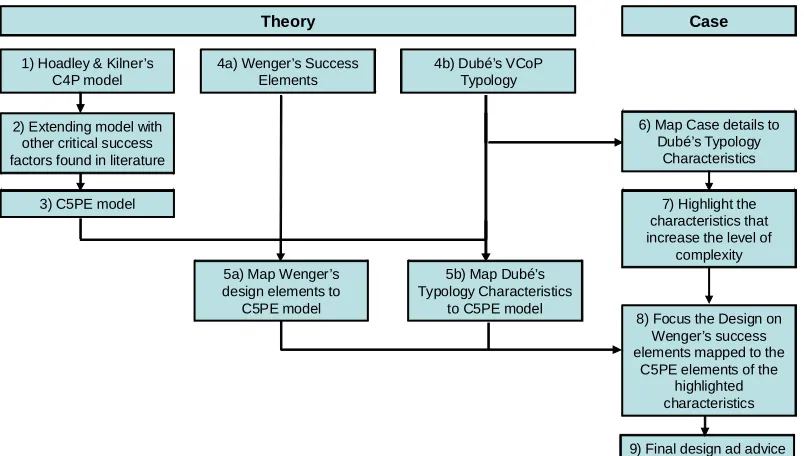
The characteristics of the CoP, described with Dubé’s typology, will pose challenges to these core elements. The emphasis of the design will then thus lie on the design principles of the elements that are being challenged most.
r:
T
h
e
o
re
ti
c
a
l
fr
a
m
e
w
o
rk
Case
4a) Wenger’s Success Elements
6) Map Case details to Dubé’s Typology
Characteristics
Theory
1) Hoadley & Kilner’s C4P model
4b) Dubé’s VCoP Typology
5b) Map Dubé’s Typology Characteristics
to C5PE model
8) Focus the Design on Wenger’s success elements mapped to the
C5PE elements of the highlighted characteristics 3) C5PE model
2) Extending model with other critical success factors found in literature
5a) Map Wenger’s design elements to
C5PE model
7) Highlight the characteristics that increase the level of
complexity
[image:13.612.106.508.78.306.2]9) Final design ad advice
3
Goal statement
The goal of this project is to give Centric an advice on how to design a Community of Practice that supports its clients in the migration to the new software. At the end of the project this will lead to an informed plan for realizing a CoP within Centric which is founded on literature and grounded in the case at hand.
In order to provide a well-founded advice this project uses, as depicted earlier in figure 4, two ‘swimlanes’; theory and the case. Following the path of Figure 8, the following research questions will be answered:
• How does Centric need to design its Community of Practice?
- What are the elements that define the success of a Community of Practice? - What are successful design principles to support the success of CoPs?
o How do these design principles relate to the success elements? - How can the case be characterised according to the typology of Dubé et al.?
o Which characteristics increase the level of complexity?
o Which characteristics are still open to design?
r:
B
a
c
k
g
ro
u
n
d
4
Background
This chapter will discuss the relevant topics of this thesis separately and in more detail. These topics are; Learning, Communities of Practice and the Base Registrations. The quick reader can possibly skip this section and head to the design, which connects the background knowledge to the case at hand via the C5PE framework.
4.1
Learning
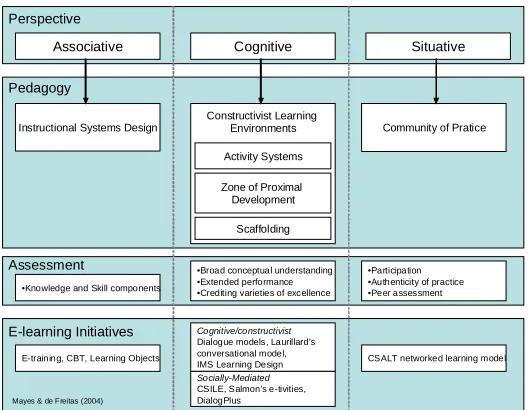
Beetham & Sharp (2007) and Mayes & de Freitas (2004) follow Greeno et al. (1996) with the distinction of three perspectives about the nature of learning within educational theory traditions: associative, cognitive and situative.
The associative view emphasises
• Learning is understood as building concepts or competences step by step. • Routines of organised activity
• Clear goals and feedback
• Individualised pathways and routines – matched to the individual’s prior performance
The cognitive view emphasises
• Learning is understood as achieving understanding through active discovery, dialogue and collaboration.
• Interactive environments for construction of understanding
• Teaching and Learning Activities (TLAs) that encourage experimentation and the discovery of broad principles
• Support for reflection
The situative view emphasises
• Learning is understood as developing practice in a particular community. • Environments of participation in social practices of enquiry and learning • Support for development of identities as capable and confident learners • Dialogue that facilitates the development of learning relationships (Beetham & Sharpe, 2007)
E-learning Initiatives Perspective
Associative Cognitive Situative
Pedagogy
Instructional Systems Design
Constructivist Learning Environments
Activity Systems
Zone of Proximal Development
Scaffolding
Community of Pratice
Mayes & de Freitas (2004)
Assessment
•Knowledge and Skill components
•Broad conceptual understanding •Extended performance •Crediting varieties of excellence
•Participation •Authenticity of practice •Peer assessment
E-training, CBT, Learning Objects
Cognitive/constructivist
Dialogue models, Laurillard’s conversational model,
IMS Learning Design CSALT networked learning model
Socially-Mediated
CSILE, Salmon’s e-tivities, DialogPlus
Figure 4. Layers of Learning Design (Based on Mayes & de Freitas, 2004)
[image:16.612.172.436.68.273.2]There is a trend towards the social aspect of learning; learning on demand and on the job in a more informal way. Furthermore, “as knowledge continues to grow and evolve, access to what is needed is more important than what the learner currently possesses” (Siemens, 2004). This development is compared by Kozlowski (2007) as the hierarchical and collaborative way of learning (see Table 1). This same trend is also visible in the development of e-learning systems.
Table 1. Comparison between the Hierarchical way of learning and Collaborative way of learning (Kozlowski, 2007)
Hierarchical Way of Learning
Collaborative Way of Learning
Roles Clearly defined roles of educator (sender) and learner (recipient)
No clear distinction between educator and learner
Communication mono-directional multi-directional Distribution of
Power
Power lies with the teacher
Distribution of power between all parties
Definition of Learning Goals
By the teacher, or by an institutional framework
By the learners; there might be non-mandatory help from educator
Measuring of Learning Success
By the teacher based on his principles
By the learners; there might be non-mandatory help from educator
Conceptually e-learning is nothing more than learning with electronic means. The current means is mainly the internet, but in the basic is independent of it. Also education via the radio like for example in Australia (e.g. ‘School of Air’ in Alice Springs1) can be called e-learning. An important characteristic of e-learning is the physical separation of the actors in the learning process: between teacher & learner and learner & learner. “At its best, e-learning is a reconceptualization of learning that makes use of not only instructor-led-pedagogy but all the flexibility that asynchronous, multi-party contribution can bring.” (Andrews, & Haythornthwaite, 2007)
When searching for e-learning the focus is a lot on the ‘e’; the technology. A list of technologies includes:
• screencasts • ePortfolios
• electronic performance support system
r:
B
a
c
k
g
ro
u
n
d
• PDA's
• MP3 Players with multimedia capabilities • web-based teaching materials
• hypermedia in general • multimedia CD-ROMs
• web sites and web 2.0 communities • discussion boards
• collaborative software • e-mail
• blogs • wiki • text chat
• computer aided assessment • educational animation • simulations
• games
• learning management software • electronic voting systems • virtual classrooms • podcasts
(Wikipedia.org)
Just like in learning there is also a trend towards the social aspect in the e-learning field. This trend is initiated by the possibilities of Web 2.0 and the changing demand on learners. Key technologies within the 2.0-paradigm are wikis and blogs. These two technologies facilitate the easy exchange of opinions, experiences and knowledge of individuals with a broad public.
“Today, one does not need to know the answer to every problem but to know where to find a solution. Today, when the problem is complex and the volumes of information are overwhelming, that ‘where’ is more likely to be found in social contexts than in terabytes of data.” (Andrews & Haythornthwaite, 2007; p. 454)
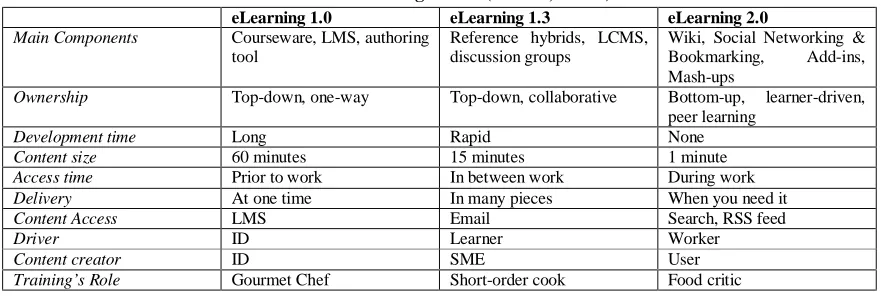
[image:17.612.87.530.508.656.2]This trend has led to the evolution of e-learning to e-learning 2.0. E-learning 2.0 is best explained in relation with the traditional e-learning and its technologies. Karrer (2006) gives the following table (2):
Table 2. e-Learning trends (Karrer, 2006a)
eLearning 1.0 eLearning 1.3 eLearning 2.0
Main Components Courseware, LMS, authoring tool
Reference hybrids, LCMS, discussion groups
Wiki, Social Networking & Bookmarking, Add-ins, Mash-ups
Ownership Top-down, one-way Top-down, collaborative Bottom-up, learner-driven,
peer learning
Development time Long Rapid None
Content size 60 minutes 15 minutes 1 minute
Access time Prior to work In between work During work
Delivery At one time In many pieces When you need it
Content Access LMS Email Search, RSS feed
Driver ID Learner Worker
Content creator ID SME User
4.2
Communities of Practice
Communities of Practice (CoPs), which are groups of people who come together to share and to learn from one another, are seen as an innovative way to manage knowledge in organizations and to combine working, learning and innovating (Dubé. Bourhis, & Jacob, 2005). Communities of practice are “an important vehicle for developing social capital in organizations” (Lesser, & Storck, 2001). In turn, this social capital improves the organizational performance (Lesser, & Storck, 2001).
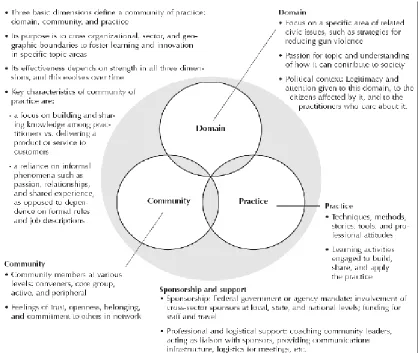
The thought-leader about Communities of Practice is Etienne Wenger who defines them as “groups of people who share a concern or a passion for something they do, and learn how to do it better as they interact regularly” (Wenger, 2004a). Three characteristic dimensions are crucial (Wenger, 1998; 2004a):
• The domain – joint enterprise: Members of a community of practice have a shared competence and shared domain of interest that distinguishes them from other people.
• The community – mutual engagement: Relationships between the members are guided by the learning aspect of interaction. Sharing knowledge and information, engage in joint activities and discussions, and helping each other is what forms/makes the community.
• The practice – shared repertoire: Members of a community of practice are practitioners. They develop a shared repertoire of resources: experiences, stories, tools, ways of addressing recurring problems—in short a shared practice. This takes time and sustained interaction.
[image:18.612.98.516.350.703.2]Based on this description from Wenger (2002; 2004a) Snyder & Briggs (2003) visualized the concept of Community of Practice as follows (see figure 3).
r:
B
a
c
k
g
ro
u
n
d
The origins of the theory behind communities of practice lie within the situative learning perspective. Therefore great emphasis is given to the role of the situation in which the learning takes place and more importantly the relationships between the individuals that perform the same practice within that situation (Beetham, & Sharpe, 2007). Individuals learn with and from others by doing and participating.
The concepts identity and perceived expertise are therefore important (Andrews, & Haythornthwaite, 2007) in that they define the status of a person within the community and the scope of the community; who is in and who is out. Lave & Wenger (1991) characterize learning of practices as processes of participation in which beginners are initially relatively peripheral in the activities of a community and as they learn the practices their participation becomes more central. By becoming skilful, individuals will form an identity on which they are proud and which gives them gratification. This provides a major motivation to participate in a community, next to the individual career development.
In short they are an informal group of people interacting and discussing about the current and future ‘way of doing’ set with a common background knowledge shared among its members.
The idea is to connect people with a shared passion about what they do in practice on a regular/daily basis. Their passion and energy drives them to discuss the How’s and Why’s to develop their practice, resulting in improvements of efficiency and flexibility towards market demands.
The forming of these connections and groups of like-minded people is not a new phenomenon. It can even be traced back and compared to guilds in the middle ages. They naturally evolve within organizations. What is new, is that organizations more and more see the importance and business value of the knowledge creation and exchange capabilities within these communities. Recent developments increasingly focus on the intentional creation of communities of practice.
Organizations have recognized the unique possibilities of CoPs within their knowledge management strategy. CoPs can fill an important role in all of the processes defined in the renown spiral of organizational knowledge creation or SECI process (see Figure 6) of Nonaka (1994; 2000), especially in the support of the socialization (the facilitating of experience exchange) and externalization (by providing shared ways of expression) processes.
Explicit Knowledge Socialization
Externalization Internalization
Combination Tacit Knowledge
Figure 6. The Nonaka SECI process concerning organizational knowledge creation.
severe troubles to generate this passion. It risks losing its informal, unpushed and unconstrained nature. We therefore like to point at another important aspect of a CoP; the border crossing. Most topics are applied in very different settings and business processes. Therefore different people are involved in several ways on the same topic. A CoP facilitates the creation of social links between these people/experts who normally would have never met each other.
[image:20.612.90.529.179.316.2]Being intentional also has implications on the development stages, which will be discussed in the next subsection.
Table 3. A comparison between CoP with other collaboration structures (Wenger & Snyder, 2000).
What’s the purpose? Who belongs? What holds it together?
How long does it last?
Community of practice
To develop members’ capabilities; to build and exchange knowledge
Members who select themselves
Passion, commitment, and identification with the group’s expertise
As long as there is interest in maintaining the group
Formal work group To deliver a product Everyone who reports to the group’s manager
Job requirements and common goals
Until next reorganization
Project team To accomplish a specified task
Employees assigned by senior managers
The project’s milestones and goals
Until the project has been completed Informal network To collect ad pass on
business information
Friends and business acquaintances
Mutual needs As long as people have a reason to connect
4.2.1
Community Development
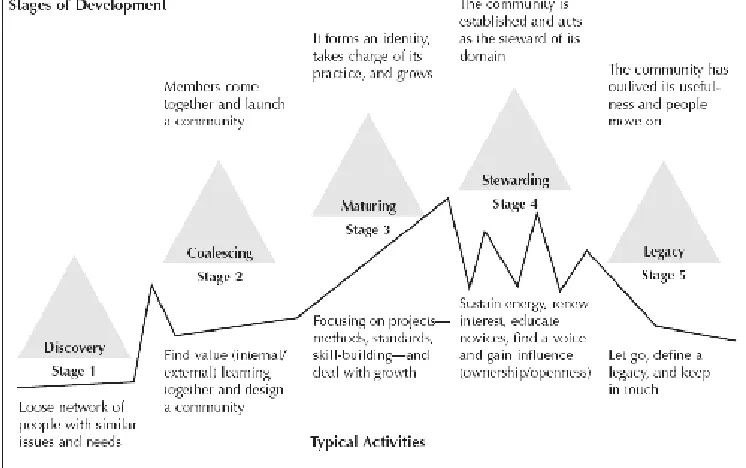
Because of the informal nature, Communities of Practice are often ‘grown out of human sociability’ (Sharp, 1997). Therefore they tend to follow a growth development of an organism (Nickols, 2003b) and follow an evolution in time (Gongla & Rizutto, 2001). Several authors have identified certain development stages (Gongla & Rizutto, 2001; Nickols, 2003b; Snyder & Briggs, 2003; McDermott, 2000; Wenger et al., 2002). Although they differ in terms of timing of their stages, the elements emphasized, and the vocabulary used, they all describe the same process (Dubé, Bourhis, & Jacob, 2006). The typical community development stages are depicted in Figure 8 (Snyder, & Briggs, 2003).
[image:20.612.122.495.456.690.2]r:
B
a
c
k
g
ro
u
n
d
Because of the intentional character of the community at hand, the first targeted development stage will be the coalescing stage. Intentional communities, such as the one at hand, will often skip the first development stage ‘Discovery’ to speed up the visibility of the community to the organization. This is not a problem for the immediate performance, as long as the community “returns to restructure of build elements from earlier stages that it may have shortcharged” (Gongla & Rizutto, 2001). The community will start with a careful design, but will therefore also partially skip the first, more informal and unconstrained, discovery stage.
4.2.2
Inter-Organizational Communities
Communities of practice are a mechanism within which collaboration between organizations can occur. A driver for increased collaboration is the recognition that success in a global economy comes from innovation in order to keep up with the rapid developments in technology, increasingly demanding customers and changes in the competitive environment through deregulations, social changes and the actions of competitors (Van Winkelen, 2003). Another driver comes from the idea that the more change there is in its environment, the more connections an organization needs with the outside world.
The challenge of inter-organizational communities is establishing “a culture of trust and openness” (Van Winkelen, 2003). Organizations fear opportunistic behaviour from competitors and need confidence, either through trust or formal legal mechanisms that other firms will be cooperative and not take competitive advantage of the knowledge-exchanges (Braun, 2002).
4.3
The domain – Base registrations
To support a smooth exchange and management of the data stream within the government, the most asked-for and used information will be collected in six so-called ‘Base Registrations’. These Base Registrations will form the fundament of a scheme. By recording the data in a scheme there will arise an ordering in the huge amount of data and will increase the quality of the data. The governments have been obliged to use of these Base Registrations. In the new situation, citizens and companies only have to offer their data one-off.
At the moment the following six base administrations are defined:
Gemeentelijke Basis Administratie (GBA)
This registration consists of the personal data of all citizens of The Netherlands. Example data are names, addresses, day of birth and gender;
Nieuw Handelsregister (NHR)
This registration contains the data of all companies and institutions. This includes the name, address, number of employees, venture form, description of main activities and the various offices;
Basisregistratie Kadaster (BRK)
Every parcel is registered at the Kadaster. This can be a building, but also a cornfield. Each parcel is described with information about the owner and which private law restrictions apply; Basisregistratie Topografie (BRT)
This Base Registration consists of the topographical information of The Netherlands. A detailed map of the whole country is recorded;
Basis Registratie Adressen (BRA)
The BRA contains all addresses. This is of major importance for the GBA and NHR as they depend on the link to BRA;
Basis Gebouwen Registratie (BGR)
In the future the number of Base Registrations within the government will be expanded.
This research project will focus on the Base Registrations of Addresses and Buildings. On October the 4th 2007 the Tweede Kamer accepted the bill “Basisregistraties voor Adressen en Gebouwen” (BAG). Within this bill it is regulated that municipalities may only store a restricted amount of standardized data about buildings and addresses in an automated registration. Governmental institutions are obliged to use these data in the execution of their public tasks. Intended date of the introduction of the regulation is mid-2009. As of then, the municipal BAG-registrations have to be ready. Until mid-2011 they have the time to prepare for the use of the Base Registrations within their processes.
Their will be a demand for the delivery of BAG-compliant software products from the municipalities. Centric is one of the software suppliers who is able to provide these. All suppliers, who have successfully completed the conformity tests of the ministry of VROM are: Centric, Getronics PinkRoccade, GISkit, Gouw IT, Grontmij, OBTERRA en Vicrea (VROM, 2007).
4.3.1
Base Registrations for Addresses and Buildings (BAG)
The registrations for addresses and buildings are two of the Base Registrations that will form the core of the data housekeeping of the government. Within the Basic Building Registrations the foundation is made for an unambiguous indication of panden, verblijfsobjecten, standplaatsen and ligplaatsen. This way, the objects can be made mutually consistent and the data from the different processes can be used at other processes or together. The (trans)formation to unambiguous and consistent data is one of the key functions of the Base Registrations.
The objects ‘verblijfsobject’ (place of residence), ‘standplaats’ (dwelling) and ‘ligplaats’ (anchoring berth) are the only objects to which addresses can formally be assigned. The Basic Address Registration entails the complete list of these assigned addresses.
The software and registration support of the building registration comprises broadly the lifecycle of the object. At a certain point in time an object will be created on account of some event and on another time the object can lose its meaning on account of another event. The Base Registration provides tracking of these events by storing every mutation within the lifecycle of the object in its history. An event is formulated as a provable fact that has taken place in reality which has caused a standardized modification of the data in the registration.
Within the lifecycle of panden and verblijfsobjecten there is made a distinction between four phases in which events take place which give a cause for mutation of the data objects in the BGR:
• Planvorming (Planning) • Bouwen pand (Building)
• Gebruik pand en verblijfsobject (Use) • Sloop pand en verblijfsobject (Demolish)
Within the lifecycle of a standplaats and a ligplaats two main events can be distinguished: • Benoemen standplaats of ligplaats (Denomination)
• Intrekken standplaats of ligplaats (Withdrawing)
The objects within the BRA only have a partially independent lifecycle; most of it is linked with other objects. For example, the lifecycle of a number indication is indissolubly connected with the verblijfsobject, standplaats or ligplaats. For public spaces (often the same as street name) and residences the denomination, withdrawal and mutation of the naming are the most important events. Next to these common events the following special events can be distinguished:
• Hernummeren verblijfsobject, standplaats of ligplaats (Renumbering)
r:
B
a
c
k
g
ro
u
n
d
Panden and verblijfsobjecten are registered at the moment the building permit is granted, the real existence of the object is observed, or the existence of the object is noted by client of the Base Registration via a read back.
Panden and verblijfsobjecten also stay within the registration even after they are demolished or withdrawn. By means of the status data and the beginning and end date, the life cycle of the pand and verblijfsobject can be found out.
Standplaatsen and ligplaatsen are registered at the moment of denomination. The same is true for the number assignments, public spaces and residences. Also these objects will stay within the registration after withdrawal and therefore will also be able to provide an overview of its history.
Within the ‘Processenhandboek Basisregistraties voor Adressen en Gebouwen’ published by the ministry of VROM, the processes regarding the events mentioned above are described in detail.
The solution of Centric to support these events around the BAG is called Suite4Basisgegevens with the modules Key2Adressen and Key2Gebouwen. This software package will introduce both the new software architecture of Centric which based on Service Oriented Architecture, and its new interface standard. The new architecture encompasses a separation of storage and process knowledge. The Basisgegevens will form a separate Suite4Basisgegevens and contains several smaller (Key2)-modules which support the storage and querying of the several Base Registrations. The new software, Suite4Belastingen, will replace the current GISVG and HIS4all products and provides the support on process level. All other new process systems of Centric (e.g. Suite4Burgerzaken and Suite4Vergunningen) will use the information and storage services of the Suite4Basisgegevens. The new architectural situation is depicted in Figure 8, the interface change is depicted in Figure 9.
[image:23.612.179.421.388.600.2]Note. 6: landelijke voorzieningen. 9: Base Registration of others.
Figure 9. Interface change (old and new situation)
4.4
The practice – The implementation process of the BAG
Central to the CoP and this thesis is the practice of implementing a new software product, more specifically the implementation process for Suite4Basisgegevens and its modules within municipalities. Based on some internal documents, a model of the general implementation process is constructed. This model is added in Appendix A.
An important aspect of this process is the fact that many different people of several organizations and roles are involved in the process steps. For example, the step “Installation Key2Adressen and Key2Gebouwen” involves the system administrator at the municipality and a technical consultant of Centric, while the process step “Support/Training Key2Gebouwen” involves the application manager and end-users of the municipality and a training consultant with more didactical skills of Centric. This latter process step is the initial process step which raised the question of optimizing this support and training.
4.5
The Community – Description by means of a typology
Using the typology of Dubé (2006) the community of practice to be developed at Centric can be described to highlight the characteristics that pose challenges in the design. The described characteristics are also summarized in Appendix D.
4.5.1
Demographics
The community of practice will be created and formed by choice of the management and is therefore intentional. Furthermore, since the CoP still needs to be started, the age and level of maturity is still young and potential respectively.
r:
B
a
c
k
g
ro
u
n
d
4.5.2
Organizational context
As noted before, the environment is very important in the success of the community. The resource availability has yet to be determined. In concurrence with the environment and leadership, the management of Centric has to create a facilitating environment and allocate resources and clear responsibilities to persons such that this doesn’t inhibit the growth of the community. It is best to assign individuals to specific roles within the community as this may lead to engagement and accountability, and helps people legitimate time spent working on the CoP (Dubé et al., 2006).
The degree of institutionalized formalism for the case at hand is more or less ‘unrecognized’ in that it will first be set up as a pilot project. The community is not formalized within Centric and the municipalities as new project teams or business units. The members of the community will stay within their current roles and organization.
Cultural diversity is influenced by three levels: the nation, organizational and professional culture (Wenger et al., 2002). Because the CoP will go across different organizations (Centric and the municipalities most prominently), the CoP will have a certain degree of both boundary crossing and cultural diversity. The cultural diversity is heterogeneous on both the organizational (difference between Centric and municipalities) and professional level (differences between system administrators, consultant, technical specialists, managers). Because the community will span across multiple organizations (multiple municipalities across the Netherlands), the geographic dispersion will also be medium-high. Since the Netherlands is a relatively small country (maximum of around 3 hours travel time), the dispersion could be qualified as medium in terms of Dubé’s typology. The challenge of a higher distance is that it also encourages psychological distance; it takes more intentional participation efforts from members of the CoP to keep the community alive (Wenger et al., 2002). However, the size of the Netherlands still makes it possible to arrange face-to-face meetings if necessary.
4.5.3
Membership characteristics
The membership characteristics of the CoP are partially dependent on the design decision of who will be allowed access to the community. The community can be set up as relatively protected, in which only a selected number of people can join the community. They then need to authorize themselves to gain access to and add content to the community. This also has an impact on whether people will be able to join voluntarily or compulsorily. Self-selected members will generally have a higher motivation to participate in the community. However, without some management guidance and ‘pressure’ to join, people may feel a lack of legitimacy of the community. We advise to design a CoP comprised of a mix of voluntary and drafted members. At the start of the project the higher motivated people should be recruited. Finding motivated people shouldn’t lead to too much trouble as the relevance of the topic is high on both the municipalities side (the implementation of the software is mandatory) as Centrics (for the consultants, supporting the client during the implementation process is part of their job).
An important characteristic of the community at hand is its membership stability, which is rather fluid. What’s special about this case is that municipalities will probably come and go depending on their progress in the implementation process of the supported software package (initially Suite4basisgegevens). This means that it is important to 1) capture the knowledge so it can be used by municipalities joining later on, 2) make the Centric consultant the stable factor across the implementation processes, and 3) let the implementation process be the guide line within the community set-up. Incentives for ‘older’ municipalities to stay connected and reachable should be supported for a more stable membership.
management is best to assign individuals to specific roles within the community to give structure to the formation of the community. The specific roles and allocated persons are described in §6.1.
4.5.4
Technological context
r:
V
is
io
n
o
f
a
s
u
c
c
e
s
s
fu
l
C
o
P
5
Vision of a successful CoP
It is important to have a clear vision about the future state of the CoP and how it connects to Centric and its customers. After everything is set up, installed and fully operational, a successful community at Centric will motivate people to share knowledge by increasing the enjoyment to help others, and will encourage the discussion of the How’s and Why’s of every day’s business processes. Among them, the most important processes will be the ones which include contact with external parties (most importantly the customers). This includes discussing and sharing the business processes of these external partners. This way Centric can develop a better understanding of the way of working at their customers and better anticipate on this and provide better suited support. The informal discussions will lead to improvements of the processes and more customer satisfaction. The implementation processes of Centric’s products are important examples of processes in which a good interaction between actors and their knowledge is fruitful.
Next to the discussion facilitation, the CoP will also serve as a knowledge base, providing relevant information and knowledge at each execution of tasks within the business processes. This includes digital versions of the communication between Centric and the municipalities (such as PowerPoint presentation, planning documents and reports). By providing an extensive knowledge base, together with the possibility to discuss and ask questions about these topics, will enable the municipalities to solve and answer problems and questions with less physical contact time of Centric consultants. This will save time for Centric and costs for the municipalities. Furthermore, the Centric consultants themselves will use the knowledge base to increase their own knowledge, since they have access to detailed information about other projects and can more easily discuss their way of working with each other.
Furthermore, a successful CoP facilitates the process of ‘connecting people’; connecting members located at different municipalities, departments and hierarchy who all share a common aspect within their daily task (e.g. the topic, the specific technology, the solution or goal).
6
Design
The classification of the CoP by means of Dubé typology revealed that the added value is mainly in establishing connections between the members of different municipalities and the consultants of Centric, as the main challenging characteristics are the that CoP is intentional, young and dispersed. The CoP will therefore be designed to facilitate and structure these connections. This is in line with the observed evolution enablers in the study of Gongla & Rizutto (2001). The design of the CoP at Centric should focus on the objectives of the first development stages (as were discussed in §4.2.1). The fundamental functions to support are ‘connection’ and ‘memory & context’. Later on, feedback functionality can be added to the CoP to evolve to the next, and for this community probably final, stage where the community manages itself as a stable source of knowledge. The later development stages are probably out of the scope of the goal of this community, mostly because of the relative short time frames of projects and because Centric has its own product development department. The community could evolve towards use within this department.
In our C5PE framework, this means that the focus lies on structuring the inner-circle elements connection & conversation in the first development stage and content & context in the second stage. The function of the control layer at this point is mainly providing support and establishing the environment by setting up the needed structures.
Wenger (2004) defines three structures which management has to set up in order to roll out the CoP strategy:
• Sponsorship structure: money, and political backup and legitimacy in that the ideas and proposals from the community find their way back into the organization.
• Recognition structure: entails a focus on the acknowledgements the participating members of the community get from their peers and the organization as a whole.
• Support structure: providing facilities which support the community in their performance.
To set up the structures one needs a combination of people, processes and technology (Gongla & Rizutto, 2001).
People
The Defense Acquisition University (DAU, 2007) has identified a variety of roles to support the ongoing activities of a community. Within these roles they make a distinction between roles specific to the community at hand and support roles. The latter are roles that can span multiple communities set up by the organization.
Community roles:
• Community sponsor: high level sponsorship and support.
• Community leader: guides community’s purpose and strategic intent.
• Subject Matter Expert: knowledgeable and experienced members of the community which provide the main content.
• Content Editor: maintains the accuracy of the content. • Facilitator: fosters and facilitates member interaction. • Member: participates and contributes/receives knowledge.
Support roles:
• Support team: provides operational infrastructure, procedural guidelines, technical support and direct community support.
r:
D
e
s
ig
n
Processes
During the first development stages of a community of practice the supporting processes and tasks focus on bringing community members together and storing the available knowledge. The following processes are the most important ones that need to be supported in both technological as organizational ways (Gongla & Rizutto, 2001; DAU, 2007; Draaijer, 2008):
• Identifying and Locating community members • Facilitating bringing individuals together • Classifying and storing knowledge
• Accessing and contributing to the knowledge
• Broadcast the existence and purpose of the community
• Planning of regular face-to-face meetings between the members
• Harvesting/creating new knowledge from experience and external sources • Organize user-training sessions and helpdesk support
• Review and validation of submitted content (periodical and on submitting new content) • Monitoring of community activity by means of metrics
• Perform outreach of the community results
To support the use of the community knowledge base, and to trigger adding knowledge to it, it is important to integrate the use of the community web application in current processes. An example is to direct users to the knowledge base to read some material before they get their face-to-face classroom meeting. Another example is to give training assignments that need to be delivered as a knowledge base contribution. Yet another way is to let consultants write short ‘diary’-notes on each activity they perform related to a specific process step.
Furthermore, it is important to organize informal events at which members of the community can meet and contact each other. Since technology should play a supporting role within the context of communities of practice (Wenger, 2001). In fact, communities intentionally designed to support learning will rarely be successful if the interaction takes place exclusively online (Cothrel, & Williams, 1999; Schwen, & Hara, 2004).
Technology
The choice and functionality of the technology is subject to the goals and processes of the community. The processes and first goals of the community are focussed around bringing community members in contact with each other and each other’s knowledge. Therefore, the technology needs to primarily facilitate contact information and content storage. This means the technology needs to be able to register personal information of each member and provide content management functionalities.
6.1
Design focus
Central to our design is the implementation process. This is the common denominator that links the members. An important feature of the CoP supporting system will be the modelling of a visual representation of this implementation process. This model provides the structure of the knowledge base within the CoP.
Every content page in the system can have a model. In turn, every modelled step is a content page. This will create a structure of increased detail about the implementation steps, ending at the most basic practical executed steps. This way a direct relationship and relevance to the daily practice is guaranteed.
An important implication of this approach is the tree-like growth of the community and the supporting system. To elaborate on this metaphor, one seeds a community with a single overall and global process model. This will then grow and get branches which in turn also get branches, leafs and flowers/fruits. A potential branch can provide the fruits to grow a new tree. The members of a community can be seen as bees, moving around and buzzing over a certain branch. When members fly over to another branch they take some of the pollen of their previous flower which fosters the growth of the new one. The enrollment of the members should follow the essence of this natural growth.
Members’ enrollment
In order to recruit members for the community we recommend using an invitation model. The recommended design of the invitation model uses the hierarchy of responsibility to guarantee the coverage of the whole process.
The principle behind the design is as follows: every time someone is assigned to do a job, that person is invited to the community by the assigner. In turn, that person assigns and thus invites other persons for jobs that are part of fulfilling his own job. In general the inviter will be a little higher (or at least at the same level) in the chain of responsibility, therefore the invitee is more willing (or pressed) to respond to the invitation. This creates a kind of social pressure/relationship which fuels the connection. This principle is supported by the theory of Social Influence and has proven to have an direct impact on knowledge sharing (Draaijer, 2008).
Assignment to a certain process step means that you are allowed to modify or set up the detailed models of this step and substeps.
Community roles
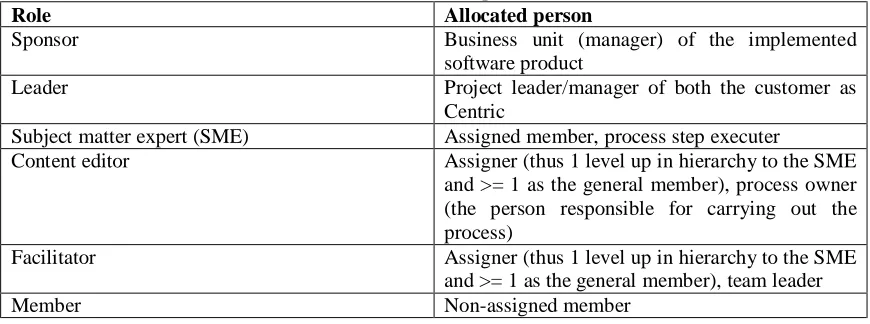
[image:30.612.88.523.482.644.2]Because of the hierarchical structure of responsibilities, the role of each member depends on the level of the process model. At one level he is just a participant in a leaf, where at a lower level he is responsible for the whole management of the process. This means that most members will have multiple roles. If we review the roles defines by DAU (2007), we can allocate the following persons to the roles (Table 4):
Table 4. Allocation of Roles Specific to the Case
Role Allocated person
Sponsor Business unit (manager) of the implemented
software product
Leader Project leader/manager of both the customer as
Centric
Subject matter expert (SME) Assigned member, process step executer
Content editor Assigner (thus 1 level up in hierarchy to the SME
and >= 1 as the general member), process owner (the person responsible for carrying out the process)
Facilitator Assigner (thus 1 level up in hierarchy to the SME
and >= 1 as the general member), team leader
Member Non-assigned member
r:
D
e
s
ig
n
6.2
Technological features
In order to provide context to each implementation step several features will need to be implemented. Firstly, each member can be assigned to implementation steps/content pages. Secondly, each content page has a discussion area. Thirdly, documents and files can be connected to the content page. Fourthly, on every content page members can pose questions that are related to the implementation step which then can be answered by other members. And fifthly, project specific notes can be added.
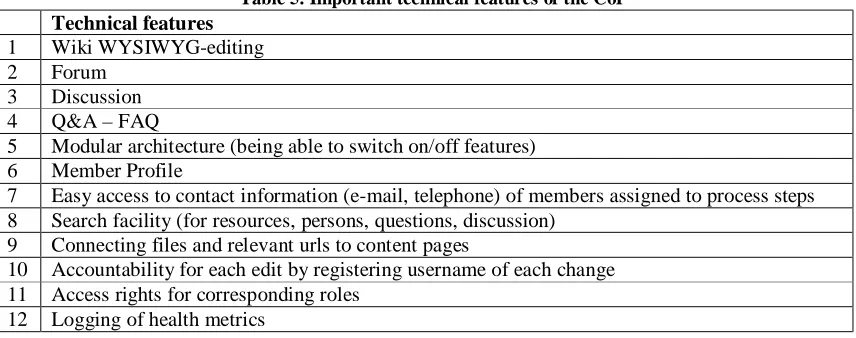
[image:31.612.90.518.270.439.2]Important aspect of the CoP support system is the free editing style, like Wiki; every member will be able to update most of the content and increase the knowledge assets. Process model modification is limited to members who have the overview, best knowledge and responsibility for the work processes (most notably the project managers). It is however important for the other members to discuss and question the models in the discussion areas. Only with their practice knowledge about the individual steps the process can be improved. Furthermore, each change will be logged and connected to the member. See Table 5.
Table 5. Important technical features of the CoP
Technical features 1 Wiki WYSIWYG-editing
2 Forum
3 Discussion 4 Q&A – FAQ
5 Modular architecture (being able to switch on/off features) 6 Member Profile
7 Easy access to contact information (e-mail, telephone) of members assigned to process steps 8 Search facility (for resources, persons, questions, discussion)
9 Connecting files and relevant urls to content pages
10 Accountability for each edit by registering username of each change 11 Access rights for corresponding roles
12 Logging of health metrics
Process Step / Article Features
View
Edit
History Process
Model
Add Delete
Modify Q&A Contacts
View
User
Profile Login
Log out Modify/Personalize
Page Dialog
Page
element Page element group
Page group
[image:32.612.159.456.67.327.2]Legend
Figure 10. General website structure.
6.2.1
General Look and Feel of the Web Application
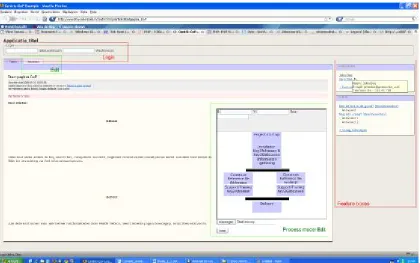
To give an impression about the structure and content areas of the envisioned web application to support the CoP, a sketchy (mock-up) prototype is made. A screenshot, with highlighted areas, is given in Figure 11. The prototype can also be viewed online at the following address:
http://www.tcwonderzoek.nl/centric/ccop/. The final web application will correspond more with the
style used in the new .NET software packages.
[image:32.612.98.518.441.704.2]r:
D
e
s
ig
n
6.2.2
Details on some specific features
In this section some of the foremost features will be described in more detail in order to give a better and more concrete understanding. The discussed features deal with the two functions ‘connection’ and ‘memory & context’ which were determined to be the most important for the case at hand in the first stage.
6.2.2.1 Easy, Fast and WYSIWYG-editing
Creating and updating content is important for the health of the community. It is therefore important to make these functions easily accessible and easy to use. The proposed design uses tabs to directly connect the functions to the article (see Figure 13). The content editing itself is done in a WYSIWYG (What You See Is What You Get) style, comparable to the Word functionality (see
Figure 12 for the most basic editing options). This includes easily adding images and highlighting text with several styles. For users who are more web-savvy the editor also gives the option to edit the code (HTML).
As shown in Figure 13 every single modification is logged and attributed to the logged in member. This creates a way to both address malicious edits and to give credits to the contributor. The latter can increase the enjoyment in helping others, which is identified as important to encourage knowledge sharing (Draaijer, 2008).
6.2.2.2 On-site Process Modelling
An important aspect of the design proposal is the addition of an on-site process modelling tool within the web application. In order to give some feeling about how this could work and look like, a first prototype is developed (see Figure 14). Within this prototype it is possible to freely create, delete and move ‘process blocks’ in a drawing like manner. Simply filling in the text and pushing the button creates another box on the drawing field.This box can then be dragged around to position it. Dragging a box into the gray area will delete it. Saving the model (not available in prototype) is easily and efficiently done by only storing the coordinates and the text. In the ‘view’-mode the boxes are clickable and will link to the given process step article page. A prototype of the editing functionality can be viewed online at: http://www.tcwonderzoek.nl/centric/processmodel/.
[image:33.612.92.510.287.388.2]Figure 12. Compact editing possibilities in a Word-like style.
Figure 14. Simple process model drawn with the prototype
6.2.2.3 Questions & Answers – FAQ
The Q&A feature is implemented as a module in the feature box. It entails the adding, modifying and deleting of questions and answers. These questions are connected to a specific article/process step. In each box there is also a link to the general (and categorical) overview of all questions and answers available in the community. To better unlock the knowledge, a search facility will have to be implemented to search questions and answers. Another way to unlock the knowledge is by means of the FAQ (Frequently Asked Questions). Persons within the community who have a good understanding and overview of most processes and content are to be assigned to maintain a good FAQ; a good selection of available questions. To support their task, several functions are suggested:
• Notification of Q&A changes (newly submitted questions, answers, modifications);
• Overview of database statistics about the questions and answers (page views, feedback rating functionality).
6.2.2.4 Easy access to contact information
r:
D
e
s
ig
n
Figure 15. Example of a contact info text balloon
To connect a person to a process step you have two options depending on whether the person is alrdy registered. When adding a person the web application first searches the member database (browsable by the user). If the right person is found, it can easily be added by selecting the person. In case the person isn’t found you have to add a new person. Persons can easily be added by means of filling in a form with contact details. The person in question will receive an email-invitation to join the Community and register to update his/her profile. In the mean time the general contact info provided by the inviter is visible.
6.3
Object overview
An overview of the objects and their relationships which will be present in the supporting CoP system is depicted in the models below (Figure 16 and Figure 17). Figure 16 depicts the core of the web application, since all other information is directly connected to the process step articles. The split between Article and Content is made to efficiently store history/backup information to support rollback in case of malicious editing. All additional features will reference to the article_id.
id title created_on current_version description keywords
Article
process_steps x_position y_position
Model
name article_id
Process step
article_id version_id text author date
Content
name rights
Member Personal Profile page
1 *
1
1..* * 1
1 1
1
1
1 1
1
1
-T itle -T e x t
C o n te n t
P ro c e s s M o d e l
-A u th o r -T e x t
D is c u s s io n
-N a m e -E m a il -A d re s -T e le p h o n e -U se rn a m e -P a s s w o rd -U se rR ig h ts
P e rs o n
-P re fe re n c e s -A re a s o f In te re s t -P e rs o n a l N o te s
P ro file
-M u n ic ip a lity -P ro je c tL e a d e r -S ta rtD a te -E n d D a te -S ta tu s
P ro je c t
-F ile n a m e -F ile typ e -F ile p a th
D o c u m e n ts
P ro c e s s S te p
-N a m e
P ro c e s s
1 * 1 0 ..1 1 * * * * * 1 1 * *
Q u e s tio n A n s w e r
1
* 1 *
[image:36.612.125.492.66.367.2]1 *
Figure 17. Relationship diagram which includes objects from multiple features
The Article or Content class is therefore the most important part of the system; it connects all functionalities.
6.4
Overall implementation guide
On the base of the design focus, technological features and organizational roles the following 14 steps have been formulated which need to be carried out to successfully implement the CoP at Centric.
Table 6. Implementation steps (steps marked with a '*' are not applicable in a pilot)
1. Build a system/platform which supports the features in a modular way to support switching on/off features.
2*. Se