Abstract:—In contemporary era, there have been very significant deliberations on the infrastructural growth and management of the resources worldwide, focusing largely on reducing the consumption pace. These debates hinged predominantly on the quantity of energy, water, wastewater and indeed the overall resources utilized within any infrastructural systems towards sustainable building practices. On the increase, the lifespan of the building is essential in reducing materials use hence minimizing waste production to the environment. Particularly, the concern of energy is exceedingly crucial due to the energy involvement in the extraction of (building) materials during construction and operation phases of such infrastructure. Water also plays significant role from the inception through operation stages in any building project. Therefore, the duo- (energy and water) sources and their indirect impacts must be evaluated in view of sustainability attainment. Issues of this kind have made resources application become very challenging requiring proper attention. The purpose of this paper is to appraise “best practice” of infrastructure policy and reliability framework within the Aluminum Smelting Plant in Nigeria. However, the study principally overviews the sustainable development goals, against which existing settings can be compared and areas identified where improvement may be made. Findings revealed that there is a strong degree of agreement between the respondents in implementing novel development concept towards managing the building infrastructural systems.
Index Terms— Infrastructure, management practices, reliability index, resources, sustainable development
INTRODUCTION
The increasing experience in different cities around the globe owing to population explosion has imposed a greater burden on infrastructure thereby, demanding the need for speedy development. In fact, researches have made it clear that this upsurge can only be properly handled with the mindset of sustainability thinking. Sustainability concept and its applications have been a major focus in the building construction industry and engineering infrastructure management. As a result, numerous investigation efforts in contemporary society have been inclined towards this notion
1Bassey Okon, PhD Student with the School of Construction and Project Management UCL Bartlett Faculty of the Built Environment London,WC1H 0QB, United Kingdom; email: [email protected]
2 Dr.T.S.M.Elhag, Senior Lecturer with the School of Construction and Project Management UCL Bartlett Faculty of the Built Environment London, WC1H 0QB, United Kingdom; email: [email protected]
based on the rate of consumption of available resources in the environment. Development efforts which seek to address the social requirements while minimizing potential negative environmental make up the sustainable development.
In essence, [1] puts forward that sustainability significance in engineering infrastructure (building) is aimed to move the industry towards achieving sustainable development, taking into account the environmental, socio-economic and cultural issues. Consequently, the building infrastructure and the environment are inextricably linked. In this case, energy, materials, water and land are all consumed in the construction and operation phases of the buildings infrastructure for improved services delivery. These built structures are also part of the living environment, affecting the entire living conditions, social well-being and health. Thus, it is important to explore environmentally and economically sound design and development techniques to ensure that building infrastructure are sustainable, affordable and healthy for habitation [2].
Notwithstanding, [3] indicates the design, construction and operation stages of the built infrastructure systems must be taken into full account of the whole life cycle of infrastructure management systems as a holistic system. These efforts cannot be accomplished without the concept of sustainability regarding building construction and sustainable infrastructure management systems. The entire notion of sustainability theory in this context addresses the whole process from the stages of pre-design and design, procurement, construction towards the final product and then the different phases over the building’s lifetime. Accordingly, the concept of sustainability and innovation application in the corporate community is by developing the principle of triple bottom line (TBL) for sustainable development. The TBL within this perspective refers to the three themes of social, environmental and economic (financial) performances and values which are directly tied to the concept and goal of sustainable development. These values are highly interrelated and are of equal importance. This expression is increasingly acceptable worldwide within the corporate community and as a framework for commercial reporting practices in pursuit of sustainable development [4, 5].
Contextually, this will accounts for the generic polices hitherto formulated to address sustainability and its values within the building infrastructure at large for sustainable development. Therefore, the World Commission on Environment and Development (WCED, 1987) observes that, the issue of sustainability has become an important criterion in infrastructural development due to the resources depletion. Sustainable development according to the Bruntland Commission report on environment titled “Our
Infrastructure Assessment: A Case Study of
Aluminium Smelting Plant, Nigeria
Common Future” explains the enhancement in quality of life thus, enhancing people to live in a healthy environment and improve economic, social and environmental condition for the present and future generations [6]. Building infrastructural development commonly have very significant impact on sustainability, then promoting environmentally sustainable and eco-efficient infrastructure is an important objective for the economic growth of any nation. Generally, infrastructure system is normally regarded as the physical assets that are defined as “basic facilities and systems” serving a country, city, or a geographical area. These systems are transportation, communication systems, industrial buildings, schools and lots more [5, 6]. In this situation, it could be described as the components of infrastructure systems which include facilities for water supplies, wastewater, energy, ventilation and maintenance management practices of the entire system. It is considered as the complex part of the overall infrastructure network [1, 7]. Alternatively, the non-physical aspects of infrastructure including management likewise play important role in achieving sustainability.
A sustainable infrastructure explained an “infrastructure in harmony with the continuation of social, economic and environmental sustainability”. As a consequence of this trio sustainability stance, a more pragmatic effort is desired in the building construction industry and other corporate firms. More interestingly, a holistic approach is found to be of necessity in infrastructural growth and management of any system. Therefore, this requires the consideration of production and consumption of physical and non-physical aspects at the various stages of infrastructure expansion. Currently, careful management of the resources within any infrastructure system has become more challenging for the sustainability accomplishment [1, 6, 7]. In spite of this development, the current crisis associated with the resources management demands for careful evaluation. This is basically within homes, offices and other building infrastructural systems necessitating for an urgent need to implement strategic changes for improved services delivery.
Indeed, [1] further enlightens that a typical measure is to adopt the green-growth practice as innovative technology concept. This perception is inclined towards achieving the economic growth necessary for enhancing quality of life, while simultaneously minimizing pressure on the resources. Complementary efforts in this direction birthed out a new paradigm shift of reduce, reuse and recycle (3R). This of course is an innovative-technology model driven towards sustainability success in view of managing the building infrastructure systems for improved services delivery. Accordingly, this concept is a catchphrase in the recent corporate board-room, design meetings and infrastructure construction industry. These measures will foster improved eco-efficiency of infrastructure development, thereby creating more value with fewer resources and less impact. Hence, the sustainable engineering and innovation technology stand point in managing infrastructural systems should promote a rigorous interaction for a balance amongst the three themes of sustainability [5, 6, 8].
However, in responding to the prevalent circumstances surrounding proper utilization of resources within the infrastructure systems, then relevant indices and values of sustainability must be defined and modelled as a set of integrated systems parameters. This could be achieved
through the implementation of modern innovative models such as the grey and white water concepts, installation of dual toilet flushing accessories in managing water, wastewater and wireless urinals. Additionally, the use of sensor-based energy (electricity) bulbs in some parts of the apartment and efficient energy saving fixtures within the building infrastructure enhance cost saving [9].
In the previous assessment conducted by [9], it is evident that the general life span of any infrastructure network towards sustainability goals anchored mainly on pragmatic policy framework. Other prominent aspects are the employment of technical/ skilful expertise and just-in-time maintenance culture in handling infrastructure upkeep. Obviously, it has become imperative to reckon that the overall success of sustainability implementation role rests on these indices. Also, improper interpretations of the operational procedures during installation and fixtures of appliances either conserve or promote wastage of the resources [10]. Although, factors such as nature of the building and installation of safety equipment are less significant in managing building infrastructure systems for improved services delivery. Generally, from the sustainable infrastructure perspective; the design infrastructure concept from the cradle to grave should be the watchword towards sustainable development in the 21st century.
METHODOLOGYOFSTUDY
The research adopted a two stage methodologies, literature review and survey. The analysis was conducted in Aluminium Smelting Plant in Nigeria. The literature review was aimed at identifying the lapses in the management practices and the survey provided feedback from the participants within the company. Those who participated in the study were the design engineers, architects, operation/ maintenance managers and supervisors. This was aimed at reviewing the resources (energy, water and the management procedures) within the organization.
SUSTAINABILITYANDRELIABILITYINDICES
A
sustainable index (SI) and the reliability index (RI) as a function of system variables probabilities were developed from the TBL of sustainable development for this scenario. Thus, the indices summarize the trio economic, social and environmental values (as sets of system goals) for the sustainability values (Suv) success. Additionally, itnormalizes sustainability to be within ranges of 0 ≤ Suv≤ 1 by
applying the probability (P) and set theory into sustainability. This is aimed at providing accurate and reliable indices of the sustainability concept. For an ideal project, the Suv is 1.
Though, this is not viable in the real engineering projects circumstances [10].
In this case, from eqn. (1) the trio sustainability values also comprises of the subsets yielding viability, bearability and equitability values.
n(Ecv ∩ Env ∩ Sov) = n(Suv) (1)
where,
Env –Environmental values,
Ecv – Economic values,
Sov – Social values,
Then, for the systems probability (P) analysis on the building infrastructure, eqn. (2) was applied;
P(A).P(B).P(C) (2) Practically, the contributions of this examination from the economic value (A) = 0.83, social value (B) = 0.83 and environmental value (C) = 0.6 in terms of system probability from this case study yielded: Suv factor of 0.41. The result is
reasonable within the boundary conditions of 0 ≤ Suv ≤ 1 in
any viable situation [10]. Moreover, in the reliability(R) investigation of this circumstance, eqn. (3) and eqn. (4) indicate the adopted measure of evaluation.
Accordingly, the (social, economic and environmental) values of sustainability for each failure mode from the mathematical notion would yield a suitable model for any sustainable infrastructural systems (SIS). The reliability of any sustainable system explains the products of the TBL values of sustainable development. Thus;
Reliability(R) (SIS) = R (Ecv) x R (Sov) x R (Env) (3)
Also for the systems failure situation;
R (System Failing) = 1- Interference (System) (4)
Interference as a result is the risk involvement within the reviewed infrastructure system. However, the reliability index for serviceable facilities (resources) within the building infrastructure (Aluminium Company) is determined from the state where the services are delivered satisfactorily. But, when the services can no longer be achieved at the optimum level it posits systems failure. Therefore, from the engineering sustainability view point, it explains a situation due to over pressure on the infrastructure resources (water, energy) and probably absence/irregular maintenance
practices on the building. In this context, the reliability of the building infrastructure failure is based on the stress and/or strength interference (resources) during operation eqn. (4), [12]. Technically, failure in terms of services delivery of such an infrastructural system under failure defined a condition when the consumption rate of the resources is greater than the available resources. Assessing accurately, the area of interference represents the probability of failure from the engineering perspective. In reality, there is no infrastructure (building) when put to use without the resources and facilities not being interfered.
Consequently, the developed SI, RI within the probability model reported is a package that has defined and normalised Suv values to unity for engineering application. Further
details of the case study analyses are contained in the results and discussion of this paper.
RESULTS AND DISCUSSION
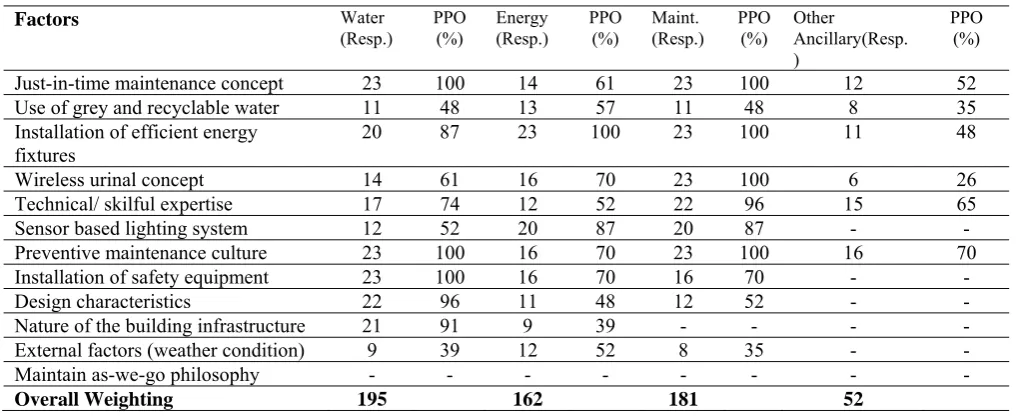
The study further evaluates the case study factors with a mathematical model expression of probability percentages outcomes (PPO) in eqn. (5). These results are as presented in Table 1.
PPO
=
Where; Qn represents a typical question from the list of the factors.
From Table 1, [13, 14] observe that with negative variation trends on the results, it would have signified random variable increase. Therefore, the factors would have been insignificant and of low effects in the direction of the services delivery within the building infrastructure systems. Also, in Table I, water management practice is ranked 1st in the overall scale of this investigation. The result reveals a strong concordance amongst the respondents on its degree of influence and importance towards achieving improved services delivery within company. In addition, on the top scale are three factors having common PPO results with 100% as the highest percentages outcomes in this class. These characteristics were: (a) the just-in-time maintenance concept on the water facilities, (b) the preventive maintenance culture and (c) the installation of safety equipment.
The other highly rated factors are between 96 — 87% as the PPO results. Theses include (a) the design characteristics, (b) the nature of the building infrastructure and (c) the installation of efficient energy fixtures. The respondents indicate that these factors are very crucial in the water management practice within the Aluminium plant. Therefore, this signifies a strong correlation between their significant influences towards the building infrastructure from the respondents’ point of view. Observably, characteristics such as (a) the wireless urinal concept and (b) the use of grey and recyclable water were not highly rated in this case. The respondents however perceived that these technologies are not commonly applicable in the organization. Also, the external factor in this category was of less significance to the study.
results of 100 — 87%. These characteristic are (a) the installation of efficient energy fixtures and (b) the sensor based lighting system. These factors are considered as being very significant from the respondents’ perspective. Moreover, four characteristics are in the range of 70 — 61% as the PPO outcomes. These include (a) the wireless urinal idea, (b) the preventive maintenance culture and (c) the installation of safety equipment gaining overlapping results. The group also has (d) the just-in-time maintenance model. The other remaining five factors are of less influence in this context as indicated in the research analysis.
The investigation from Table 1 presents maintenance management procedure within the company as 2nd in the overall weighting scale. Findings revealed that four factors gained corresponding PPO rating of 100% in this class. These characteristics are (a) the just-in-time maintenance concept, (b) the installation of efficient energy fixtures and (c) the wireless urinal model. Furthermore, (d) the preventive maintenance culture practices. The research noted the outcome to be consistent since majority of the respondents were from the maintenance and operation sections of the company. As a result, the respondents uphold that a proper maintenance management practice is underscored as a veritable tool for sustainable building infrastructure. Besides, the category discloses three factors achieving PPO results between 96 — 70%. The characteristics comprise of (a) the employment of technical/ skilful expertise, (b) the fitting of sensor based lighting systems and (c) the installation of safety equipment within company infrastructure. The research found that these factors degree of influence are significant which could be properly addressed through proper design and implementation procedures. The other remaining factors are assessed based on their significance in the building activities from the respondents’ results.
Table 1 analysis further depicts the other ancillary operation undertaken within the Aluminium Company. It is evident that (a) the preventive maintenance culture and (b) the employment technical/ skilful expertise in maintaining the infrastructure play more part for the services delivery. Also, the just-in-time maintenance conception factor is generally admitted to be innovative in this background from the respondents’ point of view. These factors are considered very important in the sustainability of modern building growth. However, the remaining factors including the (maintain as-we-go philosophy) posses less impact within this case. The study indicates that other factors associated in the building infrastructure were accordingly appraised by the respondents in the organization. Basically, the research found that some factors with less significant degree of influence could be properly addressed through proper management procedures.
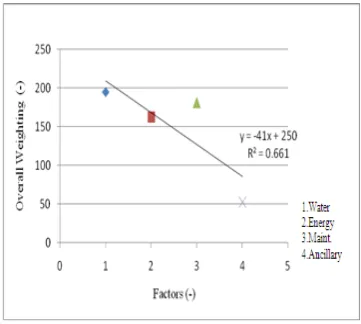
In Fig. 2, the case study analysis describing the overall weighting (-) against factors (-) are shown. It is apparent that proper management culture within any building infrastructure will promote the sustainability objectives as revealed in this examination. The result also established that more concentration should be accorded to the current technological and innovative model in managing water, energy and the maintenance management practices. Generally, this development is aimed towards sustainability attainment and improved services delivery. In addition, the
highest weighting in this case is assigned to water before other factors in this company. Therefore, proper water, energy and the management practices are emphasized in this perspective for sustainable building infrastructure as a holistic approach.
[image:4.595.336.517.215.377.2]Nevertheless, further outcomes from the study demonstrate a coefficient of determination (COD) of 66%, Fig.2. This expression suggests a high degree of consistency from the respondents’ appraisal. Additionally, the analysis correlation coefficient (CC) of 81% portrays the current overall management procedures within this company.
Fig. 2 The relationship between overall weighting (-) and the investigated factors (-).
SUMMARY AND CONCLUSIONS
The research reassesses twelve different factors within the building infrastructure network in Aluminium Smelting Company of Nigeria. In this study, the outcomes of findings disclose differences in each case of the infrastructure characteristics. This investigation has presented and examined the aim of research, background literature and survey results on the infrastructure systems within this organization. Therefore, from a thorough literature search, pilot study and surveys, 12 essential factors were identified and subsequently evaluated.
However, the analysis offers a system probability of economic value (A) = 0.83, social value (B) = 0.83 and environmental value (C) = 0.6 respectively from this scenario yielding a Suv factor of 0.41. Moreover, a reliability index of
R(System Failing) = 1- Interference(System) for the reviewed
company can salvage the services delivery failure. This becomes imperative since interference analysis stem from the risk involvement in this organization’s infrastructure system. Also, the obtained sustainability indices are realistic within the boundary conditions of 0 ≤ Suv ≤ 1 in this case.
Table 1 The study Outcomes
Factors Water
(Resp.)
PPO (%)
Energy (Resp.)
PPO (%)
Maint. (Resp.)
PPO (%)
Other
Ancillary(Resp. )
PPO (%)
Just-in-time maintenance concept 23 100 14 61 23 100 12 52
Use of grey and recyclable water 11 48 13 57 11 48 8 35
Installation of efficient energy fixtures
20 87 23 100 23 100 11 48
Wireless urinal concept 14 61 16 70 23 100 6 26
Technical/ skilful expertise 17 74 12 52 22 96 15 65
Sensor based lighting system 12 52 20 87 20 87 - -
Preventive maintenance culture 23 100 16 70 23 100 16 70
Installation of safety equipment 23 100 16 70 16 70 - -
Design characteristics 22 96 11 48 12 52 - -
Nature of the building infrastructure 21 91 9 39 - - - -
External factors (weather condition) 9 39 12 52 8 35 - -
Maintain as-we-go philosophy - - - -
Overall Weighting 195 162 181 52
* No. of Respondents (Resp.)
ACKNOWLEDGEMENT
The authors hereby acknowledge the support of the Akwa Ibom State University of Technology (AKUTECH), Nigeria for their continued sponsorship. Also, the contributions of the participants within the Aluminum Smelting Plant in Nigeria are appropriately acknowledged.
REFERENCES
[1] UN ESCAP (2006), Sustainable Infrastructure in Asia. Overview and Proceedings of the United Nations Economic and Social Commission for Asia and the Pacific Environment and Sustainable Development Division.
[2] Hill, R. C. and Bowen, P. A. (1997). “Sustainable Construction: Principles and Framework for Attainment.” Journal of Construction management and
Economics, 15 pp.223-239.
[3] Miyatake, Y. (1994), Sustainable Construction. Keynote address to First International Conference of CIB TG 16 on Sustainable Construction, Tampa, Florida, 6-9 November.
[4] Sattertherwaite, D. (2001), “In The Earthscan Reader in Sustainable Cities”.
[5] Elkington, J. (1997), Cannibals with Folks: The Triple Bottom Line of 21st Century Business. Capstone, Oxford.
[6] WCED (1987), World Commission on Environment and Development – “Our Common Future”, Session A (42) 427, World Commission on Environment and Development, United Nations.
[7] Grigg, N.S. (1988), Infrastructure Engineering and Management. John Wiley & Sons Incorporated, Canada.
[8] Green Practice Guide, (GPG) Green Practices for homes and Offices. Available Internet:
http://www.sfu.ca/~sustain/pdf/green_practices_guide.pdf. Accessed on 20/03/11.
[9] Okon, B. B. and Elhag, T. M. S. (2011), Sustainable Engineering and Innovative Technology in Managing Infrastructure Systems, 10th International Research Conference on Quality, Innovation & knowledge Management, February 15- 18, Malaysia.
[10] Okon, B., Ekpo, S. and Elhag, T. (2010), A Sustainable Engineering Infrastructure Model for the 21st Century. Proceedings of the ICME, 298, World Congress on Engineering (WCE), London, United Kingdom.
[11] Elhag, T.M.S; Boussabine, A.H; Ballal,T. M. A (2005) Critical determinant of construction tendering costs: Quantity surveyors’ standpoint International Journal of Project Management 23, pp.538-545.
[12] Matthew, C.(2006), Engineers’ Data Book, third edition, The Cromwell Press,Trowbridge, Wilts, United Kingdom.
[13] Hensher, D; Rose, J.M; Greene, W.H. (2005) Applied Choice Analysis – A Primer published by University Press.