Abstract—Optimization of engine mounts has been performed in several studies; some of them investigated single mount model, some studied mounted engine model, and others discussed on full-vehicle model. The goal of this study is to determine which model is more appropriate for the optimization of Hydraulic Engine Mounts (HEMs). A full-vehicle model is difficult to be modeled, and simulation of the model is time consuming. On the other hand, a simple model cannot express the exact behavior of vehicle system and the optimization may not result in the desired performance of the vehicle; thus, it is desired to optimize the engine mount in the simplest model capable of achieving approximately the best performance. In this study, hydraulic engine mounts are optimized to improve the vehicle ride comfort using a global optimization method called Directed Tabu Search (DTS) method. A full-vehicle model is used to evaluate the optimization results, and to determine whether it is enough to optimize the HEMs in the simplified models to achieve the desired performance, or it is required to precede the optimization for the vehicle model or even a more intricate model.
Index Terms—Optimization, Directed Tabu Search (DTS), Hydraulic Engine Mount (HEM), Full-Vehicle Model.
I. INTRODUCTION
The main role of engine mounting system as one of the principal vehicle vibration isolating systems, besides suspension system, is to reduce the Noise, Vibration and Harshness (NVH) perceived by driver and to improve the ride comfort. The main vehicle NVH sources are low frequency road roughness and high frequency engine force. Thus, engine mounts should be capable of adequate isolation in a wide range of frequency. Almost constant stiffness and damping of rubber engine mounts with respect to frequency, leaded vehicle industries to develop Hydraulic Engine Mounts (HEMs). A HEM equipped with inertia track and decoupler performs a desirable performance in a wide range of frequency [1]. The unfavorable high stiffness in fluid resonance frequency motivated the development of bell plate. Equipping the HEM with bell plate provides a good performance in all working frequencies [2]. A better performance will be achieved if an appropriate HEM is
*
Manuscript received March 6, 2011
Abdolreza Ohadi is with Department of Mechanical Engineering, Amirkabir University of Technology, No.424, Hafez Ave., Tehran, Iran (corresponding author to provide phone: 6454-3484; fax: +98-21-6454-3484; e-mail: [email protected]).
Yadollah Rasekhipour is withDepartment of Mechanical Engineering, Amirkabir University of Technology, No.424, Hafez Ave., Tehran, Iran (e-mail: [email protected]).
provided by executing an optimization process.
Optimization based on modal analysis has been performed in several studies for rubber engine mounts [3]-[5]. But there is no guarantee that the system designed to decouple modes exhibits the best performance, e.g. the system will have a better ride comfort performance if the optimization objective is ride comfort than if it is to decouple system modes.
In some studies [6]-[8], optimization of HEM has been performed using a model of a single mount (a model of a 1DOF-body supported on a HEM). Some other optimization investigations on rubber mounts have been preceded for an engine model mounted on their mounts [9], whereas some studies have been performed for full-vehicle models [10], [11]. Although several kinds of models- a simple single engine mount model to an intricate vehicle model- have been used for optimization procedure, but it is not known whether it is required to optimize the engine mounts in an intricate full-vehicle model or some simpler models can be adequate for the optimization. The main goal of the current study is to find the answer of the above mentioned question.
The system of interest in this study is a vehicle system whose engine is mounted to the chassis via three HEMs. It is desired to improve the ride comfort, and the vertical acceleration of the driver position is used as the ride comfort index. A 13DOF model (Fig. 1(a)) called model No. 1 is used as the reference model of the system. Two simpler models are also investigated. An appropriate simplified model for optimization of the HEMs is a 6DOF engine mounted to the ground via three HEMs (Fig. 1(b)) called model No. 2. Besides, a simplification in model No. 2 results in a 1DOF body which is mounted to the ground via one HEM (Fig. 1(c)) called model No. 3. Optimization is performed for these three models, and for each model, the optimized parameters of the HEM(s) are obtained. The resulted optimized parameters are used in the reference full vehicle model. The ride comfort indexes of the three resultant reference models are compared to clarify whether optimization in model No. 2 or model No. 3 can result in a favorable performance, or the optimization have to be performed for the model No. 1.
In this study, a global optimization method called Directed Tabu Search (DTS) method is used, which is the result of combining Tabu Search (TS) method with direct search methods [12]. Memory structures are the main elements of a TS method which improve the performance of the method by avoiding searching visited regions. It causes the method to search more regions with equal number of function evaluations that makes DTS advantageous over
Optimization of Hydraulic Engine Mounts
through Simplified and Full Vehicle models
other global optimization methods.
The structure of the paper is as follows. Initially the mathematical model for each model is obtained. Next, a study on HEM parameters is performed to determine the most effective parameters to be used as design parameters in optimization. Then, DTS method is explained and objective functions and constraints of the optimization are determined. Finally, optimization results are expressed, the corresponding results are substituted in the reference model, and comparison between three models is done.
(a)
[image:2.595.344.507.168.414.2](b) (c)
Figure 1: Optimization models, (a) Model No. 1 - 13 DOF full-vehicle (reference model), (b) Model No. 2 - 6DOF engine mounted to the ground via three HEMs, (c) Model No. 3 - 1DOF engine supported on
a HEM.
II. MATHEMATICAL MODELS
A. Mathematical Model of HEM
The HEM of interest is structurally similar to the conventional HEM except that a bell plate is added to it. The improvement in the behavior of conventional HEM by supplementing bell plate to it is studied by Ohadi and Fakhari [2]. Cross Section and lumped parameter system model of the HEM are illustrated in Fig. 2 [1]. As demonstrated in Fig. 2(b), the HEM contains three chambers: bell chamber, upper chamber, and lower chamber, and three passages: inertia track, decoupler, and bell plate.
Excitation causes relative motion of the two ends of the HEM; thus pressure varies in the chambers which motivates the fluid to flow through the three passages. The fluid passing the inertia track, which is a long narrow passage, causes a high damping. But in high frequency behavior, low damping is required which motivated the creation of the
decoupler [1]. In high frequencies, the decoupler disk, which lies on one of its limits and blocks the decoupler passage in low frequencies, stands in the middle, and the pressure difference between the upper and lower chambers causes the fluid to flow through the decoupler –which is a short wide passage- instead of the inertia track. Undesirable behavior due to resonance of the containing fluid, which causes high stiffness in fluid resonance frequency, motivated the development of bell plate.
(a)
(b)
Figure 2: (a) Cross section of HEM, (b) Lumped parameter system model of HEM [13].
Continuity equations for the three chambers are:
=− (−−) (1)
= (−)−−− (2)
=+ (3)
in which , ଵ and ଶ are the compliances of bell
chamber, upper chamber and lower chamber, respectively.
, ଵ and ଶ represent the pressure of bell chamber, upper
chamber and lower chamber and , and ௗ are the
flow passing through bell passage, inertia track and decoupler, respectively. is the area of bell plate,
represent effective pumping area, is the area of the
HEM, and is the displacement of the upper end of the
HEM. Momentum equations for inertia track, decoupler and bell plate, respectively, are:
−=+ (+||) (4)
−=+ (+||+
బ
బ)
(5)
−=+ (++)(+) (6)
in which represents the inertia of each passage, and ′
[image:2.595.64.281.182.500.2]and turbulent flow, and , and indices represent the inertia track, decoupler, and bell passage. First, second and third terms on the right side of (4)-(6) demonstrate momentum resulting by fluid inertia, resistance due to laminar flow, and resistance due to turbulent flow, respectively. The last terms on the right side of (5) represents the additional resistance created by decoupler disk when it approaches any of its limits [1].
Transmitted force to the base of the HEM is:
=++−−++
+||−−
(7)
in which and are the stiffness and damping of rubber
part of the mount, respectively, and ௗି is the
equivalent decoupler area defined in order to express the transmitted force in a continuous equation for both occasions when the decoupler disk blocks the passage and when it does not [1]:
=
− arctan మ
ഏ(
ುభషುమ
ುబ )షೌೣ
భ
(8)
Moreover, the force acting on the upper end of the HEM differs from the transmitted force to the base:
=++−+−− (9)
Equations acting on model No. 3 (Fig. 1(c)) are the same as Eqs. (1)-(9) except that because of the mass placed on the upper end of the mount, Eq. (9) changes to:
=+++−+−
−
(10)
in which is the excitation force exerted to the mass. B. Mathematical Model of Vehicle
Reference model of vehicle investigated in this study consists of an engine body mounted to vehicle body, and four wheel bodies jointed to the vehicle body via suspension system, as demonstrated in Fig. 1(a). In this system, engine is modeled as a 6DOF rigid body, mounting to the vehicle body via three similar inclined HEMs. The engine roll axis can coincide with mount elastic axis, if HEMs lie in an appropriate inclined manner, which decouples roll engine mode from other engine modes, and reduces vibration amplitude [5]. Vehicle body and chassis are modeled as a unified body capable to move in bounce, roll and pitch modes. Four wheels are connected to it via suspension system; each is assumed as a rigid body travels in vertical direction and is connected to the ground through the tire. Suspension system and tires are modeled as linear springs and dampers.
A V-shape four-cylinder engine is studied whose engine force arises from the motion of engine inner bodies including piston, conrod, crankshaft, and balancing system. The engine force acting on the engine body is the only source of excitation. The forces and torques acting on the engine can be expressed in the format [2]:
⋮=sin+ωcos+ωcos 2 (11)
in which = 1,2,3 are determined for each torque or
force component. Newton’s second law results in the following equations for the wheels:
= +!"−#" −+$+
!"−#" −− !−! %= 1, … ,4
(12)
in which ௨ and ௨ represent i-th unsprung mass and its
vertical displacement, respectively, ௦ and ௦ are i-th
suspension stiffness and damping, , ௧ indicates the i-th tire
stiffness, ௦,௦௬ and ௦௭ are bounce, roll, and pitch motions
of vehicle body, respectively, ௧ is the vertical displacement
of the lower end of the tire that represents the road disturbance and is assumed to be zero in this study. Also,
௦ and ௦ represent the position of each suspension from
vehicle coordinate located on center of mass of vehicle body. Vehicle body motion originates from the forces transmitted from suspension system and mounting system:
=∑ # "+∑ $# " (13)
"=∑ # "!− +∑ $# "! (14)
" =∑ # −"#+ ∑$#(−"#) (15)
in which ௦,௦௬ and ௦௭ are the mass of the vehicle body
and momentum of inertia of it in y- and z-directions, respectively,
ᇱ ,
ᇱ , and
ᇱ represent the position of each
mount in vehicle body coordinate, and ௦௫ is the force
transmitted to vehicle body from suspension system:
"= − +!"−#" −−$+
!"−#" −
(16)
Inclined HEMs lie in x-y plane, and are oriented at angle related to y-axis. Therefore, ௦, which is the force
transmitted from engine mounts, can be formulated as follows:
"= "+$"+−−
+++||sin' (17)
=+!"−#" − +!′ "−#′ "
(18)
= (+$(+−−
+++||cos' (19)
(=#+" −!""−′ " (20)
= )+$ ) (21)
)=!+#""−"+′ " (22)
in which ௫,௬,௭,௫,௬, and ௭ represent the
stiffness and damping of each mount in x-, y-, and z-direction, respectively, ,, and are the relative
displacement of each mount in each direction,
of engine body in each direction, and
represent the position of each mount in engine body coordinate, which is located on center of mass of engine body. Engine body motion is caused by force
from engine mounts () and engine excitation force
(ா, ா):
* + ∑ # ", "
#* + ∑ # ,
!* + ∑ # ,
"""* + "" + ∑ # #+ ! , "
"* + "" ""+ ∑ # "!+
,
" * "+ """+ ∑ # "# ,
in which , ௫, ௬, and ௭ are the mass of the engine body
and momentum of inertia of it in each direction. As mentioned in the previous section, the force transmitted from the mount to the vehicle body (௦
the force exerted to the mount by engine (
"* + ", $" , .+
+ + / sin '
* + (, $( , .+
+ + / cos '
* + ), $ )
The equations acting on model No. 2 (Fig. 1(b)) can be achieved from Eqs. (23)-(31) while the displacements and rotations of the vehicle body in Eqs. (18)
zero.
III. PARAMETER STUDY
In an optimization process, first of all, design parameters which are the most effective parameters, must be specified. In this study, it is desired to optimize HEMs in order to improve the vibration behavior of vehicle. Thus, a parameter study is performed to determine the most effe parameters of the HEM on vibration behavior of vehicle
Several researchers have investigated the design parameters through sensitivity analysis [3
goes through a direct way to do so. The procedure is performed by varying each parameter while others remain unchanged, and plotting vibration behavior of the system for three different amounts of the parameter
value, half of it, and double of it). The plots clearly illustrates how the vibration behavior alters as e parameter changes; so, by studying all changeable parameters of the HEM and a brief look at the plots, the most effective parameter can be specified.
of engine body in each direction, and , , and
represent the position of each mount in engine body coordinate, which is located on center of mass of engine by force transmitted engine excitation force
(23) (24) (25)
+ (26)
+ (27)
+ (28)
are the mass of the engine body and momentum of inertia of it in each direction. As mentioned in the previous section, the force transmitted
௦) is different from
):
,
(29)
,
(30)
(31)
The equations acting on model No. 2 (Fig. 1(b)) can be ile the displacements and ), (20) and (22) are
TUDY
first of all, design parameters which are the most effective parameters, must be specified. In this study, it is desired to optimize HEMs in order to improve the vibration behavior of vehicle. Thus, a parameter study is performed to determine the most effective parameters of the HEM on vibration behavior of vehicle.
Several researchers have investigated the design parameters through sensitivity analysis [3], [4]. This paper goes through a direct way to do so. The procedure is parameter while others remain unchanged, and plotting vibration behavior of the system for three different amounts of the parameter [6] (the original value, half of it, and double of it). The plots clearly illustrates how the vibration behavior alters as each parameter changes; so, by studying all changeable parameters of the HEM and a brief look at the plots, the most effective parameter can be specified.
HEM parameters including
, , and are studied to determine the design
parameters. As a sample, Fig. 3
effective parameters on driver position acceleration in range of 0-5000 rpm of engine rotating speed value of parameters, the simulation is per different amounts of engine rotating
value of the driver position condition is determined to construct
from the figures that these parameters have a great influence on vibration behavior of the system. Thus, design parameters are chosen to be ,
(a)
[image:4.595.308.542.208.496.2](b) Figure 3: Effect of two design parameters
(a) rubber stiffness, (b) upper chamber compliance
IV. OPTIMIZATION PROCESS
A. Optimization method
The optimization method executing in this study is Directed Tabu Search (DTS) method being a developed version of Tabu Search (TS) method. TS is a
method benefiting memory elements to avoid searching visited regions, and DTS is the result of combining TS with some direct search methods such as
(APS) method. DTS is a global optimization method whi performs local search from plenty of initial points instead of one, in which the best point among the resultant local optimized points is the global optimized point.
Three search procedures are used in DTS: Exploration, Diversification, and Intensificat
search, local search is performed by em
strategy to lead the search, and introducing memory elements called Tabu List (TL), Tabu Regions (TRs), and Semi-TRs to prevent cycling. The diversification search generates new trial points to be used as initial points of the , , ଵ, ଶ, , , ௗ, ௗ,
tudied to determine the design Fig. 3 shows the influence of two effective parameters on driver position acceleration in the of engine rotating speed. For each of parameters, the simulation is performed for engine rotating speed, and the peak value of the driver position acceleration at steady state construct the plots. It is clear from the figures that these parameters have a great influence on vibration behavior of the system. Thus, design
, ଵ, , and .
(a)
(b)
design parameters on driver position acceleration: (a) rubber stiffness, (b) upper chamber compliance.
PTIMIZATION PROCESS
The optimization method executing in this study is Directed Tabu Search (DTS) method being a developed method. TS is an optimization method benefiting memory elements to avoid searching regions, and DTS is the result of combining TS with such as Adaptive Pattern Search . DTS is a global optimization method which performs local search from plenty of initial points instead of one, in which the best point among the resultant local optimized points is the global optimized point.
exploration search. It benefits another memory element called Visited Regions List (VRL) to diversify the search from the visited points. Eventually, the intensification search performs local searches from the best points arisen from previous search procedures, to intensify the answer.
The main loop of DTS consists of exploration and diversification searches. It starts from an initial point x0, and exploration procedure starts from this initial point in a loop called inner loop. After the inner loop is accomplished, diversification search generates another point to be used as initial point of the inner loop in the next main loop iteration.
In the exploration search, memory elements including TL, TRs, and Semi-TRs are introduced to prevent searching in neighborhood of visited points in order to avoid cycling. The most recent points and the best points resulting from exploration search are stored in TL. TRs are defined to be regions around each point of TL with radius rTR, and Semi-TRs are defined to be surrounding regions around Semi-TRs with radius rSTR > rTR. Thus, if the trial points do not enter TRs, exploration search has avoided cycling. So, if the current point is in Semi-TRs, the direction of generating trial points will be outward from the center of Semi-TRs. Otherwise trial points are generated in a random direction along each axis. In the both abovementioned procedures, if one of the trial points is better than the current point, it is chosen as the resultant point and this iteration of the inner loop is accomplished, otherwise local points are generated employing APS to determine the resultant point of this inner loop iteration. Simply said, TL, TRs, and Semi-TRs exclude the visited regions from the search area, and the search is directed to the local optimized point by APS. The resultant point is added to TL and VRL, and is used as initial point for the next inner loop iteration.
The inner loop is terminated after linner iterations, and then the diversification search is executed. It introduces a memory element called VRL to diversify the search. VRL is defined to be a spherical region around each resultant point. The center of sphere as well as frequency of visiting the point is stored in VRL. In the diversification search a random trial point is generated; if it is not in the neighborhood of visited regions, it will be the resultant point of the diversification.
The main loop is terminated after lmain iterations have been performed. Assuming that the procedure has searched the entire optimization region, the best points of TL can make the best local optimized points if the intensification search is performed for them. Thus, in the intensification search, some local optimization processes are performed whose initial values are the best points of TL. The best point among the local optimized points is the global optimized point.
B. Objective function
One of the main indexes of an appropriate vehicle is its ride comfort. In this study the vertical acceleration of the driver position is chosen as the ride comfort index, and the objective of this study is to reduce it. HEM in the three models is optimized and the resultant HEMs of each model are replaced the original HEM in the reference model. Ride comfort index of the three resultant reference models are evaluated to determine whether simplified models are
capable to optimize the HEMs for vehicle or optimization is required to be executed for more intricate models. The objective of model No. 1 is minimizing the driver position acceleration. For the two other models, the objective has to be chosen such that the resultant HEMs can afford the objective of the reference model (which is identical with model No. 1). Since transmitted force to the chassis is the source of vibration of the chassis, the objective of the two models No. 2 and 3 is selected to be the transmitted force to the ground. In all three models, the objective function is the least mean squares of the mentioned objectives in the frequency range of 0-200Hz. Besides, the excitation of the system has to be modeled appropriately so that the optimization results in proper HEMs for the vehicle. For models No. 1and 2 it is the engine force acting on engine [2], and for model No. 3 it is chosen to be one third of vertical component of engine force acting on the mounted mass. The engine rotating speed (the frequency of the excitation force) sweeps in time from 1000 to 5000 rpm in the simulation of the models.
The designer cannot assign any desired amount to the design parameters. Thus, constraints which must be held on design parameters and their limits have to be specified. As the length and area of the inertia track can vary independently, and can alter independently; but the
length and the area cannot get any amount.ଵ and can
alter by changing the chambers walls materials. Similarly, they cannot take any value, because of the limitations in materials. changes by changing the shape and material of the rubber part of the mount, and should have limited values. In this study, it is assumed that all design parameters can vary in the range of half of their original value to double of it in the optimization. The design parameters used in DTS are the ratio of the design parameter to their original values to be non-dimensional.
V. RESULTS
In this study, it is desired to determine whether it is required to precede the optimization for an intricate model of vehicle to achieve desired ride comfort performance or it is enough to optimize the HEMs in a simple model. A 13DOF model is used as the reference model (model No. 1), and is simplified twice to constitute two other models (Fig. 1). A procedure is performed for each of the three models; the optimized HEMs of the model is obtained via DTS, and the original HEMs in the reference model are replaced by this HEMs to create three resultant reference models, then vertical acceleration of the driver position- as the ride comfort index- of each resultant reference model is evaluated to determine which model is more appropriate to be used for optimization.
The distance between every two points can be calculated as follows:
%&'ଵ( ' ଶ) ଶ
* &+ଵଵ( +ଵଶ) ଶ
* &,భ( ,మ) ଶ
* &-భ( -మ) ଶ
* & 0.2
Since the design parameters are the nondimensional they can be added to each other. DTS makes it possible to select best points from distinct regions, since it searches all the design area for local optimized points and provides the best points in every region while other global optimization methods do not obtain the best points of each region. Since the simplified models are structurally different form the full vehicle system, and acceleration and force
the reference model and simplified models,
different in nature, the global optimized point of the simplified models do not coincide the global optimized point of the reference model, and even may exhibit an undesirable response in reference model. But if the best points of a simplified model exhibit a desirable response in resultant system (resulting from replacing the original HEMs of the reference model by optimized HEMs), the simplified model robustly performs well, and can be safely used instead of the reference model in the op
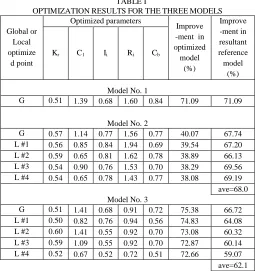
process. Thus the average of the five best points of each simplified system tabulated in table 1 is used as the index of effectiveness of optimization of the simplified
TABLE I
OPTIMIZATIONRESULTSFORTHETHREE
Global or Local optimize d point Optimized parameters optimized Kr C1 Ii Ri Cb
Model No. 1 G 0.51 1.39 0.68 1.60 0.84
Model No. 2 G 0.57 1.14 0.77 1.56 0.77 L #1 0.56 0.85 0.84 1.94 0.69 L #2 0.59 0.65 0.81 1.62 0.78 L #3 0.54 0.90 0.76 1.53 0.70 L #4 0.54 0.65 0.78 1.43 0.77
Model No. 3 G 0.51 1.41 0.68 0.91 0.72 L #1 0.50 0.82 0.76 0.94 0.56 L #2 0.60 1.41 0.55 0.92 0.70 L #3 0.59 1.09 0.55 0.92 0.70 L #4 0.52 0.67 0.52 0.72 0.51
For each point, the percentage of improvement in the objective function of the model that the point is resulted from optimization of it, and the percentage of improvement in the objective function of the resultant reference model, is shown in the last two columns of the table.
values are determined with respect to the
objective functions. Moreover, the first column
whether the point is global optimized point (G) or local optimized one (L).
distance between every two points can be calculated
) &+భ( +మ) ଶ
1 (32)
design parameters are the nondimensional they can be added to each other. DTS makes it possible to select best points from distinct regions, since it searches all the design area for local optimized points and provides the best e other global optimization methods do not obtain the best points of each region. Since the simplified models are structurally different form the full vehicle system, and acceleration and force- the objectives of the reference model and simplified models, respectively- are different in nature, the global optimized point of the simplified models do not coincide the global optimized point of the reference model, and even may exhibit an undesirable response in reference model. But if the best ified model exhibit a desirable response in resultant system (resulting from replacing the original HEMs of the reference model by optimized HEMs), the simplified model robustly performs well, and can be safely used instead of the reference model in the optimization process. Thus the average of the five best points of each simplified system tabulated in table 1 is used as the index of
the simplified model.
HREEMODELS
Improve -ment in optimized model (%) Improve -ment in resultant reference model (%)
71.09 71.09
40.07 67.74 39.54 67.20 38.89 66.13 38.29 69.56 38.08 69.19 ave=68.0
75.38 66.72 74.83 64.08 73.08 60.32 72.87 60.14 72.66 59.07 ave=62.1
percentage of improvement in the that the point is resulted from optimization of it, and the percentage of improvement in the objective function of the resultant reference model, is shown in the last two columns of the table. All percent the original values of Moreover, the first column indicates whether the point is global optimized point (G) or local
Table I shows 71.09% improvement
optimization of the reference model demonstrating that the optimization is necessary for the system. Besides, global optimized point of model No. 2 results in 67.74% improvement in the behavior of the resultant reference model; and the average of the
best points resulted from optimization of the model is 68.0%. This demonstrates that a
system parameters may result in another optimal point which will perform similar to the current optimal poi noticeable that the point L#3 makes
the resultant model in comparison with global optimized point, which is because of the different structures of reference model and model No. 2. The similar observation for model No. 3 shows that its global optimized point performs 66.72% improvement
resultant reference model, and the best five optimal points of the system exhibit an average improvement
Obtained results indicate that reference model (model No. 1)
No. 2 with an insignificant loss of about improvement. Moreover, if m
optimization, an average loss of 9% improvement of the system, which is
loss is because of the different structures of model No. 3 and the reference model; but since t
of the engine mass and the excitation force is selected to be one third of the vertical component of the engine force model No. 3, the model can somehow simulate the behavior of the intricate reference model
acceptable.
The vibration behavior of the reference model resulting from global optimized point of each model is compared to the original reference model in Fig. 4. Both plots demonstrate the improved behavior of the system due to optimization of each model. But it can be noticed from the plots that though the objective functions of the resultant reference model of global optimize
models are so close (as table 1 demonstrates), their maximum values of the driver position acceleration and transmitted force to the chassis are widely different. It indicates that different objective functions result in different global optimized points e.g. if the maximum value of the driver position acceleration in a range of engine rotating speed is used as the objective function the optimized points will be different.
Figure 4: Driver point acceleration versus engine rotating speed systems in comparison with original
improvement resulting from optimization of the reference model demonstrating that the optimization is necessary for the system. Besides, global optimized point of model No. 2 results in 67.74% in the behavior of the resultant reference he improvement due to the five best points resulted from optimization of the model is his demonstrates that a small variation in the may result in another optimal point which will perform similar to the current optimal point. It is makes a more improvement in the resultant model in comparison with global optimized point, which is because of the different structures of reference model and model No. 2. The similar observation s that its global optimized point improvement in the behavior of the the best five optimal points of improvement of 62.1%. that, for the optimization, the reference model (model No. 1) can be replaced by model insignificant loss of about 3% of . Moreover, if model No. 3 is used for the an average loss of 9% will be occurred in which is also acceptable. The loss is because of the different structures of model No. 3 and but since the mass is chosen one third of the engine mass and the excitation force is selected to be component of the engine force in model No. 3, the model can somehow simulate the behavior of the intricate reference model and the results are somehow The vibration behavior of the reference model resulting from global optimized point of each model is compared to nal reference model in Fig. 4. Both plots demonstrate the improved behavior of the system due to optimization of each model. But it can be noticed from the plots that though the objective functions of the resultant ference model of global optimized points of the three models are so close (as table 1 demonstrates), their maximum values of the driver position acceleration and transmitted force to the chassis are widely different. It indicates that different objective functions result in different imized points e.g. if the maximum value of the driver position acceleration in a range of engine rotating-speed is used as the objective function the optimized points
[image:6.595.41.296.392.663.2] [image:6.595.319.538.621.756.2]VI. CONCLUSION
Ride comfort of a vehicle is desired to be improved by optimization of its HEMs in this study. A full-vehicle model (model No. 1) is a highly nonlinear model with many degrees of freedom, and if its engine is mounted by HEMs, its nonlinearity makes the simulation more intricate; so if a simplified model like an engine mounted to the ground (model No. 2), which only contains the degrees of freedom of the engine and nonlinearity of its HEMs, or a 1DOF body mounted to ground by a HEM (model No. 3) can afford the optimization and result in an acceptable performance, the optimization is preferred to be done for these simplified models.
Different structures of the models make the optimal region of the reference model different from those of the simplified models. However, if the optimal regions of a simplified model coincide with not the best but appropriate enough regions of the reference model, i.e. best local optimized points of the simplified model result in good enough behavior of resultant reference model, the optimization can be done for the simplified model instead of the reference model. The obtained results indicate that both simplified models exhibit a good performance, and can be used for optimization process instead of full-vehicle model. Model No. 2 shows an insignificant loss of 3% in improvement of optimization if it is used instead of the reference model, which makes it completely reasonable to be preferred for the optimization. Besides, model No. 3 causes a loss of 9% in the improvement of the optimization if it is used for the optimization instead of the reference model. Thus, it is rational to use model No. 3 for the optimization except that the optimization improvement is more important than optimization cost, in which case model No. 2 is to be used. As a conclusion, instead of the complex full-vehicle model which is too hard to be thoroughly modeled, a model of a 1DOF body mounted on the ground via one HEM can be used.
REFERENCES
[1] A. Geisberger, A. Khajepour, F. Golnaraghi, “Non-linear modeling of hydraulic mounts: theory and experiment,” Journal of Sound and
vibration, 2002, 249(2), 371-397
[2] A. R. Ohadi, V. Fakhari, “Effect of bell plate on vibration behavior of automotive engine supported by hydraulic engine mounts,” SAE
Technical Paper Series 07NVC-223
[3] T. Arai, T. Kubozuka, S. D. Gray, “Development of an angine mount optimization method using modal parameters,” SAE Technical Paper
Series 932898
[4] C. Q. Liu, “A computerized optimization method of engine mounting system,” SAE Technical Paper Series 2003-01-1461
[5] J. S. Sui, C. Hoppe, J. Hirshey, “Powertrain mounting design principles to achieve optimum vibration isolation with demonstration tools,” SAE Technical Paper Series 2003-01-1476
[6] Y. K. Ahn, J. D. Song, B. S. Yang, “Optimal design of engine mount using an artificial life algorithm,” Journal of Sound and Vibration 261, 2003, 309–328
[7] Q. Li, J. C. Zhao, B. Zhao, X. S. Zhu, “Parameter optimization of a hydraulic engine mount based on a genetic neural network,” Proc.
IMechE Vol. 223 Part D: J. Automobile Engineering, 2009
[8] B. H. Lee, C. W. Lee, “Optimal design of electromagnetic type active control engine mount in consideration of actuator efficiency,” SAE
Technical Paper Series 2007-01-2424
[9] W. Yuan, X. Wang, S. Han, “Optimal mount selection with scattered and bundled stiffness rates,” SAE Technical Paper Series 2006-01-0736
[10] T. Wang, F. Sturla, V. C. Salazar, “Mount rate robust optimization for idle shake performance,” SAE Technical Paper Series 2004-01-1536 [11] M. S. Foumani, A. Khajepour, “Optimization of engine mount
characteristics using experimental/numerical analysis,” Journal of
Vibration and Control, 9: 1121–1139, 2003
[12] A. R. Hedar, M. Fukushima, “Tabu search directed by direct search methods for nonlinear global optimization,” European Journal of
Operational Research 170 (2006) 329–349
[13] A. A. Geisberger, “Hydraulic Engine Mount Modeling, Parameter Identification and Experimental Validation” Thesis for Master of
Applied Science in Mechanical Engineering, University of waterloo
![Figure 2: (a) Cross section of HEM, (b) Lumped parameter system model of HEM [13].](https://thumb-us.123doks.com/thumbv2/123dok_us/1292730.658459/2.595.64.281.182.500/figure-cross-section-hem-lumped-parameter-model-hem.webp)