An Algorithm to Align Words for
Historical Comparison
M i c h a e l A. C o v i n g t o n * The University of Georgia
The first step in applying the comparative method to a pair of words suspected of being cognate is
to align the segments of each word that appear to correspond. Finding the right alignment may
require searching. For example, Latin
dO 'Igive' lines up with the middle
doin Greek
didOmi,not the initial
di.This paper presents an algorithm for finding probably correct alignments on the basis of
phonetic similarity. The algorithm consists of an evaluation metric and a guided search procedure.
The search algorithm can be extended to implement special handling of metathesis, assimilation,
or other phenomena that require looking ahead in the string, and can return any number of
alignments that meet some criterion of goodness, not just the one best. It can serve as a front end
to computer implementations of the comparative method.
1. The Problem
The first step in applying the comparative method to a pair of words suspected of being cognate is to align the segments of each word that appear to correspond. This alignment step is not necessarily trivial. For example, the correct alignment of Latin dcr with Greek
did~Ymi
is- - d o - -
d i d O m i and not
d o . . . . d - - O . . . d o d i d o m i d i d O m i d i d O m i
or numerous other possibilities. The segments of two words may be misaligned be- cause of affixes (living or fossilized), reduplication, and sound changes that alter the number of segments, such as elision or monophthongization.
Alignment is a neglected part of the computerization of the comparative method. The computer programs developed by Frantz (1970), Hewson (1974), and Wimbish (1989) require the alignments to be specified in their input. The Reconstruction Engine of Lowe and Mazaudon (1994) requires the linguist to specify hypothetical sound changes and canonical syllable structure. The cognateness tester of Guy (1994) ignores the order of segments, matching any segment in one word with any segment in the other.
This paper presents a guided search algorithm for finding the best alignment of one word with another, where both words are given in a broad phonetic transcription.
The algorithm compares surface forms and does not look for sound laws or phono- logical rules; it is meant to correspond to the linguist's first look at unfamiliar data. A prototype implementation has been built in Prolog and tested on a corpus of 82 known cognate pairs from various languages. Somewhat surprisingly, it needs little or no knowledge of phonology beyond the distinction between vowels, consonants, and glides.
2. Alignments
If the two words to be aligned are identical, the task of aligning them is trivial. In all other cases, the problem is one of inexact string matching, i.e., finding the alignment that minimizes the difference between the two words. A dynamic programming algo- rithm for inexact string matching is well known (Sankoff & Kruskal 1983, Ukkonen 1985, Waterman 1995), but I do not use it, for several reasons. First, the strings being aligned are relatively short, so the efficiency of dynamic programming on long strings is not needed. Second, dynamic programming normally gives only one alignment for each pair of strings, but comparative reconstruction may need the n best alternatives, or all that meet some criterion. Third, the tree search algorithm lends itself to modifi- cation for special handling of metathesis or assimilation. More about this later; first I need to sketch what the aligner is supposed to accomplish.
An alignment can be viewed as a w a y of stepping through two words concurrently, consuming all the segments of each. At each step, the aligner can perform either a match or skip. A match is what happens when the aligner consumes a segment from each of the two words in a single step, thereby aligning the two segments with each other (whether or not they are phonologically similar). A skip is what happens when it consumes a segment from one word while leaving the other word alone. Thus, the alignment
a b c - - b d e
is produced b y skipping a, then matching b with b, then matching c with d, then skipping e. Here as elsewhere, hyphens in either string correspond to skipped segments in the other. 1
The aligner is not allowed to perform, in succession, a skip on one string and then a skip on the other, because the result would be equivalent to a match (of possibly dissimilar segments). That is, of the three alignments
a b - c a - b c a b c a - d c a d - c a d c
only the third one is permitted; pursuing all three would waste time because they are equivalent as far as linguistic claims are concerned. (Determining whether b and d actually correspond is a question of historical reconstruction, not of alignment.) I call this restriction the no-alternating-skips rule.
To identify the best alignment, the algorithm must assign a penalty (cost) to every skip or match. The best alignment is the one with the lowest total penalty. As a first
Covington An Algorithm to Align Words
approximation, w e can use the following penalties:
0.0 for an exact match;
0.5 for aligning a v o w e l with a different vowel, or a c o n s o n a n t with a different consonant;
1.0 for a c o m p l e t e mismatch;
0.5 for a skip (so that t w o alternating s k i p s - - t h e disallowed case----would h a v e the same p e n a l t y as the m i s m a t c h to w h i c h they are equivalent).
T h e n the possible alignments of Spanish el a n d French le (phonetically [lo]) are: e l
1 o 2 complete mismatches = 2.0
- e l
1 0 - 2 skips + 1 v o w e l pair -- 1.5
e l -
- 1 o 2 skips + 1 exact m a t c h = 1.0
The third of these has the lowest p e n a l t y (and is the etymologically correct alignment).
3. The Search Space
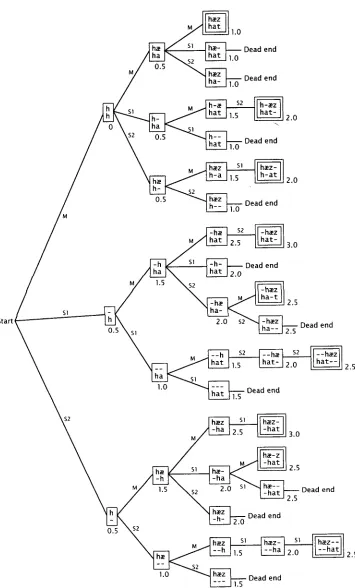
Figure 1 shows, in the f o r m of a tree, all of the m o v e s that the aligner m i g h t try while a t t e m p t i n g to align two three-letter w o r d s (English [h~ez] a n d G e r m a n [hat]). We k n o w that these w o r d s c o r r e s p o n d segment-by-segment, 2 b u t the aligner does not. It has to w o r k t h r o u g h n u m e r o u s alternatives in o r d e r to conclude that
h~ez h a t is i n d e e d the best alignment.
The alignment algorithm is simply a depth-first search of this tree, b e g i n n i n g at the top of Figure 1. That is, at each position in the pair of i n p u t strings, the aligner tries first a match, then a skip on the first w o r d , then a skip on the second, a n d c o m p u t e s all the consequences of each. After completing each alignment it backs u p to the m o s t recent tmtried alternative a n d tries a different one. " D e a d e n d s " in the tree are places w h e r e further c o m p u t a t i o n is blocked b y the no-alternating-skip rule.
As s h o u l d be evident, the search tree can be quite large e v e n if the w o r d s being aligned are fairly short. Table 1 gives the n u m b e r of possible alignments for w o r d s of various lengths; w h e n b o t h w o r d s are of length n, there are a b o u t 3 "-1 alignments, not c o u n t i n g d e a d ends. Without the no-alternating-skip rule, the n u m b e r w o u l d be a b o u t 5"/2. Exact formulas are given in the appendix.
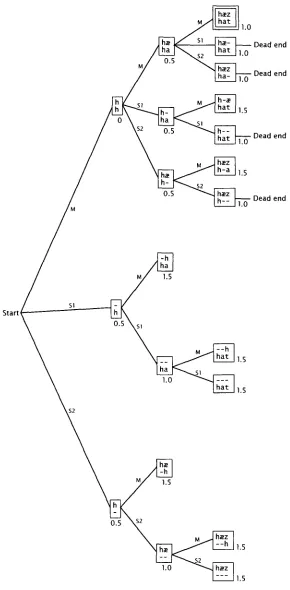
Fortunately, the aligner can greatly n a r r o w the search b y p u t t i n g the evaluation metric to use as it works. The k e y idea is to a b a n d o n a n y b r a n c h of the search tree
[image:3.468.122.315.206.303.2]Start
0.5
;2 0.5
0.5
IL~----al 1. 0
1.0
2.0
~ / 1.5 ~ s 2 2.0
o 5
M
1.o
Figure 1
Search space for a l i g n i n g English / h ~ e z / w i t h G e r m a n / h a t / .
end
end
I t - ~ - J I 2.0 - - Dead end
.:___..dl.) ~ 2 . 0
~ D e a d end
U::-Z-=~a.) ~ 3 . 0
~
Dead end7 ~ 2 . 5
s ~ 2.5 Dead end
~
Dead end3.0
~ " ~ 2 . 5
Dead end 2.5
~ D, ead end
Dead end
L---~ ] 2. 5
[image:4.468.68.423.47.635.2]Covington An Algorithm to Align Words
Table 1
Number of alignments as a function of lengths of words.
Lengths of words Alignments
2 2 3
2 3 5
2 4 8
2 5 12
3 3 9
3 4 15
3 5 24
4 4 27
4 5 46
5 5 83
10 10 26,797
as soon as the accumulated penalty exceeds the total penalty of the best alignment found so far. Figure 2 shows the search tree after pruning according to this principle. The total amount of work is roughly cut in half. With larger trees, the saving can be even greater.
To ensure that a relatively good alignment is found early, it is important, at each stage, to try matches before trying skips. Otherwise the aligner would start by gener- ating a large number of useless displacements of each string relative to the other, all
of which have high penalties and do not narrow the search space much. Even so, the algorithm is quite able to skip affixes when appropriate. For example, when asked to align Greek didomi with Latin dO, it tries only three alignments, of which the best two are:
d i d o m i d i d O m i
d - - o . . . . d O - -
Choosing the right one of these is then a task for the linguist rather than the alignment algorithm. However, it would be easy to modify the algorithm to use a lower penalty for skips at the beginning or end of a word than skips elsewhere; the algorithm would then be more willing to postulate prefixes and suffixes than infixes.
4. T h e Full E v a l u a t i o n Metric
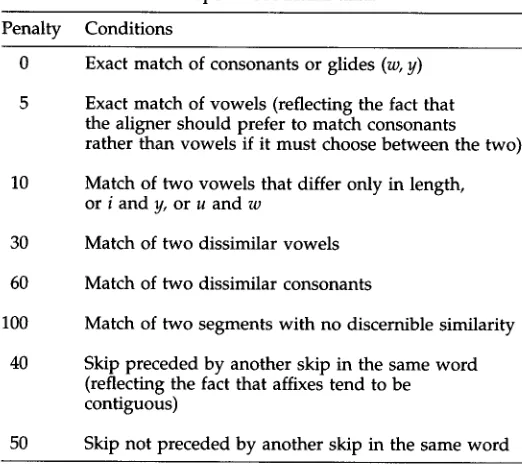
Table 2 shows an evaluation metric developed by trial and error using the 82 cognate pairs shown in the subsequent tables. To avoid floating-point rounding errors, all penalties are integers, and the penalty for a complete mismatch is now 100 rather than 1.0. The principles that emerge are that syllabicity is paramount, consonants matter more than vowels, and affixes tend to be contiguous.
$2 0.5
0.5
~
Dead end~
Dead end,,~c i1. 5
hh
~---~---- Dead end
0.5
~ 1 . 5 $2
~ D e a d end
1.5
Start4 S1
0.5
~
1.5$1
1.5
M / ].5
[image:6.468.103.393.50.640.2]0.5
Figure 2
Same tree as in Figure 1, after pruning. $2
1.0
- - " 1 1 . 5
Covington An Algorithm to Align Words
Table 2
Evaluation metric developed from actual data. Penalty Conditions
0 Exact match of consonants or glides (w, y) Exact match of vowels (reflecting the fact that the aligner should prefer to match consonants rather than vowels if it must choose between the two) 10 Match of two vowels that differ only in length,
or i and y, or u and w
30 Match of two dissimilar vowels 60 Match of two dissimilar consonants
100 Match of two segments with no discernible similarity 40 Skip preceded by another skip in the same word
(reflecting the fact that affixes tend to be contiguous)
50 Skip not preceded by another skip in the same word
It follows that the i n p u t to the aligner s h o u l d be in b r o a d p h o n e t i c transcrip- tion, using symbols with closely similar values in b o t h langauges. Excessively n a r r o w p h o n e t i c transcriptions d o not help; t h e y introduce too m a n y subtle m i s m a t c h e s that s h o u l d h a v e b e e n ignored.
P h o n e m i c transcriptions are acceptable insofar as they are also b r o a d phonetic, but, unlike c o m p a r a t i v e reconstruction, alignment does not benefit b y taking p h o n e m e s as the starting point. One reason is that alignment deals with syntagmatic rather than paradigmatic relations b e t w e e n sounds; w h a t counts is the place of the s o u n d in the w o r d , not the place of the s o u n d in the s o u n d system. A n o t h e r reason is that earlier and later languages are tied together m o r e b y the physical nature of the s o u n d s than b y the structure of the system. The physical s o u n d s are h a n d e d d o w n from earlier generations b u t the system of contrasts is constructed a n e w b y e v e r y child learning to talk.
The aligner's only job is to line u p w o r d s to m a x i m i z e phonetic similarity. In the absence of k n o w n s o u n d correspondences, it can do no more. Its p u r p o s e is to simulate a linguist's first look at unfamiliar data. Linguistic research is a b o o t s t r a p p i n g process in w h i c h data leads to analysis a n d analysis leads to m o r e a n d better-interpreted data. In its present form, the aligner does not participate in this process.
5. R e s u l t s o n A c t u a l D a t a
Tables 3 to 10 s h o w h o w the aligner p e r f o r m e d on 82 cognate pairs in various lan- guages. (Tables 5-8 are loosely based o n the S w a d e s h w o r d lists of Ringe 1992.) 3
[image:7.468.29.290.82.318.2]Table 3
Alignments obtained with test set of Spanish-French cognate pairs.
yo : je T y o
2 o
tu : tu 'you' t u
t f i
nosotros : nous 'you' n o s o t r o s
n u . . .
quign : qui 'who?' k y e n
k i - -
qug: quoi 'what?' k - e
k w a
todos : tous 'all' t o d o s
t u - - -
u n a
una : une 'one' (f.sg.) ti n -
dos : deux 'two' d o s
d 6 -
tres: troix 'three' t r - e s
t r w a -
hombre : homme 'man' omb r e
o i - n o ° _
These are "difficult" language pairs. O n closely similar languages, such as Span- i s h / I t a l i a n or G e r m a n / D a n i s h , the aligner w o u l d h a v e p e r f o r m e d m u c h better. Even so, o n Spanish a n d French---chosen because t h e y are historically close b u t p h o n o l o g i - cally v e r y d i f f e r e n t - - t h e aligner p e r f o r m e d almost flawlessly (Tables 3 a n d 4). Its o n l y clear mistake is that it missed the hr c o r r e s p o n d e n c e in arbre : drbol, b u t so w o u l d the linguist w i t h o u t other data.
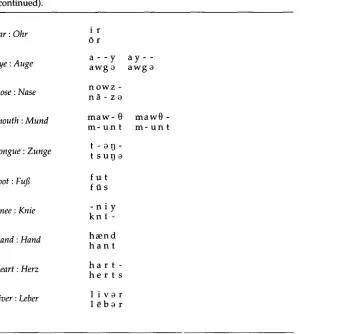
With English a n d G e r m a n it d i d almost as well (Tables 5 a n d 6). The s i n this is aligned with the w r o n g s i n dieses because that alignment gave greater p h o n e t i c similarity; taking off the inflectional e n d i n g w o u l d h a v e p r e v e n t e d this mistake. The alignments of m o u t h w i t h M u n d a n d eye w i t h A u g e gave the aligner some trouble; in each case it p r o d u c e d t w o alternatives, each getting p a r t of the alignment right.
Covington An Algorithm to Align Words
Table 4
Alignments obtained with test set of Spanish-French cognate pairs (continued).
drbol : arbre 'tree' a r b - o 1
a r b r o -
pluma : plume 'feather'
cabeza 'head' : cap 'promontory'
p l u m a p l u m - k a b e 0 a k a p - - -
boca : bouche 'mouth' b o k a
b u ~ -
pie : pied 'foot' P y e p y e
corazdn : coeur 'heart' k o r a O o n
k 6 r . . . .
,~p,~, b - e r
voir vel"
v w a r
venir : venir 'come' b e n i r
v o n i r d e 0 i r
decir : dire 'say' d - - i r
pobre : pauvre 'poor' p o b r e
p o v r o
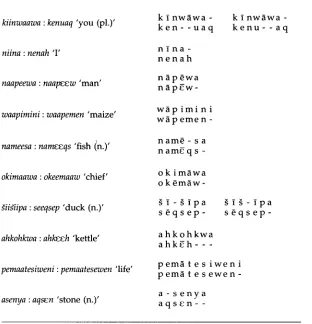
Table 9 s h o w s that the a l g o r i t h m w o r k s well w i t h n o n - I n d o - E u r o p e a n languages, in this case Fox a n d M e n o m i n i c o g n a t e s chosen m o r e or less r a n d o m l y f r o m Bloomfield (1941). A p a r t f r o m s o m e m i n o r trouble w i t h the suffix of the first item, the aligner h a d s m o o t h sailing.
Finally, Table 10 s h o w s h o w the aligner fared w i t h s o m e w o r d pairs i n v o l v i n g Latin, Greek, Sanskrit, a n d Avestan, a g a i n w i t h o u t k n o w l e d g e of m o r p h o l o g y . Because it k n o w s n o t h i n g a b o u t place of articulation or G r i m m ' s Law, it c a n n o t tell w h e t h e r the d i n d a u g h t e r c o r r e s p o n d s w i t h the th or the g in G r e e k thugat~r. But o n c e n t u m : h e k a t o n a n d c e n t u m : s a t o m the aligner p e r f o r m e d perfectly.
6. Improving the Alignment Algorithm
This a l i g n m e n t a l g o r i t h m a n d its e v a l u a t i o n metric are, in effect, a f o r m a l reconstruc- tion of s o m e t h i n g that historical linguists do intuitively. As such, t h e y p r o v i d e an e m p i r i c a l test of theories a b o u t h o w historical reconstruction is practiced.
Table 5
Alignments obtained with test set of English-German cognate pairs.
this : dieses 6 i - - s
d i z o s
t h a t : das 6 ~e t
d a s
w h a t : w a s w a t
v a s
n o t : n i c h t n a - t
n i x t
l o n g : l a n g 1 o I 3
l a o m~e n
m a n : M a n n
m a n f l e - ~
f l e s h : Fleisch
f l a y ~
blood : B l u t b 1 o d
b l Q t
~ o a ~ e r : F e d e r f e 6 ~ r
f @ d o r
h a i r : H a a r h a~ r
h a r
One obvious improvement would be to implement feature-based phonology. Im- plicitly, the aligner already uses two features, vocalicity and vowel length. A fuller set of features w o u l d have given a better alignment of p i s c i s with f i s h , preferring f : p
to f : k . Features are not all of equal importance for the evaluation metric; syllabicity,
for instance, will surely be more important than nasality. Using multivariate statistical techniques and a set of known "good" alignments, the relative importance of each feature could be calculated.
[image:10.468.53.397.83.418.2]Covington An Algorithm to Align Words
Table 6
Alignments obtained with test set of English-German cognate pairs (continued).
e a r : O h r i r
o r
e y e : A u g e a - - y a w g 0
n o s e : N a s e n o w z -
n a - z o
m o u t h : M u n d maw - 0
m - u n t
t o n g u e : Z u n g e t - o ~ -
t s u ~ o
f o o t : F u r l f u t
f O s
k n e e : K n i e - n i y
k n i -
h a n d : H a n d hahn d
h a n t
h e a r t " H e r z h a r t -
h e r t s
l i v e r : L e b e r 1 i v o r
l ~ b o r
a y ~ -
a w g o
mawO- m - u n t
Another crucial difference between my algorithm and dynamic programming is that, by altering the tree pruning criterion, m y algorithm can easily generate, not just the best alignment or those that are tied for the best position, but the n best alignments, or all alignments that are sufficiently close to the best (by any computable criterion).
Multilateral alignments are needed when more than two languages are being com- pared at once. For example,
e l - - l o i l -
is the etymologically correct three-way alignment of the masculine singular definite article in Spanish, French, and Italian. Multilateral alignments can be generated by aligning the second word with the first, then the third word with the second (and implicitly also the first), and so on, but it would be advantageous to apply the eval- uation metric to the whole set rather than just the pairs that are chained together. Multilateral alignment is also an important problem in DNA sequence analysis, and no general algorithm for it is known, but research is proceeding apace (Kececioglu
[image:11.468.39.391.85.419.2]~ b l e 7
M i ~ m e n t s o b t a i n e d w i t h t e s t s e t o f E n g l i s h - L a t m c o ~ a t e p a i r s .
a n d : a n t e 2end- a n t e
a t : a d a~ t
a d
b l o w : f l a r e b 1 - - ow- f l a r e -
e a r : a u r i s i - r - -
a w r i s
e a t : e d e r e i y t - - -
e - d e r e
- - - f i ~
f i s h : p i s c i s p i s k i s
f l o w : f l u e r e f l o w - - - f l - u e r e
s t a r : ste-lla s t a r - -
s t ~ l l a
- - - f u l
f u l l : p l ~ n u s p 1 ~ n u s
g r - - ~ e s
g r a s s : g r ~ m e n g r a m e n
h e a r t : c o r d i s (gen.) h a r - - t k o r d i s
h o r n -
h o r n : c o r n ¢
k o r n O
- - a y
I : e g o e g o -
f - - - i ~ f i - - - ~ f i ~ - - - p i s k i s p i s k i s p i s k i s
f - - - u l
p l e n u s
g r ~ - - s g r ~ s - - g r a m e n g r a m e n
h a r t - - k o r d i s
7. F r o m H e r e to t h e C o m p a r a t i v e M e t h o d
C o m p a r a t i v e r e c o n s t r u c t i o n c o n s i s t s o f t h r e e e s s e n t i a l s t e p s :
.
2.
3.
A l i g n t h e s e g m e n t s i n t h e ( p u t a t i v e ) c o g n a t e s ;
F i n d c o r r e s p o n d e n c e s e t s ( c o r r e s p o n d i n g to p r o t o - a l l o p h o n e s ) ;
Covington An Algorithm to Align Words
Table 8
Alignments obtained with test set of English-Latin cognate pairs (continued).
- - n i y
k n e e : g e n ~ g e n o -
m o t h e r : m a t e r mo 6 o r
m a t e r
m a w n t o n
m o u n t a i n : m G n s
m O - n - - s
n a m e : n f f m e n n e y m - - nO - m e n
n y u w - -
n e w : n o v u s
n - o w u s
w o n - -
o n e : a n u s
- f i n u s
r o u n d : r o t u n d u s r a - w n d - -
r o t u n d u s
SOW - - -
s e w : s u e r e S - u e r e
s i t : s ~ d e r e s i t - - -
s ~ d e r e
t h r e e : t r ~ s 0 r i y
t r ~ s
- - - t u w 0
t o o t h d e n t i s
~'~
~ben'/ d e n t i - s
t h i n : t e n u i s 0 i n - - -
t e n u i s
m a w n t o n m O - n s - -
n y u w - n o w u s
Kay (1964) n o t e d that the "right" set of alignments (of each of the cognate pairs) is the set that p r o d u c e s the smallest total n u m b e r of s o u n d correspondences. Steps 1 a n d 2 c o u l d therefore be a u t o m a t e d b y generating all possible alignments of all of the cognate pairs, then c h o o s i n g the set of alignments that gives the fewest c o r r e s p o n d e n c e sets.
As Kay notes, this is n o t practical. S u p p o s e the putative cognates are each 3 seg- m e n t s long. There are then 9 different alignments of each cognate pair, a n d if 100 cognate pairs are to be considered, there are 9 l°° ~ 2.65 x 1095 sets of alignments to choose from, far too m a n y to try o n e v e n the fastest computer.
[image:13.468.35.353.92.473.2]Table 9
Alignments obtained with test set of Fox-Menomini cognate pairs.
k i i n w a a w a : kenuaq 'you (pl.)' k i n w a w a - k e n - - u a q k i n w a w a - k e n u - - a q
niina : nenah T n i n a -
n e n a h
naapeewa : naap~,cw 'man'
w a a p i m i n i : w a a p e m e n 'maize'
nameesa : narnccqs 'fish in.)'
okimaawa : okeemaaw 'chief'
giigiipa : seeqsep 'duck (n.)'
ahkohkwa : ahlcceh 'kettle'
pemaatesiweni : pemaatesewen 'life'
asenya : aqs~n 'stone (n.)'
n a p ~ w a n a p g w - w a p i m i n i w a p e m e n -
n a m ~ - s a n a m ~ q s - o k i m a w a o k ~ m a w -
g i - g i p a g i g - i p a s ~ q s e p - s ~ q s e p - a h k o h k w a
a h k ~ h - - - p e m a t e s i w e n i p e m a t e s e w e n - a - s e n y a a q s c n - -
c o g n a t e pair, n o t i n g w h e t h e r the size of the set of c o r r e s p o n d e n c e sets decreases. If so, a d o p t the n e w a l i g n m e n t i n s t e a d of the p r e v i o u s one. For a set of 100 c o g n a t e pairs, this requires a total of o n l y a f e w h u n d r e d steps, a n d the result s h o u l d be close to the o p t i m a l solution. R e d u c t i o n of c o r r e s p o n d e n c e sets to p r o t o - p h o n e m e s is, of course, a s e p a r a t e task r e q u i r i n g a k n o w l e d g e b a s e of p h o n o l o g i c a l features a n d i n f o r m a t i o n a b o u t p h o n e t i c plausibility.
Appendix: Size of the Search Space
The total n u m b e r of a l i g n m e n t s of a p a i r of w o r d s of lengths m a n d n can b e calculated as follows. 4 Recall that a m a t c h c o n s u m e s a s e g m e n t of b o t h w o r d s ; a skip c o n s u m e s a
Covington An Algorithm to Align Words
Table 10
Alignments obtained with cognate pairs from other languages.
Greek did(Ymi : Latin d6 'I give' d i d o m i - - d O - -
Greek thugat¢r : German Tochter 'daughter' t h u t o
English daughter : Greek thugat¢r 'daughter' t h u
a - Latin ager : Sanskrit ajras 'field' a j
g a t ~ r x - t o r d o t o r g a t ~ r g e r r a s
Sanskrit bhar~mi : Greek pher6 'I carry'
Latin centum : Greek hekaton '100'
Latin centum : Avestan satom '100'
d i d o m i d - - O - -
d - - o t o r t h u g a t @ r a g - e r a g e r - - a j r a s a j - r a s
d o - - t o r t h u g a t @ r
b h a r a m i b h a r a m i p h e r - - 6 p h e r o - -
- - k e n t u m h e k a - t o n k e n t u m s a - t o m
s e g m e n t f r o m o n e w o r d b u t not the other. The c o m p l e t e a l i g n m e n t h a s to c o n s u m e all the s e g m e n t s of b o t h words. Accordingly, a n y a l i g n m e n t containing k m a t c h e s m u s t also contain m - k skips on the first w o r d a n d n - k skips on the second w o r d . The n u m b e r of m a t c h e s k in t u r n r a n g e s f r o m 0 to min(m, n). Thus, in general, the n u m b e r of possible a l i g n m e n t s is
min(m,n)
A l i g n m e n t s ( m , n) = Z n u m b e r of a l i g n m e n t s containing k m a t c h e s k=0
W i t h o u t the no-alternate-skip rule, the n u m b e r of a l i g n m e n t s containing k m a t c h e s is s i m p l y the n u m b e r of w a y s of p a r t i t i o n i n g a set of k + (m - k) + (n - k) = m + n - k m o v e s into k m a t c h e s , m - k skips on w o r d 1, a n d n - k skips on w o r d 2:
min(m,n) (m + n - k)! A l i g n m e n t s ( m , n ) -- Z k!(m - k)!(n - k)!
k=0
(To give y o u a n idea of the m a g n i t u d e , this is close to 5n/2 for cases w h e r e m -- n a n d n < 20 or so.)
With the n o - a l t e r n a t e - s k i p rule, the n u m b e r of a l i g n m e n t s is e x p o n e n t i a l l y smaller (about 3 n-1 w h e n m = n) a n d can be calculated f r o m the recurrence relation
n - 2 m--2
a(m,n) = a ( m - 1 , n - 1) + Z a ( m - 1,i) + Z a ( i , n - 1)
i=0 i=0
[image:15.468.38.418.81.326.2]References
Anttila, Raimo. 1989. Historical and
Comparative Linguistics. Second revised
edition. Amsterdam Studies in the Theory and History of Linguistic Science, W: Current Issues in Linguistic Theory, 6. Benjamins, Amsterdam.
Bloomfield, Leonard. 1941. Algonquian. In C. Osgood, editor, Linguistic Structures of
Native America. Viking Fund Publications
in Anthropology, 6. Reprint, Johnson Reprint Corporation, New York, 1963, pages 85-129.
Covington, Michael A. and Canfield, E. Rodney. In preparation. The number of distinct alignments of two strings. Research report, Artificial Intelligence Center, The University of Georgia. Frantz, Donald G. 1970. A PL/1 program to
assist the comparative linguist.
Communications of the ACM, 13:353-356.
Guy, Jacques B. M. 1994. An algorithm for identifying cognates in bilingual wordlists and its applicability to machine
translation. Journal of Quan titative
Linguistics, 1:35-42.
Hewson, John. 1974. Comparative reconstruction on the computer. In John M. Anderson and Charles Jones, editors,
Historical Linguistics h Syntax, Morphology, Internal and Comparative Reconstruction.
North Holland, Amsterdam, pages 191-197.
Kay, Martin. 1964. The logic of cognate
recognition in historical linguistics. Memorandum RM-4224-PR. The RAND Corporation, Santa Monica.
Kececioglu, John. 1993. The maximum weight trace problem in multiple sequence alignment. In A. Apostolico et al., editors, Combinatorial Pattern Matching:
4th Annual Symposium, Springer, Berlin,
pages 106-119.
Lowe, John B. and Martine Mazaudon. 1994. The reconstruction engine: A computer implementation of the comparative method. Computational
Linguistics, 20:381-417.
Ringe, Donald A., Jr. 1992. On Calculating the Factor of Chance in Language Comparison.
American Philosophical Society, Philadelphia.
Sankoff, David and Joseph B. Kruskal, editors. 1983. Time Warps, String Edits, and Macromolecules: The Theory and Practice of
Sequence Comparison. Addison-Wesley,
Reading, MA.
Ukkonen, Esko. 1985. Algorithms for approximate string matching. Information
and Control, 64:100-118.
Waterman, Michael S. 1995. Introduction to Computational Biology: Maps, Sequences and
Genomes. Chapman & Hall, London.
Wimbish, John S. 1989. WORDSURV: A program for analyzing language survey word lists. Summer Institute of
![Figure 1 shows, in the form of a tree, all of the moves that the aligner might try while attempting to align two three-letter words (English [h~ez] and German [hat])](https://thumb-us.123doks.com/thumbv2/123dok_us/1277391.656020/3.468.122.315.206.303/figure-aligner-attempting-align-letter-words-english-german.webp)