Abstract— In this paper an innovative method for one and seven-day forecast of electricity load is proposed. The new approach has been tested on three different cases from south-west Western Australia’s interconnected system. They have been tested under the most realistic conditions by considering only minimum and maximum forecasts of temperature and relative humidity as available future inputs. Two different nonlinear approaches of neural networks and decision trees have been applied to fit proper models. A modified version of mean absolute percentage error (MMAPE) of each model over the test year is presented. By applying a developed criterion to recognize the dominant component of the electricity load, user of this work will be able to choose the most efficient forecasting method.
Index Terms— load forecasting, neural networks, decision trees, signal reconstruction
I. INTRODUCTION
HE complexities of nowadays electricity markets are enormous [1]. Electricity is traded based on bilateral contracts between energy providers and energy consumers. The role of electricity demand forecasting is very significant in present electricity markets and an accurate load forecast introduces significant savings in costs and improvement in network reliability. Forecasts ranging from several hours to seven days are known as short term load forecasts (STLF). Applications of STLF are in dispatching and commitment of generators, load shedding and determining the market prices. Because of its importance many methods have been developed to perform STLF. A review of the previous methods are addressed in [2–4]. The focus of this paper is on two methods of artificial neural networks (ANN), and decision trees. References [5], [6] have applied neural networks for hourly load forecasts. Applications of artificial neural networks in one-day load forecasts have been addressed in [7], [8]. Weather inputs have not been considered in [7], and [8] has assumed measured values of temperatures during the test period. Using the measured values of weather variables in load forecasting instead of simulated or reconstructed values, makes the method incapable of performing the forecast in real world problems when measured values of weather variables are not available at the time of forecasting. An adaptive neural network approach has been used for seven-day forecast of electricity
* This work is supported by Murdoch University, Western Australia, 6150.
M. K. Moghaddam and P. A. Bahri are with the School of Engineering and Energy, Murdoch University, Western Australia, 6150 (E-mails: [email protected], [email protected] ).
load in [9], in which the weather variables have not been directly considered as inputs. Electricity load is decoupled into three different ranges of frequencies and each range is forecasted by one neural network. Deviation of the achieved load forecast from the real one defines the temperature sensitive component which is forecasted by another neural network. Unfortunately the method has been tested during the winter time in the north east of USA where, because of heavy snow and freezing cold weather during the winter time, electric heating is not common. According to [1] temperature-load curve of such a kind of load makes a hockey stick shape with very small correlation between temperature and load in the cold season. Reference [10] applied decision trees to forecast the demand in retail sale. Decision trees have been introduced as a potential method to predict a one-day load in Spanish power systems in [11].
Although numerous methods have been proposed for the short-term forecasting of electricity load, there is no superior forecasting approach that can be applied on all the different systems [1]. The main reasons for that are the unique characteristics of each system, and also the different consumer behaviours. Such characteristics become more significant in spatial load forecasting applications. More vital information from the grid can be extracted by having the spatial load forecast in hand. As mentioned by [12] a spatial forecast that covers all the regions of the service area can assure the planner that nothing has been missed in the utility transmission and distribution planning. Spatial load forecasting divides the service area into different regions and each region load has its own characteristics. In this paper different load behaviours of a sample service area will be thoroughly investigated and the efficiency of two forecasting methods will be tested. By defining a load type determination criterion the best approach for the presented benchmarks will be selected.
II. CASE STUDY
In real world problems the electricity load data are composed of residential, industrial and commercial components. To study the characteristics of each component individually, three different benchmarks will be used. A pure residential area, an industrial area, and a dominantly commercial area in south-west Western Australia have been selected as the case studies. The main reason for choosing a pure residential load for model testing is that there are no high autocorrelations of industrial load in the data, so the model should be able to capture all the behaviours of
A Novel Approach for Forecasting of
Residential, Commercial and Industrial
Electricity Loads*
Mehdi K. Moghaddam, Parisa A. Bahri
households. The selected residential area load is highly temperature sensitive. The region is called East Perth metropolitan area and consists of one 6.6 kV and six 22 kV distribution substations and the total of seventeen transformers. Kalgoorlie1 area has been selected as the industrial load sample. Industrial loads have their own complexities; for example the random behaviour of a large industrial customer can dramatically deviate the real load from the forecasted one. The region consists of one 11 kV and three 33 kV distribution substations and the total of seventeen transformers. And finally, Perth CBD with nine substations and the total of twenty five transformers has been selected as the dominantly commercial load. Compared to residential loads, commercial loads exhibit higher temperature sensitivity in hot seasons and lower temperature sensitivity in cold seasons.
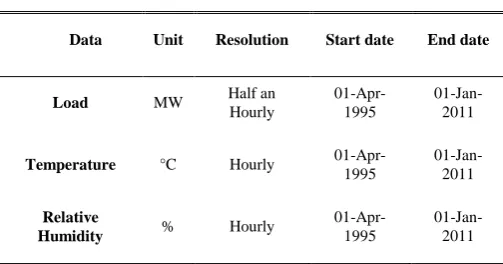
[image:2.595.324.540.60.234.2]The load information of each individual transformer has been extracted from the database of Western Power, the company that is responsible for building, maintaining and operating SWIS2 electricity grid. The load data are then added up to find the electricity load of the test regions. The weather data are provided by the Australian Bureau of Meteorology (BOM). The specifications of raw data for the short term forecasting framework are presented in Table I.
Table I. Raw data specifications
Data Unit Resolution Start date End date
Load MW Half an
Hourly
01-Apr-1995
01-Jan-2011
Temperature °C Hourly
01-Apr-1995
01-Jan-2011
Relative
Humidity % Hourly
01-Apr-1995
01-Jan-2011
III. DATA PREPARATION
A. Removing Outliers and Missing Data Points
The raw input data are composed of seven-day minimum and maximum temperature and relative humidity forecasts and also the historical data of load, temperature and relative humidity. A plot of Kalgoorlie load data for fifteen years of observation is presented in Fig. 2. The presented figure contains the raw data. It can be seen that during the first 50,000 samples the load has been dramatically increased. The main reason for that is commissioning new industrial projects. In the future steps this part will be excluded from the industrial load data to increase the forecasting accuracy. As it can be seen, the raw data have some outliers. There also exist some missing data points in this figure that are not observable unless you zoom in.
1
Also known as country goldfields
[image:2.595.42.294.376.508.2]2 SWIS: South west interconnected system
Fig. 1. Kalgoorlie raw data for fifteen years of observation
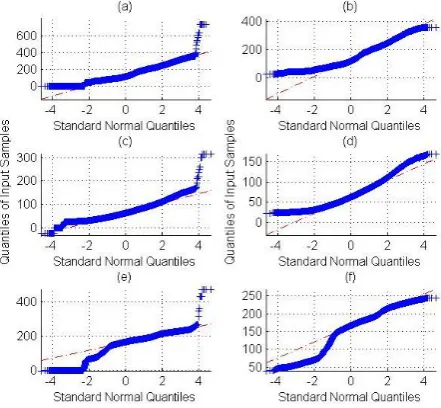
After resolution adjustment, outliers and missing data points need to be removed. According to the available literature on electricity load consumption behaviours [13– 15] and also the practical methods that are being used in electricity industries a transformer load in a specific time of a day is closely related to previous and future weeks3 load data at the same time of the same day. Missing data points have been replaced by the average of previous and future weeks’load of the same hour of the same weekday.
As being recommended by [1], one dimensional median filtering can be used for outliers removal. But median filtering by itself is not capable of removing all the outliers automatically. To capture normal outliers a short window should be used. A long window needs to be applied after that to capture outliers in a row. Human supervision is also required for outlier removals. The human expert can change the window sizes and investigate the data graphs and Q-Q4 plots to make sure that the outliers have been removed properly. Supervised one dimensional median filtering has been used for outliers’ removal. Q-Q plots of the three systems, before, and after the outliers’ removal step are presented in Fig. 2 Outliers can be easily identified in panel (a), (c) and (e) which contain the raw data of Perth CBD, East Perth and Kalgoorlie respectively. Panels (b), (d) and (f) confirm the capability of this method in outliers’ removal.
3 The correlation between the load data decreases as the number of
weeks increases. In this study the maximum number of two future weeks and two previous weeks has been used for missing data estimation.
4
Fig. 2. Q-Q plot of load data versus standard normal, (a) raw commercial load, (b) commercial load without outliers and missing data
points, (c) raw residential load, (d) residential load without outliers and missing data points, (e) raw industrial load, (f) industrial load without
outliers and missing data points
B. Clustering and Signal Reconstruction
Clustering has been intensively used in load forecasting applications [16–18]. Because of the seasonal nature of weather variables and electricity consumption, clustering can help in deriving very important information out of the data set. Weather forecasters are usually capable of giving out seven-day forecasts of weather variables in a limited resolution5 of time. Because of the unpredictable nature of influential variables on weather systems, forecasts of beyond this horizon cannot be accurate enough to rely on.
The most important elements of weather for electricity demand forecasting are temperature and relative humidity [12]. In load forecasting applications the input data to the framework should be realistic and available at the time of running the framework. If not, the framework would become useless for practical applications. To avoid this issue, only the minimum and maximum values of temperature and relative humidity for seven days are considered as the future weather inputs of this framework.
To extract the weather distribution data out of the available minimum and maximum forecasts, historical data of temperature and relative humidity are clustered. Data sets of each cluster follow a similar pattern. By recognizing such a kind of pattern in the clusters and using the maximum and minimum forecasts of temperature and relative humidity, their signals are reconstructed. Fig. 3 shows daily temperature of a representative cluster with a regular pattern to be easily be seen in that. With the help of clustering, and using the available seven-day forecast of maximum and minimum temperature and relative humidity, weather signals can be accurately reconstructed as a feed to training models.
5
Although sometimes these forecasts are available for every three hour of the following week, to avoid the loss of generality only minimum and maximum values of temperature and humidity are considered to be available to this framework at the time of forecasting.
IV. BEHAVIORS OF RESIDENTIAL,INDUSTRIAL AND
COMMERCIAL LOADS
Behaviors of residential, industrial and commercial loads are different. Although in the practical case the load can be a combination of all the three types, it is worthwhile to study the properties of each separately. In this section the ways that these loads can be distinguished from each other will be presented. A criterion will be proposed to recognize the dominancy of any of the mentioned types in a load data set. This criterion can then be used in places where the dominant type of load is not known.
A. Temperature Sensitivity
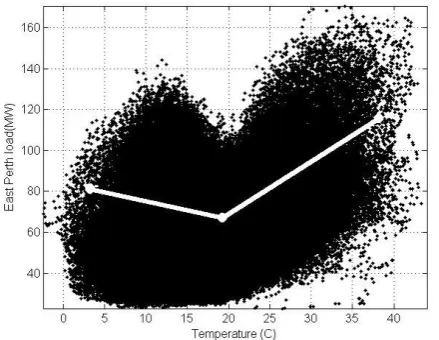
The following are the region’s load versus temperature for 15 years of data. The white line in each graph roughly shows the regression between load and temperature during the hot and cold seasons. In most of the cases, the slope of the line shows positive regression in the hot season and negative regression for the cold season.
[image:3.595.333.519.478.619.2]Fig. 4 shows the scatter plot of East Perth electricity consumption versus temperature over fifteen years of observation. It can be seen that, in the residential case, electricity consumption is very sensitive to temperature changes, and household cooling and heating demands strongly affect the load. The temperature correlation with load exhibits seasonal changes. At around 20°C, which is known as the comfort region, the temperature-load correlation is close to zero. Positive regression for the hot season and negative regression for the cold season is very clear in this figure. The reason behind this type of graph is the fact that East Perth is mainly a residential area and people of that area use electricity both for cooling and heating purposes.
Fig. 3. Daily temperature distribution of a representative cluster from East Perth
Fig. 6 shows the electricity load of country goldfields versus temperature. White lines are almost flat in this graph. That illustrates a negligible temperature sensitivity of load for this case. Irrespective of the outside temperature, load varies based on the factory demand. This confirms the fact that this region is dominated by industrial loads.
[image:4.595.315.533.59.234.2]It can be concluded that more integration of residential load into a grid will introduce more temperature sensitivity and on the other hand more integration of industrial load will reduce it. The behavior of commercial loads is very similar to residential loads in the hot season and resembles industrial loads in cold seasons. It is very important to mention that such kind of conclusions can be only valid for the places where people use electricity for both cooling and heating purposes. If the users do not use electricity for heating purposes then the temperature-load regression during the winter will be zero (flat line) and the similar case will happen if the users do not use electricity for cooling purposes. The latter case is very rare but the example would be the customers who are using absorption chillers.
Fig. 4. Half an hourly electrical load consumption (MW) of the residential region versus temperature data (degrees Celsius) from fifteen
years of observation
Fig. 5. Half an hourly electrical load consumption (MW) of the commercial region versus temperature data (degrees Celsius) from fifteen
years of observation
Fig. 6. Half an hourly electrical load consumption (MW) of the industrial region versus temperature data (degrees Celsius) from fifteen
years of observation
B. Data Distributions
Another way of distinguishing among the three types of loads is distribution analysis. Q-Q plots of the electricity load versus three different distributions are presented bellow.
Fig. 7 and Fig. 8 illustrate the Q-Q plots of all three types of load versus Rayleigh (R) and generalized Pareto (GP) distributions. In both figures the best fit is for commercial load. It is not completely fitted for the residential load but it is a fairly good fit compared to the industrial one which shows a totally different distribution.
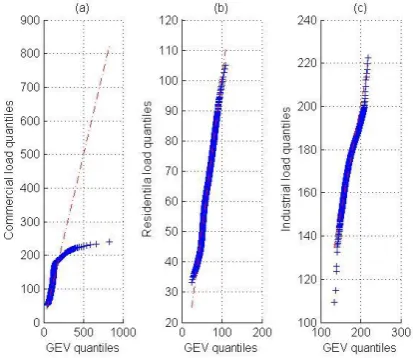
Generalized extreme value (GEV) distribution has been used in Fig. 9. Unlike the previous ones, the fit is very good for the industrial and the residential cases. The commercial load cannot be fitted by this type of distribution.
[image:4.595.57.277.321.491.2] [image:4.595.58.274.545.715.2]Fig. 7. (a). Q-Q plot of commercial load versus Rayleigh distribution, (b). Q-Q plot of residential load versus Rayleigh distribution, (c). Q-Q plot
of industrial load versus Rayleigh distribution
Fig. 8 (a). Q-Q plot of commercial load versus generalized Pareto distribution, (b). Q-Q plot of residential load versus generalized Pareto distribution, (c). Q-Q plot of industrial load versus generalized Pareto
distribution
Fig. 9 (a). Q-Q plot of commercial load versus generalized extreme value distribution, (b). Q-Q plot of residential load versus generalized
[image:5.595.66.276.53.235.2]extreme value distribution, (c). Q-Q plot of industrial load versus generalized extreme value distribution
Table II Load type determination criterion
Distribution Commercial Residential Industrial
R good fairly good bad GP good fairly good bad GEV bad good good
V. RESULTS,OBSERVATIONS AND DISCUSSIONS
After pre-processing and clustering the data, thirteen sets of input variables are defined based on the available temporal and weather data as the feed for the training models. Preparing a proper set of input variables is a very significant step in any training procedure and it can strongly affect the accuracy of the method. Proper input data includes either variables with good correlation with the output data or variables that help to classify the other input variables. The input variables are year, month, day of the week, hour of the day, temperature, relative humidity, previous-day same-hour demand, previous-week same-hour demand, holidays6, average past-twenty-four-hour demand, average past-seven-day demand, summer temperature to help the classification of temperature in hot days, and winter temperature to distinguish the cold-day temperature.
The set of feed variables to train the models consists of thirteen column vectors of input variables with, a total of 275,513 observations in each vector and one column vector of the same size for target variables. The number of observations in each column of industrial load is 225,513.
Two different nonlinear training methods of artificial neural networks (ANN), and decision trees learning have been used in this study. Input and target variables for the training period have been used to find the optimum configuration for ANN, and bagging decision trees. The neural network has 13 input neurons, 40 hidden neurons and one output neuron. The network trained using the back error propagation algorithm. Because of its performance under classification noise, bagging has been selected for ensembles’ construction of decision trees [19]. 40 bagged regression trees have been used for the training purpose.
The residential and commercial models have been trained with fourteen years of data from April, 1995 to December, 2009. And, the industrial load model has been trained with eleven years of data from January 1998 to December, 2009. The testing period is the year 2010 for all the cases. Once the training procedures are done, the trained models can be used for future simulations. Using the single-day forecast and the reconstructed temperature and humidity signals as a new input set to the trained models, the forecasting horizon can be stretched from one day to seven days.
Because different benchmarks have different average load, mean absolute percentage error (MAPE) may not be able to present a good comparison. For a better comparison of the performance of the models for out of sample data
[image:5.595.299.556.66.132.2] [image:5.595.65.275.300.478.2] [image:5.595.66.273.534.713.2](during the test year), modified mean absolute percentage error has been defined in (1).
z except regions the all of Number T samples of Number N load Forecasted F load Actual A A F A N A N A N T MMAPE N t zt zt zt T i N t it N t zt z : : : : 1 1 1 1 1 1
(1)Equation (1) will basically multiply the MAPE value by a coefficient which is a function of average load in different regions. The resulting MMAPE is not affected by the average load of the region itself.
[image:6.595.59.274.71.186.2]Daily and weekly MMAPE of both models have been calculated for each month of the test period. The results are shown in Tables III, IV and V. It can be seen that both methods perform very similarly. The daily MMAPE of all of the applied methods is less than 5% which as investigated by [20] is within the range of adequate forecast and the economic impact of more accurate forecasts is very small.
Table III. MMAPE of East Perth for out of sample data (2010 test year) D a il y M M A PE NN D a il y M M A PE DT We ek ly M M A PE NN We ek ly M M A PE DT A v er a g e T emper a tu re (C)
Jan 2.8 3.4 3.9 4.1 24.3
Feb 2.3 2.4 3.5 3.7 24.7
Mar 2.6 2.4 3.6 3.5 22.6
Apr 2.2 1.4 3.3 2.8 18.3
May 2.3 1.4 3.3 2.9 14.2
Jun 2.1 1.5 2.9 2.7 11.2
Jul 2.3 1.8 3.1 2.9 11.8
Aug 2.3 1.6 3.3 2.7 12.2
Sep 2.1 1.4 3.0 2.8 15.1
Oct 1.9 1.3 3.0 2.5 17.5
Nov 2.1 2.5 3.3 3.8 22
Dec 2.3 2.3 3.3 3.6 22.6
It can be observed that for hot months neural networks is a better choice for forecasting the electricity load of residential and commercial load. On the other hand it would be better to use decision trees for the rest of year. The situation is totally different for the industrial case. It can be seen that decision trees perform better for all the months of the test year of the industrial case irrespective of the temperature. Decision trees perform better than neural networks when the system’s nonlinearity is low. But when the system’s nonlinearity increases, neural networks will be a better choice. In load forecasting applications the higher
[image:6.595.44.294.363.636.2]the temperature sensitivity, the higher the nonlinearities will be in the system.
Table IV. MMAPE of Perth CBD for out of sample data (2010 test year) D a il y M M A PE N N D a il y M M A PE D T We ek ly M M A PE NN We ek ly M M A PE D T A v er a g e T emper a tu re (C)
Jan 4.3 4.9 5.5 5.8 25.5
Feb 3.7 4.0 4.7 4.9 24.4
Mar 4.1 4.5 5.4 5.6 23.1
Apr 3.0 3.0 4.0 3.8 18.7
May 2.0 1.4 2.8 2.3 14.7
Jun 2.5 2.4 3.4 3.3 12.3
Jul 2.6 2.0 3.7 3.0 11.3
Aug 2.6 1.4 3.8 2.3 12.3
Sep 2.9 1.6 3.8 2.5 14.8
Oct 2.7 1.5 3.8 2.5 17.4
Nov 3.3 2.8 4.3 4.0 22.0
Dec 4.7 4.2 5.6 5.1 22.5
Table V. MMAPE of Kalgoorlie for out of sample data (2010 test year) D a il y M M A PE N N D a il y M M A PE D T We ek ly M M A PE N N We ek ly M M A PE D T
Jan 3.3 3.0 4.1 3.7
Feb 3.1 2.6 4.1 3.5
Mar 3.0 2.3 4.0 3.2
Apr 3.1 2.6 4.0 3.4
May 3.9 2.1 4.8 3.1
Jun 4.5 2.3 6.5 3.2
Jul 3.6 2.3 4.7 3.9
Aug 3.9 2.4 5.6 3.3
Sep 3.3 2.6 4.2 3.8
Oct 3.8 2.0 4.8 3.0
Nov 4.1 2.5 5.3 3.1
Dec 3.7 2.5 4.8 3.6
[image:6.595.305.548.405.668.2]system decision trees or a combination of decision trees and neural networks can be used for dominantly commercial and residential cases.
ACKNOWLEDGMENT
The authors gratefully acknowledge Matthew Kok, Roshan Fernando, Kim Eddy, Duy Nguyen, Mart Bondoc, and Raphael Ozsvath from Western Power for their contribution in extracting the regional electricity load data of SWIS and also Michelle Dal Pozzo from BOM for providing the regional weather information of south west of Western Australia.
REFERENCES
[1] R. Weron, Modeling and forecasting electricity loads and prices A
Statistical Approach. 2006, p. 178.
[2] H. K. Temraz, M. M. a. Salama, and A. Y. Chikhani, “Review of electric load forecasting methods,” in IEEE Canadian Conference on
Electrical and Computer Engineering, 1997, vol. 1, pp. 289–292.
[3] G. Kourtis, I. Hadjipaschalis, and A. Poullikkas, “An overview of load demand and price forecasting methodologies,” International
Journal of Energy and Environment, vol. 2, no. 1, pp. 123-150,
2011.
[4] H. Hahn, S. Meyer-Nieberg, and S. Pickl, “Electric load forecasting methods: Tools for decision making,” European Journal of
Operational Research, vol. 199, no. 3, pp. 902-907, Dec. 2009.
[5] A. Sharaf, T. Lie, and H. Gooi, “A neural network based short term load forecasting model,” in IEEE Canadian Conference on Electrical
and Computer Engineering, 1993, pp. 325–328.
[6] D. C. Park, M. El-Sharkawi, R. Marks, L. Atlas, and M. Damborg, “Electric load forecasting using an artificial neural network,” IEEE
Transactions on Power Systems, vol. 6, no. 2, pp. 442–449, 1991.
[7] N. Amral, D. King, and C. S. Ozveren, “Application of artificial neural network for short term load forecasting,” 43rd International
Universities Power Engineering Conference, pp. 1-5, Sep. 2008.
[8] S. Munkhjargal and V. Z. Manusov, “Artificial neural network based short-term load forecasting,” in The 8th Russian-Korean
International Symposium on Science and Technology, 2004, vol. 1,
pp. 262-264.
[9] T. Peng, N. Hubele, and G. Karady, “An adaptive neural network approach to one-week ahead load forecasting,” IEEE Transactions on
Power Systems, vol. 8, no. 3, pp. 1195–1203, 1993.
[10] P. K. Bala, “Decision tree based demand forecasts for improving inventory performance,” in IEEE International Conference on
Industrial Engineering and Engineering Management, 2010, pp.
1926–1930.
[11] E. Lobato, A. Ugedo, and R. Rouco, “Decision Trees Applied to Spanish Power Systems Applications,” IEEE 9th International
Conference on Probabilistic Methods Applied to Power Systems, pp.
1-6, Jun. 2006.
[12] H. L. Willis, Spatial Electric Load Forecasting, Second Edition, vol. 71, no. 2. CRC, 2002, p. 760.
[13] D. Asber, S. Lefebvre, J. Asber, M. Saad, and C. Desbiens, “Non-parametric short-term load forecasting,” International Journal of
Electrical Power & Energy Systems, vol. 29, no. 8, pp. 630-635, Oct.
2007.
[14] A. Seppälä, “Load research and load estimation in electricity distribution,” Technical research centre of Finland, 1996.
[15] R. J. Hyndman and S. Fan, “Density Forecasting for Long-Term Peak Electricity Demand,” IEEE Transactions on Power Systems, vol. 25, no. 2, pp. 1142-1153, May 2010.
[16] G. Chicco, R. Napoli, and F. Piglione, “Load pattern clustering for short-term load forecasting of anomalous days,” in IEEE Porto
Power Tech Proceedings, 2001, vol. 2.
[17] A. Jain and B. Satish, “Clustering based Short Term Load Forecasting using Artificial Neural Network,” in IEEE/PES Power Systems
Conference and Exposition, 2009, pp. 1-7.
[18] M. Meng, J.-chang Lu, and W. Sun, “Short-Term Load Forecasting Based on Ant Colony Clustering and Improved BP Neural Networks,”
in International Conference on Machine Learning and Cybernetics,
2006, pp. 3012-3015.
[19] T. Dietterich, “An experimental comparison of three methods for constructing ensembles of decision trees: Bagging, boosting, and randomization,” Machine learning, vol. 22, pp. 1-22, 2000. [20] D. K. Ranaweera, G. G. Karady, and Richard. G. Farmer, “Economic
impact analysis of load forecasting,” IEEE Transactions on Power