Squibs and Discussions
Memoization in Top-Down Parsing
M a r k J o h n s o n " Brown University
1. Introduction
In a paper published in this journal, Norvig (1991) pointed out that memoization of a top-down recognizer program produces a program that behaves similiarly to a chart parser. This is not surprising to anyone familiar with logic-programming approaches to natural language processing (NLP). For example, the Earley deduction proof procedure is essentially a memoizing version of the top-down selected literal deletion (SLD) proof procedure employed by Prolog. Pereira and Warren (1983) showed that the steps of the Earley Deduction proof procedure proving the well-formedness of a string S from the standard 'top-down' definite clause grammar (DCG) axiomatization of a context- free grammar (CFG) G correspond directly to those of Earley's algorithm recognizing S using G.
Yet as Norvig notes in passing, using his approach the resulting parsers in general fail to terminate on left-recursive grammars, even with memoization. The goal of this paper is to discover w h y this is the case and present a functional formalization of memoized top-down parsing for which this is not so. Specifically, I show how to formulate top-down parsers in a 'continuation-passing style,' which incrementally enumerates the right string positions of a category, rather than returning a set of such positions as a single value. This permits a type of memoization not described to my knowledge in the context of functional programming before. This kind of memoization is akin to that used in logic programming, and yields terminating parsers even in the face of left recursion.
In this paper, algorithms are expressed in the Scheme programming language (Rees and Clinger 1991). Scheme was chosen because it is a popular, widely known language that many readers find easy to understand. Scheme's 'first-class' treatment of functions simplifies the functional abstraction used in this paper, but the basic approach can be implemented in more conventional languages as well. Admittedly elegance is a matter of taste, but personally I find the functional specification of CFGs described here as simple and elegant as the more widely known logical (DCG) formalization, and I hope that the presentation of working code will encourage readers to experiment with the ideas described here and in more substantial works such as Leermakers (1993). In fact, my own observations suggest that with minor modifications (such as the use of integers rather than lists to indicate string positions, and vectors indexed by string positions rather than lists in the memoization routines) an extremely efficient chart parser can be obtained from the code presented here.
Ideas related to the ones discussed here have been presented on numerous occa- sions. Almost 20 years ago Shiel (1976) noticed the relationship between chart parsing and top-down parsing. Leermakers (1993) presents a more abstract discussion of the functional treatment of parsing, and avoids the left-recursion problem for memoized
Computational Linguistics Volume 21, Number 3
functional parsers by using a 'recursive ascent' or PLR parsing strategy instead of a top-down strategy. At a more abstract level than that of this paper, Shieber, Schabes, and Pereira (1994) show that a variety of well-known parsing algorithms can be viewed as computing the closure of a set of basic parsing operations on a representation of the input string.
2. Formalizing Context-Free Grammars
It is fairly straightforward to implement a top-down parser in a functional program- ming language. The key insight is that a nonterminal category A in a grammar defines a function fA that maps a string position 1 in the input string 7 to a set of string po- sitions
fA(l)
such thatr C fA(1)
iff A can derive the substring of "7 spanning string positions I to r (see e.g., Leermakers [1993] for discussion).For example, suppose V, gP, and S are already bound to
fv, fwP
andfs,
and the grammar contains the following productions with VP on the left hand side.(1) VP --+ V NP VP --+ V S
Then the following Scheme definition binds vp to
fvP.
(2) (define (VP p)
(union (reduce union '() (map NP (V p))) (reduce union '() (map S (V p))))))
If sets are represented by unordered lists, union can be given the following defini- tion. The function reduce is defined such that an expression of the form (reduce f e' (xl ...
Xn))
evaluates to ( f (... 0 c e Xl)...)Xn).(3)
(4)
(define (reduce fn init args) (if (null? args)
init
(reduce fn (fn init (car args)) (car args))))
(define (union set1 set2) (if (null? set1)
set2
(if (member (car set1) set2) (union (cdr set1) set2) (cons (car set1)
(union (cdr set1) set2)))))
When evaluated using Scheme's applicative-order reduction rule, such a system be- haves as a depth-first, top-down recognizer in which nondeterminism is simulated by backtracking. For example, in (2) the sequence V NP is first investigated as a potential analysis of VP, and then the sequence V S is investigated.
Rather than defining the functions f by hand as in (2), higher-order functions can be introduced to automate this task. It is convenient to use suffixes of the input string to represent the string positions of the input string (as in DCGs).
Mark Johnson Memoization in Top-Down Parsing
(5)
(define (terminal X) (lambda (p)(if (and (pair? p)
(eq? (car p) X)) (list (cdr p))
' ( ) ) ) )
The expression (seq fA fB) evaluates to a function that maps a string position 1 to the set of string positions
{ri}
such that there exists an m 6 fA(1), andri 6 fB(rrl).
Informally, the resulting function recognizes substrings that are the concatenation of a substring recognized by fA and a substring recognized by f~.(6) (define (seq A B) (lambda (p)
(reduce union '() (map B (A p)))))
The expression ( a l t
fA fB)
evaluates to a function that maps a string position 1 tofa(l) U fB(1).
Informally, the resulting function recognizes the union of the substrings recognized byfA
and fB.(7) (define (alt A B) (lambda (p)
(union (A p) (B p))))
While t e r m i n a l , seq, and a l t suffice to define (epsilon-free) context-free grammars, we can easily define other useful higher-order functions. For example, e p s i l o n recog- nizes the empty string (i.e., it maps every string position 1 into the singleton set {1}), (opt fA) recognizes an optional constituent, and (k* f,O recognizes zero or more occur- rences of the substrings recognized by fA.
(8)
(9)
(10)
(define epsilon list)
(define (opt A) (alt epsilon A))
(define (k* A) (alt epsilon
(seq A (k* A))))
These higher-order functions can be used to provide simpler definitions, such as (2a) or (2b), for the function VP defined in (2) above.
(2a)
(2b)
(define VP (alt (seq V NP) (seq V S)))
(define VP (seq V (alt NP S)))
This method of defining the functions corresponding to categories is quite appealing. Unfortunately, Scheme is deficient in that it does not allow mutually recursive func- tional definitions of the kind in (2a) or (2b). For example, suppose S is defined as in (11) and VP is defined as in (2a).
Computational Linguistics Volume 21, Number 3
Further, s u p p o s e (11) p r e c e d e s (2a) textually in the p r o g r a m . T h e n the v a r i a b l e VP in (11) will b e incorrectly i n t e r p r e t e d as u n b o u n d . C h a n g i n g the o r d e r of the definitions will not help, as t h e n the variable S will be u n b o u n d . ~ A w o r k - a r o u n d is to a d d a vac- u o u s l a m b d a abstraction a n d a p p l i c a t i o n as in (11a), in effect d e l a y i n g the e v a l u a t i o n of function definition.
(11a)
(define S (lambda args (apply (seq NP VP) args)))With a m a c r o definition such as (12) ( n a m e d to r e m i n d us of this deficiency in the c u r r e n t S c h e m e specification a n d p e r h a p s e n c o u r a g e the l a n g u a g e d e s i g n e r s to do better in the future), the definition of functions s u c h as (11a) can be w r i t t e n as (11b).
(12)
(define-syntax vacuous (syntax-rules ()((vacuous fn)
(lambda args (apply fn args)))))
(11b) (define S (vacuous (seq NP VP)))
Figure 1 contains a f r a g m e n t d e f i n e d in this way. After these definitions h a v e b e e n loaded, a n expression such as the o n e in (13) can be evaluated. It r e t u r n s a list of the i n p u t string's suffixes that c o r r e s p o n d to the right string p o s i t i o n of a n S.
(13) > (s '(Kim knows every student likes Sandy)) ((likes sandy) ())
In e x a m p l e (13), the list resulting f r o m the e v a l u a t i o n contains t w o suffixes, corre- s p o n d i n g to the fact that b o t h Kim knows every student a n d Kim knows every student likes Sandy can be a n a l y s e d as Ss.
Finally, the r e c o g n i z e p r e d i c a t e can be d e f i n e d as follows. T h e e x p r e s s i o n ( r e c o g - n i z e words) is true iff words is a list of w o r d s that can b e a n a l y s e d as an S, i.e., if the e m p t y string is a o n e of right string positions of an S w h o s e left string p o s i t i o n is the w h o l e string to be recognized.
(14) (define (recognize words) (member '() (S words)))
3. M e m o i z a t i o n a n d Left R e c u r s i o n
As n o t e d above, the S c h e m e functions d e f i n e d in this w a y b e h a v e as t o p - d o w n , back- tracking recognizers. It is well k n o w n that such p a r s i n g m e t h o d s suffer f r o m t w o m a j o r p r o b l e m s .
1 This problem can arise even if syntactic constructions specifically designed to express mutual recursion are used, such as letrec. Although these variables are closed over, their values are not applied when the defining expressions are evaluated, so such definitions should not be problematic for an
applicative-order evaluator. Apparently Scheme requires that mutually recursive functional expressions
Mark Johnson Memoization in Top-Down Parsing
(define S (vacuous (seq NP VP)))
;S--~NP VP
(define VP (vacuous (alt (seq V NP) ;
V P - + V N P
(seq (V S))))) ; ] V S(define NP (vacuous (alt PN
;NP--*PN
[image:5.468.42.328.383.503.2](seq Det N))))
;[DetN
(define PN (alt (terminal 'Kim) (terminal 'Sandy))) (define V (alt (terminal 'likes) (terminal 'knows))) (define Det (alt (terminal 'every) (terminal 'no))) (define N (alt (terminal 'student) (terminal 'professor)))Figure 1
A CFG &agmentdefined using the highe~orderconstructors.
First, a t o p - d o w n p a r s e r u s i n g a left-recursive g r a m m a r typically fails to t e r m i n a t e on s o m e inputs. This is true for recognizers d e f i n e d in the m a n n e r just described; left- recursive g r a m m a r s yield p r o g r a m s that contain ill-founded recursive definitions. 2
Second, b a c k t r a c k i n g p a r s e r s typically i n v o l v e a significant a m o u n t of r e d u n d a n t c o m p u t a t i o n , a n d p a r s i n g time is e x p o n e n t i a l in the length of the i n p u t string in the w o r s t case. Again, this is also true for the recognizers just described.
M e m o i z a t i o n is a s t a n d a r d technique for a v o i d i n g r e d u n d a n t c o m p u t a t i o n , a n d as N o r v i g (1991) noted, it can be a p p l i e d to t o p - d o w n recognizers to c o n v e r t exponential- time recognizers into p o l y n o m i a l - t i m e recognizers.
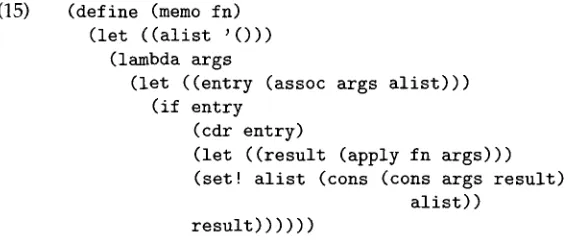
A general w a y of d o i n g this is b y defining a h i g h e r - o r d e r p r o c e d u r e memo that takes a function as an a r g u m e n t a n d r e t u r n s a m e m o i z e d v e r s i o n of it. 3 This p r o c e d u r e is essentially the s a m e as the memoize predicate that is extensively discussed in A b e l s o n a n d S u s s m a n (1985).
(15)
( d e f i n e (memo f n )(let ((alist ' ( ) ) ) (launbda a r g s
(let ((entry (assoc args alist))) (if entry
(cdr entry)
(let ((result (apply fn args))) (set! alist (cons (cons args result)
alist)) result))))))
To m e m o i z e the recognizer, the original definitions of the functions s h o u l d be r e p l a c e d w i t h their m e m o i z e d counterparts; e.g., ( l l b ) s h o u l d be replaced w i t h (11c). Clearly these definitions could be f u r t h e r simplified w i t h suitable m a c r o definitions or other 'syntactic sugar.'
2 Specifically, if A is a Scheme variable bound to the function corresponding to a left-recursive category, then for any string position p the expression (A p) reduces to another expression containing (A p). Thus the (applicative-order) reduction of such expressions does not terminate.
Computational Linguistics Volume 21, Number 3
(11c) ( d e f i n e S (memo (vacuous ( s e q NP V P ) ) ) )
As an aside, it is interesting to note that m e m o i z a t i o n can be applied selectively in this approach. For example, because of the o v e r h e a d of table l o o k u p in c o m p l e x feature- based g r a m m a r s , it m i g h t be m o r e efficient not to m e m o i z e all categories, b u t rather restrict m e m o i z a t i o n to particular categories such as N P a n d S.
N o w w e turn to the p r o b l e m of left recursion. In a logic p r o g r a m m i n g setting, m e m o i z a t i o n (specifically, the use of Earley d e d u c t i o n ) avoids the n o n t e r m i n a t i o n problems associated with left recursion, e v e n w h e n u s e d with the DCG axiomati- zation of a left-recursive grammar. But as N o r v i g m e n t i o n s in passing, with parsers defined in the m a n n e r just described, the m e m o i z e d versions of p r o g r a m s d e r i v e d from left-recursive g r a m m a r s fail to terminate.
It is easy to see why. A memo-ed p r o c e d u r e constructs an e n t r y in a m e m o table o n l y after the result of a p p l y i n g the u n m e m o i z e d function to its a r g u m e n t s has b e e n c o m p u t e d . Thus in cases of left recursion, m e m o i z a t i o n does n o t h i n g to p r e v e n t the ill-founded recursion that leads to n o n t e r m i n a t i o n .
In fact it is not clear h o w m e m o i z a t i o n could help in these cases, given that w e require that memo b e h a v e s semantically as the identity function; i.e., that (memo f ) a n d f are the same function. Of course, w e could try to w e a k e n this identity r e q u i r e m e n t (e.g., b y o n l y requiring that ( f x ) a n d ((memo f ) x) are identical w h e n the r e d u c t i o n of the f o r m e r terminates), b u t it is not clear h o w to d o this systematically.
P r o c e d u r a l l y speaking, it seems as if m e m o i z a t i o n is a p p l y i n g 'too late' in the left-recursive cases; reasoning b y a n a l o g y with Earley deduction, w e n e e d to construct an e n t r y in the m e m o table w h e n such a function is called; not w h e n the result of its evaluation is k n o w n . Of course, in the left recursive cases this seems to lead to an inconsistency, since these are cases w h e r e the value of an expression is required to c o m p u t e that v e r y value.
Readers familiar with Abelson a n d Sussman (1985) will k n o w that in m a n y cases it is possible to c i r c u m v e n t such a p p a r e n t circularity b y using a s y n c h r o n o u s 'lazy streams' in place of the list representations (of string positions) u s e d above. The continuation-passing style e n c o d i n g of CFGs discussed in the next section can be seen as a m o r e functionally oriented instantiation of this kind of approach.
4. Formalizing Relations in Continuation-Passing Style
The a p p a r e n t circularity in the definition of the functions c o r r e s p o n d i n g to left-recur- sive categories suggests that it m a y be w o r t h w h i l e r e f o r m u l a t i n g the recognition prob- lem in such a w a y that the string position results are produced incrementally, r a t h e r than in o n e fell swoop, as in the formalization just described. The k e y insight is that each n o n t e r m i n a l category A in a g r a m m a r defines a relation rA such that rA(l, r) iff A can derive the substring of the i n p u t string s p a n n i n g string positions I to r . 4 Informally
speaking, the r can be e n u m e r a t e d one at a time, so the fact that the calculation of
rA(l, r) requires the result rA(l, r') n e e d not lead to a vicious circularity.
One w a y to i m p l e m e n t this in a functional p r o g r a m m i n g language is to use a 'Continuation-Passing Style' (CPS) of p r o g r a m m i n g , s It turns out that a m e m o i z e d
4 The relation rA and the function fA mentioned above satisfy V r ~/l rA(l, r) ~ r C f(l).
Mark Johnson Memoization in Top-Down Parsing
t o p - d o w n parser written in continuation-passing style will in fact terminate, e v e n in the face of left recursion. Additionally, the treatment of m e m o i z a t i o n in a CPS is instructive because it s h o w s the types of table l o o k u p operations n e e d e d in chart parsing.
Informally, in a CPS p r o g r a m an additional argument, call it c, is a d d e d to all functions a n d procedures. W h e n these functions a n d p r o c e d u r e s are called c is always b o u n d to a p r o c e d u r e (called the continuation); the idea is that a result value v is ' r e t u r n e d ' b y evaluating (c v). For example, the s t a n d a r d definition of the function s q u a r e in (16) w o u l d be rewritten in CPS as in (17). (18) shows h o w this definition could be used to c o m p u t e a n d display (using the Scheme builtin d i s p l a y ) the square of the n u m b e r 3.
(16) ( d e f i n e ( s q u a r e x) (* x x ) )
(17) ( d e f i n e ( s q u a r e c o n t x) ( c o n t (* x x ) ) )
(18) > ( s q u a r e d i s p l a y 3)
9
Thus w h e r e a s result values in a non-CPS p r o g r a m flow ' u p w a r d s ' in the p r o c e d u r e call tree, in a CPS p r o g r a m result values flow ' d o w n w a r d s ' in the p r o c e d u r e call tree. 6,7 The CPS style of p r o g r a m m i n g can be used to formalize relations in a p u r e functional language as p r o c e d u r e s that can be t h o u g h t of as 'returning' multiply v a l u e d results a n y n u m b e r of times.
These features of CPS can be u s e d to e n c o d e CFGs as follows. Each category A is associated with a function gA that represents the relation rA, i.e., (gA C I) reduces (in an applicative-order reduction) in such a fashion that at some stage in the reduction the expression (c r) is r e d u c e d iff A can derive the substring s p a n n i n g string positions I to r of the i n p u t string. (The value of (gA c I) is immaterial a n d therefore unspecified, b u t see footnote 8 below). That is, if (gA C I) is evaluated with l b o u n d to the left string position of category A, then (c r) will be e v a l u a t e d zero or m o r e times with r b o u n d to each of A's right string positions r c o r r e s p o n d i n g to I.
For example, a CPS function recognizing the terminal item 'will' (arguably a future auxiliary in a class of its own) could be written as in (19).
(19) (define (future-aux continuation pos) (if (and (pair? pos) (eq? (car pos)
(continuation (cdr pos))))
'will))
For a m o r e complicated example, consider the two rules defining VP in the f r a g m e n t above, repeated here as (20). These could be formalized as the CPS function defined in (21).
(20)
(21)
VP --+ V N P VP --+ V S
(define (VP continuation pos) (begin
(V (lambda (posl) (NP continuation posl)) pos) (V (lambda (posl) (S continuation posl)) pos)))
6 Tail recursion optimization prevents the procedure call stack from growing unboundedly. 7 This CPS formalization of CFGs is closely related to the 'downward success passing' method of
Computational Linguistics Volume 21, Number 3
In this example V, NP, and S are assumed to have CPS definitions. Informally, the expression (lambda (poe1) (NP c o n t i n u a t i o n p o s l ) ) is a continuation that specifies what to do if a V is found, viz., pass the V's right string position posl to the NP recognizer as its left-hand string position, and instruct the NP recognizer in turn to pass its right string positions to c o n t i n u a t i o n .
The recognition process begins by passing the function corresponding to the root category the string to be recognized, and a continuation (to be evaluated after suc- cessful recognition) that records the successful analysis. 8
(22) ( d e f i n e ( r e c o g n i z e words) ( l e t ( ( r e c o g n i z e d # f ) )
(S (lambda (pos) ( i f ( n u l l ? pos) words)
r e c o g n i z e d ) )
(set! recognized #t)))
Thus rather than constructing a set of all the right string positions (as in the previous encoding), this encoding exploits the ability of the CPS approach to 'return' a value zero, one or more times (corresponding to the number of right string positions). And although it is not demonstrated in this paper, the ability of a CPS procedure to 'return' more than one value at a time can be used to pass other information besides right string position, such as additional syntactic features or semantic values.
Again, higher-order functions can be used to simplify the definitions of the CPS functions corresponding to categories. The CPS versions of the terminal, se% and a l t functions are given as (23), (25), and (24) respectively.
(23) (define (terminal word) (lambda (continuation poe)
(if (and (pair? poe) (eq? (car poe) word)) (continuation (cdr poe)))))
8 Thus this formaliza~on makes use of mutability to return final results, and so cannot be expressed in a purely func~onal language. Howeve~ it is possible to construct a similiar formalization in the purely functional subset of Scheme by passing around an additional 'result' argument (here the last argument). The examples above would be rewritten as the following under this approach.
(19') (define (future-aux continuation poe result) (if (and (pair? poe) (eq? (car poe) 'will))
(continuation (cdr poe) result)))
(21') (define (VP continuation poe result) (V (lambda (posl resultl)
(NP continuation posl resultl)) poe
(V (lambda (posl resultl)
(S continuation posl result1)) poe
result)))
(22') (define (recognize words) (S (lambda (poe result)
Mark Johnson Memoization in Top-Down Parsing
(24)
(25)
(define (alt altl alt2) (lambda (continuation pos)
(begin (altl continuation pos) (alt2 continuation pos))))
(define (seq seql seq2) (lambda (cont pos)
(seql (lambda (posl)
p o s ) ) )
(seq2 cent posl))
If these three functions definitions replace the earlier definitions given in (5), (6), and (7), the fragment in Figure I defines a CPS recognizer. Note that just as in the first CFG encoding, the resulting program behaves as a top-down recognizer. Thus in general these progams fail to terminate when faced with a left-recursive grammar for es- sentially the same reason: the procedures that correspond to left-recursive categories involve ill-founded recursion.
5. Memoization in Continuation-Passing Style
The memo procedure defined in (15) is not appropriate for CPS programs because it as- sociates the arguments of the functional expression with the value that the expression reduces to, but in a CPS program the 'results' produced by an expression are the val- ues it passes on to the continuation, rather than the value that the expression reduces to. That is, a memoization procedure for a CPS procedure should associate argument values with the set of values that the unmemoized procedure passes to its continua- tion. Because an unmemoized CPS procedure can produce multiple result values, its memoized version must store not only these results, but also the continuations passed to it by its callers, which must receive any additional results produced by the original unmemoized procedure.
The cps-memo procedure in (26) achieves this by associating a table entry with each set of argument values that has two components; a list of caller continuations and a list of result values. The caller continuation entries are constructed when the memoized procedure is called, and the result values are entered and propagated back to callers each time the unmemoized procedure 'returns' a new value. 9
9 The dolist f o r m u s e d in (26) behaves as the dolist form in C o m m o n L i s p . It can be defined in terms of Scheme primitives as follows:
(define-syntax dolist (syntax-rules ()
((dolist (var list) . body) (do ((to-do list))
((null? to-do)) (let ((var (car to-do)))
Computational Linguistics Volume 21, Number 3
(26) (define (memo cps-fn)
(let ((table (make-table))) (lambda (continuation . args)
(let ((entry (table-tel table args))) (cond ((null? (entry-continuations entry))
;fi~ttime memo~ed procedu~has been called with
args(push-continuation! entry continuation) (apply cps-fn
(lambda result
(when (not (result-subsumed? entry result)) (push-result! entry result)
(dolist (cont (entry-continuations entry)) (apply cont result))))
args)) (else
; memoizedprocedu~hasbeen called with
argsbefo~
(push-continuation! entry continuation) (dolist (result (entry-results entry))(apply continuation result))))))))
Specifically, when the memoized procedure is called, c o n t i n u a t i o n is bound to the continuation passed by the caller that should receive 'return' values, and args is bound to a list of arguments that index the entry in the memo table and are passed to the unmemoized procedure c p s - f n if evaluation is needed. The memo table t a b l e initially associates every set of arguments with empty caller continuation and empty result value sets. The local variable e n t r y is bound to the table entry that corresponds to args; the set of caller continuations stored in e n t r y is null iff the memoized function has not been called with this particular set of arguments before.
The cond clause determines if the memoized function has been called with args before by checking if the continuations component of the table entry is nonempty. In either case, the caller continuation needs to be stored in the continuations compo- nent of the table entry, so that it can receive any additional results produced by the unmemoized procedure.
If the memoized procedure has not been called with args before, it is necessary to call the unmemoized procedure c p s - f n to produce the result values for args. The continuation passed to c p s - f n checks to see if each r e s u l t of this evaluation is sub- sumed by some other result already produced for this entry; if it is not, it is pushed onto the results component of this entry, and finally passed to each caller continuation associated with this entry.
If the memoized procedure has been called with args before, the results associ- ated with this table entry can be reused. After storing the caller continuation in the table entry, each result already accumulated in the table entry is passed to the caller continuation.
Efficient implementations of the table and entry manipulation procedures would be specialized for the particular types of arguments and results used by the unmem- oized procedures. Here we give a simple and general, but less than optimal, imple- mentation using association lists. 1°
Mark Johnson Memoization in Top-Down Parsing
A table is a headed association list (27), which is extended as needed by t a b l e - r e f (28). In this fragment there are no partially specified arguments or results (such as would be involved if the fragment used feature structures), so the subsumption relation is in fact equality.
(27)
(28)
(define (make-table) (list '~head~))
(define (table-ref table key)
(let ((pair (assoc key (cdr table))))
( i f p a i r ;an entry alreadyexists (cdr p a i r ) ; ~ t u r n i t
(let ((new-entry (make-entry)))
(set-cdr! table (cons (cons key new-entry) (cdr table)))
new-entry))))
Entries are manipulated by the following procedures. Again, because this fragment does not produce partially specified results, the result subsumption check can be per- formed by the Scheme function member.
(29)
(3O)
(31)
(32)
(33)
(34)
(define (make-entry) (cons '() '()))
(define entry-continuations car)
(define entry-results cdr)
(define (push-continuation! entry continuation) (set-car! entry (cons continuation (car entry))))
(define (push-result! entry result)
(set-cdr! entry (cons result (cdr entry))))
(define (result-subsumed? entry result) (member result (entry-results entry)))
As claimed above, the memoized version of the CPS top-down parser does terminate, even if the grammar is left-recursive. Informally, memoized CPS top-down parsers terminate in the face of left-recursion because they ensure that no unmemoized pro- cedure is ever called twice with the same arguments. For example, we can replace the definition of NP in the fragment with the left-recursive one given in (35) with- out compromising termination, as shown in (36) (where the input string is meant to approximate Kim's professor knows every student).
(35)
(36)
(define NP (memo (vacuous
(alt PN
;NP-+PN
(alt (seq NP N) ; I N P N
(seq Det N ) ) ) ) ) ) ; I D e t N
> (recognize '(Kim professor knows every student)) #t
Computational Linguistics Volume 21, Number 3
Memoized CPS top-down recognizers do in fact correspond fairly closely to chart parsers. Informally, the memo table for the procedure corresponding to a category A will have an entry for an argument string position 1 just in case a predictive chart parser predicts a category A at position l, and that entry will contain string position r as a result just in case the corresponding chart contains a complete edge spanning from l to r. Moreover, the evaluation of the procedure PA corresponding to a category A at string position l corresponds to predicting A at position l, and the evaluation of the caller continuations corresponds to the completion steps in chart parsing. The CPS memoization described here caches such evaluations in the same w a y that the chart caches predictions, and the termination in the face of left recursive follows from the fact that no procedure PA is ever called with the same arguments twice. Thus given a CPS formalization of the parsing problem and an appropriate memoization technique, it is in fact the case that "the maintenance of well-formed substring tables or charts can be seen as a special case of a more general technique: memoization" (Norvig 1991), even if the grammar contains left recursion.
6. C o n c l u s i o n a n d Future W o r k
Mark Johnson Memoization in Top-Down Parsing
Acknowledgments
I would like to thank Jeff Sisskind, Edward Stabler, and the CL reviewers for their stimulating comments. This paper was made available via the CMP-LG pre-print server after it was accepted by Computational Linguistics, and I thank my colleagues on the Internet for their numerous suggestions and technical improvements.
References
Abelson, Harold, and Sussman, Gerald Jay (1985). Structure and Interpretation of Computer Programs. MIT Press.
Kahn, K. M., and Carlsson, M. (1984). "How to implement Prolog on a Lisp machine." In Implementations of Prolog, edited by J. A. Campbell, 117-134. Ellis Horwood Limited.
Lang, Bernard (1991). "Towards a uniform formal framework for parsing." In Current Issues in Parsing Technology, edited by Masaru Tomita, 153-172. Kluwer Academic Publishers.
Leermakers, Ren4 (1993). The Functional Treatment of Parsing, Kluwer Academic Publishers.
Norvig, Peter (1991). "Techniques for
automatic memoization with applications to context-free parsing." Computational Linguistics, 17(1), 91-98.
Pereira, Fernando, and Warren, David H. D. (1983). "Parsing as deduction." In Proceedings, 21st Annual Meeting of the Association for Computational Linguistics, 137-144.
Rees, Jonathan, and Clinger, William (1991). "Revised report on the algorithmic language scheme." Technical Report 341, Computer Science Department, Indiana University.
Shell, B. A. (1976). "Observations on context-free parsing." Technical Report TR 12-76, Center for Research in Computing Technology, Aiken Computation
Laboratory, Harvard University. Shieber, Stuart M.; Schabes, Yves; and
Pereira, Fernando C. N. (1994). "Principles and implementation of deductive parsing." Technical Report TR-11-94, Center for Research in Computing Technology (also available from the cmp-lg server), Computer Science Department, Harvard University. Tomita, Masaru (1985). Efficient Parsing for