
Effect of Process Parameters on Squeeze Cast
MMC- An Overview
Krushnakant Patil
1, Prof. K. T. Patil
21ME Student, 2Guide, D. N. Patel College of Engineering, Maharashtra, India
Abstract: Al-based Metal matrix composites (AMMCs) are now gaining their usage in aerospace, automotive and other industries because of their inherent properties like high strength to weight ratio, hardness and wear resistance, good creep behaviour, light weight, design flexibility and low wear rate etc. Aluminium based metal matrix replaces high melting point and high density conventional materials, thus minimizing the usage of energy and supporting the environment. Squeeze casting is the combination of the casting and forging processes that can be done with help of pressure when it is applied during molten metal solidification. Applying pressure on the solidification of melt can modify melting point of alloys which increase the solidification time. In addition it improves the micro and macrostructure. These changes are supportive to decrease the gas and shrinkage porosities of the castings. This paper tries to find the effect of process parameters (squeeze pressure, die temperature, melting temperature and solidification rate) for better mechanical properties. Also the mechanical properties depend on reinforcement particle sizes, porosity presence and agglomeration.
Keywords: Process parameters, squeeze casting, mechanical properties
I. INTRODUCTION
Al-based Metal matrix composites (AMMC) are widely used in automobile and aerospace purpose owing to their better mechanical properties such as low density, low coefficient of thermal expansion, high stiffness, strength, and conductivity. Considering the fixed safety requirements in aerospace industry, the service performance of the utilized materials is of much higher importance than the cost considerations. An example of MMCs’ application in aerospace industry is rockets. Military aircraft structures are among other examples that require increased strength and specific stiffness to improve the performance of aircraft. Space rockets undergo immense quantities of heat, and thus, the materials utilized in such applications must be able to withstand temperatures in excess of 3200 °C [1]. Another example for successful utilization of metal matrix composites in aerospace industry is F-16 Falcon fighter jet in which the aluminum doors used to be vulnerable to fatigue cracking. The issue was addressed by replacing them with reinforced MMC (Al/SiCp) doors without compromising the weight [2]. MMCs are also employed to build blade sleeves in helicopters. Blade sleeve must safely withstand the centrifugal loads from the blades of the rotor [2]. It must also satisfy factors like fatigue life, toughness, and high specific strength. To achieve these properties, silicon carbide (SiC) particles are used in an alloy matrix. Billets can be formed by the use of powder metallurgy and then extruded, cut, and forged. The resultant cost is lower than the original titanium alloy that used to be implemented for that application [2]. Missiles are another important field of application for MMCs in aerospace and defense industry. Conventional aluminum alloys are neither strong enough nor temperature resistant to cope with the demanding service conditions of such applications. Steels or titanium alloys have the needed strength but they cannot be used due to their relatively heavy weight. MMCs are good candidates because they can provide higher strength and stiffness without jeopardizing the weight. They are also exposed to elevated temperatures of the missile for only a short duration that can be well sustained [2].
MMC would achieve 12–20% reduction in secondary shaking force, 0.5– 1% increase in fuel economy, 15–20% increase in maximum RPM, reduced bearing width, and ultimately improved durability of bearing and crankshaft [5].
As the light weight and better mechanical properties of MMC, Honda and Toyota established this material in engine, piston, piston rings, connecting rod, engine block etc [6]. In many passenger cars like AudiA8, Audi AL2, Honda NSX, Jaguar XJ220, Alcan-Ford AIV has used AMMC for different component of vehicles [7]. The use of hybrid metal matrix composite leads to minimize the power loss, maintenance and oil consumption.
II. EFFECT OF SQUEEZE PRESSURE
[image:2.595.135.472.397.505.2]The applied pressure has an under-cooling effect which, together with the loss of heat through the dies, favors rapid solidification. The high pressure also discourages the nucleation of gas bubbles [8]. The high pressure further reduces the size of the gas bubbles, but may be absorbed into the solution and disappear in a bubble free casting. Hajjari, E and Divandari, M (2008) [9] reported that increasing the squeeze pressure led to the formation of finer microstructure and enhanced the mechanical properties of the cast specimens. It is also explained that 2024 aluminium alloy, conventionally used for wrought products and subjected to the casting process, a large number of shrinkage porosities will be produced within its microstructure due to its long solidification range. The high pressure used in this process, reduces the degree of micro-segregation [10] and leads to excellent feeding of solidification shrinkage and a refined microstructure, both of which result in excellent mechanical properties [11-13]. In addition squeeze cast components have superior weldability, electrical conductivity and surface finish [14–16] and also show improved response to heat treatment [17].
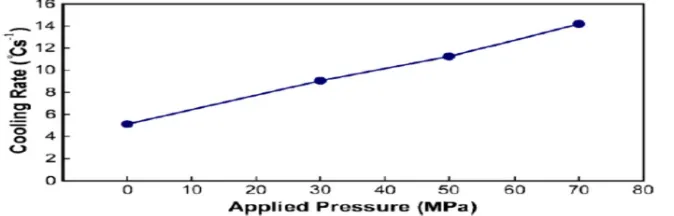
Fig. 1 shows cooling rate values as a function of the applied pressure for various samples in this work. As can be seen in this figure, applying pressure on the melt in squeeze casting process has increased the cooling rate values and thus seems to be the main reason for grain refinement of the alloy microstructure Due to the under-cooling, the contact time between the reinforced particles and the molten aluminum was shortened, and this decreased the possibility of interfacial reactions [18].
Fig no. 1 the effect of applied pressure on the cooling rate of various 2024 Al alloy samples [9]
[image:2.595.74.526.579.735.2]For both the Al alloy and the composites, a squeeze pressure of the order of 100 MPa is found to be sufficient to get the micro-structural refinement, to reduce these porosities, and obtain a complete contact between the metal and the die surface.
III. EFFECT OF DIE TEMPERATURE/ MELT TEMPERATURE:-
Casting temperature has an effect on the mechanical properties of squeeze cast aluminium metal matrix composites. Theoretically, the largest melt under-cooling would be achieved, if the pressure were applied when the melt temperature in the die was lower than its liquidus temperature, and just above the temperature required for the explosion of nucleation (i.e. about 0.98 of the melting point of the alloy in the case of heterogeneous nucleation) [19]. Chiang et al. (2009) [20] studied the effects of processing parameters on the performance characteristics of the pressure die casting process of Al–Si alloys. It was observed that the value of mean particle size of primary silicon increases with increase in die temperature. Increasing the die temperature will result in larger grain due to slower heat transfer and smaller cooling rate during solidification. The molten metal injected into die mould under higher die temperature results in the slower rate of solidification. Thus, the melt has more time for the growth of primary silicon particle. As a result, the mean particle size of the primary silicon increases. Lee, TW and Lee, CH (2000) [21] performed the die casting processes using a preheated die at the pouring temperature of 700°C. From that, it was concluded that due to rapid cooling rate the SiC particulates were distributed homogeneously in Al alloy matrix, resulting from the refinement of cell size. The tensile strength of the as-die-cast composite was higher than that of the as die-cast aluminium alloy. Furthermore, the tensile strength slightly increased with increasing SiC particulate volume fraction. Author also investigated the effect of melt temperature on the macro and microstructure of squeeze cast scroll compressor castings. In this paper, it has been stated that the sound castings could be produced with proper control of melt temperature. Also, it is examined the effects of casting temperature and solidification time on mechanical properties of squeeze cast LM6 alloy. The results of this experimental study revealed that casting temperature of 720oC exhibited good mechanical properties and shorter solidification time resulted in higher density, impact energy, yield strength and ultimate tensile strength. When the melt temperature was lowered from 780 to 730°C and then to 680°C, the macrostructures gradually became finer, and the grains became smaller. However, further decrease of the melt temperature to 630°C results in the formation of very fine and uniform equi-axed grains. It is established that to ensure successful perform infiltration, a preform temperature of 600°C or above is necessary [19]. For the squeeze casting of the aluminium alloy, the best melt temperature to use was either 690 or 660°C; the former would give a better property at the top of the casting while the latter, at the bottom of the casting. Zhang Wei-Wen et al (2007) [22] investigated the particle distribution, and the interfacial reaction of Al-Si alloy reinforced with B4C particles processed by pressure die casting. The pressure varies between 30-80 MPa. He discussed the mechanism of the particle migration duration solidification, at the early stage of crystallization; the solid fraction of particles near the wall surface was maximum. As the primary alpha grain grows it pushes the particles to the centre of the casting, longer solidification range lead to the formation of particle clusters. Since the B4C was not stable in the aluminium melt small amount of Ti particles were added to avoid the formation of inter-metallic phases. Sukumaran, K et al (2008) [23] fabricated 2124 aluminium alloy matrix composite with 10 wt % SiC by squeeze casting process. The improvement in the mechanical properties can be attributed to the refinement of the microstructure obtained by the application of pressure during solidification. The slurry is poured into the die maintained at the temperature 120-130°C. The squeeze pressure of 45-120 MPa is acted upon the melt. The composite shows lower UTS initially compared to the alloy due to the presence of higher defects. However, the value of UTS for the alloy and composite are well comparable when the applied pressure is around 100 MPa, at which the porosities are eliminated entirely. Applied pressure not only demolished shrinkage and porosity but also it helps in the distribution of second phase particles.
[image:3.595.125.462.619.736.2]It is seen that, the tensile strength and elongation increased rapidly as the die temperature increased from 200°C to 250°C, but only slightly altered with the die temperature between 250 and 300°C. However, the tensile strength and elongation decreased suddenly as the die temperature increased to 350°C [24]. The optimum levels of the process parameters to obtain a good surface finish of the SC components of LM6 aluminium alloy, are a squeeze pressure of 140 N/mm2, and die preheating temperature of 250°C [25].
Rajagopal, S (1981) [26] reported that lower die temperature (<150oC) causes low fluidity, thermal fatigue failures in the dies due to and cold laps on the surfaces of the casting whereas higher die temperature (>400oC) leads to hot spots and shrinkage pores in the casting. For the elimination of shrinkage and gas porosity, the pressure is usually in the range of 70 to 105 MPa for simple shapes and 140 to 210 MPa for thin sections and complex shapes. It permits the use of a variety of nonferrous and ferrous alloy compositions, both cast and wrought. For aluminium alloys, the casting temperature is usually selected to be 10 to 100oC above the liquidus temperature. With the lower limit applicable to alloys like 7075 and 390 aluminum that has extended freezing ranges, and the upper limit of narrow freezing range alloys such as 3003 and A413 aluminum. Thin sections and non-uniform profiles also require a higher casting temperature to promote die filling.
Maleki, A et al. (2006) investigated the effects of applied pressure, melt and die temperatures on the density, microstructure and hardness of squeeze cast LM13 alloy. The results showed that the density of the casted specimen decreased with the external pressure of 20 MPa, but increased steadily for higher applied pressures up to 100 MPa after which it became almost constant. Increasing the applied pressure reduces the grain size and improves the hardness. A decrease in the melt or die temperature rendered similar effects on the microstructure and hardness of the samples.
IV. REINFORCEMENT IN MICRON SIZE AND VOLUME FRACTION ON PROPERTIES:-
Kok, M (2005) [28] developed 2024 AMCs reinforced with Al2O3 particles with 10, 20, 30 vol. % in size of 16,32,66 micron. It was observed that the density of the composite decreased with increasing vol. % and reducing the particle size, whereas the porosity and hardness of the composites increased with increasing particle content and decreasing particle size. The coarser particles are uniformly distributed in the matrix where the finer particles lead to agglomeration. The better results were obtained when the matrix is reinforced with 10 vol. % in both the cases. Sahin, Y (2003) [29] examined the effect of SiC in 2024 AMCs, and the composites were fabricated by stir casting with argon setup. The particles sizes were 45micron, 105 microns and weight fraction of 10 and 20%. The results revealed that the hardness and density of the composite increase linearly with increased in weight fraction of SiC, but the porosity increases slightly with an increase in weight fraction and particle size of the reinforcement. This trend may attribute to the entrapment of air surrounding the particles during mixing, as the percentage of particle increases the amount of entrapped air increases resulting in high porosity levels.
V. CONCLUSION
In this paper study on the various parameters of squeeze casting and their effect has been done. It was concluded that there should be a proper control over process parameters for uniform distribution of the particles. From the study the weight fraction and should be within 0 to 15 wt.% above which the agglomeration occurs in both the cases. Squeeze casting the has the potential to defeat the defects like porosity and shrinkage due to the pressurization on the molten melt. The process parameter for the squeeze casting may vary according to the size and volume of the casting and ranges between 40-150 MPa of squeeze pressure, 650-800˚C of melt temperature and 150-300˚C of die temperature. The optimum pressure used in the squeeze casting of Aluminium alloys and composites, which gives a better microstructural refinement and increase in the mechanical properties, is 100 MPa. The selection of the reinforcement particle size also influences the strength of the material in the squeeze casting process. The smaller the grain size the better the improvement in the properties.
REFERENCES
[1] Rawal SP. Metal-matrix composites for space applications. JOM. 2001;53 (4):14–7. [2] Chawla N, Chawla KK. Metal matrix composites. New York: Springer; 2013. [3] Suresh, S. fundamentals of metal-matrix composites. Elsevier; 2013.
[4] Deuis R, Subramanian C, Yellup J. Dry sliding wear of Aluminium composites—a review. Compos Sci Technol. 1997; 57(4):415–35. [5] Chawla N, Chawla K. Metal-matrix composites in ground transportation. JOM. 2006;58 (11):67–70.
[6] Varuzan Kevorkijan, Development of Al MMC Composites For Automotive Industry,Yugoslav Association of Metallurgical Engineers (2002)8-4 [7] Carlos H. Cáceres, Transient environmental effects of light alloy substitutions in transport vehicles, Materials and Design. 30 (2009) 2813–2822. [8] R.E. Smallman, R.J. Bishop, Modern Physical Metallurgy & Materials Engineering, Butterworth-Heinemann, 6th edition, 1999.
[9] Hajjari, E. and Divandari, M. (2008) An Investigation on the Microstructure and Tensile Properties of Direct Squeeze Cast and Gravity Die Cast 2024 Wrought Al Alloy. Materials & Design, 29, 1685-1689.
[10] Zhong Y, Su G, Yang K. Microsegregation and improved methods of squeeze casting 2024 aluminium alloy. J Mater Sci Technol 2003;19(5):413–6 [11] Chadwick GA, Yue TM. Principles and applications of squeeze castings. Met Mater 1989;5(1):6–12.
[12] HU H. Squeeze castings of magnesium alloys and their composites. J Mater Sci 1998;25:1579–89.
[14] Ghomashchi MR, Vikhrov A. Squeeze casting: an overview. J Mater Process Technol 2000;101:1–9. [15] Prakasan K, Seshan S. Electrical conductivity of squeeze cast copper. J Mater Sci Lett 1997;16:1588–9.
[16] Vijian P, Arunachalam VP. Optimization of squeeze cast parameters of LM6 aluminium alloy for surface roughness using Taguchi method. J Mater Process Technol 2006;180:161–6.
[17] Campbell John. Casting. 2nd ed. Oxford: Butterworth-Heinemann; 2003. pp. 273–274.
[18] Jinfeng Leng, Gaohui Wu, Qingbo Zhou, Zuoyong Dou and XiaoLi Huang, Mechanical properties of SiC/Gr/Al composites fabricated by squeeze casting technology, Scripta Materialia 59, pp 619-622, 2008.
[19] M. Dhanashekar, V. S. Senthil Kumar, “Squeeze Casting of Aluminium Metal Matrix Composites- An Overview” 12th GLOBAL CONGRESS ON MANUFACTURING AND MANAGEMENT, GCMM 2014, Procedia Engineering 97 ( 2014 ) 412 – 420
[20] Ko-Ta Chiang, Nun-Ming Liu and Te-Chang Tsai, “Modeling and analysis of the effects of processing parameters on the performance characteristics in the high pressure die casting process of Al–SI alloys”, The International Journal of Advanced Manufacturing Technology April 2009, Volume 41, Issue 11–12, pp 1076–1084
[21] Lee, TW, & Lee, CH 2000, ‘Statistical analysis for strength and spatial distribution of reinforcement in SiC particulate reinforced aluminum alloy composites fabricated by die-casting’, Journal of Materials Science, vol. 35, no. 17, pp. 4261-4269.
[22] Zhang Wei-Wen, Luo Zong-Qiang, Xia Wei & Li Yuan-Yuan 2007, ‘Effect of plastic deformation on microstructure and hardness of Alsi/Al gradient composites’, Transactions of Nonferrous Metals Society of China, vol. 17, no. 6, pp. 1186-1193.
[23] Sukumaran, K, Ravikumar, KK, Pillai, SGK, Rajan, TPD, Ravi, M, Pillai, RM & Pai, BC 2008, ‘Studies on squeeze casting of Al 2124 alloy and 2124-10% SiCp metal matrix composite’, Materials Science and Engineering A, vol. 490, no. 1, pp. 235-241.
[24] Vanluu Dao, Shengdun Zhao, Wenjie Lin, Chenyang Zhang, Effect of process parameters on microstructure and mechanical properties in AlSi9Mg connecting –rod fabricated by semi-solid squeeze casting, Materials Science & Engineering A, 2012.
[25] P. Vijian, V .P. Arunachalam, Optimization of squeeze cast parameters of LM6 aluminium alloy for Surface roughness using Taguchi method, Journal of Materials Processing Technology 180, pp 161-166, 2006.
[26] Rajagopal, S 1981, ‗Squeeze Casting: A Review and Update‘, Journal Of Applied MetalWorking‘, vol. 1, no. 4, pp. 3-14.
[27] Maleki, A, Niroumand, B and Shafyei, A 2006, ‗Effects of squeeze casting parameters on density, macrostructure and hardness of LM13 alloy‘, Materials Science and Engineering A, vol. 428, no. 1, pp. 135- 140.
[28] Kok, M 2005, ‗Production and mechanical properties of Al2O3 particlereinforced 2024 aluminium alloy composites‘, Journal of Materials Processing Technology, vol. 161, no. 3, pp. 381-387.
![Fig. no 2 Casting (Melt) temperature and Die temperature for Squeeze Casting [19]](https://thumb-us.123doks.com/thumbv2/123dok_us/1242673.650392/3.595.125.462.619.736/fig-casting-melt-temperature-die-temperature-squeeze-casting.webp)
