Forecasts oF the Future
development oF the population
The first forecast of the world population was the Uno forecast from 1950. Even if more that half a century went since then and the technological condi-tions for processing of such a forecast changed in a revolutionary was, still there are not many new sub-jects which would endeavour such a task in this scope. Besides the U.n. Population Division, it is the World Bank, the Population Program of the international
institute for Applied system Analysis (iiASA) and the centre of international Programs of the U.S. census Bureau (UScB). The WB co-operated closely with the Uno, therefore, their prognoses from the mid90s do not differ considerably. The iiASA computes their forecasts not on the individual countries level, but for 13 world regions. Therefore, at present there exist only 2 organisations producing their forecasts on the individual countries and, perhaps, even independ-ently to certain extent: the Uno in new York and the UScB in Washington.
population problem in the future – challenges,
questions
Populační problém budoucnosti – výzvy, otazníky
Vladimír JENÍČEK
Faculty of International Relations, University of Economics, Prague,
Czech Republic
abstract: Population regulation cannot be left just to wars, epidemics and famines in future. A mutual cooperation is necessary to accept suitable measures helping to decrease, or at least to sustain, the population at the desirable level and at the same time to improve life conditions of many inhabitants of the Earth. The mankind has the necessary knowledge and means to find the right solution. The belief into a better future is the driving force of the necessary steps. A decisive role is played by the population transition. its first phase, which still prevails in some regions, started the exponential increase of the Earth population. in the second phase, the demographic revolution causes ageing of the population. At present, the world population increments are decreasing and it can be presupposed in the long run that the size of the population will stabilise. All population increments will be the matter of developing countries, while the population of the most developed countries will stagnate or, under the influence of the de-population in some countries, even slightly decrease.
Key words: forecast of the population, population changes, allocation, ageing of population
abstrakt: nelze do budoucna regulaci populace nechat pouze na válkách, epidemiích a hladomorech. Je nutné vzájemnou spoluprací podniknout vhodná opatření, která by napomohla snížit nebo alespoň zachovat stav populace na žádoucí úrovni a zároveň zlepšit životní podmínky mnoha obyvatel země. Lidstvo má potřebné znalosti a prostředky nalézt správné řeše-ní. Víra v lepší budoucnost je hnacím motorem potřebné kroky uskutečnit. rozhodující roli hraje demografický přechod. Jeho první fáze, která přetrvává v některých regionech dodnes, odstartovala exponenciální nárůst počtu obyvatel země. V druhé fázi zapříčiňuje demografická revoluce stárnutí populace. V současné době dochází ke snižování přírůstků světo-vého obyvatelstva a v dlouhodobém horizontu lze předpokládat, že se velikost populace ustálí. Veškeré přírůstky obyvatel budou taženy rozvojovými zeměmi, přičemž populace nejrozvinutějších zemí bude stagnovat či pod vlivem depopulace v některých zemích dokonce mírně ubývat.
Klíčová slova: odhad populace, populační změny, rozmístění, stárnutí populace
World population forecasts
To estimate the future development of the world population is almost impossible, however, many different approaches to the problematic emerge at present. The U.n. Population Division processed estimates based on the different possibilities of the future natality, while mortality and migration are of the same development in all variants. The high and low estimates depict the extreme natality de-velopment margins. The middle estimate expresses the evaluation of the future based on the long-term population trends. The constant variant utilises the
constant, therefore, the results of this variant are of rather illustrative value and are not aimed at the future state depiction.
the medium-term model of population development (up to the year 2050)
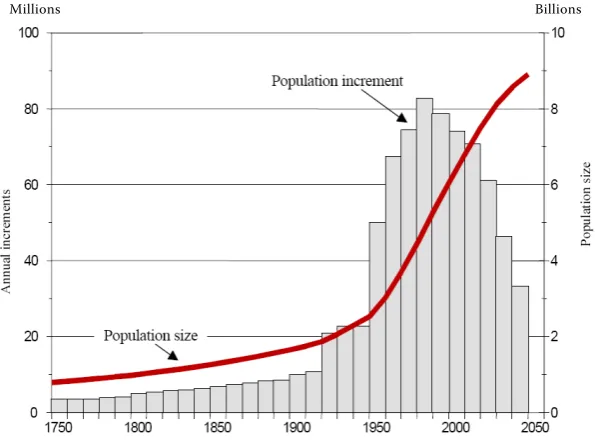
According to the middle estimates, the world will reach the number of 9.1 billion inhabitants by 2050 at the yearly increment of 34 million. in 2050, the trend of a slight population decrease in the developed countries, approximately by 1 million per year, is
1950 1960 1970 1980 1990 2000 2010 2020 2030 2040 2050 12
[image:2.595.133.468.257.437.2]11 10 9 8 7 6 5 4 3 2
Figure 1. World population, the individual variants estimates for the period 1950–2050 Source: World Population Prospects: The 2008 revision (2008)
250
200
150
100
50
0
More developed
regions Least developed countries
1950 1960 1970 1980 1990 2000 2010 2020 2030 2040 2050 Period
Less developed regions
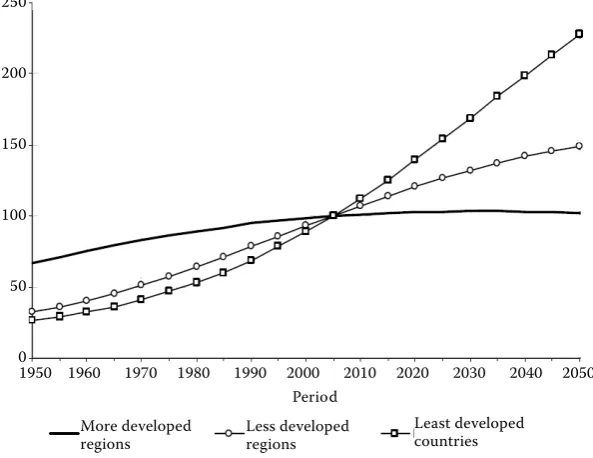
Figure 2. Population changes in relation to the development level, 1950–2050 Source: World Population Prospects: The 2008 revision (2008)
....
[image:2.595.145.442.495.724.2]
supposed, and the population increase in developing countries by 35 million yearly (in that, 22 million in the least developed countries) (Figure 1).
regarding the small decreasing natural increment of developed countries, there is expected a sustained level of these countries population at approx. 1.2 billion. The population of 51 countries including germany, italy, Japan, the Baltic states and most of the former USSr countries will probably decrease under the 2005 level by 2050. on the contrary, the population of 50 least developed countries will probably more than double in this period, from 0.8 to 1.7 billion. The most pro-nounced increase will prevail in Afghanistan, Burkina Faso, Burundi, chad, congo, guinea-Bissau, Liberia, Mali, niger and Uganda, where the population will probably treble at the least. The increase in the rest of the developing world will stay important, but probably not so accelerated. The population of these regions will increase from the present 4.5 billion to 6.1 billion.
in the middle of the century, a decrease of the world natality to 2.05 children is expected. in developed countries, a slight increase of natality to 1.84 chil-dren is expected, some developing countries will approach by their natality the developed countries with the decreased rate of 1.92 children/1 woman. The measure of the future natality decrease of devel-oping countries is substantially influenced by several factors including e.g. a greater approach to family planning means and the strengthened position of women in the society.
regarding mortality, it is almost certain that it will decrease on the world level, and at the same time, the
medium life span will increase. While in developed countries it will rise up to 82 years, in the developing ones it will increase to 67 years. Since many of these countries fight the AiDS epidemics, the forecasted increase will depend on the success of the programs mitigating the impacts of this disease.
The scope of migration is estimated at approx. 98 million migrants in 2005–2050, what means that 2.2 million people will migrate yearly. For the de-veloped world, which is in most cases the goal of this migration, that means the compensation of the 73 million debit caused by the prevalence of deaths over births (Figure 2 and 3).
the lonG-term model oF population development, 2050–2300
All hypotheses of the Population Division regarding the development after 2050 are based on the presup-position of zero migration, a stable mortality decrease and the simultaneous prolongation of life.
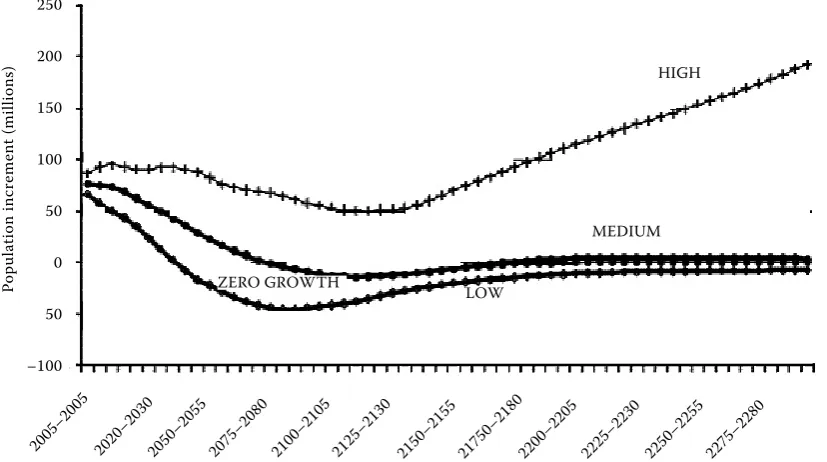
The size of the future population is strongly de-pendent on any small deviations of natality from the net reproduction level. This fact is the reason of the huge differences among the individual prediction variants (Figure 4 and 5).
The expected natality of the individual countries should drop gradually under the simple reproduction level and stay there for 100 years. Then it should in-crease again to this level and be sustained there up to 2300.At this development, the population would reach
[image:3.595.160.458.67.289.2]
Figure 3. Population growth and its increments in the period 1750–2050 Source: World Population Prospects: The 2008 revision (2008)
9.2 billion in 2075, then decrease again to 8.3 billion in 2175. The return to the net natality level after 2175, together with the increasing life expectancy, would lead to 9 billion in 2300, while 7.7 billion would be the developing world population and 1.3 billion that of developed countries (The World Population in 2300).
population allocation
A more important characteristic than the number of the world population is its allocation. Without doubt, the intensive shift of the population centre
towards the group of the less and least developed countries will continue also in the next decades. The total world population increase, which should occur, according to the middle U.n. variant, between the years 2000 and 2050 on the level of 47%, would have a high probability, as a relatively the same relative increase is expected in all big world regions with the exception of Africa and Europe. The increase of 127%, which is expected by the U.n. prognostics in Africa, is the consequence of a more pronounced share of countries with high women fertility. This is connected in Africa, but also in other countries, to a lower level of economic development, what is proved also by the fact that from 56 African countries in the Uno list, 2000 2025 2050 2075 2100 2125 2150 2175 2200 2225 2250 2275 2300 40
35
30
25
20
15
10
5
0
Po
pu
la
tio
n
(b
ill
io
ns
)
zEro groWTh
MEDiUM high
LoW
high
MEDiUM
zEro groWTh LoW
2020 –203
0
2050 –205
5
2075 –208
0
2100 –210
5
2125 –213
0
2150 –215
5
2175 0–21
80
2200 –220
5
2225 –223
0
2250 –225
5
2275 –228
0
2005 –200
5
Po
pu
la
tio
n
in
cr
em
en
t (
m
ill
io
ns
)
250
200
150
100
50
0
50
[image:4.595.99.513.67.244.2]–100
[image:4.595.83.497.307.538.2]Figure 5. Yearly population growth according to the individual scenarios, 2000–2300 Source: The World Population in 2300 (2008)
36 are included among the least developed countries. These differences should be slightly levelled; however, they will persist up to 2050. in the middle of the cen-tury, the number of developed countries population will already have increased for 20 years, but it will still grow in developing countries by about 0.4% per year. The population of the least developed countries should still increase in the period 2045–2050, and that by 1.2% per year.
The less developed countries population should change from 4.9 billion in 2000 (middle variant) to 7.7 billion in 2050. An especially accelerated growth is expected in the least developed countries. The number of their inhabitants might increase from 668 mil-lions to 1.7 billion, even if a pronounced decrease of natality is expected in future (from the present 5.1
to 2.5 children/1 woman in the period 2045–2050). At the sustained yearly population growth over 2.5% in 2000–2050, the total population of the country group, including Burkina Faso, Mali, niger, Uganda and Yemen, will increase from 85 to 369 million, i.e. four times.
The European countries population perspectives are the topics often discussed in the media. notwithstanding that, the population decrease by almost 100 million people (13%) during 50 years might surprise many people. The scope of the decrease is not only surpris-ing, but also alarming. Almost half of it will be the matter of the russian Federation, the population of which will probably decrease by 45 million.
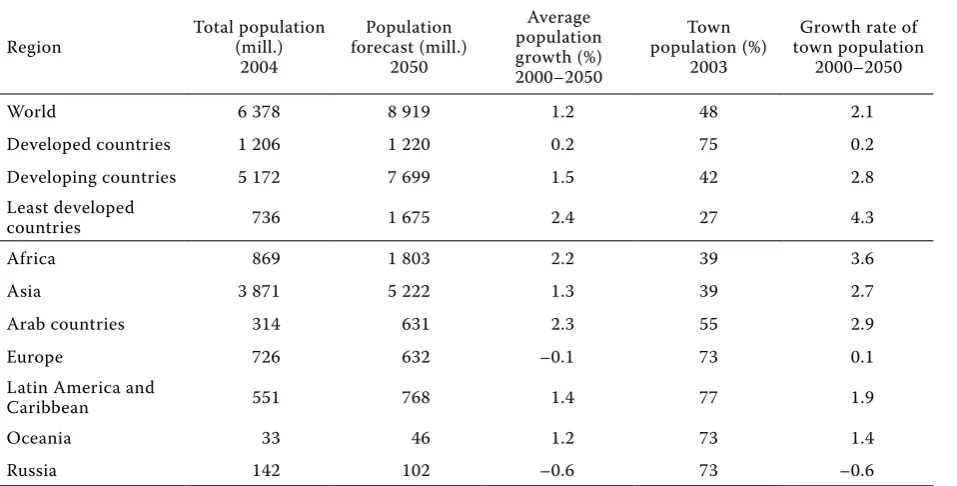
A more outstanding difference will be shown also in mortality. The expected length of life will be pro-Table 1. Selected demographic, social and economic indicators
region Total population (mill.) 2004
Population forecast (mill.)
2050
Average population growth (%) 2000–2050
Town population (%)
2003
growth rate of town population
2000–2050
World 6 378 8 919 1.2 48 2.1
Developed countries 1 206 1 220 0.2 75 0.2
Developing countries 5 172 7 699 1.5 42 2.8
Least developed
countries 736 1 675 2.4 27 4.3
Africa 869 1 803 2.2 39 3.6
Asia 3 871 5 222 1.3 39 2.7
Arab countries 314 631 2.3 55 2.9
Europe 726 632 –0.1 73 0.1
Latin America and
caribbean 551 768 1.4 77 1.9
oceania 33 46 1.2 73 1.4
russia 142 102 –0.6 73 –0.6
Source: www.unfpa.org/swp/2008/espanol/indicators/index.htm
1950 2000 2050
Percents
8 10
21 % 25
20
15
10
5
[image:5.595.64.543.86.329.2]0
[image:5.595.127.463.603.732.2]longed from the present 65 to 74 years on the world level in 2045–2050. however, while it will grow in the developed regions, where today it reaches 76 years, to 82 years, in less developed regions it will stay much lower and it will reach only 73 ears before the mid-century (today, it is 63 years). in the least developed countries group, the majority of which is impacted by the hiV/AiDS, the present life expectancy is still below the level of 50 years and it will probably not surpass 67 years before 2050. Therefore, notwithstand-ing the narrownotwithstand-ing gap in life expectancy among the different country groups, the differences will still be evident in the middle of the century.
The pronounced natality decrease will issue into a more accelerated ageing of the developing countries population. in total, the share of older population (60+) will almost treble and will thus grow from 606 million in 2000 to almost 1.9 billion in 2050. While at present every 6 older people out of 10 live in less developed regions, it will be 8 out of 10 by 2050. A still higher increase is expected on the world level in the oldest people group (80+), and that from 69 million (2000) to 377 million (2050). in less developed regions, it will be from 32 to 265 million and again this would mean that most of the oldest people will live in the less developed countries by 2050.
in developed countries, the 60+ group represents 19% of the population at present and it will be 32% by 2050. The share of older people has already over-reached the number of children (0–14 years) and in 2050, there will be 3 older people per 1 child. in less developed countries, the share of 60+ inhabit-ants will increase from 8% in 2000 to 20% in 2050 (Figure 6).
international migration
Before the middle of the century, a high level of international migration is expected. The highest inflow of immigrants will still aim at the developed countries. in average, this should regard approxi-mately 2 million people yearly during the next 50 years. it is presupposed that up to 2050, the immi-grants will aim namely at the following countries (the numbers in brackets represent the average yearly number of persons): the USA (1.1 million), germany (211 thousand), canada (173 thousand), great Britain (136 thousand) and Australia (83 thousand). on the opposite, the countries with the biggest outflow of inhabitants will be china (–303 thousand), Mexico (–267 thousand), india (–222 thousand), Philippines (–184 thousand) and indonesia (–180 thousand) (www.osn.cz).
the World-Wide endeavours at the mitiGation oF the population GroWth neGative impacts
The global goal of the outstanding decrease of world population through more efficient measures and programmes in the individual countries including a wider international support is to get the number of population into balance with the existing resources. The unprecedented increase of population, the gen-eral poverty and economic inequality – including the inequality between men and women – and the waste in consumption accelerate the depletion of the basic resources and intensively deteriorate the environment. Efficient steps to the solution of these problems are inseparable, if the quality of life of the present and future generations is to be sustained or improved.
international conference on population and development (ipcd)
Therefore, the action programme of the international conference on population and development (ipcd)
in 1994 binds the world society to fulfil the quantita-tive goals for the period 1995–2015, which should contribute to the present situation improvement. The aim of the action plan, which was adopted by 179 countries at the conference in cairo 11 years ago, is to create the equilibrium between the world population andthe accessible resources, to improve the position of women and to ensure a common approach to the health and reproduction care, in-cluding family planning. The starting point of the conference was the presupposition that the size of the population, its growth and allocation are closely connected to the complex development possibilities and that the steps in one sphere are strengthening the fulfilled aims in the other.
in this direction, the iPcD follows, among other, the results of the World Summit for children in 1990, the U.n. conference on Environment and Development (UncED) in 1992 and the World conference on human rights in 1993 and represents a contribution to the World Summit for Social Development 1995, the 4th World conference on Women in 1995 and the
World Summit on nutrition.
poverty, environment protection, migration and or-ganisation, the discrimination of women and girls. it analyses also the key problems of the reproduction health, including the approach to contraception, health of mothers, the hiV/AiDS prevention and the needs of the maturing people living in critical situations (www.unfpa.org/swp/swpmain_spa.htm).
however, the cairo consensus set as its priority the investments into human development and extension of the opportunities, not the endeavours at decreasing the population growth. As the key prerequisites of sustainable economic growth and decreased poverty, it regards improving the position of women and en-suring their rights, as well as the rights of men and young people, including the rights to reproduction health and the possibility of choice when and if at all to start a family.
Also the use of modern contraception improved and spread about. While in 1994 only 55% of couples used contraception, now the number increased up to 61%. With the aim to decrease the number of deaths and disablements of mothers at the child delivery, an increased stress is put on the births under the medical doctor��s control, the acute birth care and accepting the patients in hospital care. The individual states strengthened their endeavours in fighting the AiDc epidemic in the field of prevention, cure, as well as support of the diseased. Still more is getting into the world focus also the reproduc-tion health of the adolescents. A still wider support is also given to the campaign against the violence towards women.
To ensure the reproduction health and rights, in-cluding the rights of 1.3 million adolescents in the whole world, to support secure motherhood and to stop spreading of the hiV/AiDS, still much is left to be done.
Even 25 years after the cairo conference, the fol-lowing is still valid:
– More than 350 million couples still have no access to the family planning methods in its full scope. – The main reason the death and illness of young
women still are the complications in pregnancy and at birth. Every year, 529 thousand of them die, mainly from the reasons which could have been prevented.
– During 2003, further 5 million people were infected by the hiV. Almost one half of the infected are women and almost 3/5 of them are the Sub-Saharan Africa inhabitants.
– Even if the natality decreases in many parts of the world, still the world population will grow from the present 6.4 billion to 8.9 billion by 2050, while the population of 50 poorest countries will treble
up to 1.7 billion people (www.unfpa.org/swp/swp-main_spa.htm).
The success at reaching the cairo agenda goals depends mainly on the sufficient financial resources and the efficient cooperation of all interested parties. Since the iPcD, the cooperation of the governments with civil society, trade unions, universities and the private sector developed.
however, the financial resources are not sufficient. The international donors promised to supply for the programs regarding population development and the reproduction health protection 6.1 billion USD every year. however, this represents only 1/3 of the needed amount. in 2002, the donors supplied approximately 3.1 billion USD, what is only one half of the promised amount.
The world needs to step forward on the way of the population development more than ever. The present appeals – the questions of security, the AiDS epidemic and the persisting poverty – call urgently for the cairo agenda realisation in the interests of fulfilling the goal, that is a better future for all of us (www.unfpa.org/swp/swpmain_spa.htm).
the population problem solutions
The population problem and the UNO
The activities of the Uno are of high importance for the lives of millions of people in the whole world. The Uno endeavours at decreasing of the differences between the industrially developed countries and developing countries. Many economic and social changes during the last 50 years were initiated and supported just by this world organisation.
– poverty mitigation – the u.n. development pro-gram (undp)
its aim is to help the governments and civil organisa-tions to strengthen their ability to solve the problems contributing to the origin of poverty.
– Fighting hunger – the international Fund for agricultural development
it finances development programs aimed at rural poverty and hunger in the poorest regions of the world
– health – the children Fund uniceF
it supports the health care for children and moth-ers.
– aids – the World program for hiv/aids (un-aids)
– human habitation – the u.n. program for human habitats un-haBitat
it supports the sustainable development of towns and securing of the adequate housing for all inhab-itants.
The U.N. Fund for Population Aid – UNFPA
The main co-ordinator of the Uno aid to devel-oping countries in the field of the population policy is the U.n. Population Fund UnFPA. its activities were started in 1969 and 10 years later it became a subordinate body of the Uno general Assembly. At present, it shares the coordinating committee with the UnDP.
The UnFPA helps the states to improve the repro-duction health of their population, supports family planning and the development population policy. Another task of the UnFPA is spreading of the in-formation, population data and strengthening of the general knowledge on the population problems. Supporting initiatives of the UnFPA are the equal position of women, the problems of ageing, the AiDS prevention, reproduction health of the adolescents, population development and the environment etc.
The UnFPA represents the biggest internationally financed source of aid to the developing countries inhabitants. it supplies Ľ of the total amount of money spent fro the solution of the over-population prob-lem. Financial means of the fund are acquired from voluntary donations of 171 countries of the world. During the last years, its incomes jumped up, and in 2004 they even surpassed the level of 500 million USD. The biggest part of the aid aims at the Sub-Saharan Africa, a smaller one to Asia and Pacific, Arab states and finally to Latin America.
The action programme IPCD
in September 1994, 170 countries of the world accepted the action plan (iPcD) which connects the question of population and economic growth, at the international conference on Population and Development in cairo. The programme is aimed rather at the life conditions of individuals at the na-tional level than at the global demographic goals. it binds the participant countries to co-operation and improvement of the situation in the areas of:
– women rights
– health care – namely in connection with the repro-duction health (i.e. decreasing the infant, children and mothers mortality, assisted births)
– prevention of the contagious infections including the AiDS
– access to the family planning means
– supplying basic education.
This forms the basic prerequisites for reaching the economic development. Women emancipation and the possibility to control own fertility become the main goals.
The 10th anniversary of the iPcD action plan
re-minded of reaching the middle of the 20-years pro-gramme and became an opportunity to reflect the reached progress and to remember the set goals. Many countries really incorporated the cairo com-mitments into their national policies and strategies. As the biggest success, we can regard the spreading of the contraception use, on the other hand, poverty, low education, distance and the lack of information still prevent more than 123 million women from the access to these means. Besides that, in many coun-tries, an open discussion on sexual behaviour is still regarded as culturally unsuitable and the utilisation of the reproduction health services often meets with the religious refusal. Alas, no improvement was recorded regarding the mothers mortality. notwithstanding the endeavour of the states, still 40% of the developing countries mothers deliver their babies without the medical assistance. The problem also remains the high number of the unwanted pregnancies terminated by the abortion, which, according to the estimates, reach up to 46 million yearly, while 20 million of them are performed under risky conditions. however, it should be stated that it is already a great progress that the countries are interested in all the questions of the cairo summit and make steps (in develop-ing the legislation supportdevelop-ing reproduction health, implementing population policies and cooperating in research and acquiring population data), which doubtless lead to certain improvements.
reaching the set goals is, among other, hindered by the financial resources. Since many problems con-nected with the population question (e.g. ageing of the population, migration and reproduction health of the adolescents) are also ailing the developed countries, it is necessary to make more efficient the cooperation between the donor and the developing countries.
The Millennium Development Goals
goals are closely interconnected; therefore, they have to be reached simultaneously:
– removal of the extreme poverty and hunger
– implementing the gender equality and strengthen-ing of the position of women
– Accessibility of quality education for all
– Decreasing maternal and children mortality
– Fighting the AiDS epidemic
– Environment protection
– creation of the global partnership for develop-ment.
developed countries problem
Ageing of population
The process during which there occurs an increase of the number of older persons (60+) compared to the younger ones (up to 15) is called ageing of the population. it is the consequence of the demographic transition from the high natality and mortality level to the low one (in other words, decrease of the number of born children and the simultaneous prolongation of the middle life span). Primarily, it is namely the influence of the decreasing natality. To ensure a young population structure, a high natality is the basic pre-requisite. The impact of the decreasing mortality is more variable. it depends, among other, on the fact whether it regards prevalently the younger or the older population. in the first step, the newborn and infant mortality is decreasing what leads to the juve-nalisation of the society. however, in the countries where this mortality is already very low, a further decrease occurs namely in the older population, what leads, on the contrary, to the ageing of the population (Demography of population ageing 2007).
in the 20. century, ageing disturbed namely the de-veloped countries. it is almost certain, however, that it will spread also into the developing world during the 21.century. The shift in the age structure connected with the ageing of population has a considerable ef-fect on a wide scale of economic, political and social questions. in the economic sphere, it impacts e.g. the economic growth.
solution of the population ageing
Approaches to the solution on the individual governments level
Economists as well as politicians are well acquainted with all the possible impacts of the population ageing
and in majority, they agree on certain measures which should form the base of coping with the problem. in short, these can be characterised as:
– later retirement
– lowering of the retirement payments, partial retire-ment insurance
– increasing of the share of women entering the labour market
– liberalisation of the migration flows.
however, from the long-term perspective, this ap-proach does not solve the population ageing; it only mitigates its impacts. it is necessary to concentrate on the reasons of this trend and to look for the solution directly in changing the population demographic be-haviour – i.e. in the sustained increase of the number of children born. in this direction, the governments try to motivate people by the changes in the social supports system in favour of a more numerous families (transfers, tax alleviations, housing subsidies, paid maternity leave etc.). however, as it can be seen from the north European countries experience, where ag-gressive pro-population policies are implemented and where a wide system of social support is applied, the way of removing the obstacles to upbringing children is not much efficient. The number of children per 1 women is higher there than in most of the South and east Europe countries, however, it still does not reach by far the simple reproduction level for more than three decades. having children is an expres-sion of positive future expectations and the belief in securing a dignified life for own descendants. These expectations can be influenced by the economic and political factors, as well as the cultural and social stability. The environment we are living in brings about too many changes and therefore it evokes indi-vidualism. The question is whether these influences can be compensated by social policy (Lošťák and hudečková 2008).
by foreigners. if the immigration is to mitigate the fiscal burden of the productive population, its level has to be sustained on a high level in the long run. it is then unavoidable that even the immigrants will be once retired. Further, we are faced with the problem of the selection of immigrants suitable for the home labour market, which should reflect the economic needs and the conditions of the recipient country. The priority is education and skills. however, it can be only estimated whether the structure of the im-migrants will bring a sufficient number of students and qualified workers for the scientific and techno-logical branches.
By a considerably postponed retirement age, the state will decrease the lack of labour force and simultane-ously, it will postpone (and therefore also decrease) the social security expenditures. The governments try to induce the workers to postpone retirement, or to ask for the retirement payments, but to stay active still. in this connection, higher demands will be put to the population. The ageing population will have to permanently replace the quality human resources and to contribute to the country social and economic capital. The life-long education will become an inseparable part of the professional career. More time and attention will be pad to schooling and re-qualification and they will be open to all age groups. Jobs occupied by older workers will be most supported by the state through subsidies, even if the traditional bias towards older workers is gradually receding. The 65+ workers are now healthier and more educated; they contribute by their intellect and experience. Many of them probably do not yearn so much for retirement, however, they would appreci-ate a more flexible working hours, which often is at their disposal (Tichá 2008).
A further resource of labour can be educated women, which stay at home under the pressure of discrimina-tion (this example is typical e.g. for the South Korean republic).
in the field of health care, there will prevail a stress put on the strengthening and widening of the inter-generation solidarity. A certain shift of the participa-tion and responsibility for the old people��s health from��s health from health from the public sector primarily to themselves, eventually to their family, can be presupposed. The programs aimed at the compensations for the care suppliers should be improved. With the growing demand for the medical, social and nursing care (namely for the oldest), also the utilisation of professional services will increase.
The number of different approaches to the prob-lematic is very high, if we consider the combinations of all the accessible tools. however, hitherto there
exists no guarantied way of solving such an important problem impacting almost all sides of the society life (Srnec and Svobodová 2009).
The U.N. action plans
the madrid action plan on population ageing
The Action Plan from 2002, which was accepted at the 2nd World convention on Population Ageing
in Madrid, was aimed at outlining the way which forming of the all ages population should take. it appeals to the world society to be fully interested in the direct relationships between the older population problematic and the development, and it also appeals to the re-valuation f the conventional perception of the ageing in the society. it states clearly that ageing is not a problem, but a success reached by the human society and that it is not only the question of the social and life security, but also one of the development and economic policy questions. The Madrid Plan offers a wide spectrum of social, political and economic recommendations to the considerable improvement of the seniors�� situation.
The Program concentrated namely on 3 basic sphe-res:
– older population and development
– the progress in health and welfare till the high age
– securing and enabling of a supportive environ-ment.
These negotiations moved, for the first time, the governments to taking a complex approach to the population ageing question in the mutual relationship to the social and economic development and human rights, which were agreed on at the Uno summits and conferences in the 90s. The Social Development committee decided to revise and evaluate the progress in the Madrid Action Plan implementation every 5 years.
conclusion
regarding the key points of the aforementioned Action Plan, it is necessary to research the economic and social consequences of demographic changes and their impact on the plans in the sphere of the complex development and the needs of the individuals. At present, the necessity of it is still increasing.
the demographic development begun to show the un-precedented scope. The notion “population problem” became the topic of many discussions. gradually, all states of the developed countries started to apply the natality regulation strategy. The forcible methods ap-plied in china and india cannot be accepted as they do not fulfil the human approach demands.
The most important prerequisite of the gradual population stabilisation is the attitude of the families themselves. To decrease the population considerably, it is necessary to abolish the family as well as state patriarchal structures in developing countries, to give women completely equal rights. it is important that both man and women participated equally in the upbringing and nutrition of children. Women should have the possibility to decide on the number of their children. They should be able to make their own decisions regarding marriage, job, as well as the way of spending money. however, many women lack this possibility; they are the slaves of their fathers and husbands. The implementation of women rights into the population policy is the most important issue.
At present, namely the population ageing problems get forward. The overpopulation determination is rather controversial, as it is to a high extent connected with the development level of the region and the irregular inhabitance caused by the life conditions. Many examples show (e.g. in Western Europe) that a high population numbers need not exclude a high level of living.
however, it is not possible to contradict the high importance of the developing countries population explosion, which is the more threatening as it is con-nected with further global problems, like the AiDS epidemics, poverty, the non-renewable resources depletion and the environment degradation. Just because of their mutual interconnection, it is almost impossible to solve these problems separately. in solving all these questions, a simultaneous support of the countries economic development, increasing the level of living of the population, access to edu-cation and information and, least but not least, the women emancipation are necessary. These goals can be reached only through the co/operation with the developed countries and the financial support
co-ordinated by the different development programs, international organisations and institutions.
The trend of the population ageing is intensifying on the global level. The loss of the economically active population evokes already at present fears in many developed countries. regarding the fact that the probability of returning back to the original demographic structure of the population is near to zero and that the hitherto pre-natal policies did not register much success, the world will have to cope with the still stronger burden on the economically active population and with important socio-economic problems.
The solution to the question lies namely in the hands of the government themselves. it regards in the first place the health and retirement systems reforms and the immigration.
reFerences
Demography of population ageing (2007). Population Divi-sion of the Department of Economic and Social Affairs of the United nations.
Lošťák M., hudečková h. (2008): Agriculture and farming related activities. Agricultural Economics – czech, 54: 245–262.
Srnec K., Svobodová E. (2009): Microfinance in less de-veloped countries: history, progress, present – char-ity or business? Agricultural Economics – czech, 55: 467–474.
The World Population in 2300 (2008). Population Division of the Department of Economic and Social Affairs of the United nations.
Tichá i. (2008): intelectual capital reporting. Agricultural Economics – czech, 54: 57–62.
World Population Prospects: The 2008 revision (2008). Population Division of the Department of Economic and Social Affairs of the United nations. Available at http://esa.un.org/unpp/
www.osn.cz
www.unfpa.org/swp/2008/espanol/indicators/index.htm www.unfpa.org/swp/swpmain_spa.htm
Arrived on 5th october 2009
Contact address: