Supported by the Slovak Research and Development Agency (Projects No. APVV-0458-10 and No. APVV-0416-10) and Research and Development Operational Programme funded by ERDF (Project Comenius University in Bratislava Science Park, ITMS 26240220086).
Time-dependent changes in milk fatty acid composition
of ewes fed a winter ration supplemented with linseed
or sunflower oils
L. Soják
1, J. Blaško
1, R. Kubinec
1, R. Górová
1, A. Hengerics Szabó
1,
P. Májek
2, M. Margetín
3,41Institute of Chemistry, Faculty of Natural Sciences, Comenius University in Bratislava, Bratislava, Slovak Republic
2Institute of Analytical Chemistry, Faculty of Chemical and Food Technology, Slovak University of Technology in Bratislava, Bratislava, Slovak Republic
3Faculty of Agrobiology and Food Resources, Slovak University of Agriculture in Nitra, Nitra, Slovak Republic
4Animal Production Research Centre Nitra, Lužianky, Slovak Republic
ABSTRACT:The effects of adding sunflower and linseed oils to a standard winter ration with a lower concentrate content on the milk fatty acid composition in lactating ewes were investigated. Eighteen dairy ewes randomly chosen from the ewe flock were divided into three groups: the first group was fed a winter ration, the second one a winter ration supplemented with sunflower oil, and the third a winter ration supplemented with linseed oil for a period of 12 days. In the treatment groups, the concentrate was partially replaced by 3.0 g/100 g sunflower or linseed oils. Milk samples were taken daily from morning milking for the analysis of fatty acid composition to determine their temporal daily variations. The responses to sunflower oil compared with linseed oil addition after the end of experi-ment were slightly higher for conjugated linoleic acid (CLA) (P < 0.05), linoleic acid (P < 0.001), trans-10 18:1 (P < 0.001), 6:0 to 16:0 (P ≈ 0.05 – P < 0.001), whereas a higher content of α-linolenic acid (ALA) (3-fold) (P < 0.001), oleic acid (P < 0.001), and 18:0 (P < 0.001) was found in milk after linseed oil addition. The responses to both oil additions were relatively sustainable with regard to CLA, trans-11 18:1 (vaccenic acid, VA), and ALA content after the last 6 days of supplementation. The winter ration supplementation with sunflower or linseed oil led to a 3-fold increase in CLA milk fat content (0.6–2.0 or 1.8 g/100 g fatty acid methyl esters (FAME), P < 0.001) and a 3-fold increase in VA milk fat content (1.2–3.8 or 4.1 g/100 g FAME, P < 0.001), however the content of trans-10 18:1 was 5–6-fold higher, compared with unsupplemented winter ration. Plant oil supplementation enhanced the total content of CLA, VA, ALA by 5.0 and 3.9 g/100 g FAME (P < 0.001) for linseed and sunflower oil supplementation, and decreased the total content of 12:0, 14:0, and 16:0 by 9.3 and 5.8 g/100 g FAME (P < 0.001) compared to winter diet, respectively.
Keywords: ewes’ standard winter diet; supplementation of plant lipids; daily changes of milk fatty acid composi-tion; CLA content
INTRODUCTION
The specific profile of ewe milk fatty acids (FA) is particularly valuable for human nutrition and health. The biological effects and nutritional value
anti-atherogenic, anti-diabetic, and other advantageous physiological effects (Benjamin and Spener 2009). The trans-11 18:1 (vaccenic acid, VA) should also be considered as a FA with particular benefits for human health. The anti-carcinogenic effect of VA is associated with its conversion to CLA, humans convert on average 19% of dietary VA to CLA via Δ9-desaturase (Turpeinen et al. 2002; Field et al. 2009). Nevertheless, a ruminant milk fat contains higher levels of saturated FA (SFA), particularly lauric acid (LAA, 12:0), myristic acid (MA, 14:0), and palmitic acid (PA, 16:0) showing hypercholester-olemic properties, and lower contents of some trans FA (TFA) representing a dietary risk (Shingfield et al. 2013). In contrast to SFA 12:0 to 16:0, the 18:0 is non-atherogenic (Chilliard et al. 2007). It is suggested that CLA has similar beneficial effects in humans. It is therefore desirable to increase especially the content of CLA and VA and at the same time to lower that of LAA, MA, and PA in milk and dairy products.
Ration is the most important factor determin-ing the CLA and VA content in milk fat. Addition of lipids to dairy ruminant ration can be used to increase ration energy density, milk fat content, and to modify milk FA composition. Supplemen-tation with plant lipids such as linseed oil (rich in cis-9,cis-12,cis-15 18:3 (α-linolenic acid, ALA)) or sunflower oil (rich in cis-9,cis-12 18:2 (linoleic acid, LA)) enhances the content of CLA, VA, and ALA in milk (Bauman et al. 2000; Bauman and Griinari 2003). CLA can be a product of incom-plete biohydrogenation of LA in the rumen and primarily of Δ9-desaturation of VA in the mam-mary gland (Griinari et al. 2000). Dietary ALA and LA are metabolized and biohydrogenated in the rumen leading to the formation of 18:0 and various isomers of monounsaturated FA (MUFA) and polyunsaturated FA (PUFA). Some of these intermediates are absorbed in the gut and se-creted into milk while others are metabolized in body tissues, especially in the mammary gland, where a cis double bond is being added to the FA structures by the action of Δ9-desaturase enzyme. Rumen-escaped dietary PUFA and 18:0 formed in the rumen are residual precursors and the final products of biohydrogenation. Biohydrogenation affects the interaction between the ration com-ponents and the mammary fatty acid synthesis.
The milk fat CLA responses after lipid sup-plementation were sometimes transient and de-clined over time (Bauman et al. 2000; Dhiman et
al. 2000). Roy et al. (2006) found that the content of CLA in cow milk from starch-rich based diets supplemented with sunflower oil were transient and declined after one to two weeks. Nevertheless, cows feeding a high forage hay based diet sup-plemented with linseed oil resulted in a gradual enrichment with CLA and VA in milk fat and the increase was maintained until the end of experi-ment. Transient decreases in cis-9,trans-11 CLA content were found to be associated with high proportions of corn silage and/or concentrates, and subsequent increases in the milk fat content of unhealthy trans FA (TFA), especially trans-10 18:1 (Ferlay et al. 2003, Chilliard et al. 2007).
Despite the fact that the effects of lipid oil sup-plementation on milk FA synthesis bear some similarities across ruminants, ewes often respond differently than cows or goats in many aspects of mammary lipid metabolism (Chilliard et al. 2003). The effects of plant oil supplementation on milk FA synthesis of ewes were reported by Anton-giovanni et al. (2004), Zhang et al. (2006), Luna et al. (2008), Toral et al. (2010), Gomez-Cortes et al. (2011). The CLA milk fat content was in a relatively broad range of 0.8–2.5 g/100 g fatty acid methyl esters (FAME). The changes in milk FA composition after plant oil supplementation were dependent on the amount of oil included in the rations, the FA profile of lipid supplement, the form of lipid supplement, the composition of basal ration (forage type, starch and concentrate content) and their interaction with dietary lipids.
are potentially important for human nutrition and health (CLA, VA, ALA) and to decrease that of FA with negative effects on human health (LA, MA, PA).
MATERIAL AND METHODS
The study was carried out at the experimental ewe farm in Trenčianska Teplá, Animal
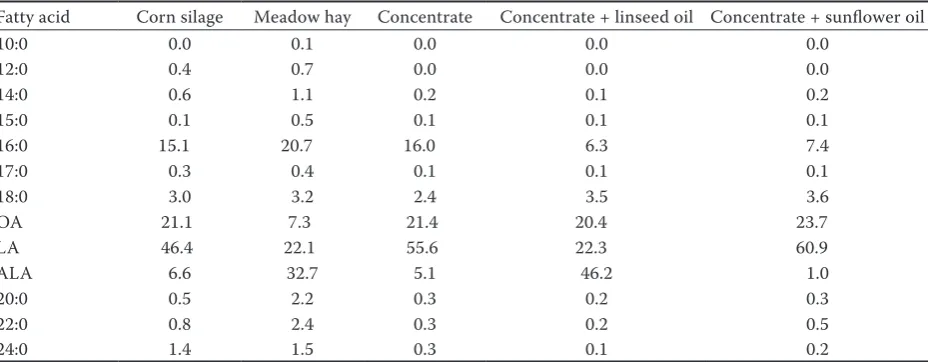
[image:3.595.62.291.124.332.2]Produc-tion Research Centre Nitra, Slovak Republic. The farm keeps 350 dairy ewes belonging to three pure breeds and crossbreeds based on Tsigai (n = 160), Improved Valachian (n = 130), and Lacaune (n = 60) breeds in the first to eighth parity. The ewes consumed the unsupplemented winter basal ration (uWBR) containing corn silage (1190 g), meadow hay (961 g), commercial concentrated feed mixture (614 g), and mineral supplement, in total 2765 g per ewe per day (Table 1). Sunflower oil and linseed oil were mixed manually with concentrate and other components of WBR immediately before feeding. The effect of partial supplementation of concentrate fed mixture of WBR with 3.0% sunflower oil or 3.0% linseed oil (g/100 gdry matter(DM)) on the temporal changes of fatty acid composition of ewes’ milk fat was investigated. The FA composition of components of experimental rations is presented in Table 2. Eighteen dairy ewes randomly chosen from the ewe flock fed WBR were divided into three groups, each containing 6 lactating ewes with initial lactation days of 64 ± 3 and an average body weight of 68 kg. The first group was fed WBR, the second one was fed WBR supplemented with sunflower oil, and the third one was fed WBR supplemented with linseed oil. In the course of the experimental period, the ewes were kept in group-pens and the ration was offered once per day at 8:00 h. Machine milk-ing was carried out twice daily (at 7:00 and 19:00 h) and daily temporal variations in FA composition were determined from the morning milk samples. On the first day of experiment ewes were milked before feeding the plant oil supplemented WBR. Table 1. Ingredients of experimental diets (dry matter
basis) (g/kg)
WBR LO SO
Corn silage 430 430 430
Meadow hay 348 348 348
Concentrate 222 194 193
Linseed oil – 28.2 –
Sunflower oil – – 29.2
WBR basic nutrients contents
NEL (MJ) 4.2
PDI 68.4
NS 114
Fibre 130
Ca 6.1
P 3.6
Na 1.4
K 14.8
WBR = winter basal diet, LO = linseed oil supplemented ra-tion, SO = sunflower oil supplemented rara-tion, concentrate = commercial concentrated feed mixture, NEL = net energy of lactation, PDI = protein digestible in intestine, NS = nitrogen-containing substances
Table 2. Fatty acid composition of experimental diet (g/kg dry matter)
Fatty acid Corn silage Meadow hay Concentrate Concentrate + linseed oil Concentrate + sunflower oil
10:0 0.0 0.1 0.0 0.0 0.0
12:0 0.4 0.7 0.0 0.0 0.0
14:0 0.6 1.1 0.2 0.1 0.2
15:0 0.1 0.5 0.1 0.1 0.1
16:0 15.1 20.7 16.0 6.3 7.4
17:0 0.3 0.4 0.1 0.1 0.1
18:0 3.0 3.2 2.4 3.5 3.6
OA 21.1 7.3 21.4 20.4 23.7
LA 46.4 22.1 55.6 22.3 60.9
ALA 6.6 32.7 5.1 46.2 1.0
20:0 0.5 2.2 0.3 0.2 0.3
22:0 0.8 2.4 0.3 0.2 0.5
24:0 1.4 1.5 0.3 0.1 0.2
[image:3.595.65.531.555.736.2]The contents of FA were determined in bulk milk samples from each group.
The content of about seventy FA in the ewes’ milk fat as well as in the experimental rations was analyzed using capillary gas chromatography (GC). Lipids from milk samples were extracted using chloroform-methanol mixtures (2 : 1). The extracts were filtered through anhydrous sodium sulfate, and then dried and stored under nitrogen at –18°C. For the FAME preparation, the base-catalyzed methylation procedure with a solution of sodium methoxide in methanol was used. GC analyses of milk and experimental rations extracts were performed on a 6890N Gas Chromatograph (Agilent Technologies, Waldbronn, Germany) with Flame Ionization Detector and 5973 Network Mass Selective Detector. FAME were separated in a capillary column (100 m × 0.25 mm i.d. × 0.2 µm film thickness) of HP-88 stationary phase (Agilent Technologies, Santa Clara, USA). The initial col-umn temperature of the programmed run was set to 45°C and was held for 2 min, then followed by a step up ramp of 15°C/min to 145°C, and then of 5°C/min to 240°C and held for 5 min. Helium was used as the carrier gas with a linear velocity set at 20 cm/s. 2 µl samples representing approximately 10 mg/ml FAME were injected using a split 50 : 1 at injection temperature of 300°C. Separated FA were identified by reference materials, published retention data, and mass spectrometric meas-urements. The chromatograms were evaluated quantitatively using a method of internal normali-zation and published response factors of flame ionization detector for FAME (Ackman 2002). The FA composition of milk fat was expressed in grams of each individual FAME per 100 g of sum detected FAME. The average relative standard deviation of the analyzed FAME with the content > 0.5 g/100 g was 1.1%, for the whole analytical procedure and 5 replicate samples. The CLA con-tent in analyzed milk samples represents the total content of gas chromatographic unseparated triplet of cis-9,trans-11 + trans-7,cis-9 + trans-8,cis-10 CLA isomers with prevailing (about 90%) content of cis-9,trans-11 CLA (Blasko et al. 2009).
The data set of selected 25 FA milk fat contents was subjected to analysis of variance (ANOVA) for a randomized block design with three repeated measures using a Linear Mixed Models procedure (IBM SPSS Advanced Statistics 21, 2012; Statistical Analysis System, Version 16.0, 2006) The model
included three types of diet (D) and twelve sam-pling days (T) as fixed effects and measures from bulk milk samples from each group as a random effect, and an interaction between the type of diet and the sampling days (D × T). All variables were considered significant at P < 0.05. Pair-wise means comparisons in selected data sets were evaluated post-hoc by Scheffé’s method.
RESULTS AND DISCUSSION
Temporal changes in FA composition in ewes’ milk during winter basal diet supplementation with sunflower or linseed oils
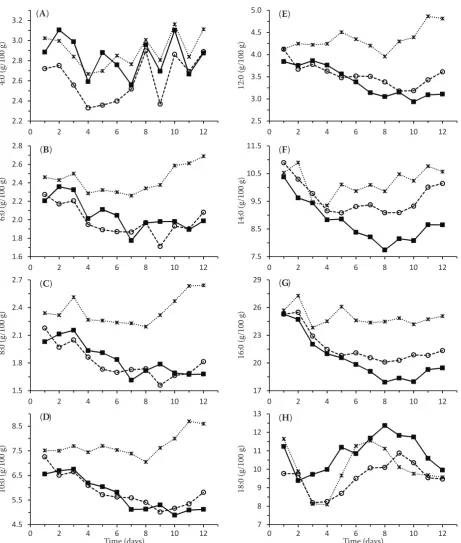
The time-dependent changes in milk FA content during the supplementation period followed mod-erately different temporal patterns between both oil treatments. The responses of individual FA to sunflower and linseed oil supplementation and to a lesser degree to WBR (except for 18:0 and oleic acid (OA)) varied according to the time on a diet. Figures 1 and 2 show the time-dependent changes in SFA, MUFA, and PUFA contents in milk fat of ewes fed uWBR, and WBR supplemented with sunflower or linseed oils during the 12-day ex-periment. Final results are summarized in Table 3. Figures 1 and 2 show that temporal milk responses in ewes fed WBR alternately increased and decreased for the first 8 days of experiment. Approximately from day 9, the milk FA showed more systematic trends, i.e. an increased content of 6:0 to 16:0, cis-9 14:1 and 16:1, and LA, and a decreased content of 18:0 and OA, and they remained relatively stable for CLA, VA, ALA, trans-10 18:1; the differences of means of these FA for the last four days were statis-tically insignificant. As the FA responses to uWBR also varied according to time on a diet, the temporal changes in sunflower and linseed supplementation were related to the same day of the experiment.
2.2 2.4 2.6 2.8 3.0 3.2
0 2 4 6 8 10 12
4:0
(g
/100
g
)
(A)
1.6 1.8 2.0 2.2 2.4 2.6 2.8
0 2 4 6 8 10 12
6:0
(g
/100
g
)
(B)
1.5 1.8 2.1 2.4 2.7
0 2 4 6 8 10 12
8:0
(g
/100
g
)
(C)
4.5 5.5 6.5 7.5 8.5
0 2 4 6 8 10 12
10:0
(g
/100
g
)
Time (days)
(D)
2.5 3.0 3.5 4.0 4.5 5.0
0 2 4 6 8 10 12
12:0
(g
/100
g
)
(E)
7.5 8.5 9.5 10.5 11.5
0 2 4 6 8 10 12
14:0
(g
/100
g
)
(F)
17 20 23 26 29
0 2 4 6 8 10 12
16:0
(g
/100
g
)
(G)
7 8 9 10 11 12 13
0 2 4 6 8 10 12
18:0
(g
/100
g
)
Time (days)
[image:5.595.68.530.92.636.2](H)
Figure 1. Temporal changes in 4:0 to 18:0 saturated fatty acids content in milk from ewes fed a winter ration (×), winter ration supplemented with linseed (■) and sunflower (○) oils. Values represent the means from six ewes
(SO) or linseed oil (LO) supplemented WBR) on sampling days (days 1–12) and their interactions were significant at P < 0.05 for almost all FA, except for D × T for 4:0 and 17:0 anteiso, and T for 17:0 anteiso. The variation > 80% in the evaluated FA can be ascribed to the statistical model used (D,
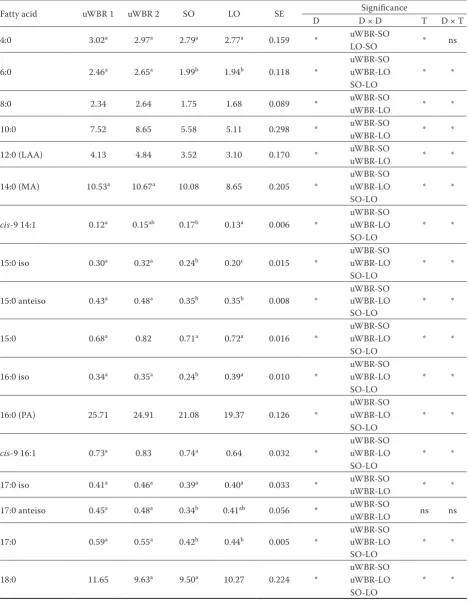
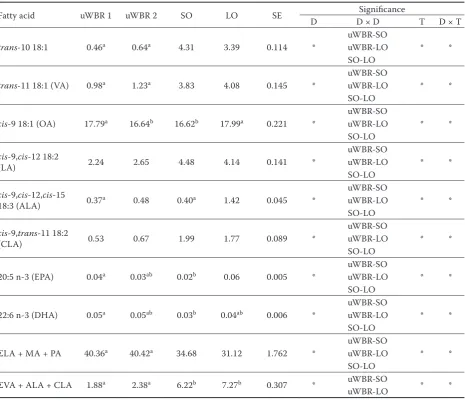
Table 3. Effect of diet composition and days of plant oils supplementation on selected milk fatty acids content of ewes fed unsupplemented winter basal ration (uWBR) at the start (1) and end (2) of the experiment, and winter basal ration (WBR) supplemented with sunflower oil (SO) and linseed oil (LO) (g/100 g fatty acid methyl esters (FAME)) at the end of the experiment
Fatty acid uWBR 1 uWBR 2 SO LO SE Significance
D D × D T D × T
4:0 3.02a 2.97a 2.79a 2.77a 0.159 * uWBR-SO * ns
LO-SO
6:0 2.46a 2.65a 1.99b 1.94b 0.118 * uWBR-SOuWBR-LO * *
SO-LO
8:0 2.34 2.64 1.75 1.68 0.089 * uWBR-SOuWBR-LO * *
10:0 7.52 8.65 5.58 5.11 0.298 * uWBR-SO * *
uWBR-LO
12:0 (LAA) 4.13 4.84 3.52 3.10 0.170 * uWBR-SO * *
uWBR-LO
14:0 (MA) 10.53a 10.67a 10.08 8.65 0.205 * uWBR-SOuWBR-LO * *
SO-LO
cis-9 14:1 0.12a 0.15ab 0.17b 0.13a 0.006 * uWBR-SOuWBR-LO * *
SO-LO
15:0 iso 0.30a 0.32a 0.24b 0.20c 0.015 * uWBR-SOuWBR-LO * *
SO-LO
15:0 anteiso 0.43a 0.48a 0.35b 0.35b 0.008 * uWBR-SOuWBR-LO * *
SO-LO
15:0 0.68a 0.82 0.71a 0.72a 0.016 * uWBR-SOuWBR-LO * *
SO-LO
16:0 iso 0.34a 0.35a 0.24b 0.39a 0.010 * uWBR-SOuWBR-LO * *
SO-LO
16:0 (PA) 25.71 24.91 21.08 19.37 0.126 *
uWBR-SO
* *
uWBR-LO SO-LO
cis-9 16:1 0.73a 0.83 0.74a 0.64 0.032 * uWBR-SOuWBR-LO * *
SO-LO
17:0 iso 0.41a 0.46a 0.39a 0.40a 0.033 * uWBR-SO * *
uWBR-LO
17:0 anteiso 0.45a 0.48a 0.34b 0.41ab 0.056 * uWBR-SO ns ns
uWBR-LO
17:0 0.59a 0.55a 0.42b 0.44b 0.005 * uWBR-SOuWBR-LO * *
SO-LO
18:0 11.65 9.63a 9.50a 10.27 0.224 * uWBR-SO uWBR-LO * *
Fatty acid uWBR 1 uWBR 2 SO LO SE Significance
D D × D T D × T
trans-10 18:1 0.46a 0.64a 4.31 3.39 0.114 * uWBR-SOuWBR-LO * *
SO-LO
trans-11 18:1 (VA) 0.98a 1.23a 3.83 4.08 0.145 * uWBR-SOuWBR-LO * *
SO-LO
cis-9 18:1 (OA) 17.79a 16.64b 16.62b 17.99a 0.221 * uWBR-SOuWBR-LO * *
SO-LO
cis-9,cis-12 18:2
(LA) 2.24 2.65 4.48 4.14 0.141 *
uWBR-SO
* *
uWBR-LO SO-LO
cis-9,cis-12,cis-15
18:3 (ALA) 0.37a 0.48 0.40a 1.42 0.045 *
uWBR-SO
* *
uWBR-LO SO-LO
cis-9,trans-11 18:2
(CLA) 0.53 0.67 1.99 1.77 0.089 *
uWBR-SO
* *
uWBR-LO SO-LO
20:5 n-3 (EPA) 0.04a 0.03ab 0.02b 0.06 0.005 * uWBR-SOuWBR-LO * *
SO-LO
22:6 n-3 (DHA) 0.05a 0.05ab 0.03b 0.04ab 0.006 * uWBR-SOuWBR-LO * *
SO-LO
ΣLA + MA + PA 40.36a 40.42a 34.68 31.12 1.762 * uWBR-SOuWBR-LO * *
SO-LO
ΣVA + ALA + CLA 1.88a 2.38a 6.22b 7.27b 0.307 * uWBR-SO * *
uWBR-LO
SE = standard error, D = type of diet, T = sampling day, D × D = significant diet pair, D × T = interaction between type of diet and sampling days, LAA = lauric acid, MA = myristic acid, PA = palmitic acid, VA = vaccenic acid, OA = oleic acid, ALA = α-linolenic acid, CLA = conjugated linoleic acid, LA = linoleic acid
a–cmeans not connected by the same letter are considered different at P < 0.05, SE and significance effect were assessed for
[image:7.595.66.532.111.512.2]each day of the 12-day experiment, *P < 0.001, ns = not significant Table 3 to be continued
WBR-SO and WBR-LO were significant for all FA (except WBR-LO for 4:0). The data for 4:0 could have been affected by its relatively high volatility and higher variance of measurements. The pair effect diet LO-SO was found not to be significant for SFA (8:0–12:0 and isomers 17:0).
Milk saturated fatty acids. In contrast to uWBR, the milk fat contents of 6:0 to 12:0 upon oil sup-plementations declined steadily up to day 7 to relatively sustainable values. In the case of PA this pattern was observed for all dietary treatments. Greater reductions in SFA content were observed for 6:0 to 16:0 after supplementation with
0.06 0.08 0.10 0.12 0.14 0.16 0.18 0.20
0 2 4 6 8 10 12
ci s -9 14:1 (g /100 g )
(A)
0.5 0.6 0.7 0.8 0.9 1.0 1.1
0 2 4 6 8 10 12
ci s -9 16:1 ( g/ 100 g )
(B)
15 16 17 18 19 20 21 22
0 2 4 6 8 10 12
ci s -9 18: 1 (g /100 g )
(C)
0.0 1.0 2.0 3.0 4.0 5.0
0 2 4 6 8 10 12
tr an s -10 18:1 ( g/ 100 g ) Time (days)
(D)
0.0 1.0 2.0 3.0 4.0 5.0 6.0 7.0
0 2 4 6 8 10 12
VA
(g
/100
g
)
(E)
0.0 0.5 1.0 1.5 2.0 2.5 3.0
0 2 4 6 8 10 12
ci s -9 , tr an s -1 1 C LA ( g/ 100 g
) (F)
2.0 2.5 3.0 3.5 4.0 4.5 5.0 5.5
0 2 4 6 8 10 12
LA ( g/ 100 g )
(G)
0.0 0.5 1.0 1.5 2.0 2.5
0 2 4 6 8 10 12
A LA (g /10 0 g) Time (days)
[image:8.595.66.530.93.641.2](H)
Figure 2. Temporal changes in C14 to C18 mono- and poly-unsaturated fatty acids content in milk from ewes fed a winter ration (×), winter ration supplemented with linseed (■) and sunflower (○) oils. Values represent the means from six ewes
VA = vaccenic acid, CLA = conjugated linoleic acid, LA = linoleic acid, ALA = α-linolenic acid
after the linseed oil and sunflower supplementa-tion (P < 0.001), respectively (Table 3). In contrast to 6:0–16:0, the content of 18:0 increased from
statistically significantly different after uWBR and sunflower oil addition. Zhang et al. (2006) found the lowest 18:0 content in ewe’s milk after the control diet probably due to a different basal diet composition.
The lower content of short- and medium-chain SFA in milk from the uWBR supplemented ewes compared to the content in milk from WBR supple-mented ewes can be associated with the inhibitory effect of the increased availability of long-chain FA to the mammary gland on de novo synthesis of FA (Grummer 1991, Shingfield et al. 2006). The reduced 6:0 to 16:0 SFA content after lipid oil supplementation is consistent with the previ-ously published data for dairy cows, goats, and ewes (Sanz Sampelayo et al. 2007; Shingfield et al. 2008). The temporal changes of 18:0 content in milk are different from those of other SFA. The 18:0 milk fat content rapidly dropped down reaching the nadir on day 3, then it gradually rose on days 8–10, and then decreased again until the end of experiment. The lower 18:0 milk fat content from sunflower oil compared with linseed oil supple-mentation (9.5 vs 10.3 g/100 g FAME, P<0.001) can be associated with the inhibitory effect of LA on the biohydrogenation of C18 UFA to 18:0 in the rumen (Shingfield et al. 2008).
Similarly to SFA with an even number of carbon atoms in a molecule, WBR supplementation with linseed and sunflower oil resulted in lower contents of all odd- and branch-chain 15:0 to 17:0 having posi-tive health effects. The mean decrease in the total content of these FA was 21%, i.e. similar as in SFA with the even number of carbon atoms. Nevertheless, the content of these FA in milk fat is substantially lower (up to 0.86%) than that of SFA with the even number of carbon atoms. In addition, Vlaeminck et al. (2006) reported lower milk fat contents of odd- and branch-chain SFA after supplementation of cows’ diet with oils rich in LA or ALA.
Milk unsaturated fatty acids. The effect of dietary treatment on the content of cis-9 14:1 to 18:1 in ewes’ milk fat is presented in Figures 2A–C. When comparing linseed and sunflower oil supplemen-tations, the variance in MUFA content gradually decreased with the increasing number of FA carbon atoms, from the higher variation for cis-9 14:1 and 16:1 to the lower variation and a reverse content ratio for cis-9 18:1. In contrast to cis-9 14:1 and cis-9 16:1, but similarly to 18:0, the content of cis-9 18:1 increased from day 5 to day 8 of experiment, and then it decreased for all the three diets. At
the end of the experiment, the milk OA content increased by 1.4 g/100 g FAME for linseed oil (P < 0.001), and it remained unchanged for sunflower oil if compared with uWBR. The higher content of cis-9 18:1 after linseed oil and the lower content after sunflower oil supplementation compared with uWBR can stem from the combination of ruminal biohydrogenation and 18:0 desaturation in the mammary gland by the action of Δ9-desaturase enzyme (Dhiman et al. 2000).
The time-dependent changes of OA/18:0 content ratio are presented in Figure 3A. The 18:0 desatura-tion ratio was markedly higher for WBR in days 3–4 (P < 0.001) and reached the nadir on day 8 of ex-periment. The OA/18:0 ratio after sunflower oil was higher than that after linseed oil supplementation, however, it was statistically identical with all the three diets at the end of experiment. Thus, unlike in cows (Chilliard and Ferlay 2004), it was only slightly affected by lipid supplementation, although dietary lipids are putative inhibitors of Δ9-desaturase.
due to different WBR composition as both studies found a similar increase of CLA content in milk fat after sunflower supplementation (by 1.4 g/100 g FAME) compared with uWBR.
Figure 2F shows that the CLA content in milk fat of the ewes from the group still fed uWBR differed on the first day (uWBR group 0.53, LO group 0.62, and SO group 0.77 g/100 gFAME) suggesting the effect of individual ewes on the CLA production in milk (Sojak et al. 2013). Unexpectedly, the CLA content in milk fat for uWBR increased from 0.5 to 1.2 g/100 g and correspondingly for VA from 0.8 to 1.7 g/100 g FAME from day 1 to 4, and then it steeply decreased toward the initial values on day 6 (Figure 2F). The temporal relation of CLA/VA milk fat content ratio after uWBR between days 1 and 4 showed a steep increase from 0.54 to 0.68 on day 4 (P < 0.05) and then a steep decrease toward initial values. Such a fluctuating Δ9-desaturase activity could be due to the lack of homogeneity in the ALA content of meadow hay in the course of the study period. Previous analyses showed a broad range of the ALA content (15–54 g/kg DM) in meadow hay samples from Slovakia (unpublished data).
The temporal changes in CLA content in milk fat were associated with the changes in the content of other FA. Most significantly, the time dependence of CLA milk fat content correlated with VA milk fat content changes during the supplementation period (R2 = 0.97, P < 0.001) (Figure 2E, F). The VA
formation in the rumen reflected an overall increase in trans 18:1 accumulation in the rumen. The VA milk fat content increased from 1.7 to 6.4 g/100 g FAME during the first 5 days of sunflower oil supplementation (P < 0.001), and then it gradually decreased to the content of 3.9 g/100 gFAME (P < 0.001). Thus, a higher CLA milk fat content after sunflower oil supplementation was in agreement with ruminal biohydrogenation that was shifted toward the formation of VA as a major intermediate because the milk fat content of trans-10 18:1 was lower during the entire supplementation period except for the last day of experiment.
The changes in the content of CLA, VA, and trans-10 18:1 in milk fat during the supplementa-tion period (Figure 2D–F) followed moderately different temporal patterns between both oil treat-ments. The CLA content after linseed oil addition was lower compared with sunflower oil addition with the peak of 2.1 g/100 gFAME on day 6 of
supplementation (P < 0.05), and then it decreased to nearly sustainable value of 1.8 g/100 gFAME (P < 0.01). When compared with sunflower oil supplementation, markedly different temporal changes were observed after linseed addition for trans-10 18:1 milk fat content, which gradually increased only after the 5th day of
supplementa-tion from 1.0 to 3.4 g/100 gFAME at the end of experiment (P < 0.001). In contrast to sunflower oil supplementation, the CLA content in milk fat after linseed oil supplementation was slightly higher than that reported by Zhang et al. (2006) (1.8 vs 1.5 g/100 gFAME), although its relative change compared to WBR was remarkable (1.2 vs 0.4 g/100 gFAME in the mentioned study). These differences can be attributed to the variations in the basal diet composition.
The lower milk fat contents of VA and CLA were observed after linseed oil supplementation up to day 5 (P < 0.001). In goats fed a basal diet with a higher content of concentrate (67%), Martinez Marin et al. (2013) found weaker responses of VA and CLA to diets with linseed oil as compared to sunflower oil supplemented diets (50 vs 10%). With linseed oil the biohydrogenation of dietetic PUFA passes slowly and more completely thus the formation of saturated FA is more enhanced than that of CLA and VA (Sanz Sampelayo et al. 2007). A different temporal altera-tion of lipid metabolism in the rumen through plant oil effect on the VA/trans-10 18:1 content ratio was most notable for linseed oil with a maximum on day 5 of supplementation (P < 0.001, Figures 2D, E and 3B). The VA/trans-10 18:1 ratio was higher for linseed oil compared with sunflower oil on day 2 (P < 0.001), however, it was similar and relatively stable for both plant oils after 8 days, and lower compared with WBR (P < 0.001) (Figure 3B). There was no marked trans-11 to trans-10 18:1 formation shift at the beginning of linseed oil supplementa-tion because ruminal microflora needed 5 days for adaptation of biohydrogenation to linseed oil. In contrast, sunflower oil addition caused an ap-parent increase in trans-10 18:1 content after the first day of supplementation (P < 0.001).
content (0.68 g/100 gFAME). Thus, the linearity of CLA and VA relationship was found across the full range of VA contents suggesting that the ∆9-desaturation capacity of the mammary gland was not exceeded during the supplementation period. Because of the low content of concentrate in supplemented WBR (19.2 g/100 gDM), the oil supplementation favoured the rumen accumulation of VA with an increasing secretion of VA and CLA in milk. A decreased ewe’s sensitivity to the shift of biohydrogenation to the trans-10 18:1 can also contribute to high and sustainable CLA content in milk fat (Sanz Sampelayo et al. 2007).
The temporal changes in CLA/VA milk content ratio presented in Figure 3C show peak values in days 3–4 for uWBR. Unlike uWBR, the CLA/VA milk content ratio after plant oil addition was decreased till day 5, then it increased till day 8, and thereafter it declined to relatively stable values at the end of experiment. The CLA/VA ratio was the highest for uWBR, medium for sunflower oil, and the lowest for linseed oil supplementation, and it was relatively stable during the last days of experiment. These data reflect the changing activity of the mammary
gland Δ9-desaturase for conversion of VA to CLA, which decreased in the following order: uWBR < sunflower oil < linseed oil addition. The trends of temporal changes in CLA/VA and OA/18:0 ratios were similar (Figure 3A, C) (R2 = 0.911, P < 0.001).
The inclusion of plant oils also altered the profiles of other 18:2 and 18:3 FA in milk. The CLA content in milk fat can be increased using the rations con-taining LA or ALA, which serve as precursors for VA formation. These PUFA are not synthetized by ruminant tissue, and the content of LA and ALA in milk is dependent on the amount of these PUFA absorbed and partitioned toward the mammary gland (Shingfield et al. 2008). The content of LA and ALA in milk also depends on the extent of their metabolism in rumen. The temporal variation of LA and ALA content in milk fat after sunflower and linseed oil supplementation and uWBR are presented in Figure 2G, H. If compared with uWBR, supplementation with sunflower and linseed oils increased the LA content in milk fat by 1.8 and 1.5 g/100 gFAME (P < 0.001), respectively. The LA content in milk was significantly (P < 0.001) higher after sunflower supplementation partly
0.35 0.40 0.45 0.50 0.55 0.60 0.65 0.70
0 2 4 6 8 10 12
C
LA
/V
A
(C)
0 4 8 12 16
0 2 4 6 8 10 12
LA
/A
LA
Time (days)
(D)
0.6 1.4 2.2 3.0 3.8 4.6
0 2 4 6 8 10 12
VA
/
tr
an
s
-10
18:
1
Time (days)
(B) 1.4 1.8 2.2 2.6
0 2 4 6 8 10 12
O
A
/18:0
[image:11.595.70.524.91.374.2](A)
Figure 3. Temporal changes in cis-9 18:1 (oleic acid, OA)/18:0 (A), trans-11 18:1 (vaccenic acid, VA)/trans-10 18:1 (B),
cis-9,trans-11 18:2 (conjugated linoleic acid, CLA)/trans-11 18:1 (VA) (C), and cis-9,cis-12 18:2 (linoleic acid, LA)/
because of the higher LA content in sunflower oil compared with linseed oil. The lowest LA content was found in the milk of ewes fed uWBR (P < 0.001). With linseed oil supplementation, the ALA content in milk fat sharply rose on day 2, decreased in days 2–5, and then it moderately increased toward the end of experiment (P < 0.001), whereas for sunflower oil it changed only slightly, statistically insignificantly throughout the experiment. The linseed oil supple-mentation led to 0.9 g/100 gFAME increase in the ALA content in milk fat compared with uWBR (P < 0.001). In contrast, sunflower oil supplementation resulted in negligibly lower, statistically insignifi-cant, but steady ALA content of –0.1 g/100 gFAME, compared with uWBR. These differences in the milk ALA content are also associated with the higher ALA content in linseed oil.
The temporal changes in LA/ALA milk content ratio was presented in Figure 3D. The LA/ALA ratio was sharply increased up to day 5 (P < 0.001) of supple-mentation with sunflower oil, whereas supplementa-tion with linseed oil led to a steep decrease on day 2 (P < 0.001) and then a very slight increase up to day 4 (P < 0.05). Furthermore, this parameter decreased moderately for sunflower oil and insignificantly for linseed oil to relatively stable values. The LA/ALA ratio for uWBR is higher (P < 0.001) than that for lin-seed oil and lower (P <0.001) than that for sunflower oil addition. At the end of experiment, the LA/ALA ratio was ideal (equal to 3) for linseed oil, but unfa-vourable with regard to human health for sunflower oil (equal to 11).
The effect of WBR supplementation on FA com-position must have also been affected by randomiza-tion of the ewe groups studied. Three experimental groups of ewes were randomly chosen from the herd of 328 ewes fed a winter diet. Later in the summer season the CLA content in milk fat of individual grazing ewes of this herd varied in a wide range (0.5–2.6 g/100 gFAME) for milk sampled on the same day (Sojak et al. 2013). The selection of ewes into more homogeneous experimental groups based on a similar CLA content in milk fat should lead to more representative results of the effect of oil supplementation on milk FA composition.
CONCLUSION
The study data suggest that addition of 3% linseed oil or sunflower oil to a standard winter diet with a relatively low concentrate content is a perspective
nutritional intervention to achieve ewes’ winter milk with a higher content of health-promoting fatty acids cis-9,trans-11 18:2, and trans-11 18:1, and a lower content of lauric, myristic, and pal-mitic acid showing health adverse effects. The fatty acid composition in milk fat of the plant oil supplemented ewes was similar to that of the ewes grazed on a lowland pasture in the middle of a pasture season (Meluchova et al. 2008), however, the content of unhealthy trans-10 18:1 was sig-nificantly higher. Optimization of the amount and fatty acid profile of the supplemented plant oils as well as the composition of winter basal ration can further improve milk fatty acid composition of ewes fed a winter diet.
REFERENCES
Ackman R.G. (2002): The gas chromatograph in practical analyses of common and uncommon fatty acids for the 21st century. Analytica Chimica Acta, 465, 175–192.
Antongiovanni M., Mele M., Boccioni A., Petacchi F., Serra A., Melis M.P., Cordeddu L., Banni S., Secchiari P. (2004): Effect of forage/concentrate ratio and oil supplementation on C18:1 and CLA isomers in milk fat from Sarda ewes. Journal of Animal and Feed Sciences, 13 (Suppl. 1), 669–672. Bauman D.E., Griinari J.M. (2003): Nutritional regulation
of milk fat synthesis. Annual Review of Nutrition, 23, 203–227.
Bauman D.E., Barbano D.M., Dwyer D.A., Griinari J.M. (2000): Technical note: production of butter with enhanced conjugated linoleic acid for use in biomedical studies with animal models. Journal of Dairy Science, 83, 2422–2425. Benjamin S., Spener F. (2009): Conjugated linoleic acids
as functional food: an insight into their health benefits. Nutrition and Metabolism, 6, 36.
Blasko J., Kubinec R., Ostrovsky I., Pavlikova E., Krupcik J., Sojak L. (2009): Chemometric deconvolution of gas chro-matographic unresolved conjugated linoleic acid isomers triplet in milk samples. Journal of Chromatography A, 1216, 2757–2761.
Chilliard Y., Ferlay A. (2004): Dietary lipids and forages interactions on cow and goat milk fatty acid composi-tion and sensory properties. Reproduccomposi-tion, Nutricomposi-tion, Development, 44, 467–492.
Chilliard Y., Ferlay A., Rouel J., Lamberet G. (2003): A review of nutritional and physiological factors affecting goat milk lipid synthesis and lipolysis. Journal of Dairy Science, 86, 1751–1770.
nutritional quality of cow and goat milk fat. European Journal of Lipid Science and Technology, 109, 828–855. Dhiman T.R., Satter L.D., Pariza M.W., Galli M.P., Albright
K., Tolosa M.X. (2000): Conjugated linoleic acid (CLA) content of milk from cows offered diets rich in linoleic and linolenic acid. Journal of Dairy Science, 83, 1016–1027. Ferlay A., Capitan P., Ollier A., Chilliard Y. (2003):
Interac-tions between nature of forage and oil supplementation on cow milk composition. 3. Effects on kinetics and percent-ages of milk CLA and trans fatty acids. In: van der Honing Y. (ed.): Book of Abstracts of the 54th Annual Meeting of the
European Association for Animal Production. Wageningen Academic Publishers, Wageningen, the Netherlands. Field C.J., Bleweth H.H., Prector S., Vine D. (2009): Human
health benefits of vaccenic acid. Applied Physiology, Nutri-tion, and Metabolism, 34, 979–991.
Gomez-Cortes P., de la Fuente M.A., Toral P.G., Frutos P., Juarez M., Hervas G. (2011): Effects of different forage : concentrate ratios in dairy ewe diets supplemented with sunflower oil on animal performance and milk fatty acid profile. Journal of Dairy Science, 94, 4578–4588.
Griinari J.M., Corl B.A., Lacy S.H., Chouinard P.Y., Nurmela K.V.V., Bauman D.E. (2000): Conjugated linoleic acid is synthesized endogenously in lactating dairy cows by Δ-9 desaturase. Journal of Nutrition, 130, 2285–2291. Grummer R.R. (1991): Effects of feed on the composition of
milk fat. Journal of Dairy Science, 74, 3244–3257. Lock A.L., Bauman D.E. (2004): Modifying milk fat
compo-sition of dairy cows to enhance fatty acids beneficial to human health. Lipids, 39, 1197–1206.
Luna P., Bach A., Juarez M., de la Fuente M.A. (2008): Influ-ence of diets rich in flax seed and sunflower oil on the fatty acid composition of ewes’ milk fat, especially on the level of conjugated linoleic acid, n-3 and n-6 fatty acids. International Dairy Journal, 18, 99–107.
Martinez Marin A.L., Gomez-Cortes P., Gomez Castro G., Juarez M., Perez Alba L., Perez Hernandez M., de la Fuente M.A. (2013): Time-dependent variations in milk fatty acid content of goats fed 3 different plant oils. Journal of Dairy Science, 96, 3238–3246.
Meluchova B., Blasko J., Kubinec R., Gorova R., Dubravska J., Margetin M., Sojak L. (2008): Seasonal variations in fatty acid composition of pasture fodder plants and CLA con-tent in ewe milk fat. Small Ruminant Research, 78, 56–65.
Roy A., Ferlay A., Shingfield K.J., Chilliard Y. (2006): Exami-nation of the persistency of milk fatty acid composition re-sponses to plant oils in cows given different basal diets, with particular emphases on trans-C 18:1 fatty acids and isomers of conjugated linoleic acid. Animal Science, 82, 479–492. Sanz Sampelayo M.R., Chilliard Y., Schmidely P., Boza J.
(2007): Influence of type of diet on the fat constituents of goat and sheep milk. Small Ruminant Research, 68, 42–63. Shingfield K.J., Reynolds C.K., Hervas G., Griinari J.M.,
Grandison A.S., Beever D.E. (2006): Examination of the persistency of milk fatty acid composition responses to fish oil and sunflower oil in the diet of dairy cows. Journal of Dairy Science, 89, 714–732.
Shingfield K.J., Chilliard Y., Toivonen V., Kairenius P., Giv-ens D.I. (2008): Trans fatty acids and bioactive lipids in ruminant milk. Advances in Experimental Medicine and Biology, 606, 3–65.
Shingfield K.J., Bonnet M., Scollan N.D. (2013): Recent devel-opments in altering the fatty acid composition of ruminant-derived foods. Animal, 7, 132–162.
Sojak L., Blasko J., Kubinec R., Gorova R., Addova G., Ostrovsky I., Margetin M. (2013): Variation among individuals, breeds, parities and milk fatty acid profile and milk yield of ewes grazed on pasture. Small Ruminant Research, 109, 173–181. Toral P.G., Frutos P., Hervas G., Gomez-Cortes P., Juarez
M., de la Fuente M.A. (2010): Changes in milk fatty acid profile and animal performance in response to fish oil supplementation, alone or in combination with sunflower oil, in dairy ewes. Journal of Dairy Science, 93, 1604–1615. Turpeinen A.M., Mutanen M., Aro A., Salminen I., Basu S., Palmquist D.L., Griinari J.M. (2002): Bioconversion of vac-cenic acid to conjugated linoleic acid in humans. American Journal of Clinical Nutrition, 76, 504–510.
Vlaeminck B., Fievez V., Cabrita A.R.J., Fonseca A.J.M., Dewhurst R.J. (2006): Factors affecting odd- and branched-chain fatty acids in milk: A review. Animal Feed Science and Technology, 131, 389–417.
Zhang R.H., Mustafa A.F., Zhao X. (2006): Effect of feeding oilseed rich in linoleic and linolenic fatty acids to lactat-ing ewes on cheese yield and on fatty acid composition of milk and cheese. Animal Feed Science and Technology, 127, 220–233.
Received: 2014–03–31 Accepted after corrections: 2014–10–30
Corresponding Author
RNDr. Jaroslav Blaško, PhD., Comenius University in Bratislava, Faculty of Natural Sciences, Institute of Chemistry, Mlynská dolina CH-2, 842 15 Bratislava, Slovak Republic