Supported by the Ministry of Agriculture of the Czech Republic (Project No. QJ1210128).
Effect of maize kernel endosperm type and maturity
stage on ruminal in situ degradability and post-ruminal
in vitro dry matter and starch digestibility
J. Třináctý
1, J. Nedělník
1, J. Lang
1, R. Loučka
2, J. Kučera
31Agricultural Research, Ltd., Troubsko, Czech Republic
2Institute of Animal Science, Prague-Uhříněves, Czech Republic 3Czech Fleckvieh Breeders Association, Prague, Czech Republic
ABSTRACT: The objective of this study was to evaluate the interaction effect of maize grain texture (dent vs semi-flint) and two different stages of maturity (1/2 vs 3/4 milk line) on ruminal starch degradability and total tract digestibility using in situ and combined in situ–in vitro methods, respectively. The content of whole plant dry matter was 324.6 vs 399.5 g/kg (1/2 vs 3/4 milk line, respectively) for dent maize and 330.2 vs 401.3 g/kg for semi-flint maize. Organic nutrients (neutral detergent fibre, crude protein, ether extract, starch), 1000-grain weight, vitreousness, and mean particle size were determined. The evaluation was performed using two non-lactating Holstein cows fitted with ruminal cannulae. Effective degradability of dry matter and starch was calculated at ruminal outflow rates of 4, 6, and 8%/h. Vitreousness was lower for dent than for semi-flint grain, averaging 65.6% and 74.3% (P < 0.001). Ground dent maize grain showed lower mean particle size than did that of semi-flint maize (1.76 vs 1.88 mm, respectively, P < 0.001). Effective starch degradability calculated for the medium outflow rate (6%/h) was 69.1% vs 65.3% (P < 0.01) for dent and semi-flint maize and 69.0% vs 65.4% (P < 0.01) for lower (1/2 milk line) and higher (3/4 milk line) maturity, respectively. Higher (P < 0.001) mean starch total tract digestibility was found for dent maize (88.5%) than for semi-flint maize (82.5%) and for kernels harvested at 1/2 milk line (87.4%) than for those harvested at 3/4 milk line (83.6%, P < 0.001). Small differences in grain texture and silage maturity stage significantly influenced ruminal in situ degradability and total tract in situ–in vitro dry matter and starch digestibility.
Keywords: maize grain; dent; flint; vitreousness; mean particle size; rumen; effective degradability; starch degradability
INTRODUCTION
Shifting starch digestion from the rumen to small intestine has potential benefits. First, starch digested in the small intestine provides glucose more efficiently than does ruminally fermented starch (Harmon and McLeod 2001). Second, de-creasing rumen starch digestion may help limit the incidence of bloat, acidosis, and laminitis (Owens et al. 1998).
Variable ruminal starch digestibility is well documented (Offner and Sauvant 2004). Some
opaque endosperm (Philippeau et al. 2000), vitreous particles of maize kernels may be more resistant to bacterial degradation than are less vitreous particles. An important factor in this context is the particle size. Mechanical processing breaks the outer coat of the kernels and the prolamin encapsulation of the starch granules, thereby in-creasing microbial access to starch reserves and, consequently, increasing rumen and total tract starch digestion (Remond et al. 2004).
The final result of the in situ analytical method is effective degradability (ED), and this is influenced by the interaction of the degradation rate and rate of digesta outflow from the rumen (Orskov and McDonald 1979). The digesta outflow rate is usu-ally a variable in given systems for feed evaluation. The French system uses 6%/h (INRA 1989), the Nordic AAT/PBV system uses 5%/h (Madsen et al. 1995), and the US NRC system (NRC 2001) for high-yielding dairy cows assumes an outflow rate of 8%/h. Offner and Sauvant (2004) mentioned widely ranging outflow rates (2.7–7.8%/h) depend-ing on dry matter intake, diet composition, and starch degradability rate. In their previous work, Offner et al. (2003) had recommended evaluating starch degradability of feeds for outflow rates ranging 4–8%/h.
Because of the importance of particle size in starch digestibility, it is necessary to include this factor into the process of feeds evaluation. For example, Blasel et al. (2006) suggested a procedure for enzymatic determination of starch digestibility without processing of samples and thus using the original particle size. Sapienza (2002) recom-mended grinding samples through a 6 mm screen so that values of in situ starch ruminal degradability were more similar to in vivo data. This author also presented a modified procedure for determining total tract dry matter digestibility (TTDMD) and total tract starch digestibility (TTStD) on the basis of a three-step combined in situ–in vitro method in accordance with Calsamiglia and Stern (1995). To date, there has been but limited data avail-able in the literature from evaluating the effect of grain texture on ruminal and post-ruminal starch degradability of maize within the range of silage maturity. Therefore, the objective of this study was to evaluate the interaction effect of grain texture and maturity parameters in the range common for silage. We hypothesized that small differences in grain texture and silage maturity stage would not
influence ruminal in situ degradability and total tract in situ–in vitro dry matter (DM) and starch digestibility.
MATERIAL AND METHODS
Czech Republic) as follows: 30 µl of sample was dosed to a 10 ml tube and 3 ml of GOD-POD reagent solution was added to each tube; tubes were vortexed and allowed to stand for 20 min at 20–25°C. The absorbance of samples and glu-cose and amylopectin standards was read using a Spekol 11 spectrophotometer (Carl Zeiss Jena, Germany) at 500 nm. Starch content in samples was calculated from glucose concentration using the original procedure according to Ehrman (1996).
Vitreousness was measured using a manual dis-section method (Correa et al. 2002). From each sample, 100 kernels were randomly selected and divided into 10 visually homogeneous groups based on kernel size and shape. Vitreousness was deter-mined on one kernel randomly selected from each group. The entire process was repeated twice so that 20 kernels were evaluated in total. Kernels were soaked in distilled water for 5 min, the envelope (pericarp and pedicel) and germ were removed with a scalpel, and total endosperm was weighed. Floury endosperm was then manually removed using a scalpel. The weight of the remaining vit-reous endosperm was expressed as a percentage of the total endosperm.
The 1000-grain weight was determined from the weight of two randomly selected samples of 500 grains. The 1000-grain weight was adjust-ed for 9.0% moisture content (Philippeau et al. 1999). Mean particle size (MPS) of samples ground through a 6 mm screen for the degradability and in vitro digestibility studies was determined for tested samples using a dry sieving method and a set of four sieves: 4000, 2000, 800, and 355 µm (ISO 3310). Material retained on each screen was weighed and MPS calculated by fitting the data to a log normal distribution (Waldo et al. 1971).
Amylose and amylopectin contents in the samples were determined using a commercial kit for the Megazyme amylose/amylopectin assay procedure K-AMYL 04/06 (Megazyme Ireland International, Bray, UK).
In situ degradability in rumen. Ruminal in situ degradation of maize kernel DM and starch were determined in two non-lactating Holstein cows fitted with ruminal cannulae. Cows were fed meadow hay ad libitum and 2 kg (fresh matter) of supplemental mixture. The supplemental mixture was composed of maize (50%), barley (10%), oats (5%), barley rootlets (10%), soybean meal (3%), sunflower meal (6%), wheat bran (5%), apple marc
(4.5%), and mineral-vitamin premix (6.5%). Daily DM intake was about 8 kg. Cows were adapted to the diet for at least 2 weeks prior to the start of ruminal incubations. Approximately 2.5 g of the ground sample was weighed into 5 × 10 cm nylon bags Uhelon 130 T with pore size of 42 µm (SILK & PROGRESS spol. s r. o., Brněnec, Czech Republic). Ruminal incubation times were 3, 6, 9, 15, 24, and 48 h. Eight nylon bags (2 replications × 2 cows × 2 incubation replications) were incubated for each incubation time, endosperm type, and maturity stage. Four nylon bags for each combination of endosperm type and maturity stage were processed without incubation in the rumen as zero-hour bags.
Bags attached to the carrier (Trinacty et al. 1996) were inserted into the rumen at the same time (6:00 h) except for the 15 h bags, which were added to the others at 15:00 h. After incubation, the bags were rinsed under running cold water and then placed into a freezer to stop microbial activity. When all bags had been removed from the rumen and frozen, they were thawed and washed in an ordinary Whirlpool clothes washing machine for 3 × 4 min without spinning and dried in an oven at 55°C for 48 h. Zero-hour bags were washed with the incubated bags during the same washing machine cycle. The two bags for each combination of factors (endosperm type, maturity stage, cow, incubation) were pooled for starch content determination and DM and starch residues were determined in four samples for each incubation time. DM and starch residues were determined for each incubation time within each cow. The degradation kinetics of DM and starch were fitted to an exponential model:
disappearance (t) = a + b (1 – e–ct)
where:
a = rapidly degradable fraction in the rumen b = slowly degradable fraction
c = rate of degradation of fraction b which is reduced exponentially over time (t)
e = Euler’s number (e = 2.7182 …)
Washing losses of DM and starch particles from nylon bags were determined according to Philip-peau and Michalet-Doreau (1997). After samples were weighed (2.5 g) into bags (four replications), they were placed into 250 ml of a buffer solution at pH 6.9 and then agitated for 2 h in a 39°C water bath. After removal, the bags were washed with distilled water. Lost particles were recovered from the solution by filtration (6 µm). The filters were dried at 103°C for 4 h and weighed, and the starch content was determined using the aforementioned enzymatic method.
In situ–in vitro total tract DM and starch di-gestibility determination. The same animals, sam-ples, and nylon bags as mentioned above were used. Eight nylon bags (2 replications × 2 cows × 2 incu-bations) were incubated for each endosperm type and maturity stage. After samples were weighed (2.5 g) into bags, they were attached to the carrier and incubated for 14 h. After incubation, the bags were rinsed under running water and kept frozen at −20°C until both incubations were completed. The bags were then thawed, washed in a washing machine, and dried as described above. After de-termination of residue weights in bags, the bags were subjected to an enzymatic incubation to simulate post-ruminal digestion (Calsamiglia and Stern 1995). Bags were first incubated in pepsin (P7125; Sigma-Aldrich, St. Louis, USA) for 2 h and after rinsing they were directly incubated in pancreatin (P7545; Sigma-Aldrich) and dissolved in buffer (pH 7.8) for 6 h. The final residue was rinsed and oven dried at 55°C for 48 h; DM and starch residues were determined separately for each bag (eight samples for each combination of factors: endosperm type, maturity stage, cow, incubation). TTDMD and TTStD were calculated according to Ngonyamo-Majee et al. (2008).
Statistical analysis. Nutrient content, vitreous-ness, 1000-grain weight, and MPS were evaluated by analysis of variance using the GLM procedure of STATISTICA software (Version 7, 2004) ac-cording to the following model:
Yijm = m + Ei + Mj + Rm + eijm
DM and starch in situ ruminal degradation data were evaluated using the following model: Yijkl = m + Ei + Mj + Ck + Il + eijkl
For comparison of total tract in vitro digestibility means, the following model was used:
Yijklm = m + Ei + Mj + Ck + Il+ Rm + eijklm where:
m = general mean
Ei = effect of endosperm texture (i = 2) Mj = effect of maturity (j = 2)
Ck = effect of cow (k = 2) Il = effect of incubation (l = 2) Rm = effect of replication (m = 2)
eijklm = residual error
The means of all aforementioned parameters were compared using Fisher’s least significant difference post hoc test.
RESULTS AND DISCUSSION
authors did not confirm improvement in ruminal and post-ruminal DM degradability of waxy maize relative to common maize. According to those au-thors, vitreousness appears to be a stronger factor for starch availability than is the amylose/amylopectin ratio. In our work, differences between hybrids in this ratio were small and not significant (P > 0.05), and so an effect on ruminal and post-ruminal starch degradability was improbable.
The 1000-grain weight was higher (P < 0.001) for dent maize than it was for semi-flint maize (306.5 vs 254.5 g, P < 0.001), as it was for later harvest time in comparison to earlier. Similarly, in the
study of Philippeau et al. (1999) the 1000-grain weight was higher for dent maize than for flint maize, averaging 278 and 222 g, respectively.
Vitreousness was lower in dent grain than in semi-flint grain, averaging 65.6% and 74.3%, re-spectively (P < 0.001), with a similar tendency as that mentioned by Philippeau et al. (1998, 2000). In our study, significant differences in vitreousness were found between 1/2 ML and 3/4 ML maturity (66.6% and 73.3%, respectively; P < 0.001) in agree-ment with Philippeau and Michalet-Doreau (1997).
[image:5.595.63.532.125.321.2]Table 2 presents MPS and distribution of parti-cles of different sizes for maize kernels after 6 mm Table 1. Effect of endosperm type and maturity of maize hybrids on nutrient composition, amylose/amylopectin ratio, 1000-grain weight, and vitreousness
Dent Semi-flint
SEM (n = 4)
P-values
1/2 ML 3/4 ML 1/2 ML 3/4 ML endosperm type maturity endosperm type × maturity
WPDM (g/kg FM) 324.6b 399.5a 330.2b 401.3a 0.421 0.418 < 0.001 0.666 KDM (g/kg FM) 539.7c 625.6a 522.0d 609.7b 0.431 0.008 < 0.001 0.839 Ash (g/kg DM) 13.8c 13.6d 14.8a 14.1b 0.06 < 0.001 < 0.001 0.004 NDF (g/kg DM) 114.7a 91.0c 101.8b 89.1c 0.86 < 0.001 < 0.001 < 0.001 CP (g/kg DM) 98.7a 98.3a 92.5b 97.2a 0.99 0.003 0.050 0.025 EE (g/kg DM) 39.4b 37.8c 43.8a 44.3a 0.37 < 0.001 0.168 0.018 Starch (g/kg DM) 728.5a 744.5a 700.3b 730.5a 6.14 0.005 0.003 0.269 Amylose (amylopectin)
(% starch) (75.3)24.7 (74.5)25.5 24.6
(75.4) (76.6)23.4 0.48 0.051 0.621 0.071 1000-grain weight (g) 275.7c 337.3a 213.7d 295.2b 1.55 < 0.001 < 0.001 < 0.001 Vitreousness (%) 62.6c 68.6b 70.6b 78.1a 1.512 < 0.001 < 0.001 0.634
ML = milk line, WPDM = whole plant dry matter, KDM = kernel dry matter, FM = fresh matter, EE = ether extract, NDF = neutral detergent fibre, CP = crude protein
[image:5.595.63.533.598.724.2]a–dvalues in the same row followed by different superscripts differ significantly (P < 0.05) 1n = 3, 2n = 20
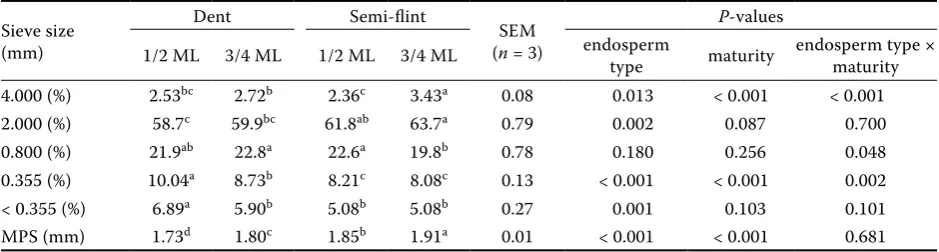
Table 2. Effect of endosperm type and maturity of maize hybrids on distribution of particles and mean particle size after 6 mm kernel grinding
Sieve size (mm)
Dent Semi-flint
SEM (n = 3)
P-values
1/2 ML 3/4 ML 1/2 ML 3/4 ML endosperm type maturity endosperm type × maturity
4.000 (%) 2.53bc 2.72b 2.36c 3.43a 0.08 0.013 < 0.001 < 0.001 2.000 (%) 58.7c 59.9bc 61.8ab 63.7a 0.79 0.002 0.087 0.700 0.800 (%) 21.9ab 22.8a 22.6a 19.8b 0.78 0.180 0.256 0.048 0.355 (%) 10.04a 8.73b 8.21c 8.08c 0.13 < 0.001 < 0.001 0.002 < 0.355 (%) 6.89a 5.90b 5.08b 5.08b 0.27 0.001 0.103 0.101 MPS (mm) 1.73d 1.80c 1.85b 1.91a 0.01 < 0.001 < 0.001 0.681
ML = milk line, MPS = mean particle size
grinding as influenced by endosperm type and maturity stage. Higher MPS was associated with semi-flint endosperm (means 1.76 vs 1.88 mm, P < 0.001) and later harvest time (means 1.79 vs 1.85 mm, P < 0.001). In the work of Le Deschault de Monredon et al. (1996), dent maize had been characterized by a smaller proportion of coarse particles (61.9% vs 69.6%) and a higher proportion of fine particles (15.6% vs 9.0%) in comparison to flint maize. In our study, dent maize (maturity 1/2 ML) had a signifi-cantly lower proportion of particles found on the 2 mm sieve (P < 0.01). Higher proportions of smaller particles were found in dent maize after sieving the material on the 0.355 (9.39%) and < 0.355 mm (6.40%) sieves than were found for semi-flint maize (8.15% and 5.08%, respectively), with P < 0.001 and P < 0.01, respectively. Dent and flint kernels differed markedly in their proportions of coarse particles also in the study of Philippeau and Michalet-Doreau (1998). The arithmetic mean of maize kernel par-ticle size was lower (P < 0.1) in dent maize than in flint maize when the sample was ground through a 2 mm screen. An effect of maturity on the MPS of maize kernels ground through a 6 mm screen was mentioned by Ngonyamo-Majee et al. (2009). They found small but significant differences (P < 0.001). These authors determined MPS of 1.001 mm at 1/2 ML maturity and 1.041 mm at black layer maturity. Ruminal degradability and total tract digest-ibility of DM and starch. Table 3 presents deg-radation characteristics of DM in the rumen. The
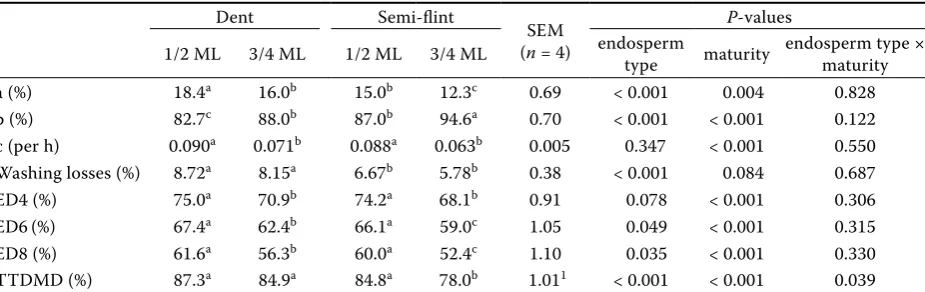
rapidly degradable fraction a and the slowly degra-dable fraction b were significantly influenced by both endosperm type and maturity. Parameter a was higher in dent maize (17.2%) than in semi-flint maize (13.6%, P < 0.001). According to Ngonyamo-Majee et al. (2009), larger a fractions in soft-dent endosperm could be explained by increased content of fine particles, inasmuch as they are easily washed out of the bags. Our values for washing losses of DM particles from bags (Table 3) comparable with those for 5 mm ground maize (6.6%) in the work of Philippeau and Michalet-Doreau (1997) negatively correlate with MPS. This fact may explain the larger a fraction for dent endosperm and lower maturity stage as reported by Ngonyamo-Majee et al. (2009). In our study, the degradation constant rate c was lower (P < 0.001) in kernels at a later maturity stage while no effect of endosperm type was observed. In agreement with Philippeau and Michalet-Doreau (1998) and Philippeau et al. (1999), it was confirmed that an increase in DM ED was linked to increases in the rapidly degradable fraction a and the degra-dation constant rate c while the slowly degradable fraction b decreased.
[image:6.595.67.530.539.685.2]Although the effect of kernel maturity on the ED of DM was significant (P < 0.001) for the entire range of outflow rates from the rumen (4–8%/h), in the case of endosperm type significant differences were observed only for the two highest outflow rates (6% and 8%/h, P < 0.05). A negative effect of vitreousness on the ED of DM, connected with flint endosperm,
Table 3. Effect of endosperm type and maturity of maize hybrids on washing losses, ruminal degradability, and total tract digestibility of dry matter
Dent Semi-flint
SEM (n = 4)
P-values
1/2 ML 3/4 ML 1/2 ML 3/4 ML endosperm type maturity endosperm type × maturity a (%) 18.4a 16.0b 15.0b 12.3c 0.69 < 0.001 0.004 0.828 b (%) 82.7c 88.0b 87.0b 94.6a 0.70 < 0.001 < 0.001 0.122 c (per h) 0.090a 0.071b 0.088a 0.063b 0.005 0.347 < 0.001 0.550 Washing losses (%) 8.72a 8.15a 6.67b 5.78b 0.38 < 0.001 0.084 0.687 ED4 (%) 75.0a 70.9b 74.2a 68.1b 0.91 0.078 < 0.001 0.306 ED6(%) 67.4a 62.4b 66.1a 59.0c 1.05 0.049 < 0.001 0.315 ED8 (%) 61.6a 56.3b 60.0a 52.4c 1.10 0.035 < 0.001 0.330 TTDMD (%) 87.3a 84.9a 84.8a 78.0b 1.011 < 0.001 < 0.001 0.039
ML = milk line, a = rapidly degradable fraction in the rumen, b = slowly degradable fraction, c = rate of degradation of fraction b, ED = effective degradability for digesta passage rates from rumen (ED4 – 4%, ED6 – 6%, and ED8 – 8% per h), TTDMD = total tract dry matter digestibility
has been discussed by Philippeau and Michalet-Doreau (1998), Philippeau et al. (1999), and Ramos et al. (2009). Similarly, the vitreousness connection with maturity factor was discussed by Philippeau et al. (2000) and Ngonyamo-Majee et al. (2008, 2009). TTDMD was also significantly influenced by both factors. A higher (P < 0.001) mean was determined for dent endosperm (86.1%) than for semi-flint maize (81.4%) and a lower mean (P < 0.001) for kernels har-vested at 3/4 ML (81.5%) than for those harhar-vested at 1/2 ML (86.0%). A negative correlation of TTDMD with vitreousness was described by Ngonyamo-Majee et al. (2008) at 1/2 ML maturity. Good agreement was achieved with the results of Ngonyamo-Majee et al. (2009), who reported a range of TTDMD between 86.2% and 81.1% for 1/2 ML and black-layer maturity, respectively. Unlike the study by Ngonyamo-Majee et al. (2009) in which the authors compared additional eventualities of single-gene mutations, our work found an interaction (P < 0.05) between endosperm type and maturity stage. This response manifested itself in a greater decline in TTDMD in semi-flint endosperm at later maturity stage than was found in that of dent maize.
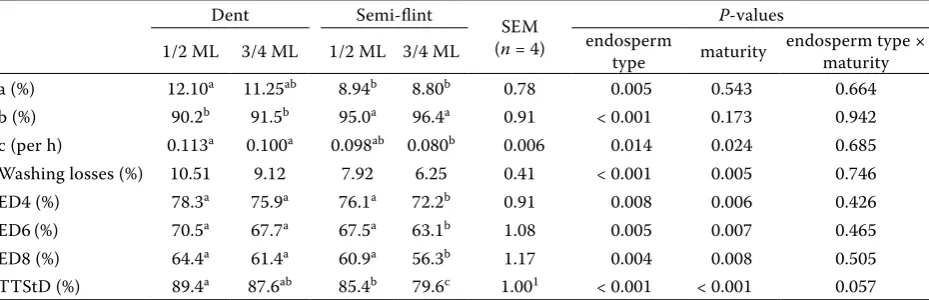
Because starch is a major constituent of the kernel, DM degradation parameters (Table 3) were largely correlated with the values for starch (Table 4). Unlike for DM, however, the rapidly de-gradable component a for starch was significantly influenced only by endosperm type (11.67% for dent
maize and 8.87% for semi-flint maize, P < 0.01). In contrast, washing losses of starch particles (Table 4) were significantly (P < 0.01) influenced by both factors. These values were higher than those for washing losses of DM particles, as had been found by Philippeau and Michalet-Doreau (1997). In the case of slowly degradable fraction b, an effect of endosperm type was found, with the proportions calculated at 90.9% for dent and 95.7% for semi-flint (P < 0.001) maize. While in the case of DM the degradation constant rate c was not affected by endosperm type, in that of starch a higher value was found for dent (0.107/h) than for semi-flint (0.089/h, P < 0.05) and in grains at earlier matu-rity stage (0.106/h) than in those harvested later (0.090/h, P < 0.05). According to Philippeau and Michalet-Doreau (1998), the lower degradability of starch in flint kernels reported from in situ studies was caused by a lower proportion in the rapidly degradable fraction, by a lower constant rate of degradation, or by both factors.
[image:7.595.65.530.535.685.2]Starch ED (Table 4) was comparable to ED for DM (Table 3) at all outflow rates and with similar responses to both main factors (i.e. higher ED for dent than for semi-flint and for 1/2 ML than for 3/4 ML). Starch ED calculated for the medium outflow rate of 6%/h showed the following differ-ences: 69.1% for dent vs 65.3% for semi-flint (P < 0.01) and 69.0% for 1/2 ML vs 65.4% for 3/4 ML (P < 0.01). According to Offner et al. (2003), the
Table 4. Effect of endosperm type and maturity of maize hybrids on washing losses, ruminal degradability, and total tract digestibility of starch
Dent Semi-flint SEM
(n = 4)
P-values
1/2 ML 3/4 ML 1/2 ML 3/4 ML endosperm type maturity endosperm type × maturity a (%) 12.10a 11.25ab 8.94b 8.80b 0.78 0.005 0.543 0.664 b (%) 90.2b 91.5b 95.0a 96.4a 0.91 < 0.001 0.173 0.942 c (per h) 0.113a 0.100a 0.098ab 0.080b 0.006 0.014 0.024 0.685 Washing losses (%) 10.51 9.12 7.92 6.25 0.41 < 0.001 0.005 0.746 ED4 (%) 78.3a 75.9a 76.1a 72.2b 0.91 0.008 0.006 0.426 ED6(%) 70.5a 67.7a 67.5a 63.1b 1.08 0.005 0.007 0.465 ED8 (%) 64.4a 61.4a 60.9a 56.3b 1.17 0.004 0.008 0.505 TTStD (%) 89.4a 87.6ab 85.4b 79.6c 1.001 < 0.001 < 0.001 0.057
ML = milk line, a = rapidly degradable fraction in the rumen, b = slowly degradable fraction, c = rate of degradation of fraction b, ED = effective degradability for digesta passage rates from rumen (ED4 – 4%, ED6 – 6%, and ED8 – 8% per h), TTStD = total tract starch digestibility
impact of variable passage rates (4–8%/h) on starch ED was more important for feedstuffs with a lower degradability of starch (in our case for semi-flint maize) and with a larger b fraction. In our case for semi-flint maize (at 3/4 ML) and with outflow rates of 4–8%/h, for instance, the ED of starch ranged between 72.2% and 56.3%.
Agreement between the ED of DM and starch has been described in the literature, such as the strong (P < 0.001) positive correlation for ED of DM with the ED of starch (r = 0.98) published by Correa et al. (2002). Differences within en-dosperm types in our study were significant only for starch ED at 3/4 ML maturity in semi-flint maize. Findings of negative relationships between vitreousness and starch ED have been published (e.g. Ramos et al. 2009). Philippeau and Michalet-Doreau (1998) found that the difference in ruminal starch degradability (in their study 10.7 percentage points) could be related to the difference in the proportion of vitreous endosperm in the grain (in their study 15.1 percentage points). In our case, the difference in starch ED at the 6%/h passage rate for dent maize between 1/2 and 3/4 ML was 2.81% and that for vitreousness was 6.05%. The respective differences for semi-flint maize were calculated as 4.46% and 7.51%.
Ngonyamo-Majee et al. (2009) found a positive correlation (r = 0.90) between TTDMD and TTStD (P < 0.001). Our values for TTStD were, as in the case of TTDMD, affected in the same way by both endosperm type and maturity and with strong levels of significance. Higher (P < 0.001) TTStD was found for dent (88.5%) than for semi-flint (82.5%) and for kernels at earlier maturity stage (87.4%) than for those harvested at a later date (83.6%, P < 0.001). While in the case of TTDMD an interaction was found between endosperm type and maturity (P < 0.05), the interaction of the mentioned factors for TTStD showed only a strong tendency (P < 0.1). Semi-flint endosperm has a tendency for greater decrease in TTStD with increasing maturity in comparison with dent endosperm.
CONCLUSION
With advancing maturity, kernel vitreousness increased while ruminal starch degradability and total tract starch digestibility decreased. As a con-sequence of the interaction between endosperm type and maturity stage, a greater decrease in total
tract starch digestibility was observed in semi-flint maize. Lower starch effective degradability in dent maize was determined in comparison to that for semi-flint endosperm. Dent maize was character-ized by a smaller proportion of coarse particles and by a higher proportion of fine particles con-nected with its higher proportion of the rapidly degradable fraction. The mentioned significant factors directly influenced the amount of starch digested in the rumen and intestine. Small differ-ences in grain texture and silage maturity stage significantly influenced ruminal in situ degrada-bility and total tract in situ–in vitro dry matter and starch digestibility.
REFERENCES
Blasel H.M., Hoffman P.C., Shaver R.D. (2006): Degree of starch access: an enzymatic method to determine starch degradation potential of corn grain and corn silage. Ani-mal Feed Science and Technology, 128, 96–107. Boyer C.D., Shannon J.C. (2003): Carbohydrates of the
ker-nel. In: White P.J., Johnson L.A. (eds): Corn: Chemistry and Technology. American Association of Cereal Chem-ists, St. Paul, USA, 289–312.
Calsamiglia S., Stern M.D. (1995): A three-step in-vitro procedure for estimating intestinal digestion of protein in ruminants. Journal of Animal Science, 73, 1459–1465. Commission Regulation (2009): Commission Regulation
(EC) No 152/2009 of 27 January 2009 laying down the methods of sampling and analysis for the official control of feed. Official Journal of the European Union, L54, 1–130. Correa C.E., Shaver R.D., Pereira M.N., Lauer J.G., Kohn
K. (2002): Relationship between corn vitreousness and ruminal in situ starch degradability. Journal of Dairy Science, 85, 3008–3012.
Ehrman T. (1996): Determination of Starch in Biomass Sam-ples by Chemical Solubilization and Enzymatic Digestion. LAP-016. Department of Energy, National Bioenergy Center, Washington D.C., USA.
Fernandez I., Noziere P., Michalet-Doreau B. (2004): Site and extent of starch digestion of whole-plant maize silages differing in maturity stage and chop length, in dairy cows. Livestock Production Science, 89, 147–157.
Harmon D.L., McLeod K.R. (2001): Glucose uptake and regulation by intestinal tissues: implications and whole-body energetics. Journal of Animal Science, 79, E59–E72. INRA (1989): Ruminant Nutrition: Recommended Allow-ances and Feed Tables. John Libbey Eurotext, London, UK. Le Deschault de Monredon F.M., Devaux F., Chaurand M.
frac-tions of dent and flint maize. Sciences des Aliments, 16, 117–132.
Madsen J., Hvelplund T., Weisbjerg M.R., Bertilsson J., Ols-son I., Sporndly R., Harstad O.M., Volden H., Tuori M., Varvikko T., Huhtanen P., Olafsson B.L. (1995): The AAT/ PBV protein evaluation system for ruminants: a revision. Norwegian Journal of Agricultural Sciences, 19, 1–37. Mertens D.R. (2002): Gravimetric determination of
amyl-ase-treated neutral detergent fibre in feeds with reflux-ing beakers or crucibles: collaborative study. Journal of AOAC International, 85, 1217–1240.
Ngonyamo-Majee D., Shaver R.D., Coors J.G., Sapienza D., Lauer J.G. (2008): Relationships between kernel vit-reousness and dry matter degradability for diverse corn germplasm II. Ruminal and post-ruminal degradabilities. Animal Feed Science and Technology, 142, 259–274. Ngonyamo-Majee D., Shaver R.D., Coors J.G., Sapienza D.,
Lauer J.G. (2009): Influence of single-gene mutations, harvest maturity and sample processing on ruminal in situ and post-ruminal in vitro dry matter and starch degradability of corn grain by ruminants. Animal Feed Science and Technology, 151, 240–250.
NRC (2001): Nutrient Requirements of Dairy Cattle. 7th Ed. The National Academies Press, Washington D.C., USA. Offner A., Sauvant D. (2004): Prediction of in vivo starch
digestion in cattle from in situ data. Animal Feed Science and Technology, 111, 41–56.
Offner A., Bach A., Sauvant D. (2003): Quantitative review of in situ starch degradation in the rumen. Animal Feed Science and Technology, 106, 81–93.
Orskov E.R., McDonald I. (1979): The estimation of protein degradability in the rumen from incubation measure-ments weighed according to rate of passage. Journal of Agricultural Science, 92, 499–503.
Owens F.N., Secrist D.S., Hill W.J., Gill D.R. (1998): Acidosis in cattle: a review. Journal of Animal Science, 76, 275–286. Philippeau C., Michalet-Doreau B. (1997): Influence of
genotype and stage of maturity of maize on rate of ruminal starch degradation. Animal Feed Science and Technol-ogy, 68, 25–35.
Corresponding Author
Dr. Ing. Jiří Třináctý, Agricultural Research, Ltd., Zahradní 1, 664 41 Troubsko, Czech Republic Phone: +420 603 352 127, e-mail: [email protected]
Philippeau C., Michalet-Doreau B. (1998): Influence of genotype and ensiling of corn grain on in situ degrada-tion of starch in the rumen. Journal of Dairy Science, 81, 2178–2184.
Philippeau C., Landry J., Michalet-Doreau B. (1998): Influ-ence of the biochemical and physical characteristics of the maize grain on ruminal starch degradation. Journal of Agricultural and Food Chemistry, 46, 4287–4291. Philippeau C., Le Deschault de Monredon F.,
Michalet-Doreau B. (1999): Relationship between ruminal starch degradation and the physical characteristics of corn grain. Journal of Animal Science, 77, 238–243.
Philippeau C., Landry J., Michalet-Doreau B. (2000): Influ-ence of the protein distribution of maize endosperm on ruminal starch degradability. Journal of the Science of Food and Agriculture, 80, 404–408.
Ramos B.M.O., Champion M., Poncet C., Mizubuti I.Y., Noziere P. (2009): Effects of vitreousness and particle size of maize grain on ruminal and intestinal in sacco degradation of dry matter, starch and nitrogen. Animal Feed Science and Technology, 148, 253–266.
Remond D., Cabrera-Estrada J.I., Champion M., Chauveau B., Coudure R., Poncet C. (2004): Effect of corn particle size on site and extent of starch digestion in lactating dairy cows. Journal of Dairy Science, 87, 1389–1399. Sapienza D.A. (2002): Pioneer tripartite method: linking
nutrient content to availability. In: Proc. 64th Mtg. Cornell Nutrition Conference for Feed Manufacturers. Cornell University, Ithaca, USA, 27–40.
Trinacty J., Simek M., Komprda T. (1996): The influence of a nylon bag carrier on alfalfa crude protein degradabil-ity. Animal Feed Science and Technology, 57, 129–137. Waldo D.R., Smith L.W., Cox E.L., Weinland B.T., Lucas H.L.
(1971): Logarithmic normal distribution for description of sieved forage materials. Journal of Dairy Science, 54, 1465–1469.