Effect of selected factors on the content of ascorbic acid
in potatoes with different tuber flesh colour
K. Hamouz
1, J. Lachman
2, P. Dvořák
1, M. Orsák
2, K. Hejtmánková
2, M. Čížek
31
Department of Plant Production, Faculty of Agrobiology, Food and Natural Resources,
Czech University of Life Sciences Prague, Prague, Czech Republic
2
Department of Chemistry, Faculty of Agrobiology, Food and Natural Resources,
Czech University of Life Sciences Prague, Prague, Czech Republic
3
Potato Research Institute Ltd., Havlíčkův Brod, Czech Republic
AbstrAct
in precise field trials in the years 2004–2008 in the Czech republic the effect of conditions of location, variety and mineral fertilization on ascorbic acid content (aa) in potatoes with different tuber flesh color was investigated. Sig-nificant was the effect of variety. The Marabel variety with the highest aa content (248 mg/kg FW) exceeded other eight varieties by 13.4–74.1%. The valfi variety, in five-year trials the only variety with purple colored flesh, ranked among analyzed varieties moderately below average. in addition, in the year 2008 the group of seven varieties with purple and red tubers was evaluated and aa content lower by 15.2% compared to the group of varieties with yellow flesh was determined. also, significant differences were determined between the varieties with coloured tubers; the highest aa content was found in the red-fleshed variety Highland Burgundy red (234 mg/kg FW). a negative effect on aa content in tubers was observed at increased intensity of n fertilization (at 180 kg n/ha, aa decreased by 12.4% compared to 100 kg n/ha). Enhanced levels of potassium and magnesium fertilization had no effect on the aa content. The effect of location on aa content was not shown; however, from the four locations in average of five years a pronounced trend of the highest content of ascorbic acid on the location Přerov nad labem with the highest temperature averages during vegetation period of experimental years was determined (by 0.9°C, 2.3°C, and 5.9°C higher compared with other locations).
Keywords: ascorbic acid; potatoes; yellow; purple and red fleshed varieties; location; mineral fertilization
Supported by the Ministry of agriculture of the Czech republic, Project no. QH 92110, and by the Ministry of Educa-tion, Youth and Sports of the Czech republic, Project no. MSM 6046070901.
ascorbic acid (vitamin C) is the main vitamin in potatoes. Global dietary contribution of vitamin C from potatoes is important with an estimate of 40% of daily-recommended intake (oECD 2002). there is a wide range of vitamin C content in tu-bers, with the usual range for freshly harvested tubers reported as 10–25 mg/100 g FW. Brown (2005) reported an average level of 20 mg/100 g FW, which may account for up to 13% of the total antioxidant capacity of tuber.
ascorbic acid content in freshly harvested potato tubers is importantly influenced by dynamics of changes of its concentration in the tubers during the vegetation period. these changes are in most
location, which influenced aa content only in two from four varieties and the effect of variety prevailed above the effect of location. nowacki et al. (2000) investigated in twelve-year experi-ments the effect of the sum of precipitation on the aa content. in dry years (in average of ap-proximately hundred varieties) they recorded higher aa content (22.1 mg/100 g FW) than in wet years (18.9 mg/100 g FW). Many authors describe negative effects of nitrogen fertilization on the aa content (takebe and Yoneyama 1992, rogozińska and Wojdyla 1996, nowacki et al. 2000). However lin et al. (2004) discovered only a little effect of nitrogen fertilization on the aa content; only high doses of nitrogen that lead to the yield depression significantly reduced aa content. two sources of potassium fertilizer, KCl and K2So4 significantly increased the ascorbic acid content in the experi-ments carried out by Mondy and Munshi (1993). nowacki et al. (2000) also determined favourable effect of potassium fertilization in the form K2So4 and phosphorus fertilization on the aa content, while rogozińska and Wojdyla (1996) obtained inconsistent and non-significant results in the case of potassium fertilization.
this work has extended our recent report (Hamouz et al. 2007). Previous two-year experi-mental results are completed by further three years to five-year results; it revises some conclusions and newly presents the results of ascorbic acid content in seven purple- or red-fleshed varieties from the year 2008. the aim of this study was to examine the influence of location, genotype with different flesh colour, fertilization with inorganic fertilizers (n, P, K) and also the effect of the year of cultivation on the aa content in potato tubers.
MAtEriAL AnD MEtHODs
[image:2.604.72.542.80.192.2]in precise field trials in the years 2004–2008 on four locations in the Czech republic (Přerov nad labem, Praha-Suchdol, lípa, Stachy) with differ-ent altitude, the impala, Karin, Ditta and Saturna potato varieties were cultivated in unified way ac-cording to the standards of common agricultural engineering. Furthermore, on the location lípa, the agria, asterix, Magda, Marabel and valfi va-rieties were cultivated; on the location Přerov nad labem the purple-fleshed Blaue St. Galler, Blue
table 1. Characterization of experimental locations
location level above sea (m) temperature (°C)average annual of precipitation (mm)annual sum Soil type Soil category
Přerov nad labem 178 8.8 622 hl sl, l
Praha-Suchdol 286 8.2 510 hl l
lípa 505 7.7 632 saC sl
Stachy 860 6.3 755 eP ls
valečov 460 6.9 649 saC sl, l
Soil categories: hl – haplic luvisol; saC – stagnic acid Cambisol; eP – entic Podzol; soil texture: sl – sandy loamy; ls – loamy sandy; l – loamy
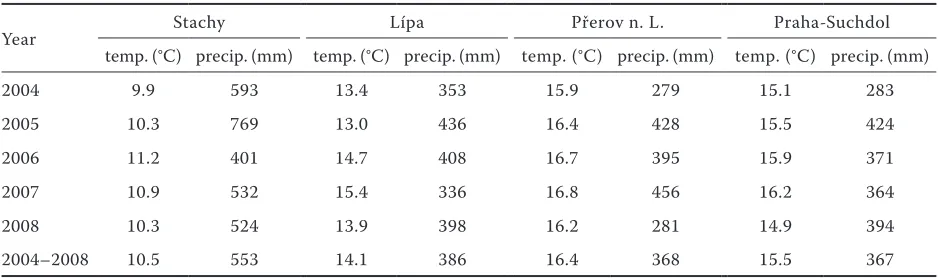
table 2. average temperatures (°C) and precipitation totals (mm) during vegetation period april–September in the years 2004–2008 on experimental locations
Year Stachy lípa Přerov n. l. Praha-Suchdol
temp. (°C) precip. (mm) temp. (°C) precip. (mm) temp. (°C) precip. (mm) temp. (°C) precip. (mm)
2004 9.9 593 13.4 353 15.9 279 15.1 283
2005 10.3 769 13.0 436 16.4 428 15.5 424
2006 11.2 401 14.7 408 16.7 395 15.9 371
2007 10.9 532 15.4 336 16.8 456 16.2 364
2008 10.3 524 13.9 398 16.2 281 14.9 394
[image:2.604.72.541.623.762.2]Congo, Salad Blue, valfi, violette varieties and the red-fleshed Highland Burgundy red variety were included in the experiment in the year 2008. Basic characteristics of various locations are described in table 1. Data about agricultural engineering are reported in our recent article (Hamouz et al. 2007).
the second trial was based on the valečov location (table 1), where the influence of different fertilization levels with n, P, K, Mg nutrients was investigated. the trial was made with the Ditta and Karin varieties, agricultural engineering was (with exception of inorganic fertilizers) the same as in the first experiment. Fertilization variants: variant 1: without fertilization with industrial fertilizers; variant 2: 100 kg n/ha, 44 kg P/ha, 108 kg K/ha, 30 kg Mg/ha = control variant accordant with routine fertiliza-tion in the given locafertiliza-tion; variant 3: 100 kg n/ha, 44 kg P/ha, 166 kg K/ha, 60 kg Mg/ha; variant 4: 180 kg n/ha, 44 kg P/ha, 108 kg K/ha, 30 kg Mg/ha.
after the harvest in the stage of physiological maturity the samples of tubers from parallels of every experiment were sampled for laboratory analyses, which were per-formed at the Department of Chemistry of the Czech University of life Sciences in Prague. aa content was determined by HPlC-DaD method (reverse phase, iso-cratic elution, wavelength for detection λ = 251 nm). as extractive agent 3% HPo3 was used. obtained results were statistically run by the method of variance analysis (anova) with more detailed evaluation by means of tukey test in SaS computer programme (version 8.02) at the level of significance P = 0.05.
rEsuLts AnD DiscussiOn
Effect of location. From four experimental locations
in average of five years, the highest aa content was de-termined on the location Přerov nad labem; this result was unambiguous and conclusive during the first two years of our experiments (2004, 2005) and again in the year 2008 (table 3). in the year 2006 the differences in aa content between locations were non-conclusive and in the year 2007 the highest aa content inconsistent with other years was demonstrated on the coolest and the most humid Stachy location. the five-year average of results was affected by all these factors and the aa increase in comparison with other locations exceeded confirmative HSD difference only in the case of Suchdol location. that is why we can more closely specify conclu-sions of our report (Hamouz et al. 2007); the previously determined highest aa content in potatoes from the warm and dry Přerov nad labem location is not decisive in the average of five years, but it still constitutes a permanent distinct trend. the highest average aa content on the Přerov nad labem location was evidently affected by
[image:3.604.79.214.84.768.2]the weather with the highest temperatures during the vegetation period of the trial years from all locations (difference of five years’ temperature average during vegetation period compared with other locations achieved 0.9°C, 2.3°C and 5.9°C) and low precipitation (table 2). our result is in accordance with conclusions resulting from ex-periments of Sawicka and Mikos-Bielak (1995), where high air temperatures in vegetation period favourably stimulated vitamin C accumulation in the tubers of very early potato varieties. also Jablońska-Ceglarek and Wadas (2005) came to the same conclusion on the basis of six-year experi-ment. Simultaneously with climatic conditions the effect of sandy loamy brown soil on the Přerov
[image:4.604.72.537.62.253.2]nad labem locality could come across (significant difference compared to the Praha-Suchdol locality with similar climatic conditions, but on the loamy soil); it is in accordance with the results obtained by Mondy et al. (1979). Hereafter Pawelzik et al. (1999) documented the effect of location on the aa content. a significant effect on aa content was found in some cases for the year of cultiva-tion (Figure 1). From the weather characteristics in individual years, unambiguous dependence of aa content with some of meteorological factors is not evident, however the lowest aa contents were determined in the years 2005 (165 mg/kg FW) and 2007 (157 mg/kg FW) with above-aver-age sum of precipitation 514 mm and 422 mm,
Figure 1. Effect of the year of cultivation on ascorbic acid content in mg/kg FW (average values of all locations and varieties in a given year)
vertical lines represent HSD (P ≥ 0.05); HSD = 13.632
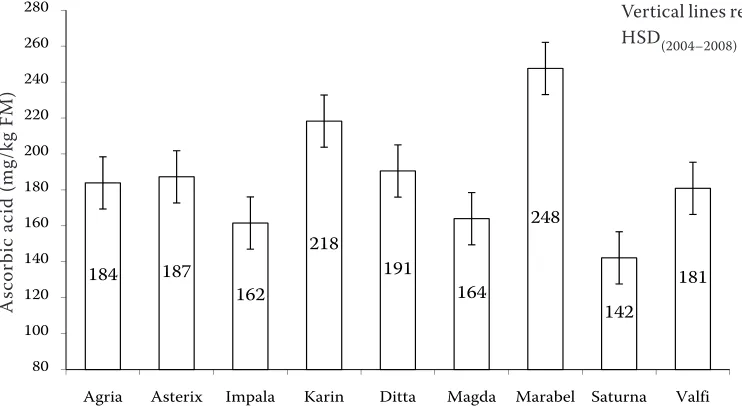
Figure 2. Effect of variety on ascorbic acid content (mg/kg FW); lípa location 2004–2008
184 187
162
218
191
164
248
142
181
80 100 120 140 160 180 200 220 240 260 280
Agria Asterix Impala Karin Ditta Magda Marabel Saturna Valfi
As
corbic
ac
id
(mg/kg F
M
)
a
sc
or
bi
c
ac
id
(m
g/
kg
F
M
)
176 165 179
157
213
0 25 50 75 100 125 150 175 200 225 250
2004 2005 2006 2007 2008
As
corbic
ac
id
(mg/kg F
M
)
a
sc
or
bi
c
ac
id
(m
g/
kg
F
M
)
[image:4.604.74.445.536.739.2]respectively, in the average of all locations during the vegetation period as compared with other years of cultivation with sum of precipitation in the range of 364–399 mm, where aa content was by 7–26% higher. thus, the knowledge of nowacki et al. (2000) of favourable effect of drier climate on the aa content was confirmed; these authors found it during long-term monitoring of the aa content in the dry and wet years during the veg-etation periods in the years 1974–1997.
Effect of variety. aa content in average of five
experimental years ranged between 248–142 mg/kg FW and it was provably influenced by variety (Figure 2). the highest aa content was deter-mined in the Marabel variety, which conclusively
[image:5.604.66.419.62.264.2]exceeded all other varieties (it has exceeded them significantly by 13.4–74.1%). Further, among the analysed varieties Karin, Ditta, asterix had above average aa values, and agria was shown to possess an average content. in the valfi variety with purple-fleshed tubers the aa content was determined as moderately lower than the average value of analysed varieties. the Marabel, Karin and Ditta varieties with the highest aa content belong to semi-early varieties with favourable consumer quality; among the varieties with significantly lower aa content, the impala and Magda varieties belong to the group of very early varieties, whereas Saturna is a semi-late variety designated for the production of fried potato chips.
Figure 4. Effect of the level of mineral fertilization (fertilization variants) on ascorbic acid content (mg/kg FW); valečov location 2004–2008
204
234
221
200
223
215
205 215
150 160 170 180 190 200 210 220 230 240 250
As
corbic
ac
id
(mg/kg F
W
[image:5.604.68.453.535.727.2])
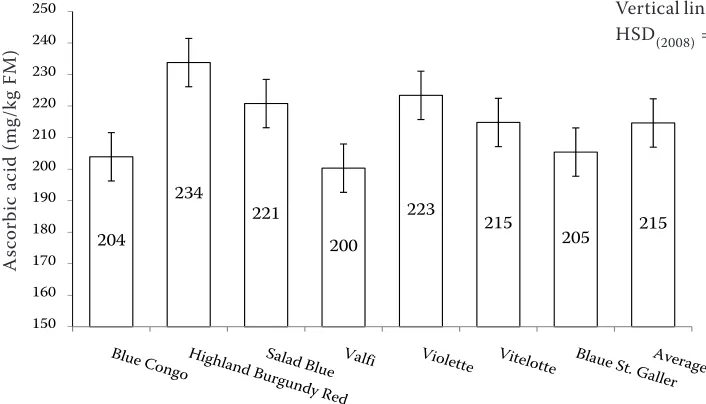
Figure 3. Effect of purple- and red-fleshed varieties on ascorbic acid content (mg/kg FW); Přerov nad labem 2008 vertical lines represent HSD (P ≥ 0.05); HSD(2008) = 15.34
a
sc
or
bi
c
ac
id
(m
g/
kg
F
M
)
216 215 213
188
100 120 140 160 180 200 220 240
Var. 1 Var. 2 Var. 3 Var. 4
As
corbic
ac
id
(mg/kg F
M
)
a
sc
or
bi
c
ac
id
(m
g/
kg
F
M
)
in the group of seven purple- or red-fleshed va-rieties cultivated in the year 2008 at the Přerov nad labem location, the average of all varieties deter-mined aa content as 215 mg/kg FW (Figure 3), which is by 15.2% less compared to yellow-fleshed varieties (247.2 mg/kg FW, table 3) in the same year and the same location. However, on the other hand, these varieties related to antioxidants have a higher content of total phenols and higher antioxidant activity of tubers as compared to yellow-fleshed varieties (lachman et al. 2008). Within the scope of colour-fleshed varieties the absolutely high-est aa content was recorded in the red-fleshed Highland Burgundy red variety (234 mg/kg FW); still, the differences in aa content of this variety in comparison with the violette and Salad Blue varieties were inconclusive. nevertheless, in the aa content the Highland Burgundy red convinc-ingly outweighed other purple-fleshed varieties by 8.8–17% (Figure 3). aa concentration in potatoes obtained from our experiments conforms to the results published by other authors (oECD 2002, Zgórska and Frydecka-Mazurczyk 2000, Brown 2005). our results also confirm a significant effect of variety on aa content that was described by Pawelzik et al. (1999), Weber and Putz (1999) and Zgórska and Frydecka-Mazurczyk (2000).
Effect of mineral fertilization. in the first two
years a favourable trend of the enhanced aa con-tent, when potassium dose has reached 166 kg K/ha and at the same time magnesium dose has increased to 60 kg Mg/ha, has been found (vari-ant 3 in the year 2005, signific(vari-ant result); these results are in accordance with previously reported findings (Mondy and Munshi 1993, nowacki et al. 2000). However, in the next three years this trend was not confirmed, aa content in the variant 3 did not differ in five-year average significantly from the control variant 2 and rather decreased below its level (Figure 4).
However, a negative effect of increased level of nitrogen fertilization 180 kg n/ha (variant 4) on the aa content was proved. The aa content decreased in average of experimental years by 12.4% in comparison with the control variant 2. in this case, the results of most authors who investigated this matter have been confirmed (takebe and Yoneyama 1992, rogozińska and Wojdyla 1996, nowacki et al. 2000).
rEfErEncEs
Brown C.r. (2005): antioxidants in potato. american Journal of Potato research, 82: 163–172.
Hamouz K., lachman J., Dvořák P., Dušková o., Čížek M. (2007): Effect of conditions of locality, variety and fertilization on the content of ascorbic acid in potato tubers. Plant, Soil and Environment, 53: 252–257. Jablońska-Ceglarek r., Wadas W. (2005): Effect of
non-woven polypropylene covers on early tuber yield of potato crops. Plant, Soil and Environment, 51: 226–231.
lachman J., Hamouz K., Šulc M., orsák M., Dvořák P. (2008): Differences in phenolic content and antioxi-dant activity in yellow and purple-fleshed potatoes grown in the Czech republic. Plant, Soil and Envi-ronment, 54: 1–6.
lin S., Sattelmacher B., Kutzmutz E., Muhling K.H., Dittert K. (2004): influence of nitrogen nutrition on tuber quality of potato with special reference to the pathway of nitrate transport into tubers. Journal of Plant nutrition, 27: 341–350.
Mondy n.i., Munshi C.B. (1993): Effect of type of po-tassium fertilizer on enzymatic discoloration and phenolic, ascorbic acid, and lipid contents of pota-toes. Journal of agricultural and Food Chemistry,
41: 849–852.
Mondy n.i., Koch r.l., Chandra S. (1979): influence of nitrogen fertilization on potato discolouration in relation to chemical composition. 2. Phenols and ascorbic acid. Journal of agricultural and Food Chem-istry, 27: 418–420.
nowacki W., Gluska a., Gruczek t., lis B., lutomirska B., roztropowicz S., Zarzynska K. (2000): Growing of potatoes, ware and technological quality of tu-bers. in: Proceedings of the Scientific Conference of agricultural University in Wroclaw, Polanica Zdrój, 23–32. (in Polish)
oECD organisation for Economic Co-operation and Development (2002): Series on the safety of novel foods and feeds, no. 4. Consensus document of compositional considerations for new varieties of potatoes: key food and feed nutrients, anti-nutrients and toxicants: 20.
Pawelzik E., Delgado E., Poberezny J., rogozińska i. (1999): Effect of different climatic conditions on quality of certain German and Polish potato varieties. in: abstracts of 14th triennial Conference, EaPr, Sorrento: 635–636.
rogozińska i., Wojdyla t. (1996): the effect of min-eral fertilization on the vitamin C content in potato tubers. in: abstracts of 13th triennial Conference, EaPr, veldhoven: 216–217.
Sawicka B., Mikos-Bielak M. (1995): an attempt to evaluate the fluctuation of chemical composition of potato tubers in changing conditions of arable field. advances of agricultural Sciences Problem issues,
Corresponding author:
Prof. ing. Karel Hamouz, CSc., Česká zemědělská univerzita v Praze, Fakulta agrobiologie, potravinových a přírodních zdrojů, Kamýcká 129, 165 21 Praha 6-Suchdol, Česká republika
phone: + 420 224 382 548, fax: + 420 224 382 535, e-mail: [email protected] takebe M., Yoneyama t. (1992): Plant growth and
ascor-bic acid. l. Changes of ascorascor-bic acid concentrations in the leaves and tubers of sweet potato (Ipomea batatas
lam.) and potato (Solanum tuberosum l.). nippon Dojo Hiryogaku Zasshi, 63: 447–454.
Weber l., Putz B. (1999): vitamin C content in potatoes. in: abstracts of 14th triennial Conference, EaPr, Sorrento: 230–231.
Zgórska K., Frydecka-Mazurczyk a. (2000): Factors affecting the susceptibility of potato tubers to after-wounding blackspot. Biuletyn iHar Jadwisin, 213: 253–260. (in Polish)