
The K Value Distribution of Liquid Phase Sintered Microstructures
5
0
0
Full text
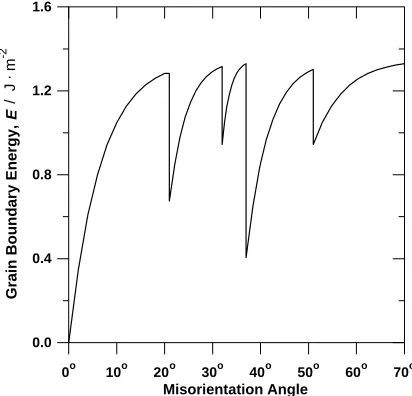
(2) P.-L. Liu and S.-T. Lin. 2. Model Geometry The simulation of a 3-D multi-particle arrangement incorporated the interface energy spectrum employs an identical procedure to that previously developed by the present authors.6) It assumed that base powders and additive powders in the powder compact are mixed and packed together. Mixed powders are heated to a temperature at which liquid forms in sintering. These powders are assumed to be spherical particles. In this model, all particles are assumed to bond together during heating, prior to liquid formation. The additive particles are assumed to melt into the liquid phase at the sintering temperature. A realistic model is generated by employing powders of the liquid (additive powders) and solid phases (base powders) whose particle size distributions exhibit truncated normal distributions. In the truncated normal distribution, only the particle sizes situating in the interval between R−3σ and R+3σ are generated in the calculation, where R is the mean particle radius and σ is the standard deviation of the distribution. The distribution function is denoted by Ň (R, σ ). Four different particle size distribution functions representing different mean particle sizes and different standard deviations were assumed (Fig. 1), and different combinations of liquid phase and solid phase particles were employed for simulation. In addition, monosized particles, Ň (R, 0), were also employed for simulation in the present investigation. The relative volumetric ratios of solid phase to liquid phase, designated 25, 50, 75, and 90 vol% solid phase particles with the remainder of the liquid phase particles, were treated as input variables that determined their relative probabilities in probabilistic generation of particles. Each particle was randomly generated according to the size distribution functions of solid and liquid phases, and the relative volume fraction of each phase. In liquid phase sintered systems, solid grains can either exist as isolated grains or bond with the adjacent grains, which accordingly yields a distribution of dihedral angle.. Anisotropy in grain boundary energy causes such a phenomenon. In fact, the grain boundary energy between two adjacent grains is determined by the misorientation angle of these two grains. According to the previous papers, the relation between the measured grain boundary energy of tungsten and the misorientation angle can be expressed in Fig. 2.7, 8) Bonding of adjacent grains occurs prior to the formation of liquid phase. When the liquid phase is formed, it causes to dissolve the grain boundary under the following thermodynamic criterion. 2χsl ≤ χGB ,. where χsl and χGB respectively denote the energy of a solidliquid interface and the grain boundary energy.9–13) If the grain boundary energy is smaller than twice the energy of the solid-liquid interface during liquid phase sintering, the liquid dose not penetrate and dissolve the grain boundary. Under such a condition, there will exist an equilibrium dihedral angle Ψ among the solid grains and the liquid phase (Fig. 3), which can be expressed by: χGB = 2χsl cos(Ψ/2).. 1.6. 1.2. 0.8. 0.4. 0.0 o. 10. o. 20. 0.5. N (8, 1). (3). Herein, the energy of a solid(W)-liquid(Ni–Fe) interface, χsl , is taken as 0.55 J/m2 .14). 0. N (4, 1). (2). -2. sten grains. The result of this study should simplify the task of finding the 3-D coordination number of tungsten grains.. Grain Boundary Energy, E / J . m. 2116. o. o. o. 30 40 50 Misorientation Angle. o. 60. o. 70. o. Fig. 2 Tungsten grain boundary energy spectrum.7, 8). N (16, 1). Probability Density. 0.4. Liquid phase 0.3. Grain boundary. N (8, 2). 0.2. 0.1. Solid particle. Solid particle. 0.0. 0. 4. 8. 12. 16. 20. Particle Size, r/ m Fig. 1 Four distributions describing sharpness of particles used in this work.. Fig. 3 The dihedral angle between two intersecting solid particles with a partially penetrating liquid phase..
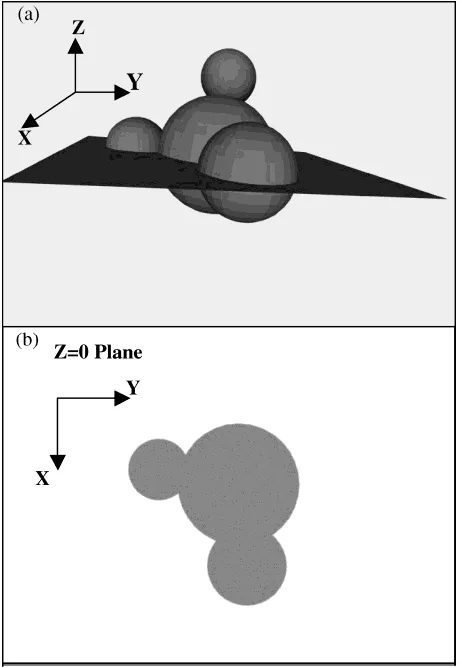
(3) The K Value Distribution of Liquid Phase Sintered Microstructures 0.8. 2117. (a). Mean = 1.19 Standard Deviation = 0.44. 0.6 0.4 0.2 0 1.5. (b). Mean = 0.97 Standard Deviation = 0.44. 1. Probability Density. 0.5 0. 1.5. (c). Mean = 0.82 Standard Deviation = 0.41. 1 0.5 0. 1.5. (d). Mean = 0.71 Standard Deviation = 0.33. 1 0.5 0 Fig. 4 Sketch of contacts per particle in (a) a three-dimensional space and (b) a two-dimensional cross section.. The packing coordination number of each central particle is determined in the model shown in Fig. 4. To determine the mean contacts per grain in a 2-D cross section, it is assumed that the x–y plane at z = 0 is a typical 2-D metallographic cross section. Neighboring contacts of each base particle in this 2-D cross section are determined. Furthermore, the probability model determines the effect of system thermodynamics (χGB /χsl ) on the dihedral angle during liquid phase sintering. The model’s basic operation generates a random misorientation, which is applied to the specified grain boundary between two-bonded particles, to determine the grain boundary energy. Grain boundaries with the lowest boundary energy are more likely to be formed by the rotation of particles, which is not considered in this analysis. If the grain boundary energy is smaller than twice the energy of the solid-liquid interface during liquid phase sintering, solving the eq. (3) will calculate the dihedral angle. With the above definition, the K value can be calculated by using the eq. (1). 3. Numerical Simulation The Monte Carlo method provides approximate solutions to a possible K value distribution by performing statistical sampling experiments on a computer. The program was run on a workstation of the SunOS Release 4.1.3 of the UNIX system using SIMCRIPT as the computer programming language. The Monte Carlo method is best suited for representing complex simulation models. Statistical comparisons of. 0.25. 0.75. 1.25. 1.75. 2.25. K Value Fig. 5 The effect of volume fractions of solid on K value distributions for Ň (8, 2) particle size distributions: solid volume fractions (a) 25%, (b) 50%, (c) 75%, and (d) 90%.. 1000 simulated grains were made between the present results of the two effects of the volume fraction of solid phase and the particle size distribution during the initial stage of liquid phase sintering. Subsequently, the results by numerical computation are briefly discussed. 4. Results and Discussion The simulations were performed for four different particle size distributions and monosized particles, and solid volume fractions of 25, 50, 75, and 90 vol%. Figure 5 reveals histograms for K value distributions of specimens with different solid volume fractions for Ň (8, 2) base and additive particle size distributions. According to our results, the mean of the K value distribution increases with an increase in the volume fraction of liquid phase, mainly due to the decreasing of the probability of particle contacts. Figure 6 displays histograms for K value distributions of specimens of solid volume fractions of 90 vol% for various ratios of the mean base particle size to the mean additive particle size. The majority of small base particles with some large additive particles have an advantage contributing to the probability of particle contacts. The mean of K value distributions for a given volume fraction of solid decreases with an increase in the probability of parti-.
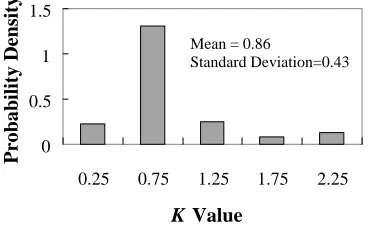
(4) 2118. P.-L. Liu and S.-T. Lin 1. 1.6. (a). Base Particles:Additive Particles N (4,1): N (8,1) N (8,2): N (8,2) N (8,1): N (8,1) N (8,0): N (8,0) N (16,1): N (8,1). Mean = 0.69 Standard Deviation= 0.40. 0.8 0.6. 1.4. 0.4. K Value. 0.2. Probability Density. 0. 1.5. (b). Mean = 0.76 Standard Deviation= 0.37. 1 0.5. 1.2. 1.0. 0.8. 0 0.6. 1.5. (c). 1. 1.0. Fig. 8 Variations in the K value with an increase of volume fraction of solid.. 0.5. Table 1 K value and correlation coefficient of different particle size distributions.. 0 0.25. 0.75. 1.25. 1.75. 2.25. K Value Fig. 6 The effect of ratios of the mean base particle size to the mean additive particle size on K value distributions with 90% volume fraction of solid: (a) Ň (4, 1): Ň (8, 1), (b) Ň (8, 1): Ň (8, 1), and (c) Ň (16, 1): Ň (8, 1).. Probability Density. 0.6 0.4 0.8 Volume Fraction of Solid. 0.2. Mean = 0.90 Standard Deviation= 0.41. Base particle Ň (4, 1) Ň (8, 1) Ň (16, 1) Ň (8, 0) Ň (8, 2). Additive particle Ň (8, Ň (8, Ň (8, Ň (8, Ň (8,. 1) 1) 1) 0) 2). K value. Correlation coefficient. 0.944–0.0031 × (vol%) 1.429–0.0077 × (vol%) 1.683–0.0085 × (vol%) 1.441–0.0064 × (vol%) 1.359–0.0073 × (vol%). 0.955 0.987 0.994 0.999 0.997. 1.5 Mean = 0.86 Standard Deviation=0.43. 1. Table 2 Connectivities, solid volume fractions, and dihedral angles of tungsten alloys.3). 0.5 0 0.25. 0.75. 1.25. 1.75. 2.25. K Value. Alloy (mass%). Solid volume fraction (vol%). Connectivity. 78W–Ni–Fe 83W–Ni–Fe 88W–Ni–Fe 93W–Ni–Fe. 51.7 54.7 79.4 85.4. 0.9 1 1.5 2.3. Dihedral angle 30◦ –45◦. Fig. 7 K value distribution for monosized particles with 90% volume fraction of solid.. cle contacts or a decrease in the ratio of the mean base particle size to the mean additive particle size. Investigating how the effect of monosized particles on K value distributions was also studied, as shown in Fig. 7. Decreasing the standard deviation of the particle size distribution increases the mean of K value distributions, due primarily to a decreased likelihood of particle contacts. Figures 5(d) and 6(b) confirm that the mean of K value distributions decreases with an increase in the standard deviation of the particle size distribution. Figure 8 plots the mean K value vs the solid volume fraction for various base and additive particle size distributions. An important result is that the mean K value of each specimen decreases linearly with the solid volume fraction. Thus, the mean K value can be estimated from a least squares regression, giving the equations in Table 1. Equations from the Table 1 fit the results with correlation coefficients ranged from 0.955 to 0.999, which are highly significant.. The solution from the Table 1 linking the eq. (1) can be converted into a more useful form based on the solid volume fraction. Table 2 presents the previous experimental connectivities, dihedral angles, and solid volume fractions of tungsten alloys with compositions ranging from 78 to 93 mass% tungsten. The remainder of the alloy consists of Ni and Fe, where the ratio of Ni and Fe is 7:3.3) Elemental powders of W (purity 99.95% and mean particle size 8.0 µm), Ni (purity 99.99% and mean particle size 10.4 µm) and Fe (purity 99.5% and mean particle size 6.3 µm) were used to produce the alloys. These alloys were pre-sintered at 1400◦ C in a flowing dry hydrogen atmosphere for 3 h to provide handling strength. Then they were heated to a sintering temperature of 1507◦ C for 1 minute in the vacuum and microgravity environment. Combining the past experimental data in Table 2 and the present results calculated by Ň (8, 2) particle size distributions shown in Table 1 provides the results in Table 3. It is noted that two powders, including base powders and additive powders, are.
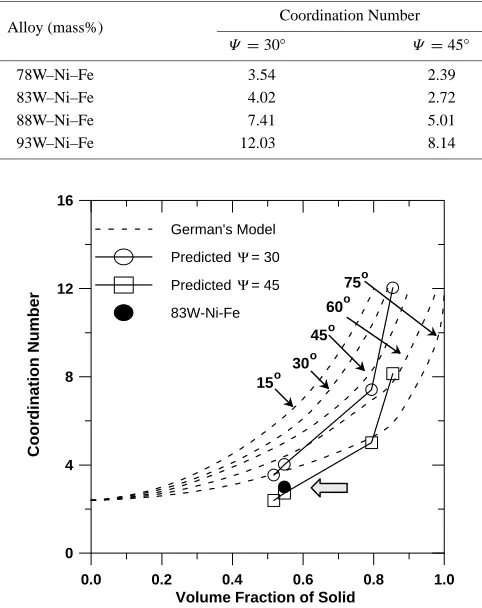
(5) The K Value Distribution of Liquid Phase Sintered Microstructures Table 3 Predicted coordination number of tungsten alloys. Coordination Number. Alloy (mass%). Ψ =. 78W–Ni–Fe 83W–Ni–Fe 88W–Ni–Fe 93W–Ni–Fe. 30◦. Ψ = 45◦. 3.54 4.02 7.41 12.03. 2.39 2.72 5.01 8.14. 16. Coordination Number. German's Model. 12. Predicted. = 30. Predicted. = 45. 75 60. 83W-Ni-Fe. 45 8. 15. o. 30. o. o. o. o. 4. 2119. the two-dimensional connectivity to the three-dimensional coordination number) distribution during the initial stage of liquid phase sintering. Based on analysis results, we conclude the following: (1) The three-dimensional Monte Carlo model combines a multi-particle arrangement, non-uniform particle size, irregular packing and continuous spectrum of grain boundary energy to simulate the K value distributions. (2) The K value distribution strongly depends on the ratio of the mean base particle size to the mean additive particle size, and on the standard deviation of the particle size distribution. The mean K value increases with decreasing the standard deviation or increasing the ratio of the mean base particle size to the mean additive particle size. (3) There are strong correlations between the mean K values and the volume fractions of solid phase, which can be expressed through simple mathematical relationships. (4) These simulations provide a basis for attaching the more significant relation between the two-dimensional connectivity to the three-dimensional coordination number. Acknowledgements. 0 0.0. 0.2. 0.4 0.6 0.8 Volume Fraction of Solid. 1.0. Fig. 9 The predicted coordination number vs volume fraction of solid, comparing the current model with German’s model and the experimental report for an 83 mass%W–11.9 mass%Ni–5.1 mass%Fe alloy.1, 2). used in this model. Given the limitations of the model, the mean additive particle size was assumed to be the mean of the sizes of Ni and Fe powders. Here, tungsten powders, simulated base powders, and Ni and Fe powders or simulated additive powders, were randomly selected according to Ň (8, 2) powder size distributions. The German’s two-grain model2) based on the two monosized grains have been combined with Table 3 to construct Fig. 9. Figure 9 illustrates the predicted 3-D coordination number, shown as the solid line, linking the past experimental parameter and the result of this study, compared with the two-grain model as the dashed line. Previous work shows that the mean 3-D coordination numbers of an 83 mass%W–11.9 mass%Ni–5.1 mass%Fe alloy under above processed is about 3 (indicated by an arrow in the Fig. 9) by using the montage serial sectioning technique.1) Notably, the current results correspond well with the experimental ones on the liquid phase sintered W–Ni–Fe alloy. 5. Conclusions This study has demonstrated the feasibility of applying the Monte Carlo method to calculate the K value (a constant links. Professor Wei-Ning Yang is appreciated for allowing us to use a computer on a workstation with the UNIX system, and for many stimulating discussions. REFERENCES 1) A. Tewari, A. M. Gokhale and R. M. German: Acta Metall. 47 (1999) 3721–3734. 2) R. M. German: Metall. Trans. A 18A (1987) 909–914. 3) J. L. Johnson, A. Upadhyaya and R. M. German: Metall. Mater. Trans. B 29B (1998) 857–866. 4) C. M. Kipphut, A. Bose, S. Farooq and R. M. German: Metall. Trans. A 19A (1988) 1905–1913. 5) Y. Liu, D. F. Heaney and R. M. German: Acta Metall. 43 (1995) 1587– 1592. 6) P. L. Liu and S. T. Lin: Mater. Trans., JIM 43 (2002) 544–550. 7) V. Glebovsky, B. Straumal, V. Semenov, V. Sursaeva and W. Gust: High Temp. Mater. Processes 14 (1995) 67–73. 8) L. E. Murr: Interfacial Phenomena in Metals and Alloys, (AddisonWesley Pub. Co., Massachusetts, 1975) pp. 132. 9) W. D. Kingery: J. Appl. Phys. 30 (1959) 301–306. 10) H. D. Park, W. H. Baik, S. J. L. Kang and D. Y. Yoon: Metall. Mater. Trans. A 27A (1996) 3120–3125. 11) A. D. Rollett, D. J. Srolovitz and M. P. Anderson: Acta Metall. 37 (1989) 1227–1240. 12) D. R. Clarke: Intergranular Phases in Polycrystalline Ceramics in Surface and Interfaces of Ceramic Materials, (Kluwer Academic Publishers, Dordrecht, Boston, 1989) pp. 57–79. 13) S. S. Kim and D. Y. Yoon: Acta Metall. 31 (1983) 1151–1157. 14) S. C. Yang, S. S. Mani and R. M. German: Ad. Powder Metall., ed. by E. R. Andreotti and P. J. McGeehan (Metal Powder Industries Federation, Princeton, New Jersey, 1990) pp. 469–482..
(6)
Figure
Related documents