1-Allyl-1
H
-1,3-benzimidazol-2(3
H
)-one
Dounia Belaziz,a* Youssef Kandri Rodi,aFouad Ouazzani Chahdi,aEl Mokhtar Essassi,b,cMohamed Saadidand Lahcen El Ammarid
aLaboratoire de Chimie Organique Applique´e, Universite´ Sidi Mohamed Ben Abdallah, Faculte´ des Sciences et Techniques, Route d’immouzzer, BP 2202 Fe`s, Morocco,bLaboratoire de Chimie Organique He´te´rocyclique URAC21, Faculte´ des Sciences, Universite´ Mohammed V-Agdal, Avenue Ibn Battouta, BP 1014, Rabat, Morocco,cInstitute of Nanmaterials and Nanotechnology, MASCIR, Rabat, Morocco, anddLaboratoire de Chimie du Solide Applique´e, Faculte´ des Sciences, Universite´ Mohammed V-Agdal, Avenue Ibn Battouta, BP 1014, Rabat, Morocco
Correspondence e-mail: [email protected]
Received 9 October 2012; accepted 21 October 2012
Key indicators: single-crystal X-ray study;T= 296 K; mean(C–C) = 0.002 A˚; Rfactor = 0.045;wRfactor = 0.128; data-to-parameter ratio = 21.4.
The fused five- and six-membered rings in the title compound, C10H10N2O, are approximately coplanar, with an r.m.s.
deviation of 0.008 A˚ . The mean plane of the allyl group is roughly perpendicular to the mean plane of the 1,3-benzimidazol-2(3H)-one system, making a dihedral angle of 86.1 (2). In the crystal, each molecule is linked to its
symmetry equivalent partner by a pair of N—H O and C—H O hydrogen bonds.
Related literature
For the pharmacological and biochemical properties of the title compound, see: Gravattet al.(1994); Hortonet al.(2003); Kim et al. (1996); Roth et al. (1997). For compounds with similar structures, see: Belaziz et al. (2012); Ouzidan et al.
(2011).
Experimental
Crystal data
C10H10N2O Mr= 174.20
Monoclinic,P21=c a= 10.2749 (5) A˚ b= 5.5787 (3) A˚ c= 16.6220 (9) A˚
= 100.976 (4)
V= 935.35 (8) A˚3
Z= 4
MoKradiation
= 0.08 mm1 T= 296 K
0.380.290.27 mm
Data collection
Bruker X8 APEX diffractometer 13429 measured reflections 2570 independent reflections
1393 reflections withI> 2(I) Rint= 0.046
Refinement
R[F2> 2(F2)] = 0.045 wR(F2) = 0.128 S= 1.04 2570 reflections
120 parameters
H-atom parameters constrained max= 0.14 e A˚
3 min=0.14 e A˚
[image:1.610.44.230.563.692.2]3
Table 1
Hydrogen-bond geometry (A˚ ,).
D—H A D—H H A D A D—H A
N2—H2 O1i
0.86 2.00 2.8274 (14) 161
C3—H3 O1ii
0.93 2.52 3.3080 (19) 142
Symmetry codes: (i)xþ1;y;zþ2; (ii)x;yþ1 2;z
1 2.
Data collection:APEX2(Bruker, 2005); cell refinement:SAINT (Bruker, 2005); data reduction:SAINT; program(s) used to solve structure:SHELXS97(Sheldrick, 2008); program(s) used to refine structure: SHELXL97 (Sheldrick, 2008); molecular graphics: ORTEP-3 for Windows(Farrugia, 2012); software used to prepare material for publication: PLATON (Spek, 2009) and publCIF (Westrip, 2010).
The authors thank the Unit of Support for Technical and Scientific Research (UATRS, CNRST) for the X-ray measurements.
Supplementary data and figures for this paper are available from the IUCr electronic archives (Reference: FJ2602).
References
Belaziz, D., Kandri Rodi, Y., Essassi, E. M. & El Ammari, L. (2012).Acta Cryst.E68, o1276.
Bruker (2005).APEX2andSAINTBruker AXS Inc., Madison, Wisconsin, USA.
Farrugia, L. J. (2012).J. Appl. Cryst.45, 849–854.
Gravatt, G. L., Baguley, B. C., Wilson, W. R. & Denny, W. A. (1994).J. Med. Chem.37, 4338–4345.
Horton, D. A., Bourne, G. T. & Smythe, M. L. (2003).Chem. Rev.103, 893–930. Kim, J. S., Gatto, B., Yu, C., Liu, A., Liu, L. F. & La Voie, E. J. (1996).J. Med.
Chem.39, 992–998..
Ouzidan, Y., Essassi, E. M., Luis, S. V., Bolte, M. & El Ammari, L. (2011).Acta Cryst.E67, o1822.
Roth, T., Morningstar, M. L., Boyer, P. L., Hughes, S. H., Buckheit, R. W. & Michejda, C. J. (1997).J. Med. Chem.40, 4199–4207.
Sheldrick, G. M. (2008).Acta Cryst.A64, 112–122. Spek, A. L. (2009).Acta Cryst.D65, 148–155. Westrip, S. P. (2010).J. Appl. Cryst.43, 920–925. Acta Crystallographica Section E
Structure Reports Online
supporting information
Acta Cryst. (2012). E68, o3212 [doi:10.1107/S1600536812043620]
1-Allyl-1
H
-1,3-benzimidazol-2(3
H
)-one
Dounia Belaziz, Youssef Kandri Rodi, Fouad Ouazzani Chahdi, El Mokhtar Essassi, Mohamed
Saadi and Lahcen El Ammari
S1. Comment
Benzimidazoles are very useful intermediates/subunits for the development of molecules of pharmaceutical or biological interest. Benzimidazole and its derivatives are an important class of bioactive molecules in the field of drugs and pharmaceuticals. Benzimidazole derivatives have found applications in diverse therapeutic areas including anti-ulcers, anti-hypertensives, anti-virals, anti-fungals, anti-cancers, (Gravatt et al. 1994; Horton et al. 2003; Kim et al. 1996; Roth
et al. 1997).
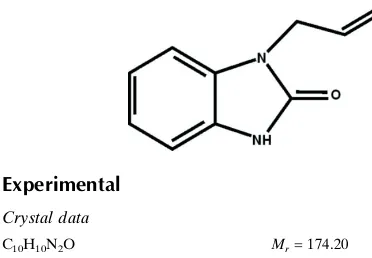
As a continuation of our research work devoted to the development of substituted benzimidazol-2-one derivatives (Belaziz et al., 2012; Ouzidan et al. 2011), we reported in this paper the synthesis of new benzimidazol-2-one derivative by action of allyl bromide with 1H-1,3-benzimidazol-2(3H)-one in the presence of a catalytic quantity of tetra-n-butyl-ammonium bromide under mild conditions to furnish mono-substituted compound (Scheme 1).
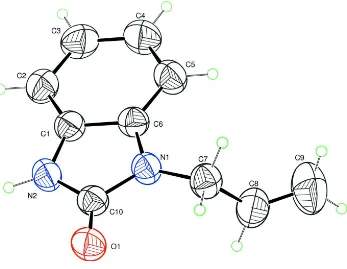
The crystal structure of the 1-allyl-1H-1,3-benzimidazol-2(3H)-one molecule is built up from fused six-and five-membered rings linked to C3H5 chain as shown in Fg.1. The fused-ring system is essentially planar, with a maximum
deviation of -0.010 (1) Å for C10. The allyl group is nearly perpendicular to the 1H-1,3-benzimidazol-2(3H)-one plane as indicated by the torsion angle of C8 C7 N1 C6 - 70.44 (18)°. In the crystal, each molecule and its symmetry through the inversion center are linked by N2—H2···O1 and C3—H3···O1 hydrogen bonds in the way to form dimers as shown in Fig.2.
S2. Experimental
To 1H-1,3-benzimidazol-2(3H)-one (0.2 g, 1.49 mmol), potassium carbonate (0.41 g, 2.98 mmol) and tetra-n-butyl-ammonium bromide (0.05 g, 0.15 mmol) in DMF (15 ml) was added allyl bromide (0.14 ml, 1.78 mmol). Stirring was continued at room temperature for 6 h. The salt was removed by filtration and the filtrate concentrated under reduced pressure. The residue was separated by chromatography on a column of silica gel with ethyl acetate/hexane (1/2) as eluent. The product was obtained with quantitative yield of 70%. It was recrystallized from hexan/acetate to give colourless crystals.
S3. Refinement
Figure 1
Molecular structure of the title compound with the atom-labelling scheme. Displacement ellipsoids are drawn at the 50% probability level. H atoms are represented as small circles.
Figure 2
[image:3.610.125.485.393.606.2]1-Allyl-1H-1,3-benzimidazol-2(3H)-one
Crystal data
C10H10N2O
Mr = 174.20
Monoclinic, P21/c
Hall symbol: -p 2ybc
a = 10.2749 (5) Å
b = 5.5787 (3) Å
c = 16.6220 (9) Å
β = 100.976 (4)°
V = 935.35 (8) Å3
Z = 4
F(000) = 368
Dx = 1.237 Mg m−3
Melting point: 342.7 K
Mo Kα radiation, λ = 0.71073 Å Cell parameters from 2570 reflections
θ = 2.9–29.4°
µ = 0.08 mm−1
T = 296 K Block, colourless 0.38 × 0.29 × 0.27 mm
Data collection
Bruker X8 APEX diffractometer
Radiation source: fine-focus sealed tube Graphite monochromator
φ and ω scans
13429 measured reflections 2570 independent reflections
1393 reflections with I > 2σ(I)
Rint = 0.046
θmax = 29.4°, θmin = 2.9°
h = −13→14
k = −7→7
l = −22→22
Refinement
Refinement on F2
Least-squares matrix: full
R[F2 > 2σ(F2)] = 0.045
wR(F2) = 0.128
S = 1.04 2570 reflections 120 parameters 0 restraints
Primary atom site location: structure-invariant direct methods
Secondary atom site location: difference Fourier map
Hydrogen site location: difference Fourier map H-atom parameters constrained
w = 1/[σ2(F
o2) + (0.0584P)2]
where P = (Fo2 + 2Fc2)/3
(Δ/σ)max < 0.001
Δρmax = 0.14 e Å−3
Δρmin = −0.14 e Å−3
Extinction correction: SHELXL97 (Sheldrick, 2008), Fc*=kFc[1+0.001xFc2λ3/sin(2θ)]-1/4
Extinction coefficient: 0.011 (4)
Special details
Geometry. All s.u.'s (except the s.u. in the dihedral angle between two l.s. planes) are estimated using the full covariance matrix. The cell s.u.'s are taken into account individually in the estimation of s.u.'s in distances, angles and torsion angles; correlations between s.u.'s in cell parameters are only used when they are defined by crystal symmetry. An approximate (isotropic) treatment of cell s.u.'s is used for estimating s.u.'s involving l.s. planes.
Refinement. Refinement of F2 against ALL reflections. The weighted R-factor wR and goodness of fit S are based on F2,
conventional R-factors R are based on F, with F set to zero for negative F2. The threshold expression of F2 > 2σ(F2) is
used only for calculating R-factors(gt) etc. and is not relevant to the choice of reflections for refinement. R-factors based on F2 are statistically about twice as large as those based on F, and R- factors based on ALL data will be even larger.
Fractional atomic coordinates and isotropic or equivalent isotropic displacement parameters (Å2)
x y z Uiso*/Ueq
C3 0.70534 (18) 0.4825 (3) 0.76048 (9) 0.0638 (5) H3 0.7056 0.4732 0.7046 0.077* C4 0.77162 (19) 0.6684 (3) 0.80584 (10) 0.0651 (5) H4 0.8153 0.7820 0.7798 0.078* C5 0.77454 (16) 0.6892 (2) 0.88889 (10) 0.0557 (4) H5 0.8189 0.8149 0.9191 0.067* C6 0.70925 (14) 0.5166 (2) 0.92520 (8) 0.0436 (4) C7 0.74323 (15) 0.6384 (2) 1.07492 (9) 0.0512 (4) H7A 0.7020 0.5928 1.1205 0.061* H7B 0.7180 0.8027 1.0605 0.061* C8 0.88971 (17) 0.6264 (3) 1.10148 (10) 0.0656 (5) H8 0.9191 0.4602 1.1144 0.105 (7)* C9 0.9688 (2) 0.8074 (4) 1.11471 (13) 0.0968 (7) H9A 1.0714 0.7945 1.1346 0.116* H9B 0.9256 0.9702 1.1048 0.116* C10 0.61611 (15) 0.2860 (2) 1.01062 (9) 0.0441 (4) N1 0.69312 (11) 0.48505 (18) 1.00561 (7) 0.0452 (3) N2 0.58638 (12) 0.19162 (19) 0.93391 (7) 0.0481 (3) H2 0.5401 0.0640 0.9210 0.058* O1 0.58255 (11) 0.21105 (17) 1.07330 (6) 0.0559 (3)
Atomic displacement parameters (Å2)
U11 U22 U33 U12 U13 U23
C1 0.0415 (9) 0.0445 (7) 0.0468 (9) 0.0002 (5) 0.0072 (7) 0.0025 (6) C2 0.0578 (11) 0.0578 (9) 0.0476 (10) −0.0040 (7) 0.0064 (8) −0.0033 (6) C3 0.0733 (13) 0.0750 (11) 0.0442 (9) −0.0033 (8) 0.0137 (8) 0.0056 (7) C4 0.0751 (13) 0.0680 (11) 0.0555 (11) −0.0120 (8) 0.0205 (9) 0.0106 (8) C5 0.0597 (11) 0.0523 (9) 0.0567 (10) −0.0101 (7) 0.0149 (8) 0.0027 (6) C6 0.0417 (9) 0.0443 (7) 0.0451 (8) 0.0006 (6) 0.0091 (6) 0.0028 (5) C7 0.0556 (11) 0.0511 (8) 0.0483 (9) −0.0034 (6) 0.0132 (8) −0.0068 (6) C8 0.0591 (12) 0.0633 (11) 0.0695 (12) −0.0024 (8) 0.0001 (9) −0.0102 (8) C9 0.0674 (15) 0.0902 (15) 0.130 (2) −0.0206 (10) 0.0128 (13) −0.0189 (12) C10 0.0420 (9) 0.0437 (7) 0.0469 (9) 0.0000 (6) 0.0090 (7) 0.0037 (6) N1 0.0476 (8) 0.0444 (6) 0.0442 (7) −0.0063 (5) 0.0106 (6) −0.0014 (4) N2 0.0514 (8) 0.0439 (6) 0.0491 (8) −0.0094 (5) 0.0100 (6) −0.0008 (5) O1 0.0631 (8) 0.0575 (6) 0.0491 (7) −0.0111 (5) 0.0159 (6) 0.0066 (4)
Geometric parameters (Å, º)
C4—H4 0.9300 C10—O1 1.2313 (16) C5—C6 1.3768 (19) C10—N2 1.3594 (17) C5—H5 0.9300 C10—N1 1.3751 (17) C6—N1 1.3890 (16) N2—H2 0.8600
C2—C1—N2 132.67 (13) C8—C7—H7A 108.9 C2—C1—C6 121.20 (13) N1—C7—H7B 108.9 N2—C1—C6 106.13 (12) C8—C7—H7B 108.9 C1—C2—C3 117.58 (14) H7A—C7—H7B 107.7 C1—C2—H2A 121.2 C9—C8—C7 125.79 (19) C3—C2—H2A 121.2 C9—C8—H8 122.9 C4—C3—C2 121.15 (15) C7—C8—H8 111.0 C4—C3—H3 119.4 C8—C9—H9A 124.4 C2—C3—H3 119.4 C8—C9—H9B 115.7 C5—C4—C3 121.56 (14) H9A—C9—H9B 119.9 C5—C4—H4 119.2 O1—C10—N2 127.79 (13) C3—C4—H4 119.2 O1—C10—N1 125.63 (13) C6—C5—C4 117.39 (14) N2—C10—N1 106.57 (12) C6—C5—H5 121.3 C10—N1—C6 109.64 (11) C4—C5—H5 121.3 C10—N1—C7 123.39 (12) C5—C6—N1 131.91 (13) C6—N1—C7 126.93 (11) C5—C6—C1 121.11 (13) C10—N2—C1 110.67 (12) N1—C6—C1 106.97 (11) C10—N2—H2 124.7 N1—C7—C8 113.31 (12) C1—N2—H2 124.7 N1—C7—H7A 108.9
N2—C1—C2—C3 −179.87 (15) N2—C10—N1—C6 1.06 (15) C6—C1—C2—C3 −0.4 (2) O1—C10—N1—C7 −1.5 (2) C1—C2—C3—C4 −0.2 (3) N2—C10—N1—C7 178.85 (12) C2—C3—C4—C5 0.3 (3) C5—C6—N1—C10 178.59 (15) C3—C4—C5—C6 0.3 (3) C1—C6—N1—C10 −0.59 (15) C4—C5—C6—N1 179.99 (14) C5—C6—N1—C7 0.9 (2) C4—C5—C6—C1 −0.9 (2) C1—C6—N1—C7 −178.28 (13) C2—C1—C6—C5 1.0 (2) C8—C7—N1—C10 112.16 (16) N2—C1—C6—C5 −179.39 (13) C8—C7—N1—C6 −70.44 (18) C2—C1—C6—N1 −179.73 (12) O1—C10—N2—C1 179.19 (14) N2—C1—C6—N1 −0.11 (15) N1—C10—N2—C1 −1.14 (15) N1—C7—C8—C9 130.56 (19) C2—C1—N2—C10 −179.66 (15) O1—C10—N1—C6 −179.26 (13) C6—C1—N2—C10 0.79 (16)
Hydrogen-bond geometry (Å, º)
D—H···A D—H H···A D···A D—H···A
N2—H2···O1i 0.86 2.00 2.8274 (14) 161
C3—H3···O1ii 0.93 2.52 3.3080 (19) 142