This contribution reflects the current state of the work on the SQuaRE project and is based on the valid and prepared international standards and technical reports of the ISO/IEC 9126, ISO/IEC 14598 and ISO/IEC 250xx series; mainly use of the principles of Azuma (2001) or Azuma and Vaníček (2001).
Quality is the key attribute of each product. Product is a result of each process, which is intended to deli-very. There are four generic categories of products:
– Services
– Software (in the more general sense than only com-puter software)
– Hardware (also not only a computer hardware)
– Processed material.
Information systems as product are mostly a combina-tion of software, hardware and associated services.
Quality in the general sense is the degree to which a set of inherent characteristics fulfils the requirements. Requirements are needs or expectations that are stated, generally implied, or obligatory. From the user’s point of view, the product quality can be considered as a degree in which the product fulfils the user needs. The transformation of needs to exact requirements can be a problem, which is not easy to solve.
Quality of each product is the key characteristic for the success in the market. The quality care is also the main motive power of the industrial and social progress General requirements for the qual-ity management to creating process of each product are given in the ISO 9000 and ISO 9001 standards. These standards are mostly process oriented and are intended previously for developers. It is not easy to
Software and data quality
Jakost softwaru a dat
J. VANÍČEK
Czech University of Agriculture, Prague, Czech Republic
Abstract: The paper presents new ideas in the InternationalSQuaRE (Software Quality Requirements and Evaluation) standardisation research project, which concerns the development of a special branch of international standards for soft-ware quality. Data can be considered as an integral part of softsoft-ware. The current international standard and technical report of the ISO/IEC 9126, ISO/IEC 14598 series and ISO/IEC 12119 standard covert the whole software as an indivisible entity. However, such data sets as databases and data stores have a special character and need a different structure of quality cha-racteristic. Therefore it was decided in the SQuaRE project create a special international standard for data quality. The main idea for this standard and the critical discussion of these ideas is presented in this paper. The main part of this contribution was presented on the conference Agricultural Perspectives XIV, aligned by Czech University of Agriculture in Prague, Sep-tember 20 to 21, 2005.
Key words: software quality; data quality; international standardization; project SQuaRE
Abstrakt: Příspěvek pojednává o novém záměru v mezinárodním normalizačním výzkumném projektu SQuaRE (Poža-davky na jakost software a jejich hodnocení), který spočívá v zpracování zvláštní skupiny norem pro jakost softwaru. Za integrální součást software mohou být považována i data. Stávající mezinárodní normy řad ISO/IEC 9126, ISO/IEC 14598 a norma ISO/IEC 12119 pokrývají software jako nedělitelnou entitu. Avšak takové datové množiny jako jsou báze dat a da-tové sklady mají zvláštní charakter, který vyžaduje odlišnou strukturu charakteristik jakosti. Proto bylo v rámci projektu SQuaRE rozhodnuto vytvořit zvláštní mezinárodní normu pro jakost dat. V tomto příspěvku jsou uvedeny hlavní myšlenky této připravované mezinárodní normy a podrobeny kritické diskusi. Podstatná část tohoto příspěvku byla přednesena na konferenci Agrární perspektivy XIV, uspořádané Českou zemědělskou univerzitou v Praze 20.–21. září 2005.
Klíčová slova: jakost softwaru, jakost dat, mezinárodní normalizace, projekt SQuaRE
establish such general standards for project from the acquirers and users point if view, because prod-ucts are of the different nature. The main effort for software production consists in developer’s process, and in product maintenance. The necessary effort to manifold software is only marginal.
For software products and products, which contain software as their crucial part, such as information sys-tems, the international standards are prepared by the Joint Technical Committee “Information Technology”, organized by the cooperation of ISO and IEC. Today the following main series of international standards are available:
– ISO/IEC 15939 “Information engineering – Software engineering – Software measurement process”, which describes the measurement framework for general software attributes, including quality attributes.
– ISO/IEC 9126 series “Information technology – Soft-ware product quality”, which contains the standard
9126-1 “Quality model”, and three technical report
9126-2, 9126-3 and 9126-4, describing the “Internal quality measures”, “External quality measures” and
“Quality in use measures”, respectively.
– ISO/IEC 14598 series “Information technology – Software product evaluation”, with six standards describing the quality evaluation process from various points of view.
– ISO/IEC 12119 “Information technology – Software packages – Quality requirements and testing”, which describes the necessary information concerning
quality, which is the supplier of the off the shelf software obliged to be published before the contract and the rules of testing these requirements.
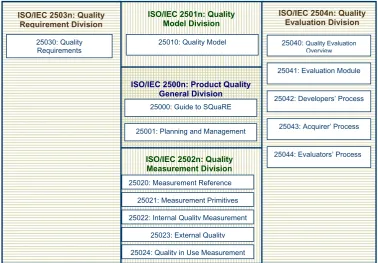
In the present state, the set of standards for software product quality is a little bit inconsistent and rather blind. These standards have not a unified terminol-ogy and do not fully reflect the current state of art in software engineering. Therefore, the international project SQuaRE starts with the aim to develop a con-sistent series ISO/IEC 250xx for the software product quality. The intended structure of the SQuaRE project is the following architecture of the 250xx series, see Figure 1; more details in Azuma, Vaníček (2001) or in the textbook Vaníček (2005).
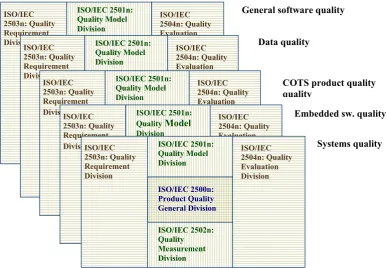
During the works on SQuaRE project, the require-ment to extend the set of 250xx standards to a special standard for a date quality occurs. The reason why the special data quality standard is prepared and why it is not sufficient to evaluate the quality of data as an integral part of software (software is defined as a program with the associated data and documenta-tion) is the following. In the modern data processing, the same data warehouse can be used for various software products and also in different information systems. Therefore, the separate and independent data quality evaluation seems to be useful. The prob-lem how to add the data quality standard into an intended SQuaRE standard structure is not solved till now. This problem shall be probably solved by
25044: Evaluators’ Process 25043: Acquirer’ Process 25042: Developers’ Process
25041: Evaluation Module 25040:Quality Evaluation
Overview
ISO/IEC 2500n: Product Quality General Division
ISO/IEC 2501n: Quality Model Division
ISO/IEC 2502n: Quality Measurement Division
25010: Quality Model
25000: Guide to SQuaRE
25020: Measurement Reference 25021: Measurement Primitives 25022: Internal Quality Measurement
25001: Planning and Management
25023: External Quality Re
ISO/IEC 2503n: Quality quirement Division
25030: Quality Requirements
25024: Quality in Use Measurement
[image:2.595.117.496.478.741.2]ISO/IEC 2504n: Quality Evaluation Division
the multilevel structure simultaneously with some of other ideas how to extend the ISO/IEC 250xx series for another quality standards with the special branches of software. Such directions are the ready made software which quality will be standardized by the standard “Software Engineering – Software product evaluation – Requirements for quality of Commercial Off-The-Shelf (COTS) software product and instructions for testing”, intended to replace the current ISO/IEC 12119 and other related standards for special software branches.
This structure is outlined in Figure 2.
The intention of this paper is to describe the base terminology, approaches and principles, which will be probably used in the new ISO/IEC standard for the data quality as well as the possible questions and problems, which accurse during the work on this standard.
TERMS INTENDED TO BE USED
IN INTENDED DATA QUALITY STANDARD The following meanings are intended for the main terms in data quality standard:
Attributeis an inherent property or characteristic of an entity that can be distinguished quantitatively or qualitatively by human or automated means.
Entity is an object that is to be characterised by measuring its attributes.
Data is a reinterpretable representation of informa-tion. Data is a representation of the perception of the real world. Any data has a degree of information. Data is considered stored in an electronic format and managed by an information system.
Data value is the atomic content of an attribute. The structured data are stored on an electronic device and are described through its structure, which is man-aged by an Information System. Structured data are considered at different levels such as: file (table, segment etc), record (row, topple etc.), specific field (attribute, column etc.) and the atomic content of a field. The data description and the structure in a data base management system are logically stored with the data, while in differ-ent legacy data organizations, the data description and the structure can reside separately by the data.
Data format is the description of: type, length or scale/precision of data (e.g. type character, numeri-cal, date, timestamp etc.)
Information is the meaning given to data or the interpretation of data, based on its context. The finished product is the result of the interpretation of such data (English 1999).
Metadata is the data that describes other data. Technologyis the framework for defining, manipu-lating and managing data. It consists of hardware
ISO/IEC 2503n: Quality Requirement Division ISO/ 2500n: uct IEC Prod Quality G l ISO/IEC 2501n: Quality Model Division ISO/IEC 2504n: Quality Evaluation Division IEC ISO/ 2502n: Quality Measurement Di i i
ISO/IEC 2503n: Quality Requirement Division ISO/I ct l EC 2500n: Produ Qua ity G l ISO/IEC 2501n: Quality Model Division ISO/IEC 2504n: Quality Evaluation Division EC ISO/I 2502n: Quality urem Meas ent Di i i
ISO/IEC 2503n: Quality Requirement Division ISO/I 500n: ct EC 2 Produ Quality ISO/IEC 2501n: Quality Model Division ISO/IEC 2504n: Quality Evaluation Division EC : ity ISO/I 2502n Qual Measurement ISO/IEC 2503n: Quality Requirement Division ISO/I 2500n: Produ EC ct Quality ISO/IEC 2501n: Quality Model Division ISO/IEC 2504n: Quality Evaluation Division EC ISO/I 2502n: Quality
MeasurementISO/IEC 2502n:Quality Measurement Division ISO/IEC 2500n: Product Quality General Division ISO/IEC 2501n: Quality Model Division ISO/IEC 2504n: Quality Evaluation Division ISO/IEC 2503n: Quality Requirement Division
General software quality
Data quality
COTS product quality quality
Embedded sw. quality
[image:3.595.110.498.464.732.2]Systems quality
components, software components of operating sys-tems, data base management systems or middleware in general.
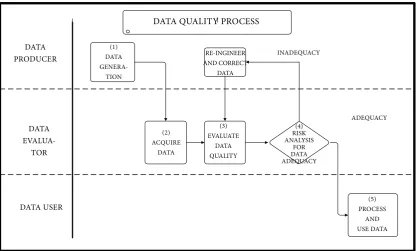
INTENDED APPROACH TO DATA QUALITY The following diagram shows the life cycle for data beginning with its generation from a source through its application by a user. There are 3 stakeholders or contributors to data quality:
– The data producer
– The data evaluator
– The data user.
The data producer (or developer) can be an in-dividual, an organization, agency, institution, who has the responsibility for generating data. The data producer shall:
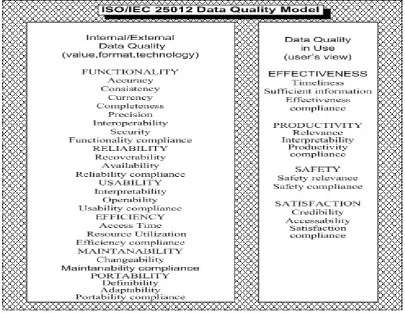
– produce data compliant with the quality charac-teristics listen on Figure 4
– transmit data in accordance with the procedures defined/agreed by the acquirer/evaluator of the data
– respond to data evaluator and/or data user requests for correction of the faulty or completion of the missing data.
The data evaluator (or acquirer) may be an in-dividual, an organization, agency, institution, who has the responsibility to determine the quality of
the data. The data evaluator has the responsibility to determine if the quality of the data is adequate for the intended user. This involves risk analysis of the adequacy of the quality characteristics including the format, correctness completeness, understand-ability, accuracy, precision and relevance for the intended use. The data quality evaluator uses risk analysis to determine the adequacy of the data for the intended purpose. It may be unwise and costly to require the data that are more precise or accurate than needed.
The data user is the stakeholder/s affected by the quality of the data. The user/s may be the producer, the evaluator, or a user that is not the producer or an evaluator. The user may be the processor of the data or the recipient of the processed data. The data user and the evaluator may collaborate to determine risks.
The life cycle for data beginning with its genera-tion by a source through its applicagenera-tion by a user is shown on Figure 3.
DATA QUALITY MODEL
The general concept of the intended model, does not directly deal with how databases have been con-ceptually and logically designed. In this model, “data” refers to “structured data”, without making distinc-tions between them.
There are different views of Data Quality:
RE-INGINEER AND CORRECT
DATA (1)
DATA
GENERA-TION DATA
PRODUCER
DATA
EVALUA-TOR
DATA USER
DATA QUALITY PROCESS
(2) ACQUIRE
DATA
(3) EVALUATE
DATA QUALITY
(4) RISK ANALYSIS
FOR DATA ADEQUACY
ADEQUACY INADEQUACY
(5) PROCESS
[image:4.595.65.483.492.743.2]AND USE DATA
Internal Data Quality: Capability of a set of static attributes of data to satisfy the stated and implied needs when the data are used under specified con-ditions.
External Data Quality: Capability of data to enable the behaviour of a system to satisfy the stated and implied needs when the system is used under speci-fied conditions
Data Quality in Use: Capability of the data to enable specific users to achieve specific goals with timeless amount of information, relevancy, credibility, under-standability in the specific contexts of use.
During the tentative preparation of data quality standard project, the advancement from the first concepts described in Vaníček (2003) in the direction to be more conform to other software quality model occurs. The Figure 4 utlines the Data Quality Model (prepared for the ISO/IEC 25012) after having taken into account the already mentioned considerations. It categorises the internal and external data qual-ity attributes into six characteristics defined in the ISO/IEC 9126-1 and intended to be use also in the ISO/IEC 250xx (functionality, reliability, usability, efficiency, maintainability and portability), which are further subdivided in the mentioned standard into subcharacteristics.
INTERNAL AND EXTERNAL DATA QUALITY The intention is to use for data quality the same set of six characteristics of data considered also from the internal and external point of view. The six charac-teristics (functionality, reliability, usability, efficiency, maintainability and portability) are mainly related to the values of data, to the format used for storing the data and the technological environment, i.e. hardware, software and middleware. For data quality, it seems to be useful to divide the accuracy subcharacteristic into syntactical and semantical accuracy and to add new subcharacteristic consistency, currency, completeness and precision instead of suitability, or a sub-subchar-acteristic of suitability. The following definition for data quality characteristics and subcharacteristics are prepared on the SQuaRE project.
Functionality
[image:5.595.88.494.428.741.2]Functionality is the capability of the data to pro-vide functions, which meet its functional require-ments. Functionality requirements are refined into the requirements for the data to be suitable, accurate, interoperable, secure and compliant with relevant functional standards and regulations. The suitability,
for what concerns data, is expanded into: consistency, currency, completeness and precision.
Consistency
Consistency refers to the absence of apparent con-tradictions in a database. For example, the data value name and sex related to the same person must be consistent, Mary cannot be a man; the information of “Name” and “Sex” must be compatible. Inconsistency can be verified on the same or different tables. Currency
Currency is the extent, to which data are up-to-date (Redman 1996). It is critical for volatile data (by “volatility” we mean how frequently the data is updated) (Bovee et al. 2001).
Completeness
Completeness is the fraction (ratio) between the amount of data stored and the amount of data in an ad-hoc reference set. For example: if a database contains information about company employees, all the employees must be recorded.
Precision
The level of detail of the data that measures the ability to distinguish between the nearly equal val-ues. For example, a three-digit numeral to the base 10 discriminates among 1 000 possibilities.
Accuracy
Accuracy is defined as the degree of conformity of an acquired, measured and calculated value to its actual or specified value. Accuracy has two main aspects:
Syntactical accuracy
Syntactical accuracy is defined as the closeness of the data values to a set of values defined in a domain considered syntactically correct. For example: a low degree of syntactical accuracy is when the name Mary is stored as Mari.
Semantic accuracy
Semantic accuracy is defined as the closeness of the data values to a set of values defined in a domain considered semantically correct. For example: a low degree of a semantical accuracy is when the name Mary is stored as John. John is syntactically accurate, because of the domain of reference in which it resides, but it is another name.
Interoperability
Interoperability is the capability of data to be ac-cessed and exchanged among different platforms and systems.
Security
Security is the capability of the data to be accessed only by authorized users.
Functionality compliance
Functionality is the capability of the data to adhere to standards, conventions or regulations in laws and similar prescriptions relating to functionality.
Reliability
Reliability is the capability of the data to maintain a specified level of operations in a specific environ-ment. Reliability requirements are refined into re-quirements for the data to be recoverable, available and compliant with relevant reliability standards and regulations.
Recoverability
Recoverability is the capability of the data to maintain and preserve its physical and logical integrity, even in the event of failure (for example with features like: com-mit/synch point, rollback and backup-recovery). Availability
Availability is the capability of data to be always retrievable.
A particular case of availability is the concurrent access (in reading and writing) by more than one user and/or application.
Reliability compliance
Reliability compliance is the capability of the data to adhere to standards, conventions or regulations in laws and similar prescriptions relating to reliability.
Usability
Usability is the capability of the data to be un-derstood, learned, and used and to catch the user’s attention, when used under the specified conditions. Usability requirements are refined into requirements for the data to be untreatable, operable, attractive for the users and capable to adhere to standards, conven-tions or regulaconven-tions in laws and similar prescripconven-tions relating to usability.
Understandability
Undesirability is the extent to which data is in the appropriate languages, symbols and units, and to which its definitions are clear (Wang, Strong 1996; Pipino et al. 2002).
Operability
Operability is the capability of the data to be rep-resented appropriately from the functional point of view. For example, the data representing “date” should be represented in “date format” and not like an integer number, to permit operations, such as the difference between dates.
Attractiveness
Attractiveness is the capability of the data to be attractive to the user.
Usability compliance
Efficiency
Efficiency is the capability of data to be processed by software products which provide the appropriate performance, relative to the amount of resources used, under stated conditions. Efficiency requirements are refined into requirements for the time behaviour, re-source compliance with relevant efficiency standards and regulations.
Time behaviour
Time behaviour is the capability of the data to be accessed within the appropriate processing times and within the throughput rates (Wang, Strong 1996).
Resource utilization
Resource utilization is the capability of the data to be stored or accessed using the appropriate amounts and types of resources under the stated conditions.
Efficiency compliance
Efficiency compliance is the capability of the data to adhere to standards, conventions or regu-lations in laws and similar prescriptions relating to efficiency.
Maintainability
Maintainability is the capability of data to be modi-fied for changes in environments, in requirements or in functional specifications. Maintainability require-ments are refined into requirerequire-ments for the data to be changeable and capable to adhere to standards, conventions or regulations in laws and similar pre-scriptions relating to maintainability.
Chengeability
Changeability is the capability of the data to be changed in its format.
Portability
Portability is the capability of data to be transferred from one environment to another. Portability require-ments are refined into the requirerequire-ments for the data to be adaptable and capable to adhere to standards, conventions or regulations in laws and similar pre-scriptions relating to portability.
Adaptability
Adaptability is the capability of the data to be moved from one platform to another.
Maintainability compliance
Maintainability compliance is the capability of the data to adhere to standards, conventions or regula-tions in laws and similar prescripregula-tions relating to maintainability.
DATA QUALITY IN USE
Data Quality in Use is the capability of data to enable users to reach specific goals in terms of ef-fectiveness, productivity, safety and satisfaction in specified contexts of use.
Effectiveness
Effectiveness is the capability of data to enable users to achieve the specified goals with accura-cy and completeness in a specified context of use. Requirements for the effectiveness can be refined into the requirements for the data to be timeliness, to contain sufficient information and adhere to stand-ards, conventions or regulations in laws and similar prescriptions relating to effectiveness.
Timeliness
Timeliness is the extent to which data is sufficient-ly up-to-date for the task at hand (Wang, Strong 1996).
Sufficient information
Sufficient information is the completeness of data from the user’s point of view and its stated needs. For example, data have the right “amount of information” if there are all fields that user needs and nullable fields have a “valid value” where the user is expecting one. Effectiveness compliance
Effectiveness compliance is the capability of the data to contain sufficient information and adhere to standards, conventions or regulations in laws and similar prescriptions relating to effectiveness.
Productivity
Productivity is the capability of data to enable us-ers to expend the appropriate amount of resources in relation to effectiveness achieved in a specific context of use. Requirements for the productivity can be refined into requirements for the data to be relevant, interoperable and to adhere to standards, conventions or regulations in laws and similar pre-scriptions relating to productivity.
Relevancy
Relevancy is the extent, to which data is applicable and helpful for the task at hand (Wang, Strong 1996; Pipino et al. 2002).
Interpretability
Interpretability is the extent to which data is easy to comprehend. Metadata can help the comprehen-sion of data.
Productivity compliance
regula-tions in laws and similar prescripregula-tions relating to productivity.
Safety
Safety is the capability of data to achieve the ac-ceptable level of risk of harm to people, business in a specified context of use. Requirements for safety can be refined into requirements for the data to be relevant and to adhere to standards, conventions or regulations in laws and similar prescriptions relating to productivity.
Safety relevance
Safety relevance is the capability similar prescrip-tions relating to safety.
Safety compliance
Safety compliance is the capability of the data to adhere to standards, conventions or regulations in laws and similar prescriptions relating to safety.
Satisfaction
Satisfaction is the capability of data to satisfy us-ers in a specified context of use. Requirements for the satisfaction can be that the data are credible, accessible and adhere to standards, conventions or regulations in laws and similar prescriptions relating to satisfaction.
Credibility
Credibility is the extent to which data is regarded as true and credible (Wang, Strong 1996).
Accessibility
Accessibility is the capability of the data to be ac-cessed, particularly by people who need the support-ing technology or special configuration because of some disability.
Satisfaction compliance
Satisfaction compliance is the capability of the data to adhere to standards, conventions or regula-tions in laws and similar prescripregula-tions relating to satisfaction.
CRITICAL DISCUSSION
The main problem concerning the development of new SQuaRE series of standard and also concerning the data quality standard is the enormous volume of standardisation documents. The quality aspects measurement is not a cheap procedure. If we extend the number and span of standards, nobody will use them. For the personal point of view and experience of the author, we are in this moment in the situation when “less can be more”.
The second serious problem is that the SQuaRE development and consideration are permanent only on the general level. Extensive researches about the standard set structure, quality model and live cycle model and meta-models are available, but the concrete attributes and measures for quality requirements and quality evaluation are absent. It seems that the commitment what is tangible is essential for the software and data quality and how to measure it is not outside the door. Without concrete contents, the quality evaluation standards cannot be utilizable in practice.
The last but not least problem from the author’s personal point of view consists in the non-fully con-sistent fragmentation of the quality into internal, external and quality in use. According to the quality definition, the product quality is only the external quality in the ISO/IEC standards terminology. The so-called “internal quality” does not fulfil any users or shack holder’s requirements. It can be interpreted only as quality predictors or indicators. The so-called “quality in use” is not an attribute of the product. It is in fact the attribute of the process of product utilization. It depends not only on the product itself, but also on the organization, which uses the prod-uct, and several other factors. This aspect shall be evaluated using the ISO 9000 series standard, not according to the SQuaRE ISO/IEC 250xx standards. The author’s felling is that the elucidation of this crisscross is absolutely necessary for the SQuaRE project success.
REFERENCES
Azuma M. (2001): Square, the Next Generation of the ISO/IEC 9126 and 14598 International Standard Series on Software Product Quality. Proceedings of the 12th European Software Control and Metrics Conference, London.
Azuma M., Vaníček J. (2001): SQuaRE: Next Genera-tion of ISO/IEC 9126 & 14598. In: EurOpen CZ. XVIII konference Dolní Malá Úpa: 1–16.
Ballou D.P., Pazer H.L. (1985): Modeling data and proc-ess quality in multi-input, multi-output information systems. Management Science, 31 (2): 150–162. Batini C., Lenzerini M., Navathe S.B. (1984): A
compar-ative analysis of methodologies for database schema integration. ACM Computing Survey, 15 (4). Bovee M., Srivastava R.P., Mak B.R. (2001): A
Calvanese D., De Giacomo G., Lenzerini M., Nardi D., Rosati R. (1998): Information Integration: concep-tual Modeling and Reasoning Support. Proceedings of the 6th International Conference on Coopera-tive Information Systems (CoopIS’98), New York City, NY, USA.
Crosby P.B. (1984): Quality without Tears. McGraw-Hill, New York.
English L.P. (1999): Improving Data Warehousing and Business Information Quality, Wiley, New York. Gertz M. (1998): Managing Data Quality and Integrity
in Federated Databases. Second Annual IFIP TC-11 WG TC-11.5 Working Conference on Integrity and Internal Control in Information Systems, Airlie Center, Warrenton, Virginia.
Huang K.T., Lee Y., Wang R. (1999): Quality Informa-tion and Knowledge. Prentice Hall, Upper Saddle River.
ISO 8402: Quality Management and Quality Assur-ance-Vocabulary.
ISO/IEC 9126: Information Technology – Software Product Evaluation – Quality Characteristics and Guidelines for their Use.
ISO/IEC 9126-1: 2001. Software engineering – Prod-uct quality – Part 1: Quality model.
ISO/IEC TR 9126-2: 2003. Software engineering – Product quality – Part 2: External metrics. ISO/IEC TR 9126-3: 2003. Software engineering
– Product quality – Part 3: Internal metrics. ISO/IEC TR 9126-4: 2004. Software engineering —
Product quality – Part 4: Quality in use metrics ISO/IEC WD circulation and CD Registration
Bal-lot, WD 25012 , Software Engineering – Software Quality Requirements and Evaluation (SQuaRE) – Data Quality Model.
Kriebel C.H., Mikhail O. (1980): Dynamic pricing of resources in computer networks. Logistics. Madnick S. (1999): Metadata Jones and the Tower of
Babel: The Challenge of Large – Scale Semantic Heterogeneity. Proceeding of the 3rd IEEE Meta-Data Conference (Meta-Meta-Data ’99), Bethesda, MA, USA.
Natale D. (1995): Qualità e Quantità nei Sistemi Software. Franco Angeli.
Natale D., Scannapieco M., Angeletti P., Catarci T., Raiss G. (2001): Qualità dei dati e standard ISO/ IEC 9126: Analisi critica ed esperienze nella Pub-blica Amministrazione Italiana”, Workshop AIPA “Sistemi in rete nella Pubblica Amministrazione” with the participation of Sogei-Società Generale d’Informatica S.p.A. and the University of Rome “La Sapienza”, (in conjunction with The VLDB Very Large Data Base Conference 2001) Rome, September. Esempi di misurazioni.
Olson J.E. (2003): Data Quality: the accuracy dimen-sion. Ed. Morgan Kaufmann Publishers. Wang, R., Storey V.C., Firth, C.F. (1995): A framework for analysis of Data Quality Research. IEEE Transac-tions on Knowledge and Data Engineering, 7 (4): 623–640.
Pipino L., Lee Y., Wang R. (2002): Data Quality As-sessment. Communications of the ACM, 45 (4). Redman T.C. (1996): Data Quality for the Information
Age. Artech House, Boston, London.
Scannapieco M., Catarci T. (2004): Data quality under the Computer Science perspective, University of Rome.
Ulmann J.D. (1997): Information Integration using Logical Views. Proceedings of the Internation-al Conference on Database Theory (ICDT ‘97), Greece.
Vaníček J. (2003): Data Quality model. In: Sborník příspěvků ze semináře k výzkumnému záměru VZ 411100010 ”Zpracování dat a matematické modelování”, ČZU, Praha: 21–26.
Vaníček J. (2005): Measurement and rating of infor-mation systems quality, Part 2 – Quality model. ČZU, Prague.
Wang R.Y., Strong D.M. (1996): Beyond accuracy: what data quality means to data consumers. Jour-nal of Management Information Systems, 12 (4): 5–34.
Arrived on 1st February 2006
Contact address: