In the development of regions and especially in the development of rural regions, the very important role is played by the realization of structural processes. The structural processes which accompany the realization of structural and regional policy are oriented on the decrease of differences among regions, on strengthen-ing of their economic and social consistency, and on
the decrease of social tension. By the means of that, a frame for the permanent development of rural areas should be formed and agricultural integration secured with a wider economic and social environment of rural areas. Visions that accompany these processes are connected with the realization of the European agricultural model. It is established on the integrated
Proces analysis – the proposal of method for evaluation
of the efectivenesses of the use of structural supports
at the regional level
Procesní analýza – návrh metody pro hodnocení efektivnosti
využívání strukturálních podpor na regionální úrovni
I. BOHÁČKOVÁ
1, M. HRABÁNKOVÁ
21
Czech University of Agriculture, Prague, Czech Republic
2South-Bohemian University, České Budějovice, Czech Republic
Abstract: Regional development and gradual adjustment of the regions’ economic and social level belong to basic priorities of the EU development strategy. Among others, structural supports serve to fulfill this aim. However, the sense of these supports is not to provide regions with a financial life-net, but, on the opposite, their target is to support realization of the development strategy in such a way so that the regions themselves activate their potential to a positive change of economic and social dimensions. A question of measurement of effectiveness of these expended means. The article introduces a pro-posal of the methodology (the original works of authors) which is called “process analysis”. This method could in a simple and transparent way enable the monitoring and continuous and final evaluation of effects which had arisen within the ap-plication of structural supports. The proposal of methodology is an original proposal; the mentioned literature represents authors’ publications which concern these problems in partial way.
Key words: EU regional and structural policy, development potential of regions, process analysis, social-economic indica-tors of regional development, monitoring, evaluation of structural supports effectivity
Abstrakt: Rozvoj regionů a postupné vyrovnávání jejich ekonomické a sociální úrovně patří k základním prioritám roz-vojové strategie EU. K naplňování tohoto cíle slouží, mimo jiné, strukturální podpory. Smyslem těchto podpor není však představovat pro regiony finanční záchranou síť, ale naopak jejich cílem je podpora realizace rozvojové strategie tak, aby regiony samy aktivovaly svůj potenciál k pozitivní změně ekonomických i sociálních dimenzí. Aktuální se v této souvislosti stává otázka měření efektivnosti-účinnosti těchto vynaložených prostředků. Článek uvádí návrh metodiky (původní práce autorek), která je pracovně nazvaná „procesní analýza“. Tato metoda by mohla jednoduchým a transparentním způsobem umožnit monitoring i průběžné a konečné hodnocení efektů, které aplikací strukturálních podpor vznikly. Návrh metodi-ky je návrhem původním, uvedená literatura představuje publikace autorek, které se dílčím způsobem této problematimetodi-ky dotýkají.
Klíčová slova: regionální a strukturální politika EU, rozvojový potenciál regionů, procesní analýza, sociálně-ekonomické indikátory regionálního rozvoje, monitoring, hodnocení účinnosti strukturálních podpor
rural development by means of multifunctional and competitive agriculture (Boháčková et al. 2003).
The structural processes, which take place in ru-ral space and are connected with agriculture, are influenced by natural conditions from which the application of different shares of non-production and production functions issues in relation to the rate of intensity of production in various production areas. From the viewpoint of security of a steady develop-ment of regions and creation of favourable social conditions for their inhabitants, especially structural processes which will not decrease the level of living in the countryside are acceptable.
AIMS AND METHODOLOGY
Regarding the significant role of structural policy in the development of regions and regarding its aims, principles and the way of fulfillment, the utmost necessity is to create a system which would moni-tor and analyze both the expounding of structurally oriented supports and their effects. The structural supports which are determined to regions from both the European Union’s sources (farther only the EU) and national sources are first of all oriented on the use of the regional potential aimed to activate this potential for to dynamic development, to strengthen positive changes in regional structures and to eliminate or dampen the influence of unfavourable factors.
The substance of supports providing is their success-ful use with the aim of stabilization and development of a region as a whole. That is why it is necessary to monitor the process of expounding of means as well as the process of creation of the partial and result-ing effects which were invoked by this expoundresult-ing. It is clear that the evaluation of the use efficiency of
structural means in a region is not a single process but that it is a process which within the present char-acter and principles of the structural policy should never end in fact.
Considering the character of the above mentioned process, the evaluation has to take place in phases, gradually in time so that their character, a course, reaching continuous and final effects could be worked out. This approach can be named “the process analy-sis” (Hrabánková et al. 2005).
RESULTS
The process analysis is a method stemming from the need of institutions at the regional and nation-wide level which could enable a complex approach to monitoring, evaluation and analysis of the whole process of the application, use and effectivity of sup-ports in the frame of the EU structural policy as well as the national structural policy. The aims of process analysis in regional dimension can be simplified in the following way:
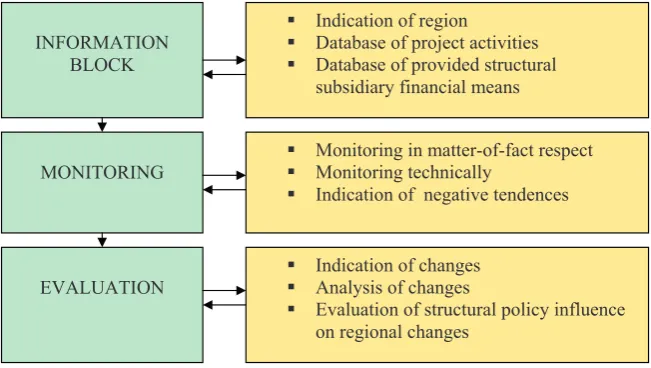
– to provide basic information on the starting situation of a region (in the economic and economic-social areas) for the possible comparison in a final evalu-ation of the effects of structural supports (Figure 1 – “information block”)
– to create a database relating to the structural activi-ties in a region to enable monitoring and evaluating them continuously (Figure 1 – “monitoring”) – to realize the final evaluation of effects of the
struc-tural policy in the regional dimension and to analyze relevant factors which have influenced these effects (Figure 1 – “evaluation”).
[image:2.595.68.394.585.769.2]In principle, it deals with obtaining the relevant information in the course of expounding of structural
Figure 1. Block scheme of process analysis (3 basic blocks)
INFORMATION BLOCK
� Indication of region
� Database of project activities
� Database of provided structural subsidiary financial means
MONITORING �� Monitoring in matter-of-fact respect Monitoring technically
� Indication of negative tendences
EVALUATION �� Indication of changes Analysis of changes
� Evaluation of structural policy influence
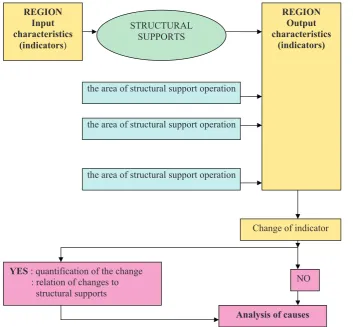
supports and effects which these supports invoked or did not invoke. These information will enable the subsequent decisions whether the structural supports were oriented in the right way or whether it is necessary to change the area of the structural support application, eventually whether it would be desirable to strengthen or reduce the structural support in certain area. The general recommenda-tions can be then concretized regionally with tak-ing the individuality of every region into account (Figure 2).
The process analysis is based on the following prin-ciples and approaches:
1. Its main sense (the aim) is evaluation of the process of expounding of the structural financial supports from the viewpoint of the reached effect.
2. The used indicators, which have quantitative cha-racter and express the basic economic and social parameters of the reached degree of regional devel-opment, are derived from the main aim. Quantita-tive processes will in time grow in to qualitaQuantita-tive processes.
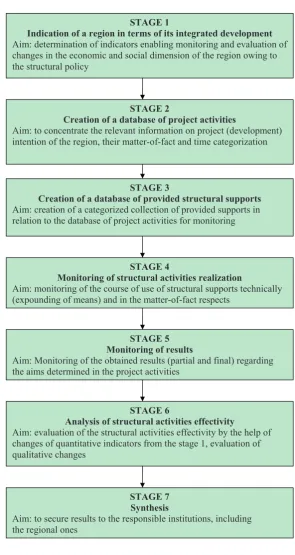
3. The procession analysis represents a procedure which includes several (e.g. seven) stages whose content relates to the relevant procedures con-nected with the set aim (see Figure 3). All seven stages stem from the basic needs of the process
analysis fulfillment in evidence, monitoring, ana-lytical and synthetic sense.
4. Results of process analysis could be used:
– for the evaluation of the matter-of-fact and economic impacts of efficiency of the adopted measures and the expounded financial means – for a control of the solution course and
fulfill-ment of determined indicators, i.e. for a control of gradual fulfillment of aim values, for a signal-ing of negative phenomena of matter-of-fact and financial character
– for a presentation of evaluation results and for security of outputs for the EU bodies and ap-propriate national institution with full security of compatibility with valid legislative norms of the EU and the Czech Republic.
Within fulfillment of particular stages of process analysis (see Figure 3) it is not dealt with mutually isolated steps in a sense of a shift of efficiency of particular development activities but vice versa in agreement with the principle of complexity it is dealt with evaluation of the total impacts of all development activities on economic and social level of the entire region. The time factor is fully respected because despite the total evaluation will be referred to a cer-tain term, it is obvious that some activities will be
REGION Input characteristics
(indicators)
REGION Output characteristics
(indicators)
STRUCTURAL SUPPORTS
the area of structural support operation
Change of indicator
NO
Analysis of causes YES: quantification of the change
: relation of changes to structural supports
the area of structural support operation
the area of structural support operation
finished, other not, other activities will bring effects gradually and so on. Fulfillment of particular stages of process analysis will correspond to it – i.e. each activity will fulfill its own stage of the process analysis. On a certain date (the end of calendar year is presup-posed) obvious impacts will have been quantified. In unfinished activities results obtained by monitoring of their realization in connection with the expounded financial resources will be evaluated.
1. Indication of a region in sense of its integrated development
The stating point of the process analysis should lie in determination of a set of indicators (indicators, characteristics) which would enable in a relevant way:
– to characterize the starting point of regional de-velopment
– to enable a continuous monitoring of the struc-tural supports efficiency, especially in long-term projects
– to enable an evaluation of final changes which hap-pened due to the influence of structural measures and the related financial means.
Regions can be indicated (defined, characterized) by the help of various indicators. These indicators can be both quantitative and qualitative. In the selection of indicators which should serve in the frame of the process analysis for evaluation of the dynamics of regional development, their purposeful selection is necessary because from the view of transparency of the evaluation and from a viewpoint of a clear rela-tion to fulfillment of aims of the structural policy, the sense is not to involve all regional characteristics but on the opposite it is purposeful to concentrate the attention on that characteristics which closely relate to the fulfillments of aims and the extent of which can be influenced by the allocation of financial structural means. This approach is completely in ac-cordance with the actual approach of the European Union in evaluation of the parameters of regional development by the help of selected groups of indi-cators (see “Updating Appendix to the Commission Report 2005” for the spring meeting of the European Council relating to just structural indicators.
The possible selection of indicators defining a region for the needs of procession analysis
As mentioned above, economic and social aspects of regional development cannot be separated, evaluated
apart, but on the opposite it is desirable to evaluate them in mutual connections. The mentioned ap-proach completely corresponds to trends which are followed by the EU strategy in terms of the so-called “integrated development of rural regions”. Under the term “integrated development”, there can be under-stood a development connecting:
– economic stability and prosperity of the region – stabilization of the settlement of the countryside
by the means of development of entrepreneurial activities, by the means of creation of relevant citizen and technical amenities, support of main-taining young inhabitants
– preservation of the growth of quality of environment, including multifunctional agricultural activities
The selection of indicators which will play a non-replaceable role in the process analysis should corre-spond to understanding of the regional development as an integrated development.
These indicators:
– have to fulfill the matter-of-fact point of view. The indicators can be chosen with regard to structural-political aims partly as:
– economic indicators representing the relevant characteristics of economic efficiency of the region
– social indicators focused on human potential of the region
– indicators which can be considered as a part of both above mentioned groups in which there is not always a significant dividing border between the economic and social aspects
– above all have to have the character of quantitative indicators – they should be measurable, expressible in value, comparable in time (trends) and space (the inter-regional comparison). It is obvious that the difference and the particularity of regions will offer and already offer also specific and unique charac-teristics which cannot be expressed by a numeric value. These indicators can serve as subsidiary, i.e. qualitative characteristics. However, in principle, if we want to evaluate and express the final effect, it is necessary to prefer quantitative characteristics which are the only comparative at various levels. – have to be available on the base of statistic
monitor-ing and have to be treated with the same methods to be applicable for the purposes of the process analysis and possibly for other processing purposes – do not have to represent a too big group of
whether there were a positive “shift” on the base of structurally-political activities including financial supports or not.
– their selection has to respect the indicators pre-ferred from the EU side but at the same time it has to take into account certain national or regional specifics.
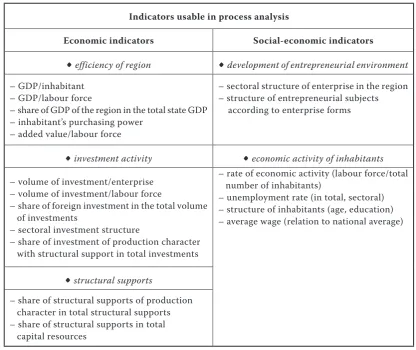
From the viewpoint ofthe matter-of-fact content, it has been mentioned that the basic indicators on which the process analysis should be based are the indicators of economic-social character. Their possible
choice is illustrated in the Figure 4. It deals with the indicators of a purely quantitative character which are relatively easily calculable and which express the basic economic-social parameters of the region.
In spite of the purposeful preference of the quan-titative approach, the starting and final situation in the region can be completed with qualitative char-acteristics which would inform e.g. about:
– the degree of information and communication basis at the regional level
– the state of infrastructure which could be in con-nection with the use of structural supports the
STAGE 1
Indication of a region in terms of its integrated development
Aim: determination of indicators enabling monitoring and evaluation of changes in the economic and social dimension of the region owing to the structural policy
STAGE 2
Creation of a database of project activities
Aim: to concentrate the relevant information on project (development) intention of the region, their matter-of-fact and time categorization
STAGE 3
Creation of a database of provided structural supports
Aim: creation of a categorized collection of provided supports in relation to the database of project activities for monitoring
STAGE 4
Monitoring of structural activities realization
Aim: monitoring of the course of use of structural supports technically (expounding of means) and in the matter-of-fact respects
STAGE 5 Monitoring of results
Aim: Monitoring of the obtained results (partial and final) regarding the aims determined in the project activities
STAGE 6
Analysis of structural activities effectivity
Aim: evaluation of the structural activities effectivity by the help of changes of quantitative indicators from the stage 1, evaluation of qualitative changes
STAGE 7 Synthesis
Aim: to secure results to the responsible institutions, including
[image:5.595.60.356.224.780.2]subject of their “application” and a starting point for development of for example entrepreneurial activities
– the quality of environment in relation to the re-gional development
The mentioned indicators have their hierarchy. The top indicator is, in terms of the evaluation of economic efficiency, the indicator GDP/inhabitant which is also the indicator preferred by the European Union. All other indicators included in the Figure 4 can be considered as indicators which can be from the regional point of view an aim of the provided subsidiary means, but in comparison with the prior-ity of regional development as a whole contribute to obtaining a certain value of the top indicator GDP and its development.
As it has been mentioned, the individual character of development of a concrete region should be concisely expressed by the choice of indicators. However, at
the same time these indicators cannot be selected in a completely different way than it is recommended (especially for the needs of comparison) and used by the European Union. As it was claimed by the Commission, the number of structural indicators has increased disproportionately over the last year. The final number was then 42 characteristics. On the base of the Commission recommendation, the Council decided on reduction of this large collec-tion to 14 synthesizing indicators. This decision can be considered as a very rational step because it is not really reasonable to monitor a large amount of indicators. The sense is to hit the most important points which characterize the region regarding to its development potential.
The mentioned indicators respect fully the EU approach but at the same time they are concretized to correspond to the needs of the process analysis aiming to find out and monitor the reached degree of regional activities. It is possible to assume that this
Indicators usable in process analysis
Economic indicators Social-economic indicators
•
efficiency of region•
development of entrepreneurial environment– GDP/inhabitant – GDP/labour force
– share of GDP of the region in the total state GDP – inhabitant’s purchasing power
– added value/labour force
– sectoral structure of enterprise in the region – structure of entrepreneurial subjects according to enterprise forms
•
investment activity•
economic activity of inhabitants– volume of investment/enterprise – volume of investment/labour force
– share of foreign investment in the total volume of investments
– sectoral investment structure
– share of investment of production character with structural support in total investments
– rate of economic activity (labour force/total number of inhabitants)
– unemployment rate (in total, sectoral) – structure of inhabitants (age, education) – average wage (relation to national average)
•
structural supports [image:6.595.82.499.353.703.2]– share of structural supports of production character in total structural supports – share of structural supports in total capital resources
Figure 4. Social-economic indicators of regional character usable in the process analysis
collection of indicators does not have to be stable in the longer time horizon, and probably it would be neither purposeful, however, it could be changed and completed according to the actual needs. Also the Commission supposes updating of structural indicators.
2. Creation of database of project activities
Not less important step in process of the process analysis is the creation of the project activities data-base in each region. Today, every region has already basically delimited the concrete strategy of its devel-opment. It corresponds not only to the nation-wide program documents but also stems from the practi-cal needs and concrete development conditions of the region.
The concrete output of the mentioned stage of pro-cess analysis is the creation of a database of projects which have been adopted in the region and whose realization is or will be supported from structural financial resources. It should not deal only with the concentration of these projects but also with their categorization according to the content external-ization, time dimensions or other characteristics important for monitoring.
3. Creation of the database of the provided structural supports
Monitoring of the provided financial subsidiary means for structural development of regions can take place (and takes place) at various levels and in vari-ous structure. In the frame of the process analysis in creation of the database, the purpose of monitoring of the expounding supports – i.e. the evaluation of their efficient use, should be strictly to comply, not only for receivers (enterprises, municipalities and so on), but also, and especially, as it has been mentioned, to strengthen regional development.
– Creation of structural supports database should respect the categorization of project activities to realize the monitoring and evaluation from both the point of view of the purpose of “application” of fi-nancial means and the time or regional convenience. The database should enable a review of the data on the individual project activities as well as it should contain the possibilities of aggregation according to time (in the long-term or short-term expounded means), of the dimension (individual, regional or mixed effects) or of the purpose (the economic or social aim of the project realization).
– Also the time dimension is respected – the projects are monitored as short-term or long-term activi-ties.
4. Monitoring of subsidiary activities realization The principle of monitoring of the supported pro-ject activities course is one of the basic principles of the structural policy. The sense is to get the relevant information on the course of the concrete activities realization and on drawing of the money which were allotted to them. It is advisable to aim the continuous monitoring at two following areas:
– formal aspects – matter-of-fact aspect
Technically, it is necessary that drawing of the national and the Union resources takes place in ac-cordance with the adopted intentions and rules. Especially it means above all to evaluate the course of the expounded subsidiary means:
– complying of the height of the allotted financial means (overdrawal, underdrawal of the allotted sum in a time dimension);
– complying of the agreed structure of costs for which the subsidiary means have been allotted (transfers between cost groups by the reason of overdrawal in one and underdrawal in another group); – complying of the formal requisites in registration
and clearing of documents and so on.
Except following the formal aspects, it is necessary in particular to monitor the course of fulfillment of the determined aims. It is obvious that during realization – mainly in the long-term development activities – it will be dealt with monitoring of ful-fillment rather the continuous partial aims which are, however, also the condition of fulfillment of the main-resulting aim. What can be considered in this connection as the main sense of monitoring is that the continuous monitoring will provide the continuous information on how the entire activity develops and whether there are not signals of the possible negative development. Early awareness will then enable an immediate reaction from the side of reliable and accredited institutions. The result of continuous monitoring can have several variations:
– the monitoring will provide some negative signals on the course of achieving the determined aim. These signals can be either of a principal character, it means that on their base it can be judged that the determined aim will not be successfully reached, or they regard possible immediate difficulties which can be eliminated and which will not jeopardize the successful fulfillment of the activity. In both cases the responsible institutions have to prepare scenarios and measures how to proceed (an im-mediate stopping of the action, financial sanctions, granting of a temporary exception and so on).
In short-time activities, the monitoring of the fulfill-ment of aims is simpler in that the time interval of the action is not too long, the numbers of the partial aims are small or the aim is only the main aim. The short interval which on one hand simplifies the monitoring can be on the other hand also a complication in some cases, if the evaluator does not evaluate the formal aspect of the activity correctly and in the final stage the determined aim is not fulfilled and the received resources are not spent.
It is possible to state that the stage of continuous monitoring a very important place in the process analysis. On its base, it is possible to evaluate the level of quality of the project realization and in time to implement measures in case of the negative de-velopment signals.
5. Monitoring of results
In the stage of achieved results (fulfillment of the determined aim, fulfillment of partial aims), it does not regard final analysis of achieved results in the sense of influence on strengthening of development potential of a region, but rather a creation of the review of the finished short-term activities and the degree of realization of the activities of longer charac-ter. In this sense, it does not then mean a continuous evaluation, it is included in the fourth stage, but it regards the basic information to a certain date, over a certain period – a year. Monitoring of results is determined rather for the purpose of evidence, not for the decision-making processes. Nevertheless, its role can not be treated as a second-rate, because the relation is closed here among a project activity – financial means – the realization of project activity – the achieved result (fulfillment of the aim). The most suitable period to which the monitoring stage should refer can be considered a calendar year, i.e. by 31. 12. in the current year. The result would be the aggregated information partly on which
activi-ties had been finished, what financial means had been spent in these finished activities, and further on in which grade of fulfillment the longer-term activities (or also the short-tem ones which exceed the next year) are and what is the realization of spending the structural means in them. At the same time, it would be possible regarding the structure of project databases to judge the representation of projects oriented economically (entrepreneurial subjects), municipal projects or projects of the re-gional character.
6. Analysis of efficiency of structural measures In this stage, one of the pivotal stages of the process analysis, it is dealt with the evaluation of the activity of structural measures and supports in a region by the help of quantitative and qualitative changes. It is a stage which should provide information whether structural means were applied in the region in the right direction, whether these means brought the desirable effects and in what force (rate) these effects manifested themselves.
Simultaneously, it is necessary to respect the fact that the effect of most of the realized activities will not show immediately, for example immediately in the following year, but that the impacts of the greater part of structural measures will show after a longer period. Also an immediate effect cannot be excluded, e.g. an increase in job opportunities (employment growth), by creation of new entrepreneurial activi-ties the GDP/inhab. in a region can increase; by im-provement of infrastructure business relations can develop and so on. However, in evaluation of the efficiency of structural supports the sense is not to evaluate only the immediate effects. The structural measures should, first of all, work in the long term in terms of stabilization and regional development. The evaluation should run systematically, not only at the level and monitoring and comparison of syn-thetic indicators (see the stage 1), but for a certain time also “the fate” of the already finished from the structural resources supported activities should be also monitored. For example in such a way that in some cases it can be dealt with successfully real-ized activities which brought estimated effect, but whether this effect still lasts, in a longer time horizon and whether it still has desirable contributions for the region.
The analysis of effects (impacts) should be formed by two evaluation approaches:
Quantitative analysis of effects
The following principles can be suggested for the analysis of efficiency of structural measures as regards quantitative aspects:
1) if there is a sense to judge the effectivity of struc-tural activities in the regional dimension, then it means including of all finished activities from the projects database (see the stage 1) and evidence of the achieved results (see the stage 5), and at the same time also the use of information on input means (see the stage 3).
2) to express the effects on development of the region by the means of indicators of qualitative character (see the stage 1) which represent the synthetic characteristics of regional economic and social level. These indicators should characterize the region in the starting point of evaluation and these indicators should characterize the region in the final stage of evaluation. Use of the same relevant indicators will enable time and inter-regional com-parison, because, as it has been already mentioned, the process analysis cannot be considered as a time-limited process, but on the opposite it is a collection of processes concurring at each other and mutually completing themselves.
3) in processing these indicators, the choice of the method which will be used in the analysis is impor-tant. It can be supposed that it is not necessary (at least for basic orientation) to use too complicated procedures. On the contrary, a choice of simple method, which is intelligible not only to the data processors but also to people who use the evalu-ation (that is why it is necessary that they know the procedure how the results were achieved), contributes to the definiteness and transparency of results. The decisive aim in this direction is to provide the practice (institutions) with operational and transparent outputs.
In application of the quantitative way of evaluation, there can be used for example:
– a change of economic values, event. social-economic indicators according to a simple relation:
change of indicator = final indicator value – starting indicator value
The resulting changes can gain positive and nega-tive mathematical values, but above all important is the economic interpretation (a negative value does not have to always mean an undesirable result – for example a fall of unemployment rate, decrease in average age of inhabitants and so on).
– the power of this change when structural measures can invoke a significant effect, or on the contrary a very week or no effect.
A relation which could express the “effect power” that can be used is again very simple and has two variants:
In the first case, it is a relative indicator the result of which expresses in percents the increase or decrease of value of the monitored indicator.
In the second case, it is also a relative indicator. Its result is the share of the indicator change in its resulting value.
In the determination of the influence of structural measures on the change of the selected indicators, it is necessary to realize that the gained changes of indicators do not have to be caused only and purely by the allocation of structural supports but that they can be, and in most cases they are, a result of the in-fluence of other factors. In the “Efficiency Analysis”, the occurrence of such factors should be monitored and eliminated, if possible (or at least to express in some way their influence on the change of the selected indicators).
In the qualitative evaluation, it is dealt with the evaluation of characteristics which depict quantita-tive indicators. It is for example the evaluation of structural changes in the entrepreneurial sphere (a sectoral structure of enterprise, a size structure of entrepreneurial subjects, a form of enterprise), changes relating to the human potential of a region (education and age structure of inhabitants, event. of labour force), or an evaluation of changes which happened in connection with the application of structural supports in environment quality and so on.
The evaluation stage cannot be ended only by stating the quantitative and qualitative changes which hap-pened in the region with concurrence of the structural supports. It is necessary to further evaluate these changes, to analyze them, and to find out whether: – the structural supports were oriented in the right
way (in the right economic and social-economic areas);
– they have already brought a desirable effect or not, or whether, in the longer-term, this effect can be estimated or not;
– the rate of influence of the structural supports was really significant or the structural supports played
100 value indicator startingfinalindicator value power”
“effect � �
(%) 100 value indicator finalofindicatorvalue change
power”
only the role of completive factors, or whether they did not have any influence at all;
– the system of structural supports allotment was transparent and comprehensible; and so on; – in the case of negative answers to the above
men-tioned “questions”, why the negative development happened, which factors influenced the undesir-able development and if and in what extent these factors are eliminable.
CONCLUSION
The method of process analysis is aimed at the identification, quantification and evaluation of all processes which occur in context of the allocation of structural supports in regions and with evalua-tion of their effects. It is applicable to all produc-tion, non-producproduc-tion, ecological, demographical and social processes and at all regional NUTS level. Nevertheless, in connection with the economic de-velopment of regions, it is possible to assume that the stress should be laid above all on the processes of entrepreneurial activities leading to the growth of the regions efficiency. Other processes (ecologi-cal, social, demographic) can be seen as subsidiary or completive activities, though no less important (Svatošová et al. 2005).
The content of process analysis is given by the system of mutually logically connected steps and procedures, from the starting characteristics of re-gion, through the creation of a transparent base of structurally oriented projects and a transparent base of financial means provided for them to enable moni-toring of their real effect. An integral part is then a monitoring process on the base of which the first decisions are made with regard to the continuation or stopping of the projects realization. Then the final step is the analysis the result of which should be a clear conclusion whether the concrete application of
financial means led to the support of the region activ-ity, which manifested itself in the final consequence in synthetic and social indicators, or whether it did not. Reasons why the decisive criterion should be unambiguously indicators expressing the regional development are obvious. Partly it is the fact that in the frame of aims of structural policy there is a rumour about the adjustment of the “economic level” of regions, in principle about monitoring of the eco-nomic efficiency of regions which can be measured only by the means of synthetic economic indicators, and further also because the achievement of partial aims, for example improvement in employment in the region or growth of investment activities in the region by itself does not have to mean simultane-ously a growth of its economic efficiency. It is given, among others, also by the virtue of the subsequent use of the possibilities of market environment. The structural supports in the entrepreneurial sphere help to “start” economic activities but by themselves they do not have any influence on “the life” of these activities. It depends on the ability or disability or the entrepreneurial sphere.
REFERENCES
Boháčková I., Hrabánková M., Svatošová L. (2003): Role of agriculture in the development of rural regions. Agricultural Eeconomics – Czech, 49 (5): 229–232.
Hrabánková M., Svatošová L., Boháčková I. (2005): Monitoring of regional development dynamics with use of process analysis. Agricultural Eeconomics – Czech, 51 (3): 112–116.
Svatošová L., Boháčková I., Hrabánková M. (2005): Regionální rozvoj z pozice strukturální politiky (Regional development from position of structural policy). Scientific monograph, České Budějovice; ISBN 80-7040-749-2.
Arrived on 31st March 2006
Contact address:
Ivana Boháčková, Czech University of Agriculture in Prague, Kamýcká 129, 165 21 Prague 6-Suchdol, Czech Republic Magdalena Hrabánková, South-Bohemian University in České Budějovice, Branišovská 31, 370 05 České Budějovice, Czech Republic