Saturation of conductance in single ion channels: The blocking effect of the near reaction field
Boaz Nadler,1,*Zeev Schuss,2,† Uwe Hollerbach,3,‡and R. S. Eisenberg3,§1
Department of Mathematics, Yale University, New Haven, Connecticut 06520, USA
2
Department of Applied Mathematics, Tel-Aviv University, Ramat-Aviv 69978, Israel
3
Department of Molecular Biophysics and Physiology, Rush Medical Center, 1750 Harrison Street, Chicago, Illinois 60612, USA
(Received 21 June 2004; published 23 November 2004)
The ionic current flowing through a protein channel in the membrane of a biological cell depends on the concentration of the permeant ion, as well as on many other variables. As the concentration increases, the rate of arrival of bath ions to the channel’s entrance increases, and typically so does the net current. This concen-tration dependence is part of traditional diffusion and rate models that predict Michaelis-Menten current-concentration relations for a single ion channel. Such models, however, neglect other effects of bath concen-trations on the net current. The net current depends not only on the entrance rate of ions into the channel, but also on forces acting on ions inside the channel. These forces, in turn, depend not only on the applied potential and charge distribution of the channel, but also on the long-range Coulombic interactions with the surrounding bath ions. In this paper, we study the effects of bath concentrations on the average force on an ion in a single ion channel. We show that the force of the reaction field on a discrete ion inside a channel embedded in an uncharged lipid membrane contains a blocking(shielding)term that is proportional to the square root of the ionic bath concentration. We then show that different blocking strengths yield different behavior of the current-concentration and conductance-current-concentration curves. Our theory shows that at low current-concentrations, when the blocking force is weak, conductance grows linearly with concentration, as in traditional models, e.g., Michaelis-Menten formulations. As the concentration increases to a range of moderate shielding, conductance grows as the square root of concentration, whereas at high concentrations, with high shielding, conductance may actually decrease with increasing concentrations: the conductance-concentration curve can invert. There-fore, electrostatic interactions between bath ions and the single ion inside the channel can explain the different regimes of conductance-concentration relations observed in experiments.
DOI: 10.1103/PhysRevE.70.051912 PACS number(s): 87.16.Uv, 83.10.Mj, 87.15.Aa
I. INTRODUCTION
Ionic permeation through protein channels embedded in otherwise impermeable cell membranes is one of the most important processes in life[1], governing an enormous range of biological function in health and disease [2]. The ionic current flowing through an open protein channel depends on many factors, reflecting the thermal fluctuations, the concen-tration gradient, the electrostatic forces, the frictional retard-ing force on ions in the channel, and the physical forces linking those ions with their environment. These factors in turn depend on the geometry and charge distribution of the channel, the friction within the channel, and obviously, on the bath concentrations on both sides of the channel.
One of the roles of ionic concentration is readily under-stood. As the surrounding bath concentration is increased, so does the arrival rate of ions to the entrance of the channel, thus increasing the net current. Since ions in the surrounding electrolyte bath diffuse to the channel’s mouth, the arrival rate depends linearly on the bath concentrations, at least in a mean-field approximation[4,5].
Standard rate models[1]assume rate constants inside the channel that are independent of bath concentrations and
pre-dict a Michaelis-Menten dependence of the current and con-ductance on the concentration, when the arrival rate of ions from bath to channel is linearly proportional to concentra-tion. I-C curves are linear for small bath concentrations, and a saturation of the conductance occurs for high concentra-tions in these models[1,3].
Some channels indeed exhibit conductance-concentration relations that resemble the Michaelis-Menten law; others, however, exhibit a variety of nonlinear behaviors that deviate from this simple formula. Experiments show that in some channels, conductance depends on the square root of the concentration, even at physiological concentrations [6–10], while in other channels conductance (or current) can de-crease as concentrations inde-crease [11,12]. The latter case, however, typically occurs well beyond physiological concen-trations. The inward rectifying K+channels[13–15]form an important family of channels for which conductance in-creases as the square root of concentration. They also show a decrease in conductance as external concentrations are de-creased in asymmetrical cases [16–18]. Multisite multi-ion rate models are typically used to explain both the square root dependence of conductance on concentration, in some chan-nels, and the decrease in conductance at high concentrations, in others[14,19], although these models have serious limita-tions(see, for example,[20,21]).
Such conductance-concentration curves suggest that bath concentrations do more than set the arrival rate of ions to the channel. Indeed, the net current through the channel depends not only on the arrival rate, but also on the force acting on *Email address: [email protected]
†
Email address: [email protected] ‡
Email address: [email protected] §
the ions when they are in the channel pore. These forces, in turn, depend not only on the applied potential and on the channel charge distribution, but also on the bath concentra-tions, through the long-range Coulombic interactions with the bath ions. We call the component of the force on an ion due to the surrounding bath concentrations the reaction field force(RFF).
It seems that the RFF inside the channel has been over-looked in recent literature, in contrast to earlier treatments of [22,23]. Reaction field effects are neglected in traditional rate models, because these models assume (i) hopping rates in-side the channel that are independent of concentrations, and (ii) entrance rates into the channel that scale linearly with bath concentrations. The effects of bath concentrations on the forces inside the channel have not been studied by detailed molecular-dynamics(MD)simulations because these simula-tions typically include only one or two ions inside the pore and few if any ions in the small simulated volume of the surrounding baths[24–27]. Due to their computational com-plexity, MD simulations are not an adequate tool for the study of these effects, at least in the foreseeable future. A study of these effects by Brownian dynamics simulations, while possibly feasible, would require enormous computer resources, especially in the case of low concentrations, and would likely remain infeasible in the case of nonhomoge-neous mixtures that contain trace concentrations, such as a mixture of 100 mM Na-Cl and 10−6M Ca2+. Many, even most biological systems, use trace concentrations of solutes (e.g., cofactors such as Ca2+)as controllers of important bio-logical function [28] and so trace concentrations must be present, and well estimated, if computations are to have bio-logical relevance. Thus, a theoretical study of these effects with continuum models is needed.
Continuum-type models, mainly the Poisson-Nernst-Planck (PNP) system of equations, have been used to de-scribe ionic permeation through protein channels since the early 1990s. However, as was obvious and stated from the beginning, and has become explicit in recent years both in simulations [29–32] and theory [33], standard PNP models provide an inadequate description of currents and concentra-tions inside narrow pores, because they fail to capture the force components related to the finite size of the mobile ions and to their discrete(rather than continuum)charge distribu-tion.
In previous work[33,34], we showed that the concentra-tion of each ionic species, inside and outside the channel pore, satisfies a Nernst-Planck-type equation, assuming ions are interacting Brownian particles. The average force in the Nernst-Planck equation depends on conditional charge den-sities and also explicitly includes the dielectric boundary force[35]. Thus, the average force includes the finite size of the ions, and also takes into account the discrete nature of the ion’s charge.
The importance of the dielectric boundary force in narrow channels is shown in much recent work[27,29,32,35]. These papers, however, have not studied the effects of the sur-rounding bath concentrations, e.g., the RFF. In this paper, we consider the effect of bath concentrations on the permeation characteristics of a protein channel that can contain at most one positive ion at a time. Thus, we make a connection to the
classical literature of rate theories of single ion channels that is based on detailed electrostatic calculations, including both the dielectric boundary force and the electrostatic effects of the baths.
The study of the permeation characteristics of a single ion channel has a long history. Early approaches were limited to rate models[1], while more modern ones were based on the assumption of diffusive motion of the ion inside the channel [3,36–38]. The main goal of these modeling approaches was to derive a Nernst-Planck equation and boundary conditions that take into account the restriction of the single-ion chan-nel. All of these models, however, assumed that the contri-bution of the surrounding bath ions is only through the ar-rival rate to the channel. The electrostatic effects of bath ions were not considered in these models.
In this paper, we study the electrostatic effects of bath ions on the permeating ion inside the channel. We use the implicit solvent (“primitive”) model of ionic solutions in which the solvent water molecules are not modeled explic-itly, but rather are described electrostatically by an effective dielectric coefficient, and are the source of friction and noise for diffusion. Following Jordan et al. [23], we express the single ion channel assumption, by combining a discrete scription of the ion inside the channel with a continuum de-scription of the surrounding bath ions. Specifically, we as-sume that the(conditional)concentrations in the two baths, given the presence of a discrete ion either inside the channel or near its entrance, are described by the solution of the stationary Poisson-Boltzmann equation(in the baths), in the presence of the discrete ion (in or near the channel). The novelty in our approach is the coupling of a discrete ion in the channel with a continuum description of the baths, in order to compute currents with a Nernst-Planck equation.
Our main result is that the force on a discrete ion inside (or near)the channel can be decomposed into almost additive independent terms. These force terms are (i)the interaction force with the fixed charges of the channel (FCF denotes fixed charge force),(ii)the dielectric boundary force(DBF), (iii)the membrane potential force(MPF)due to the applied potential (often assumed to be a constant field), and finally (iv)the reaction field force(RFF)due to the bath concentra-tions.
By definition, the first three forces are independent of bath concentrations. Our calculations show that for a few model channels embedded in neutral lipid membranes, the RFF scales approximately as the square root of bath concentra-tions, a property noticed by[23]. A mathematical explanation for this square root dependence is provided in the Appendix. In addition, we show that the RFF decreases as the radius of the channel increases.
way, our theory explains the observed square root dence of current on concentration. The square root depen-dence does not necessarily imply more than one ion inside the channel at any given time nor specific binding sites in-side the channel. Of course, other explanations, such as mul-tisite multi-ion rate models, are possible as well.
II. THE REACTION FIELD AND BATH CONCENTRATIONS
We consider the concentration cell used to study transport and membranes in electrochemistry and biophysics. Two electrolyte baths, here with equal concentrations C and rela-tive dielectric coefficientb= 80, are separated by an imper-meable lipid membrane of dielectric coefficientm= 2. Span-ning this membrane is a single protein channel that allows ions to go through its pore from one bath to the other. For simplicity, we assume that only positive ions can enter this pore, and that the pore can accommodate at most one ion at a time.
In addition, we consider only the case of a 1-1 simple monovalent electrolyte bathing solution, though our analysis can be easily generalized to more complex electrolytes. Our aim is to compute the ionic current through this channel, given its spatial structure, its permanent charge distribution, the applied voltage, and the surrounding bath concentrations. Following[33], we start with a Langevin model for the motion of all mobile ions in a finite system, combined with a continuum description of the solvent water molecules. We thus assume that on sufficiently coarse length and time scales, the joint motion of all 2N mobile ions can be de-scribed by a system of coupled Langevin equations, with independent noise sources,
x¨pj+␥p共xpj兲x˙jp= fj p
mp+
冑
2␥p共xjp兲kBT mp w˙j
p 共j = 1,2, . . . ,N兲,
x¨k n
+␥n共xk n兲
x˙k n
= fk n
mn+
冑
2␥n共xkn兲kBT mn w˙k
n共
k = 1,2, . . . ,N兲,
共1兲 where xpj and xkndescribe the locations of the jth positive and kth negative ions, respectively, while fpj and fknare the forces acting on them. In addition, ␥c describes the location-dependent friction coefficient of ions of species c 共c = p , n兲, mcis their effective mass, w˙jpand w˙
k
nare Gaussian noises, k B is Boltzmann’s coefficient, and T is the temperature. In this formulation, the water molecules are not represented explic-itly. Rather, they are the source of friction and noise, and also determine the effective possibly location-dependent dielec-tric coefficient. As described in[33,34], we assume that the system is connected to an external control mechanism that maintains a stationary state with constant average concentra-tions C in the left and right baths, respectively, and a stant average current flowing through the pore, due to a con-stant applied voltage V between the baths.
In a previous paper [33], we showed that under these assumptions, the steady-state time-averaged concentration of
ions of species c, described by c共x兲, satisfies the Nernst-Planck equation
0 = · Jc共x兲= ·
冋
f ¯c共x兲mc␥c共x兲c共x兲−
kBT
mc␥c共x兲c共x兲
册
,共2兲 where mc is the effective mass of the ion, ␥c共x兲 is its (location-dependent)friction coefficient, and f¯c共x兲 is the av-erage force acting on a discrete c-type ion at x. This avav-erage force is the sum of three terms,
f
¯c共x兲= f D c共
x兲+ f¯SRc 共x兲+ f¯ELc 共x兲, 共3兲 where the first term describes the dielectric boundary force [35], the second is the average short-range force, and the third term is the average electrostatic force. The average electrostatic force accounts for all Coulombic interactions of the ion with the other fixed, mobile, and induced charges in the system, excluding the charges induced by the ion itself, which are taken into account by the dielectric boundary force.
The time-averaged electrostatic force on a c ion at x is given by
f
¯ EL
c 共x兲=兩− q
c共y兩x兲兩y=x, 共4兲
wherec共y兩x兲is the mean (conditional)electrostatic poten-tial at y, given an ion of species c at x. This potenpoten-tial is the solution of the conditional Poisson equation
·关共y兲c共y兩x兲兴= − e
0
冋
ch共y兲+兺
jzjj兩c共y兩x兲
册
, 共5兲wherech共y兲 is the fixed charge distribution of the channel and j兩c共y兩x兲 is the conditional density of species j at y, given an ion of species c at x. For the case of a simple 1-1 monovalent solution and a positive ion at x, Eq.(5)becomes
·关共y兲p共y兩x兲兴= − e
0关ch共y兲+p兩p共y兩x兲−n兩p共y兩x兲兴, wherep兩p andn兩pare the conditional positive and negative ion concentration profiles, given a positive ion at x.
The net current flowing through the channel can be com-puted from the solution of Eq.(2). Assuming the channel has a narrow, approximately cylindrical pore, whose axis is aligned with the z axis, the net electric current is simply the integral over any cross section in the xy plane of
Jz= e共Jz p
− Jz n兲
,
where Jzcis the z component of the flux vector Jcof species c.
Equation(2), however, cannot be solved unless a specific (closed or computational) form of the conditional densities
j兩c共y兩x兲 is known. As shown in [33], standard PNP theory corresponds to the approximation
j兩c共y兩x兲=j共y兲.
in Eq.(3). These approximations neglect the finite size of the ions, and more importantly in our case, neglect the fact that, by assumption, the channel can accommodate at most one ion at a time. As shown in theory and in simulations, both of these approximations of standard PNP are oversimplifica-tions that lead to the loss of important properties of narrow channels embedded in low dielectric lipid membranes [33,29–31,27,35].
Here, we adopt a different approximation for these condi-tional concentrations, which retains the advantage of a con-tinuum description, while taking into account the properties of a single-ion channel assumption. In this paper, we de-scribe the conditional bath concentrations at a continuum level by the steady-state Poisson-Boltzmann equation, in the presence of a discrete ion at x. The channel is forced to be singly occupied by no-flux boundary conditions at the two entrances to the channel, on the left and right edges of its pore, imposed when an ion is inside the channel at location
x. We also include some of the correlation effects of finite
size and short-range forces of ions very close to the channel. We impose no flux boundary conditions both at the surface of a sphere of radius 1.5 Å around the center of the ion and at the edges of the channel, just after an ion has exited the pore, thus effectively assuming that no other ion has yet entered the channel. In essence, we have a three-site model, with sites coupled by electrostatics and the one ion assump-tion.
This approximation retains the notion of a single-ion channel, but neglects both the finite size of ions in the bath away from the channel, and the dielectric boundary force acting on those bath ions. As shown in[35,39], the dielectric boundary force(DBF)on a single ion in the bath is relatively small, because of shielding, and the shielded DBF decreases exponentially with distance from the dielectric wall, rather than the long-range inverse square Coulomb law. We there-fore assume that the conditional positive and negative con-centrations outside the channel pore, given a positive ion inside the channel at location x, follow a Poisson-Boltzmann (PB)distribution,
p兩p共y兩x兲= C exp
再
−e共y兩x兲
kT
冎
, n兩p共y兩x兲= C exp再
e共y兩x兲kT
冎
.共6兲
The conditional potential共y兩x兲—that depends on both the bath ions and the discrete ion inside the channel—is the so-lution of the Poisson equation,
·关共x兲共y兩x兲兴= − 1
0关ech共x兲+ ep兩p共y兩x兲− en兩p共y兩x兲 + q␦共y − x兲兴, 共7兲 where q is the charge of the discrete ion. These approxima-tions lead to electrostatics similar to those computed without concomitant flux[23].
In summary, the presence of a discrete ion(either inside the channel or just outside) leads to a redistribution of the ionic concentrations in the surrounding baths, according to Eqs. (6) and (7). These conditional concentrations, in turn, create a modified force on the discrete ion, according to Eqs. (4)and(5). We call the concentration-dependent component of this force the reaction field force(RFF). Thus our formu-lation accounts for the redistribution of the local bath con-centrations near the entrance to the channel, due to the pres-ence of the discrete ion inside it. Note that even when a positive ion is inside the pore, we maintain the assumption that neither a negative nor positive ion can enter the channel: nonelectrical forces, e.g., Lennard-Jones, are assumed to pre-vent entry of an additional ion into the channel.
III. NUMERICAL RESULTS
We present numerical results, corresponding to the solu-tion of Eqs. (3)–(7) for two different cylindrical channel models. First, we consider an uncharged channel, that is, an ideal cylindrical hole in a dielectric wall, with length L = 25 Å and radius r = 2.5 Å. Then, we consider a negatively charged channel, with a total charge of −e. The fixed charge is spread along a ring ranging from r = 2.5 Å to r = 4.5 Å and spanning the whole channel. In both of these cases, we nu-merically solve Eqs.(4)–(7), and present the mean force on a positive ion as a function of its location z on the channel axis.
of the force from the case of zero bath concentration is plot-ted. The higher the bath concentrations, the larger the total repulsive force driving the ion out of the channel. It is clear from this figure that when the ion is outside the uncharged channel—that is, when兩z兩⬎12.5 Å—the effect of the reac-tion field is reversed. Then, the force on the charged ion has an opposite sign but the absolute value of the force still increases as concentration increases, essentially shielding the dielectric boundary force near the entrance of the channel.
The corresponding force in a negatively charged channel is shown in the right part of Fig. 1. In comparison to the uncharged channel, the force on a positive ion is now greatly reduced. As in the case of a noncharged channel, the force depends on the bath concentrations, and the higher the bath concentrations, the larger the repulsive force pushing an ion in the channel outwards towards the baths.
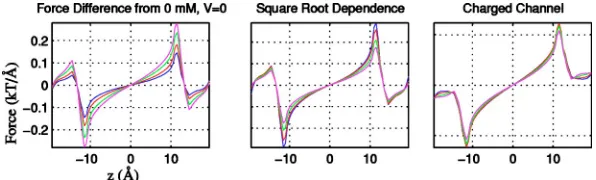
We are interested in the study of the reaction field and its dependence on bath concentrations, and so in Fig. 2(left)we plot the difference between the total force at a bath concen-tration C and the total force with zero bath concenconcen-trations. Figure 2(left)shows these differences for various bath con-centrations for the uncharged channel. Similar results (not shown in the graph)occur in the charged channel as well. In the center and rightmost plots of Fig. 2, the same differences are shown for the uncharged and charged channels, respec-tively(normalized by division by the square root of the dif-ference in bath concentration C). As seen from these graphs, division by the square root of concentration approximately aligns these differences between forces, at concentrations be-low 1 M.
It seems that as in[23], the electrostatic force F on an ion inside or near the entrance of a narrow channel adopts a simple form, when the applied voltage is zero,
F共z,C,V = 0兲 ⬇Fch共z兲+
冑
CFRF共z兲,where Fch共z兲 is the total electrostatic force on an ion at lo-cation z, in the case of zero bath concentrations, and FRF共z兲 is the unit-normalized reaction field force due to the presence of mobile ions in the surrounding electrolyte baths.
The force Fch共z兲contains the contribution of the dielectric boundary force and of the electrostatic interactions of the mobile ion with the fixed charges of the protein. The reaction field force FRF共z兲contains the contribution of the bath con-centrations to the total force. This reaction or blocking force depends on the geometry and fixed charges of the protein and of the lipid membrane, and on the concentration of ions in
the bath. A mathematical explanation for the observed square root dependence of the reaction field force on concentration is described in the Appendix, where a simpler problem is analyzed analytically, that of a fixed charge inside an infinite dielectric wall near an electrolyte bath.
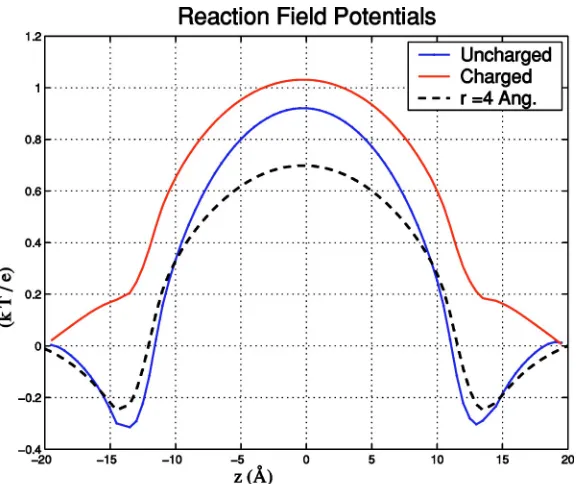
The bath concentrations have a stronger effect on an un-charged channel than on a un-charged channel (Fig. 3). The differences, however, are not large, and both cases yield a potential barrier slightly more than 1 kBT for a 1 M bath concentration in a channel with radius of 2.5 Å. Also shown in this figure is the corresponding potential barrier for an uncharged channel with radius of 4Å. As expected, the RFF potential is now reduced, in this case by about 0.25 kBT.
An additional potential barrier of 1 kBT has a significant effect on the single channel conductance because, from Kramer’s theory, the escape rate over a potential barrier is proportional to e−⌬E/kBT. Therefore, even a seemingly small
addition of 1 kBT to the energy difference ⌬E leads to a decrease of 1 / e⬇0.37 in the transition rate over the barrier. Effects of the order of 63% are highly significant when com-paring different models of ion permeation. See Sec. IV for further discussion.
Further numerical calculations of the total force, not pre-sented here, show that in the presence of an additional exter-nal voltage, the total force on an ion can be approximated,
F共z,C,V兲 ⬇Fch共z兲+
冑
CFRF共z兲+ VFex共z兲, 共8兲 where Fex共z兲is the force due to the applied external voltage. The formula shows that for small voltages, the effects of bath concentrations are independent of the applied voltage, be-cause of the additivity of the force terms冑
CFRF共z兲 and VFex共z兲.IV. THE REACTION FIELD AND SINGLE CHANNEL CONDUCTANCE
In the previous section, we computed the average force on an ion inside a channel that can accommodate at most one ion at a time, and we showed that the force on the ion is (nearly)the sum of simple components; see the decomposi-tion (8). We now use these results to compute the current flowing through the channel.
[image:5.612.157.455.56.146.2]one-dimensional Nernst-Planck equation is likely to be a bet-ter model of concentration than a three-dimensional Nernst-Planck equation, with its artifactually large concentrations of ions, e.g., at the membrane-channel boundaries where per-manent charges are located. Then, the three-dimensional Nernst-Planck equation(2)for the average concentration in-side the channel can be reduced to the simpler one-dimensional version
− d dzJ共z兲=
d dzD
冋
dc dz+ c
e kT
d dz
册
= 0.The solution to this equation, for a nondimensional channel of unit length, is given by[3,40]
J = Dc共0兲e
e共0兲/kBT− c共1兲ee共1兲/kBT
冕
0 1ee共z兲/kBTdz
, 共9兲
where c共0兲and c共1兲are the concentration values at the edges of the channel. As shown by Levitt[3], for a channel that can accommodate at most one ion at a time and surrounded by symmetric bath concentrations C, the concentrations at the edges of the channel can be approximated by
c共0兲= c共1兲= C
1 +␥C, 共10兲
where
␥= LA
冕
0 1e−共x兲
冋
eex共0兲−H共x兲H共1兲共e
ex共0兲− eex共1兲兲
册
dx,共11兲
withexthe potential corresponding to the external field, L the length of the channel, A its cross-sectional area, and
H共x兲= L DA
冕
0x e共s兲ds.
Assuming the force is given by Eq.(8), the corresponding potential follows a similar decomposition,
共z,C,V兲=ch共z兲+
冑
CRF共z兲+ Vex共z兲. 共12兲 Combining Eq. (12) with Eq. (9) gives that for small bath concentrations C,冕
0 1exp
再
e共s兲 kBT冎
ds =
冕
0 1exp
再
ech共s兲+ Vex共s兲 kBT冎
⫻
冉
1 +冑
CeRF共s兲 kBT冊
ds= I0+
冑
CI1, 共13兲where
I0=
冕
01
eech共s兲/kBTds, I
1=
冕
0 1eRF共s兲 kBT
exp
冉
ech共s兲 kBT冊
ds.
共14兲 For small voltages and small concentrations, the functional relation of current versus concentration takes the form
I共C,V兲= const⫻V C 1 +
冑
C1
1 +␥C, 共15兲 where= I1/ I0, and␥ is given by Eq. (11). This relation is obviously different from the Michaelis-Menten formula,
I共C,V兲= const⫻V C
1 +␥C, 共16兲
[image:6.612.52.341.54.296.2]difference between the two formulas for small concentra-tions. Both predict a linear increase in conductance as a func-tion of concentrafunc-tion. The differences between the two for-mulas arise when is not small, as we analyze in the next subsection.
Shielding and possible current-concentration curves
The effects of shielding on the possible current-concentration curves are shown in the following example. We assume that the potential of mean force inside and near the channel has a decomposition like Eq.(12),
共z兲=ch共z兲+␣
冑
CRF共z兲+ Vz, 共17兲 where, in this formulation, ␣ measures the strength of the shielding and blocking. Different amounts of shielding cor-respond to different values of ␣ and give rise to different behaviors of the current as a function of concentration, and thus of the conductance as a function of concentration. For example, the reaction field in a wider channel is smaller than in a narrower channel, thus leading to a smaller value of␣. Specifically, for illustrative purposes we consider analytic expressions for the channel potential and the reaction field potential, of the formch共z兲= 4 kBT
e exp
冉
−共z − 0.5兲2 0.1
冊
,RF共z兲= kBT
e exp
冉
−共z − 0.5兲2
0.05
冊
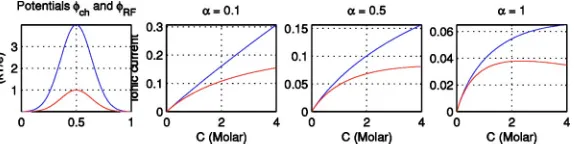
, 共18兲which can correspond to a slightly charged channel, for which the combination of the dielectric boundary force and the interactions with the fixed charges of the channel create a moderate barrier 4 kBT high, with an additional reaction field barrier of 1 kBT for a 1 M solution, similar to those com-puted in Fig. 3. For a specific channel structure, of known or assumed three-dimensional structure and charge distribution, these potentials should be computed from the solution of the relevant Poisson equations.
To compute the current-concentration curve, we insert Eqs. (17) and (18) into the explicit formula (9) with c共0兲 = c共1兲given by Eq.(10)and with a small applied potential of V = 1 kBT / e⬇25 mV. For these graphs, we considered a channel of length L = 25 Å and cross-sectional area A = 9Å2. On the left side of Fig. 4, the potentialschandRF are plotted along the nondimensional channel axis z between z = 0 and z = 1. The other panels of this figure show I-C curves for three different values of␣. The top curves show J with c共0兲= c共1兲= C, while the bottom curves show the pre-dicted flux with the single ion assumption, e.g., with c共0兲,
c共1兲 given by Eq.(10). For␣= 0.1, as seen from the linear top curve, shielding is negligible, so the current grows lin-early with low concentration, and then bends following a Michaelis-Menten formula. For ␣= 0.5, shielding is moder-ate, and the current grows first linearly for small concentra-tions but then like the square root of the concentration for moderate concentrations. Finally, for ␣= 1, shielding is a first-order effect in the force acting on the ion inside the channel. For ␣= 1, the current decreases at concentrations around 1 M, because at these concentrations the electrostatic energy required for an ion to leave the electrolyte solution and enter the channel becomes very high. Note that this can also be seen from the theoretical formula(15), since in this case for large concentrations, I⬇1 /
冑
C.In conclusion, our theory explains different conductance-concentration behaviors, based on the effects of the reaction field on an ion either inside or near the channel due to the ions in the surrounding electrolytes.
V. SUMMARY AND DISCUSSION
The permeation of ions through a protein channel is a complex multiscale process, which depends not only on the atomistic details of the protein but also on the configurations of the surrounding baths. Traditional approaches, whether molecular-dynamics simulations or rate models, do not con-sider the electrostatic effects of the bath ions on the perme-ation process. Standard continuum formulperme-ations, such as the Poisson-Nernst-Planck system of equations, do not ad-equately describe the dielectric boundary force inside the channel nor the finite size of the ions.
We present a different approach, a hybrid PNP theory that couples a discrete description of the contents of the channel with a continuum description of the surrounding baths. Our main result is that for a single ion channel embedded in an uncharged lipid membrane, the surrounding bath concentra-tions create a reaction field whose strength scales with the square root of the bath concentration. The reaction field force (RFF) predicts a square root dependence of conductance on concentration, even with single occupancy. The square root dependence of shielding on concentration should not be sur-prising, because similar dependences are well known, for example in Onsager’s theory of conductance of electrolytes and in the Debye-Hückel theory of ionic shielding [41,42]. We note that when the lipid membrane is charged, the reac-tion field is quite different in nature and does not typically scale as the square root of the concentration. An analysis of this case will be published elsewhere[43].
[image:7.612.54.341.57.130.2]sumptions. For example, our analysis is at the level of the implicit solvent (primitive) model, in which solvent water molecules are described as an effective dielectric coefficient. In addition, we neglect(in the bath) the effects of the finite size of ions. Incorporation of these finite-size effects in ho-mogeneous solutions is a well studied problem, with well established theories such as the mean spherical approxima-tion and the hypernetted chain theory, to name just a few [41,42,44–46]. Appropriate incorporation of similar theories into the confined geometry near and inside a protein channel remains an open research problem[47–51].
APPENDIX A: AN ION INSIDE A DIELECTRIC MEMBRANE
In this section, we investigate the square root dependence of the reaction field force on bath concentrations, using a much simpler setting that allows mathematical analysis.
The three-dimensional spaceR3 is composed of two infi-nite regions, a bath and a membrane, with dielectric coeffi-cientsbandmseparated by the y-z plane at x = 0. A single charge q is located at x0=共−x0, 0 , 0兲 inside the membrane, while in the bath region there is a simple 1:1 electrolyte with average concentration at infinity. Note that a similar prob-lem, in which the particle is inside the domain occupied by the electrolyte, rather than inside the dielectric wall, was considered by Stillinger[52].
Let 共x兩x0兲 describe the electric potential throughout space and let p共x兩x0兲 and n共x兩x0兲 describe the conditional positive and negative concentrations, given the presence of a discrete positive ion of charge q at x0. Thensatisfies Pois-son’s equation
·关兴= −关e共p − n兲+ q␦共x − x0兲兴.
We consider an equilibrium mean-field approach, in which the concentrations p and n are the solutions of the Boltzmann equation with the same potential,
p共x兲=e−e/kBT, n共x兲=ee/kBT.
We consider an ion far away from the interface, so the po-tential inside the bath is everywhere less than 1kBT / e. In this case, linearization of the exponentials leads to the linear-ized Poisson-Boltzmann equation,
·关兴= −
冋
q␦共x − x0兲− 2 e2kT
册
. In the two different regions, this equation is⌬=
冦
2, x⬎0
− q
0m
␦共x − x0兲, x⬍0,
冧
共A1兲
where
=
冑
2e 2 0bkBTis the reciprocal of the Debye length, and equals
冑
/ 3.1 Å for b= 80, where is measured in units of molars (moles/liter). We solve Eq.(A1)in cylindrical coordinates, because there is no dependence on the angle, but only on the coor-dinates 共x , r兲. In the region x⬍0, we write 共x兲=0共x兲 +共x兲, where satisfies a homogeneous Laplace equation, and 0共x兲 is the Coulombic potential created by a point charge q located at x0in a homogeneous region with uniform dielectric coefficient共x兲=m. Separation of variables 共x兲 = X共x兲R共r兲gives
X
⬙
= ±2X and R⬙
+R⬘
r ±2R = 0. 共A2兲
The corresponding solutions of the modified Bessel equation (A2)with a negative sign are linear combinations of I0and K0, which are singular either at r = 0 or r =⬁. Since is everywhere finite and decays at infinity, all solutions with a negative sign are excluded. In addition, for the positive sign, only one solution of the corresponding Bessel equation, namely, J0共r兲, is admissible. The other independent solution, Y0共r兲, is singular at r = 0.
The general solution in this region can then be written as
共x,r兲=0共x,r兲+
冕
0 ⬁A共兲J0共r兲exd, 共A3兲
where A共兲is yet to be determined.
Now consider the homogeneous solution for the region x⬎0. Here separation of variables leads to
X
⬙
=2X, R⬙
+R⬘
r +共2−2兲R = 0. 共A4兲
Similar analysis shows that2艌2, and therefore the general solution for x⬎0 is
共x,r兲=
冕
0 ⬁B共兲J0共r兲e−冑
2+2x
d,
where B共兲is another yet undetermined function.
1. Equal dielectric coefficients
First consider the case of equal dielectric coefficients on both sides of the interface, that is,b=m. In this case, the two constraints on the yet undetermined functions A共兲and B共兲are continuity of the potential and continuity of its nor-mal derivative at x = 0. These two conditions are
0共0,r兲+
冕
0⬁
A共兲J0共r兲d=
冕
0 ⬁B共兲J0共r兲d,
0共0,r兲
x +
冕
0⬁
A共兲J0共r兲d
= −
冕
0⬁
冑
2+2B共兲J0共r兲d.
0共x,r兲= 1 4m0
q
冑
共x + x0兲2+ r2 and rearranging terms gives冕
0 ⬁A共兲− B 共兲J0共r兲d= − 1 4m0
q
冑
x02+ r2,冕
0 ⬁
冋
A共兲+冑
2+2 B共兲
册
J0共r兲d= 1 4m0qx0
共x02+ r2兲3/2.
Using known Hankel transforms, we obtain the linear system of equations
A共兲− B共兲= − q 40m
e−x0,
A共兲+
冑
2+2 B共兲= q
40m e−x0,
whose solution is
A共兲= q 40m
冋
−
冑
2+2 +冑
2+2册
e−x0. 共A5兲
Inserting Eq.(A5) into Eq. (A3), we find that the reaction field force on the discrete charge at x0is given by
F共C,x0兲=
冏
− q x冋
冕
0⬁
A共兲J0共r兲exd
册
冏
共x,r兲=共−x0,0兲
= − q
2
40m
冕
0 ⬁
冋
2+
冑
2+2− 1册
e −2x0d.共A6兲
To study the effect of bath concentrations, present inside the coefficient, we change variables=to obtain
F共C,x0兲= q 22
40m
冕
0 ⬁
冑
1 +2−
冑
1 +2+e−2x0d. 共A7兲
This is a Laplace transform type integral, for which we have not been able to find a closed-form solution. Asymptotic analysis shows that for large x0, the integral is approxi-mately
F共C,x0兲= q22 40m
1
共2x0兲2 ,
so that for either very large concentrations or very large dis-tances from the wall, the reaction field increases linearly as a function of concentration. The other extreme—when x0 is very close to the wall—is inconsistent with the linearization of the nonlinear PB equation.
In our biological application, we are interested in dis-tances which are of the order of a few angstroms, and con-centrations that range between 50 mM and 2 M. In this range, x0= O共1兲. Expansion of Eq. (A7) in powers of x0 − 1 gives
F共C,x0兲=
q2 40b共2x0兲2
⫻关0.275 + 0.237共x0− 1兲兴+ O共x0− 1兲2,
with similar expansions near other values ofx0. Because scales like the square root of the concentration, we obtain a square root dependence of the force on concentration.
2. Different dielectric coefficients
In the casem⫽b, the continuity equations are
A共兲− B共兲= − q 40me
−x0,
mA共兲+b
冑
2+2 B共兲=m q
40m e−x0.
Solving for A共兲gives
A共兲= q 4m0
−r
冑
2+2 +r冑
2+2e−x0,
[image:9.612.51.343.55.315.2]where r=b/m. Therefore, the force at the fixed charge location is
F共C,x0兲= q 2
4m0
冕
0 ⬁ 2共
r 2
− 1兲+r22
共+r
冑
2+2兲2e−2x0d.
Note that when there are no bath concentrations, C = 0, that is
= 0, we obtain that
F共0,x0兲= q2 4m0
冕
0⬁ r− 1 r+ 1
e−2x0d
= q
2
4m0 r− 1 r+ 1
1
共2x0兲2 ,
which is the familiar expression for the dielectric boundary force on a particle near a dielectric wall.
Because we are interested in the effects of the bath con-centrations on the overall force, we consider the difference
␦F共C , x0兲= F共C , x0兲− F共0 , x0兲, which removes the purely
di-electric component due only to the different didi-electric coef-ficients of the two regions. We have then
␦F共C,x0兲= q 22
40m 2r r+ 1
冕
0⬁
冑
2+ 1 − r
冑
2+ 1 +e−2x0d,
which indeed reduces to Eq.(A6)whenr= 1. Similar analy-sis shows that this force also increases as the square root of the concentration whenx0= O共1兲.
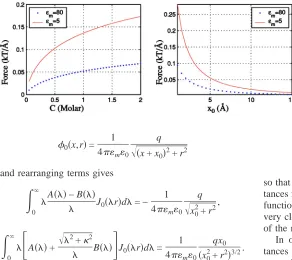
In Fig. 5, the force as a function of bath concentrations is plotted for a charged particle at a distance of 3 Å from the wall(left)for two cases, one withb=m= 80 and the other with m= 5. Note that in the case of a dielectric wall, the force is stronger than in its absence, because the force bath ions exert on the fixed ion is larger in this case. Moreover, the shielding force decreases monotonically as a function of m, for fixed b. Specifically, the shielding force more than doubles whenmis reduced from 80 to 5.
[1]B. Hille, Ionic Channels of Excitable Membranes, 2nd ed., (Sinauer Associates, Sunderland, MA, 1992).
[2]F.M. Ashcroft, Ion Channels and Disease (Academic, New York, 1999).
[3]D.G. Levitt, Annu. Rev. Biophys. Biophys. Chem. 15, 29 (1986).
[4]J. Bockris and A.K. Reddy, Modern Electrochemistry, 2nd ed. (Plenum, New York,1998).
[5]B. Nadler, T. Naeh, and Z. Schuss, SIAM(Soc. Ind. Appl. Math.)J. Appl. Math. 62, 433(2001).
[6]E. Cooper and A. Shrier, J. Gen. Physiol. 94, 881(1989). [7]C. Ransom and H. Sontheimer, J. Neurophysiol. 85, 790
(2001).
[8]A. Zholos, L. Baidan, A. Starodub, and J. Wood, Neuroscience
2, 603(1999).
[9]MP Mahaut-Smith, J. Physiol.(London) 484, 15(1995).
[10]V. Malev, L. Schagina, P. Gurnev, J. Takemoto, E. Nestorov-ich, and S. Bezrukov, Biophys. J. 82, 1985(2002).
[11]Z. Lu and R. MacKinnon, J. Gen. Physiol. 104, 477(1994). [12]T. Rostovtseva, V. Aguilella, I. Vodyanoy, S. Bezrukov, and
V.A. Parsegian, Biophys. J. 75, 1783(1998).
[13]B. Sakmann and G. Trube, J. Physiol. (London) 347, 641
(1984).
[14]A. Lopatin and C. Nichols, Biophys. J. 71, 682(1996). [15]A. Aleksandrov, B. Velimirovic, and D.E. Clapham, Biophys.
J. 70, 2680(1996).
[16]P. Horowicz, P.W. Gage, and R.S. Eisenberg, J. Gen. Physiol.
51, 193s(1968).
[17]B.C. Spalding, O. Senyk, J.G. Swift, and P. Horowicz, Am. J. Physiol. 241, C68(1981).
[18]B.C. Spalding, J.G. Swift, and P. Horowicz, J. Membr. Biol.
93, 141(1986).
[19]M.F. Schumaker and R. MacKinnon, Biophys. J. 58, 975
(1990).
[20]D. Chen et al., Biophys. J. 73, 1337(1997). [21]R.S. Eisenberg, J. Membr. Biol. 171, 1(1999). [22]D.G. Levitt, Biophys. J. 48, 19(1985).
[23]P.C. Jordan, R.J. Bacquet, J.A. McCammon, and P. Tran, Bio-phys. J. 55, 1041(1989).
[24]T. Allen, O.F. Andersen, and B. Roux, Proc. Natl. Acad. Sci. U.S.A. 101, 117(2004).
[25]T. Allen, T. Batu, S. Kuyucak, and S. Chung, Biophys. J. 84, 2159(2003).
[26]S. Bernèche and B. Roux, Biophys. J. 78, 2900(2000). [27]A. Mamonov, R. Coalson, A. Nitzan, and M.G. Kurnikova,
Biophys. J. 84, 3646(2003).
[28]R.S. Eisenberg, J. Membr. Biol. 115, 1(1990).
[29]G. Moy, B. Corry, S. Kuyucak, and S. Chung, Biophys. J. 78, 2349(2000).
[30]B. Corry, S. Kuyucak, and S. Chung, Biophys. J. 78, 2364 (2000).
[31]P. Graf, A. Nitzan, M.G. Kurnikova, and R.D. Coalson, J. Phys. Chem. B 104, 12 324(2000).
[32]P. Graf, M.G. Kurnikova, R.D. Coalson, and A. Nitzan, J. Phys. Chem. B 108, 2006(2004).
[33]Z. Schuss, B. Nadler, and R.S. Eisenberg, Phys. Rev. E 64, 036116(2001).
[34]B. Nadler, Z. Schuss, A. Singer, and R.S. Eisenberg, J. Phys.: Condens. Matter 16, S2153(2004).
[35]B. Nadler, U. Hollerbach, and R.S. Eisenberg, Phys. Rev. E
68, 021905(2003).
[36]D.G. Levitt, Curr. Top. Membr. Transp. 21, 181(1984). [37]E. Jakobsson and S.W. Chiu, Biophys. J. 52, 33(1987). [38]P. McGill and M.F. Schumaker, Biophys. J. 71, 1723(1996). [39]J.N. Aqua and F. Cornu, J. Stat. Phys. 105, 211(2001). [40]R.S. Eisenberg, M.M. Klosek, and Z. Schuss, J. Chem. Phys.
203, 1767(1995).
[41]J. Barthel et al., Physical Chemistry of Electrolyte Solutions:
Modern Aspects(Springer, New York, 1998).
[42]S. Durand-Vidal et al., Electrolytes at Interfaces(Kluwer, Bos-ton, 2000).
2423(1998).
[46]J. Rosgen et al., J. Phys. Chem. B 108, 2048(2004). [47]R.S. Eisenberg, Biophys. Chem. 100, 507(2003).
[48]D. Gillespie et al., J. Phys.: Condens. Matter 14, 12 129 (2002).
[49]W. Nonner et al., Biophys. J. 79, 1976(2000). [50]W. Nonner et al., J. Phys. Chem. B 105, 6427(2001).
[51]A. Koumanov, U. Zachariae, H. Engelhardt, and A.