Introduction
It has been estimated that nearly 70, 530 new cases of bladder cancer (BC) were diagnosed in the United States in 2010, with approximately 14, 680 people dying of the disease [1]. BC is the most common genitourinary malignancy in China, and the incidence of this disease is gradually increasing [2]. Despite improvement in surgical techniques, 5-year disease-free sur-vival (DFS) and cancer specific sursur-vival (CSS) after radical cystectomy (RC) remains between 50% and 70% [3, 4]. Conventional clinicopa-thological parameters, such as tumor-node-metastasis (TNM), stage and grade of the tu-mor, as prognostic tools for patient counseling and treatment decisions. While these parame-ters have provided useful estimates of survival outcome, the heterogeneity of tumor biology leads to large variation in outcomes within each stage and grade. Therefore, specific molecular markers which could serve as standard prog-nostic factors are needed.
Previous studies [5, 6] describe the isolation of six proteins (BLCA-1 to -6) found to be uniquely expressed in the tumor tissue of patients with bladder cancer. BLCA-4, one of the most abun-dant of these proteins, was isolated by excising gel spots from negatively stained two-dimensional gels. The gel spots were then con-centrated to obtain protein sequences and syn-thesized for antibody production. The first re-sulting peptide sequence was EISQLNAG, with a 75% homology with a number of nonvertebrate proteins including the epidermin biosynthesis protein, whereas the second peptide of BLCA-4 was VYEDIMQK, with a 75% homology with the ERECTA receptor protein kinase according to the BLAST database [7]. BCLA-4 is a nuclear transcription factor present in bladder tumors and adjacent benign areas of the bladder, but not in benign urothelium. BLCA-4 is one of six such factors which are promising tumor mark-ers in bladder cancer detection. This protein is tested by an ELISA on voided urine. Preliminary
Original Article
High expression level of BLCA-4 correlates with poor
prognosis in human bladder cancer
Qian Zhao1*, Wen-Hao Shen2*, Zhi-Wen Chen2, Zhan-Song Zhou2, Hui-Xiang Ji2
1Urology Department, Kunming General Hospital of Chengdu Military Region. No. 212, Daguan RD, Kunming, 650032; 2Urology Department, Southwest Hospital Affiliated to Third Military Medical University. *Contributed to this paper equally.
Received April 6, 2012; accepted May 11, 2012;Epub May 23, 2012; Published June 30, 2012
Abstract: Objectives: To evaluate the association between BLCA-4 tissue expression and patients' prognosis in blad-der cancer (BC). Methods: BLCA-4 expression was analyzed using immunohistochemical staining methods on tissue samples from a consecutive series of 325 BC patients who underwent resections between 2000 and 2006. The cor-relation of BLCA-4 expression and patients’ clinicopathological parameters was evaluated. Survival analysis was per-formed using the Kaplan-Meier method and Cox's proportional hazards model. Results: BLCA-4 was highly expressed in 54.8% of the BC patients. BLCA-4 overexpression was significantly associated with tumor grade (P<0.001), and stage (P<0.001). Kaplan-Meier survival analysis showed that high expression level of BLCA-4 resulted in a signifi-cantly poor prognosis of BC patients. Multivariate analysis revealed that the BLCA-4 expression level was an inde-pendent prognostic parameter for the overall survival rate of BC patients. Conclusions: These findings provide evi-dence that high expression level of BLCA-4 serves as a poor prognostic biomarker for BC. BLCA-4 may be a potential target of antiangiogenic therapy for BC.
studies indicate a sensitivity of 89%-96% with a specificity of 100% for bladder cancer [8-12]. However, there have been no reports on the actual expression level of BLCA-4 and the corre-lation between clinicopathologic features and prognosis of BC patients. In this study, we ex-plored the expression of BLCA-4 and investi-gated its clinicopathological and prognostic sig-nificance in human BC.
Materials and methods
Tissue specimens
BC specimens were obtained from 325 patients who underwent surgery between January 2000 and December 2006. Their diagnosis was made by a pathological examination, and all patients did not receive any preoperative treatment be-fore admission. The histomorphology of all specimens was assessed by the Department of Pathology at Southwest Hospital Affiliated to Third Military Medical University. Histological cell types were assigned following the WHO classification criteria. Specimens were fixed in 10% formaldehyde and embedded in paraffin for histological sectioning. Clinical information was collected and stored in a database. Follow-up information for all participants was obtained every 3 months by telephone, at a visit or via a posted questionnaire. During the follow-up pe-riod, overall survival was measured from diag-nosis to death or the last follow-up (5 years). The death of a patient was ascertained by re-porting from the family and verified by a review of public records.
Immunohistochemical analysis
All 325 tissue specimens were subjected to immunohistochemical analysis using the avidin-biotin-peroxidase method. Sections were depar-affinized in xylene and dehydrated using a graded alcohol series before endogenous per-oxidase activity was blocked with 0.5% H2O2 in methanol for 10 minutes. Nonspecific binding was blocked by incubating sections with 10% normal goat serum in phosphate-buffered saline (PBS) for 1 hour at room temperature. Without washing, sections were incubated with anti-BLCA-4(1:100; Abnova, Taipei, Taiwan) in PBS at 4ºC overnight in a moist box. Biotinylated goat anti-rabbit immunoglobulin G (IgG) (1:400; Sigma, St. Louis, MO, USA) was incubated with the sections for 1 hour at room temperature
and detected with a streptavidin-peroxidase complex. The brown color indicative of peroxi-dase activity was developed by incubating sec-tions with 0.1% 3, 3-diaminobenzidine (Sigma) in PBS with 0.05% H2O2 for 5 minutes at room temperature. The tissue specimens were viewed separately by two pathologists under double-blinded conditions, where they had no prior knowledge of the clinical or clinicopathological status of the specimens. Expression of BLCA-4 in the BC specimens was evaluated by scanning the entire tissue specimen under low magnifica-tion (×40), and then confirmed under high mag-nification (×200 and×400). An immunoreactivity score (IRS) system was applied as described elsewhere [14]. The percent of positive cells was scored as '0'(<5%, negative), '1'(5%-25%, sporadic), '2'(25%-50%, focal), and'3'(>50%, diffuse), respectively. The staining intensity was scored as '0' (no staining), '1'(weakly stained), '2'(moderately stained) and '3' (strongly stained), respectively. Both the percent of posi-tive cells and cell staining intensity were de-cided in a double-blinded manner. The final BLCA-4 immunostaining score was calculated using the percent of positive cell score × stain-ing intensity score rangstain-ing 0-9. High BLCA-4 expression level was defined as a total score ³ 4, and low BLCA-4 expression level as a total score < 4.
Statistical analysis
All statistical analyses were performed using SPSS software (version 17. 0; SPSS Inc., Chi-cago, IL, USA). Correlation of BLCA-4 expression with immunohistochemistry and clinicopa-thologic parameters was evaluated by chi-square test or Fisher’s exact probability test. Survival curves were plotted using the Kaplan-Meier product-limit method, and differences between survival curves were tested using the log-rank test. Cox's proportional hazards model was used to identify the factors that had a sig-nificant influence on survival. Statistical signifi-cance was set at p<0. 05.
Results
Expression of BLCA-4 in BC tissues
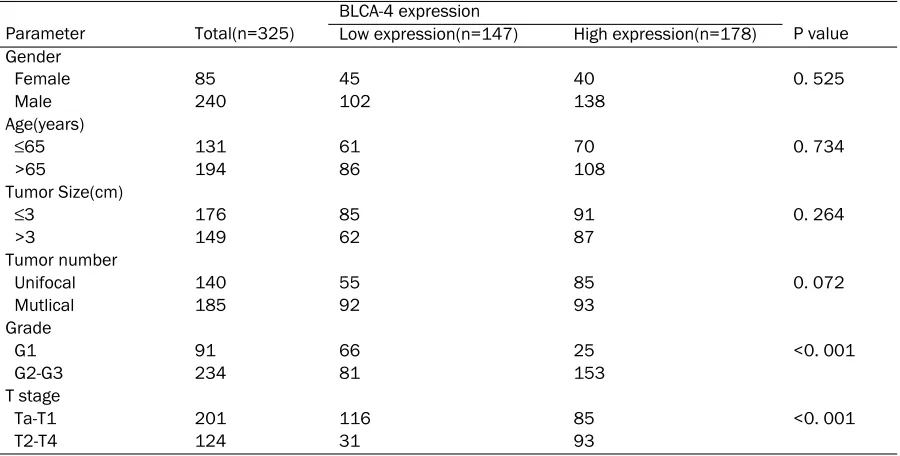
posi-tively and negaposi-tively expressed in 254 (78. 2%) and 71 (21. 8%) of the 325 BC patients, respec-tively. BLCA-4 was highly and lowly expressed in 178 (54. 8%) and 147 (45. 2%) of the 325 BC patients, respectively (Figure 1). BLCA-4 overex-pression was significantly associated with tumor grade (P<0. 001), and stage (P<0. 001), but not with age, gender, tumor size, and tumor number (Table 1).
Univariate and multivariate analyses of prognostic variables in BC patients
[image:3.612.82.535.85.266.2]The prognostic effect of BLCA-4 on the overall survival rate of BC patients with a high or low BLCA-4 protein expression level was compared using Kaplan-Meier survival curves and the log-rank test respectively, showing that high expres-sion level of BLCA-4 protein was a significant Figure 1. Immunohistochemical analysis of BLCA-4 in bladder cancer patients. A: High expression level of BLCA-4; B:Low expression level of BLCA-4; A, B: Original magnification×200.
Table 1. Correlation Between BLCA-4 Protein Expression and Clinicopathologic Features of the Patients With BC.
BLCA-4 expression
Parameter Total(n=325) Low expression(n=147) High expression(n=178) P value
Gender
Female 85 45 40 0. 525
Male 240 102 138
Age(years)
≤65 131 61 70 0. 734
>65 194 86 108
Tumor Size(cm)
≤3 176 85 91 0. 264
>3 149 62 87
Tumor number
Unifocal 140 55 85 0. 072
Mutlical 185 92 93
Grade
G1 91 66 25 <0. 001
G2-G3 234 81 153
T stage
Ta-T1 201 116 85 <0. 001
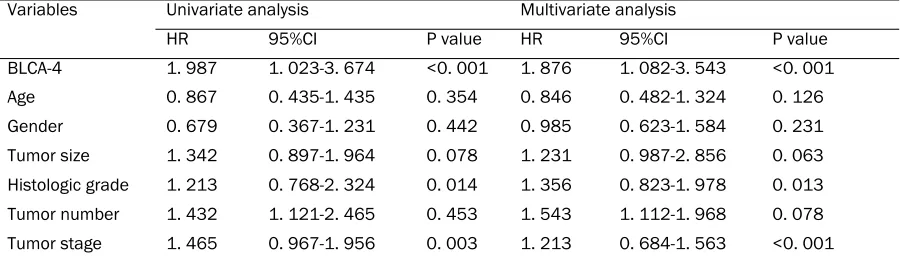
[image:3.612.83.533.347.575.2]prognostic factor for poor overall survival rate of BC patients. The 5-year survival rate of BC pa-tients with a high or a low BLCA-4 protein ex-pression level was 50% and 89.8%, respec-tively. A significant difference was observed on the Kaplan-Meier survival curves for BC patients with a high or a low expression level of BLCA-4 (P<0. 001, log-rank test, Figure 2). Univariate Cox regression analysis also identified that clini-cal variables including age, sex, tumor size, tu-mor number, tutu-mor grade, and tutu-mor stage and BLCA-4 expression were significantly associated with overall survival (Table 2). Furthermore, to evaluate the potential of BLCA-4 expression as an independent predictor for overall survival of BC, multivariate Cox regression analyses were performed. While the others failed to demon-strate independence, tumor grade, tumor stage and BLCA-4 expression may play a role in pre-dicting the overall survival in BC (Table 2).
Discussion
Despite many advances in diagnostic imaging of tumors, combination chemotherapy, and radia-tion therapy, little improvement has been
[image:4.612.82.368.81.207.2]achieved within the last decade in terms of prognosis and quality of life for patients with BC. Given the frequent failure of conventional treat-ment strategies, many cancer-related molecules have been characterized toward the goal of de-veloping novel anticancer therapies such as molecular-targeted drugs and antibodies or can-cer vaccines [13, 14]. Molecular-targeted thera-pies are expected to be highly specific to malig-nant cells, with minimal adverse effects due to their well-defined mechanisms of action. Equally desirable in prospect are minimally invasive, highly sensitive, and specific new diagnostic methods that would adapt readily to clinical settings. From these points of view, tumor-specific transmembrane/secretory proteins should have significant advantages because they are presented either on the cell surface or within the extracellular space and/or in serum, making them easily accessible as molecular markers and therapeutic targets. Some tumors specific markers already available, such as CY-FRA or Pro-GRP, are transmembrane/secretory proteins [15, 16]; the example of rituximab (Rituxan), a humanized monoclonal antibody against CD20-positive lymphomas, provides Table 2. Univariate analysis and multivariate analysis showing the overall survival rate for bladder
cancer patients
Variables Univariate analysis Multivariate analysis
HR 95%CI P value HR 95%CI P value
[image:4.612.82.533.256.387.2]BLCA-4 1. 987 1. 023-3. 674 <0. 001 1. 876 1. 082-3. 543 <0. 001 Age 0. 867 0. 435-1. 435 0. 354 0. 846 0. 482-1. 324 0. 126 Gender 0. 679 0. 367-1. 231 0. 442 0. 985 0. 623-1. 584 0. 231 Tumor size 1. 342 0. 897-1. 964 0. 078 1. 231 0. 987-2. 856 0. 063 Histologic grade 1. 213 0. 768-2. 324 0. 014 1. 356 0. 823-1. 978 0. 013 Tumor number 1. 432 1. 121-2. 465 0. 453 1. 543 1. 112-1. 968 0. 078 Tumor stage 1. 465 0. 967-1. 956 0. 003 1. 213 0. 684-1. 563 <0. 001
proof that targeting specific cell surface pro-teins can result in significant clinical benefits [17]. As an approach to identifying novel cancer-specific cell surface or secretory proteins, we have been exploiting the power of genome-wide expression analysis to select genes that are overexpressed in cancer cells. Analysis of candi-date molecules revealed BLCA-4 as a potential target for development of novel tools for diagno-sis and treatment of bladder cancer.
BCLA-4 is a nuclear transcription factor present in bladder tumors and adjacent benign areas of the bladder, but not in benign urothelium. BLCA-4 is one of six such factors which are promising tumor markers in bladder cancer detection. This protein is tested by an ELISA on voided urine. Preliminary studies indicate a sensitivity of 89%-96% with a specificity of 100% for bladder can-cer [8-12]. BLCA-4 seemed likely to have a po-tential role in tumor development or progres-sion. In this study, we evaluated the association between BLCA-4 tissue expression and patients’ prognosis in bladder cancer. In our tumour ma-terial, BLCA-4 was positively expressed in 78.2% of BC patients and highly expressed in 54.8% of BC patients. BLCA-4 overexpression was signifi-cantly associated with tumor grade (P<0. 001), and stage (P<0. 001), but not with age, gender, tumor size, and tumor number (Table 1). In this study, the prognosis of BC patients with a high expression level of BLCA-4 was poor, and Cox regression analysis indicated that high expres-sion level of BLCA-4 was a significant prognostic factor for a poor overall survival rate of BC pa-tients, suggesting that BLCA-4 may become a novel prognostic marker for BC.
In conclusion, our results provide a basis for the concept that high expression level of BLCA-4 in bladder cancer may be important in the tumor progression and serves as an independent bio-marker for poor survival. Thus, high expression level of BLCA-4 identifies patients at high risk and is a potential novel therapeutic target for bladder cancer.
Funding
This study was supported by a grant from Chongqing Municipal Major Scientific and Tech-nological Project (CSTC, 2011AC5027).
Address correspondence to: Dr. Hui-Xiang Ji, Vice professor, Urology Department, Southwest Hospital Affiliated to Third Military Medical University. No. 33,
Gaotanyanzheng RD, Chongqing, 400038, China. E-mail: [email protected]
References
[1] Jemal A, Siegel R, Xu J, Ward E. Cancer statis-tics, 2010. CA Cancer J Clin 2010; 60: 277-300.
[2] Zhang W, Xiang YB, Liu ZW, Fang RR, Ruan ZX, Sun L, Gao LF, Jin F, Gao YT. Trends analysis of common urologic neoplasm incidence of elderly people in Shanghai, 1973-1999. Ai Zheng 2004; 23: 555-558.
[3] Ghoneim MA, Abdel-Latif M, el-Mekresh M, Abol -Enein H, Mosbah A, Ashamallah A, el-Baz MA. Radical cystectomy for carcinoma of the blad-der: 2,720 consecutive cases 5 years later. J Urol 2008; 180: 121-127.
[4] Shariat SF, Karakiewicz PI, Palapattu GS, Lotan Y, Rogers CG, Amiel GE, Vazina A, Gupta A, Bas-tian PJ, Sagalowsky AI, Schoenberg MP, Lerner SP. Outcomes of radical cystectomy for transi-tional cell carcinoma of the bladder: A contem-porary series from the Bladder Cancer Re-search Consortium. J Urol 2006; 176: 2414-2422.
[5] Getzenberg RH, Konety BR, Oeler TA, Quigley MM, Hakam A, Becich MJ and Bahnson RR. Bladder cancer-associated nuclear matrix pro-teins. Cancer Res 1996; 56: 1690-1694. [6] Konety BR, Nguyen T-ST, Lavelle JP, Zeidel ML
and Getzenberg RH. Expression of BLCA-4, a nuclear matrix protein (NMP) marker in a car-cinogen induced model of bladder cancer. J Urol 2000; 163: abstract 597.
[7] Murphy WM and Soloway MS. Urothelial dyspla-sia. J Urol 1982; 127: 849-854.
[8] Konety BR, Nguyen TS, Brenes G, Sholder A, Lewis N, Bastacky S, Potter DM, Getzenberg RH. Clinical usefulness of the novel marker BLCA-4 for the detection of bladder cancer. J Urol 2000; 164: 634-639.
[9] Van Le TS, Miller R, Barder T, Babjuk M, Potter DM, Getzenberg RH. Highly specific urine-based marker of bladder cancer. Urology 2005; 66: 1256-1260.
[10] Feng CC, Wang PH, Guan M, Jiang HW, Wen H, Ding Q, Wu Z. Urinary BLCA-4 is Highly Specific for Detection of Bladder Cancer in Chinese Han Population and Is Related to Tumour Invasive-ness. Folia Biologica 2011; 57: 242-247. [11] Konety BR, Nguyen TS, Dhir R, Day RS, Becich
MJ, Stadler WM, Getzenberg RH. Detection of Bladder Cancer Using a Novel Nuclear Matrix Protein, BLCA-4. Clinical Cancer Research 2000; 6: 2618-2625.
[12] Myers-Irvin JM, Van Le TS, Getzenberg RH. Mechanistic Analysis of the Role of BLCA-4 in Bladder Cancer Pathobiology. Cancer Res 2005; 65: 7145-7150.
Grevstad PK, Moinpour CM, Ramsey SD, Wozniak AJ, Weiss GR, Moore DF, Israel VK, Livingston RB, Gandara DR. Randomized phase III trial of paclitaxel plus carboplatin versus vinorelbine plus cisplatin in the treatment of patients with advanced non-small-cell lung cancer: a Southwest Oncology Group trial. J Clin Oncol 2001; 19: 3210-3218.
[14] Hennessy BT, Hanrahan EO, Daly PA. Non-Hodgkin lymphoma: an update. Lancet Oncol 2004; 5: 341-353.
[15] Pujol JL, Grenier J, Daures JP, Daver A, Pujol H, Michel FB. Serum fragment of cytokeratin sub-unit 19 measured by CYFRA 21-1 immunoradi-ometric assay as a marker of lung cancer. Can-cer Res 1993; 53: 61-66.
[16] Miyake Y, Kodama T, Yamaguchi K. Pro-gastrin-releasing peptide (31-98) is a specific tumor marker in patients with small cell lung carci-noma. Cancer Res 1994; 54: 2136-2140. [17] Tuck AB, O'Malley FP, Singhal H, Harris JF,