Original Article
Association of NER pathway gene polymorphisms with
susceptibility to laryngeal cancer in a
Chinese population
Yanan Sun1, Lijun Tan2, Huijun Li1, Xiaowei Qin1, Jiangtao Liu1
1Department of Otorhinolaryngology, The First Affiliated Hospital of Harbin Medical University, Harbin 150001,
China; 2Department of Medical Oncology, The First Affiliated Hospital of Harbin Medical University, Harbin
150001, China
Received May 9, 2015; Accepted June 25, 2015; Epub September 1, 2015; Published September 15, 2015 Abstract: We systematically analyzed the association of nine SNPs of seven key NER pathway genes with the devel-opment of laryngeal cancer patients, and investigated whether NER pathway polymorphisms could serve as poten-tial biomarkers for laryngeal cancer risk. 271 patients with pathologically proven laryngeal cancer and 271 control subjects were included in our study. Genotyping of ERCC1 rs11615 and rs2298881, ERCC2 rs13181 and rs50871, ERCC3 rs4150441, ERCC4 rs6498486, ERCC5 rs2094258, XPA rs2808668 and XPC rs2228001 were analyzed by polymerase chain reaction (PCR) coupled with restriction fragment length polymorphism (RFLP). By conditional lo-gistic regression analysis, individuals carrying the TT genotype of ERCC1 rs11615 were correlated with an increased risk of larynx cancer when compared with the CC genotype (OR=1.89, 95% CI=1.07-3.37; P value=0.02). Moreover, individuals with the GG genotype of ERCC2 rs50871 were associated with an elevated risk of larynx cancer when compare with the TT genotype (OR=2.03, 95% CI=1.15-3.63; P value=0.01). We found a significant interaction be -tween ERCC2 rs50871 polymorphism and tobacco smoking in the risk of larynx cancer (P for interaction <0.05). In
conclusion, our study showed that ERCC1 rs11615 and ERCC2 rs50871 polymorphisms could influence the risk of
larynx cancer in Chinese population, particularly among smokers.
Keywords: NER pathway gene, single nucleotide polymorphism, laryngeal cancer
Introduction
Larynx cancer is an important entity of cancer, which accounts for 30%-40% of all malignant head and neck tumors [1, 2]. It is estimated that the there were 138,102 new cases with laryngeal cancer and 73,261 deaths from laryngeal cancer worldwide in 2012 [3]. It is well known that larynx cancer is a complex dis-ease, which is caused by many environmental and genetic factors [4, 5]. Several environmen-tal factors are reported to be associated with increased risk of laryngeal cancer, including smoking, alcohol consumption, exposure to carcinogens in the work environment, nutrition, and viral infections with human papilloma virus (HPV) and Eostein-Barr virus (EBV) [4, 5]. Many molecular factors are reported to be involved in the mechanisms of carcinogenesis in the lar-ynx, such as RECQL5, nucleotide excision repair genes, NOD2 and GSTM1 genes [4-8].
DNA repair systems play a pivotal role in main-taining the stability and integrity of the genome, which include nucleotide excision repair (NER), base excision repair (BER), mismatch repair (MMR) and double-strand break repair (DSBR) [9, 10]. Nucleotide excision repair (NER) is a ver-satile system that monitors and repairs DNA damage caused by both endogenous and exog-enous factors. DNA repair gene polymorphisms
may be responsible for modified function and/ or proficiency of DNA repair, and may contribute
to inter-individual variation of DNA repair capac-ity [9, 11, 12]. NER process include steps of damage recognition, damage demarcation and unwinding, damage incision, and new strand ligation, all of which require corresponding func-tional proteins [13]. Polymorphisms of core NER
polymorphisms of several NER genes have pre-viously been studied in relation to the develop-ment of laryngeal cancer [4-6, 14], but the
results are conflicting. In the present study, we
systematically analyzed the association of nine SNPs of seven key NER pathway genes (ERCC1, ERCC2, ERCC3, ERCC4, ERCC5, XPA and XPC) with the development of laryngeal cancer patients, and investigated whether NER path-way polymorphisms could serve as potential biomarkers for laryngeal cancer risk.
Materials and methods
Patients
Patients with pathologically proven laryngeal cancer were recruited in the period between January 2012 and December 2014. All the cases were newly diagnosed and previously untreated. A total of 292 patients with larynge-al cancer were collected into our study, and
finally 271 patients agreed to participate into
our study, with a participation rate of 92.81%. Clinical characteristics including basic medical data were obtained from medical records. The control group consisted of 271 subjects with-out malignant pathologies consulting between January 2012 and December 2014 in the same hospital. The controls were recruited simulta-neously from similar geographic areas and matched with patients in terms of age, gender and social conditions.
Blood samples and genotyping
Each patient was asked to provide 5 ml periph-eral blood and kept in -70ºC until use. Genomic DNA was extracted from peripheral blood leu-kocytes using a DNA extraction kit (Beijing Bioteke Co. Ltd. Beijing, China). Genotyping of ERCC1 rs11615 and rs2298881, ERCC2 rs13181 and rs50871, ERCC3 rs4150441, ERCC4 rs6498486, ERCC5 rs2094258, XPA rs2808668 and XPC rs2228001 were ana-lyzed by polymerase chain reaction (PCR) cou-pled with restriction fragment length polymor-phism (RFLP). The PCR fragments of the inves-tigated polymorphisms were subsequently
digested with their specific restriction enzyme. The 25 μL PCR mixture contained about 100 ng
of DNA, 12.5 pmol of each primer, 0.2 mmol/L of dNTPs, 2 mmol/L of MgCl2 and 1 U of Taq DNA polymerase. The PCR condition was con-ducted using the following steps: an initial denaturation at 95°C for 5 min, 35 cycles of
amplification with denaturation at 95°C for 30
sec, annealing at 56°C for 30 sec, and
exten-sion at 72°C for 30 sec, followed by a final
[image:2.612.90.375.95.309.2]extension step of 7 min at 72°C. Digestion products were separated by electrophoresis on ethidium bromide stained agarose gel and visu-alized under UV light. Two researchers without the knowledge of case or control status blindly conducted all assays. Additionally, approxi-mately 10% of the samples were randomly selected and retested, and the results were 100% concordant.
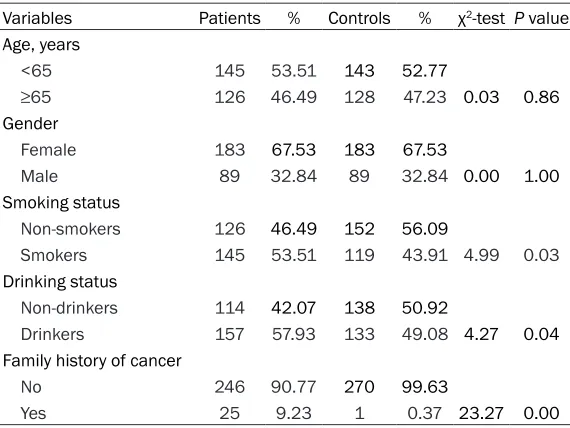
Table 1. Baseline characteristics of larynx cancer patients and control subjects
Variables Patients % Controls % χ2-test P value
Age, years
<65 145 53.51 143 52.77
≥65 126 46.49 128 47.23 0.03 0.86 Gender
Female 183 67.53 183 67.53
Male 89 32.84 89 32.84 0.00 1.00 Smoking status
Non-smokers 126 46.49 152 56.09
Smokers 145 53.51 119 43.91 4.99 0.03
Drinking status
Non-drinkers 114 42.07 138 50.92
Drinkers 157 57.93 133 49.08 4.27 0.04 Family history of cancer
No 246 90.77 270 99.63
Yes 25 9.23 1 0.37 23.27 0.00
Cases and controls were interviewed using a standard-ized questionnaire including socio-demographic character-istics, such as sex, age, occu-pation, residence and lifestyle habits. Lifetime consumption of tobacco smoking and alco-hol drinking were also collect-ed. Subjects who had smoked cigarettes at least one ciga-rette a week of more than one
year previously were defined
as smokers. Similarly, sub-jects who had drunk alcoholic beverages at least once a week for more than one year
previously were defined as
Statistical analysis
Means of quantitative variables were compared between groups using Student t-test after log transformation to obtain normal distribution, while distributions of categorical variables were
compared by Pearson χ2-test. Hardy-Weinberg equilibrium (HWE) was examined using a
Chi-square (χ2)-test with one degree of freedom. Multiple logistic regression models were estab-lished to estimate relative risks of tobacco and alcohol consumption as well as risks related to each SNP after adjustment for age, gender, smoking and alcohol drinking. Additional regression models were designed where
sub-jects were stratified on smokers and non smok -er subgroups and genetic common type and polymorphism carriers of the studied varia-tions. Risks attributable to combined geno-types were also assessed using recoding of genotypic classes for pairs of markers. Odds
ratios (ORs) and their 95% confidence intervals
(CIs) were calculated. All tests were two-sided
with a significant level of P-value <0.05. The SPSS software (SPSS, Chicago, IL) was used for statistical analyses.
Results
The characteristics of the patients and controls were presented in Table 1, including age, gen-der, smoking and drinking status, and family history of cancer. The mean ages of patients and controls were 63.70±10.50 and 64.50±
9.60 years, respectively. There were no signifi -cant differences between larynx cancer patients and controls in terms of age and gen-der. By comparing baseline characteristics between larynx cancer patients and controls,
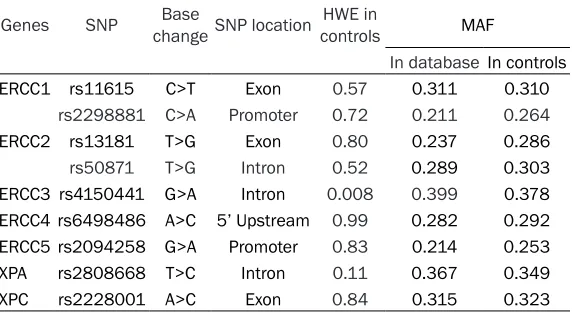
(Table 2). The minor allele frequencies (MAF) of the nine in control subjects were similar with them in dbSNP database.
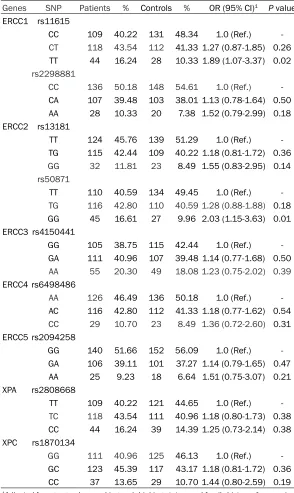
The association between the nine SNPs in NER pathway genes and risk of larynx cancer was shown in Table 3. By conditional logistic regres-sion analysis, individuals carrying the TT geno-type of ERCC1 rs11615 were correlated with an increased risk of larynx cancer when compared with the CC genotype (OR=1.89, 95% CI=1.07-3.37; P value=0.02). Moreover, individuals with the GG genotype of ERCC2 rs50871 were asso-ciated with an elevated risk of larynx cancer when compare with the TT genotype (OR=2.03, 95% CI=1.15-3.63; P value=0.01). However, ERCC1 rs2298881, ERCC2 rs13181, ERCC3 rs4150441, ERCC4 rs6498486, ERCC5 rs209- 4258, XPA rs2808668 and XPC rs2228001 polymorphisms were not associated with risk of larynx cancer.
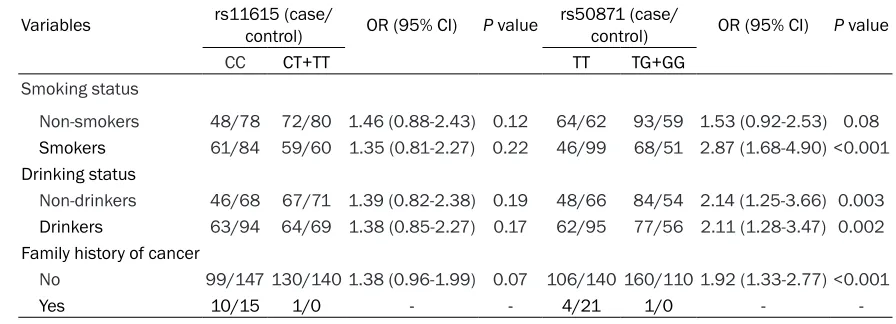
We further analyzed the association between ERCC1 rs11615 and ERCC2 rs50871 and risk
of larynx cancer stratified by smoking status,
drinking status and family history of cancer in
first relatives (Table 4). Individuals carrying the TG+GG genotype of ERCC2 rs50871 were asso-ciated with risk of larynx cancer in smokers (OR=2.87, 95% CI=1.68-4.90; P value <0.001), non-drinkers (OR=2.14, 95% CI=1.25-3.66; P value=0.003), drinkers (OR=2.11, 95% CI=1.28-3.47; P value=0.002) and those with family history of cancer (OR=1.92, 95% CI=1.33-2.77; P value <0.001). Moreover, we
found a significant interaction between ERCC2
[image:3.612.92.379.85.241.2]rs50871 polymorphism and smoking status in the risk of larynx cancer (P for interaction <0.05).
Table 2. Detailed information of nine SNPs in NER pathway
Genes SNP change SNP locationBase controlsHWE in MAF
In database In controls
ERCC1 rs11615 C>T Exon 0.57 0.311 0.310
rs2298881 C>A Promoter 0.72 0.211 0.264
ERCC2 rs13181 T>G Exon 0.80 0.237 0.286
rs50871 T>G Intron 0.52 0.289 0.303
ERCC3 rs4150441 G>A Intron 0.008 0.399 0.378
ERCC4 rs6498486 A>C 5’ Upstream 0.99 0.282 0.292
ERCC5 rs2094258 G>A Promoter 0.83 0.214 0.253
XPA rs2808668 T>C Intron 0.11 0.367 0.349
XPC rs2228001 A>C Exon 0.84 0.315 0.323
larynx cancer patients were more likely to be a smokers and drinkers, and have a
fam-ily history of cancer in first
relatives.
The genotype distributions of ERCC1 rs11615 and rs- 2298881, ERCC2 rs13181 and rs50871, ERCC4 rs- 6498486, ERCC5 rs2094- 258, XPA rs2808668 and
XPC rs2228001 confirmed
Discussion
Polymorphisms have an important role in the regulation of gene expression, and can contrib-ute to the differences between individuals in the susceptibility to a disease and its severity. The regulation of DNA repair is a key factor in the multistep process of carcinogenesis, and NER pathway genes are important parts of the
influence the DNA repair capacity and the risk
of larynx cancer.
[image:4.612.89.383.96.589.2]Recently, several previous molecular studies have indicated that SNPs in DNA repair genes may contribute to the development of larynx cancer [4, 5, 14, 22], but the results were inconclusive. Li et al. conducted a 1:1 matched case-control study in a Chinese population, and Table 3. Association between NER pathway genes and risk of larynx
cancer
Genes SNP Patients % Controls % OR (95% CI)1 P value ERCC1 rs11615
CC 109 40.22 131 48.34 1.0 (Ref.)
-CT 118 43.54 112 41.33 1.27 (0.87-1.85) 0.26
TT 44 16.24 28 10.33 1.89 (1.07-3.37) 0.02
rs2298881
CC 136 50.18 148 54.61 1.0 (Ref.)
-CA 107 39.48 103 38.01 1.13 (0.78-1.64) 0.50
AA 28 10.33 20 7.38 1.52 (0.79-2.99) 0.18
ERCC2 rs13181
TT 124 45.76 139 51.29 1.0 (Ref.)
-TG 115 42.44 109 40.22 1.18 (0.81-1.72) 0.36
GG 32 11.81 23 8.49 1.55 (0.83-2.95) 0.14
rs50871
TT 110 40.59 134 49.45 1.0 (Ref.)
-TG 116 42.80 110 40.59 1.28 (0.88-1.88) 0.18
GG 45 16.61 27 9.96 2.03 (1.15-3.63) 0.01
ERCC3 rs4150441
GG 105 38.75 115 42.44 1.0 (Ref.)
-GA 111 40.96 107 39.48 1.14 (0.77-1.68) 0.50
AA 55 20.30 49 18.08 1.23 (0.75-2.02) 0.39
ERCC4 rs6498486
AA 126 46.49 136 50.18 1.0 (Ref.)
-AC 116 42.80 112 41.33 1.18 (0.77-1.62) 0.54
CC 29 10.70 23 8.49 1.36 (0.72-2.60) 0.31 ERCC5 rs2094258
GG 140 51.66 152 56.09 1.0 (Ref.)
-GA 106 39.11 101 37.27 1.14 (0.79-1.65) 0.47
AA 25 9.23 18 6.64 1.51 (0.75-3.07) 0.21
XPA rs2808668
TT 109 40.22 121 44.65 1.0 (Ref.)
-TC 118 43.54 111 40.96 1.18 (0.80-1.73) 0.38
CC 44 16.24 39 14.39 1.25 (0.73-2.14) 0.38
XPC rs1870134
GG 111 40.96 125 46.13 1.0 (Ref.)
-GC 123 45.39 117 43.17 1.18 (0.81-1.72) 0.36
CC 37 13.65 29 10.70 1.44 (0.80-2.59) 0.19
1Adjusted for age, gender, smoking and drinking status, and family history of cancer in the first relatives.
DNA repair machinery. In our study, we suggest that the ERCC1 rs11615 and ERCC2 rs50871 polymor-phisms are correlated with risk of larynx cancer.
Nucleotide excision repair (NER) is an important mechanism of the DNA repair pathway, and it main-tains genomic integrity by removing DNA interstrand crosslinks [15, 16]. Both products of ERCC1 and ERCC2 genes are two important rate-limiting en- zymes in the NER pathway. ERCC1 is a subunit of the NER complex and interacts with XPA, XPF and/or RPA, and this gene guides the 5’ cleavage activity in the NER pathway [17, 18]. Cells from
they reported that ERCC1 rs11615 and ERCC5 rs17655 were correlated with development of laryngeal cancer in a Chinese population, espe-cially in smokers and drinkers [4]. Lu et al. also conducted a case-control study in a Chinese population, and they also suggested that ERCC1 rs11615 and ERCC5 rs17655 polymor-phisms are correlated with an elevated risk of laryngeal cancer [5]. Abbasi et al. reported the association between 14 SNPs in eight NER genes and laryngeal cancer risk, and they found that ERCC5 Asp1104His, RAD23B Ala249Val and ERCC6 Arg1230Pro were associated with the development of larynx cancer [14]. Cui et al. investigated the effects of XPG His1104Asp polymorphism on the risk of larynx risk, and they found that this gene polymorphism may
influence the susceptibility to the risk of larynx
cancer [22]. The discrepancies of these results may be caused by different in sample size, can-cer patients and controls selection, and study design. In our study, we found that ERCC1 rs11615 and ERCC2 rs50871 polymorphisms
could influence the development of larynx can -cer. Therefore, further large sample studies are
greatly needed to confirm our results.
It is well known that genetic factors may inter-act with environmental finter-actors, such as tobac-co smoking and altobac-cohol drinking, in the devel-opment of cancers. It is reported that NER is a critical pathway in regulating the susceptibility to larynx cancer, because NER pathway is an important mechanism for repairing bulky and helical and distorting DN adducts caused by cigarette smoke [23-25]. Proteins in the NER pathway could have a key role in repairing
dif-ferent types of oxidative damage [26-28]. In our study, we reported the ERCC2 rs50871 poly-morphism interacted with tobacco smoking in the risk of larynx cancer, which proved the above-mentioned hypothesis.
Several limitations should be considered in our
study. First, ERCC3 rs4150441 did not confirm
with Hardy-Weinberg equilibrium in the con-trols, since the included controls may have vari-ous non-malignant diseases. However, this bias could be corrected by matching of controls to patients. Second, the sample size relative small, which might suffer from lack of power to
find association of DNA repair genes with the
risk of larynx cancer.
In summary, our study showed that ERCC1 rs11615 and ERCC2 rs50871 polymorphisms
could influence the risk of larynx cancer in
Chinese population, particularly among smok-ers. Future studies using larger patient sample and employing either similar or different ana-lytic strategies may help to elucidate the impact of these polymorphisms on the development of larynx cancer.
Disclosure of conflict of interest
None.
Address correspondence to: Dr. Jiangtao Liu, Department of Otorhinolaryngology, The First
Affiliated Hospital of Harbin Medical University, 23
[image:5.612.79.527.97.259.2]Post Street, Nangang District, Harbin 150001, China. Tel: 85553919; Fax: +86-451-85553919; E-mail: [email protected]
Table 4. Association between ERCC1 rs11615 and ERCC2 rs50871 polymorphisms and risk of larynx
cancer stratified by demographic characteristics
Variables rs11615 (case/control) OR (95% CI) P value rs50871 (case/control) OR (95% CI) P value
CC CT+TT TT TG+GG
Smoking status
Non-smokers 48/78 72/80 1.46 (0.88-2.43) 0.12 64/62 93/59 1.53 (0.92-2.53) 0.08
Smokers 61/84 59/60 1.35 (0.81-2.27) 0.22 46/99 68/51 2.87 (1.68-4.90) <0.001
Drinking status
Non-drinkers 46/68 67/71 1.39 (0.82-2.38) 0.19 48/66 84/54 2.14 (1.25-3.66) 0.003
Drinkers 63/94 64/69 1.38 (0.85-2.27) 0.17 62/95 77/56 2.11 (1.28-3.47) 0.002
Family history of cancer
No 99/147 130/140 1.38 (0.96-1.99) 0.07 106/140 160/110 1.92 (1.33-2.77) <0.001
-References
[1] Markou K, Christoforidou A, Karasmanis I, Tsiropoulos G, Triaridis S, Constantinidis I, Vital V, Nikolaou A. Laryngeal cancer: epidemiologi-cal data from Northern Greece and review of the literature. Hippokratia 2013; 17: 313-8. [2] Takiar R, Krishnan SK, Shah VP. A Model
Approach to Calculate Cancer prevalence from 5 Years Survival Data for Selected Cancer Sites in India -Part II. Asian Pac J Cancer Prev 2014; 15: 5681-4.
[3] GLOBOCAN 2012: Estimated Cancer Incidence, Mortality and Prevalence Worldwide in 2012. http://globocan.iarc.fr/Pages/fact_sheets_ population.aspx. accessed in 2015-05-05. [4] Li X, Xu J, Yang X, Wu Y, Cheng B, Chen D, Bai
B. Association of single nucleotide polymor-phisms of nucleotide excision repair genes with laryngeal cancer risk and interaction with cigarette smoking and alcohol drinking. Tumour Biol 2014; 35: 4659-65.
[5] Lu B, Li J, Gao Q, Yu W, Yang Q, Li X. Laryngeal cancer risk and common single nucleotide polymorphisms in nucleotide excision repair pathway genes ERCC1, ERCC2, ERCC3, ERCC4, ERCC5 and XPA. Gene 2014; 542: 64-8.
[6] Qi Y, Zhou X. Haplotype analysis of RECQL5 gene and laryngeal cancer. Tumour Biol 2014; 35: 2669-73.
[7] Liu J, He C, Xu Q, Xing C, Yuan Y. NOD2 poly-morphisms associated with cancer risk: a me-ta-analysis. PLoS One 2014; 9: e89340. [8] Zhang Y, Chen W, Ji JF, Wang ZY, Wu MH, Zhang
K, Wang QP. GSTM1 null polymorphisms is as-sociated with laryngeal cancer risk: a meta-analysis. Tumour Biol 2014; 35: 6303-9. [9] Goode EL, Ulrich CM, Potter JD. Polymorphisms
in DNA repair genes and associations with can-cer risk. Cancan-cer Epidemiol Biomarkers Prev 2002; 11: 1513-30.
[10] Lindahl T, Wood RD. Quality control by DNA re-pair. Science 1999; 286: 1897-905.
[11] Monaco R, Rosal R, Dolan MA, Pincus MR, Brandt-Rauf PW. Conformational effects of a common codon 399 polymorphism on the BRCT1 domain of the XRCC1 protein. Protein J 2007; 26: 541-546.
[12] Lunn RM, Helzlsouer KJ, Parshad R, Umbach DM, Harris EL, Sanford KK, Bell DA. XPD
poly-morphisms: effects on DNA repair proficiency.
Carcinogenesis 2000; 21: 551-5.
[13] Nouspikel T. DNA repair in mammalian cells: Nucleotide excision repair: variations on versa-tility. Cell Mol Life Sci 2009; 66: 994-1009. [14] Abbasi R, Ramroth H, Becher H, Dietz A,
Schmezer P, Popanda O. Laryngeal cancer risk associated with smoking and alcohol
con-sumption is modified by genetic polymor -phisms in ERCC5, ERCC6 and RAD23B but not
by polymorphisms in five other nucleotide exci -sion repair genes. Int J Cancer 2009; 125: 1431-9.
[15] Neumann AS, Sturgis EM, Wei Q. Nucleotide excision repair as a marker for susceptibility to tobacco-related cancers: a review of molecular epidemiological studies. Mol carcinog 2005; 42: 65-92.
[16] Wu Q, Christensen LA, Legerski RJ, Vasquez KM. Mismatch repair participates in error-free processing of DNA interstrand crosslinks in hu-man cells. EMBO Rep 2005; 6: 551-7. [17] Volker M, Moné MJ, Karmakar P, van Hoffen A,
Schul W, Vermeulen W, Hoeijmakers JH, van Driel R, van Zeeland AA, Mullenders LH. Sequential assembly of the nucleotide exci-sion repair factors in vivo. Mol Cell 2001; 8: 213-24.
[18] Sijbers AM, de Laat WL, Ariza RR, Biggerstaff M, Wei YF, Moggs JG, Carter KC, Shell BK, Evans E, de Jong MC, Rademakers S, de Rooij J, Jaspers NG, Hoeijmakers JH, Wood RD. Xeroderma pigmentosum group F caused by a
defect in a structure-specific DNA repair endo -nuclease. Cell 1996; 86: 811-22.
[19] Melton DW, Ketchen AM, Núñez F, Bonatti-Abbondandolo S, Bonatti-Abbondandolo A, Squires S,
Johnson RT. Cells from ERCC1-deficient mice
show increased genome instability and a re-duced frequency of S-phase-dependent illegiti-mate chromosome exchange but a normal fre-quency of homologous recombination. J Cell Sci 1998; 11: 395-404.
[20] Sung P, Bailly V, Weber C, Thompson LH, Prakash L, Prakash S. Human xeroderma pig-mentosum group D gene encodes a DNA heli-case. Nature 1993; 365: 852-855.
[21] de Boer J, Hoeijmakers JH. Nucleotide excision repair and human syndromes. Carcinogenesis 2000; 21: 453-460.
[22] Cui Y, Morgenstern H, Greenland S, Tashkin DP, Mao J, Cao W, Cozen W, Mack TM, Zhang ZF. Polymorphism of Xeroderma Pigmentosum group G and the risk of lung cancer and squa-mous cell carcinomas of the oropharynx, lar-ynx and esophagus. Int J Cancer 2006; 118: 714-20.
[23] Sancar A, Lindsey-Boltz LA, Unsal-Kaçmaz K, Linn S. Molecular mechanisms of mammalian DNA repair and the DNA damage checkpoints. Annu Rev Biochem 2004; 73: 39-85.
[25] Asami S, Manabe H, Miyake J, Tsurudome Y, Hirano T, Yamaguchi R, Itoh H, Kasai H. Cigarette smoking induces an increase in oxi-dative DNA damage, 8-hydroxydeoxyguano-sine, in a central site of the human lung. Carcinogenesis 1997; 18: 1763-6.
[26] Reardon JT, Bessho T, Kung HC, Bolton PH, Sancar A. In vitro repair of oxidative DNA dam-age by human nucleotide excision repair sys-tem: possible explanation for neurodegenera-tion in xeroderma pigmentosum patients. Proc Natl Acad Sci U S A 1997; 94: 9463-8.
[27] Torres-Ramos CA, Johnson RE, Prakash L, Prakash S. Evidence for the involvement of nucleotide excision repair in the removal of abasic sites in yeast. Mol Cell Biol 2000; 20: 3522-8.