Original Article
Interleukin-10 -1082A/G polymorphism is associated
with the development of acute pancreatitis in a
Chinese population
Feng Cai1, Ning Cui1, Hongyan Ma2, Xueli Wang2, Guihong Qiao2, Danping Liu3
1Department of General Surgery, The First People’s Hospital of Shangqiu, Shangqiu 476100, Henan, China; 2
De-partment of Clinical Medicine, Shangqiu Medical College, Shangqiu 476100, Henan, China; 3Internal Medicine,
Shaanxi Provincial People’s Hospital, Xi’an 710068, Shanxi, China
Received September 28, 2015; Accepted October 28, 2015; Epub November 1, 2015; Published November 15, 2015
Abstract: We conducted a case-control study to investigate the association between IL-10 gene polymorphism (-1082A/G, -819T/C, and -592A/C) and risk of acute pancreatitis in a Chinese population. A total of 240 patients with proven acute pancreatitis and 240 control subjects were collected between May 2012 and January 2015. Geno-typing of the IL-10-1082A/G, -819T/C, and -592A/C gene polymorphisms was conducted by using polymerase chain reaction-restriction fragment length polymorphism (PCR-RFLP) method. By univariate logistic regression analysis, patients with acute pancreatitis were more likely to have higher BMI (OR=2.12, 95% CI=1.45-3.12; P<0.001) and have a habit of alcohol drinking (OR=2.01, 95% CI=1.37-2.95; P<0.001). There were significant differences in the genotype distributions of IL-10-1082A/G between patients with acute pancreatitis and control subjects (χ2=9.97,
P=0.007). By multiple logistic regression analysis, we found that individuals with the GG genotype of IL-10-1082A/G were associated with an increased risk of acute pancreatitis when compared with the AA genotype (OR=2.32, 95% CI=1.20-4.59; P=0.007). In dominant and recessive models, the IL-10-1082A/G gene polymorphism was signifi -cantly correlated with an elevated risk of acute pancreatitis, and the adjusted Ors (95% CI) were 1.50 (1.03-2.20) and 1.99 (1.06-3.79), respectively. However, no significant different was found between IL-10-819T/C and -592A/C gene polymorphisms and susceptibility to acute pancreatitis. In conclusion, we suggest that IL-10-1082A/G gene polymorphisms contribute to the development of acute pancreatitis in codominant, dominant and recessive models.
Keywords: Interleukin-10, -1082A/G, -819T/C, -592A/C, polymorphism, acute pancreatitis
Introduction
Acute pancreatitis is a sudden inflammation
disease, and acute pancreatitis patients have clinical features of a sudden onset of upper abdominal pain, nausea, emesis and an elevat-ed level of pancreatic digestive enzymes in the serum and urine [1-3]. The pathological pro-cesses of acute pancreatitis include edema and hemorrhage as well as even necrosis [4]. It is estimated that about 30% of acute pancre-atitis patients would develop severe attack with a high mortality rate [5-7]. The mechanisms of developing acute pancreatitis not well under-stood, and the development of this disease is a complex process, involving in many lifestyle and environmental factors, such as excessive drinking, pancreatic duct stricture,
hyperlipe-would develop acute pancreatitis, suggesting that genetic factors may contribute to the devel-opment of this disease.
Previous studies have indicated that interleukin (IL)-1, IL-6, and tumor necrosis factor-α (TNF-α) levels are associated with the development of acute pancreatitis [13, 14]. IL-10 is an immuno-regulatory cytokine, which is produced by Th2 cells, regulatory T cells, and monocytes/macro-phages. The encoding gene of IL-10 is located on chromosome 1 (1q31-1q32). Previous stud-ies have reported the IL-10 polymorphisms are
and -592A/C) and risk of acute pancreatitis in a Chinese population.
Patients and methods
Study subjects
Patients with proven acute pancreatitis were recruited from our hospital between May 2012 and January 2015. Acute pancreatitis was diag-nosed in patients who showed abdominal pain or abdominally localized signs of this disease, had features of acute pancreatitis according to computed tomography (CT) examination, and had serum amylase level more than three times of the upper limit of normal. The exclusion crite-ria of acute pancreatitis were patients who had serious liver and kidney diseases. A total of
240 patients with acute pancreatitis were col-lected into our study.
Two hundred and forty control subjects were selected from the hospital clinic during the same period of time and served as controls. All control groups were free of acute pancreatitis and serious liver and kidney diseases. The con-trol subjects were frequently matched with the acute pancreatitis patients by sex and age (±5 years).
The demographic and lifestyle characteristics of patients with acute pancreatitis and control subjects were collected from a self-designed questionnaire. Detailed clinical data included age, gender, body mass index, alcohol con-sumption and tobacco smoking as well as fam-Table 1. Primers, restriction enzymes and digested fragments for IL-10 gene polymorphisms
Gene
poly-morphism Primers gested fragmentLength of di- Restriction enzyme Digested fragment
-1082A/G 5’-TCTGAAGAAGTCCTGATGTCACTG-3’ 139 bp Mnll G allele: 106 bp and 33 bp;
5’-ACTTTCATCTTACCTATCCCTACTTCC-3’ A allele: 139 bp
-819T/C 5’-GCTTCTTATATGCTAGTCAGGTA-3’ 209 bp MsII C allele: 93 bp and 116 bp;
5’-TGGGGGAAGTGGGTAAGAGT-3’ T allele: 209 bp
-592A/C 5’-GGTGAGCACTACCTGACTAGC-3’ 412 bp RsaI A allele: 176 bp and 236 bp;
[image:2.629.98.532.95.198.2]5’-CCTAGGTCACAGTGACGTGG-3’ C allele: 412 bp
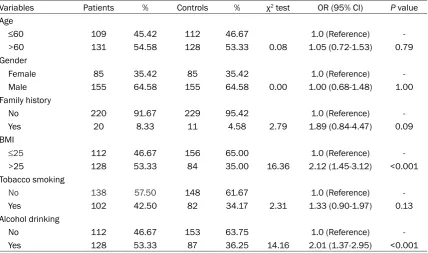
Table 2. Demographic and lifestyle characteristics between patients with acute pancreatitis patients and control subjects
Variables Patients % Controls % χ2 test OR (95% CI) P value
Age
≤60 109 45.42 112 46.67 1.0 (Reference)
>60 131 54.58 128 53.33 0.08 1.05 (0.72-1.53) 0.79
Gender
Female 85 35.42 85 35.42 1.0 (Reference)
Male 155 64.58 155 64.58 0.00 1.00 (0.68-1.48) 1.00
Family history
No 220 91.67 229 95.42 1.0 (Reference)
Yes 20 8.33 11 4.58 2.79 1.89 (0.84-4.47) 0.09
BMI
≤25 112 46.67 156 65.00 1.0 (Reference)
>25 128 53.33 84 35.00 16.36 2.12 (1.45-3.12) <0.001
Tobacco smoking
No 138 57.50 148 61.67 1.0 (Reference)
Yes 102 42.50 82 34.17 2.31 1.33 (0.90-1.97) 0.13
Alcohol drinking
No 112 46.67 153 63.75 1.0 (Reference)
[image:2.629.102.531.244.497.2]ily history. A blood sample (5 mL) and a signed informed consent forms was obtained from each subject prior to their participation in the study, and our study was approved by our hospital.
DNA isolation
The blood samples were kept in tubes with eth-ylene diamine tetra-acetic acid (EDTA), and stored at -20°C until use. The genomic DNA was extracted from the peripheral blood sam-ples using the TIANamp Blood DNA Kit (Tiangen, Beijing, China). Genotyping of the IL-10 -1082A/G, -819T/C, and -592A/C gene morphisms was conducted by using poly-merase chain reaction-restriction fragment length polymorphism (PCR-RFLP) method. The primer sequences for genotyping and restric-tion enzymes for digesrestric-tion products were shown in Table 1. The PCR cycles were using the following program: one cycle of DNA dena-turation at 95°C for 5 minutes; 35 cycles of denaturation at 94°C for 40 seconds, anneal-ing at 55°C for 60 seconds, and extension at
72°C for 40 seconds; and a final extension at 72°C for 10 minutes. The amplified products
were digested with corresponding restriction
endonucleases, and confirmed using 2% aga -rose gel stained with ethidium bromide and visualized under ultraviolet light.
Statistical analysis
The differences in demographic and lifestyle characteristics between patients with acute
pancreatitis and control subjects were com-pared by using chi-square test and univariate
logistic regression analysis. The goodness-of-fit χ2-test was taken to assess whether the geno-type distributions in the patients and controls were deviation from the Hardy-Weinberg equi-librium (HWE). Multiple logistic regression anal-ysis was taken to assess the association between IL-10-1082A/G, -819T/C, and -592A/ C gene polymorphisms and development of acute pancreatitis. The association between
IL-10-1082A/G, -819T/C, and -592A/C gene polymorphisms and development of acute pan-creatitis was estimated by adjusted odds ratio
(OR) and their associated 95% confidence
intervals (CIs). The wide-type genotype of IL-10 -1082A/G, -819T/C, and -592A/C was consid-ered as reference for analysis. Statistical analy-sis was performed using SPSS 16.0 (SPSS Inc., Chicago, IL, USA). A P values <0.05 were taken
as a statistically significance.
Results
[image:3.629.100.530.103.292.2]The demographic and lifestyle characteristics between patients and control subjects were shown in Table 2. The mean age of patients with acute pancreatitis and control subjects were 62.12±8.18 and 61.9±8.45 years. There were 85 females and 155 males respectively in patients with acute pancreatitis and control subjects. By univariate logistic regression anal-ysis, patients with acute pancreatitis were more likely to have higher BMI (OR=2.12, 95% CI=1.45-3.12; P<0.001) and have a habit of Table 3. Genotype distributions of IL-10 -1082A/G, -819T/C, and -592A/C gene polymorphisms in acute pancreatitis patients and controls
IL-10 PatientsN=240 % ControlsN=240 % In cases In controlsP for HWE testχ2 valueP In database In controlsMinor allele frequency
-1082A/G
AA 92 38.33 116 48.33
AG 113 47.08 105 43.75
GG 35 14.58 19 7.92 0.97 0.48 7.8 0.02 0.2722 0.2979
-819T/C
TT 85 35.42 93 38.75
TC 109 45.42 106 44.17
CC 46 19.17 41 17.08 0.29 0.26 0.69 0.71 0.4347 0.3917
-592A/C
AA 87 36.25 95 39.58
AC 117 48.75 113 47.08
alcohol drinking (OR=2.01, 95% CI=1.37-2.9;
P<0.001).
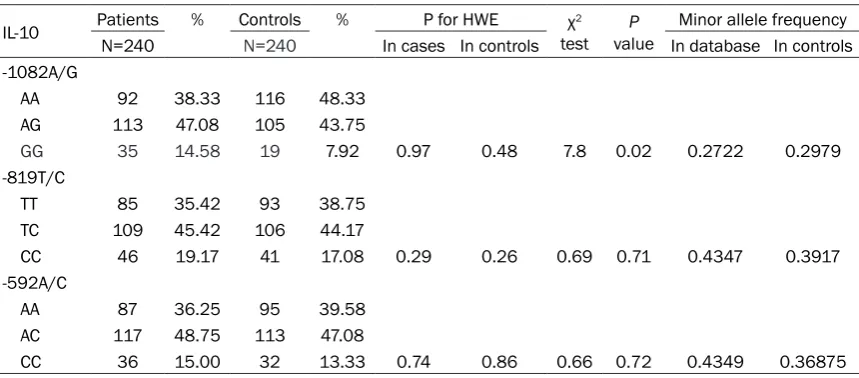
The genotype distributions of IL-10-1082A/G, -819T/C, and -592A/C in acute pancreatitis patients and controls are summarized in Table 3. The genotype distributions of IL-10-1082A/G, -819T/C, and -592A/C in patients with acute
pancreatitis and controls confirmed with the
Hardy-Weinberg equilibrium (All P values >0.05). By the chi-square test, there were
sig-nificant differences in the genotype distribu
-between IL-10-819T/C and -592A/C gene poly-morphisms and susceptibility to acute pancre-atitis in codominant, dominant and recessive models.
Moreover, we conducted stratified analysis
between IL-10-1082A/G polymorphism and acute pancreatitis risk based on demographic and lifestyle characteristics. However, we did
[image:4.629.98.402.106.554.2]not find significant interaction between IL-10 -1082A/G polymorphism and gender, age, fami-ly history, BMI, tobacco smoking and alcohol Table 4. Association between IL-10-1082A/G, -819T/C, and -592A/C
gene polymorphisms and development of acute pancreatitis
IL-10 Patients % Controls % OR (95% CI)1 P value
-1082A/G Codominant
AA 92 38.33 116 48.33 1.0 (Reference)
AG 113 47.08 105 43.75 1.36 (0.91-2.02) 0.12
GG 35 14.58 19 7.92 2.32 (1.20-4.59) 0.007
Dominant
AA 92 38.33 116 48.33 1.0 (Reference)
AG+GG 148 61.67 124 51.67 1.50 (1.03-2.20) 0.03 Recessive
AA+AG 205 85.42 221 92.08 1.0 (Reference)
GG 35 14.58 19 7.92 1.99 (1.06-3.79) 0.02
-819T/C Codominant
TT 85 35.42 93 38.75 1.0 (Reference)
TC 109 45.42 106 44.17 1.13 (0.74-1.71) 0.56
CC 46 19.17 41 17.08 1.23 (0.71-2.12) 0.43
Dominant
TT 85 35.42 93 38.75 1.0 (Reference)
TC+CC 155 64.58 147 61.25 1.15 (0.78-1.70) 0.45 Recessive
TT+TC 194 80.83 199 82.92 1.0 (Reference)
CC 46 19.17 41 17.08 1.15 (0.70-1.88) 0.55
-592A/C Codominant
AA 87 36.25 95 39.58 1.0 (Reference)
AC 117 48.75 113 47.08 1.13 (0.75-1.70) 0.54
CC 36 15.00 32 13.33 1.23 (0.68-2.23) 0.47
Dominant
AA 87 36.25 95 39.58 1.0 (Reference)
AC+CC 153 63.75 145 60.42 1.15 (0.78-1.70) 0.45 Recessive
AA+AC 204 85.00 208 86.67 1.0 (Reference)
CC 36 15.00 32 13.33 1.15 (0.66-1.99) 0.60
1Ajusted for family history and tobacco drinking.
tions of IL-10-1082A/G between patients with acute pancreatitis and
control subjects (χ2=9.97,
P=0.007). However, no
significant differences
we-re observed in the geno-type distributions of IL-10
-819T/C (χ2=0.58, P=0.75)
and -592A/C (χ2=0.12,
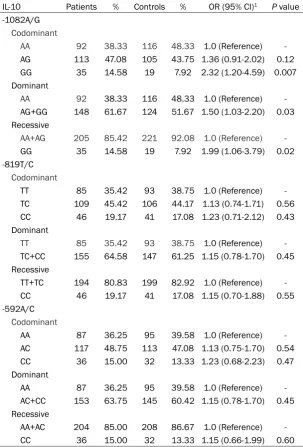
P=0.94) between acute pancreatitis patients and controls by chi-square test. Moreover, the minor allele frequencies (MAF) of IL-10-1082A/G, -819T/ C, and -592A/C in controls were similar with those in dbSNP (http://www.ncbi. nlm.nih.gov/snp/). By multiple logistic regres-sion analysis, we found that individuals with the GG genotype of IL-10
-1082A/G were associat-ed with an increasassociat-ed risk of acute pancreatitis when compared with the AA genotype (OR=2.32, 95% CI=1.20-4.59; P=0.007) (Table 4). In dominant and recessive models, the
IL-10 -1082A/G gene
poly-morphism was significant -ly correlated with an ele-vated risk of acute pan- creatitis, and the adjusted Ors (95% CI) were 1.50 (1.03-2.20) and 1.99 (1.06-3.79), respectively.
However, no significant
drinking in the susceptibility to acute pan- creatitis.
Discussion
Cytokines play an important role in the modifi -cation of immune responses, and maintaining
a balance between pro-inflammatory and anti-inflammatory stimuli during the development of
several kinds of diseases. Single nucleotide
polymorphisms (SNPs) is defined by the gene
sequence of a single nucleotide bases insert-ing, missing or replacing to cause the polymor-phism of the nucleic acid sequence [19]. SNPs in the cytokine genes could alter the gene expression, structure and quantity of the
prod-ucts, and thus influence the function of the
gene [20, 21]. In the present case-control study, we assessed the role of three important SNPs in IL-10 gene in the susceptibility to acute pancreatitis. We indicated that IL-10-1082A/G gene polymorphisms were associated with an increased risk of acute pancreatitis in codomi-nant, dominant and recessive models, which suggested that IL-10-1082A/G gene polymor-phisms play an important role in the develop-ment of this disease.
The IL-10 gene is a candidate gene in the patho-physiological mechanism of auto-immune/
inflammatory disease, since it plays an impor -tant role in regulating both the cellular and humoral immunity. Previous studies have reported that the IL-10 gene polymorphism is
associated with inflammation-related diseas -es, such asnephropahty, helicobacter pylori infection, deep venous thrombosis, rheumatic heart disease, and Crohn diseases [15, 22-25]. For the correlation between IL-10 gene poly-morphisms and development of acute pancre-atitis, only several studies reported their asso-ciation, but the results are inconclusive [26-31].
Sargen et al. firstly reported the association
between IL-10 gene loci and the occurrence or severity of acute pancreatitis, and they found that IL-10 gene polymorphisms did not contrib-ute to the development of accontrib-ute pancreatitis [26]. Schneider et al. also conducted a study in an American population, and they reported that
IL-10 gene polymorphisms did not play a domi-nant role in the development of pancreatitis [27, 28]. de-Madaria et al. conducted a study in a Spanish population, and they found that IL-10
gene polymorphism was not associated with biliary etiology of acute pancreatitis [29]. Bao et al. conducted a case-control study in a Chinese population, and they did not reveal a
significant association between IL-10 gene polymorphism and susceptibility to acute pan-creatitis [30]. Li et al. assessed the association between two SNPs in IL-10 gene and risk of acute pancreatitis, and they found that no association between IL-10 gene polymorphisms and susceptibility to this disease [31]. However, we conducted a study in a Chinese population, and found that IL-10-1082A/G polymorphism contributed to the acute pancreatitis risk. The results of our study are different with previous results. The discrepancies of previous studies may be caused by different in populations, sample size, patients and controls selection and also by chance.
Three limitations should be considered in our study. First, selection bias may be caused by only hospital selection of the patients and con-trol subjects. However, the genotype distribu-tions of IL-10-1082A/G, -819T/C, and -592A/C are in line with HWE and similar with MAF in dbSNP, suggesting that the samples of our study has good representation of the general population. Second, there are many other cyto-kine genes should be considered into statisti-cal analysis, which may have interaction with IL-10 gene polymorphisms. Third, we only included 182 patients with acute pancreatitis, and the small sample size may reduce the
sta-tistical power to find difference between
groups.
In conclusion, we suggest that IL-10-1082A/G gene polymorphisms contribute to the develop-ment of acute pancreatitis, and IL-10-819T/C and -592A/C gene polymorphisms are not cor-related with the increased risk of this disease. Further large sample size studies are greatly
needed to confirm the finding of our study.
Disclosure of conflict of interest
None.
References
[1] Isenmann R, Beger HG. Natural history of acute pancreatitis and the role of infection. Best Pract Res Clin Gastroenterol 1999; 13: 291-301.
[2] Banks PA, Freeman ML; Practice Parameters Committee of the American College of Gastro-enterology. Practice guideline in acute pancre-atitis. Am J Gastroenterol 2006; 101: 2379-400.
[3] Pandol SJ, Saluja AK, Imrie CW, Banks PA. Acute pancreatitis: bench to the bedside. Gas-troenterology 2007; 132: 1127-1151.
[4] Gorelick FS, Thrower E. The acinar cell and early pancreatitis responses. Clin Gastroenter-ol HepatGastroenter-ol 2009; 7: S10.
[5] Swaroop VS, Chari ST, Clain JE. Severe acute pancreatitis. JAMA 2004; 291: 2865.
[6] Neoptolemos JP, Raraty M, Finch M, Sutton R. Acute pancreatitis: the substantial human and financial costs. Gut 1998; 42: 886.
[7] Lankisch PG, Blum T, Maisonneuve P, Lowen-fels AB. Severe acute pancreatitis: When to be concerned? Pancreatology 2003; 3: 102. [8] Álvarez J, Castro P, Fernández M, Mcmullen B,
Rodríguez C, Vera J. Clinical and radiological indicators of severity in patients with acute pancreatitis. Bol Asoc Med P R 2015; 107: 33-7.
[9] Greer JB, Thrower E, Yadav D. Epidemiologic and mechanistic associations between smok-ing and pancreatitis. Curr Treat Options Gas-troenterol 2015; 13: 332-346.
[10] Pohl JF, Uc A. Paediatric pancreatitis. Curr Opin Gastroenterol 2015; 31: 380-386.
[11] Talukdar R, Vege SS. Acute pancreatitis. Curr Opin Gastroenterol 2015; 31: 374-9.
[12] Tun-Abraham ME, Obregón-Guerrero G, Rome-ro-Espinoza L, Valencia-Jiménez J. Acute pan-creatitis associated with hypercalcaemia. Cir Cir 2015; 83: 227-31.
[13] Panek J, Kuśnierz-Cabala B, Dolecki M, Pietron J. Serum proinflammatory cytokine levels and white blood cell differential count in patients with different degrees of severity of acute alco-holic pancreatitis. Pol Przegl Chir 2012; 84: 230-237.
[14] Wang XY, Tang QQ, Zhang JL, Fang MY, Li YX. Effect of SB203580 on pathologic change of pancreatic tissue and expression of TNF-α and IL-1β in rats with severe acute pancreatitis. Eur Rev Med Pharmacol Sci 2014; 18: 338-43. [15] Tang B, Chen YK, Luo WJ, Fu J, Sun JM.
Asso-ciation between interleukin-10-1082A/G, -819C/T and -592C/A polymorphisms with deep venous thrombosis. Hum Immunol 2014; 75: 203-7.
[16] Ying B, Shi Y, Pan X, Song X, Huang Z, Niu Q, Cai B, Wang L. Association of polymorphisms
in the human IL-10 and IL-18 genes with rheu-matoid arthritis. Mol Biol Rep 2011; 38: 379-85.
[17] Kang JM, Kim N, Lee DH, Park JH, Lee MK, Kim JS, Jung HC, Song IS. The effects of genetic polymorphisms of IL-6, IL-8, and IL-10 on Heli-cobacter pylori-induced gastroduodenal dis-eases in Korea. J Clin Gastroenterol 2009; 43: 420-8.
[18] Yin YW, Sun QQ, Feng JQ, Hu AM, Liu HL, Wang Q. Influence of interleukin gene polymorphisms on development of acute pancreatitis: a sys-tematic review and meta-analysis. Mol Biol Rep 2013; 40: 5931-41.
[19] Friedberg EC. DNA damage and repair. Nature 2003; 421: 436-440.
[20] Bartek J, Lukas J. DNA repair: Damage alert. Nature 2003; 421: 486-488.
[21] Aas PA, Otterlei M, Falnes PO, Vågbø CB, Skor-pen F, Akbari M, Sundheim O, Bjørås M, Slup-phaug G, Seeberg E, Krokan HE. Human and bacterial oxidative demethylases repair alkyla-tion damage in both RNA and DNA. Nature 2003; 421: 859-63.
[22] Arababadi MK, Reza Mirzaei M, Ali Sajadi SM, Hassanshahi G, Ahmadabadi BN, Salehabadi VA, Derakhshan R, Kennedy D. Interleukin (IL)-10 gene polymorphisms are associated with type 2 diabetes with and without nephropathy: a study of patients from the southeast region of Iran. Inflammation 2012; 35: 797-802. [23] Marcuzzi A, Girardelli M, Bianco AM,
Martelos-si S, Magnolato A, TommaMartelos-sini A, Crovella S. In-flammation profile of four early onset Crohn patients. Gene 2012; 493: 282-5.
[24] Rehman S, Akhtar N, Saba N, Munir S, Ahmed W, Mohyuddin A, Khanum A. A study on the as-sociation of TNF-α(-308), IL-6(-174), IL-10(-1082) and IL-1Ra(VNTR) gene polymorphisms with rheumatic heart disease in Pakistani pa-tients. Cytokine 2013; 61: 527-31.
[25] Assis S, Marques CR, Silva TM, Costa RS, Al-cantara-Neves NM, Barreto ML, Barnes KC, Figueiredo CA. IL10 single nucleotide polymor-phisms are related to upregulation of constitu-tive IL-10 production and susceptibility to Heli-cobacter pylori infection. HeliHeli-cobacter 2014; 19: 168-73.
[26] Sargen K, Demaine AG, Kingsnorth AN. Cyto-kine gene polymorphisms in acute pancreati-tis. JOP 2000; 1: 24-35.
[27] Schneider A, Barmada MM, Slivka A, Martin JA, Whitcomb DC. Analysis of tumor necrosis fac-tor-alpha, transforming growth factor-beta 1, interleukin-10, and interferon-gamma poly-morphisms in patients with alcoholic chronic pancreatitis. Alcohol 2004; 32: 19-24.
factor-be-ta1, interleukin-10 and interferon-gamma cyto-kine polymorphisms in patients with heredi-tary, familial and sporadic chronic pancreatitis. Pancreatology 2004; 4: 490-4.
[29] de-Madaria E, Martínez J, Sempere L, Lozano B, Sánchez-Payá J, Uceda F, Pérez-Mateo M. Cytokine genotypes in acute pancreatitis: as-sociation with etiology, severity, and cytokine levels in blood. Pancreas 2008; 37: 295-301.
[30] Bao XB, Ma Z, Gu JB, Wang XQ, Li HG, Wang WY. IL-8-251T/A polymorphism is associated with susceptibility to acute pancreatitis. Genet Mol Res 2015; 14: 1508-14.