inorganic papers
Acta Cryst.(2007). E63, i99–i101 doi:10.1107/S1600536807010276 Rosaleset al. Ge
0.74V0.21O2
i99
Acta Crystallographica Section EStructure Reports Online
ISSN 1600-5368
Incorporation of vanadium(V) into the rutile-type
phase of GeO
2: the solid solution Ge
0.74V
0.21&0.05O
2I. Rosales,a* E. A. Juarez-Arellano,bC. R. Magan˜a,aL. Bucioaand E. Orozcoa
aInstituto de Fı´sica, Universidad Nacional
Auto´noma de Me´xico, AP 20-364, 01000 Me´xico, DF, Mexico, andb
Institut fu¨r Miner-alogie – Abteilung Kristallographie, Universita¨t Frankfurt Senckenberganlage 30, D-60054 Frankfurt am Main, Germany
Correspondence e-mail: [email protected]
Key indicators
Powder X-ray study
T= 295 K Mean() = 0.000 A˚ Disorder in main residue
Rfactor = 0.000
wRfactor = 0.000 Data-to-parameter ratio = 0.0
For details of how these key indicators were automatically derived from the article, see http://journals.iucr.org/e.
Received 5 February 2007 Accepted 3 March 2007
#2007 International Union of Crystallography
All rights reserved
The title compound, -vanadium germanium oxide, was prepared as polycrystalline material by conventional solid-state reactions starting from-quartz-type GeO2and V2O5in a K2CO3 flux at 1123 K. Some of the Ge
4+
cations were replaced by V5+, leading to a rutile-type phase where charge neutrality is accomplished by the presence of vacancies. X-ray photoelectron spectroscopy (XPS) confirms the presence of V5+ in this compound. Its crystal structure was refined from laboratory X-ray powder data using the Rietveld method and is composed of corner- and edge-sharing MO6 octahedra where the metal positionsMare statistically occupied by Ge and V. The four equatorialMO bonds lying in the (110) plane are 0.023A˚ shorter than the two axial bonds.
Comment
Compounds adopting the rutile structure have catalytic and electrochemical applications, such as GeO2 (optical and insulating properties) and TiO2 (semiconducting properties) (Manciniet al., 1984). Examples of other rutile-type dioxides include VO2(McWhanet al., 1974) and NbO2(Bolzanet al., 1994), for which the preparation is accomplished under slightly reducing conditions at elevated temperatures. For dioxides of Ti, Ru, Ir, Sn and Ge, the rutile-type polymorph is the thermodynamically stable phase (West, 1998). Rutile-type GeO2 has attracted attention because of its similarities with stishovite, the high-pressure polymorph of SiO2, which is particularly interesting for understanding geochemical processes. The -quartz-type GeO2 polymorph is formed around 1310 K followed by fusion at 1389 K and is metastable at room temperature (Haineset al., 2002). The investigation of the phase transition between rutile-type (r-) and-quartz-type (-) GeO2 has been the subject of previous studies. Under normal conditions, a transition from-GeO2to r-GeO2is not achieved by heating GeO2samples up to 1273 K. However, following the work by Sarver & Hummel (1961), the transition to a rutile-type phase is possible by introducing low quantities of vanadium into GeO2, using K2CO3 as catalyst. We have prepared polycrystalline Ge0.74V0.21&0.05O2 by solid-state reactions starting from-GeO2and V2O5, and have structu-rally characterized this compound by Rietveld analysis of conventional X-ray powder data, Rutherford backscattering spectrometry (RBS) and X-ray photoelectron spectroscopy (XPS).
1.877 (1) A˚ lying in the (110) plane, and two axial bonds of 1.900 (1) A˚ located normal to the (110) plane (Fig. 1). The averageM—O distance of 1.885 A˚ is slightly larger than the averageM—O distance for argutite (1.881 A˚ ), but plausible in view of the slightly greater ionic radius (Shannon, 1976) of V5+ (0.58 A˚ ) in comparison with that of Ge4+(0.53 A˚ ).
Experimental
Polycrystalline material of the title compound was prepared by conventional solid-state reactions, starting from -GeO2(CERAC
99.999%, 1.255 g) and V2O5(J. T. Baker 99.7%, 0.546 g) with K2CO3
(J. T. Baker 99.9%, 0.415 g) as flux and as catalyst to set up the phase transition. The educts were mixed and ground in an agate mortar in order to obtain a fine powder, which was then heated in a furnace in air at 1123 K for two days. At the end of the treatment, the rutile-type phase was clearly identified by X-ray powder diffraction, although it was accompanied by amorphous phases which could eventually be removed by washing the sample with hot water. Because some of the employed V2O5and GeO2could be lost after thermal treatment as
vitrified products, it was necessary to determine the chemical composition for the resulting rutile-type phase. Chemical analysis was performed by means of Rutherford backscattering spectrometry (RBS), following the procedure reported by Bucioet al.(2001), and by X-ray photoelectron spectroscopy (XPS). The atomic concentra-tions obtained by RBS and XPS were, respectively, 0.71 (7) and 0.74 (7) for germanium, and 0.29 (3) and 0.26 (3) for vanadium. The XPS measurement was performed at ultra-high vacuum conditions in a Thermo-VG SCALAB 250 system equipped with a monochromatic AlKsource (h= 1486.6 eV) and a hemispherical analyzer.
Crystal data
Ge0.74V0.21O2
Mr= 96.43
Tetragonal,P42=mnm a= 4.4001 (1) A˚ c= 2.8670 (1) A˚ V= 55.51 (1) A˚3
Z= 2
CuKradiation T= 295 K
Specimen shape: flat sheet 20200.2 mm
Data collection
Bruker Advance D8 diffractometer Specimen mounting: packed powder
sample container
Specimen mounted in reflection mode
Scan method: step 2min= 5
, 2max= 110
Increment in 2= 0.02
Refinement
Rp= 0.050
Rwp= 0.07
Rexp= 0.03
RB= 0.02
S= 2.0
Profile function: pseudo-Voigt modified by Thompsonet al. (1987)
18 parameters
For the refinement of the crystal structure the starting parameters were taken from r-GeO2 (Bolzan et al., 1997) with a statistical
distribution of V5+on the Ge4+sites. The following parameters were refined: zero point, scale factor, cell parameters, peak shape, posi-tional parameters, occupancy factors (for Ge4+and V5+) and isotropic displacement parameters. The occupancy factors for Ge4+and V5+ were refined using a restraint in such a way that an increase of V5+
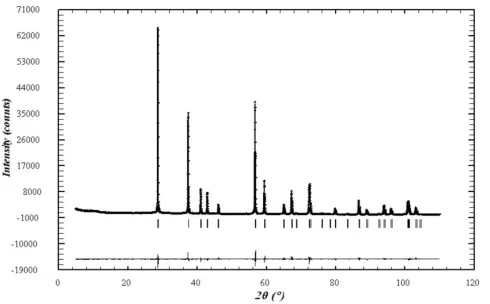
was coupled with a proportional decrease of Ge4+taking into account the difference of their oxidation states and the results of the chemical analysis. The results of the final Rietveld refinement are shown in Fig. 2.
Data collection:DIFFRAC/AT (Siemens, 1993); cell refinement:
FULLPROF (Rodrı´guez-Carvajal, 2001; data reduction: FULL-PROF; program(s) used to solve structure: coordinates taken from an isotypic compound; program(s) used to refine structure: FULL-PROF; molecular graphics: DIAMOND (Crystal Impact, 2005); software used to prepare material for publication:FULLPROF.
The authors are grateful to J. L. Ruvalcaba, M. Aguilar-Franco and Angel Osornio for their technical assistance. IR acknowledges the fellowship of Consejo Nacional de Ciencia y Tecnologı´a (CONACyT) and projects CONACyT SEP-2004-C01-47652 and DGAPA PAPIIT IN118106-3.
References
Baur, W. H. (1956).Acta Cryst.9, 515–520.
Bolzan, A. A., Fong, C., Brendan, J., Kennedy, B. J. & Howard, C. J. (1994).J. Solid State Chem.113, 9–14.
Bolzan, A. A., Fong, C., Kennedy, B. J. & Howard, C. J. (1997).Acta Cryst.B53, 373–380.
inorganic papers
i100
Rosaleset al. Ge [image:2.610.316.565.68.252.2] [image:2.610.316.561.316.468.2]0.74V0.21O2 Acta Cryst.(2007). E63, i99–i101
Figure 1
The rutile-type crystal structure of Ge0.74V0.21&0.05O2in the polyhedral
representation, viewed along thecaxis. The statistically distributed V and
Ge atoms are shown as large grey spheres and O atoms as small grey spheres of arbitrary radii.
Figure 2
Final plots of the Rietveld refinement for Ge0.74V0.21&0.05O2, showing the
Bucio, L., Ruvalcaba-Sil, J. L., Rosales, I., Garcı´a-Robledo, J. & Orozco, E. (2001).Z. Kristallogr.216, 438–441.
Crystal Impact (2005). DIAMOND. Version 3.0e. Crystal Impact, Bonn, Germany.
Haines, J., Cambon, O., Philippot, E., Chapon, L. & Hull, S. (2002).J. Solid State Chem.166, 434–441.
Mancini, N., Pennisi, A. & Simone, F. (1984).Sol. Energy Mater.11, 209–221. McWhan, D. B., Marezio, M., Remeika, J. P. & Dernier, P. D. (1974).Phys. Rev.
B,10, 490–495.
Rodrı´guez-Carvajal, J. (2001).FULLPROF.Commission on Powder Diffrac-tion (IUCr). Newsletter 26, pp. 12–19.
Sarver, J. F. & Hummel, F. A. (1961).J. Electrochem. Soc.108, 195–196. Shannon, R. D. (1976).Acta Cryst.A32, 751–767.
Siemens (1993).DIFFRAC/AT.Version 3.2. Siemens Analytical Instruments, Madison, Wisconsin, USA.
Thompson, P., Cox, D. E. & Hastings, J. B. (1987).J. Appl. Cryst.20, 79–83. West, A. R. (1998).Solid State Chemistry and its Applications.England: John
Wiley and Sons.
inorganic papers
Acta Cryst.(2007). E63, i99–i101 Rosaleset al. Ge
supporting information
sup-1 Acta Cryst. (2007). E63, i99–i101
supporting information
Acta Cryst. (2007). E63, i99–i101 [https://doi.org/10.1107/S1600536807010276]
Incorporation of vanadium(V) into the rutile-type phase of GeO
2: the solid
solution Ge
0.74V
0.21□
0.05O
2I. Rosales, E. A. Juarez-Arellano, C. R. Magaña, L. Bucio and E. Orozco
γ-vanadium germanium oxide
Crystal data Ge0.74V0.21O2 Mr = 96.43
Tetragonal, P42/mnm Hall symbol: -P 4n 2n a = 4.4001 (1) Å c = 2.8670 (1) Å V = 55.51 (1) Å3
Z = 2
F(000) = 88.1 Dx = 5.77 Mg m−3
Cu Kα radiation, λ = 1.54175 Å T = 295 K
brown
flat_sheet, 20 × 20 mm
Data collection Bruker Advance D8
diffractometer
Radiation source: sealed X-ray tube, Cu Kα Graphite monochromator
Specimen mounting: packed powder sample container
Data collection mode: reflection Scan method: step
2θmin = 5°, 2θmax = 110°, 2θstep = 0.02°
Refinement
Least-squares matrix: full with fixed elements per cycle
Rp = 0.05 Rwp = 0.07 Rexp = 0.03 RBragg = 0.02 R(F2) = 0.02 5251 data points
Profile function: pseudo-Voigt modified by Thompson et al. (1987)
18 parameters
Weighting scheme based on measured s.u.'s Background function: The background was
refined first by means of a linear interpolation between 100 background points with refinable heights. At the end of the refinement, the values for all of these heights of the background were fixed.
Fractional atomic coordinates and isotropic or equivalent isotropic displacement parameters (Å2)
x y z Uiso*/Ueq Occ. (<1)
supporting information
sup-2 Acta Cryst. (2007). E63, i99–i101
Atomic displacement parameters (Å2)
U11 U22 U33 U12 U13 U23
? ? ? ? ? ? ?
Geometric parameters (Å, º)
Ge—O 1.900 (1) Ge—Oi 1.877 (1)
O—Ge—Oi 90.00 (8)