• No results found

MATERIAL SELECTION FOR ELECTRODES TO ENHANCE THE PERFORMANCE OF“MICROBIAL FUEL CELL”

N/A
N/A
Protected

Academic year: 2020

Share "MATERIAL SELECTION FOR ELECTRODES TO ENHANCE THE PERFORMANCE OF“MICROBIAL FUEL CELL”"

Copied!
18
0
0

Loading.... (view fulltext now)

Full text

(1)

MATERIAL SELECTION FOR ELECTRODES TO ENHANCE THE PERFORMANCE OF“MICROBIAL FUEL CELL”

Prashant Tiwari Mr. Narendra Kumar Patel

M.Tech Student Assistant Professor

Dr. C.V. Raman University Dr. C. V. Raman University

Kota, Bilaspur (C.G.) Kota, Bilaspur (C.G.)

ABSTRACT

The performance and cost of electrodes are the most important aspects in the design of microbial fuel cell (MFC) reactors. A wide range of electrode materials and configurations have been tested and developed in recent years to improve MFC performance and lower material cost. As well, anodic electrode surface modifications have been widely used to improve bacterial adhesion and electron transfer from bacteria to the electrode surface. An inexpensive carbon brush is examined in this project as a substantially less expensive alternative to materials like carbon cloth, graphite fiber brushes and metals for the anode in an MFC. Dextrose with concentration of 4 g/l was used as an electron donor. Anode chamber of then fabricated MFC was inoculated with anaerobic effluent of wastewater treatment plant. The performance of MFC was

analyzed by the measurement of polarization curve.

In single electrode MFCs the maximum value of power density was observed 301.7mW/m

2

. Multi- electrode MFCs were found more effective than single electrode MFCs. Highest value of power density achieved by multi-electrode MFC was 3823.20 mW/m

2

.

1. INTRODUCTION 1.1 General

Facing today’s energy resource depletion and environmental pollution, it is desirable to look for a kind of energy which can guarantee a sufficient supply for long-term and will not cause environmental problem. Nowadays, microbial fuel cells (MFCs) attract more and more attentions due to meeting the requirements. According to Bond et. al.

microbial fuel cell (MFC) are devices that use

microorganisms as catalysts to directly generate

electricity from oxidation of organic and in organic

matters. It is a promising device in treating various

domestic and industrial wastewater if further

advances are made to improve current MFC

technologies. Despite MFC having many advantages

over energy generation from biomass, such as high

energy conversion efficiency, low operating

temperature, no requirement for gas treatment, and no

energy input. Commercialization of MFC still

remains impracticable. This is due to the low power

density output of MFC. Many factors influence MFC

performance, containing: nature of the electrode

materials, chemical substrate, microbial inoculums,

reactor design, distance of the electrodes, ionic

strength, internal and external resistances, the

(2)

MFC, electrode material plays an important role in electricity production. Also, the anode material and its composition can directly alter bacterial loading and electron transfer. Hence, it is a great challenge to introduce a new anode material to more increase the power density of an MFC. Currently, carbon materials, such as carbon cloth and felt, plain graphite, sponge carbon, graphite granules and carbon paper have been widely used as anode materials in MFC, because of their good stability in microbial inoculums mixture, low charge transfer resistance, high conductivity and specific surface area.

However, they have small activities for the anode microbial reactions and therefore, the carbon materials modifying is the main approach to improve their performance. The electrode materials in MFC have some general characters and also its self- characteristic. For all the types of electrodes, their base materials must generally be of good conduction, good chemical stability, high mechanical strength, and low cost. Carbon materials and non-corrosive metals, which can basically meet the general requirements above, are currently the most-widely used base materials. In addition, there are some specific requirements for each group of electrodes.

Electrode function not only as a conductor, but also as a carrier of bacteria, and some special surface characteristics of electrode materials, such as high surface roughness, good biocompatibility, and efficient electron transfer between bacteria and electrode surface, are essential for high bio-catalytic activity. In order to improve bacterial adhesion and electron transfer, electrode surface modification has become a new topic of interest in the research field of MFCs. the surface characteristic of anode materials is one of the deciding factors that affect bacterial attachment and electrical connections between

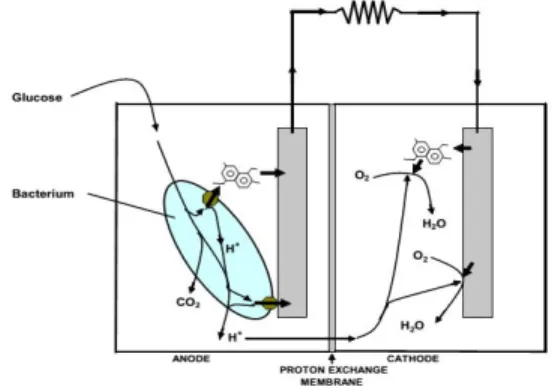
bacteria and the electrode surface. Recently, modification of the anode using different materials, which can be expected to facilitate bacterial adhesion and electron transfer to the anode surface, has been a successful approach for improving power production in studies for MFCs. These modification methods include (i) surface treatments with physical or chemical methods, (ii) addition of highly conductive or electro active coatings, and (iii) use of metal- graphite composite electrodes. The working principle of MFC is shown in figure 1.1.

Figure 1.1 Schematic drawing of a microbial fuel cell.MFC-based technologies to field application, efforts are being made to improve the performance and reduce the construction and operation costs.

Therefore, the main objective of this M.Tech. project was to improve the performance, reduce the construction cost, and expand the application scopes of different MFC-based systems. Specific objectives are:

1. Study of electrode material characteristics.

2. Study of possibility of improvement in material characteristics.

3. To setup MFCs with chosen material

with and without modification and

study about voltage-current

characteristics.

(3)

2. LITERATURE REVIEW

1) Over the past decade, a verity of electrodes have been extensively explored for

MFCs.The electrode materials in MFC have some general characters and also its self- characteristics for all the type of electrodes, their base materials must generally be of good conduction, good chemical stability, high mechanical strength, and low cost.

Carbon materials and non-corrosive metals, which can basically meet the general requirements and are currently the most- widely used based materials.

2) According to Jincheng Wei et al. (2000) Carbon The graphite brush anode is an ideal electrode that achieves high surface area, high porosities, and efficient current collection.

3) According to Logan et al. (2001) The use of a brush anode was first reported byIn their studies. Steel, fail to achieve higher power densities compared with carbon materials.

In their study Dumas et al. (2002) tested the suitability of a stainless steel plate as both the anode and biocathode electrodes in an MFC, and found that the power density (23 mW/m

2

) was limited by the anode. In another study, Dumas et al. (2002(a)) found that the stainless steel anode was less efficient than the graphite one.

4) According to Heijne et al. (2003) compared titanium and graphite in terms of their suitability as an anode in MFCs. Their results showed that the anode performance decreased in the following order: roughened

observed for the uncoated titanium anode.

Gold anodes have also been used in several studies

5) According to Crittenden et al. (2004) and Richter et al. (2005) The surface characteristic of anode materials is one of the deciding factors that affect bacterial attachment and electrical connections between bacteria and the electrode surface.

Recently, modification of the anode using different materials, which can be expected to facilitate bacterial adhesion and electron transfer to the anode surface, has been a successful approach for improving power production in studies for MFCs. These modification methods include.

surface treatments with physical or chemical methods,

addition of highly conductive or electroactive coatings, and

use of metal-graphite composite electrodes are summarized according to their performance improvements on MFC.

Now electrode could result from these different factors:

1. Higher ratio of prorogated number to the total number gives more positive charge on electrode surface, which also favors bacteria adhesion.

2. Lower C–O composition on acid and heat treated anode surface may indicate less of contaminants that interfere with charge transfer from bacteria to anode surface.

6) According to Wang et al. (2004) -

Carbonaceous materials are the most widely

(4)

stability, high conductivity, and relatively low cost.

7) According to Min and Logan (2005) and Sun et al. (2006) Carbon paper, graphite plates or sheets and carbon cloth are the most common material for plain electrodes.

Carbon paper is very thin and relatively stiff but slightly brittle. Graphite plates or sheets have higher strength than carbon paper.

8) According to Heijne et al. (2006) found their study that Roughened graphite electrodes have been reported to produce a higher power density than flat graphite electrodes These two materials have a compact structure and a relatively smooth surface, both of which facilitate the quantitative measurement of biomass per unit of surface area. However, their low specific area and high cost inhibit performance of graphite rod, felt, and foam based on the surface area of the resulting performance of graphite rod, felt, and foam based on the surface area of the resulting electrode. Similar currents and biomasses were obtained from graphite rod and felt electrodes, and the graphite foam electrode produced 2.4 times more current density and 2.7 times more cell density than the graphite rod one. Most MFC studies involving the materials mentioned above only focus on maximizing power densities on a volume or membrane area basis, and few studies have reported on normalized power densities at the surface area of the electrode, resulting in difficulties in quantitative comparisons among different materials. More porous anode materials typically produce more

power per geometric surface area compared to their smooth counterparts. This is mainly due to the larger surface area available to bacteria per unit volume of anode chamber of porous anode materials.

9) According to Aelterman et al. (2007) Packed structure increase the surface area available to bacteria, the use of carbon- based electrodes in packing forms for MFCs anode is becoming increasingly common.

Metal materials are much more conductive than carbon materials, but they are not widely applicable as carbon materials in MFCs. Many metals were ruled out because of the non-corrosive requirement for anode materials. So far, only stainless steel and titanium have qualified as relative common base materials for anodes but steel, fail to achieve higher power densities compared with carbon materials.

10) According to Dumas et al. (2007) The suitability of a stainless steel plate as both the anode and biocathode electrodes in an MFC, and found that the power density (23 mW/m2) was limited by the anode. In another study, Dumas et al. (2008)(a) found that the stainless steel anode was less efficient than the graphite one.

11) According to Erable and Bergel (2008)

Stainless steel grid anode produced much

higher current densities than plain graphite

ones when a constant potential was applied

to them. The surface characteristic of anode

materials is one of the deciding factors that

affect bacterial attachment and electrical

connections between bacteria and the

electrode surface.

(5)

12) According to Lowy and Tender (2009) reported that the kinetic activities of graphite plate anode increased 58.8 times compared to untreated anode through electrochemical oxidation pretreatment at +1.85 V vs.

Ag/AgCl.

13) According to Tang et al. (2011) Graphite felt anode produced 39.5% higher current than an untreated anode after electrochemical oxidization at a constant current density of 30 mA/cm2 for 12 h.

They further reported electrochemical treatment of graphite felts generates carboxyl-containing functional groups on the surface of the anode. These groups facilitate the electron transfer from bacteria to electrode, due to their strong hydrogen bonding with peptide bonds in bacterial cytochromes. The performance of self made metal-graphite composite anodes has been tested in several studies .

14) According to Lowy et al. (2016) Whether or not these increases in power are due to the potentials of the metals or other reasons, however, requires further investigation. In addition, the cost-effectiveness of these modified anodes also needs to be evaluated in terms of cost and long-term stability.

15) According to Aelterman et al. (2018) proved the benefits of a three dimensional anode, by analyzing the electrochemical performance of two-chambered MFCs characterized by five different three dimensional anodes.

16) According to Liu et al and Zhang et al.

( 2018-19) performance of MFC with packed bed anodes. Theyused acetate as the feed and inoculums from a wastewater.

Zhang et al MFC tests were made with a

pure culture.

(6)

3. MATERIAL AND METHOD 3.1 Materials

The materials used in this study are as follows – Two plastic jars for setting up of the Microbial fuel cell reactor, Carbon brush rods, M-seal, nutrient agar and KCl for making salt bridge, PVC pipes, glucose for feed, silica crucibles, hot air oven, muffle furnace.

The experiment was performed in two steps. In first step 250 ml volume jars were used with only one electrode. In the second part 400ml volume jars were used with 5 electrodes. Specifications of electrode materials are shown in fig 3.1.

Figure 3.1 Specification of Carbon brush 3.2 Construction of MFC

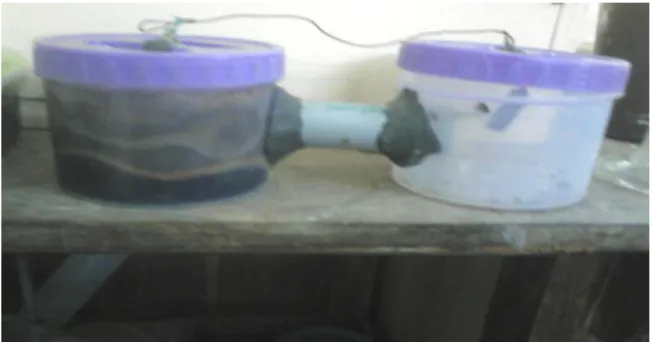
For the trial two dual chamber MFC were constructed by using cylindrical plastic container of 250 ml in volume with single electrode. Container was separated by a salt bridge of length 6 cm. after a successful trail experiment was performed with a multielectrode MFC reactor. For the reactor preparation 2 jars of 400 ml were used with 5 electrodes. Chambers were separated by using a 2 salt bridge of 3 cm in length. Salt bridge was prepared in

a hollow pipe of diameter 2 inch by using KCl and Agar. An agar solution was formed by heating a mixture of 4% agar in 1M KCl (w/v). This mixture was covered and gently heated, with stirring, in a flask until the agar was completely dissolved and bubbles were just beginning to form. When the agar had been properly prepared the bridge was immediately filled and then allowed to solidify.

Carbon brushes were used as a electrode material of dimension 25mm× 8 mm× 4 mm and surface area 6 cm

2

each. Plane carbon brush was used in all MFC-B, whereas in all MFC-A acid treated Carbon brush was used. For acid treatment carbon brush was dipped in strong H

2

SO

4

for 6 hrs, then washed by distill water.

Setup of the Reactors for MFCs is showing in fig 3.2a and 3.2b

Figure 3.2a Cylindrical MFC, with Single electrode

Figure 3.2b Rectangular MFC, with multiple

electrodes

(7)

3.3 Mechanism of MFC

A MFC consists of anode and cathode separated by a salt bridge or a cation specific membrane. Microbes (anaerobic bacteria) in the anode chamber oxidizing the mud or fuel, and the resulting electrons and protons releases are transferees to the cathode through the circuit and the salt bridge or membrane, respectively. Electrons and protons are consumed in the cathode, reducing oxidant, usually oxygen.

According to Pham et al. “The electron donors are oxidized in the anode compartment of a microbial fuel cell”

(Anode reaction);

The electrons are transferred to the cathode compartment through the circuit, because of the potential difference developed between the reducing anode and cathode supplied with air. The protons are transferred to the cathode through the membrane. The electron and proton are consumed, reducing oxygen in the cathode compartment

(Cathode.reaction);

3.4 Inoculation

The Anode chamber of dual chamber MFC was inoculated with Anaerobic sludge collected from wastewater treatment plant BILASPUR, and cathode chamber was filled with water. 5 ml Dextrose of concentration 4g/l was used for feeding. The organic matter presented in anodic chamber gives electrons and protons on oxidation of organic matter. The proton used the cation exchange membrane to travel from anodic chamber to cathodic chamber, while the electrons traveled through the external circuit.

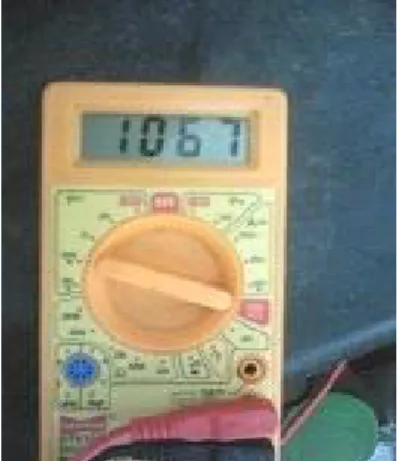
3.Analyses,Calculations,and observation table Voltage and current were recorded using a Multimeter. The power density was calculated from the measured voltage (V) and current (I), expressed as P (mW/m

2

)=V.I/A (normalized by the electrode surface area, A=6cm

2

). Fig 3.3 showing is the readings of Multimeter.

Figure 3.3 Voltage (mV) and Current (mA) Recorded

in Multimeter

(8)

OBSERVATION TABLE

Observation table, 1: voltage and current recorded during first cycle.

Days

Voltage(mV) Current(mA) PowerDensity (mW/m

2

)

P=(V*I)/A

MFC-1A MFC-1B MFC-1A MFC-1B MFC-1A MFC-1B

1 168 153 0.03 0.03 8.40 7.65

2 173 159 0.04 0.03 11.53 7.95

3 181 166 0.06 0.04 18.10 11.07

4 188 173 0.07 0.05 21.93 14.42

5 197 182 0.08 0.06 26.27 18.20

6 209 193 0.09 0.08 31.35 25.73

7 221 204 0.12 0.09 44.20 30.60

8 207 213 0.11 0.1 37.95 35.50

9 219 222 0.12 0.12 43.80 44.40

10 232 228 0.15 0.13 58.00 49.40

11 241 247 0.16 0.16 64.27 65.87

12 274 260 0.19 0.18 86.77 78.00

13 301 283 0.22 0.2 110.37 94.33

14 318 297 0.24 0.21 127.20 103.95

15 329 311 0.25 0.22 137.08 114.03

16 342 324 0.27 0.23 153.90 124.20

17 356 336 0.28 0.24 166.13 134.40

18 371 339 0.3 0.23 185.50 129.95

19 386 383 0.32 0.28 205.87 178.73

20 411 367 0.35 0.3 239.75 183.50

21 423 384 0.36 0.33 253.80 211.20

22 431 402 0.36 0.34 258.60 227.80

23 423 412 0.35 0.31 246.75 212.87

24 447 423 0.37 0.32 275.65 225.60

25 451 431 0.37 0.32 278.12 229.87

26 451 429 0.36 0.3 270.60 214.50

27 457 433 0.37 0.31 281.82 223.72

28 448 436 0.35 0.32 261.33 232.53

29 455 437 0.36 0.32 273.00 233.07

30 453 432 0.36 0.31 271.80 223.20

(9)

Observation table2 voltage and current recorded during second cycle.

Days Voltage(mV) Current(mA) PowerDensity (mW/m

2

)

P=(V*I)/A

MFC-2A MFC-2B MFC-2A MFC- 2B MFC-1A MFC-1B

1 132 118 0.02 0.01 4.40 1.97

2 137 113 0.03 0.01 6.85 1.88

3 129 106 0.02 0.01 4.30 1.77

136 98 0.05 0.009 11.33 1.47

5 142 103 0.06 0.01 14.20 1.72

6 159 108 0.07 0.02 18.55 3.60

7 173 121 0.09 0.03 25.95 6.05

8 186 133 0.11 0.06 34.10 13.30

9 197 142 0.12 0.07 39.40 16.57

10 183 156 0.11 0.09 33.55 23.40

11 187 163 0.13 0.16 40.52 43.47

12 213 181 0.16 0.18 56.80 54.30

13 259 178 0.21 0.2 90.65 59.33

14 247 193 0.23 0.21 94.68 67.55

15 273 214 0.27 0.22 122.85 78.47

16 289 247 0.28 0.23 134.87 94.68

17 303 231 0.31 0.24 156.55 92.40

18 352 239 0.35 0.23 205.33 91.62

19 378 254 0.37 0.28 233.10 118.53

20 392 269 0.38 0.29 248.27 130.02

21 388 293 0.38 0.36 245.73 175.80

22 415 324 0.41 0.34 283.58 183.60

23 407 357 0.41 0.28 278.12 166.60

24 419 386 0.42 0.31 293.30 199.43

25 422 375 0.41 0.29 288.37 181.25

26 431 379 0.42 0.28 301.70 176.87

27 429 381 0.4 0.29 286.00 184.15

28 426 368 0.4 0.26 284.00 159.47

29 418 372 0.39 0.27 271.70 167.40

30 423 367 0.4 0.26 282.00 159.03

31 427 351 0.38 0.25 270.43 146.25

(10)

MFC-3A MFC-3B MFC-3A MFC-3B MFC-3A MFC-3B

1 319 332 0.22 0.17 116.97 94.07

2 327 345 0.31 0.19 168.95 109.25

3 335 343 0.32 0.2 178.67 114.33

4 344 351 0.36 0.25 206.40 146.25

5 352 368 0.39 0.27 228.80 165.60

6 366 375 0.45 0.3 274.50 187.50

7 359 361 0.39 0.29 233.35 174.48

8 384 348 0.31 0.32 198.40 185.60

9 388 371 0.42 0.32 271.60 197.87

10 392 403 0.43 0.34 280.93 228.37

11 401 419 0.46 0.38 307.43 265.37

12 427 438 0.5 0.43 355.83 313.90

13 440 469 0.54 0.48 396.00 375.20

14 442 473 0.62 0.49 456.73 386.28

15 467 456 0.54 0.46 420.30 349.60

16 474 441 0.51 0.44 402.90 323.40

17 491 438 0.51 0.41 417.35 299.30

18 517 472 0.57 0.48 491.15 377.60

19 522 486 0.59 0.5 513.30 405.00

20 543 498 0.63 0.53 570.15 439.90

21 551 531 0.76 0.61 697.93 539.85

22 546 560 0.81 0.59 737.10 550.67

23 570 584 0.84 0.65 798.00 632.67

24 612 635 0.91 0.72 928.20 762.00

25 656 668 0.98 0.79 1071.47 879.53

26 674 689 1.04 0.83 1168.27 953.12

27 701 718 1.11 0.91 1296.85 1088.97

28 730 732 1.16 0.95 1411.33 1159.00

29 758 778 1.24 0.98 1566.53 1270.73

30 819 811 1.32 1.07 1801.80 1446.28

31 847 839 1.46 1.16 2061.03 1622.07

32 889 878 1.58 1.21 2341.03 1770.63

33 922 859 1.43 1.28 2197.43 1832.53

34 959 897 1.61 1.36 2573.32 2033.20

35 981 933 1.75 1.43 2861.25 2223.65

36 995 981 1.8 1.47 2985.00 2403.45

37 1003 995 1.82 1.49 3042.43 2470.92

38 991 1012 1.89 1.46 3121.65 2462.53

39 987 1022 1.93 1.39 3174.85 2367.63

40 1011 1067 2.07 1.41 3487.95 2507.45

41 998 1036 2.02 1.12 3359.93 1933.87

42 992 1041 2.03 1.07 3356.27 1856.45

(11)

Observation table,4: voltage and current recorded during forth cycle.

Days Voltage(mV) Current(mA) power density (mW/m

2

)

P=(V*I)/A

MFC-3A MFC-3B MFC-3A MFC-3B MFC-3A MFC-3B

1 342 309 0.29 0.21 165.30 108.15

2 349 325 0.31 0.23 180.32 124.58

3 354 339 0.32 0.25 188.80 141.25

5 379 389 0.37 0.31 233.72 200.98

6 402 376 0.42 0.29 281.40 181.73

7 392 396 0.41 0.32 267.87 211.20

8 408 372 0.44 0.3 299.20 186.00

9 421 387 0.48 0.33 336.80 212.85

10 435 391 0.49 0.35 355.25 228.08

11 428 413 0.47 0.37 335.27 254.68

12 443 427 0.52 0.41 383.93 291.78

13 489 445 0.63 0.43 513.45 318.92

14 507 439 0.66 0.42 557.70 307.30

15 535 455 0.71 0.47 633.08 356.42

16 558 467 0.76 0.49 706.80 381.38

17 597 495 0.81 0.55 805.95 453.75

18 631 522 0.89 0.58 935.98 504.60

19 653 548 0.92 0.61 1001.27 557.13

20 678 576 0.93 0.66 1050.90 633.60

21 705 597 0.97 0.68 1139.75 676.60

22 736 621 1.08 0.73 1324.80 755.55

23 765 652 1.15 0.77 1466.25 836.73

24 782 693 1.21 0.83 1577.03 958.65

25 819 727 1.3 0.87 1774.50 1054.15

26 852 748 1.37 0.88 1945.40 1097.07

27 872 779 1.41 0.91 2049.20 1181.48

28 887 792 1.48 0.93 2187.93 1227.60

29 903 831 1.51 0.97 2272.55 1343.45

30 912 886 1.55 1.04 2356.00 1535.73

31 938 917 1.63 1.1 2548.23 1681.17

32 967 938 1.69 1.14 2723.72 1782.20

33 981 975 1.75 1.17 2861.25 1901.25

34 986 1009 1.77 1.26 2908.70 2118.90

35 998 978 1.81 1.21 3010.63 1972.30

36 1003 992 1.83 1.23 3059.15 2033.60

37 1029 976 1.89 1.19 3241.35 1935.73

38 1041 948 1.92 1.15 3331.20 1817.00

39 1056 917 2.1 1.12 3696.00 1711.73

40 1062 923 2.16 1.14 3823.20 1753.70

(12)

RESULTS

The maximum Voltage of 457 mV, Current of 0.37mA with a power density of 281.8 mW/m

2

was recorded in the first round of 30 days in MFC-1A.

Single acid treated carbon brush were used on that MFC-1A. Voltage, Current and Power density characteristics are shown in figure-

The maximum Voltage of 437 mV, Current of 0.32 mA with a power density of 233.3 mW/m

2

was recorded in the first round of 30 days in MFC-1B.

Single plain carbon steel electrodes were used on that MFC-1B. Voltage, Current and Power density

characteristics are shown in fig. 4.4, fig 4.5 and fig 4.6

For checking the stability of voltage, current and

power density second round of 31 days, continue

examine the MFCs

(13)

The maximum Voltage of 431 mV, Current of 0.42 mA with a power density of 301.7 mW/m

2

was recorded in the second round of 31 days in MFC-2A.

Single carbon brushs electrodes were used on that MFC-2A.Voltage, Current and Power density characteristics are shown in fig. 4.7, fig 4.8 and fig

The maximum Voltage of 386 mV, Current of 0.30 mA with a power density of 199.43 mW/m

2

was recorded in the second round of 31 days in MFC-2B.

Single plain carbon steel electrodes were used on that

characteristics are shown in fig. 4.10, fig 4.11 and fig 4.12

MODIFICATION:-

1. Use 5 acid treated carbon brush electrode (Multiple electrode).

2. Rectangular shape of reactor box with capacity of 400ml.

3. Reduce the length of salt bridge ( 3cm)

4. Increase the number of salt bridges

5. Use an air pump on cathode side for fast

(14)

According to do that modifications following results were obtained-

From the third round, experiment was extended to 6 weeks with modify reactors. Fig 4.13, 4.14 and fig 4.15 are showing variation of voltage, current and power density with time in MFC-3A. Maximum voltage and current was achieved by this MFC was 1011mV and 2.07mA consequently with a highest power density of 3487.95mW/m

2

which was about 12.37 times more than the maximum power density achieved by single acid treated electrode MFCs. The system was more stable and more effective in electricity generation.

The maximum Voltage of 1067 mV, Current of 1.41 mA with a power density of 2507 mW/m

2

was recorded in the third round of 6 weeks (42days) in MFC-3B. Multiple plain carbon steel electrodes were used on that MFC-3B.Voltage, Current and Power density characteristics are shown in fig. 4.16, fig 4.17 and fig 4.18

For checking the stability of voltage, current and power density fourth round of 6 weeks (42 days), continue examine the MFCs with Multiple electrodes.

A. The maximum Voltage of 1062 mV, Current

of 2.16 mA with a power density of 3823.20

mW/m

2

was recorded in the fourth round of

6 weeks (42 days) in MFC-4A. Acid treated

Multiple carbon brushs electrodes were used

on that MFC-4A.Voltage, Current and

Power density characteristics are shown in

fig. 4.19, fig 4.20 and fig 4.21

(15)

B. The maximum Voltage of 1009 mV, Current of 1.26 mA with a power density of 2118.90

mW/m

2

was recorded in the fourth round of

6 weeks (42 days) in MFC-4B. Multiple

plain carbon steel electrodes were used on

that MFC-4B.Voltage, Current and Power

density characteristics are shown in fig. 4.22,

fig 4.23 and fig 4.24

(16)

IN SHORT WE CAN SEE ALL THE MAXIMUM VALUES OF VOLTAGE, CURRENT AND POWER DENSITY IN A TABLE (4-A) FORM-

CONCLUSION

Electrode designs are the greatest challenge in manufacturing MFCs. A variety of carbon and metal materials have been explored to develop anodes and cathodes, and several electrode modification methods have been developed to improve power generation. In this study Carbon brush was chosen as an electrode material. For improvement in material characteristics it was treated with Acid (conc. H

2

SO

4

for 6 hours).

The average power density 291.7mW/m

2

for single acid treated carbon brush and 3655.575mW/m

2

for multiple acid treated carbon brush with normalized electrode surface area (6 cm

2

). The result showed that the power density was enhanced by the modification the Electrode material. The treated cathodes were proved to be effective to enhance the performance of MFCs. In single electrodes MFCs the maximum power density was found 301.7mW/m

2

by single acid treated electrode which is 51.28% more than the maximum power density achieved by the single plain carbon electrodes that is 199.43mW/m

2

. In multiple electrodes MFCs the maximum power density was found 3823.20 mW/m

2

by multiple acid treated

electrode which is 80.43% more than the maximum power density achieved by the multiple plain carbon steel electrode that is 2118.90 mW/m

2

. The

improvement in power generation with the acid and

heat treated anode could result from these different factors:

i. Higher ratio of protonated N to the total N gives more positive charge on electrode surface, which also favors bacteria adhesion.

ii. Lower C-O composition on acid electrode surface may indicate less of contaminants that interfere with charge transfer from bacteria to anode surface.

Modification in Electrode chamber (increased no of electrodes from 1 to 5, reduced length of salt bridge, Reactor shape and volume, use an air pump on cathode side for fast dissolving of proton in water) were proved to be effective. It is clear from the results that modification in MFC chamber can Rounds of

observations MFC-A

( Acid treated carbon brush) MFC-B

(Plan carbon steel) Number Type of

electrode Voltage

(mV) Current

( mA) Power

density (mW/m

2

)

Voltage

(mV) Current

( mA) Power

density (mW/m

2

)

1 Single 457 0.37 281.8 437 0.32 233.3

2 Single 431 0.42 301.7 386 0.30 199.43

3 Multiple 1011 2.07 3487.95 1067 1.41 2507

4 Multiple 1062 2.16 3823.20 1009 1.26 2118.90

(17)

improve the power production. The low cost and good performance of the carbon brush could allow it to be used as electrodes in MFCs.

Conclusion of the project is that carbon brushes are good material for electrodes and can be used in MFCs. Good conductivity; low price and availability are advantages of the material. Multi-electrode MFC is suitable for power generation in comparison with single electrode MFC.

REFRENCES

1. Bond, D.R., Lovley,D.R.,(2003).

Electricity production by geobactor sulfurreducens attached to electrodes. Appl.

Environ. Microbial.(69,(3)):1548-1555 2. Chaudhuri, S,K,, Lovely, D.R.( 2003.)

Electricity generation by direct oxidation of glucose in mediator less microbial fuel cells. Nat biotechnol, 21(10),1229-1232.

3. Min, b., Logan, B.E., (2004). Continuous electricity generation from domestic wastewater and organic substrates in a flat plate microbial fuel cell. Environ. Sci.

technol. 38 (21),5809-5814.

4. Aelterman, P. Rabaey ,k., pham, H.T., boon,N., Verstraete, W.(2006). Continuous electricity generation at high voltages and

current using stacked microbial fuel cells.

Environ.sci. technol.40(10),3388-3394.

5. Crittenden, S.R., Sund, C.J., Sumner, J.J.(2006) Mediating electron transfer from bacteria to a gold electrode via a self- assembled

monolayer.Environ.sci Tecnol,41(9),3354- 3360.

6. Logan, B.E., Cheng, S.A., Watson, V., Estadt, G.(2007) Graphite fiber brush anodes for increased power production in air-cathode microbial fuel cells.environ. sci.

techno. 41,3341-3346.

7. Aelterman, P., Versichele. M., Marzorati.

M., Boon. N., Verstraete.(2008) Loading rate and external resistance control the electricity generation of microbial fuel cells with different three-dimensional anodesbioresour technol,99(18), 8895-8902.

8. Freguia, S., Rabaey, K., Yuan, Z., Keller, J.(2008). Sequential anode-cathode configuration improves cathodic oxygen reduction and effluent quality on microbial fuel cells. Electrochemical Acta. 53,598- 603.

9. Ter Heijne,A., Hameleres, H.V.M., Saakes, M., Buisman, C.J.N. (2008). Performance of non-porous graphite and titanium based anodes on MFC. Electrochem. Act a 53,5697-5703.

10. Feng, Y., Yang, Q., Wang, X., Logan, B.E.

(2010) Treatment of carbon fiber brush anodes for improving power generation in air-cathode microbial fuel cells. J.Power sources.195,1841-1844.

configurations, electrolyte solutions, and electrode materials on power generation.

Appl. Biochem. Biotechnol. 160,168-181.

12. Wei J, Liang P, Huang X ;(2013.) Recent

progress in electrodes for microbial fuel

(18)

13. Huang, L., Regan, J.M., Quan, X., (2015).

Electron transfer mechanisms, new applications, and performance of biocathodemicrobial fuel cells. Bioresource Technol. 102,316-323.

14. Denis Suor, Jinxing Ma, Zhiwei Wang, Yongli Li, Jixu Tang, Zhichao Wu;(2016)

“Enhanced power production from waste activated sludge in rotating-cathode

microbial fuel cells”: The effects of aquatic worm predation; chemical engineering journal 248(2016)415-421.

15. Vanessa Lanas, YongtaeAhn, Bruce E.

Logan; (2018). Effects of carbon brush

anode size and loading on microbial fuel

cell performance in batch and continuous

mode. Journal of power sources

247(2017)228-234.

Figure

Figure 1.1 Schematic drawing of a microbial fuel cell.MFC-based technologies to field application, efforts are being made to improve the performance and reduce the construction and operation costs.
Figure 3.2a Cylindrical MFC, with Single electrode
Figure 3.3 Voltage (mV) and Current (mA) Recorded in Multimeter

References

Related documents