Page 1 of 16
Faculty of Business and Law
How do knowledge brokers work?
The case of WERS
Hilary Drew, Felix Ritchie and Anna King
University of the West of England, Bristol, UK
Page 2 of 16
How do knowledge brokers work? The
case of WERS
Hilary Drew, Felix Ritchie and Anna King
University of the West of England, Bristol
Abstract
A resource-based view of organizations suggests that internal knowledge is amongst the most important sources of competitive advantage. Regardless of whether these ideas are exaggerated, it is not necessary to buy into them all to accept the significance of knowledge as a resource. Knowledge is complex, multi-faceted, intangible, often tacit and specialised; consequently, it is difficult to manage exchange. This has implications for narrowing the gap between academic research and policy impact, and for developing policy-relevant academic research.
One way of improving the exchange and flow of knowledge is to use knowledge brokers (KBs), who bridge the gap between creators and users of knowledge. The function of a KB may vary according to context. In the case of specialised knowledge, some have gone as far as to suggest that KBs are part of a creative process, where knowledge-broking may be a way of codifying, translating and sharing difficult-to-disseminate knowledge. This idea has been expanded upon in the literature with KBs engaged in the process of the creation of new knowledge.
This paper examines how one particular study, the Workplace Employment Relations Study (WERS), uses KBs to bridge the gap between research and practical knowledge. the findings indicate that KBs in both government and academia have been essential in the effective deployment of WERS research in policy-making and commercial practice.
JEL classification
O33, O38, M15, M50
Keywords
WERS, Workplace Employment Relations Survey, knowledge, knowledge exchange
Corresponding author
Felix Ritchie, Bristol Business School, University of the West of England, Bristol.
Page 3 of 16
1.
Introduction
Since Bell (1973), it has become de rigueur to claim that advanced capitalist economies are now ‘post-industrial’, or even `knowledge-intensive´. ‘Knowledge’, it is often claimed, has displaced traditional factors of production, such as land and capital, as the primary source of competitive advantage for organizations and national economies (Barley, 1996). Simultaneously, there has been a refocusing of business management literature on the importance of competitive advantage as a determinant of a firm’s success and growth (see, for example, Porter, 1985; Prahalad and Hamel, 1990; Barney, 1991). Within this body of literature, a resource-based view of organizations suggests that internal knowledge is amongst the most important sources of competitive advantage (Hendry and Pettigrew, 1990; Leonard-Barton, 1995). Whilst some of these ideas are, clearly, exaggerations, it is not necessary to buy into them all to accept that knowledge is an important cause of competitive advantage.
However, knowledge, itself, is complex, multi-faceted, intangible, often tacit (we don´t know that we know), specialised (if tacit knowledge is about ‘knowing how’, specialised knowledge is about ‘knowing that’) and ambiguous (Davenport and Prusak, 2000; Ahmed et al, 2002). Consequently, it is difficult to manage exchange: within organizations, processes exist to manage and, thereby improve, knowledge-flows between and across organizations (Mankin, 2009); outside these knowledge-based networks and relationships, organizations, try to ensure that knowledge flows are equally effective, in order to develop know-how and remain innovative. Narrowing the gap between academic research and policy impact, and the need to develop policy-relevant academic research, is a topic of increasing importance within knowledge economies; the latter is also highly controversial.
One way of improving the exchange and flow of knowledge is to use knowledge brokers (KBs), who bridge the gap between creators and users of knowledge (Lavis, 2006). The function of a KB may vary according to context. In the case of specialised knowledge (‘knowing that’), Stuiver et al (2013) have gone as far as to suggest that KBs are part of a creative process, where knowledge-broking may be a way of codifying, translating and sharing difficult-to-disseminate knowledge. This idea has been expanded upon in the literature with KBs engaged in the process of the creation of new knowledge (Oldham and McLean, 1997; Stuiver et al, 2013).
Page 4 of 16
This paper, therefore, highlights the significant role which KBs play in bridging the gap between research, knowledge and policy-making. The paper is structured as follows: the next section contextualises the importance of knowledge. Sections three and four provide a brief background to WERS and the empirical study itself. The fifth section outlines the empirical findings on knowledge-broking. Section six discusses the findings and engages with issues of best practice in regards to the findings on KB, which have relevance for academics, policy makers and industry practitioners. Section 7 concludes.
2.
Knowledge and the role of KBs
Knowledge is an intangible resource for organisations. The literature distinguishes between two types of knowledge. The first is explicit knowledge (or information), which is held consciously, may be described, can be transferred easily, can be codified, and can be stored. It is sometimes referred to as `knowing that´. The second is tacit knowledge, which is held unconsciously or at least with varying degrees of consciousness, making it difficult to express and capture (Bollinger and Smith, 2001; Grayson and O’Dell, 1998; Nonaka, 1994). Tacit knowledge is sometimes referred to as `knowing how´. Whilst it is important to make this distinction, the knowledge encapsulated by WERS is predominantly explicit.
The scope for successful knowledge transference is also dependent on the recipient(s); how much previous knowledge is held, the nature of the information source, the context and the characteristics of the receiver(s) (Elwyn et al, 2007). Furthermore, underpinning all discussion of knowledge transfer is that knowledge, as Hislop (2005) posits, is embedded in formal and informal structures, as well as through networks; this means that knowledge can (where possible) be reproduced and shared through social processes within the firm, particularly through face-to-face interaction (Hislop, 2005; Jasimuddin, 2008).
At the most basic level, the knowledge transfer process requires two parties – the recipient and the knowledge source. In some cases, this two-way process might not function easily and a KB may be used to bridge this gap. Knowledge-broking has been defined as “processes used by intermediaries (KB) in mediating between sources of knowledge (usually in research) and users of knowledge. [. . .] It involves bringing people together, helping to build links, identifying gaps and needs, and sharing ideas” (Bielak et al, 2008: 220).
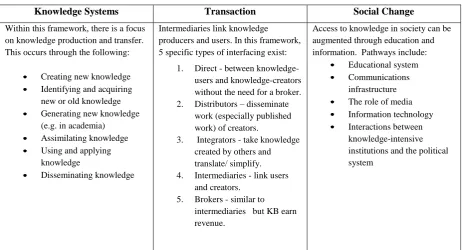
Numerous authors have developed typologies to discuss the transfer of knowledge. Oldham and McLean (1997) summarise these on three alternative levels (see figure 1).
Page 5 of 16
Figure 1 Knowledge-broking Frameworks.
Knowledge Systems Transaction Social Change
Within this framework, there is a focus on knowledge production and transfer. This occurs through the following:
Creating new knowledge Identifying and acquiring new or old knowledge Generating new knowledge (e.g. in academia)
Assimilating knowledge Using and applying knowledge
Disseminating knowledge
Intermediaries link knowledge producers and users. In this framework, 5 specific types of interfacing exist:
1. Direct - between knowledge-users and knowledge-creators without the need for a broker. 2. Distributors – disseminate
work (especially published work) of creators.
3. Integrators - take knowledge created by others and translate/ simplify. 4. Intermediaries - link users
and creators. 5. Brokers - similar to
intermediaries but KB earn revenue.
Access to knowledge in society can be augmented through education and information. Pathways include:
Educational system Communications infrastructure The role of media Information technology Interactions between knowledge-intensive institutions and the political system
Adapted from Oldham and McLean (1997)
The transactional framework highlights how relationships within the production and transmission of knowledge may differ, suggesting that a KB function may occur at different points in the transfer. However, ,referring to a KB as someone who only operates where value is attached to the transfer of knowledge and earns revenue may be problematic, as Oldham and McLean (1997) acknowledge.
While the exact role and function of KB are conceptualised and operationalised differently in various sectors and settings, it is this facilitation of knowledge exchange or sharing between and among various stakeholders, including researchers, practitioners, and policy makers, which is a common feature. In the case of academically-generated knowledge, in the field of social sciences, KB can play a significant role in this process, by disseminating information about data and enhancing analysis and impact, particularly policy impact, as well as acting as intermediaries between universities, research units, think-tanks and policy makers (Drew et al, 2013).
Page 6 of 16
It is worth noting that KB activity is different from other academic activity as it may produce no direct output; its function is to support others in the application of knowledge, This public service function therefore makes it hard to separate out the ‘value’ of the KB function, and can make cases for funding difficult to argue.
3.
The Workplace Employment Relations Study (WERS): an overview
The WERS is a valuable resource on contemporary British working life and has been run six times since 1980. The overarching objective of the survey is to provide a nationally representative account of the state of employment relations and working life inside British workplaces1 from both management and employee perspectives (Bryson et al, 2008). More specifically, WERS aims to provide a map of British employment relations, which is available in a statistically reliable, and publicly available, dataset (VanWanrooy et al, 2013). The survey collects a wide range of information on the experiences of workplaces and their workforces in the recent economic recession, structures and practices of employment relations and the experiences of workers from managers, employees and representatives. This provides important insights into employment relationships (VanWanrooy et al, 2013).
The significance of the survey partially derives from the calibre of its sponsors. WERS is currently co-sponsored by the Department for Business, Innovation and Skills (BIS), the Advisory, Conciliation and Arbitration Service (Acas), the Economic and Social Research Council (ESRC), the UK Commission for Employment and Skills (UKCES), the Health and Safety Executive (HSE) and the National Institute of Economic and Social Research (NIESR). Five of the sponsors are government bodies with a policy interest in the operation and management of the workplace. The sixth sponsor, NIESR, is an academic research organization which received support from the charitable Nuffield Foundation for its involvement2. Each WERS survey is managed by a Steering Committee, in which each of the sponsors is represented.
For academics, the survey is of particular interest as it also aims to monitor changes in employment practices over time. The quality of the dataset (in particular, the reliability and validity of WERS) was mentioned by all users in the survey; the data was perceived as “authoritative and credible”. WERS users emphasised that its consistency was a key strength of the survey and the continuity of the dataset had practical value for all users.
In addition, WERS data is intended to inform policy development, and to stimulate and inform debate and practice. Government departments and organizations defined WERS as
1
In 2011, senior managers at almost 2,700 workplaces were surveyed, along with 1000 worker representatives and 21,000 employees.
2 The Policy Studies Institute was academic sponsor for the WERS 2004 data collection and analysis, but
Page 7 of 16
essential for identifying changes in employment relations over time - a ‘benchmark survey’ providing the basis for a host of other analyses using more specific data.
4.
Methodology of the policy impact study
Drew et al (2013, DKR) aimed to identify and study specific policy and practice impacts of WERS, and to identify the range of organizations and/or individuals who have made use of WERS. In addition, the research studied the role of think tanks, and other intermediaries and KBs, as transmission routes through which WERS may have influenced policy, through comparative activity. It is these latter findings which are summarised and considered in this paper.
The study employed a mixture of desk-based research and qualitative interviews. A combination of ‘tracking forwards’ and ‘tracking backwards’ approaches (Molas-Gallart and Puay Tang, 2007) were used. The literature review identified potential research users and researchers, and a snowballing technique was used to generate more interview respondents. Members of the WERS steering committee were interviewed and they generated further possible contacts. Fifteen interviews (face-to-face and telephone) were conducted in total.
By focusing the interviews on the steering committee (academic and non-academic), DKR were able to track the processes through which knowledge was used by intermediaries such as think tanks, consultancies, and KBs. DKR identified staff managing the WERS Information and Advice Service (WIAS) within NIESR – an independent economic research institute – as playing a key role in transfer.
Despite its importance for academic users, the study only interviewed those academics who were Steering Group members. This initially was for three reasons. First, the priority of the study funders were to concentrate on the policy relevance, and so practicality dictated that the limited resources were focused on those who were able to describe the policy context in detail. Second, academics on the Steering Group were involved in the design of the survey and could provide an academic perspective on the policy context. Third, the initial literature review indicated that these academics were also closely connected to the academic literature, and so could cost-effectively provide an overview of this.
A fourth reason was also advanced, and proved to be supported by the research itself. Non-academic users could provide an overview of the strategic value of WERS to their organization. In contrast, academic researchers were less likely to have that direct policy link; indeed, much of the policy impact of academic research was mediated through the KBs discussed below.
5.
Research Findings
Page 8 of 16
stemming from the WERS surveys. DKR were able to demonstrate that WERS data was an essential source of context for policy in various fields. Yet WERS was often perceived, rightly or wrongly, to be a complex dataset and the research showed that a relatively small number of non-academic users directly analysed the WERS data. Instead non-academic users relied on simplified aggregate statistics and/or publications prepared from the findings; for example, Inside the Workplace (Kersley et al, 2005) is the most widely cited publication on WERS 2004 and, in the interviews, non-specialist users regularly identified this as the source of their information on British contemporary work practices despite being largely one- or two-dimensional tabulations.
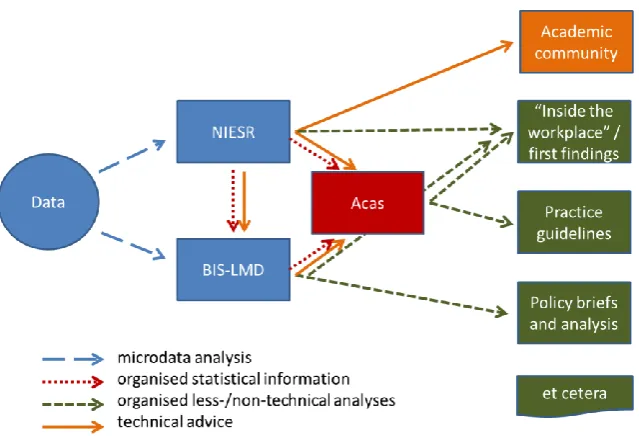
This was an indication that DKR were focusing on knowledge which may be difficult to disseminate and transfer unless codified for a specific audience. The research suggested three organizations providing a knowledge-broking function: NIESR, the Labour Markets Division of the Department for Business Industry and Skills (BIS-LMD), and Acas. Each of these had a different audience and transformed a different set of inputs into relevant knowledge, but they also interacted closely: Inside the Workplace was co-written by BIS, NIESR and ACAS staff, and all three bodies were part of the WERS Steering Group.
5.1 NIESR: technical and academic KBs
As noted above, accessing datasets was difficult for non-specialist users. Therefore, the primary task was to understand how WERS data was being identified and codified. This role was predominantly taken on by the National Institute of Economic and Social Research (NIESR), an academic research organisation with strong university links, which formed a bridge between the academic and policy-making communities.
NIESR’s involvement in the codifying, storing and dissemination of WERS data was consistent with Oldham and McLean (1997), that the successful knowledge-broker role is built on relationships. NIESR was equally a designer, a user, as well as broker of the data. As a member of the steering committee, however, NIESR was part of a wider group of users and creators of knowledge.
NIESR played a key role in encouraging the exchange of ideas, problems and solutions between users of the WERS data, as well as producing sets of statistics from the original dataset for non-specialist users. NIESR performed this KB function through the creation of services funded by the ESRC for each round of WERS. The most recent KB activities of NIESR consisted of the WERS 1998 Data Dissemination Service (established in October 1999 and closed in January 2002) and the WERS 2004 Information and Advice Service (WIAS) (between 2006 and 2008). WIAS ran an e-mail discussion list open to users and also organized six-monthly user group meetings, which also included presentations from invited speakers on methods of analysis or WERS 2004 based research.
Page 9 of 16
unclear whether the methods of search engines increase or decrease the significance of the KB. We return to this in the discussion. No WIAS service is currently planned for the 2011 WERS, which has led to concerns regarding how this might impact negatively upon the dissemination of WERS.
In addition, NIESR contributed to primary analysis on WERS and produced reports for other users, for instance, reports to BIS on workplace skills. This was especially important for those who could not access the data set themselves. Despite the fact that NIESR did not update the WIAS website after funding ended in 2008, they still acted unofficially as a bridge between the data source and user; WIAS (ex-)staff were frequently referenced by WERS users as ongoing, albeit unpaid, advisers. This further emphasises the importance of their function.
5.2 BIS-LMD: bridging the policy gap
Government analysts in BIS used the data extensively as a research resource for their own operations. However, they also provided an informal consultancy service to other parts of government. WERS was recognised as being a source of valuable information to a range of government departments, but it was felt to be a complex dataset and the end users did not have (and did not want to develop) the necessary analytical skills. This negative reputation of WERS amongst the non-technical users was a recurrent theme in the interviews.
As a result, information requests were channelled to BIS-LMD, who advised other parts of government on the appropriate use of published WERS aggregates; they also carried out bespoke analyses. This did not have to be the case: the data was available to government users, and NIESR/BIS were willing to support users wishing to develop their own analytical skills; however, it appears that the reputation of WERS as being a specialist dataset discouraged direct use of the microdata.
BIS-LMD had a complementary role to play in getting academic studies into the policy sphere. By sponsoring activities such as PhDs, user group meetings and workshops, and by BIS-LMD staff participating in academic events, they could stimulate a two-way flow of information: interesting academic work could be forward on to policy departments, and policy departments could pass on information about their interests to the academic community.
5.3 Acas and others: from evidence to practice
Acas addressed a different audience: those who would have found the information useful in their work but who did not have the time or skills to work through even the ‘non-technical’ publications such as Inside the Workplace. Acas saw one of its key functions as turning statistical knowledge into business knowledge. Acas could make the judgements about reliability, correlations, statistical significance and so on, on a range of datasets, and turn these into strongly-evidenced practice guidelines.
Page 10 of 16
interest in the evidence per se, and assumed that it was correct. In contrast, users of BIS-LMD’s knowledge broking were often keen to know the provenance of evidence, as it was likely to come under scrutiny.
Acas was not the only organization to carry out this function. Other members of the Steering Committee, as well those in the ‘outer circle’ (interested parties not formally involved, such as CBI, TUC and CIPD) took a similar role of turning statistics into operating guidelines
5.4 Steering Committee and User Community Networks
From the outset, in the desk-based research, DKR noticed a repetitive pattern of authors and contributors of publications drawing on WERS. This raised questions of the extent to which the recurrence of names was evidential of other relationships with WERS that reinforced the
transfer of knowledge.
The WERS user community appeared strongly networked. The steering committee, including NIESR members, were involved with the design and throughout the process of WERS, as developers and end-users. Members of the steering group were also engaged in promoting and disseminating WERS. The WERS Steering Group provided a natural set of connections in the network and these connections seemed to be reinforced by formal and informal contacts. DKR found evidence of a well-defined group of contacts which enabled government, academic and business-users to engage with each other.
What is equally interesting here is that the stability of user community was linked to the fact that WERS was well-established. Interview respondents stated that, when looking to exploit WERS: “we know who to talk to”. Hence, the WERS network was underpinned by tacit knowledge of how the community functioned.
As figure 2 illustrates, the knowledge networks of WERS are represented by a hierarchical pattern of contacts, with different parties in the WERS central network playing a different role and broking a different level of knowledge.
Page 11 of 16
Figure 2 Knowledge Networks of WERS
6.
Discussion
Our findings indicated that intermediaries – or KBs – were the key routes through which WERS data was transferred. KB fell into two categories; firstly, research intermediaries, which helped non-specialist users to make effective use of WERS. NIESR was the most prominent organization in the knowledge-broker role of research intermediaries. The second group of KB could be described as non-specialist intermediaries and included other members of the steering group and the ‘outer circle’, including BIS, TUC CBI, and Acas. These all produced non-specialist information for members or clients using WERS; see Figure 3.
Figure 3 Forms of knowledge intermediation
[image:11.595.166.431.503.682.2]Page 12 of 16
Within the ‘knowledge systems’ framework, DKR identified activities that spanned from the creation of knowledge through to assimilation, application and the eventual dissemination of knowledge. NIESR and BIS formed part of the design and development team, NIESR and BIS supported other research users and created reports for them from the raw data. NIESR’s major role within the assimilation, usage and application of knowledge was to support micro data users through WIAS. This function was of such significance that it extended past the period of its funding. BIS supported government users of the data and, additionally, NIESR, BIS and ACAS were involved in the production of the widely cited WERS sourcebook,
Inside the Workplace.
Within the ‘transactional’ framework (Oldham and McLean, 1997), KBs, especially NIESR, were involved in interfacing at various levels. As designers of the WERS surveys, users of WERS data and members of the steering committee who were, in turn, users and developers themselves, relationships could be categorised as direct. Information was transferred between knowledge-users and knowledge-creators without the need for a broker. As distributors, the steering committee members published the raw data into more user-friendly formats in the form of first findings and the WERS sourcebook, Inside the Workplace. The main objective of these publications was to simplify the data, identifying that an integrative function was taking place. In the form of WIAS, for NIESR, and for union representatives, in the case of Acas, for example, DKR recognised intermediaries. Finally, if we follow Oldham and McLean’s (1997) arguably narrow categorisation of brokers, NIESR were funded, albeit for a shorter period than they were active, for running WIAS.
Oldham and McLean’s (1997) third framework, ‘social change’, was more applicable to the activities of the government bodies, BIS and Acas. As section three highlights, WERS is an important source for academics, but the activities of BIS and Acas were crucial for bridging the gap between research and practitioners or policymakers. These two bodies have a mandated role in the societal development, and their KB activities reflected that, providing contextual information for specialist research, workplace research, government reports, government papers and other routes into social, political, economic and legal changes in Britain. Hence, KBs within the context of WERS have a function in the transfer and expansion of knowledge pertaining to social change.
It can thus be seen that the three KBs identified in this study played slightly different roles, reflecting their organisational interests. However, the fact that all three were part of the same network allowed significant synergies in knowledge broking to be achieved, compared to the three organisations acting separately.
Page 13 of 16
evidence either way, but the lack of a WIAS-equivalent for the 2011 WERS will provide a test for whether the lack of a formal KB increases or decreases concentration of knowledge.
7.
Conclusion
The study highlighted the successful role played by KBs in bridging the gap between research and policy development. Drawing on the work of Oldham and McLean (1997) on the role of KBs, DKR were able to identify that these intermediaries operate in a number of guises and at important points within the knowledge creation and transfer process, as well as within the dissemination of data.
Processes that enhanced these links and relationships uncovered both intermediaries and key users, with KBs as developer and users, as well as steering group members. This multiple identity ensured that KBs facilitated effective dissemination and encouraged the use of research in policy development, as well as provided support to users unfamiliar with the dataset. WERS has a large body of non-technical users seeking analytical statistics to feed in to their work, as well as an academic community of micro-data users who are non-specialists.
As well as emphasising how KBs benefit from insider status, the study indicated how they can potentially target policy makers by translating research findings into a simpler and more useable form. This was also done by linking academic researchers to government departments and helping to translate WERS findings into meaningful data for policy. Non-specialist users expressed concerns that WIAS has been abandoned for WERS 2011, suggesting predominantly, that users of the micro data will not be adequately supported.
In the case of WERS, the KBs were also end-users of the research data, so the inter-link between creators, users and brokers of knowledge is further emphasised. The combination of academic and non-academic members of the WERS Steering Group also provided a natural bridge between research and policy. Hence, this study demonstrates how having KBs involved at inception potentially enhances policy impact.
It is clear that KBs have provided a valuable public service in the effective use of WERS. However, the question remains as to why this is funded. For government departments such as BIS and Acas, the knowledge-broking is an implicit part of their public service remit. In contrast academic activity at NIESR required explicit funding from a third party. Given the increasing pressures on academic funding and the lack of a direct ‘output’ from KB activities, this might limit the future opportunities for the academic sector to act as KBs.
References
Ahmed, P. K., Lim, K. K. K., & Loh, A. Y. (2012). Learning through knowledge management. Routledge.
Barley, S. (1996) Technicians in the Workplace: Ethnographic Evidence for Bringing Work into Organization Studies. Administrative Science Quarterly 41(3), pp 146-162.
Bell, D. (1973). The Coming of the Post-Industrial Society. Harmondsworth: Penguin.
Page 14 of 16
Bielak, A. T., Campell, A., Pope, S., Schaefer, K. and Shaxon, L. (2008) From science communication to knowledge-brokering: The shift from ‘science push’ to “policy pull”. In: Blackler,
Bollinger, A.S. and Smith, R.D. (2001). Managing organizational knowledge as a strategic asset.
Journal of Knowledge Management 5(1), pp.8 - 18.
Bryson, A., Green, F. and Whitfield, K. (2008), A Quarter Century of Workplace Employment Relations Surveys. British Journal of Industrial Relations 46, pp. 577–586.
Davenport, T. H., and Prusak, L. (2000). Working knowledge: How organizations manage what they know. Boston, MA: Harvard Business Press.
Drew, H., King, A. and Richie, F. (2013). Impact Evaluation Workplace Employment Relations Survey and European Social Survey: Final report to the ESRC. Economic and Social Research Council. Available: http://www.esrc.ac.uk/_images/WERS_ESS_tcm8-26047.pdf.
Elwyn, G., Taubert, M. andnd Kowalczuk, J. (2007). Sticky knowledge: A model
for investigating implementation in healthcare contexts. Implementation Science 2(44), pp. 1 - 8. Grant, R. (1996). Toward a Knowledge-Based Theory of the Firm. Strategic Management Journal 17, Special Issue: Knowledge and the Firm, pp. 109 - 122.
Grayson, J.C. and O'Dell, C. (1998). If only we knew what we know: Identification and transfer of internal best practices. California Management Review, 40: 3, pp. 154 - 174.
Hendry, L., and Pettigrew, A. (1990). Human resource management: An agenda for the 1990s. International Journal of Human Resource Management, 1, 17-43.
Hislop, D., 2003. Linking Human Resource Management and Knowledge Management via Commitment. Employee Relations 25(2), pp. 182 – 202. .
Jasimudddin, S.M. (2008). A holistic view of knowledge management strategy. Journal of Knowledge Management 12(2), pp. 57 - 66.
Kersley, B., Alpin, C., Forth J., Bryson, A., Bewley, H., Dix, G. and Oxenbridge, S. (2005). Inside the Workplace: Findings of the 2004 workplace employment relations survey. ESRC. London.
Lavis, J.N. (Winter 2006). Research, public policymaking, and knowledge-translation processes: Canadian efforts to build bridges. The Journal of Continuing Education in the Health Professions 26 (1), pp.37–45.
Leonard-Barton, D. (1995). Wellsprings of knowledge: Building and sustaining the source of innovation. Boston: Harvard Business School Press.
Mankin, D. (2009). Human Resource Development. Oxford: OUP.
Molas-Gallart, J. & P. Tang (2007). Policy and Practice Impacts of ESRC Funded Research Case Study of the ESRC Centre for Business Research. Swindon: ESRC. Retrieved November, 26, 2012. Nonaka, I. (1994). A Dynamic Theory of Organizational Knowledge Creation. Organization Science 5(1), pp. 14 - 39.
Oldham, G., & McLean, R. (1997). Approaches to knowledge-brokering. International Institute for Sustainable Development at http://www.iisd.org/pdf/2001/networks_knowledge_brokering. pdf accessed on, 23(10), 06.
Porter, M. E. (1985). Competitive Advantage: Creating and Sustaining Superior Performance, Free Press, New York.
Prahalad, C. K., & Hamel, G. (1990). The core competence of the corporation. Resources, firms, and strategies: A reader in the resource-based perspective, pp. 235-256.
Page 15 of 16 Recent UWE Economics Papers
See http://www1.uwe.ac.uk/bl/bbs/bbsresearch/economics/economicspapers.aspx for a full list
2014
1403 How do knowledge brokers work? The case of WERS
Hilary Drew, Felix Ritchie and Anna King
1402 Happy moves? Assessing the impact of subjective well-being on the emigration decision
Artjoms Ivlevs
1401 Communist party membership and bribe paying in transitional economies
Timothy Hinks and Artjoms Ivlevs
2013
1315 Global economic crisis and corruption experience: Evidence from transition economies
Artjoms Ivlevs and Timothy Hinks
1314 A two-state Markov-switching distinctive conditional variance application for tanker freight returns
Wessam Abouarghoub, Iris Biefang-Frisancho Mariscal and Peter Howells 1313 Measuring the level of risk exposure in tanker shipping freight markets
Wessam Abouarghoub and Iris Biefang-Frisancho Mariscal
1312 Modelling the sectoral allocation of labour in open economy models
Laura Povoledo
1311 The US Fed and the Bank of England: ownership, structure and ‘independence’
Peter Howells
1310 Cross-hauling and regional input-output tables: the case of the province of Hubei, China
Anthony T. Flegg, Yongming Huang and Timo Tohmo
1309 Temporary employment, job satisfaction and subjective well-being
Chris Dawson and Michail Veliziotis
1308 Risk taking and monetary policy before the crisis: the case of Germany
Iris Biefang-Frisancho Mariscal
1307 What determines students’ choices of elective modules? Mary R Hedges, Gail A Pacheco and Don J Webber 1306 How should economics curricula be evaluated?
Andrew Mearman
1305 Temporary employment and wellbeing: Selection or causal?
Chris Dawson, Don J Webber and Ben Hopkins 1304 Trade unions and unpaid overtime in Britain
Michail Veliziotis
1303 Why do students study economics?
Andrew Mearman, Aspasia Papa and Don J. Webber
1302 Estimating regional input coefficients and multipliers: The use of the FLQ is not a gamble
Page 16 of 16
1301 Liquidity and credit risks in the UK’s financial crisis: How QE changed the relationship
Woon Wong, Iris Biefang-Frisancho Mariscal, Wanru Yao and Peter Howells
2012
1221 The impact of the quality of the work environment on employees’ intention to quit
Ray Markey, Katherine Ravenswood and Don J. Webber
1220 The changing influence of culture on job satisfaction across Europe: 1981-2008
Gail Pacheco, De Wet van der Westhuizen and Don J. Webber
1219 Understanding student attendance in Business Schools: an exploratory study
Andrew Mearman, Don J. Webber, Artjoms Ivļevs, Tanzila Rahman & Gail Pacheco
1218 What is a manufacturing job?
Felix Ritchie, Andrew D. Thomas and Richard Welpton
1217 Rethinking economics: Logical gaps – empirical to the real world
Stuart Birks
1216 Rethinking economics: Logical gaps – theory to empirical
Stuart Birks
1215 Rethinking economics: Economics as a toolkit
Stuart Birks
1214 Rethinking economics: Downs with traction
Stuart Birks
1213 Rethinking economics: theory as rhetoric
Stuart Birks
1212 An economics angle on the law
Stuart Birks
1211 Temporary versus permanent employment: Does health matter?
Gail Pacheco, Dominic Page and Don J. Webber 1210 Issues in the measurement of low pay: 2010
Suzanne Fry and Felix Ritchie
1209 Output-based disclosure control for regressions
Felix Ritchie
1208 Sample selection and bribing behaviour
Timothy Hinks and Artjoms Ivļevs
1207 Internet shopping and Internet banking in sequence
Athanasios G. Patsiotis, Tim Hughes and Don J. Webber
1206 Mental and physical health: Reconceptualising the relationship with employment propensity Gail Pacheco, Dom Page and Don J. Webber
1205 Using student evaluations to improve individual and department teaching qualities
Mary R. Hedges and Don J. Webber