Preventing violence and reducing its impact:
How development agencies can help
ISBN 978 92 4 159658 9
Violence Prevention Alliance
Building global commitment for violence prevention
World Health Organization
Violence Prevention Alliance Secretariat Avenue Appia 20
1211 Geneva 27, Switzerland Tel +41-22-791-2064 Fax +41-22-791-4332
Violence Prevention Alliance participants
International participants
*USA Centers for Disease Control and Prevention,
National Center for Injury Prevention and Control, Division of Violence Prevention;
*Inter-American Coalition for the Prevention of Violence; International Physicians for
the Prevention of Nuclear War; International Society for Prevention of Child Abuse
and Neglect; Rehabilitation and Research Centre for Torture Victims;
Woman-to-Woman International -
Australia
Murray Mallee Community Health Service;
Onka-paringa Collaborative Approach to the Prevention of Domestic Violence and
Indig-enous Family Violence -
Belgium
Garance ASBL; *Ministry of Health -
Canada
*Public Health Agency of Canada -
Germany
*Deutsche Gesellschaft für
Technis-che Zusammenarbeit (Gtz) GmbH; *HessiTechnis-ches Sozialministerium; Institute of Legal
Medicine University Hospital Hamburg-Eppendorf -
Jamaica
*Ministry of Health
-
Malaysia
Violence and Injury Unit of the Ministry of Health, Malaysia -
Philip-pines
Child Protection Unit, University of the Philippines -
South Africa
*Medi-cal Research Council and Institute for Social and Health Sciences at the University
of South Africa -
Thailand
Ministry of Public Health’s Department of Health
Service Support -
Uganda
Injury Control Center -
United Kingdom
*Centre
for Public Health, Liverpool John Moores University; Eighteen and Under; *Health
Protection Agency North West; National Public Health Service for Wales; *North
West Public Health Team, Department of Health; The Violence Reduction Unit
of Scotland; Violent Crime Task Group, Cardiff Community Safety Partnership;
White Ribbon Campaign -
United States of America
Men’s Resources
In-ternational; Partners For A Healthier Community/Partners Against Violence; *The
California Wellness Foundation; The Waitt Institute for Violence Prevention
* Founding participants
WHO Library Cataloguing-in-Publication Data
Preventing violence and reducing its impact: how development agencies can help.
1.Violence - prevention and control. 2.Millennium development goals. 3.Health priority
agen-da. 4.International agencies. 5.National health programs. I.World Health Organization.
ISBN 978 92 4 159658 9
(NLM classification: HV 6625)
© World Health Organization 2008
All rights reserved. Publications of the World Health Organization can be obtained from
WHO Press, World Health Organization, 20 Avenue Appia, 1211 Geneva 27, Switzerland
(tel.: +41 22 791 3264; fax: +41 22 791 4857; e-mail: [email protected]). Requests for
permission to reproduce or translate WHO publications – whether for sale or for
noncom-mercial distribution – should be addressed to WHO Press, at the above address (fax: +41
22 791 4806; e-mail: [email protected]).
The designations employed and the presentation of the material in this publication do not
imply the expression of any opinion whatsoever on the part of the World Health
Organiza-tion concerning the legal status of any country, territory, city or area or of its authorities, or
concerning the delimitation of its frontiers or boundaries. Dotted lines on maps represent
approximate border lines for which there may not yet be full agreement.
The mention of specific companies or of certain manufacturers’ products does not imply
that they are endorsed or recommended by the World Health Organization in preference
to others of a similar nature that are not mentioned. Errors and omissions excepted, the
names of proprietary products are distinguished by initial capital letters.
Preventing violence
and reducing its impact:
How development
Contents
Acknowledgements iv
Foreword v
Executive Summary 1
I. How violence harms development 4
Magnitude of the problem 4
A range of harms across the development spectrum 5 Impact on the Millennium Development Goals 11
II. Preventing violence: a great advance 14
Lessons of the World report on violence and health 14 Bringing a public health approach to violence 16
Benefits of intersectoral action 16
III. Violence and the current development agenda: what is missing? 20
Current prominence of violence in Official Development Assistance
web sites and documents 21
What do the web sites and documents overlook? 21
What informs current priorities? 22
IV. Strengthened agenda: strategies that work 25
Ten key strategies for violence prevention 26 Four key strategies for reducing the consequences of violence 32
V. Strengthened agenda: the necessary foundations 35
Foundation building at national level 35
Enhancing international support for work in countries 37
VI. Conclusion 40
Appendix 41
Acknowledgements
This document has been written by Alexander Butchart, David Brown, Andrew Wilson, and Christopher Mikton. Its development is based on violence prevention and development workshops organized by the Deutsche Gesellschaft für Technische Zusammenarbeit (GTZ) team in 2003 in the context of the German presentation of the World report on violence and health; an August 2006 Violence Prevention Alliance (VPA) strategy meeting held in Brussels, Belgium; and input from the following VPA working group on violence prevention and development participants:
• Belgium: Leen Meulenberg, Department of Health, Brussels;
• Canada: Cecilia van Egmond and David Allen, Public Health Agency of Canada, Ottawa; Lori Snyder MacGregor, Region of Waterloo Public Health, Ontario; • Denmark: Jan Ole Haagensen, Jo Asvall, Finn Kjærulf, Rehabilitation and Research
Centre for Torture Victims, Copenhagen;
• Germany: Dr Assia Brandrup-Lukanow and Dr Inge Baumgarten, Deutsche
Gesellschaft für Technische Zusammenarbeit, Eschborn; Nancy Gage-Lindner, Hesse Department of Social Welfare, Wiesbaden;
• Jamaica: Elizabeth Ward, Director, Disease Prevention and Control, Ministry of Health, Kingston, Jamaica;
• Sweden: Ime John, International Physicians for the Prevention of Nuclear War, Stockholm;
• Uganda: Milton Mutto, Executive Director, Injury Control Centre Uganda, Kampala; • United Kingdom: Mark Bellis, Centre for Public Health, John Moores University,
Liverpool; Peter Donnelly, Deputy Chief Medical Officer, Scottish Executive, Edinburgh; Jonathan Shepherd, Violent Crime Task Group, Cardiff Community Safety Partnership, Cardiff, Wales;
• United States of America: Fran Henry, Global Violence Prevention, Cummington, Massachusetts; Rodney Hammond, Division for Violence Prevention, US Centers for Disease Control and Prevention, Atlanta; Lainie Reisman, Inter-American Coalition for the Prevention of Violence, Washington, DC;
• World Health Organization: Alexander Butchart, David Brown, David Meddings, and Alison Harvey, Department of Injuries and Violence Prevention, Geneva. The document has benefited greatly from peer review comments provided by the following agencies:
• Netherlands, Directorate General for International Cooperation; • United Kingdom, Scottish Executive, External Affairs Directorate;
• United States of America, National Institute of Justice; Centres for Disease Control and Prevention Foundation.
Foreword
Violence has long been considered a criminal justice issue and a
human rights issue. More recently it also has been considered a
health issue. However, with the exception of some forms of organized
violence, rarely is violence regarded as a development issue. Yet, in
many countries, violence between young people or the abuse of
women, children or the elderly seriously hampers economic and social
development.
Families edging out of poverty and investing in schooling their sons and
daughters can be ruined through the violent death or severe disability of the main breadwinner. Communities can be caught in poverty traps where pervasive violence and deprivation form a vicious circle that stifles economic growth. For societies, meeting the direct costs of health, criminal justice, and social welfare responses to violence diverts many billions of dollars from more constructive societal spending. The much larger indirect costs of violence due to lost productivity and lost investment in education work together to slow economic development, increase socioeconomic inequality, and erode human and social capital.
Recent research has also shown that the health consequences of violence – and therefore their economic costs – are much more widespread than imagined. Exposed to physical and sexual abuse, otherwise healthy infants may grow up carrying behavioural and psychological scars that can lead to sexual promiscuity, alcohol and illegal drug abuse, excessive smoking, increased likelihood of involvement in violence, and related diseases such as HIV, hepatitis, lung cancer, and depression.
The impact of violence on development too often remains ignored by those who have the possibility to act on it. This document makes the case for increased attention by international development agencies to violence prevention. A key aim is to stimulate dialogue on the role of international development agencies in the prevention of violence globally, and ultimately to increase investment in a commonly agreed set of applied violence prevention strategies.
The primary audience for this document is policy-makers, high-level planners, and others in the international development field. It will be particularly useful for those with decision-making authority in setting the international development agenda, and those who influence and shape donor policy.
We hope that this document will serve as a roadmap by which official development assistance agencies, United Nations organizations, countries, and NGOs can
move towards developing a shared vision of violence prevention and a common understanding of how to enhance and expand upon existing commitments to prevent violence.
Please join us in this crucial endeavour.
Etienne Krug
Director
Department of Violence and Injury Prevention and Disability World Health Organization
Executive Summary
This document makes the case for increased attention by
international development agencies to violence prevention, and aims
to stimulate dialogue on the role of international development
agencies in the prevention of violence globally.
Approaches to prevent violence concentrate on identifying ways to keep people from committing acts of violence. Interventions may eliminate or reduce the underlying risk factors and reinforce protective factors. Prevention strategies are conceived and implemented with reference to the interaction of risk factors among people at different stages of the life cycle and in relation to causes at the levels of the individual, family, community, and society.
Based on a review by WHO, including content analysis of 22 development agency web sites, this document provides a preliminary stocktaking of the priority accorded to violence prevention – as defined here – within international development
programming. It focuses on interpersonal and self-directed violence, since many more people lose their lives, are injured, and suffer other negative health consequences through interpersonal and self-directed violence than through collective violence.
Chapter I, “How violence harms development”, describes violence as a global challenge and a leading cause of death and disability worldwide. Violence disproportionately affects low- and middle-income countries, where its economic and social impacts are severe. Every day, more than 4000 people, over 90% of them in low- and middle-income countries, die because of violence. Of those killed, approximately 2300 die by their own hand and over 1500 because of injuries inflicted by another person. Much violence is not reported at all, so millions suffer untold and unaddressed harm. The chapter briefly reviews some of the health, social, and economic consequences of violence for individuals, communities, and countries, including:
• Health consequences for individuals and for health systems
• Economic consequences including lost opportunities, reduced productivity, and inequitable growth patterns
• Reduced progress towards gender equality
• Security and safety concerns as an obstacle to development
• Obstacles to achieving Millennium Development Goals.
Chapter III, “Violence and the current development agenda: what is
missing?”, points out that, despite increased understanding of violence as a barrier to development and growing knowledge about how to tackle it, violence prevention suffers from a combination of institutional fragmentation, weak national planning, and low political status. It also has a low priority (outside of peacekeeping and conflict resolution) within the international development agenda, including the national agencies responsible for official development assistance (ODA). Content analysis of ODA agency web sites and documents from 22 countries shows that ODA agencies tend to give the highest prominence to collective violence, followed by violence against women (particularly in the context of war), violence against children and, much less prominently, youth violence.
Perhaps the most arresting feature of this analysis is what the agencies do not address, compared to the actual impact of various forms of violence. Whereas suicide accounts for 54% of all deaths directly due to violence, homicide for 35%, and collective violence 11%, ODA agency web sites and documents accord the greatest prominence to collective violence, limited prominence to homicide, and almost none to suicide. Least prominent is abuse of elders – a serious gap given that, globally, an estimated one in 20 elderly people experience abuse. Another clear gap is visible along gender lines: although males are victims of nearly 80% of all homicides, 60% of suicides, and 80% of violence-related injuries, limited attention is paid to preventing male suicide or male-to-male interpersonal violence. Intersectoral approaches receive little attention, and programming tends to concentrate on one sector at a time. Finally, there is little reference to evidence-based approaches, support for data collection or research into violence.
Chapter IV, “Strengthened agenda: strategies that work”, suggests that while much is right with the current agenda of ODA agencies, significant potential benefits are being missed and important gaps need to be filled. The benefits can be realized and the gaps filled by re-focusing or expanding current priorities, by adding new funding to neglected violence prevention areas, and by efforts to expand the evidence base. Based on the analysis in the preceding chapter, a strengthened agenda would:
Expand programming to include types of violence and groups at high risk of victimization or perpetration that are currently inadequately addressed in programming. Among other issues, a strengthened agenda would increase attention to interpersonal violence among youth and young adult males, self-directed violence, and violence against elderly people.
Utilize sectoral entry points that are not currently supported. For example, it seems likely that municipal governments, antenatal health clinics, schools, faith-based organizations, trade unions, business associations, and many other entry points could be brought into prevention efforts, depending on the forms of violence to be tackled and the factors contributing to them. Development agencies have experience of working with or through such organizations or services, and should be able to assess which of them – in any given location – would have comparative advantages to offer.
Support efforts that take into account commonalities in risk factors and interventions that simultaneously address different types of violence. Different types of violence share common risk factors, and often occur together; one may cause the other, and they have common consequences. A strengthened agenda would, first, prioritize the following 10 scientifically credible prevention
strategies that address common underlying risk factors and so have the potential to simultaneously decrease different forms of violence:
1. Increase safe, stable, and nurturing relationships between children and their parents and caregivers
2. Reduce availability and misuse of alcohol 3. Reduce access to lethal means
4. Improve life skills and enhance opportunities for children and youth 5. Promote gender equality and empower women
6. Change cultural norms that support violence 7. Improve criminal justice systems
8. Improve social welfare systems
9. Reduce social distance between conflicting groups 10. Reduce economic inequality and concentrated poverty.
Second, it would prioritize the following four strategies for reducing the
consequences of violence:
1. Engage the health sector in violence prevention
2. Provide mental health and social services for victims of violence 3. Improve emergency response to injuries from violence
4. Reduce recidivism among perpetrators.
Chapter V, “Strengthened agenda: making it happen”, provides guidance on
the institutional foundations necessary to implement violence prevention at national level, and suggests ways to integrate evidence-based violence prevention within international development priorities.
I. How violence harms
development
In the areas with the highest violence, we also see the highest
population densities, lowest educational attainment, highest
unemploy-ment, poorest housing and highest incidence of HIV, TB, malaria, and
gastroenteritis. In these communities the life expectancy for young
males is falling. In the urban areas, we are saving the lives of our infants
through immunization only to have them die in their 20s from a stab or
gunshot wound.
Dr Elizabeth Ward, Director, Disease Prevention and Control, Ministry of Health, Jamaica
Violence is a global challenge and a leading cause of death and disability worldwide. It accounts for over 1.6 million deaths per year, at least 16 million cases of injury severe enough to receive medical attention in hospitals, and untold suffering for tens of millions of individuals.
Although the negative impacts of violence are felt by all, violence disproportionately affects low- and middle-income countries. Furthermore, since violence slows economic growth, undermines personal and collective security, and impedes social development, the economic and social impacts of violence are ultimately more severe in poorer countries.
Magnitude of the problem
Every day, more than 4000 people, over 90% of them in low- and middle-income countries, die because of violence. This is roughly the same as the daily toll of deaths due to tuberculosis and more than the daily toll of some 3500 deaths due to malaria. Of those killed by violence, approximately 2300 die by their own hand, over 1500 because of injuries inflicted by another person, and over 400 as a direct result of war or some other form of collective violence (1).
For each single death due to violence, there are dozens of hospitalizations, hundreds of emergency department visits, and thousands of doctors’ appointments. Much violence is not reported at all, so millions suffer untold and unaddressed harm. Males aged 15–44 years are at many times greater risk of being involved – as victims and as perpetrators – in fatal and severe non-fatal violence. Females are at substantially higher risk than males of being victims of sexual violence and of serious physical assault in intimate partner violence. According to data from the WHO Multi-country Study on Women’s Health and Domestic Violence against Women, the proportion of ever-partnered women who had experienced physical or sexual violence, or both, by an intimate partner in their lifetime, ranged from 15% to 71%, and the prevalence of violence in the past year ranges from 4% to 54% (2). For all types of interpersonal violence, people close to the victim – such as parents, intimate partners, friends, and acquaintances – are the most likely perpetrators.
violence. In the aggregate these forms of violence have substantial and widespread impacts. Guidance already exists for conflict resolution and peace building. However, the vast majority of violence occurs in settings that are at peace and within which the determinants of interpersonal and self-directed violence are qualitatively distinct from those of collective violence. For instance, these determinants include factors such as economic and gender inequalities, alcohol availability, illegal drug markets, access to lethal means, poor schooling and employment opportunities, experiencing parental abuse and neglect, and coming from a dysfunctional family. Addressing these determinants requires sustainable and carefully coordinated inputs from multiple sectors (e.g. education, employment, health, housing, justice, safety and security, trade and industry, welfare) directed towards population-level prevention targets, such as reduced incidence rates of homicide, suicide, rape, and child maltreatment.
A range of harms across the development spectrum
As well as the most visible physical consequences of violence such as death and injuries, there is considerable evidence showing that violence has a variety of other, less obvious consequences that can affect an individual throughout his or her life. Moreover, the impacts of violence are also felt in the wider social and economic
Box 1.1
An internationally accepted definition of violence
Since the launch of the World report on violence and health in October 2002, an increasing number of global and national agencies have adopted the World Health Organization definition of violence:
The intentional use of physical force or power, threatened or actual, against oneself, another person, or against a group or community, that either results in or has a high likelihood of resulting in injury, death, psychological harm, maldevelopment or deprivation.
This definition covers a broad range of outcomes, going beyond physical acts. The definition reflects a growing recognition of the need to address violence that does not necessarily result in injury or death, but that nonetheless imposes a substantial burden on individuals, families, communities, and health care systems worldwide.
Accompanying the definition is a typology that subdivides violence into three broad categories according to who commits the violent act:
Self-directed violence is subdivided into suicidal behaviours including suicidal thoughts, attempted suicide, and completed suicide; and abuse including acts such as self-mutilation.
Interpersonal violence is subdivided into family violence (including child abuse and neglect, intimate partner violence, and elder abuse) and community violence (including youth violence, rape or sexual assault involving strangers, and violence in institutional settings such as schools, workplaces, prisons, and nursing homes).
Collective violence is subdivided into social violence including crimes of hate or terrorist acts committed to advance a social agenda; political violence including war and related violent conflicts, state violence and similar acts carried out by larger groups; and economic violence including attacks by larger groups motivated by economic gain.
environments in which people live their lives. The following briefly reviews some of the health, economic, and social consequences of violence for individuals, communities, and society.
Health consequences: death, injury, mental illness, chronic disease,
and overburdened health systems
Interpersonal violence and self-inflicted violence are heavy contributors to global death rates, particularly among people aged 15 to 44 years – in fact, in these age groups, suicide and homicide are among the top ten causes of death (3). Beyond fatalities, the damaging effects of violence on health include physical consequences such as brain injuries, bruises and scalds, chronic pain syndromes, and irritable bowel syndrome. Violence can also be a risk factor for a range of sexual and reproductive health problems, such as infertility, pregnancy-related complications, unsafe abortion, pelvic inflammatory disorders, HIV and other sexually transmitted diseases, and unwanted pregnancy. It has also been linked with various chronic diseases including cancer, ischemic heart disease, and chronic lung disease, in part through the adoption of unhealthy behaviours such as smoking, use of alcohol and drugs, and physical inactivity (4).
Consequently, violence places a heavy burden on health systems, particularly
emergency services, consuming scarce staff time and clinical resources (blood supplies, operating theatre time, rehabilitation, etc.) that are needed to deal with other, less avoidable conditions.
Some forms of violence are strongly linked to psychological consequences such as cognitive impairment, depression, anxiety, phobias, panic disorders, and
psychosomatic disorders. Both child maltreatment and intimate partner violence are associated with difficulties in social and occupational functioning such as relationship problems, poor school performance, employment difficulties, and frequent changes in place of residence. Moreover, the lifetime implications of violence may extend far beyond the actual violent incident both in time and in type of harm experienced by an individual. This has significant implications for the health of entire populations. A recent WHO study estimated that sexual abuse experienced during childhood accounts for serious health problems in the general population including 27% of post-traumatic stress disorders, 10% of panic disorders, 8% of suicide attempts, 6% of cases of depression, alcohol misuse, and illicit drug abuse (5).
Economic consequences: lost opportunities, reduced productivity,
and inequitable growth patterns
The effects of violence place a significant burden on many national economies through increased health-care and legal costs, absenteeism from work, and lost productivity. For example, a study conducted in Cape Town concluded that serious abdominal gunshot injuries cost more than 13 times as much as the South African government’s average annual per capita expenditure on health (6).
Although there has been no systematic attempt to quantify such costs globally, it is likely that treating victims for the immediate and long-term health consequences of violence, processing perpetrators through the courts and the jails, and compensating victims for their suffering diverts many billions of dollars from more constructive investments.
that the public sector (and therefore society in general) pays the bulk of these costs. For example, it is estimated that between 56 and 80% of care and treatment for gunshot and stabbing injuries in the USA are either paid directly by public financing or are “not paid at all” (8,9) – in other words, absorbed by government, society, and ultimately the tax payer. It is probable that society in low- and middle-income countries also absorbs much of these costs through direct public expenditures. Despite the evidence that violence has a serious impact on various aspects of development, the relationship is a complex one. Current research, particularly in middle- and low-income countries where few data are available, cannot provide clear answers to several important questions, such as: “What is the actual cost of different forms of violence on economic development?” and “What savings could be made using [a given] violence prevention programme?”
A few efforts have been made to estimate the potential benefits of violence
prevention to national economies. According to a study by the United Nations Office on Drugs and Crime and the World Bank, comparison of data from Costa Rica (homicide rate 8.1 per 100,000) with four nearby countries (Haiti with 33.9; Jamaica 33.8; Dominican Republic 16.5; Guyana 16.1) suggests significant gains by the latter could be made if violence could be reduced to Costa Rican levels. Haiti and Jamaica could both increase annual economic growth per capita by an estimated 5.4 percent, while the Dominican Republic and Guyana would also benefit from growth rate increases of 1.8 and 1.7 percent, respectively (11).
Box 1.2
Jamaica: The impact of violence on business
[image:15.595.84.535.74.420.2]Violence can have a damaging effect on businesses in both short-run costs and long-run consequences for development, notably by discouraging investment and diverting scarce resources to security or crime prevention measures. A 2001 survey in Jamaica found high levels of concern about violence and crime among business managers, with many stating that violence and crime had either a significant, somewhat significant, or highly significant impact on particular business practices. More than 50% reported that violence and crime increased security costs, while 39% responded that they were less likely to expand their business because of it. Finally, 37% worried that violence and crime discourage investments that would help to improve productivity.
Figure 1.1 Impact of crime and violence on Jamaican businesses
Source: Adapted from 2001 Firm Victimization Survey (10) Other
Increased cost of services purchased Negative impact on worker productivity Negative impact on investments to improve productivity Negative impact on plans for business expansion Increased cost of security
0 10 20 30 40 50 60
% of firms reporting "Significant", "Somewhat significant", or "Highly significant" impact
51% 39%
37% 22%
Recently, the editor of the journal Foreign Policy commented on the risks faced by countries coping with rapid social, economic, and demographic change (12):
It is easy to dismiss growing crime [and violence] rates as either a local problem or one that has been with us since time immemorial. But that would be a major mistake. Because, though we may have recently lost ground, the problem has the potential to be a far greater global nightmare. Consider China and India. They have growing populations of young males, growing levels of economic inequality, and rapid urbanization. And, though drugs and guns are still relatively hard to come by, they’re becoming easier to obtain every day. If these two nations become more like other poor countries in this regard, too, their crime [and violence] rates could soar to unimagined levels. Suffice it to say, the crime [violence] pandemic would never be hidden from anyone again.
Bringing violence into discussions of development raises questions not only about the scale or speed of development but also about its quality. For example, the reality is that many countries burdened with conspicuously high violence levels (e.g. Brazil, Mexico, the Russian Federation, and South Africa) are visibly making economic progress – so long as “progress” is judged at the level of simplifying indicators such as Gross Domestic Product. The choice of indicator is, of course, key to this discussion: a different reality is revealed by more nuanced measures that take into account the substantial and sometimes growing disparities between different sectors of the population (see Box 1.3). A great deal of evidence shows that when wide economic disparities exist in a society, even a relatively wealthy one, these will be accompanied by similar disparities in levels of violence. In turn, these disparities are likely to contribute to greater overall levels of violence in that society than in less inequitable societies.
The gender factor
Gender equality and development effectiveness are closely interrelated. When women and men are relatively equal, economies tend to grow faster, the poor move more quickly out of poverty, and the well-being of men, women, and children is enhanced. By contrast, in low- and middle-income countries, economic growth is slowed and population well-being undermined by inequalities in the rights, resources, and influence of women and men (13). Accordingly, when gender relations are characterized by a high degree of men’s violence against women, women’s civil, political, and economic participation is limited and gender inequality perpetuated. Threatened or actual violence towards women, whether occurring in the home or the community, instils fear and insecurity in women’s lives and is an obstacle to the achievement of equality and development. The fear of violence, including harassment, is a permanent constraint on the mobility of women and limits their access to
resources and basic activities. High social, health, and economic costs to the individual and society are associated with violence against women (14).
Box 1.3
Three country examples: the connection between
unequal growth and violence
In São Paulo, Brazil’s largest city, the overall homicide rate in 1999 was relatively high at 67 per 100 000. Closer analysis shows that this overall figure was driven by exceptionally high rates in a number of districts where homicide rates exceeded 100 per 100 000. The districts with the highest homicide rates were those with rapidly rising population growth, large concentrations of adolescents and pre-adolescents, high household density, limited access to public sewers, limited job availability, and low educational achievement (17). These findings are not surprising and are in line with those of WHO’s Commission on Social Determinants of Health (18). At the same time, impacts were felt in other ways and in other parts of the city. For example, the number of private security personnel (many of them former police or military personnel) in São Paulo is extremely high, doubling between 2000 and 2004 from 540,334 to 1,148,568 – almost one for each twenty people in the metropolitan area. As one report put it (19):
The employment of private security forces further stratifies the segregation of society based on racial, economic and social lines. The result is a city which is punctuated by highly fortified security bubbles, protected by unaccountable and under-regulated private forces…
Similarly, in Cape Town, South Africa, a citywide homicide rate of 70 per 100 000 for the year 2001 concealed a more than three-fold variance between sub-districts with the lowest rates (around 30 per 100 000) and those with the highest rates (around 120 to 130 per 100 000). In the sub-district of Nyanga, it has been estimated that a young man celebrating his fifteenth birthday has a greater than 1 in 20 chance of being shot dead by age 35. As in São Paulo, these huge disparities coincided with the pattern of inequities seen in the provision of housing, educational levels, employment, and health expenditure (20).
A third example is taken from a study of homicide rates and development indicators in 78 of the Russian Federation’s 89 administrative regions for the year 2000. The mean homicide rate for all regions was about 30 per 100,000, while regional homicide rates varied from a low of 6.5 per 100,000 in the Kabardino-Balkaria region to a high of over 130 per 100,000 in the Tyva region. Negative socio-economic change, single-parent households, and alcohol consumption correlated with higher homicide rates, while a “polity” indicator combining measures of privatization, foreign investment, and population growth was correlated with lower rates (21).
These three examples are from countries where levels of interpersonal violence rose
homicide and suicide rates for those aged 15 years or older are substantially greater among males than females.
Preventing intimate partner violence, sexual violence, and other more subtle types of violence by men towards women therefore has the potential to reinforce development gains for women and men alike.
Security and safety: the fear factor
Recent years have seen an expansion of traditional concepts of “security,” moving from military- and state-defined notions of security to views “that put ‘humans’, with their multiple range of needs and capacities, at the centre of the picture” (22). Because they are so visible, incidents of interpersonal violence in the community (notably youth and stranger violence) have impacts beyond the burden they place on health. In particular, people’s perceptions of the safety of their local environment may be severely affected, with negative consequences for their use and enjoyment of their communities.
When an atmosphere of fear becomes pervasive, parents are afraid to let their children go to and from school unaccompanied; elderly people fear going out to their favourite meeting places; women are reluctant to walk alone after dark; young men worry about wandering into the “wrong part of town” where other young men might confront them for no particular reason; businesses and wealthier individuals hire bodyguards and install elaborate security systems. For example, Figure 1.2 shows how the fear of violence and crime has affected citizens of the Dominican Republic. Similar impacts of crime and violence on daily activities are observed among residents of South Africa, where many fear walking to town or work or using public transport (23,24), and Nairobi, where a majority feel unsafe during the evening hours – particularly in the city centre (25).
[image:18.595.162.499.607.764.2]Such fears can result in changes to the physical and political environment. For example, the fear of violence may result in wealthier communities erecting physical barriers to separate them from poorer communities, and certain areas becoming deserted outside of office hours. Citizens’ worries about real and perceived lack of security often result in political responses emphasizing “law and order” measures that, if they survive the “news cycle” and are actually implemented, may not be based on evidence-based approaches.
Figure 1.2 Dominican Republic, 2005: What do people stop doing because of fears of violence and crime?
Source: Adapted from UNODC and World Bank (2007), based on national ENHOGAR survey, 2005 (26) Going to church
Doing exercise Stop studying Others Stop working Vacations Participation in activities Stop visiting friend or relatives Going out at night Entertainment activities Leave the house
0 5 10 15 20
19.4% 12.8%
12.2% 7.0%
2.5% 2.2% 2.1% 1.9% 1.6% 0.8% 0.4%
Impact on the Millennium Development Goals
In September 2000, the UN Member States unanimously adopted the Millennium Declaration, agreeing to reach the Millennium Development Goals (MDGs) by the year 2015. Since the Declaration, there has been growing conviction that different aspects of violence are important obstacles to the achievement of several MDGs. A case in point is the growing recognition of the issue of armed violence, which is related to the wide availability of small arms and light weapons in many low-income countries. In June 2006, 42 governments adopted the Geneva Declaration to reduce armed violence by 2015, stating that (27):
a development approach to armed violence is needed because armed violence destroys lives and livelihoods, breeds insecurity, fear and terror, and has a profoundly negative impact on human development. Whether in situations of conflict or crime, armed violence imposes enormous costs on states, communities and individuals.
Similarly, a recent WHO publication linked the MDGs to violence against women, arguing strongly that many MDG targets – not just MDG 3 on gender inequality – will be missed if violence against women is not addressed on a variety of fronts (28). The writers observe that:
The relationship between sustainable development and violence against women is not explicit in the Declaration and Goals and, at first glance, none of the indicators relate directly to violence against women. Closer examination reveals, however, that violence against women – both as an extreme manifestation of gender inequality and a means of perpetuating it – is highly relevant to all of the Goals. Furthermore, the Goals provide powerful arguments and entry points for a variety of approaches to eradicating violence against women. Efforts like these, which focus on particular types of or factors contributing to
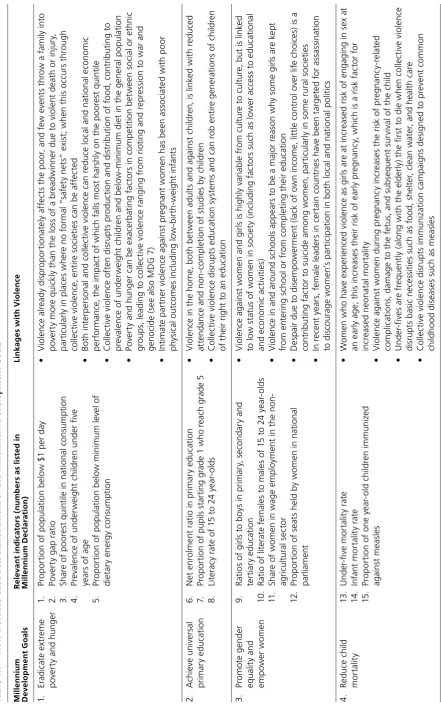
Ta bl e 1 .1 H ow v io le nc e o bs tr uc ts a ch iev em en t o f t he M ill en ni um D ev el op m en t G oa ls M ill en n iu m R el ev an t i n d ic at o rs ( n u m b er s a s l is te d i n Li n ka g es w it h V io le n ce D ev el o p m en t G o al s M ill en n iu m D ec la ra ti o n ) 1. Er ad ic at e ex tr em e 1. Pr o p or ti on o f p o pu la ti on b el ow $ 1 p er d ay • V io le nc e al re ad y di sp ro p or ti on at el y af fe ct s th e p o or , a nd f ew e ve nt s th ro w a f am ily in to p ov er ty a nd h ung er 2. Po ve rt y g ap r at io p ov er ty m or e qu ic kl y t ha n t he l os s o
f a b
[image:20.595.83.525.81.787.2]M ill en n iu m R el ev an t i n d ic at o rs ( n u m b er s a s l is te d i n Li n ka g es w it h V io le n ce D ev el o p m en t G o al s M ill en n iu m D ec la ra ti o n ) 5. Im pr ov e m at er na l 16 . M at er na l m or ta lit y ra ti o • V io le nc e ag ai ns t w om en , i nc lu di ng s ex ua l a ss au lt, is a ss o ci at ed w ith a n in cr ea se d risk o f he al th 17 . Pr o p or ti on o f b ir th s a tt en d ed b y sk ill ed h ea lth p er so nn el un in te nd ed p re gn an cy , w hi ch i s i ts el
f a r
isk f ac to r i n m at er na l m or ta lit y • W hi le p re gn an cy is a t tim es a p ro te ct iv e fa ct or a ga in st v io le nc e, r ec en t re se ar ch sh ow s th at i n m an y p la ce s w om en e xp er ie nc e h ig he r l ev el s o f d om es tic v io le nc e w hi le p re gn an t • D is ru pt io n of h ea lth c ar e se rv ic es du ring c ol le ct iv e vi ol en ce , p ar tic ul ar ly a cc es s to sk ill ed bi rt h a tt en da nt s, i nv ar ia bl y r ai se s m at er na l m or ta lit y 6. C om ba t H IV /A ID S, 18 . H IV p re va le nc e in 1 5 to 2 4 ye ar -o ld s • In a re as o f hi gh H IV p re va le nc e, v io le nc e in cr ea se s risk o f H IV in fe ct io n di re ct ly t hr ou gh m al ar ia , o th er 19 . C on d om u se r at e ra p e a nd s ex ua l a ss au lt a nd i nd ire ct ly t hr ou gh l im iti ng a bi lit y t o n eg ot ia te u se o f c on d oms di se as es 21 –2 4. M al ar ia a nd T B pr ev al en ce a nd d ea th r at es , a nd • C ol le ct iv e vi ol en ce d is ru pt s ba si c pu bl ic h ea lth m ea su re s d esi gn ed t o pr ev en t or t re at pr o p or ti on o f p o pu la ti on i n h ig h -p re va le nc e a re as m aj or d is ea se s s uc h a s T B a nd m al ar ia re ce iv ing p re ve nt io n a nd t re at m en t 7. En su re e nv iro n - 25 . Pr o p or ti on o f la nd a re a co ve re d by f or es t • C om p et iti on f or r es ou rc es du e to e nv iro nm en ta l d eg ra da ti on is a t le as t pa rt ly r es p on si bl e m en ta l s us ta in ab ili ty 31 . Pr o p or ti on o f u rb an p o pu la ti on w ith a cc es s t o i m pr ov ed fo r m uc h v io le nt c onfl ic t sa ni ta ti on • En vi ro nm en ta l d eg ra da ti on o ft en c au se s p o pu la ti on d is pl ac em en t, w hi ch is it se lf hi gh ly 32 . Pr o p or ti on o f h ou se ho ld s w ith a cc es s t o s ec ur e t en ur e as so ci at ed w ith v ar io us f or m s o f i nt er p er so na l, s el f-infl ic te d, a nd c ol le ct iv e v io le nc e (o w ne d or r en te d ) • Th e gr ow th o f sl ums la ck ing b asi c se rv ic es ( in cl ud ing r el ia bl e g ov er na nc e an d se cu rit y) is as so ci at ed w
ith a v
II. Preventing violence:
a great advance
There is a tendency worldwide for authorities to act only after cases
of highly visible violence occur, and then to invest resources for a short
time on programmes for small, easily identified groups of people.
Periodic police ‘‘crackdowns’’ on areas with high levels of violence are
classic examples of this, usually following a much-publicized incident.
In contrast, public health emphasizes prevention, especially primary
prevention efforts operating ‘‘upstream’’ of problems – efforts that try
to stop violent incidents from occurring in the first place or that prevent
violent conditions from resulting in serious injury. Primary prevention
approaches operate on the basis that even small investments may have
large and long-lasting benefits.
WHO, World report on violence and health (29)
At the same time as the impact of violence on development becomes increasingly clear, decision-makers have available a growing body of evidence about what can be done to prevent various types of violence, and to reduce the harm it wreaks on people, communities, and whole societies.
Lessons of the
World report on violence and health
Through its Global Campaign for Violence Prevention and with its Violence Prevention Alliance (VPA) partners, WHO is encouraging development agencies, donors, and recipient governments to support and implement nine recommendations published in the 2002 World report on violence and health (see Appendix). The report, produced with the contribution of over 160 experts from around the world, was the first comprehensive review of the problem on a global scale, covering the fundamental questions of what violence is, whom it affects, and what can be done about it. The objectives of the campaign are to raise awareness about the problem of violence, highlight the crucial role that public health can play in addressing its causes and consequences, and encourage action at every level of society.
Since publication of the World report on violence and health much has been achieved in raising the profile of violence and its consequences. In 2002, only a handful of health ministers could say why violence should be a public health priority. As of January 2008, three out of six WHO regional committees (Africa, the Americas, and Europe) have adopted violence prevention resolutions; there are over 100 officially appointed health ministry focal persons for the prevention of violence; over 50 countries have had national launches of the World report on violence and health; and over 25 countries have developed reports and/or plans of action on violence and health (see Figure 2.1). At the programme level, tens of thousands of people in scores of countries have been touched by violence prevention programmes and victim services established in response to the Global Campaign for Violence Prevention. Advocacy, normative guidance, and the planting of programme seeds in many
Figure 2.1 Countries that have launched the World report on violence and health and have a designated violence prevention focal person
This map is for illustrative purposes and does not imply the expression of any opinion of the authors or WHO concerning the legal status of any country or territory or concerning the delineation of frontiers or boundaries.
Countries with a national report and/or plan of action
Australia Belgium Botswana Bolivia Brazil Costa Rica El Salvador Finland Germany Guatemala France Jamaica Jordan Malaysia Mali Mexico Mongolia Mozambique Nepal New Zealand Russian Federation South Africa Sri Lanka United Kingdom Thailand TYFR Macedonia Turkey Yemen
Countries with a violence prevention focal point Angola Benin Burundi Cameroon Central African Republic Comoros Congo Cote d’Ivoire Democratic Republic of Congo Equatorial Guinea Eritrea Ethiopia Gabon Ghana Kenya Lesotho Madagascar Mauritius Malawi Mali Mozambique Namibia Nigeria
Sao Tome and Principe Senegal Seychelles South Africa Swaziland Tanzania Togo Uganda Zambia Zimbabwe Argentina Bolivia Brazil Canada Chile Colombia Costa Rica El Salvador Guatemala Guyana Honduras Jamaica Mexico Paraguay United States of
America Afghanistan Bahrain Djibouti Egypt Iran Iraq Jordan Kuwait Lebanon Libya Morocco Oman Palestine Pakistan Quatar Saudi Arabia Syrian Arab Republic Yemen Albania Armenia Austria Azerbaijan Belgium Bosnia and Herzegovina Bulgaria Croatia Cyprus Czech Republic Denmark Estonia Finland France Georgia Germany Greece Hungary Israel Italy Kyrgyzstan Latvia Lithuania Luxembourg Malta Monaco Netherlands Norway Poland
Republic of Moldova Romania
Russian Federation San Marino
Serbia and Montenegro Slovakia Slovenia Spain Sweden Switzerland Tajikistan TYFR Macedonia Turkey United Kingdom Uzbekistan China Fiji Malaysia Mongolia New Zealand Northern Marianas Palau
Papua and New Guinea Philippines Singapore Tuvalu India Myanmar Nepal Sri Lanka Thailand
Countries with a national report and/or plan of action
by a concerted effort to measure effectiveness using the outcomes that really matter – such as rates of violence-related deaths, non-fatal injuries, and other violence-related health conditions (30).
Bringing a public health approach to violence
One of the principal contributions of the World report on violence and health was to make a strong case that, with properly designed, adequately funded interventions, violence can be prevented and its impact reduced. This stemmed directly from its conceptual starting point: the public health approach to addressing public health issues. This is a systematic process that begins with defining the problem, investigating its causes, developing and testing interventions, implementing the most effective ones, and evaluating them once implemented.
Public health approaches to prevent violence concentrate on identifying ways to keep people from committing acts of violence. Interventions may eliminate or reduce the underlying risk factors and reinforce protective factors. Prevention strategies are conceived and implemented with reference to the interaction of risk factors among people at different stages of the life cycle and in relation to causes at the levels of the individual, family, community, and society.
Of course, the health sector also has its traditional function of treating injuries and other consequences of violence. For example, better emergency response systems and pre-hospital care can significantly reduce the risk of death or disability resulting from physical trauma (31,32).
Prevention roles for other sectors
A public health approach is collaborative, working with and learning from other sectors and disciplines. Such collaboration is essential in building the type of sustained, intersectoral response required to prevent violence. Potential partner sectors with valuable contributions to make include education, employment, housing, justice, safety and security, social action, sports and recreation, trade and industry, and welfare. In many countries, these sectors have both public and private (i.e. for-profit) components, as well as civil society and non-governmental organizations. For instance, civil society actors that have been involved in programming or advocating for violence prevention include victims’ associations, social action organizations (many affiliated with religious groups), and community groups working with young people. There are many examples of businesses that support violence prevention initiatives, as well as local improvement associations.
Benefits of intersectoral action
While many sectors have a role to play in addressing one or more risk factors for violence, the World report on violence and health made it clear that the challenges of violence prevention demand an intersectoral approach that recognizes the many inter-linkages between the sectors and their collective impact on violence. The Report noted a number of potential advantages including:
• improving the effectiveness of interventions, • avoiding the duplication of efforts,
• allowing research and prevention activities to be conducted in a more collaborative and coordinated way.
Ideally, a successful multi-sectoral prevention strategy would lessen the burden on all participating sectors, thus allowing resources to flow to new challenges and, potentially, into more effective areas of investment. Box 2.1 shows an example of convergence between efforts to reduce intimate partner violence, prevent HIV infection, and increase economic activity.
Box 2.1
Intersectoral action: preventing intimate partner
violence and HIV/AIDS
South Africa experiences some of the highest rates of interpersonal violence and HIV infection in the world. The overlap between violence and HIV infection, particularly for women, has been documented. For women who face intimate partner violence, HIV preventive strategies such as insisting on fidelity from partners or negotiating condom use with them are not realistic options. Women also face increased risk of violence due to partner notification of HIV status – whether it is the woman or her male partner who tests positive, the woman may be beaten or expelled from the family home.
In a three year randomized study involving women from South Africa’s Limpopo Province, the Intervention with Microfinance for AIDS and Gender Equity Study (IMAGE) examined whether (a) participation in a microfinance programme combined with (b) education of both women and men on gender and HIV/AIDS could socially and economically empower women and reduce intimate partner violence and HIV infection. The intervention provided small loans (ZAR 500 to 1000 – about US$65 to 130) to help women start up businesses (e.g. dressmaking, fruit and vegetable sales) and training sessions at loan repayment meetings over six months. The sessions explored issues such as gender roles, culture, sexuality, communication, relationships, violence, and HIV/AIDS.
Results showed that experiences of physical and/or sexual violence were reduced by half among women participating in the intervention compared to a control group of women. Levels of economic well-being improved and social changes were observed with evidence of changes in women’s empowerment. The success of the programme has been recognized, attracting more funding that will enable the programme to be scaled up and implemented in 150 villages in Limpopo province (33).
Hilary Benn, UK Secretary of State for International Development, has commented, “The innovation of the IMAGE programme is an excellent example of a really practical way of dealing with a complex issue” (34). The project was a joint initiative of the University of the Witwatersrand (Johannesburg), the London School of Hygiene and Tropical Medicine, and the Small Enterprise Foundation in South Africa, with funding from South Africa’s Ministry of Health, the United Kingdom’s Department for International Development, and AngloAmerican Chairman’s Fund Educational Trust among others.
Box 2.2
Reducing homicide: intersectoral prevention strategies
and municipal crime observatories in Colombia
In 2000, Colombia had one of the highest homicide rates in the world. Since then, a number of intersectoral prevention efforts have been successfully implemented, featuring interventions such as improved policing, reducing access to firearms, and reducing alcohol sales and consumption. The use of municipal crime observatories has been an invaluable part of this effort, both in designing and targeting the interventions and in evaluating their effectiveness.
Since 2002, the Institute for Peace Promotion and Injury/Violence Prevention in Cali and the Colombia Program at Georgetown University have implemented 21 observatories in seven cities for the documentation and prevention of violence and unintentional injury. Modelled after the mortality surveillance system developed in Cali by the mayor in 1993, the observatories were opened through a collaborative process at municipal, sub-regional, and departmental levels. Table 2.1 shows the number of homicides for selected municipalities for the year 2002, when the crime observatories were implemented, and the two following years. The average decrease in homicides over the three years was nearly 50%, with a significant decrease in events between 2002 and 2003. The table also details the prevention strategies used in each municipality.
Table 2.1 Homicide and community response strategies in selected cities
Municipality Total homicides Community response strategies
2002 2003 2004
Turbo 87 46 49 • Collaboration between police, district attorney, technical investigation body, and army
• Mobile police controls
• Firearm disarmament programmes • Targeting of juvenile gangs
Apartadó 123 66 70 • Collaboration between police, district attorney, technical investigation body, and army
• Mobile police controls
• Firearm disarmament programmes
• Restrictions on alcohol sales and consumption
Chigorodó 62 40 24 • Collaboration between police, district attorney, technical investigation body, and army
• Mobile police controls
• Firearm disarmament programmes
Popayan 174 89 97 • Use of surveillance data by Security Council
• Collaboration between police, prosecution service, and army • Firearm disarmament programmes
• Restrictions on alcohol sales and consumption
Santander de 89 59 55 • Collaboration between police, prosecution service, and army
Quilichao • Firearm disarmament programmes
• Restrictions on alcohol sales and consumption
Pitalito 208 120 70 • Collaboration between police, prosecution service, and army • Firearm disarmament programmes
• Restrictions on alcohol sales and consumption.
[image:26.595.85.539.360.696.2]urban planning – all of which have contributions to make in reducing or responding to violence – have little experience of working together, and their orientations tend to be very different. Public health approaches focus on underlying causes and risk factors that give rise to new perpetrators and new victims of violence. Service-based approaches focus on victims of violence, seeking ways to reduce their vulnerability and mitigate the impact of violence on their lives. Criminal justice systems are more focused on perpetrators, and on catching and prosecuting them after violence has been committed.
III. Violence and the current
development agenda:
what is missing?
It is increasingly recognized that many of the key determinants of health
and disease – as well as the solutions – lie outside the direct control of
the health sector, in sectors concerned with environment, water and
sanitation, agriculture, education, employment, trade, tourism, energy
and housing. Addressing the underlying determinants of health is
key to ensuring sustained health improvements in the long-term, and
ecologically sustainable development.
WHO, Health and Sustainable Development: Addressing the Issues and Challenges (35)
Despite increased understanding of the role of violence as a barrier to development and growing knowledge about how to tackle it, violence prevention in almost all countries – rich, middle-income, and poor – suffers from a combination of institutional fragmentation, weak national planning, and low political status. Internationally, the situation is similar, despite a multiplicity of global action plans: overall, prevention of violence (as opposed to post facto peacekeeping and conflict resolution) appears to have a low priority within the international development agenda, including the national agencies responsible for official development assistance (ODA).
Why is this so? One explanation is simply time: the international development agenda is like the proverbial ocean liner, taking a long time to change direction. The lessons of the World report on violence and health are still being assimilated. Another explanation is the multiplicity of problems clamouring for attention from agencies and donors in the past few years, and possibly the increasing sophistication of the advocacy efforts on behalf of these problems. Competition for attention, let alone funding and programmes, has never been so strong. A third factor is the combination of conceptual frameworks and development goals that agencies and donors use to justify and prioritize their violence prevention programming.
Current prominence of violence in Official Development
Assistance web sites and documents
Overall, the ODA agency web sites and documents reviewed display a very similar pattern. Almost all give the highest prominence to collective violence and efforts to prevent it (although in most cases this refers to violence breaking out again). Most include prominent mentions of interpersonal violence, with the highest visibility accorded to gender-based violence and more specifically violence against women and girls. This is closely followed by violence against children and, much less prominently,
youth violence.
Most mentions of gender-based violence occur within the framework of gender violence as a weapon of war, or within discussions of HIV/AIDS. References to youth and other forms of interpersonal violence are most frequent in the context of cross-cutting issues such as social development and crime prevention. Whereas all the development agency web sites and documents we reviewed address multiple types of violence, most address each type of violence without connecting it to the other types of violence mentioned, and without reference to causes that cut across different types of violence.
The prominence accorded gender-based violence in international development agency web sites and documents is consistent with the evidence that women and girls are at substantially higher risk than males for being victims of sexual violence and of serious physical assault in intimate partner violence. Similarly, the prominence of violence against children is consistent with findings that violence against children has significant life-long impacts on health and social development, including the increased likelihood of becoming a perpetrator or victim of multiple types of violence, crime, and antisocial behaviour.
What do the web sites and documents overlook?
Even to the limited extent that ODA agency web sites and documents address violence, they do not prioritize the forms of violence that put the greatest numbers of people at risk. Whereas suicide accounts for 54% of all deaths directly due to violence, homicide for 35%, and collective violence 11%, international development agency web sites and documents accord the greatest prominence to collective violence, limited prominence to homicide, and almost no visibility to suicide.
The type of interpersonal violence with least prominence is abuse of elders – a serious gap given the rapid growth of this part of the population and the fact that, globally, an estimated one in 20 elderly people experience abuse. Another clear gap is visible along gender lines. Although males are victims of nearly 80% of all homicides, 60% of suicides, and 80% of violence-related injuries severe enough to warrant medical attention, international development web sites and documents pay limited attention to male suicide or to male-to-male interpersonal violence per se.
What informs current priorities?
In linking violence prevention and development, the development agency web sites and documents appear to have drawn largely upon three conceptual frameworks and their related development goals and international instruments: the MDGs, human rights, and human security.
Millennium Development Goals
The most frequent link made by the agencies between the MDGs and violence prevention was for violence against women. Most justified this link by citing MDG 3 (“Promote gender equality and empower women”), often in tandem with the 1993 UN Declaration on the Elimination of Violence Against Women, and the September 2000 UN Millennium Declaration’s reminder of this commitment “to combat all forms of violence against women and to implement the Convention on the Elimination of All Forms of Discrimination against Women”.
As discussed in Chapter 1, the MDGs provide a wide-ranging framework from which to analyse the influence of violence on development and to consider a similarly wide range of interventions. However, it is clear that the agencies are currently missing some of the potential power of the MDGs to work against violence. In concentrating on only two MDGs (3, and to a lesser extent 6), they do not make the connection with the other six Goals, each of which can profitably be applied to violence prevention with potential benefits for both males and females (see Table 1.1).
Human rights-based approaches
Human rights are most frequently invoked in agency arguments for addressing violence against “vulnerable groups”, most notably children and women. The UN Convention on the Rights of the Child is widely mentioned as providing a moral obligation to address the general well-being of children, and to protect children from violence. The Convention on the Elimination of All Forms of Discrimination against Women, and the associated Beijing Declaration and Platform for Action, are the frequently cited cornerstones of arguments for addressing violence against women, along with the MDGs.
In the ODA web sites and documents reviewed, these rights-based arguments appear most strongly in relation to development activities centred upon legal and criminal justice sector reforms and assisting countries to enact and enforce laws against violence towards children and women. Much of the focus appears to be on (a) ending the impunity of individuals who perpetrate such violence and (b) gaining acceptance among decision-makers and civil servants that such violence is unacceptable and – for States which are signatory to the main human rights instruments – unlawful.
Human security-based approaches
In a world where most wars take place within rather than between states, the “national security” paradigm may be less and less relevant to governance (although it remains an important part of rhetoric). In contrast, the concept of “human security”, which concerns itself with threats to the safety of the individual and society rather than the defence of borders, has been increasingly embraced by development agencies.
Although almost as difficult to define as “sustainable development” (37), the term “human security” is almost invariably used by ODA agency web sites and documents in the context of collective violence. Violent conflict and instability within and
Box 3.1
The need to include victims and perpetrators
During the last decade, several initiatives aimed at protecting women against domestic violence have been instituted in Nicaragua. Strongly rights-based, these initiatives have included:
• creation of a network of police stations for women (Comisaria de la Mujer), where abused
or beaten women can find psychological, social or judicial advice and help for their problems;
• a new ministry for family affairs (Mi Familia), which, among other things, ensures that
shelter is available to women and children who have been victims of domestic violence;
• integration of gender issues and sexual abuse into the national reproductive health
programme.
At the same time, civil activist groups have campaigned to promote the rights of women and to empower them to make a stand against all forms of domestic abuse.
These efforts coincided with a dramatic increase in the reported number of violent acts against women (physical and sexual violence): the number of reports of sexual abuse received by the Comisaria de la Mujer rose from 4174 (January–June 2003) to 8376 (January– June 2004). According to researchers from the Social Sciences Department of the Universidad Centroamericana and from the Institute for Gender Studies, there are two main reasons for the increase:
• better reporting of cases, as women are encouraged to do so by activist organizations;
• increased consciousness among women that the cultural tradition of gender inequality,
including its expression through violence, is no longer acceptable according to
international laws. It is hypothesized that increased consciousness has resulted in more active resistance by women against inequality, which in turn has led to an increase in the number of domestic conflicts and violent responses from men.
between failed and failing states and their potential threat to global peace and individual security are central concerns. Conflict prevention and mitigation, peace building, and peacekeeping are frequently cited primary objectives. There is also a secondary emphasis on addressing the indirect links between collective violence and development programmes in general, which are portrayed as having the potential to both exacerbate and diminish the threat of collective violence (38).
In contrast to the ODA agency web sites and documents, most theorists and practitioners of the human security approach apply it to a wider range of objectives taking in broader development objectives. For example, the human security
framework offers much in applying evidence-based approaches (some of them inherently cross-sectoral) to preventing violence through improvements in policing, urban governance, building social capital, and the built environment.
Box 3.2
Prevention programming growing –
but what is it based on?
IV. Strengthened agenda:
strategies that work
This review suggests that there is much that is right with the current
agenda of ODA agencies, but also that significant potential benefits are
being missed and there are important gaps that need to be filled. The
benefits can be realized and the gaps filled by re-focusing or expanding
current priorities, by adding new funding to neglected violence
prevention areas, and by efforts to expand the evidence base. Drawing
on the analysis in the preceding chapter, a strengthened agenda would:
Expand programming to include types of violence and groups at high risk of victimization or perpetration that are currently inadequately addressed in programming.
The current agenda prioritizes violence against women and children and collective violence. A much lower level of attention is paid to the more lethal and equally socially destructive problems of interpersonal violence among youth and young adult males, and suicide in young and older adults; nor is much attention paid to the widely prevalent but little-researched problem of violence against elders. In the absence of prog