Eiszeitalter u. Gegenwart 34 1 - 5 1 Abb.
Hannover 1984
A Volcanic Ash-Fall at the
Early / M i d Weichselian-Würmian Transition in the Peat Bog of Grande Pile (Vosges, France)
ETIENNE JUVIGNE & NILS-AXEL MÖRNER*)
Volcanic ash-fall, lacustrine sediments, carotte, E a r l y / M i d Weichselian transition, radiometric dating, p y r o x e n e clino, peat bog.
South Vogesen, Grande Pile, Haut R h i n
A b s t r a c t : A continuous core of lacustrine sediments from the well-known Grande Pile locality in northeastern France was analysed. We report here on a new ash bed, the "diopside ash-fall"; its stratigraphic position at the Early / Mid-Weichselian-Würmian transition is quite firm. At present, radiometric dating does not not permit m o r e precise dating of this ash bed than between 53,000—62,000 B.P. In total 5 ash beds have been reported from the peat bog of Grande Pile.
[Ein vulkanischer Aschen-Niederschlag an der Wende frühes / mittleres Weichsel — Würm im Torfmoor von Grand Pile (Vogesen, Frankreich)]
K u r z f a s s u n g : An e i n e m zusammenhängenden Bohrkern aus quartären Seesedimenten von Grande Pile (Süd-Vogesen, Frankreich) wurden petrographische Untersuchungen durchgeführt und dabei eine weitere tuffitische Lage entdeckt, die durch Klinopyroxene (wahrscheinlich Diopsid) charakterisiert ist. Diese w i r d an die Wende der Hauptkaltphase der frühen Weichsel z u m mittleren Weichsel gestellt. Nach 1 4C-Datierungen liegt das Alter zwischen 53000 und 62000 B.P.. Bislang wurden 5 tuffitische Lagen aus der Lokalität Grande Pile nachgewiesen.
1. I n t r o d u c t i o n
In the last 7 years, several volcanic ash l a y e r s have been discovered in the southern part of the Vosges, France.
SERET discovered an ash layer of A l l e r ö d age in the peat bog of Frere Joseph/Vosges and the following heavy mineral suite was described: 33 % basaltic hornblende, 9 % highly pleochroic augite, 9 % euhedral zoned zircon, 5 % sphene and 44 % euhedral apatite. It is suggested that this ash was erupted in the Eifel (in FRENZEL 1978).
JUVIGNE (1976, 1977) described another heavy mineral suite for the ash layer of Frere Joseph: 58 % basaltic hornblende, 29 % clinopyroxene and 10 % sphene (3 % u n k n o w n ) . Volcanic zircon, apatite, and biotite could not be distinguished from local non-volcanic material.
* ) Addresses of authors: E. JUVIGNE, C h e r c h e u r Qualifie au F.N.R.S., Universite de Liege Laboratoire de Geomorpologie et de Geologie du Quaternaire, Place du X X Aoüt, 7- 4 0 0 0 Liege- Belgique. — N . A . MÖRNER, Ass.-Prof., Geological Insititute, Stockholm U n i v e r s i t y , S-10691 Stockholm, Sweden.
that of Frere Joseph in t w o other peat bogs: Etang du Boffy and Grande Pile core II (WoiL- LARD 1975). The ash-falls of Frere Joseph and Etang du Boffy were correlated with the
"Laacher See-Tuff 5 final" of Alleröd age but the ash-fall of Grande Pile core II occurred at 520 cm depth within the "Arcy-Kesselt interstadial" after a pollen diagram of WoiL- LARD (1975).
MÖRNER (1977, 1979, 1981), using X-ray analysis, described 2 other volcanic ash beds (Ash G and N ) in a core (labelled B 963) which was taken in Grande Pile right beside core X of WOILLARD (1975):
— Ash G, 1023 cm depth, about 50,000 years B.P.
— Ash N, 18.00—18.10 cm depth, about 130,000 years B.P.
JUVIGNE & BASTIN (1982) discovered another ash layer at 435 cm depth in a core which was also taken very close to locality Grand Pile core X. Based on pollen evidence this ash- fall occurred during the Preboreal. A sample located at 462—465 cm below the surface at the same locality was dated at about 11,500 B.P. (MÖRNER 1981).
The ash layer lies 30 cm above this sample. The source vent was probably the Chaine des Puys (Massif Central francais). Designation "tuf des Vosges meridionales" was given to this ash-fall.
2. Research
Core B 963 of MÖRNER (1979, 1981) was investigated. This core was taken with the Swedish foil piston corer in two continuous segments (455—1194 cm and 1195—1846 cm depth). The 455—1194 cm section was microscopically analyzed by one of us (JUVIGNE).
The lower segment of this core was not available because it was kept for additional paleo- magnetic analysis.
2 . 1 . Method
The core was previously cut in 3 cm-segments for paleomagnetic studies (MÖRNER 1979). A quarter of each segment (about 5 cm3) was treated as follows:
— Boil with H202 50 V.
— Boil with HCI + H N O 3 (about 10 % ) .
— Wet-sieve through screens 420 m/i and 63 mp.
— Dry fraction 63—420 m// in oven.
— Separate in bromoform (d = 2,89) using a centrifuge.
— Mount heavy minerals in Canada balsam.
— Look for volcanic minerals in the slides.
2.2. Results
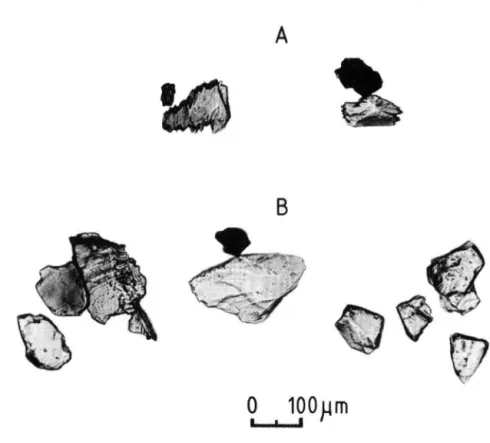
A few clinopyroxenes (less than 10 grains) are present in most of the samples; these are light green and often show a parallel stria set terminated b y acicular features (fig. l a ) . Basal
tic hornblende is rare. Both volcanic minerals are considered to be reworked from their source with non volcanic deposits.
A Volcanic Ash-Fall at the E a r l y / M i d Weichselian-Würmian Transition 3
A
0 100um
1 I i 1
Fig. 1: Clinopyroxenes from grande Pile; (A) typical singular grains found in most of the samples, and (B) grains from the enriched horizon at the 1092—1095 cm depth.
The segment of 1092—1095 cm depth is greatly enriched in volcanic heavy minerals, al
though no significant change was visible in the core. In addition to 284 clinopyroxenes and 9 basaltic hornblendes, 528 biotites were found in the slide. Most of the biotite are believed to be
long to the ash-fall because this abundance corresponds with a high enrichment of this mineral.
The clinopyroxenes are essentially colorless to pale green. Most of them are angular shards with no typical faces or cleavages (fig. lb); a few of them are saw-edged. The coarsest grain was about 250 mfi wide. These clinopyroxenes are suspected to be diopside. Because of previous use of different local terms for stratigraphical purpose (WOILLARD 1975), we propose to call this ash-fall "diopside ash-fall".
Stratigraphically, this ash lies just above the 5b stadial of MÖRNER (1979, 1981) which represents the maximum coldness of the E a r l y W e i c h s e l i a n - W ü r m i a n Glaciation (Glacia- tion M a x i m u m II of MÖRNER 1979). Hence i t marks the transition between the Early and Mid-Weichselian-Würmian.
In absolute age, it seems to fall between 53,000 BP and 62,000 BP (MÖRNER 1979, 1981;
WOILLARD & MOOK 1982).
We remind in the former introduction the occurrence of Laacher See-Tuff in two other peat bogs in the vicinity of Grande Pile (Etang du Boffy and Frere Joseph).
In Grande Pile core II (WOILLARD 1975), JUVIGNE discovered an enrichment in volca
nic material w i t h a heavy mineral suite similar to that of the "Laacher See-Tuff 5 final".
The designation "tuf de Grande P i l e " was given. This enrichment was within the " A r c y - Kesselt interstadial", based on a pollen diagram of WOILLARD (1975).
Five different cores from the area near the Grande Pile core X have been investigated in order to find the "tuf de Grande P i l e " and/or the "Laacher See-Tuff". This research met with no success but another ash layer was discovered (JUVIGNE & BASTIN 1982).
Using mineralogical variations demonstrated by JUVIGNE & SHIPLEY (1983) and JUVIG
NE (1983) all these ash layers could be correlated with each other but this would be incom
patible with the pollen diagrams.
3. C o n c l u s i o n
In the Grande Pile peat bog five ash-falls have been discovered.
Three of them were recognized by their heavy mineral suites in the fine sand fraction:
— the "tuf des Vosges meridionales" of preboreal age (JUVIGNE & BASTIN 1982).
— the "tuf de Grande P i l e " of "Arcy-Kesselt interstadial" age QUVIGNE 1978).
— the "diopside ash-fall" at the E a r l y / M i d Weichselian-Würmian transition.
Two other volcanic layers have been discovered by X-Ray analysis; no specific volcanic heavy minerals were found in the fine sand fraction.
— Ash G about 50,000 years BP (MÖRNER 1979).
— Ash N about 130,000 years BP (MÖRNER 1979).
Acknowledgment
SUSAN SHIPLEY (University of Washington, Quaternary Research Center) is gratefully acknowledged for correcting our manuscript.
References
FRENZEL, B. (1978): Führer zur Exkursionstagung des IGCP-Projektes 7 3 / 1 / 2 4 : "Quaternary Glaciations in the Northern hemisphere", 5. bis 13. September 1976, Südvogesen, nördliches Alpenvorland und Tirol. — Vervielfältigung: Deutsche Forschungsgemeinschaft, Bonn-Bad Go
desberg.
JUVIGNE, E. (1976): Contribution a la connaissance de la stratigraphie du Quaternaire par l'etude des mineraux denses transparents de l'Eifel au Massif Central francais et plus particulierement en Belgique. — These de doctorat en Sc. Geogr., inedit, Universite de Liege, 235 p. — Liege.
— (1977): La zone de dispersion des poussieres emises par une des dernieres eruptions du volcan du Laacher See.
A Volcanic Ash-Fall at the E a r l y / M i d Weichselian-Würmian Transition 5
JUVIGNE, E: Z. Geomorphol., 2 1 : 323—342; Berlin, Stuttgart.
— (1982): Decoverte de mineraux volcaniques dans des tourbieres des Vosges (France) — Bull. Soc.
Geog. Liege, 14: 205—210; Liege.
— (1983): Les variations mineralogiques dans les retombees de 1982 du volcan El Chichon (Chia
pas, M e x i q u e ) et leur interet pour la tephrostratigraphie. — A n n . Soc. Geol. Belg., 1 0 6 , Liege.
— [Sous presse].
— & BASTIN, B. (1982): D i c o u v e r t e d'un tuf volcanique d'äge preboreal ä la Grande Pile (Vosges, France). — Bull. Soc. Geogr. Liege, 1 8 : 31—40; Liege.
— & SHIPLEY, S. (1983): Distribution of m i n e r a l s in the downwind tephra lobe of the M a y 18, 1980 eruption of the Mount Saint Helens (Washington, U S A ) . — Eiszeitalter u. Gegenwart, 33:
1—7; Hannover.
MÖRNER, N.-A. (1977): Paleoclimatic correlations and chronology. — P r o c , IX C o n g r . IUSPP (Nice 1976), H. de L u m l e y (Ed.), last resting volume.
— (1979): The Grande Pile paleomagnetic/paleoclimatic record and the European glacial history of the last 130,000 years. — Inter. Proj. Paleolimn. Late Cenozoic C l i m . , 2 , 19—24.
— (1981): Weichselian chronostratigraphy and correlations. — Boreas. 1 0 : 463—470; Uppsala.
WOILLARD, G. (1975): Recherches palynologiques sur le Pleistocene dans l'est de la Belgique et dans les Vosges lorraines. — A c t a Geographica Lovaniensia, 14: 118p.; Louvain.
— & MOOK, W. (1982): Carbon-14 dates at Grande Pile: correlation of land and sea chronologies.
— Science, 2 1 5 : 159—161; London.
Manuscript accepted on 1.8.83.