To decrease high feeding costs, expensive milk protein and fat in milk substitutes for young calves are o�en replaced by ingredients of plant origin. The major portion of phosphorus (P) in these in-gredients is present in the form of salts of phytic acid (myo-inositolhexaphosphoric acid), which is the primary storage form of P in seeds of plants. Salts of phytic acid, phytates, are also present in various starter concentrates. Contrary to monogas-tric animals, adult ruminants utilise phytate P very well thank to symbiotic microflora in the rumen (Raun et al., 1956). Several authors concluded that phytates were hydrolysed to inositol and inorganic phosphate in high-producing dairy cows, consum-ing large quantities of concentrates (Clark et al.,
1986; Morse et al., 1992; Marounek et al., 2000). In weaned calves fed a concentrate composed of ground maize, oats and soybean meal, less than 1% of the ingested phytate P was recovered from the faeces (Nelson et al., 1976). Duskova et al. (2001a) found variable concentrations of phytic acid in rectal samples from calves 1, 6 and 13 weeks old, but no data on digestibility of phytate P in milk fed calves are available. Phytate hydrolysis has been a�ributed to rumen microorganisms, rumen func-tions, however, are impaired in the milk nutrition period. The aim of our study was to determine the digestibility of phytate P, total P and some other nutrients in young calves fed milk (6 l per day) and starter concentrate ad libitum (1st experiment),
Supported by the Ministry of Agriculture of the Czech Republic (Project No. MO2-99-04) and Ministry of Education, Youth and Sports of the Czech Republic (Project No.161700002).
Digestibility of total and phytate phosphorus
in young calves
V. S���������
1, M. M�������
1,2, R. D�����
31Research Institute of Animal Production, Prague-Uhrineves, Czech Republic
2Institute of Animal Physiology and Genetics, Academy of Sciences of the Czech Republic,
Prague, Czech Republic
3Clinic of Ruminant Diseases, University of Veterinary and Pharmaceutical Sciences, Brno,
Czech Republic
ABSTRACT: Two experiments were conducted to determine digestibility of total and phytate phosphorus (P) in young calves. In the 1st experiment 14 male calves received a commercial milk replacer (6 l of milk per day) and had free access to a starter concentrate. In the 2nd experiment 21 male calves were divided into 3 groups and fed ad libitum a milk replacer (Group I), milk replacer and starter concentrate (Group II), and milk replacer and silaged maize cobs (Group III). Digestibility measurements were carried out at the age of 10 weeks (1st experiment), and 12 and 16 weeks (2nd experiment). In the 1st experiment phytate P accounted for 27.0% of the total P intake. Phytate P was assayed by capillary isotachophoresis. On average, 27.9% of ingested P, but only 3.0% of phytate P were recovered from the faeces. The proportion of phytate P in total faecal P was 5.8%. In the 2nd experiment phytate P accounted for 8.9, 13.8 and 8.6% of total P in diets of calves of Group I, II and III, respectively. On average, 6.6% of ingested P and 3.6% of phytate P were recovered from the faeces. Dry ma�er of faeces contained total P, phytate P and phosphate P at 9.74, 0.65 and 4.69 mg/g, respectively. Faecal concentrations of total P significantly correlated with those of calcium (r = 0.71). It can be concluded that young calves utilised phytate P very efficiently as no more than a few % of phytate escaped degradation in the digestive tract.
or fed ad libitum milk without or with solid feeds (2ndexperiment).
MATERIAL AND METHODS
1st experiment
Fourteen Holstein male calves, between 4 and 5 weeks of age, were fed a commercial milk replacer Telasan V (Bodit Ltd., Tachov, Czech Republic). Milk was offered twice a day (6 l in total, 13.5% of solids) and its consumption was measured. A starter concentrate (ČOT-B from Zena Ltd., Mlada Boleslav, Czech Republic) was available ad libitum. Ingredients and determined chemical composition of feeds are presented in Table 1. The animals were housed in individual pens that were bedded with wood shavings. Calves were weighed in 10-day in-tervals. A digestibility trial was carried out at the age of 10 weeks. The preparatory period lasted for one week, then calves received 200 mg of Cr2O3 in capsule form twice a day. Feed consumption was recorded. Faeces were collected for 5 days to deter-mine digestibility of phytate and total phosphorus, dry ma�er, crude protein and ash.
2nd experiment
Twenty-one Holstein male calves, 5 weeks old on average, were divided into three groups. Calves of
all groups were fed ad libitum a commercial milk replacer Telasan V. In addition, calves of Group II had free access to a commercial starter concentrate ČOT-B. Silaged crushed maize cobs were available ad libitum to calves of Group III. Two digestibility trials were carried out as described above, at the age of 12 and 16 weeks.
Analyses and calculations
Phytate P in feeds and faeces was determined by a capillary isotachophoretic method (Duskova et al., 2001b). Faeces were freeze-dried and extracted with chloroform/methanol 2 : 1 in the Soxtec 1043 apparatus (Tecator AB, Sweden) to remove lipids. Phytic acid was then extracted with 0.95 M HCl (50 ml per 5 g sample), precipitated with FeCl3, and ferric phytate dissolved in 1.5 M NaOH. The Fe(OH)3 precipitate was removed by centrifugation, and the supernatant neutralised by adding the catex Dowex 50 WX8 in H+-cycle. The solution was
[image:2.595.62.537.528.683.2]ana-lysed by means of the column-coupling instrument EA 101 (Villa Labeco Comp., Slovakia). The limit of determination of phytic acid in the extract was ca. 0.3 µmol/ml. The phytate zone was identified on the basis of the step height using a standard solution. In addition, a pooled sample of calf faeces was treated with phytase (Sigma, No. P-1259) as described by Duskova et al. (2001b), and analysed again. Total phosphorus in feeds and faeces was determined by a molybdovanadate reagent, a�er ashing of dry
Table 1. Composition of feeds of calves
g/kg Milk replacer1 Starter concentrate2 Silaged maize cobs
Dry ma�er 950 889 499
Crude protein 225 190 43.5
Fat 149 32.8 17.1
Fibre 8.8 58.5 82.1
Ash 61.9 57.7 21.4
Phytate P 0.65 2.52 0.01
Total P 7.33 7.31 1.09
Ca 6.68 8.50 1.10
1milk replacer Telasan V contained (g/kg): dried whey with palm oil (490), dried bu�ermilk with palm oil (230),
heat-treated soybean meal (70), extracted linseed meal (50), feed casein (50), feed albumin (50), yeast (30), soybean protein (10), citric acid (10), vitamin and mineral supplement (10)
2starter ČOT-B contained (g/kg): ground barley (246), wheat (180), extracted soybean meal (172), wheat bran (120),
samples at 550°C (AOAC, 1980). Phosphates present in faeces were extracted with 5% (w/v) trichloroace-tic acid and determined by the Fiske and SubbaRow method, as modified by Peterson (1978).
Feeds and faeces were air-dried at 105°C to con-stant weight to estimate the dry ma�er content. Contents of protein, fat and fibre were determined employing instruments Kjeltec Auto 1030 Analyser, Soxtec 1043 and Fibertec 2010 from Tecator AB Comp. (Sweden), respectively. Calcium and chro-mium were determined by the atomic absorption spectrometry using a Perkin Elmer 5000 instru-ment.
Digestibility of nutrients was calculated as de-scribed by Kracmar (1981). Data were analysed by one-way analysis of variance, followed by the Bonferroni test where appropriate. Age effect was evaluated by the t-test.
RESULTS
The zone of phytates in extracts of feeds and faeces was well separated from zones of lower inositolphosphates and inorganic phosphate, and disappeared in the extract treated with phytase. Samples of feeds and faeces contained a small amount of lower inositolphosphates (Figure 1). Milk replacer, starter concentrate and silaged cobs used in this study contained 0.65, 2.52 and 0.01 g of phytate P per kg, respectively (Table 1). The
propor-tion of phytate P in total P of these feeds was 8.9, 34.5 and 0.9%.
In the 1st experiment, phytate P accounted for 27.0% of the total P intake of calves fed the milk replacer and starter. Digestibility of phytate P was higher than apparent digestibility of total P (Table 2). On average, 3.0% of ingested phytate P and 27.9% of total P were recovered from the faeces. Digestibility of dry ma�er was higher than that of crude protein (94.8 vs. 72.3%). The concentration of phytate P in faeces ranged from 0 to 1.48 mg/g dry ma�er. On average, phytate P accounted for 5.8% of total P in faeces.
In the 2nd experiment, phytate P accounted for 8.9, 13.8 and 8.6% of the total P intake in calves of Group I, II and III, respectively. The intake of phytate P was significantly higher (P < 0.05) in calves consuming milk replacer and starter
100
0
T
L L
Time P
Pi Pi
R
el
at
iv
e
re
si
st
an
ce
(%
)
T
LI LI
[image:3.595.307.531.387.725.2](before hydrolysis) (after hydrolysis)
[image:3.595.66.291.515.681.2]Figure 1. Isotachophoregrams of extracts of faeces of calves before and a�er hydrolysis of phytic acid by phytase; P = phytate; LI = lower inositolphosphates; Pi = inorganic phosphate; L = leading ion; T = terminating ion
Table 2. Intake of feeds, phytate and total P and calcium, and digestibility of nutrients, and faeces composition in calves fed milk replacer and starter concentrate. Results of the 1stexperiment
Age of calves1 70 (0.4)
Weight of calves1 82.9 (0.8)
Intake (g/day)
Milk replacer 717 (27)
Starter 1 816 (78)
Total P 18.5 (5)
Phytate P 5.0 (1)
Ca 20.2 (6)
Digestibility (%)
Dry ma�er 94.8 (0.3)
Crude protein 72.3 (1.8)
Total P 72.1 (1.4)
Phytate P 97.0 (0.4)
Ca 42.6 (3.3)
Faeces composition
Dry ma�er (mg/g) 231 (10)
Crude protein (mg/g DM) 265 (10) Total P (mg/g DM) 7.09 (0.22) Phytate P (mg/g DM) 0.41 (0.11)
Ca (mg/g DM) 22.5 (0.1)
Standard errors are given in parentheses
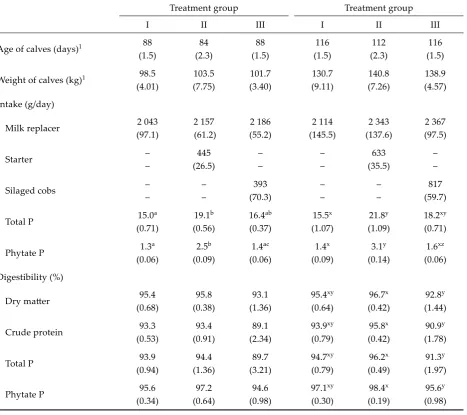
(Group II) than in the other calves (Table 3). In one calf the digestibility of phytate P was 88.9%. In other calves it ranged from 92.1 to 99.1%. Apparent di-gestibility of total P ranged from 74.8 to 97.2%. On average, 3.6% of ingested phytate P and 6.6% of total P were recovered in the faeces. Calves consuming milk replacer and starter concentrate (Group II) digested phytate P, total P, dry ma�er and crude protein be�er than calves fed milk replacer with maize cobs (Group III). In 16-week-old calves these differences were statistically significant (P < 0.05).
At the end of the experiment, calves of both groups consuming solid feeds gained insignificantly more than calves of Group I (P > 0.05).
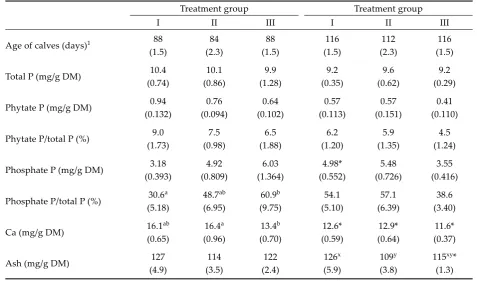
[image:4.595.67.535.299.714.2]Table 4 presents data on the composition of faeces of calves in the 2nd experiment. Phytate P accounted for on average 6.6% of total P in faeces. The concentration of total P in faeces significantly correlated with that of Ca (r = 0.71; P < 0.001). Correlation between faecal concentrations of phytate P and Ca was also statistically significant, but less pronounced (r = 0.36; P < 0.02). Phosphates
Table 3. Intake of feeds, total and phytate P, and nutrient digestibility in calves fed milk replacer (Group I), milk replacer and starter (Group II), and milk replacer and silaged maize cobs (Group III). Results of the 2nd experi-ment
Treatment group Treatment group
I II III I II III
Age of calves (days)1 88
(1.5) 84 (2.3) 88 (1.5) 116 (1.5) 112 (2.3) 116 (1.5)
Weight of calves (kg)1 98.5
(4.01) 103.5 (7.75) 101.7 (3.40) 130.7 (9.11) 140.8 (7.26) 138.9 (4.57) Intake (g/day)
Milk replacer 2 043
(97.1) 2 157 (61.2) 2 186 (55.2) 2 114 (145.5) 2 343 (137.6) 2 367 (97.5) Starter – – 445 (26.5) – – – – 633 (35.5) – –
Silaged cobs –– –– (70.3)393 –– –– (59.7)817
Total P 15.0a
(0.71) 19.1b (0.56) 16.4ab (0.37) 15.5x (1.07) 21.8y (1.09) 18.2xy (0.71)
Phytate P 1.3a
(0.06) 2.5b (0.09) 1.4ac (0.06) 1.4x (0.09) 3.1y (0.14) 1.6xz (0.06) Digestibility (%)
Dry ma�er 95.4
(0.68) 95.8 (0.38) 93.1 (1.36) 95.4xy (0.64) 96.7x (0.42) 92.8y (1.44)
Crude protein 93.3
(0.53) 93.4 (0.91) 89.1 (2.34) 93.9xy (0.79) 95.8x (0.42) 90.9y (1.78)
Total P 93.9
(0.94) 94.4 (1.36) 89.7 (3.21) 94.7xy (0.79) 96.2x (0.49) 91.3y (1.97)
Phytate P 95.6
(0.34) 97.2 (0.64) 94.6 (0.98) 97.1xy (0.30) 98.4x (0.19) 95.6y (0.98)
Standard errors are given in parentheses
1at the start of digestibility measurement
extractable with 5% trichloroacetic acid were the principal fraction of P in faeces (48.3% of total P, on average). Concentrations of phytate P, total P and calcium in faeces decreased with age, but only the effect of age on faecal Ca concentration was significant (P < 0.05).
DISCUSSION
In the 1st experiment the availability of milk was restricted to 6 l offered per day. In the 2nd experi-ment milk was available ad libitum. Table 3 shows that calves given milk ad libitum had limited desire to eat solid feeds. Most nutrients were thus sup-plied with milk replacer, and, as expected, nutri-ent digestibility was high. Digestibility of total P and crude protein in calves of 1st experiments was lower. Digestibility of phytate P was high in calves of all groups despite of the fact that rumen func-tions in young calves are not fully developed. On average, 97.0 and 96.4% of phytate was hydrolysed
in the digestive tract of calves in the 1st and the 2nd experiment, respectively. High apparent P digest-ibility (96.3%) was found by Guilloteau and Toullec (1980) in calves fed skim milk. Corresponding val-ues of apparent P digestibility in older ca�le (Wi� and Owens, 1983; Klosch et al., 1997) and weaned calves (Challa and Braithwaite, 1988) were lower. Low faecal losses of P (ca. 17 and 10 mg/day per kg of live weight in the 1st and the 2nd experiment, respectively) presumably reflect high P requirement of young, rapidly growing animals.
[image:5.595.58.536.113.394.2]Calcium hinders the phytate hydrolysis (Maenz et al., 1999; Marounek et al., 2003). Excessive Ca intake increased phytate content in faeces of pigs (Seynaeve et al., 2000), hens (Scheideler and Sell, 1987), and rats (Wise and Gilburt, 1982). In this study faecal concentrations of total and phytate P significantly correlated with concentration of Ca. This can be explained by the formation of insoluble complexes containing both elements. No correla-tion, however, was found between faecal Ca concen-tration and total P and phytate P digestibility. Table 4. Content of phosphorus fractions, calcium and ash in faeces of calves fed milk replacer (Group I), milk replacer and starter (Group II), and milk replacer and silaged maize cobs (Group III). Results of the 2nd experiment
Treatment group Treatment group
I II III I II III
Age of calves (days)1 88
(1.5)
84 (2.3)
88 (1.5)
116 (1.5)
112 (2.3)
116 (1.5)
Total P (mg/g DM) 10.4
(0.74)
10.1 (0.86)
9.9 (1.28)
9.2 (0.35)
9.6 (0.62)
9.2 (0.29)
Phytate P (mg/g DM) 0.94
(0.132)
0.76 (0.094)
0.64 (0.102)
0.57 (0.113)
0.57 (0.151)
0.41 (0.110)
Phytate P/total P (%) 9.0 (1.73)
7.5 (0.98)
6.5 (1.88)
6.2 (1.20)
5.9 (1.35)
4.5 (1.24)
Phosphate P (mg/g DM) 3.18 (0.393)
4.92 (0.809)
6.03 (1.364)
4.98* (0.552)
5.48 (0.726)
3.55 (0.416)
Phosphate P/total P (%) (5.18)30.6a 48.7(6.95)ab (9.75)60.9b (5.10)54.1 (6.39)57.1 (3.40)38.6
Ca (mg/g DM) 16.1ab
(0.65)
16.4a
(0.96)
13.4b
(0.70)
12.6* (0.59)
12.9* (0.64)
11.6* (0.37)
Ash (mg/g DM) (4.9)127 (3.5)114 (2.4)122 (5.9)126x 109(3.8)y 115(1.3)xy*
Standard errors are given in parentheses
a,b,c; x,y,zvalues in the same row and section with unlike superscript differ significantly at P < 0.05
In summary, the present results indicate that only a few % of the ingested phytate P escape hydrolysis in the digestive tract of young calves in the milk nu-trition period. Concentrations of phytate P in faeces were well measurable, but much lower than those reported in faeces of pigs and poultry (Duskova et al., 2001b). Our results are in line with the opinion that almost all phytates are degraded in the rumi-nant digestive tract.
REFERENCES
AOAC (1980): Official Methods of Analysis. Association of Official Analytical Chemists. Washington, DC. Challa J., Braithwaite G.D. (1988): Phosphorus and
cal-cium metabolism in growing calves with special em-phasis on phosphorus homeostasis. 1. Studies of the effects of changes in the dietary phosphorus intake on phosphorus and calcium metabolism. J. Agric. Sci., Camb., 110, 573–581.
Clark W.D.Jr., Wohlt J.E., Gilbreath R.L., Zajac P.K. (1986): Phytate phosphorus intake and disapperance in the gastrointestinal tract of high producing dairy cows. J. Dairy Sci., 69, 3151–3155.
Duskova D., Dvorak R., Rada V., Doubek J., Marounek M. (2001a): Concentration of phytic acid in faeces of calves fed starter diets. Acta Vet. Brno, 70, 381–385. Duskova D., Marounek M., Brezina P. (2001b):
Determina-tion of phytic acid in feeds and faeces of pigs and poultry by capillary isotachophoresis. J. Sci. Food Ag-ric., 81, 36–41.
Guilloteau P., Toullec R. (1980): Digestion of milk protein and methanol-grown bacteria protein in the prerumi-nant calf. I. Kinetics and balance in the terminal small intestine and faecal balance. Reprod. Nutr. Dev., 20, 601–613.
Klosch M., Richter G.H., Schneider A., Flachowsky G., Pfeffer E. (1997): Einfluss der Rationsgestaltung auf die faecale Phosphorausscheidung bei unterschiedlich schweren Mastbullen. Arch. Anim. Nutr., 50, 163–172. Kracmar S. (1981): Nutrition of Farm Animals (in Czech).
Agricultural University in Brno.
Maenz D.D., Engele-Schaan M., Newkirk R.W., Classen H.L. (1999): The effect of minerals and mineral chelators on the formation of resistant and phytase-susceptible forms of phytic acid in solution and in a slurry of canola meal. Anim. Feed Sci. Technol., 81, 177–192.
Marounek M., Duskova D., Skrivanova V. (2000): Isotacho-phoretic determination of phytate phosphorus in faeces of ca�le, pigs and hens. Reprod. Nutr. Dev., 40, 223. Marounek M., Duskova D., Skrivanova V. (2003):
Hy-drolysis of phytic acid and its availability in rabbits. Brit. J. Nutr., 89, 287–294.
Morse D., Head H.H., Wilcox C.J. (1992): Disappearance of phosphorus in phytate from concentrates in vitro and from rations fed to lactating dairy cows. J. Dairy Sci., 75, 1979–1986.
Nelson T.S., Daniels L.B., Hall J.R., Shields L.G. (1976): Hydrolysis of natural phytate phosphorus in the diges-tive tract of calves. J. Anim. Sci., 42, 1509–1512. Peterson G.L. (1978): A simplified method for analysis of
inorganic phosphate in the presence of interfering substances. Anal. Biochem., 84, 164–172.
Raun A., Cheng E., Burroughs W. (1956): Phytate phos-phorus hydrolysis and availability to rumen microor-ganisms. Agric. Food Chem., 4, 869–871.
Scheideler S.E., Sell J.R. (1987): Utilization of phytate phosphorus in laying hens as influenced by dietary phosphorus and calcium. Nutr. Rep. Inter., 35, 1073–1080.
Seynaeve M., Janssens G., Hesta M., Van Nevel C., De Wilde R.O. (2000): Effects of dietary Ca/P ratio, P level and microbial phytase supplementation on nutrient digestibilities in growing pigs: breakdown of phytic acid, partition of P and phytase activity along the intestinal tract. J. Anim. Physiol. Anim. Nutr., 83, 193–204. Wise A., Gilburt D.J. (1982): Phytate hydrolysis by
ger-mfree and conventional rats. Appl. Environ. Microbiol., 43, 753–756.
Witt K.E., Owens F.N. (1983): Phosphorus: ruminal availability and effects on digestion. J. Anim. Sci., 56, 930–937.
Received: 03–10–02 Accepted a�er corrections: 04–02–25
Corresponding Author
Prof. Milan Marounek, Research Institute of Animal Production, Přátelství 815, P.O. Box 1, 104 01 Praha 10-Uhříněves, Czech Republic