A monoclinic polymorph of
1-(4-chloro-
phenyl)-3-(4-methoxyphenyl)prop-2-en-1-one
Jerry P. Jasinski,a* Ray J. Butcher,bB. Narayana,c S. Samshuddincand H. S. Yathirajand
aDepartment of Chemistry, Keene State College, 229 Main Street, Keene,
NH 03435-2001, USA,bDepartment of Chemistry, Howard University, 525 College
Street NW, Washington, DC 20059, USA,cDepartment of Studies in Chemistry,
Mangalore University, Manalaganotri 574 199, India, anddDepartment of Studies in
Chemistry, University of Mysore, Manasagangotri, Mysore 570 006, India Correspondence e-mail: [email protected]
Received 5 December 2009; accepted 21 December 2009
Key indicators: single-crystal X-ray study;T= 110 K; mean(C–C) = 0.002 A˚; Rfactor = 0.035;wRfactor = 0.096; data-to-parameter ratio = 14.7.
The crystal structure of the title compound, C16H13ClO2(II),
(space group P21/c,) is a polymorph of the structure, (I),
reported by Harrison, Yathirajan, Sarojini, Narayana & Indira [Acta Cryst. (2006), E62, o1647–o1649] in the orthorhombic space group Pna21. The dihedral angle between the mean
planes of the 4-chloro- and 4-methoxy-substituted benzene rings is 52.9 (1)in (II) compared to 21.82 (6)for polymorph (I). The dihedral angles between the mean planes of the prop-2-en-1-one group and those of the chlorophenyl and 4-methoxyphenyl rings are 23.3 (3) and 33.7 (1), respectively. in (II). The corresponding values are 17.7 (1) and 6.0 (3), respectively, in polymorph (I). In the crystal, weak C—H interactions are observed.
Related literature
For the orthorhomic polymorph, see: Harrison et al.(2006). For the biological activity of chalcones and flavonoids, see: Dimmocket al.(1999); Opletalova & Sedivy (1999); Linet al. (2002); Nowakowska (2007). For the synthesis and biological activity of some fluorinated chalcone derivatives, see: Naka-muraet al.(2002). For non-linear optical studies of chalcones and their derivatives, see: Sarojiniet al.(2006); Poorneshet al. (2009); Shettigar et al.(2006, 2008). For our studies of chal-cones, see: Jasinskiet al.(2009).
Experimental
Crystal data
C16H13ClO2 Mr= 272.71
Monoclinic,P21=c a= 15.6695 (7) A˚ b= 14.1235 (8) A˚ c= 5.8455 (3) A˚
= 90.771 (5)
V= 1293.53 (12) A˚3 Z= 4
CuKradiation
= 2.57 mm1 T= 110 K
0.540.130.08 mm
Data collection
Oxford Diffraction Xcalibur diffractometer with a Ruby (Gemini Cu) detector Absorption correction: multi-scan
(CrysAlis RED; Oxford
Diffraction, 2007) Tmin= 0.483,Tmax= 0.558 5083 measured reflections 2537 independent reflections 2223 reflections withI> 2(I) Rint= 0.021
Refinement
R[F2> 2(F2)] = 0.035 wR(F2) = 0.096 S= 1.04 2537 reflections
173 parameters
H-atom parameters constrained
max= 0.25 e A˚
3
min=0.22 e A˚
[image:1.610.313.566.449.493.2]3
Table 1
Hydrogen-bond geometry (A˚ ,).
Cg1 andCg2 are the centroids of the C1–C6 and C10–C15 rings, respectively. D—H A D—H H A D A D—H A C2—H2 Cg1i
0.95 2.85 3.4675 (15) 124 C12—H12 Cg2ii
0.95 2.92 3.6616 (17) 136
Symmetry codes: (i)x;yþ3 2;zþ
1
2; (ii)x;yþ 3 2;z
1 2.
Data collection: CrysAlis PRO(Oxford Diffraction, 2007); cell refinement: CrysAlis RED (Oxford Diffraction, 2007); data reduc-tion:CrysAlis RED; program(s) used to solve structure:SHELXS97 (Sheldrick, 2008); program(s) used to refine structure:SHELXL97 (Sheldrick, 2008); molecular graphics:SHELXTL(Sheldrick, 2008); software used to prepare material for publication:SHELXL97.
SS thanks Mangalore University and the UGC SAP for financial assistance for the purchase of chemicals. RJB acknowledges the NSF MRI program (grant No. CHE-0619278) for funds to purchase an X-ray diffractometer.
Supplementary data and figures for this paper are available from the IUCr electronic archives (Reference: OM2306).
organic compounds
Acta Cryst.(2010). E66, o269–o270 doi:10.1107/S1600536809054956 Jasinskiet al.
o269
Acta Crystallographica Section EStructure Reports
Online
References
Dimmock, J. R., Elias, D. W., Beazely, M. A. & Kandepu, N. M. (1999).Curr. Med. Chem.6, 1125–1149.
Harrison, W. T. A., Yathirajan, H. S., Sarojini, B. K., Narayana, B. & Indira, J. (2006).Acta Cryst.E62, o1647–o1649.
Jasinski, J. P., Butcher, R. J., Mayekar, A. N., Yathirajan, H. S. & Narayana, B. (2009).J. Chem. Crystallogr.39, 157–162.
Lin, Y. M., Zhou, Y., Flavin, M. T., Zhou, L. M., Nie, W. & Chen, F. C. (2002). Bioorg. Med. Chem.10, 2795–2802.
Nakamura, C., Kawasaki, N., Miyataka, H., Jayachandran, E., Kim, I., Kirk, K. L., Taguchi, T., Takeuchi, Y., Hori, H. & Satoh, T. (2002).Bioorg. Med. Chem.10, 699–706.
Nowakowska, Z. (2007).Eur. J. Med. Chem.42, 125–137. Opletalova, V. & Sedivy, D. (1999).Ceska Slov. Farm.48, 252–255. Oxford Diffraction (2007). CrysAlis PRO and CrysAlis RED. Oxford
Diffraction Ltd, Abingdon, England.
Poornesh, P., Shettigar, S., Umesh, G., Manjunatha, K. B., Prakash Kamath, K., Sarojini, B. K. & Narayana, B. (2009).Opt. Mater.31, 854–859.
Sarojini, B. K., Narayana, B., Ashalatha, B. V., Indira, J. & Lobo, K. J. (2006).J. Cryst. Growth,295, 54–59.
Sheldrick, G. M. (2008).Acta Cryst.A64, 112–122.
Shettigar, S., Chandrasekharan, K., Umesh, G., Sarojini, B. K. & Narayana, B. (2006).Polymer,47, 3565–3567.
supporting information
sup-1 Acta Cryst. (2010). E66, o269–o270
supporting information
Acta Cryst. (2010). E66, o269–o270 [https://doi.org/10.1107/S1600536809054956]
A monoclinic polymorph of
1-(4-chlorophenyl)-3-(4-methoxyphenyl)prop-2-en-1-one
Jerry P. Jasinski, Ray J. Butcher, B. Narayana, S. Samshuddin and H. S. Yathirajan
S1. Comment
Chalcone is an unique template molecule that is associated with several biological activities. A review on the bioactivities
of chalcones is described (Dimmock et al. 1999). Chalcones and their heterocyclic analogs as potential antifungal
chemotherapeutic agents is published (Opletalova & Sedivy, 1999). Chalcones and flavonoids as anti-tuberculosis agents
has been reported (Lin et al. 2002) and a review of anti-infective and anti-inflammatory chalcones is also described
(Nowakowska, 2007) as well as the synthesis and biological activities of some fluorinated chalcone derivatives
(Nakamura et al. 2002). In addition, chalcones are finding applications as organic non-linear optical materials (NLO) due
to their good SHG conversion efficiencies (Sarojini et al. 2006). Recently, non-linear optical studies on a few chalcones
and their derivatives were reported (Poornesh et al. 2009; Shettigar et al. 2006; 2008). In continuation of our work on
chalcones (Jasinski et al. 2009) and in view of the importance of chloro chalcones, this paper describes a new
polymorphic form of (I), C16H13ClO2, 1-(4-chlorophenyl)-3-(4-methoxyphenyl)-prop-2-en-1-one, first reported by
Harrison et al. (2006). Substantial changes in the cell parameters provides solid support for the recognition of this new
polymorphic form for (I).
The title compound, (II), is a chalcone derivative with 4-chlorophenyl and 4-methoxyphenyl rings bonded at the
opposite ends of a propenone group, the biologically active region (Fig.1). The dihedral angle between mean planes of the
4-chloro and 4-methoxy substituted benzene rings in (II) is 52.9 (1)° compared to 21.82 (6)° (Harrison et al. (2006);
4-chlorohenyl & 4-methoxyphenyl) for polymorph (I) in the orthorhombic, Pna21, space group. The angles between the
mean plane of the prop-2-ene-1-one group and those of the 4-chlorophenyl and 4-methoxyphenyl rings in (II) are
23.3 (3)° and 33.7 (1)°, respectively. This compares to 17.7 (1)° and 6.0 (3)° in polymorph (I). A weak intramolecular
C9–H9···O1 hydrogen bond interaction is present which may help to maintain the molecular conformation of the
molecule (Table 1) and similar to that observed in (I). While no classical hydrogen bonds are present, weak
intermolecular C–H···Cgπ-ring interactions are observed, Cg1 = C1–C6 and Cg2 = C10–C15, see Table 1.
S2. Experimental
In (II), 4-chloroacetophenone in ethanol (1.54 g, 0.01 mol) (25 ml) was mixed with 4-methoxybenzaldehyde (1.36 g, 0.01
mol) in ethanol (25 ml) and the mixture was treated with an aqueous solution of potassium hydroxide (20 ml, 5%). This
mixture was stirred well and left to stand for 24 hr. The resulting crude solid mass was collected by filtration and
recrystallized from ethanol, yielding clear blocks of (II). Yield: 90%, m.p.: 391–393 K, analysis found (calculated) for
C16H13ClO2: C: 70.5 (70.4%); H: 4.72 (4.76%). The preparation and crystallization procedure for (I) was identical to that
described above for (II). However, in (I) the m.p. measured 380 K, a difference of 12 K. The samples of (I) and (II) were
S3. Refinement
All of the H atoms were placed in their calculated positions and then refined using the riding model with C—H = 0.95–
[image:4.610.133.475.126.242.2]0.98 Å, and with Uiso(H) = 1.18–1.48Ueq(C).
Figure 1
Molecular structure of the title compound, C16H13ClO2, (II), showing the atom labeling scheme and 50% probability
displacement ellipsoids.
Figure 2
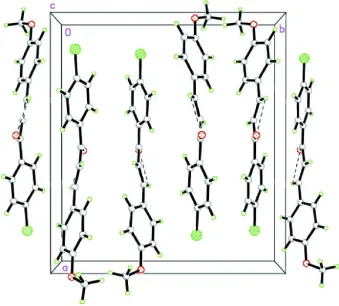
Packing diagram of the title compound, (II), viewed down the c axis. Weak C–H..O intramolecular hydrogen bond
[image:4.610.135.474.297.603.2]supporting information
sup-3 Acta Cryst. (2010). E66, o269–o270
1-(4-chlorophenyl)-3-(4-methoxyphenyl)prop-2-en-1-one
Crystal data
C16H13ClO2
Mr = 272.71
Monoclinic, P21/c
Hall symbol: -P 2ybc
a = 15.6695 (7) Å
b = 14.1235 (8) Å
c = 5.8455 (3) Å
β = 90.771 (5)°
V = 1293.53 (12) Å3
Z = 4
F(000) = 568
Dx = 1.400 Mg m−3
Cu Kα radiation, λ = 1.54184 Å
Cell parameters from 3121 reflections
θ = 4.2–73.8°
µ = 2.57 mm−1
T = 110 K
Needle, colorless 0.54 × 0.13 × 0.08 mm
Data collection
Oxford Diffraction Xcalibur
diffractometer with a Ruby (Gemini Cu) detector
Radiation source: Enhance (Cu) X-ray Source Graphite monochromator
Detector resolution: 10.5081 pixels mm-1
ω scans
Absorption correction: multi-scan
(CrysAlis RED; Oxford Diffraction, 2007)
Tmin = 0.483, Tmax = 0.558 5083 measured reflections 2537 independent reflections 2223 reflections with I > 2σ(I)
Rint = 0.021
θmax = 74.0°, θmin = 4.2°
h = −19→17
k = −16→17
l = −5→7
Refinement
Refinement on F2
Least-squares matrix: full
R[F2 > 2σ(F2)] = 0.035
wR(F2) = 0.096
S = 1.04
2537 reflections 173 parameters 0 restraints
Primary atom site location: structure-invariant direct methods
Secondary atom site location: difference Fourier map
Hydrogen site location: inferred from neighbouring sites
H-atom parameters constrained
w = 1/[σ2(F
o2) + (0.0574P)2 + 0.4041P]
where P = (Fo2 + 2Fc2)/3
(Δ/σ)max = 0.001
Δρmax = 0.25 e Å−3 Δρmin = −0.22 e Å−3
Special details
Geometry. All e.s.d.'s (except the e.s.d. in the dihedral angle between two l.s. planes) are estimated using the full covariance matrix. The cell e.s.d.'s are taken into account individually in the estimation of e.s.d.'s in distances, angles and torsion angles; correlations between e.s.d.'s in cell parameters are only used when they are defined by crystal symmetry. An approximate (isotropic) treatment of cell e.s.d.'s is used for estimating e.s.d.'s involving l.s. planes.
Refinement. Refinement of F2 against ALL reflections. The weighted R-factor wR and goodness of fit S are based on F2,
conventional R-factors R are based on F, with F set to zero for negative F2. The threshold expression of F2 > σ(F2) is used
only for calculating R-factors(gt) etc. and is not relevant to the choice of reflections for refinement. R-factors based on F2
are statistically about twice as large as those based on F, and R- factors based on ALL data will be even larger.
Fractional atomic coordinates and isotropic or equivalent isotropic displacement parameters (Å2)
x y z Uiso*/Ueq
Cl1 0.84683 (2) 0.61936 (3) 0.17788 (6) 0.02523 (13)
O1 0.47093 (7) 0.63259 (9) 0.70069 (19) 0.0289 (3)
O2 0.01821 (7) 0.61488 (8) −0.07719 (19) 0.0241 (3)
C2 0.63878 (9) 0.66090 (10) 0.5520 (2) 0.0188 (3)
H2 0.6255 0.6849 0.6990 0.023*
C3 0.72286 (9) 0.65859 (10) 0.4828 (3) 0.0198 (3)
H3 0.7672 0.6817 0.5800 0.024*
C4 0.74128 (9) 0.62174 (10) 0.2682 (3) 0.0193 (3)
C5 0.67775 (10) 0.58747 (11) 0.1233 (3) 0.0205 (3)
H5 0.6916 0.5612 −0.0212 0.025*
C6 0.59317 (9) 0.59211 (11) 0.1929 (3) 0.0202 (3)
H6 0.5489 0.5705 0.0934 0.024*
C7 0.48352 (9) 0.63066 (10) 0.4945 (3) 0.0200 (3)
C8 0.41225 (9) 0.63059 (11) 0.3255 (3) 0.0211 (3)
H8 0.4223 0.6467 0.1704 0.025*
C9 0.33359 (9) 0.60773 (11) 0.3930 (3) 0.0200 (3)
H9 0.3284 0.5885 0.5479 0.024*
C10 0.25468 (9) 0.60893 (10) 0.2562 (3) 0.0181 (3)
C11 0.24715 (9) 0.65496 (11) 0.0440 (3) 0.0202 (3)
H11 0.2960 0.6839 −0.0206 0.024*
C12 0.16938 (9) 0.65893 (11) −0.0730 (3) 0.0200 (3)
H12 0.1648 0.6915 −0.2149 0.024*
C13 0.09809 (9) 0.61476 (10) 0.0193 (3) 0.0187 (3)
C14 0.10492 (9) 0.56679 (11) 0.2274 (3) 0.0202 (3)
H14 0.0567 0.5354 0.2882 0.024*
C15 0.18181 (9) 0.56513 (11) 0.3443 (2) 0.0199 (3)
H15 0.1856 0.5336 0.4877 0.024*
C16 0.00342 (10) 0.67344 (13) −0.2722 (3) 0.0263 (3)
H16A 0.0140 0.7397 −0.2311 0.039*
H16B −0.0559 0.6662 −0.3248 0.039*
H16C 0.0420 0.6547 −0.3948 0.039*
Atomic displacement parameters (Å2)
U11 U22 U33 U12 U13 U23
Cl1 0.0180 (2) 0.0276 (2) 0.0302 (2) 0.00214 (13) 0.00556 (14) 0.00128 (15)
O1 0.0214 (6) 0.0441 (7) 0.0212 (6) −0.0035 (5) 0.0006 (4) 0.0008 (5)
O2 0.0158 (5) 0.0266 (6) 0.0298 (6) −0.0025 (4) −0.0041 (4) 0.0048 (5)
C1 0.0174 (7) 0.0170 (7) 0.0198 (7) −0.0009 (5) −0.0019 (5) 0.0039 (6)
C2 0.0197 (7) 0.0188 (7) 0.0180 (7) 0.0019 (5) −0.0009 (5) −0.0002 (6)
C3 0.0185 (7) 0.0188 (7) 0.0221 (7) 0.0000 (5) −0.0031 (5) −0.0009 (6)
C4 0.0167 (7) 0.0172 (7) 0.0239 (7) 0.0018 (5) 0.0022 (6) 0.0034 (6)
C5 0.0251 (7) 0.0189 (7) 0.0176 (7) 0.0019 (6) 0.0016 (6) −0.0002 (5)
C6 0.0194 (7) 0.0206 (7) 0.0206 (7) −0.0015 (5) −0.0038 (5) 0.0008 (6)
C7 0.0196 (7) 0.0193 (7) 0.0212 (7) −0.0006 (5) −0.0008 (6) 0.0012 (6)
C8 0.0178 (7) 0.0248 (8) 0.0207 (7) 0.0005 (6) 0.0000 (6) 0.0021 (6)
C9 0.0206 (7) 0.0189 (7) 0.0204 (7) 0.0017 (5) −0.0001 (6) 0.0010 (6)
C10 0.0167 (7) 0.0170 (7) 0.0207 (7) 0.0023 (5) 0.0015 (5) −0.0012 (6)
C11 0.0164 (7) 0.0222 (7) 0.0220 (7) −0.0007 (5) 0.0032 (5) 0.0011 (6)
C12 0.0195 (7) 0.0215 (8) 0.0190 (7) 0.0001 (6) 0.0012 (5) 0.0008 (6)
supporting information
sup-5 Acta Cryst. (2010). E66, o269–o270
C14 0.0177 (7) 0.0187 (7) 0.0245 (7) −0.0015 (5) 0.0039 (5) 0.0012 (6)
C15 0.0212 (7) 0.0186 (7) 0.0201 (7) 0.0016 (6) 0.0030 (5) 0.0015 (6)
C16 0.0213 (7) 0.0341 (9) 0.0235 (8) 0.0027 (6) −0.0036 (6) 0.0014 (7)
Geometric parameters (Å, º)
Cl1—C4 1.7431 (15) C8—H8 0.9500
O1—C7 1.2240 (19) C9—C10 1.464 (2)
O2—C13 1.3659 (18) C9—H9 0.9500
O2—C16 1.4248 (19) C10—C15 1.403 (2)
C1—C6 1.394 (2) C10—C11 1.404 (2)
C1—C2 1.401 (2) C11—C12 1.391 (2)
C1—C7 1.500 (2) C11—H11 0.9500
C2—C3 1.384 (2) C12—C13 1.395 (2)
C2—H2 0.9500 C12—H12 0.9500
C3—C4 1.392 (2) C13—C14 1.395 (2)
C3—H3 0.9500 C14—C15 1.377 (2)
C4—C5 1.386 (2) C14—H14 0.9500
C5—C6 1.393 (2) C15—H15 0.9500
C5—H5 0.9500 C16—H16A 0.9800
C6—H6 0.9500 C16—H16B 0.9800
C7—C8 1.481 (2) C16—H16C 0.9800
C8—C9 1.339 (2)
C13—O2—C16 118.00 (12) C8—C9—H9 116.2
C6—C1—C2 119.36 (14) C10—C9—H9 116.2
C6—C1—C7 122.52 (13) C15—C10—C11 118.00 (13)
C2—C1—C7 118.09 (13) C15—C10—C9 118.70 (14)
C3—C2—C1 120.69 (14) C11—C10—C9 123.25 (13)
C3—C2—H2 119.7 C12—C11—C10 121.06 (13)
C1—C2—H2 119.7 C12—C11—H11 119.5
C2—C3—C4 118.82 (13) C10—C11—H11 119.5
C2—C3—H3 120.6 C11—C12—C13 119.52 (14)
C4—C3—H3 120.6 C11—C12—H12 120.2
C5—C4—C3 121.70 (14) C13—C12—H12 120.2
C5—C4—Cl1 119.01 (12) O2—C13—C12 125.02 (13)
C3—C4—Cl1 119.29 (11) O2—C13—C14 114.83 (13)
C4—C5—C6 118.91 (14) C12—C13—C14 120.15 (13)
C4—C5—H5 120.5 C15—C14—C13 119.82 (14)
C6—C5—H5 120.5 C15—C14—H14 120.1
C5—C6—C1 120.48 (13) C13—C14—H14 120.1
C5—C6—H6 119.8 C14—C15—C10 121.41 (14)
C1—C6—H6 119.8 C14—C15—H15 119.3
O1—C7—C8 121.77 (14) C10—C15—H15 119.3
O1—C7—C1 119.92 (13) O2—C16—H16A 109.5
C8—C7—C1 118.31 (13) O2—C16—H16B 109.5
C9—C8—C7 119.51 (14) H16A—C16—H16B 109.5
C7—C8—H8 120.2 H16A—C16—H16C 109.5
C8—C9—C10 127.64 (14) H16B—C16—H16C 109.5
C6—C1—C2—C3 0.7 (2) C7—C8—C9—C10 176.11 (14)
C7—C1—C2—C3 178.69 (13) C8—C9—C10—C15 167.66 (15)
C1—C2—C3—C4 −1.0 (2) C8—C9—C10—C11 −14.8 (2)
C2—C3—C4—C5 −0.1 (2) C15—C10—C11—C12 1.4 (2)
C2—C3—C4—Cl1 179.45 (11) C9—C10—C11—C12 −176.08 (14)
C3—C4—C5—C6 1.4 (2) C10—C11—C12—C13 −1.4 (2)
Cl1—C4—C5—C6 −178.06 (11) C16—O2—C13—C12 −7.9 (2)
C4—C5—C6—C1 −1.8 (2) C16—O2—C13—C14 171.26 (13)
C2—C1—C6—C5 0.7 (2) C11—C12—C13—O2 178.95 (14)
C7—C1—C6—C5 −177.17 (14) C11—C12—C13—C14 −0.2 (2)
C6—C1—C7—O1 155.92 (15) O2—C13—C14—C15 −177.58 (13)
C2—C1—C7—O1 −22.0 (2) C12—C13—C14—C15 1.6 (2)
C6—C1—C7—C8 −24.0 (2) C13—C14—C15—C10 −1.6 (2)
C2—C1—C7—C8 158.05 (14) C11—C10—C15—C14 0.0 (2)
O1—C7—C8—C9 −17.5 (2) C9—C10—C15—C14 177.68 (13)
C1—C7—C8—C9 162.41 (14)
Hydrogen-bond geometry (Å, º)
Cg1 and Cg2 are the centroids of the C1–C6 and C10–C15 rings, respectively.
D—H···A D—H H···A D···A D—H···A
C9—H9···O1 0.95 2.47 2.8080 (19) 101
C2—H2···Cg1i 0.95 2.85 3.4675 (15) 124
C12—H12···Cg2ii 0.95 2.92 3.6616 (17) 136