1
High throughput methods applied in biomaterial development and
discovery
Andrew L. Hook1*, Daniel G. Anderson2, Robert Langer2, Paul Williams1, Martyn C. Davies1, Morgan R. Alexander1
1
Laboratory of Biophysics and Surface Analysis, University of Nottingham, Nottingham, NG7 2RD (UK)
2
David H. Koch Institute for Integrative Cancer Research, Massachusetts Institute of Technology, 77 Massachusetts Avenue, Cambridge, MA 02139 (USA)
* Corresponding author: Email address: [email protected] Fax number: +44 115 951 5110
Abstract
The high throughput discovery of new materials can be achieved by rapidly screening many different materials synthesised by a combinatorial approach to identify the optimal material that fulfils a particular biomedical application. Here we review the literature in this area and conclude that for polymers, this process is best achieved in a microarray format, which enable thousands of cell-material interactions to be monitored on a single chip. Polymer microarrays can be formed by printing pre-synthesised polymers or by printing monomers onto the chip where on-slide polymerisation is initiated.
2
cells from heterogeneous populations, the attachment and differentiation of stem cells and the controlled transfection of cells.
Further development of polymerisation techniques and high throughput biological assays amenable to the polymer microarray format will broaden the combinatorial space and biological phenomenon that polymer microarrays can explore, and increase their efficacy. This will, in turn, result in the discovery of optimised polymeric materials for many biomaterial applications.
Keywords: Microarray; Biomaterials discovery; High throughput; Surface analysis; Polymerisation
Contents
1. Introduction ... 2
2. Micro array production methods ... 6
2.1 Slide coatings ... 6
2.2 Material Array production ... 7
2.2.1 Masking ... 7
2.2.2 Microarray formation ... 7
2.2.4 Laser initiated polymerisation ... 11
3. Polymer Characterisation ... 12
4. Assessment of Biological Response to micro arrays ... 14
5. Future Outlook ... 20
Acknowledgements ... 21
References ... 21
1. Introduction
3
characterisation approaches, to both define the chemical or material structure and ‘screen’ the performance in the desired application [3]. Thus, a large amount of effort has gone into bulk, surface and biological characterisation using approaches compatible with the high throughput philosophy [4]. Such an approach is of particular interest when there is no theoretical basis for predicting performance from the structure/composition of a molecule, formulation, or material. This is often the situation when considering the application of synthetic compounds in biological environments, where the target receptor or underlying biological response remains either poorly or only partly understood. This is particularly true of the field of biomaterials where to date there has been little progress in developing a theory relating the surface chemistry of materials to the biological response e.g. in the control of stem cell differentiation or maintenance of their pluripotency for therapeutic application through material-biological interactions.
Early approaches for the combinatorial production of large numbers of different compounds utilised solid-phase peptide synthesis methods, whereupon short peptides were grown from solid resin supports, usually in the form of beads, in a stepwise manner [2]. A library of molecules was produced by sequentially splitting the beads into aliquots that were each coupled with a different monomer, then the beads were recombined, mixed and again split to repeat this process [2]. This method has also been used for producing short oligonucleotides [2], and more recently, with the advent of microwave induced solid-phase synthesis, has been used to produce non-linear organic molecules [5].
4
their wide application in bio-medicine and because of the large combinatorial space associated with the large number of monomers available and their possible combinations [20]. One methodology used for the parallel investigation of multiple polymer samples is spatial gradients [21-25]. Gradient investigations employ the variation of the relative composition of two material properties by producing a sample that varies gradually, e.g. in chemical composition [26] or topography [27], across a convenient distance. Between the two compositional/morphological extremes, the response of the property of interest, e.g. cellular adhesion, to the changing composition of the gradient as a function of position can be compared on one sample [28]. This achieves significant time saving when compared with looking at many individual samples, each with a uniform but different composition, and reduces inter-sample biological variance. Two-dimensional gradients have also been reported, whereupon orthogonal to one gradient a second gradient is introduced. As such, every position on the gradient presents a unique combination of the two properties [27]. This gradient methodology is well suited to high throughput optimisation of a particular material property where a limited number of chemical components or properties are involved. However, due to the restrictions on the number of components that can be incorporated onto a single gradient, the gradient approach is limited in the
discovery of new polymers and is more appropriate for optimisation. The gradient approach may be more
appropriate as a discovery tool for non polymer materials, e.g. ceramics, glasses and metals, where new materials are created with very different properties at different stoichiometric compositions.
5
Microarrays can be formed using a variety of different techniques including photolithography, soft-lithography, microfluidics, nanosoft-lithography, contact printing and ink-jet printing [33, 34]. Of these approaches, the best suited for the production of vast arrays of varied materials are the direct writing methods, where a print head comprising a nozzle or tip to spatially deliver molecules or using a beam of photons or high energy particles to initiate synthesis is used rather than the masking approach described previously for sputtering of materials. Of the direct writing methods, contact and ink-jet printing have almost exclusively been utilised for formation of polymer microarrays due to their ability to produce patterns of thousands of different materials at a feature size around 100 µm in a rapid manner. Furthermore, these approaches are readily amenable to changes in the printing pattern, which cannot be achieved where a master pattern is designed, for example in microcontact printing.
6
2. Microarray production methods
2.1 Slide coatings
7
2.2 Material array production
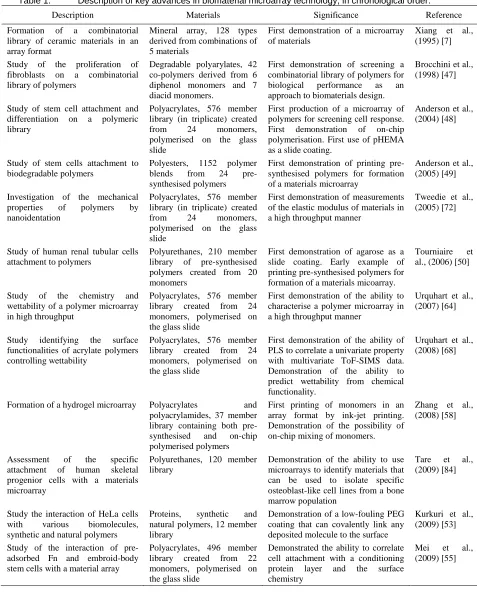
The creation of material arrays requires a combinatorial library of materials to be generated and positioned at addressable locations on a substrate surface. The library can be generated prior to the synthesis of the array, for example by printing pre-synthesised polymers, or concomitant with the formation of the array, for example by printing monomers that are polymerised on-slide. Once the material has been deposited onto the substrate it needs to be fixed with sufficient strength and durability that it can resist the biological evaluation process, which is a challenging requirement since it typically involves submersion in water. This may be achieved by physical entanglement, non-covalent or covalent interactions. The key advances in polymer microarray production are highlighted in Table 1.
2.2.1 Masking
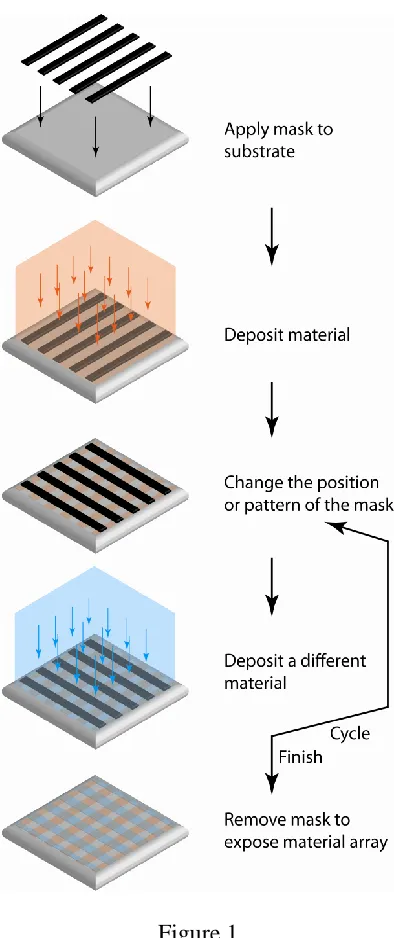
Initial methods to produce a microarray of solid materials on a single substrate used a sequential masking procedure, inspired by methodologies developed for combinatorial chemistry [7]. In this approach, illustrated in Figure 1, masks were used to ensure that certain regions were coated by a particular material, for example by sputtering a ceramic material, whereas other regions remained uncoated. The mask was then exchanged, moved or rotated such that a different pattern of exposed and unexposed regions was revealed. A new material could then be deposited. By repeating this process a number of times, each time with a varied mask and material, many different combinations of materials at unique positions on the substrate were generated (Figure 1). Using seven different sputtering targets combined at various ratios, an array of 128 unique materials was produced [7]. This approach was improved by using the stepwise generation of photomasks [2], which provided a more precise masking of the surface by eliminating the diffusion of sputtered material underneath the mask. However, this process is limited in the materials it can be used for and is not amenable to variations in pattern design, due to the requirement of a mask.
2.2.2 Microarray formation
8
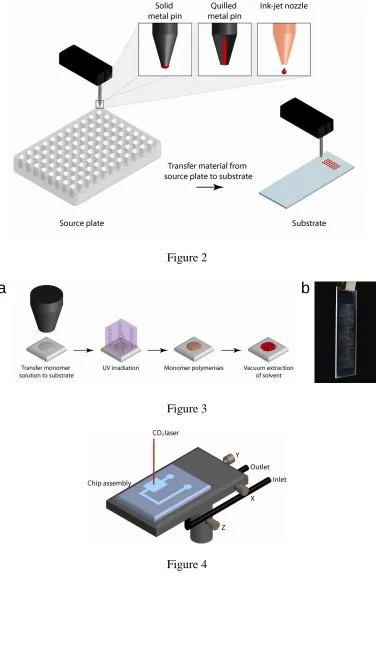
surface by making contact, as illustrated in Figure 2. The pin may either be solid or contain a groove analogous to an ink quill, such that the solution is drawn up into the pin and the spotted material is taken from this reservoir (Figure 2). The ink quill design has the advantage that more spots can be printed from a single dip in the solution. Contact printing is attractive for ease of transfer and the absence of small apertures in the system that can become blocked. The size and shape of the pin used is the determining factor in the resultant spot size. Contact printing was first used to produce an acrylate microarray on a pHEMA coated slide by Anderson et al. using on-slide UV photo initiated polymerisation, as illustrated in Figure 3a [48]. This was achieved in four steps; arraying acrylate monomers with an initiator, activation of initiator upon UV irradiation, polymerisation of the monomer, and finally removal of the solvent. This resulted in stable, covalently crosslinked polymer spots. By premixing the various monomers at a set ratio a large polymer library of 576 materials was readily achieved in triplicate on each slide. A typical array formed by this method is shown as Figure 3b. This array was printed on a pHEMA background to avoid cell attachment to unmodified regions. The attachment and pluoiptoency of embryonic stem (ES) cells was rapidly screened with many disparate chemistries on this array [48, 55]. A similar approach has also been developed on a PEG background [56]. Here, an array of seven different materials was constructed by depositing spots of monomer solution with initiator. The spots were polymerised by UV exposure and subsequently used to assess the attachment of HeLa cells. This approach decreases the time required for polymer library synthesis and microarray formation by combining these processes. Furthermore, this approach allows materials that cannot be printed, such as cross linked polymers, to be included in the polymer library as they are printed in the monomer state. However, the polymer synthesis conditions are likely to differ when materials are produced on a larger scale.
9
be utilsied. An alternative to contact-printing is ink-jet printing. In this approach a nozzle is used to draw up then eject polymer solution onto the substrate at a defined droplet volume, as depicted in Figure 2. The volume of the droplet and the surface energy of the substrate material and the printed solution determine the resulting spot size. This technique enables the precise control of the amount of material deposited and avoids contact with the surface. However, solutions of different viscosities and surface energies cannot easily be printed under similar conditions, limiting the number of different materials that can be included in a single printing run. In addition, the small orifices are susceptible to blockage by dust particles or aggregates of material [9]. This method can be cost-effective and readily accessible to most laboratories by using modified, commercially available ink-jet printers [57].
Ink-jet printing was first used to prepare a polymer array from individually deposited monomer for water soluble acrylamide monomers to form hydrogels [58]. Three monomers were deposited sequentially onto the same position, with a solution containing a catalyst to initiate the reaction being printed subsequently. This
drop in drop mixing approach required that the solvent, water in this case, did not evaporate before the
mixing was complete. The authors proposed that the turbulence induced by the printing procedure resulted in the complete mixing of the monomers within the drops after 1.5 mins. This approach was used to create an array comprising thirty-six different materials from six monomers. Similar to the on-chip polymerisation process previously described, the synthesis of a combinatorial library of polymers was successfully coupled with the production of a polymer microarray. This not only saves time by removing the need to pre-mix monomer solutions, but also greatly increases the range of combinations that can be achieved. However, the successful on-slide mixing of monomers must be carefully assessed as is likely to be different for each monomer, polymerisation and printing system employed.
10
conditions such as humidity and temperature. However, there are some monomers and solvents that cannot successfully be printed. An ingenious method for ink-jet printing was reported in order to limit solvent evaporation, hence broaden the monomers that can be printed, which employs a thin layer of paraffin oil to reduce evaporation. Monomers dissolved in 1-methyl-2-pyrrolidinone were printed through this oil layer, where they sank and settled on the substrate where they could subsequently be polymerised [61]. Water droplets could also be printed through the oil layer, and analysis of these droplets suggested that disappearance of the droplets was prevented for more than four hours. Here, relatively large droplets resulting in large spots sizes (0.62 mm) were used. Extensive washing was required after polymerisation to remove the oil. The resulting arrays were used to screen for mouse ES cell attachment. Potential contamination of the surface by the oil with the polymerised spots, and dissolution of monomer into the oil layer are important issues that remain to be addressed in this approach.
11
biomolecules, synthetic and natural polymers to be covalently linked to the surface in a suitable manner for subsequent cell attachment assays using HeLa cells [53]. This is advantageous because the structure of the arrayed material is unaltered; however, the substrate chemistry becomes limited. In this particular study a plasma polymer slide coating approach was used, which is advantageous as it can be applied to almost any base substrate.
2.2.4 Laser initiated polymerisation
12
3. Polymer characterisation
Polymer microarrays provide exciting opportunities for the HTDM. However, the surface of a polymer is often different from its bulk, as with many materials, for reasons of surface energetics. Copolymers, required for formation of a combinatorial library, are further susceptible to differences between the surface properties and the raw ingredients included in the solution due to surface segregation of components and phase separation. Thus, particularly when wishing to understand the influence that material properties have on biological systems, it is important to conduct comprehensive surface characterisation of the microarrays produced. Such analysis, in addition to the screening process, enables the elucidation of the relationship between surface chemistry and a biological phenomenon of interest, identifying not only which material is suitable for an application but also for what physico-chemical property is responsible for its good performance. It is hoped that this will help in elucidating the principles governing cell and protein adsorption to surfaces. This is an important development for the field of microarrays and can be seen as the difference between a high throughput screen of a property, where the mechanism for the performance is not necessary to the process, and the development of a structure-property relationship which can form the basis of the design of future materials. A combinatorial library including diverse constituents is particularly amenable to this process.
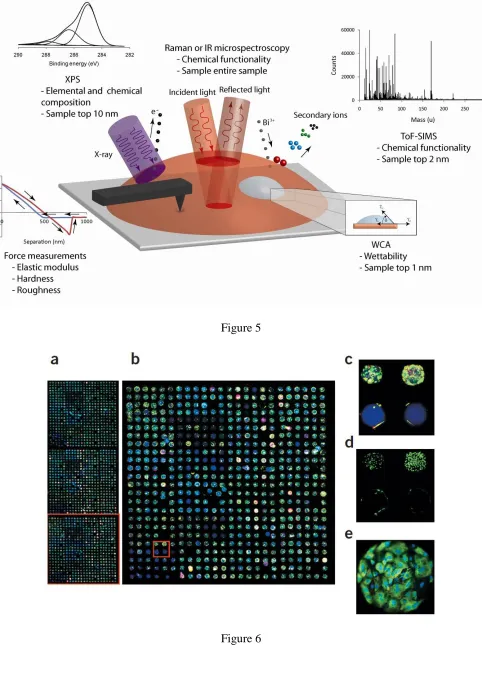
13
with X-rays and measuring the number and kinetic energy of ejected electrons, which is proportional to the number of atoms and indicative of the element it originated from respectively. The chemical state of each element can be quantitatively determined by high-resolution measurements. ToF-SIMS provides a mass spectral measurement of the top monolayer of the solid surface, however, it is not readily quantified and, thus, is used as a complementary surface analysis technique with XPS [65]. ToF-SIMS is achieved by sputtering the surface with a beam of primary ions and measuring the mass of secondary ions ejected from the top uppermost surface. The chemical information produced is vast and, therefore, requires multivariate statistical methods to identify correlations that are not obvious and cannot readily be noticed from inspecting the raw spectra. Of significance is the use of partial least square (PLS) regression to correlate particular material properties with chemical or biological phenomenom [66]. PLS is a multivariate regression technique that correlates a dependant variable with an independent variable that contains multiple components, such as spectral data from ToF-SIMS. This approach has been used to compare wettability, cell attachment and protein adsorption with surface chemistry, with clear trends being discovered that enable properties such as wettability to be predicted from the material’s chemical structure [66-68].
The measurement of wettability, achieved by sessile water contact angle measurements, is a non-destructive surface analysis methodology that can be conducted at ambient conditions; both XPS and ToF-SIMS require ultra high vacuum conditions. Typically, water contact angle measurements use droplets with a volume greater than 1 µL and a sampling area of a few square millimetres. Such an approach is not amenable to small polymer spots of diameters approximately 300 µm and is difficult to adapt to the high throughput methodology. Water contact measurements of libraries of polymers have been achieved by producing large scale polymer films, however, such an approach presents significant time restraints when trying to analyse polymer libraries comprising hundreds of constituents. To overcome these limitations, the use of picolitre sized water droplets has recently been reported, and offers an approach to sample the wettability of polymer spots in an array format in a high throughput manner [59].
14
important for the success of a material in an orthopaedic application and varied material elasticity has been shown to alter the differentiation fate of stem cells [69]. As such, methods that allow material’s bulk properties to be screened in a high-throughput manner are of interest.
Infrared and Raman microspectroscopy provides an approach to measure the bulk chemistry of materials in a spatially resolved manner [70, 71]. Moreover, spectra from a single sample can be acquired in a few seconds. Thus, this technique is well suited to the high throughput approach and could be of use for characterising the bulk chemistry of polymer microarrays. Of particular interest would be the comparison of bulk and surface chemical data. This technique has previously been used to characterise combinatorial polymer libraries [6] and should readily be adaptable to the polymer microarray format.
In order to measure the mechanical properties of a library of polymers in array format nanoindentation has been investigated. In this approach, a diamond indenter of known dimensions is pushed into a material leaving an indent. The depth of penetration, up to a user-specified load, is monitored and can be used to determine a material’s elastic modulus and hardness. This was used to study a library of 1700 polymers, which was synthesised and analysed by nanoindentation within a few days as a demonstration of the high throughput capabilities of this approach [72].
4. Assessment of biological response to microarrays
15
16
that multiple fluorochromes used to stain specific regions of cells can be captured in a rapid fashion [48, 50, 74]. Representative images of human ES cells growing on a polymer microarray with multiple channels are shown in Figure 6. In order to process the many hundreds of images that can be acquired by these methods whilst still maintaining a high throughput approach, computational qualification of image features must be realised. This has been achieved by acquiring images of transfected cells expressing a specific protein of known function with a green fluorescing protein (GFP) and assigning the fluorescence pattern to the known subcellular location of the protein. The subcellular position of expressed GFP-tagged proteins of unknown subcellular position could then be detected and assigned by reference to the set of assigned images [69]. This technique was used to identify proteins localised to the nucleus, peroxisomes, lamina, nucleoli and the plasma membrane with greater than 80% accuracy.
An alternative to fluorescence reading in the use of surface plasmon resonance, whereupon the adsorption of biomolecules to a surface is measured by observing changes in the intensity of a light source that excites surface plasmons at a gold surface [75]. This method is label free, in situ, surface sensitive, measures in real-time and, by measuring the light source with a microscope or camera, spatially resolved measurements can be made using a method termed surface plasmon resonance imaging [76-78]. This approach has been applied to the study of protein-material interactions on a microarray format [79]. Such studies are important as cell-material interactions are often governed by material-protein interactions. In this method, an array of polymers was simultaneously studied for its interactions with injected proteins, with the ability to extract kinetic and thermodynamic data. Furthermore, this approach can also be used to characterise the thickness and swelling of the polymer spots [79, 80].
17
methodology [81]. For analysis on a polymer microarray, stem cells were prepared by culturing to form embryoid bodies for six days before seeding onto the microarray. The cells were grown for a further six days with retinoic acid and serum before differentiation was screened for by staining cytokeratin 7, an intermediate filament protein found in many glandular and epithelia. This approach identified many materials that insitigated differentiation into cytokeratin positive cells, identifying a potential methodology for preparing pure populations of epithelia-like cells [48]. The chemical composition of these materials could be used as leads for the subsequent development of materials that instigate an epithelial fate for ES cells. An image of cells attached to the polymer microarray, with cells stained positive for cytokeratin shown in green, is shown in Figure 6. The large number of cells requiring analysis seen in this figure highlights the processing difficulties faced when working with microarrays.
18
bone marrow dendritic cells [84], chondrocytes and neural stem cells [49]. One important application derived from discovering materials that selectively bind specific cells is the ability to sort heterogeneous populations of cells, which is relevant for isolating specific cell lines from primary sources. This was demonstrated with osteoprogenic cells, whereupon polymer microarrays were used to identify a material from a library of polyurethanes that could exclusively bind STRO-1+ cells, derived from a human bone marrow mononuclear cell population. This material was used to isolate these cells from other immature osteoblasts like MG-63 cells, STRO-1+ human fetal skeletal cells and differentiated osteoblast-like SoOs cells, demonstrating the selectivity of the identified material [85].
19
activity of Fn on some polymers and low adsorption but high activity on other polymers. This highlights the complex nature of these interactions and the need for HTSA to elucidate underlying mechanisms. Significantly, the use of a microarray enabled the correlation of material chemistry with biological events such as cell attachment and protein adsorption [55]. This marks an innovation in microarray technology, whereby the microarray is not simply used to identify positive or negative ‘hits’ in a screening manner, but additionally can be used to determine the underlying material-biological interactions in order to predict the behaviour of a new material in certain biological conditions.
Cell attachment can also be studied by printing a polymer microarray containing naturally occurring polymers and other ECM components onto a polyacrylamide gel. Such an approach was used for the high throughput study of primary rat hepatocyte and I114 mouse ES cell interactions with varied combinations of five different ECM components to create a total of 32 unique combinations [88]. In this case maintaining hepatocyte function and differentiating embryonic cells to an early hepatic fate was of interest. The results showed that two ECM components could together produce an effect that they would do the opposite of when displayed separately [88]. For example, Fn and collagen III individually induced a negative effect on hepatocyte function compared to the average response to other ECM components present on the array, however, when combined with collagen I a positive effect on hepatocyte function was observed. This study also identified collagen I and Fn as being the two ECM components best able to instigate the differentiation of ES cells to an early hepatic fate. Furthermore, this report demonstrated the possibility of screening ES cells with a microarray to produce materials that trigger differentiation pathways in a controlled manner, although only one pathway was screened for in the present study.
20
attachment exclusively to regions where DNA has been arrayed [62]. The array consisted of plasmids encoding for either a GFP or a red fluorescing protein (RFP) in a checkerboard pattern. Furthermore, studies have shown that the underlying polymeric material plays an important role in the delivery of the DNA to the cells [91], thus, by performing this on a polymer microarray many different surface chemistries could be screened simultaneously to find the surface which best facilitates this process. The efficiency of cellular transfection for various cell lines (human embryonic kidney cells, human cervical adenocarcinoma HeLa and mouse melanoma B16F10) was screened on a polyacrylate microarray. A number of co-polymers that achieved high transfection efficiency for each cell line were identified, with a high content of methyl-methacrylate found to be a common feature [92]. This approach may be of particular use with cell lines that are typically difficult to transfect.
5. Future outlook
21
In addition to applications of microarrays in screening for desirable material properties, the size of the sample set provides enormous potential to be able to elucidate key underlying principles that govern biological-material interactions. This can be achieved by correlating material properties with biological events, such as cell attachment. This, in turn, enables the behaviour of new materials to be predicted under certain biological conditions and, consequently enables the rational design of subsequent material arrays. Such an approach requires high throughput methods that are able to analyse the surface properties of the polymer microarrays and multivariate statistical analysis that identify correlations that are not immediately obvious. This is an emerging use of material microarrays that has potential to facilitate biomaterials discovery, and we believe this to be an area of future growth [93].
A key challenge in the application of microarrays is the effective processing of the vast amounts of chemical and biological data that can readily be produced. Innovations and automation in the computational processing and experimental conduct of biological assays will continue to increase the scope of biological questions that can be explored. Innovations in the synthesis of the polymer microarrays will further increase the combinatorial space that can be investigated, which will, in turn, continue to provide insightful and solutions to the vast array of biomedical problems which involve synthetic materials.
Acknowledgements
Financial support from the Wellcome Trust is kindly acknowledged (085246).
References
[1] Webster DC. Combinatorial and high-throughput methods in macromolecular materials research and development. Macromolecular Chemistry and Physics 2008;209(3):237-246.
[2] Lowe G. Combinatorial chemistry. Chemical Society Reviews 1995;24(5):309-&.
[3] Kohn J, Welsh WJ, Knight D. A new approach to the rationale discovery of polymeric biomaterials. Biomaterials 2007;28(29):4171-4177.
[4] Barber ZH, Blamire MG. High throughput thin film materials science. Materials Science and Technology 2008;24(7):757-770.
[5] Portal C, Bradley M. Approaches to high throughput physical organic chemistry. Organic & Biomolecular Chemistry 2007;5(4):587-592.
22
[7] Xiang XD, Sun XD, Briceno G, Lou YL, Wang KA, Chang HY, Wallacefreedman WG, Chen SW, Schultz PG. A combinatorial approach to materials discovery. Science 1995;268(5218):1738-1740. [8] Wang JS, Yoo Y, Gao C, Takeuchi I, Sun XD, Chang HY, Xiang XD, Schultz PG. Identification of a
blue photoluminescent composite material from a combinatorial library. Science 1998;279(5357):1712-1714.
[9] Tekin E, de Gans BJ, Schubert US. Ink-jet printing of polymers - from single dots to thin film libraries. Journal of Materials Chemistry 2004;14(17):2627-2632.
[10] Chen B, Cui TH, Liu Y, Varahramyan K. All-polymer RC filter circuits fabricated with inkjet printing technology. Solid-State Electronics 2003;47(5):841-847.
[11] Sirringhaus H, Kawase T, Friend RH, Shimoda T, Inbasekaran M, Wu W, Woo EP. High-resolution inkjet printing of all-polymer transistor circuits. Science 2000;290(5499):2123-2126.
[12] Reddington E, Sapienza A, Gurau B, Viswanathan R, Sarangapani S, Smotkin ES, Mallouk TE. Combinatorial electrochemistry: A highly parallel, optical screening method for discovery of better electrocatalysts. Science 1998;280(5370):1735-1737.
[13] Huber J, Amgoune A, Mecking S. Patterning of polymers on a substrate via ink-jet printing of a coordination polymerization catalyst. Advanced Materials 2008;20(10):1978-+.
[14] Kamyshny A, Ben-Moshe M, Aviezer S, Magdassi S. Ink-jet printing of metallic nanoparticles and microemulsions. Macromolecular Rapid Communications 2005;26(4):281-288.
[15] Perelaer J, de Gans BJ, Schubert US. Ink-jet printing and microwave sintering of conductive silver tracks. Advanced Materials 2006;18(16):2101-+.
[16] Mott M, Song JH, Evans JRG. Microengineering of ceramics by direct ink-Jet printing. Journal of the American Ceramic Society 1999;82(7):1653-1658.
[17] Wang J, Mohebi MM, Evans JRG. Two methods to generate multiple compositions in combinatorial ink-jet printing of ceramics. Macromolecular Rapid Communications 2005;26(4):304-309.
[18] Zhao X, Evans JRG, Edirisinghe MJ, Song JH. Ink-jet printing of ceramic pillar arrays. Journal of Materials Science 2002;37(10):1987-1992.
[19] Cull TR, Goulding MJ, Bradley M. Liquid crystal libraries-ink-jet formulation and high-throughput analysis. Advanced Materials 2007;19(17):2355-+.
[20] Kohn J. New approaches to biomaterials design. Nature Materials 2004;3(11):745-747.
[21] Hanak JJ. Multiple-sample-concept in materials research - synthesis, compositonal analysis and testing of entire mulicomponent systems. Journal of Materials Chemistry 1970;5(11):964.
[22] Morgenthaler S, Zink C, Spencer ND. Surface-chemical and -morphological gradients. Soft Matter 2008;4(3):419-434.
[23] Alexander MR, Whittle JD, Barton D, Short RD. Plasma polymer chemical gradients for evaluation of surface reactivity: epoxide reaction with carboxylic acid surface groups. Journal Of Materials Chemistry 2004;14(3):408-412.
[24] Whittle JD, Barton D, Alexander MR, Short RD. A method for the deposition of controllable chemical gradients. Chemical Communications 2003(14):1766-1767.
[25] Meredith JC. Advances in combinatorial and high-throughput screening of biofunctional polymers for gene delivery, tissue engineering and anti-fouling coatings. Journal of Materials Chemistry 2009;19(1):34-45.
[26] Zelzer M, Majani R, Bradley JW, Rose F, Davies MC, Alexander MR. Investigation of cell-surface interactions using chemical gradients formed from plasma polymers. Biomaterials 2008;29(2):172-184.
[27] Yang J, Rose FRAJ, Gadegaard N, Alexander MR. A high-throughput assay of cell-surface interactions using topographical and chemical gradients. Advanced Materials 2009;21(3):300-304. [28] Yliperttula M, Chung BG, Navaladi A, Manbachi A, Urtti A. High-throughput screening of cell
responses to biomaterials. European Journal of Pharmaceutical Sciences 2008;35(3):151-160.
23
[30] Heller MJ. DNA microarray technology: Devices, systems, and applications. Annual Review of Biomedical Engineering 2002;4:129-153.
[31] Venkatasubbarao S. Microarrays - status and prospects Trends in Biotechnology 2004;22(12):630-637.
[32] Lee BH, Nagamune T. Protein microarrays and their applications. Biotechnology and Bioprocess Engineering 2004;9(2):69-75.
[33] Hook AL, Voelcker N, Thissen H. Patterned and switchable surfaces for biomolecular manipulation. Acta Biomaterialia 2009;Article In Press:doi:10.1016/j.actbio.2009.1003.1040.
[34] Bretagnol F, Valsesia A, Ceccone G, Colpo P, Gilliland D, Ceriotti L, Hasiwa M, Rossi F. Surface functionalization and pPatterning techniques to design interfaces for biomedical and biosensor applications. Plasma Processes and Polymers 2006;3(6-7):443-455.
[35] Geetha M, Singh AK, Asokamani R, Gogia AK. Ti based biomaterials, the ultimate choice for orthopaedic implants - A review. Progress in Materials Science 2009;54(3):397-425.
[36] Yu LMY, Leipzig ND, Shoichet MS. Promoting neuron adhesion and growth. Materials Today 2008;11(5):36-43.
[37] Vasita R, Shanmugam K, Katti DS. Improved biomaterials for tissue engineering applications: Surface modification of polymers. Current Topics in Medicinal Chemistry 2008;8(4):341-353. [38] Kim MS, Khang G, Lee HB. Gradient polymer surfaces for biomedical applications. Progress in
Polymer Science 2008;33(1):138-164.
[39] Ma ZW, Mao ZW, Gao CY. Surface modification and property analysis of biomedical polymers used for tissue engineering. Colloids and Surfaces B-Biointerfaces 2007;60(2):137-157.
[40] Jiao YP, Cui FZ. Surface modification of polyester biomaterials for tissue engineering. Biomedical Materials 2007;2(4):R24-R37.
[41] Ariga K, Nakanishi T, Michinobu T. Immobilization of biomaterials to nano-assembled films (self-assembled monolayers, Langmuir-Blodgett films, and layer-by-layer assemblies) and their related functions. Journal of Nanoscience and Nanotechnology 2006;6(8):2278-2301.
[42] Shin H, Jo S, Mikos AG. Biomimetic materials for tissue engineering. Biomaterials 2003;24(24):4353-4364.
[43] Poncin-Epaillard F, Legeay G. Surface engineering of biomaterials with plasma techniques. Journal of Biomaterials Science-Polymer Edition 2003;14(10):1005-1028.
[44] Lee CH, Singla A, Lee Y. Biomedical applications of collagen. International Journal of Pharmaceutics 2001;221(1-2):1-22.
[45] Chan CM, Ko TM, Hiraoka H. Polymer surface modification by plasmas and photons. Surface Science Reports 1996;24(1-2):3-54.
[46] Falconnet D, Csucs G, Grandin HM, Textor M. Surface engineering approaches to micropattern surfaces for cell-based assays. Biomaterials 2006;27(16):3044-3063.
[47] Brocchini S, James K, Tangpasuthadol V, Kohn J. Structure-property correlations in a combinatorial library of degradable biomaterials. Journal of Biomedical Materials Research 1998;42(1):66-75. [48] Anderson DG, Levenberg S, Langer R. Nanoliter-scale synthesis of arrayed biomaterials and
application to human embryonic stem cells. Nature Biotechnology 2004;22(7):863-866.
[49] Anderson DG, Putnam D, Lavik EB, Mahmood TA, Langer R. Biomaterial microarrays: rapid, microscale screening of polymer-cell interaction. Biomaterials 2005;26(23):4892-4897.
[50] Tourniaire G, Collins J, Campbell S, Mizomoto H, Ogawa S, Thaburet JF, Bradley M. Polymer microarrays for cellular adhesion. Chemical Communications 2006(20):2118-2120.
[51] Kingshott P, Thissen H, Griesser HJ. Effects of cloud-point grafting, chain length, and density of PEG layers on competitive adsorption of ocular proteins Biomaterials 2002;23(9):2043-2056.
24
[53] Kurkuri MD, Driever C, Johnson G, McFarland G, Thissen H, Voelcker NH. Multifunctional polymer coatings for cell microarray applications. Biomacromolecules 2009;Article ASAP(DOI: 10.1021/bm801417s).
[54] Yasuda H. Plasma Polymerization. Orlando, Florida: Academic Press, 1985.
[55] Mei Y, Gerecht S, Taylor M, Urquhart AJ, Bogatyrev SR, Cho S, Davies MC, Alexander MR, Langer RS, Anderson DG. Mapping the interaction among biomaterials, adsorbed proteins, and human embryonic stem cells. Advanced Materials 2009;21(early view):DOI: 10.1002/adma.200803184.
[56] Thissen H, Johnson G, McFarland G, Verbiest BCH, Gengenbach TR, Voelcker N. Microarrays for the evaluation of cell-biomaterial surface interactions. Proceedings of SPIE 2006;6413:64130B 64131-64139.
[57] Pardo L, Wilson WC, Boland TJ. Characterization of patterned self-assembled monolayers and protein arrays generated by the ink-jet method. Langmuir 2003;19(5):1462-1466.
[58] Zhang R, Liberski A, Khan F, Diaz-Mochon JJ, Bradley M. Inkjet fabrication of hydrogel microarrays using in situ nanolitre-scale polymerisation. Chemical Communications 2008(11):1317-1319.
[59] Taylor M, Urquhart AJ, Zelzer M, Davies MC, Alexander MR. Picoliter water contact angle measurement on polymers. Langmuir 2007;23(13):6875-6878.
[60] Deegan RD, Bakajin O, Dupont TF, Huber G, Nagel SR, Witten TA. Capillary flow as the cause of ring stains from dried liquid drops. Nature 1997;389(6653):827-829.
[61] Liberski A, Zhang R, Bradley M. Inkjet fabrication of polymer microarrays and grids-solving the evaporation problem. Chemical Communications 2009(3):334-336.
[62] Hook AL, Thissen H, Voelcker NH. Advanced substrate fabrication for cell microarrays. Biomacromolecules 2009;10(3):573-579.
[63] Henry OYF, Piletsky SA, Cullen DC. Fabrication of molecularly imprinted polymer microarray on a chip by mid-infrared laser pulse initiated polymerisation. Biosensors & Bioelectronics 2008;23(12):1769-1775.
[64] Urquhart AJ, Anderson DG, Taylor M, Alexander MR, Langer R, Davies MC. High throughput surface characterisation of a combinatorial material library. Advanced Materials 2007;19(18):2486-2491.
[65] Urquhart AJ, Alexander MR. Characterisation using XPS and SIMS. In: Boccaccini AR, Gough JE, editors. Tissue engineering using ceramics and polymers. Cambridge, England: Woodhrad Publishing Limited, 2007. p. 175-203.
[66] Taylor M, Urquhart AJ, Anderson DG, Langer R, Davies MC, Alexander MR. Partial least squares regression as a powerful tool for investigating large combinatorial polymer libraries. Surface and Interface Analysis 2009;41(2):127-135.
[67] Rawsterne RE, Todd SJ, Gough JE, Farrar D, Rutten FJM, Alexander MR, Ulijn RV. Cell spreading correlates with calculated logP of amino acid-modified surfaces. Acta Biomaterialia 2007;3(5):715-721.
[68] Urquhart AJ, Taylor M, Anderson DG, Langer R, Davies MC, Alexander MR. TOF-SIMS analysis of a 576 micropatterned copolymer array to reveal surface moieties that control wettability. Analytical Chemistry 2008;80(1):135-142.
[69] Engler AJ, Sen S, Sweeney HL, Discher DE. Matrix elasticity directs stem cell lineage specification. Cell 2006;126(4):677-689.
[70] Levin IW, Bhargava R. Fourier transform infrared vibrational spectroscopic imaging: Integrating microscopy and molecular recognition. Annual Review of Physical Chemistry 2005;56:429-474. [71] Treado PJ, Morris MD. Infrared and raman-spectroscopic imaging. Applied Spectroscopy Reviews
1994;29(1):1-38.
25
[73] Kumar A, Goel G, Fehrenbach E, Puniya AK, Singh K. Microarrays: The technology, analysis and application. Engineering in Life Sciences 2005;5(3):215-222.
[74] Conrad C, Erfle H, Warnat P, Daigle N, Lorch T, Ellenberg J, Pepperkok R, Eils R. Automatic identification of subcellular phenotypes on human cell arrays. Genome Research 2004;14(6):1130-1136.
[75] Green RJ, Frazier RA, Shakesheff KM, Davies MC, Roberts CJ, Tendler SJB. Surface plasmon resonance analysis of dynamic biological interactions with biomaterials. Biomaterials 2000;21(18):1823-1835.
[76] Brockman JM, Nelson BP, Corn RM. Surface plasmon resonance imaging measurements of ultrathin organic films. Annual Review of Physical Chemistry 2000;51:41-63.
[77] Rothenhausler B, Knoll W. Surface-Plasmon Microscopy. Nature 1988;332(6165):615-617. [78] Yeatman E, Ash EA. Surface-plasmon microscopy. Electronics Letters 1987;23(20):1091-1092. [79] Hook AL, Thissen H, Voelcker NH. Surface plasmon resonance imaging of polymer microarrays to
study protein-polymer interactions in high throughput. Langmuir 2009;25(16):9173-9181.
[80] Sorrell CD, Lyon LA. Bimodal swelling responses in microgel thin films. Journal of Physical Chemistry B 2007;111(16):4060-4066.
[81] Yang F, Mei Y, Langer R, Anderson DG. High throughput optimization of stem cell microenvironments. Combinatorial Chemistry and High Throughput Screening 2009;12(6):554-561. [82] Pernagallo S, Unciti-Broceta A, Diaz-Mochon JJ, Bradley M. Deciphering cellular morphology and
biocompatibility using polymer microarrays. Biomedical Materials 2008;3(3).
[83] Pernagallo S, Diaz-Mochon JJ, Bradley M. A cooperative polymer-DNA microarray approach to biomaterial investigation. Lab on a Chip 2009;9(3):397-403.
[84] Mant A, Tourniaire G, Diaz-Mochon JJ, Elliott TJ, Williams AP, Bradley M. Polymer microarrays: Identification of substrates for phagocytosis assays. Biomaterials 2006;27(30):5299-5306.
[85] Tare RS, Khan F, Tourniaire G, Morgan SM, Bradley M, Oreffo ROC. A microarray approach to the identification of polyurethanes for the isolation of human skeletal progenitor cells and augmentation of skeletal cell growth. Biomaterials 2009;30(6):1045-1055.
[86] Vroman L. Effect of Adsorbed Proteins on the Wettability of Hydrophilic and Hydrophobic Solids. Nature 1962;196(4853):476-477.
[87] Taylor M, Urquhart AJ, Anderson DG, Williams PM, Langer R, Alexander MR, Davies MC. A methodology for investigating protein adhesion and adsorption to microarrayed combinatorial polymers. Macromolecular Rapid Communications 2008;29(15):1298-1302.
[88] Flaim CJ, Chien S, Bhatia SN. An extracellular matrix microarray for probing cellular differentiation. Nature Methods 2005;2(2):119-125.
[89] Ziauddin J, Sabatini DM. Microarrays of cells expressing defined cDNAs Nature 2001;411(6833):107-110.
[90] Hook AL, Voelcker N, Thissen H. Surface manipulation of biomolecules for cell microarray applications. Trends in Biotechnology 2006;24(10):471-477.
[91] Delehanty JB, Shaffer KM, Lin BC. A comparison of microscope slide substrates for use in transfected cell microarrays Biosensors and Bioelectronics 2004;20(4):773-779.
[92] Unciti-Broceta A, Diaz-Mochon JJ, Mizomoto H, Bradley M. Combining nebulization-mediated transfection and polymer microarrays for the rapid determination of optimal transfection substrates. Journal of Combinatorial Chemistry 2008;10(2):179-184.
26
Tables
Table 1. Description of key advances in biomaterial microarray technology, in chronological order.
Description Materials Significance Reference Formation of a combinatorial
library of ceramic materials in an array format
Mineral array, 128 types derived from combinations of 5 materials
First demonstration of a microarray of materials
Xiang et al., (1995) [7]
Study of the proliferation of fibroblasts on a combinatorial library of polymers
Degradable polyarylates, 42 co-polymers derived from 6 diphenol monomers and 7 diacid monomers.
First demonstration of screening a combinatorial library of polymers for biological performance as an approach to biomaterials design.
Brocchini et al., (1998) [47]
Study of stem cell attachment and differentiation on a polymeric library
Polyacrylates, 576 member library (in triplicate) created from 24 monomers, polymerised on the glass slide
First production of a microarray of polymers for screening cell response. First demonstration of on-chip polymerisation. First use of pHEMA as a slide coating.
Anderson et al., (2004) [48]
Study of stem cells attachment to biodegradable polymers
Polyesters, 1152 polymer blends from 24 pre-synthesised polymers
First demonstration of printing pre-synthesised polymers for formation of a materials microarray
Anderson et al., (2005) [49]
Investigation of the mechanical properties of polymers by nanoidentation
Polyacrylates, 576 member library (in triplicate) created from 24 monomers, polymerised on the glass slide
First demonstration of measurements of the elastic modulus of materials in a high throughput manner
Tweedie et al., (2005) [72]
Study of human renal tubular cells attachment to polymers
Polyurethanes, 210 member library of pre-synthesised polymers created from 20 monomers
First demonstration of agarose as a slide coating. Early example of printing pre-synthesised polymers for formation of a materials micoarray.
Tourniaire et al., (2006) [50]
Study of the chemistry and wettability of a polymer microarray in high throughput
Polyacrylates, 576 member library created from 24 monomers, polymerised on the glass slide
First demonstration of the ability to characterise a polymer microarray in a high throughput manner
Urquhart et al., (2007) [64]
Study identifying the surface functionalities of acrylate polymers controlling wettability
Polyacrylates, 576 member library created from 24 monomers, polymerised on the glass slide
First demonstration of the ability of PLS to correlate a univariate property with multivariate ToF-SIMS data. Demonstration of the ability to predict wettability from chemical functionality.
Urquhart et al., (2008) [68]
Formation of a hydrogel microarray Polyacrylates and polyacrylamides, 37 member library containing both pre-synthesised and on-chip polymerised polymers
First printing of monomers in an array format by ink-jet printing. Demonstration of the possibility of on-chip mixing of monomers.
Zhang et al., (2008) [58]
Assessment of the specific attachment of human skeletal progenior cells with a materials microarray
Polyurethanes, 120 member library
Demonstration of the ability to use microarrays to identify materials that can be used to isolate specific osteoblast-like cell lines from a bone marrow population
Tare et al., (2009) [84]
Study the interaction of HeLa cells with various biomolecules, synthetic and natural polymers
Proteins, synthetic and natural polymers, 12 member library
Demonstration of a low-fouling PEG coating that can covalently link any deposited molecule to the surface
Kurkuri et al., (2009) [53]
Study of the interaction of pre-adsorbed Fn and embroid-body stem cells with a material array
Polyacrylates, 496 member library created from 22 monomers, polymerised on the glass slide
Demonstrated the ability to correlate cell attachment with a conditioning protein layer and the surface chemistry
27
Figure Headings
Figure 1. Schematic of the formation of an array of materials by a sequential sputtering and masking procedure. Initially, a
mask is applied to a surface and a material is sputtered onto the uncovered regions on the substrate. The mask is then
shifted or exchanged and a new material is sputtered onto the surface. This process can be repeated with many
different materials to produce a large combinatorial library of materials. Based upon the technique described in
reference [7].
Figure 2. Schematic of the formation of a materials microarray using contact or ink-jet printing. Spotted solution, shown as
red, are transferred from a multi-well source plate to a substrate. The solid or quilled pins used for contact printing or
the nozzle used for ink-jet printing are depicted.
Figure 3. a) Schematic of the formation of a materials microarray by depositing monomers and initiating the in situ
polymerisation. The process involves four steps; the printing of a monomer solution containing initiator, the irradiation
with UV to activate the initiator, the polymerisation of the monomer, and the vacuum extraction of the solvent. Polymer
is shown as red. Based upon the technique described in reference [48]. b) An image of a typical polymer microarray
formed by this approach.
Figure 4. Schematic of the experimental setup for the formation of a materials microarray by laser initiated polymerisation.
Based upon the technique described in reference [63].
Figure 5. Schematic depiction of the toolbox of techniques that can be applied to HTSA. Schematic not to scale.
Figure 6. hES cells grown on polymer arrays. (a-c) Six million human ES cell embryoid body day-6 cells were added on the
polymer array in the presence of retinoic acid for 6 day and then stained for cytokeratin 7 (green) and vimentin (red).
Polymer spots can be identified by blue fluorescence. (d) Nuclei were also stained (green) (not shown in other images
to simplify presentation). (e) Typical cytokeratin 7 positive spot. From reference [48] with permission.
Figure 7. (a) Map of the relationship between cell attachment and polymer composition. Cell number per spot was grouped
into four catagories 1–29, 30–59, 60–89, and 90–119 per spot. Cell numbers are mapped as a function of polymer
composition. (b) A map of the relationship between Fn adsorption and polymer composition, the major monomer 5, 6,
28
[image:28.595.206.403.72.541.2]Figures
29 Figure 2
a
b
Figure 3
30 Figure 5
31
[image:31.595.115.501.37.221.2]