Indexicality, Transparency, and Mental Files
Derek Ball
University of St Andrews
It would be easy to read Francois Recanati’sMental Filesas a sustained de-fence of the utility of a certain metaphor: that the mind is like a filing cabinet, and that our mental representations are like file cards on which our beliefs are written. But too much focus on the metaphor sells Recanati’s project short; Recanati advances a number of challenging claims about mental represen-tation, which, though phrased in terms of the file metaphor, are ultimately independent of it. This paper aims to challenge two of these claims: that mental representations areindexical, and that they aretransparent. I begin by explaining the role indexicality plays in Recanati’s system.
1 Mental Files and Indexicality
I, T, M F /
Given this view of the reference-fixing role of ER-relations, we can state token-reflexive rules by which the referent of a file can be determined (, pp. -). For example, the referent of a file is the place that the person who has tokened that file is in. Recanati regards these token-reflexive relations as capturing what all files of a given type have in common. This is the sense in which files areindexical (, pp. -).
On Recanati’s view,allfiles are indexical in this way – even those (like files, orstable files(the “encyclopedia entries” that correspond to names)) that do not ordinarily shift their referents. There is a terminological issue here about whether this is a useful way to use the word “indexical”, but let’s grant Recanati his usage. It still seems clear that there is a theoretically interesting difference between (say) names on the one hand, and words like “you” and “that” (and, on Recanati’s view, their associated files) on the other. As a rough first shot, the token-reflexive rule for “you” and “that” will link tokens of these terms will very often link different tokens to different referents, even if we hold the speaker fixed. Call terms and mental files that shift reference in this waypractically indexical.
On Recanati’s view, many mental files are not practically indexical. No-table among these are the sNo-table files. SNo-table files are linked to a higher-order ER relation: the relation that holds between an object and a file just in case some other ER relation holds between the object and the file. But, Reca-nati claims, these rest on a base of files (or proto-files, which are based on a particular ER relation, but (unlike full-fledged files) can only contain infor-mation obtained through that relation) that are closely linked to specific ER relations. Recanati writes:
I, T, M F /
Since – with a few exceptions, such as the relation associated with the file – ER relations come and go, many or most of these more basic files will be practically indexical. So Recanati endorses the following claim:
The Hierarchy Thesis Stable “encyclopedia entry” files can exist only if prac-tically indexical files exist.
I said earlier that the referent of a mental file is the object that stands to the file in the relation associated with the file. What happens if more than one object stands in the relation to the file (or if different objects stand in the relation to the file at different times?) On Recanati’s view, files are subject to a norm of proper functioning:
The ER Norm A file should be maintained only if exactly one object stands to it in its associated ER relation, and only for as long as the same object stands in this relation.
In general, if this norm is not satisfied, the file fails to refer. So, for example, if one has a file, and one’s location changes, in order to satisfy the norm one must remove the file (presumably copying the information contained in it to a file of another type), or change the file into a file of another type. One can then form another file, which will refer to one’s new location.
I, T, M F /
A system of mental files must be designed in such a way that it can obey the ER Norm, at least in typical cases. I see two ways such a design could go. Let me introduce them by discussing two ways one might design a computer to store information about different times. Computer clocks depend on an timer chip which sends a signal at a regular frequency (for example, on typical PCs, . times per second). In typical computers, this signal advances a counter. This counter represents the present time.
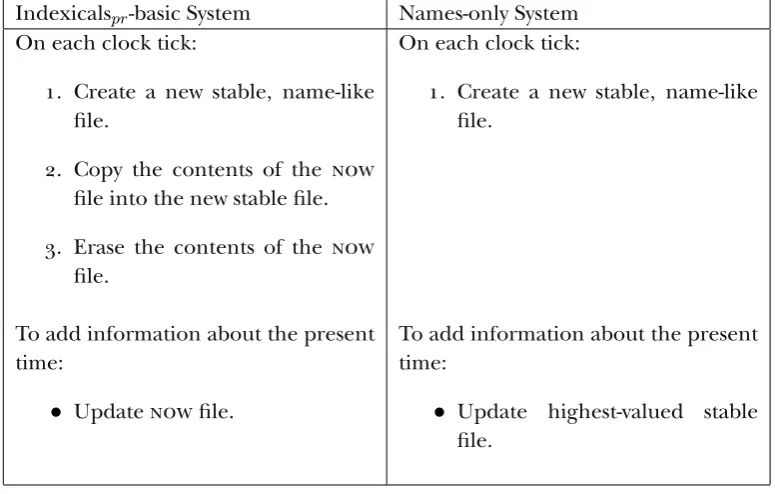
Now suppose that the computer with this sort of clock needed to gener-ate files associgener-ated with different times. On Recanati’s picture, the system should work like this: in addition to a series of stable files – the encyclope-dia entries about times, or the names of times – it would have a buffer file in which it collects information about the present moment. At each signal from the timer chip, it would generate a new, stable file, copy the informa-tion from the buffer into the stable file, and remove the informainforma-tion from the buffer. The buffer file is naturally regarded as a sort of indexical – a file. Call a computer that works in this way a practical-indexicals-basic– or for shortindexicalspr-basic– system.
Surely there could be a system of this kind. But there is another way that a computer could keep track of information about various times (without any kind of buffer). Recall that computers increment a counter at each signal from the timer chip. A computer could be designed so that just after each signal, it creates a new file, labeled with the value from the counter. Information about the present time could be stored in the highest-valued file; information about past times could be stored in relevant lower valued files.
represen-I, T, M F /
tation of time. In effect, a computer that worked in this way would have a system for generating stable files that refer to times, along with a labeling convention that enables the system to correctly store information about the present time. Call a computer that works in this way anames-onlysystem.
A names-only system could be extended to have something like temporal indexicals. One way to do this would be to add a buffer, much like the indexicalspr-basic system. Then information about the present time could be added simultaneously both to the buffer and to the highest-valued sta-ble file. This would create a hybrid system in which names and indexicals are equally basic. It is hard to see what advantage would be gained by this du-plication of effort. But there is a more interesting, and perhaps more useful, possibility. For the sake of concreteness, imagine that the computer stores in-formation about the weather. If a user enterstemperature(T), whereTis the name of a time about which the computer has information stored – i.e., the “label” of a stable file – the computer will return the temperature information stored in that file. Now suppose the programmers want to add the possibility of reporting on the present weather, with a command liketemperature(now). It seems clear that this can be done without adding a file. Instead, the computer should respond totemperature(now)with the temperature in the highest-valued file. On this way of developing the system, there would be no file. Instead, nowis acting as a pointer to whatever file happens to be the highest valued.
mech-I, T, M F /
Indexicalspr-basic System Names-only System On each clock tick:
. Create a new stable, name-like file.
. Copy the contents of the file into the new stable file.
. Erase the contents of the file.
On each clock tick:
. Create a new stable, name-like file.
To add information about the present time:
• Update file.
To add information about the present time:
[image:6.595.116.504.282.529.2]• Update highest-valued stable file.
I, T, M F /
anisms that link a being’s perceptual input systems to files could not simply output to a stable file, rather than (as Recanati would have it) first routing them through a perceptual demonstrative file.
What is the upshot of this discussion for Recanati’s views of mental files? First, I want to claim that:
The Names Thesis A names-only system is possible.
The Names Thesis does not claim that names-only systems involve no indexi-cality in Recanati’s sense of that term. But they involve no practical indexical-ity – nothing that would ordinarily be thought of as context sensitivindexical-ity. They are thus counterexamples to the Hierarchy Thesis. So the truth of the Names Thesis would undermine Recanati’s picture of stable files, with their higher-order ER relations, as resting on a foundation of files based on first-higher-order ER relations (many or most of which will be practically indexical).
Perhaps Recanati could give up this part of his picture. But the possibility of a names-only system raises a more troubling possibility for him: thatweare names-only systems:
The Names Question Are we names-only systems?
A positive answer to the Names Question would undermine much of the in-terest of Recanati’s view. If we are names-only systems, then we have only one type of file – the type associated with a higher-order ER relation – so Reca-nati’s views about the significance of ER relations, indexicality, and so forth, would be more or less irrelevant to us. So what evidence do we have for the claim that we are not names-only systems?
Let me begin by setting one style of argument aside. Recanati frequently appeals to John Perry’s view of mental files. Perry famously observed that identity claims involving both names and indexicals are very often – perhaps always – non-trivial and cognitively significant. For example:
() That guy is Francois Recanati.
I, T, M F /
() I am Derek Ball.
(In Recanati’s terms, such claims typically do not involve co-referencede jure. See below for further discussion.) Does the non-trivial nature of such claims show that the file associated with “That guy” is of a different type than the file associated with “Francois Recanati”, or that the file associated with “now” is of a different type than the file associated with “ten o’clock”? No. On Recanati’s view, what is required for cognitive significance and non-triviality is (at least roughly) that the identity claim involve distincttokenmental files. It does not require that these be tokens of distinct file types. So the Perry examples do not undermine the idea that all of our mental files are stable.
2 Conversion and Proper Function
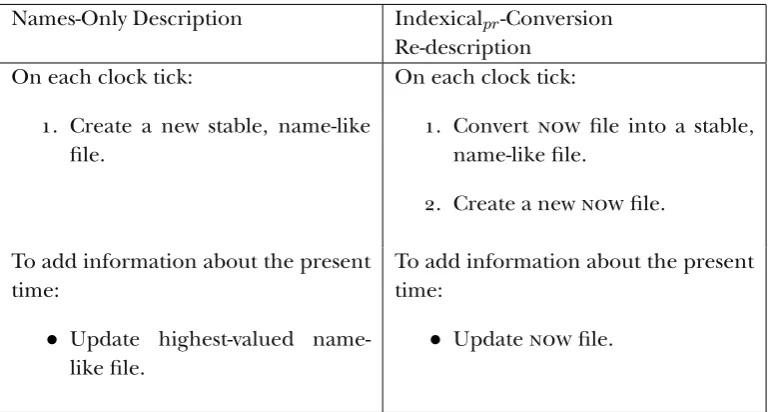
I will return the Names Question below; first, I want to examine a compli-cation in Recanati’s account. Consider again the names-only system that I described in the previous section. I claimed there that such files were from the beginning stable, name-like files. But this could be denied. In particular, on Recanati’s view, files canconvert from one type to another (, p. ). In such conversion the “pile” of information in the file stays the same, but the ER relation associated with the file changes (, pp. -). Recanati could claim that what I called the “names-only” system is really a system that (with each tick of the clock) generates a new (practically) indexical file, and converts the previous file into a stable file.
Recanati offers such an account in response to David Papineau’s ()
names-only description of a closely related case. When we see an object, Re-canati claims, we are able to form a perceptual demonstrative file about that
I, T, M F /
Names-Only Description Indexicalpr-Conversion Re-description
On each clock tick:
. Create a new stable, name-like file.
On each clock tick:
. Convert file into a stable, name-like file.
. Create a new file.
To add information about the present time:
• Update highest-valued name-like file.
To add information about the present time:
[image:9.595.118.504.142.348.2]• Update file.
Figure : Ways of describing the (alleged) names-only system
I, T, M F /
describing the scenario will have different consequences regarding when the file will fail to refer. According to the names-only description, the file will fail to refer if no object – or nosingleobject – is the dominant source of the infor-mation in it. According to the indexicalpr-conversion re-description, it fails to refer before the conversion if it fails to stand in the relevant indexical rela-tion to any object, or if stands in that relarela-tion to more than one object. (What happens after the conversion will depend on what type of file it is converted to; I’ll return to this issue shortly.)
Let’s set up a case to try to drive the predictions of the two descriptions apart. (For the sake of simplicity, I’ll use Papineau’s perceptual demonstrative case as a model, though similar cases could be developed for reference to times.) I see a bird, and judge that it is grey. On the basis of my memory I come to believe that last Tuesday, that bird was eating fish. In fact, the bird I saw last Tuesday is not the bird I am now seeing. At the same time, a friend, whom I presuppose to be watching the same bird, tells me that that is a fulmar. In fact, she is watching a different bird. I combine the information obtained from three ER-relations into the file that I opened when I saw the bird.
I, T, M F /
Again, it is hard to determine; but – granting (as Recanati would insist) that the inference is valid – there is some attraction to the thought that the file associated with “that” fails to refer. So, victory for Names-Only? Not so fast. The Indexicalprs-Conversion description can duplicate this result. The pro-ponent of the Indexicalpr-Conversion story should claim that our feeling that the file associated with “that” fails to refer shows that other ER-relations have become essentially involved in the file’s functioning; that is, just before the inference, the file has been converted from an indexicalprfile to a stable file. In this case, the Indexicalpr-Conversion story will have exactly the same con-sequences with respect to the reference of the file as the Names-Only story.
I want to draw two conclusions from this discussion:
. In cases where the Indexicalpr-Conversion story makes plausible pre-dictions, the Names-Only story can duplicate them by appealing to the notion of adominant source of information.
. In cases where the Names-Only story makes plausible predictions, the Indexicalpr-Conversion story can duplicate them by appealing to the notion ofconversion.
These conclusions entail that it is very difficult to drive a wedge between the predictions of the two descriptions of the case. This difficulty generalises: it seems to me that almost any system could be described either in terms of stable files and dominance, or in terms of practically indexical files and con-version. But this entails that it is very difficult to tell whether a given system involves indexicalpr files or not. And in particular, it is hard to see what evi-dence there could be for Recanati’s view that we are indexicalspr-basic systems rather than Names-only systems. So it is hard to see how Recanati can assume a negative answer to the Names Question.
One problem is that Recanati tells us relatively little about what conversion involves.
I, T, M F /
3 Co-reference and Transparency
The considerations of the previous two sections do not show beyond a doubt that there are no practically indexical files. But they do show that the phe-nomena can be described using Recanati’s version of the file metaphor in a way that falsifies one of his main claims. In this section, I want to show that Recanati faces a similar problem with respect to another of his main claims: that sameness of mental files istransparent.
Recanati emphasises the importance of the phenomenon ofde jure co-reference. The paradigm case ofde jure co-reference, according to Recanati,
is an anaphoric pronoun and its antecedent; for example, there is de jure co-reference in a sentence like, “Ciceroi is bald and hei is fat”, but (in the
normal case) not in a sentence like, “Cicero is bald and Tully is fat”. Moreover, Recanati claims, an analogous phenomenon can take place at the level of thought, and this can be explained in terms of mental files: two pieces of information are de jure co-referential if they “occur in the same file without the benefit of a prior judgement of identity or linking operation” (, p. ).
The distinction betweende jureco-reference and non-de jureco-reference corresponds closely to a distinction between inferences that (in Campbell’s phrase) “trade on” or presuppose identity, and those that assert identity. For example, it is natural to think that (ceteris paribus – Kripke puzzle cases and the like aside) one may validly infer from () and () to () without relying on further premises:
() Cicero is bald.
Recanati also offers the following account of the phenomenon: “The basic criterion
I, T, M F /
() Cicero is tall.
() Someone is tall and bald.
Indeed, the supposition that further premises asserting the identity of Cicero and Cicero are required seems to land one in an infinite regress. This
con-trasts with an inference from () and () to ():
() Tully is tall.
Such an inference seems (ceteris paribus) to require a further premise: that Cicero is Tully. Recanati cashes the distinction between the two inferences out in terms ofde jureco-reference: in the first inference, the occurrences of “Cicero” in the two premises arede jureco-referential – the two occurrences of “Cicero” are associated with the same file, or the information that Cicero is bald and that Cicero is tall occur in the same file – while in the second inference, the occurrence of “Cicero” in the first premise is not de jure co-referential with the occurrence of “Tully” in the second premise – the two occurrences are associated with different files.
Recanati also endorses a closely related claim: that sameness of mental file istransparent in the following sense:
The Transparency Thesis “If it seems to you that two tokens [i.e., token men-tal representations, or token words as you are using them] ‘obviously and uncontrovertibly’ mean the same, then they do mean the same and co-refer (if they refer at all)” (Recanati (, pp. -), citing Schroeter ()).
I, T, M F /
quoted in Recanati (, p. )); if you take two pieces of information to be in the same file, they will be in the same file. Similarly, if you take it that two terms “obviously and uncontrovertibly” mean the same and co-refer (as you are using them), then this will make it the case that you are associating them with the same file (and so they do co-refer, at least as you are using them).
Recanati mentions as potential problems for the transparency thesis what he calls “inverse Paderewski cases” (, p. ): cases in which a thinker is acquainted with two bearers of the same name, and does not realise that they are distinct people. In such cases, Recanati claims, a thinker may have only a single mental file, in which she (mistakenly) stores information about both bearers of the name. This file, Recanati claims, fails to refer (at least in most circumstances –setting aside situations in which one or the other source may be dominant).
This description is plausible in simple cases. But the screw can be turned. One mark of rationality is the ability to recognise our mistakes. We may be accustomed to using a certain form of inference that we later come to regard as invalid. For example, I might be accustomed to inferring from premises of the form All Fs are G to conclusions of the form There is at least one F; but upon reflection, I may become convinced that “all” in English is not existentially committing, and so that these inferences are invalid (despite the fact that they once seemed obviously valid to me). Consider the following case (based on a true story):
Recognised Equivocation I judge:
() Barry Smith is a philosopher of mind and language who works in London.
I then judge:
() Barry Smith is a ontologist who works in Buffalo.
I, T, M F /
obvious to me that the inference as valid. (I suppose that the philoso-pher in question must split his time between the two universities.) But upon further reflection, I decide that no single person could have dis-tinguished himself in two fields in this way. I judge that my informa-tion must be about two distinct people who share the same name. I conclude that my initial inference was invalid. I judge:
() Barry Smith is not an ontologist
(intending my use of “Barry Smith” to bede jureco-referential with the first premise of my initial inference). I then infer (from () and ()) that some philosopher of mind and language is not an ontologist. I also judge:
() Barry Smith does not work in London
(intending my use of “Barry Smith” to bede jureco-referential with the second premise of my initial inference). I infer (from () and ()) that some ontologist does not work in London.
To sum up the situation:
. At timet, I make an inference that trades on the identity of the refer-ent of “Barry Smith” in () and the referrefer-ent of “Barry Smith” in ().
. At timet, I make an inference that trades on the identity of the refer-ent of “Barry Smith” in () and the referrefer-ent of “Barry Smith” in (), and another inference that trades on the identity of the referent of “Barry Smith” in () and the referent of “Barry Smith” in (). I in-tend that the occurrences of “Barry Smith” in () and () do not co-refer, and I also deny that the occurrences in () and () co-refer.
I, T, M F /
() isde jureco-referential to the occurrence in (), but that the occurrence in () isnot de jureco-referential to the occurrence in (). That is, it seems to be a case in which the transitivity of de jure co-reference fails, and (as I will argue) fails in a way that is difficult for Recanati to accommodate. The second, and deeper, problem is that the case seems to be a counterexample to transparency. At the time I begin the inference, it seems obvious that the tokens of “Barry Smith” in () and () are co-referential. But I come to judge that I was mistaken, and that they in fact fail to co-refer. By my own lights, what once seemed to be an obviously valid inference turned out not to be. Let me consider each problem in turn.
I, T, M F /
the information in the file originated from more than one source, one would form two files, and copy information from the initial file into the two new files. This copying process might not be straightforward; one would have to disentangle which bits of information one had obtained from which source and put the information in the appropriate files accordingly (and perhaps there will be some pieces of information that one will not be able to place in either file, because one is not sure of their source.)
Now the analogue of Recanati’s partial merger strategy would be to appeal to “partial branching”. In this sort of case, one would form two new files, copying information as best one could, but would also retain the original file. Cases of this sort seem possible. But they would not help Recanati defuse the problem, since partial branching cannot result in co-reference in this sort of case. By Recanati’s lights, the original file (as used in the inference described) fails to refer, since no single object is the dominant source of the information in it. But (barring any further problems) the two new files that result from the branching should refer. So the new files cannot co-refer with the original file.
I, T, M F /
Recanati might try to argue that the subject’s judgment is mistaken. The subject has correctly recognised that something has gone wrong with the in-ference, he might claim, but the diagnosis is wrong: in fact, the occurrences of “Barry Smith” are de jure co-referential, so that the inference is valid, but they both fail to refer.
The problem with this response is that it ignores the inferences that fol-low. After I judge that my initial inference was invalid, it seems obvious to me obvious that the occurrences of “Barry Smith” in () and (), and in () and (), are co-referential. Transparency entails that this seeming is ac-curate. But again, it is hard to see how this is compatible (given Recanati’s commitments) with (i) the claim that the occurrences of “Barry Smith” in () and () fail to refer; and (ii) the extremely plausible claim that the oc-currences of “Barry Smith” in () and () do not fail to refer. So it seems that Recanati could only maintain transparency between () and () in this way by letting transparency fail between () and () and between () and ().
I, T, M F /
that our inferences are invalid; and to the extent that we are rational, we will respond to this evidence.
4 Conclusion
I have argued that Recanati’s commitment to the indexicality of mental repre-sentation is not well-motivated, since his own theory allows for an apparently equally good description of the phenomena purely in terms of stable files. Moreover, I have shown that there are cases in which Recanati’s account of co-referencede jure and transparency is difficult to maintain.
Regardless of the fate of his claims about indexicality and co-reference, Recanati has given us a number of subtle tools for describing mental rep-resentations. Perhaps not every distinction he introduces corresponds to a genuine difference. But there is no doubt that they should play a role in shaping future debate.
References
Papineau, D. (). Phenomenal and perceptual concepts. In Alter, T. and Walter, S., editors,Phenomenal Concepts and Phenomenal Knowledge: New Essays on Consciousness and Physicalism, pages –. Oxford University Press, New York.
Pinillos, A. (). Coreference and meaning. Philosophical Studies, :–.
Recanati, F. (). Mental Files. Oxford University Press, Oxford.
Schroeter, L. (). The illusion of transparency. Australasian Journal of Philosophy, :–.
Recanati writes, “a rational subject must be capable of reflecting critically upon his or her
I, T, M F /
Williamson, T. (). Knowledge and its Limits. Oxford University Press, Oxford.