Using Situation Lattices in Sensor Analysis
∗Juan Ye, Lorcan Coyle, Simon Dobson, and Paddy Nixon
System Research Group, School of Computer Science and Informatics,
UCD, Dublin, Ireland
E-mail:
[email protected]
Abstract
Highly sensorised systems present two parallel chal-lenges: how to design a sensor suite that can efficiently and cost-effectively support the needs of given services; and to extract the semantically relevant interpretations, or “situa-tions”, from the flood of context data collected by the sen-sors. We describe mathematical structures called situation lattices that can be used to address these two problems si-multaneously, allowing designers to both design and refine situation identification whilst offering insights into the de-sign of sensor suites. We validate the accuracy and effi-ciency of our technique against a third-party data set and demonstrate how it can be used to evaluate sensor suite de-signs.
1. Introduction
A pervasive computing environment assumes a number of invisible sensing/computational entities that collect in-formation about users and an environment. With the help of these entities, a pervasive computing system will be able to understand users’ situations or demands so that it can deliver services in a contextual manner. To facilitate this understanding, we propose a well-founded mathematical
structure, called thesituation lattices, to study relationships
between a large number of low-level sensed data and high-level situations or human activities.
Within a situation lattice, sensor data are abstracted and organised with respect to their semantics (such as different abstraction levels and conflicts between them). The situ-ation lattice will apply basic semantics to learn richer se-mantics that describe relationships between sensor data, be-tween sensor data and situations, and bebe-tween situations.
∗This work is partially supported by Science Foundation Ireland under grant numbers 05/RFP/CMS0062 “Towards a semantics of pervasive com-puting”, 07/CE/I1147 “Clarity, the centre for sensor web technologies”, and 04/RPI/1544 “Secure and predictable pervasive computing”.
Situation lattices have been proposed in our earlier work [22, 23], which allowed developers to manually or-ganise abstracted sensor data in a lattice and to label them with situations. The preliminary evaluation results were promising when we constructed a simple situation lattice to describe research activities in an office environment by using a small number of sensor data. This paper extends the initial model of situation lattices to deal with more com-plicated environments where a larger number of sensors are involved and relationships between sensor data and situa-tions are less explicit.
This paper proposes new approaches to automatically
generate a situation lattice with respect to context
predi-cates, which are abstracted from sensor data; and to auto-matically label context predicates with situations. We will use situation lattices to help system developers to evaluate the performance of sensors, including evaluating whether a new sensor (or a new type of sensors) should be intro-duced, depending on whether existing sensors can suffi-ciently recognise situations.
room) it is installed, and which object (e.g., the couch in the living room) it is attached to. More details about the PlaceLab data set will be described in Section 4.1.
This paper is organised as follows. Section 2 compares our approach with the main stream of work in situation identification and activity recognition. Section 3 describes a conceptual model of information flow in a pervasive com-puting system such as sensor data, context, and situations and introduces the theoretical foundation of situation lat-tices. Section 4 describes the PlaceLab data set (including the sensors and the primary activities of the subjects). It demonstrates how a situation lattice is constructed on this data set: abstracting context predicates from sensor data, defining semantics between context predicates, generating a situation lattice, and training and pruning it. Section 5 ap-plies situation lattices in inferring situations and analysing sensors. In the end, we will draw a conclusion of our work in Section 6.
2. Related Work
There are two typical approaches to define situations: specification-based approaches using expert knowledge [6, 8, 14, 20], and learning-based approaches using machine
learning techniques [1, 4, 5, 7, 9, 10, 18, 23]. The
complexity of a pervasive computing environment under-mines the effectiveness of these two approaches. With the specification-based approach, since information in a per-vasive computing covers sensor data, domain knowledge about an environment (that is, a property of an environment like a space map) and users (like social network or tasks), developers must consider all this information and then be able to provide good definitions of situations.
With learning-based approaches, developers widely ap-ply machine learning techniques such as decision tree [1, 7], Bayesian inference [15, 23], and Hidden Markov
Mod-els [5, 18]. Baoet al[1] used decision tree to learn user
body motions (such as bicycling, shaking hands, or typ-ing) using the raw sensor data from accelerators on
hu-man body. Kasterenet al[15] carried out activity
recogni-tion in a Bayesian framework. They used a static Bayesian model to learn the relationship between different sensor data and human activities, and also used a dynamic Bayesian network to model the temporal aspects of activities. Wo-jeket al[18] proposed to use a multi-level hidden markov model to recognise activity from the audio and video data. These approaches consume a large number of training data to build a model or estimate parameters [14].
All these machine learning techniques are good at learn-ing activities from “flat” information; that is, information consists of individual pairs of attribute and value, and there is no direct relationship between attributes. These tech-niques do not facilitate the expression of the semantics of
information. If two pieces of information are conflicting or at different abstraction levels, these techniques will not be able to represent and use the relationships in their learning process. However, these rich semantic relationships of con-text are one of the characteristics of concon-text in pervasive computing.
We assume that developers might have more accurate and sound knowledge in each local domain than their knowledge about the whole domain; that is, how to inte-grate and relate the knowledge in local domains to situa-tions. Situation lattices use a semi-learning means in that they allow experts to express their knowledge about local domains and use this knowledge to exploit the knowledge about the whole domain. This approach will be able to take the advantages of both specification-based approaches and learning-based approaches, and compensate for their defi-ciencies.
3. Situation Lattice
This section will provide an understanding of informa-tion flow in a pervasive computing, including sensor data, context, and situations. Based on this basic understanding, we will describe the theoretical model of a situation lattice.
3.1. Sensor Data, Context, and Situations
In a pervasive computing environment, sensors gather in-formation about users and their surroundings. A piece of sensor data consists of at least a time stamp, a sensor ID, and a sensor reading that represents how this sensor charac-terises a property of a user or an environment.
To facilitate the reuse and sharing of information in a system, sensor data need to be translated and represented
in a structured representation –context predicates. Context
predicates are defined as characteristic functions on sensor
data. For example in the electrical current flowcontext,
a context predicatecurrentInLivingRoomOnholds if
the current flow value from a sensor is above 100.00. In the
timecontext, a context predicate17-18holds if a time
in-stant is between the hour 17:00 and 18:00. Contextsare
in-stantiated context predicates that represent a concrete snap-shot of reality.
In one type of context, context predicates can have se-mantic relationships: various abstraction levels and conflict.
In thetimecontext, a predicate17-24holds when a time
instant is between the hour 17:00 and 24:00, which is at
a coarser granularity than another predicate17-18. Also,
two context predicates can be conflicting with each other, if any sensor datum that satisfies one of these predicates will
never satisfy the other one. Yeet al[24] has applied set
Situations are defined as an external semantic
interpre-tation of context by Coutaz et al[3]. Each situation
cor-responds to invariant characteristics of contexts and their combination [16]. Each of the characteristics can be ex-pressed as a logical description that takes context predicates as input and applies logical operators between them. A user
is considered tobe ina situation when its logical description
is satisfied by the current context related to the user. This paper aims to propose a model to express the above
semantic relationships between context predicates. The
model will be able to integrate the local knowledge and exploit richer semantics between machine-understandable sensor data and human-understandable situations.
3.2. Theoretical Model of Situation Lattices
Based on lattice theory [2], we propose a new data struc-ture to study the relationship between logical descriptions
and situations, called aSituation Lattice.
A situation lattice consists of a set of nodes that are
or-ganised with thespecialisationrelationship. Each node
rep-resents a logical description of context predicates, which is associated with a set of situations. The semantics of each node is that when the logical description of a node holds (or a node is activated), any situation in its situation set is possible to occur. Alternatively, any situation that is outside this situation set is impossible to occur.
There are two types of nodes in a situation lattice:
pre-liminary nodes, whose logical description is a single context
predicate; andcompound nodes, whose logical description
is a conjunction of context predicates. A compound node is created from preliminary or other compound nodes.
The specialisation relationship is a partial order defined
between nodes. A node is considered morespecific(v) than
another node, if and only if the logical description of the former node entails that of the latter node. The semantics of the specialisation relationship is that whenever a more specific node is activated, then all its more general nodes are activated. The formal definition of a situation lattice is given as follows.
Definition 1. A situation latticeL= (N,v)is defined as
follows.
• ∀n∈N,nhas a logical descriptionn.landn corre-sponds to a set of situationsn.Sthat are interesting to applications.
• ni v nj ∈ N iffni.l ` nj.l, where`is the logical
entailment relationship.
We specify a few assumptions on a situation lattice, which are given as follows: Among all the nodes,
• Assumption 1: there exists a unique top node n>
whose logical description is a tautologyTRUE.n>
cor-responds to all situations. Its semantics is that if no sensor reading is available, then any situation is possi-ble to occur;
• Assumption 2: there exists a unique bottom noden⊥
whose logical description is a contradiction FALSE.
n⊥ corresponds to an empty set of situations. Its
se-mantics is that if sensor readings are conflicting, then no situation can be derived;
• Assumption 3: no two nodes share the same logical description.
A situation lattice is a join semi-lattice. For any two nodes, there exists a join node that contains the greatest log-ical description that is entailed by any loglog-ical description on these nodes. The situation set on their join is the least su-perset of the union of their situation sets. There does not necessarily exist a meet for any two nodes. If there exists a meet for a set of nodes, the logical description on the meet contains the least logical description that entails any logical description on these nodes. The situation set on their meet is the greatest subset of the intersection of their situation sets.
Within a situation lattice, we can express the semantic re-lationships between context predicates: various abstraction levels and conflict. According to Definition 1, the various abstraction levels between two context predicates are repre-sented as a specialisation relationship between two prelimi-nary nodes that host these two context predicates. The meet is used to express the conflict relationship. If two nodes host conflicting context predicates, then their conjunction
isFALSE. According toAssumption 2and3, there exists a
unique noden⊥ whose logical predicate isFALSE, so the
meet of conflicting context predicate isn⊥. This conflicting
relationship is formalised in the following corollary.
Corollary 2. niunj=n⊥, iffni.l∧nj.l=FALSE.
Once the conflicting relationship is defined between two preliminary nodes, it will be “inherited” by their more
spe-cific nodes. That is, if two nodesniandnj are conflicting,
then any of their more specific nodesn0iandn0jshould
con-flict with each other (see Lemma 3). This will be used to avoid inconsistency (no compound nodes are created from conflicting nodes) during the process of automatically gen-erating a situation lattice.
Lemma 3. Ifni unj = n⊥, then∀n0i v ni,n0j v nj,
n0iun0j=n⊥.
4. Construction of Situation Lattices
ex-ample to demonstrate the following processes: (1) defin-ing preliminary nodesby abstracting sensor data into
con-text predicates; (2)defining semantic relationshipsbetween
preliminary nodes using domain knowledge; (3)generating
a situation latticebased on the preliminary nodes; and (4)
training and refiningthe lattice.
4.1. The PlaceLab Data Set
The PlaceLab is a living laboratory in Cambridge, Mas-sachusetts, which is designed to be a highly flexible and multi-disciplinary observational research facility. It is used for the scientific study of people and their interaction pat-terns with new technologies and home environments. The PlaceLab contains over nine hundred sensors inputs, which covers the following types of sensors:
Wireless infra-red motion sensors detect motion in the regions of the laboratory, including the living room, the foyer, the dining room, the kitchen, the office, the bedroom, the bathroom, and the powder room. These sensors can be used to infer the subject’s location, but they are not always accurate. The sensors are not person-specific, so the sensed motion can be caused accidentally or by the other subject. Different sensors often report the motions at the same time.
“Stick-on” object motion sensorsare installed on doors, cabinets, couches, remote controls and measure their use by sensing motion in them. These sensors are not person-specific in that it is impossible to know which subject caused an object’s motion. Since these sensors are installed in large numbers of objects, it is difficult to maintain a good sensor metadata file.
Switch sensorsmeasure the state of objects like doors, cabinets, and wardrobes: whether they are open or closed.
RFID sensorsmeasure whether an object is being accessed or not. The RFID reader does not work well due to techni-cal limitations, being inaccurate if the distance between the reader and the tag is outside the range of the reader [7]. In this data set, only the male subject wore the RFID reader on his right wrist.
Electrical current, water, and gas flow sensorsmeasure the real-time usage of current, water, and gas in the home. The current flow sensors are installed on residential circuits including the living room, the office, and the kitchen. The water flow sensors are installed on the faucets in the kitchen, the bathroom, and the powder room. The gas flow sensor is installed on the stove.
Environmentalsensors measure the temperature, humid-ity, and barometric pressure in different regions in the
liv-ing space.3-axis accelerometer sensorsmeasure a subject’s
body movement, which are only worn on the male subject’s limbs and wrists.
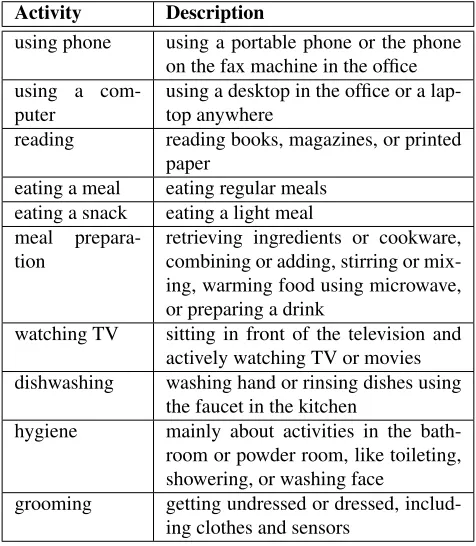
During the data collection time, the subjects tried to live as normally as possible. The primary activities that were
recorded in the diary are listed in Table 1.
Activity Description
using phone using a portable phone or the phone
on the fax machine in the office using a
com-puter
using a desktop in the office or a lap-top anywhere
reading reading books, magazines, or printed
paper
eating a meal eating regular meals
eating a snack eating a light meal
meal
prepara-tion
retrieving ingredients or cookware, combining or adding, stirring or mix-ing, warming food using microwave, or preparing a drink
watching TV sitting in front of the television and
actively watching TV or movies
dishwashing washing hand or rinsing dishes using
the faucet in the kitchen
hygiene mainly about activities in the
bath-room or powder bath-room, like toileting, showering, or washing face
grooming getting undressed or dressed,
[image:4.612.308.546.94.367.2]includ-ing clothes and sensors
Table 1. The primary activities in the PlaceLab data set
To demonstrate our work, we chose a subset of sensors that are straightforward to interpret and are potentially re-lated to the above activities, which are the wireless infra-red motion sensors, electrical current, water, and gas flow sensors, switch sensors, RFID, and object motion sensors. In our experiment, we chose a subset of the data set that included only the days that were covered by the diary data, which are 2006-08-23, 2006-08-25, 05, 2006-09-06, 2006-09-11, 2006-09-12, 2006-09-14, and 2006-09-18. In total, we used almost 40 hours of the PlaceLab data out of 104 hours.
4.2. Defining Preliminary Nodes
To create a situation lattice, developers should define preliminary nodes for each single context predicate. A con-text predicate is a characteristic function on sensor data, which is associated with a set of sensor IDs and a constraint on readings from these sensors. A context predicate holds if its constraint is satisfied by a reading from any of these sensors. For the PlaceLab data set, we use the sensor
meta-data file1. We classify the sensor IDs according to the types
1The sensor metadata file is available online. http:
//web.media.mit.edu/∼intille/data/PLCouple1/
of sensors, and defined context predicates for each sensor ID. The context predicates can be defined according to de-velopers’ knowledge on sensors, or sensors’ technical spec-ifications that indicate what a sensor reading means.
The PlaceLab researchers have published the technical
specification of their sensors online2. For a switch sensor,
the specification recorded that when its reading is either 0 or 200, then the state of an object that it attaches to is open; when a reading is 100 or 300, then the state of the object is close. One of the switch context predicates is defined
asdoorInBedroomOpen, which holds when the switch
sensor on the bedroom door produces readings 0 or 200.
We could define context predicates by observing the sen-sor readings for each sensen-sor ID in the sensen-sor output files, since the technical specification does not record charac-teristic readings for all the sensors. For example of the infra-red motion sensors, their sensor output files records a list of time stamps, sensor IDs, and their corresponding values (which are either 5 or 10). Based on the output file, we define the location context predicates; for
exam-ple,inLivingRoomis defined on a sensor ID2088when
its reading is no less than 5. Using the same approach, we define context predicates for the electrical current, water, and gas flow sensors. We also define the time context pred-icates since the activities are potentially time-related such as ”grooming”. The time predicates are defined in an hour
scale, e.g.,17-18or23-24.
RFID and object motion sensors have a similar function of sensing whether an object is accessed or moved. If one object is attached by these two sensors, we define one object access context predicate on this object. For example, we
de-fine an object access predicate calledlaptopAccessed
on the laptop that has two sensors attached: the RFID sensor
E00700001E226FEEand the object motion sensor956.
This predicate holds, if the RFID sensor is recorded, or the reading of the object motion sensor is greater than 0.
If sensors produce sophisticated readings (such as the body 3-axis motion accelerometers), machine learing tech-niques could be used to train context predicates. It would be simple if there existed a diary about fine-grained activities that recorded the movement of the subjects, such as walk-ing, sittwalk-ing, moving the arm, or lifting an object. Since the PlaceLab data set only provides a diary that records higher level activities as shown in Table 1, we cannot define move-ment context predicates from these accelerometers, so we do not use these sensors in our experiments.
2The technical specification of the PlaceLab sensors are avail-able online. http://architecture.mit.edu/house n/data/ PlaceLab/PLIA1.htm
4.3. Defining Relationships between Preliminary
Nodes
Developers can apply the domain knowledge to de-fine the semantic relationships between these preliminary
nodes as discussed in section 3.1. The domain
knowl-edge can be the knowlknowl-edge about an environment such as a location map, which defines the spatial containment, connectedness, and disjointness relationships between lo-cations [21]. In the PlaceLab environment, the location context predicates conflict with each other, since each of them represents an individual room and the subject can-not be in two different rooms at the same time. Develop-ers can also express their common-sense knowledge, for
example, the predicates lightInLivingRoomOn and
lightInLivingRoomOffcannot hold at the same time.
The conflict between context predicates is represented by defining the bottom node as the meet of their host nodes (in Corollary 2). Another semantic relationship is varying ab-straction level, which is expressed as the specialisation rela-tionship between their host nodes. For example, a
prelimi-nary node hosting the time predicate17-23is defined more
specific than another preliminary node hosting17-24.
4.4. Generating a Situation Lattice
The lattice generation algorithm will automatically gen-erate a situation lattice by starting from the preliminary nodes and combining nodes level by level until all the non-conflicting nodes are combined. This top-down generation process guarantees the existence of the join for any pair of nodes in a situation lattice. The process of creating a new
node is described as follows. Given two nodesniandnj,
their compound node (labelled asni⊗nj) can be
• the bottom node, if they are conflicting, which is
eval-uated by using Corollary 3;
• or a new nodenij=ni⊗njwith
– nij.l=n1.l∧n2.l;
– nij.S=n1.S∩n2.S;
– nij vni; and
– nij vnj.
The generation process suffers a large problem of
scal-ability. Given m preliminary nodes, the complexity of
generating a lattice (with the conjunction) will be O(2m).
With the scalability problem, it is unrealistic to list all
the combinations of the context predicates. This is the
their predicates are related to each other. In our exper-iment, we combine the context predicates if they are re-lated to the same location. For example, a node hosting
currentInLivingRoomOn is combined with a node
hosting lightInLivingRoomOn, while it is not
com-bined with a node hostingcurrentInOfficeOn. The
underlying assumption is that the context (or the sensor data) closely related to the surrounding of the subject will have a major effect on inferring his current situations.
We have defined 7 location predicates and 7 time pred-icates. We split the switch predicates, the current, water and gas flow predicates into these seven locations: 4 cur-rent predicates in the living room, 2 switch predicates and 4 current predicates in the office, 2 current predicates in the dining room, 6 switch predicates and 2 current predicates in the bedroom, 12 switch predicates, 4 current, 2 flow, and 2 gas predicates in the kitchen, 4 switch predicates, 2 current and 2 flow predicates in the bathroom and powder room re-spectively. For RFID and object motion predicates, we clas-sify them into eight groups: the predicates in the first group that are defined on moveable objects and thus can be com-bined with a predicate in any location, and the predicates in the following seven groups that were defined on objects belonging to a particular location and can only be combined with predicates in the same location.
For each location, the generation algorithm generates the compound nodes by combining non-conflicting time, loca-tion, switch, RFID, and object motion predicates, and cur-rent/water/gas flow predicates. For example in the living room, given 4 current predicates with 2 pairs of conflict-ing predicates, 8 compound nodes are generated with these
current predicates. 624 (=8×7+ 8×8+ 7×8+8×7×8)
pound nodes are generated with the above 8 current com-pound nodes, 7 time predicates, and 8 object access predi-cates in the living room. With the same process, we gen-erate a situation lattice with 27649 nodes in total: 1 top node, 1 bottom node, 113 preliminary nodes and 27534 compound nodes. The lattice of this size is easier for a sys-tem to manage, compared to a fully generated lattice with
about2113nodes.
4.5. Training and Refining a Situation Lattice
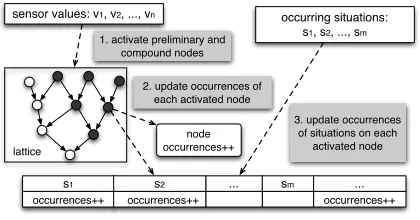
So far, we have combined all the context predicates in a lattice. Now we will start to learn what these combined context predicates mean; that is, relationship between them and human-understanding situations. This is done by train-ing a situation lattice with synchronised sensor and diary data. The training process will attach each node to a set of situations; that is, at each time instant when all context predicates on a node hold, the situations recorded occurring in the diary will be added to this node’s situation set, which is presented in Figure 1. At the end of training, each node is
associated with the times it is activated, and an array of situ-ation occurrences (how many times a situsitu-ation occurs when it is activated). For each node, the array of situation oc-currences can be normalised, by being divided by the total occurrence of each situation.
sensor values: v1, v2, ..., vn
1. activate preliminary and compound nodes
occurring situations: s1, s2, ..., sm
node occurrences++
s1 s2 ... sm ...
occurrences++ occurrences++ occurrences++ 2. update occurrences of
each activated node
3. update occurrences of situations on each
[image:6.612.320.530.147.257.2]activated node lattice
Figure 1. A process of training a situation lat-tice
After training, the lattice will be pruned by remov-ing ineffective nodes. Nodes are ineffective if they have never been activated, or no situations occur when they
are activated. By examining the removed nodes, we
summarised the features of ineffective nodes. Nodes
not being activated can be caused by ineffective
sen-sors or bad combinations of predicates. For example,
snackAccessed never holds, since RFID sensors on
all the snack related objects (such as chips or peanuts) do not work well. An example of bad combinations of
predicates is the node withcurrentInLivingRoomOn
∧ lightInLivingRoomOff that never holds in the
training data, which uncovers the subject’s activity pat-tern: whenever he used the electronics in the living room, he would switch on the light first. Another type of in-effective nodes is that they do not contribute to
identi-fying any situation. For example, no situations are
oc-curring when the node with inOffice ∧ 23-24 ∧
currentInOfficeOff ∧ lightInOfficeOff is
activated.
We synchronise the sensor and diary data, and slice them into 10-second gaps, which produce 13870 pairs of sensor and diary instances. We use two third of them to automati-cally train the lattice and prune it using the above two rules. In the end, the number of the nodes is reduced to 13035, which is half of the size of the initial lattice.
5. Applications of a Situation Lattice
5.1. Inferring Situations
With respect to inferring situations, the structure of a sit-uation lattice makes forward chaining algorithms more ef-ficient by evaluating all the predicates just once. When fed with a set of sensor readings, the system starts by evalu-ating the predicates on all the preliminary nodes from the top. Situation inference is a procedure of applying the meet
operatoruon all the activated preliminary nodes. Since the
lattice is not meet-complete, the procedure may end up with a set of nodes that are most specific among all the activated nodes, instead of a unique node.
Instead of inferring a single situation, a situation lattice will return the following two sets of situations where each situation is provided with its occurrence ratio:
• a set ofpossible-to-occur situations that is the union
of the situations in these resultant nodes, which indi-cates that the situations outside this set are impossible to occur; and
• a set ofmost-likely-to-occursituations that is the
inter-section of the situations in these resultant nodes, which indicates that these situations are more likely to occur compared to the other situations in the above set.
For example, if a situation lattice ends up with two most
specific nodes whose situation sets are{“using computer”,
“reading”} and {“watching TV”, “reading”} respectively,
then the situations possible to occur are in {“watching
TV”, “using computer”, “reading”}, and the situations most
likely to occur are in{“reading”}.
The inference result of a situation lattice provides more accurate and detailed information about what is occurring in the real world. This will help application developers to design a more robust and customised system. Applica-tions (or services) related to the most-likely-to-occur situa-tions will be provided with a high confidence, while appli-cations whose corresponding situations are not contained in the possible-to-occur situations should never be triggered. Applications related to the situations that are possible but not most likely to occur are not suggested to be triggered, but they can be triggered with the consideration of their as-sociated occurrence probability and other design require-ments.
5.1.1 Evaluation Methodology
We use the stratified 10-fold cross validation technique, and compare our result with the result using Naive Bayes and decision tree in WEKA software package [17]. These tech-niques were used in the PlaceLab data set paper [7], and they achieved good results.
The accuracy of inferring situations is evaluated using
two parameters: precisionandrecall. Precision is the ratio
of the times that a situation is correctly inferred to the times that it is inferred in most-likely-to-occur situation sets. Re-call is the ratio of the times that a situation is correctly in-ferred in possible-to-occur sets to the times that it occurs.
When there exist conflicting nodes among the resultant nodes, the most-likely-to-occur situation set should be an empty set (see Lemma 3); that is, if the nodes conflict, then their situation sets should be mutually exclusive. In addi-tion, the possible-to-occur situations will contain all the sit-uations, when the conflicting sensor data activate most of preliminary nodes. Under this circumstance, all the situ-ations are equally possible to occur, while none of them is most likely to occur. This makes both the possible-to-occur and the most-likely-to-possible-to-occur situation sets insensitive to sensors. This insensitivity will produce 100% precision and 100% recall, which is a “fake victory” in our evaluation. To avoid the insensitivity, we set thresholds on occur-rence ratio of each situation to refine situations in the most-likely-to-occur and the possible-to-occur sets. When the conflict is detected in the resultant nodes, the most-likely-to-occur situation set will contain the situations with the highest probability, which excludes the possibility of 100%
precision. The possible-to-occur situation set will filter
out the situations whose occurrence ratio is below its cor-responding threshold, which decreases the possibility of 100% recall but does not exclude it. Therefore, we will calculate the chance that a possible-to-occur situation set covers all the situations.
Since we will set thresholds on each situation to select most-likely-to-occur and possible-to-occur situations, now the question is how to set them. A threshold should bal-ance the precision and recall. If a threshold is too low, it guarantees the best recall but reduces the precision greatly. If a threshold is too high, it guarantees better precision but decreases the recall. To balance the precision and recall, we apply the following F-measurement [25] that treats the precision and recall equally.
F =2×precision×recall
precision+recall
For each situation, we set the initial threshold to 1.0 and repeat reducing the threshold down to 0 with the scale 0.005. For each situation, we calculate the F-measurements for all these thresholds and choose the inference result that achieves its highest F-measurement, which best balances its precision and its recall.
5.1.2 Inference Experiment on PlaceLab Data Set
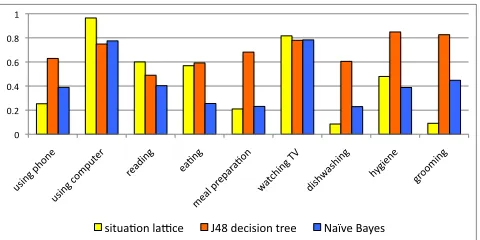
validations. It shows that there is a small chance that the possible-to-occur situation sets are insensitive. Figure 2 and 3 present the comparison of recall and precision in inferring situations between situation lattice, decision tree, and Naive Bayes.
0 0.2 0.4 0.6 0.8 1
using phone using c
omput er
reading ea8ng
meal pr epar
a8on
watching TV dishwashing
hygiene grooming
[image:8.612.51.291.145.264.2]situa8on la>ce J48 decision tree Naïve Bayes
Figure 2. Recall for situation lattice, Naive Bayes, and Decision Tree
Figure 2 shows that the situation lattice has the highest recall on most of the situations (except for “hygiene”), since the possible-to-occur situations contain all the possible sit-uations that are above the threshold. Figure 3 shows that the situation lattice has the relatively lower precision compared to the other two techniques.
0 0.2 0.4 0.6 0.8 1
using phone using c
omput er
reading ea8ng
meal pr epar
a8on
watching TV dishwashing
hygiene grooming
[image:8.612.51.291.418.538.2]situa8on la>ce J48 decision tree Naïve Bayes
Figure 3. Precision for situation lattice, Naive Bayes, and Decision Tree
By examining the low-precision situations, we sum-marise the causes that a situation lattice has the low per-formance.
• The precision of inferring a situation will be low, if the
sensors that are supposed to identify this situation are not accurate. For example, the situation “dishwashing” should be identifiable if the positioning sensor can ac-curately locate the male subject’s location (i.e., in the
kitchen), and the faucet in the kitchen can recognise that the male subject is accessing it.
• The precision of inferring a situation will be low, if
the definition of this situation is imprecise; for exam-ple, “meal preparation” covers all the cooking activ-ities (even including preparing a drink); “grooming” can be getting dressed or undressed (including clothes and worn sensors); “eating” can be eating a proper meal, or snack, or drinking. The imprecise definition of a situation makes it hard to discover its pattern.
• The precision of inferring a situation will be low, if this
situation can randomly co-occur with any other situa-tion and there are no effective sensors to identify it. For example, “using phone” can occur with any other situation at any time in any room. Since this situation cannot be identified or distinguished from other situ-ations with characterised sensor data, this situation is frequently co-inferred with other situations.
5.2. Discernibility of Sensors on Situations
With even more sensors available and ready to be widely instrumented, developers in pervasive computing will need to find out what sensors satisfy application requirements best. If there exists a pair of situations that are required to be precisely identified but cannot be distinguished from each other with the existing sensors, developers might be interested in what new sensor or new type of sensors should be introduced. When the sensors are ready to be widely installed in other environments (for example, sensors for a smart home are ready to use in normal people’s homes), de-velopers might also need to find out what is the best config-uration of sensors to achieve the best accuracy of inferring situations.
A situation lattice can facilitate detecting indistinguish-able situations; that is, the situations are always identified at the same time. Indistinguishable situations can be caused by human activity patterns, for example, in the PlaceLab data set people often watch TV while they eat. They can also be caused by the lack of effective sensors, for example, only with positioning sensors it is difficult to determine whether people are reading or watching TV. Situation lattices can-not only detect when indistinguishable situations exist, but also they can point out what condition (or what sensor data) makes them indistinguishable. According to the require-ments of applications, developers can decide whether the detected situations are necessary to be distinguished or not. If they are necessary, developers can use situation lattices to evaluate which type of sensors will have the best discerni-bility.
snap-shot of reality, since it contains a conjunction of finest
grained context predicates. Situations on each of these
nodes should reflect the exact situations that are occurring. If two situations share any of the same most specific nodes, then these two situations will be co-inferred whenever this node is activated. Algorithm 1 describes the process of de-tecting pairs of indistinguishable situations.
Algorithm 1: The algorithm of detecting
indistinguish-able situations
input : a set of nodesNimmediately above the
bottom node and a set of situation namesSs
output: pairs of indistinguishable situations
initialise a node arraynodeswith the same size asSs
foreachNoden∈Ndo
foreachSituations∈n.Sdo
addninnodes[s.id]
initialise a hashtablepairswhose key is a pair of
situation IDs and whose value is a set of nodes such that when these nodes are activated, this pair of situations are inferred together
fori←0toSs.sizedo forj←i+ 1toSs.sizedo
ifnodes[i]∩nodes[j]6=∅then if(i, j)not inpairsthen
initialise a set of nodesNij
add allnodes[i]∩nodes[j]inNij
put((i, j), Nij)inpairs
returnpairs
5.2.1 Sensor Evaluation Experiments on the PlaceLab
Data Set
We will conduct an experiment to show how situations can be gradually distinguished from each other as new sensors are introduced. We start with an environment where no sen-sors are installed. We can build a simple situation lattice simply with the time context, since time is completely cost free [11].
Since the occurrences of most situations are overlapping, so they are indistinguishable from each other in this lattice only with the time predicates. We will examine each pair of indistinguishable situations to locate which situations that should not co-occur are indistinguishable from each other. We list a few groups of situations that should not co-occur as follows: (1) “hygiene” and “watching TV”; (2) “hygiene” and “meal preparation”; (3) “hygiene” and “dishwashing”; (4) “grooming”, and “meal preparation”; and (5) “groom-ing”, and “dishwashing”.
We analyse the nature of these pairs of situations: each pair of situations occur in different rooms. We have a set of
potential types of sensors to choose: infra-red motion sen-sors to infer the subject’s location; electrical current, water, and gas flow sensors to detect the real-time usage of the flow; and the object motion sensors, switch sensors, and RFID to detect which objects are accessed or used by the subject. After examining all these sensors, we consider the infra-red motion sensors first, since their readings are di-rectly related to the subject’s location. Also, they are easy to install [19]: one sensor for each room. In contrast, the other sensors need a larger number of sensors and consume more installation effort. Therefore, the infra-red motion sensors come to our first choice.
A new situation lattice will be created with the location and time context predicates, and re-trained. Using Algo-rithm 1, we derive indistinguishable situations from the new lattice. Some of situations have been completely distin-guished; for example, “dishwashing”, “hygiene”, “groom-ing” have been distinguished from the situations “using phone”, “eating”, and “meal preparation”. “hygiene” has also been distinguished from “watching TV” and “dish-washing”; and “dishwashing” from “grooming”. These dis-tinguished pairs of situations have covered the above listed pairs of situations that should not co-occur.
Some of the situations are indiscernible at the more spe-cific condition, even though they are sill indiscernible. For example,
(1) when 19-21 ∧ inKitchenholds, “meal
prepara-tion”, “using phone”, “using computer”, “reading”, “eating”, and “watching TV” are indiscernible from each other;
(2) when 23-24 ∧inKitchen holds, “dishwashing”,
“using computer”, “reading”, and “watching TV” are indiscernible;
(3) when23-24∧inBathroomholds, “hygiene”,
“us-ing computer”, and “read“us-ing” are indiscernible; and
(4) when 23-24 ∧ (inBedroom ∨ inBathroom)
holds, “grooming”, “using computer”, “reading”, “watching TV”, and “hygiene” are indiscernible.
From the above listed conditions, it is easy to observe the involved noise of sensor data. For example, “watch-ing TV” should not be attached to the location predicates
inKitchen,inBedroom, andinBathroom. This can
be caused by the fact that when the male subject was watch-ing TV, the female subject appeared in any of these loca-tions, which fired the infra-red motion sensors in these lo-cations. This information discovered in the situation lattice is consistent with the discussion on the noise of sensor data in the PlaceLab publication [7].
“eating”. There are two types of sensors left: the electri-cal current, water, and gas flow sensors, and the object mo-tion, RFID, and switch sensors. For the condition in (1), we might consider the water flow sensors in the kitchen, and the object motion sensor on the faucet that might complement the noise on the location sensors to distinguish “dishwash-ing” from the other situations. For the condition in (2), we might consider the current flow sensor on the microwave, gas flow sensor on the stove, and any object motion sensor in the kitchen to distinguish “meal preparation” from the other sensors. For the condition in (3), we might consider the water flow sensors in the bath room, and the object mo-tion sensor on the faucets to distinguish “hygiene” from the other situations. The situations in the condition (4) have been covered in the above discussions. We will use these sensors, and create a new situation lattice using the corre-sponding context predicates.
A new situation lattice is created with the time predicates, location predicates, and part of the current, water, gas flow predicates, and part of the object
mo-tion sensors. Using the same process, we find that
the added sensors help to identify “meal preparation”, “dishwashing”, and “hygiene” from the other
situa-tions. However, “hygiene” is still indistinguishable
from “using computer” and “eating” when 18-19
∧ inPowderRoom ∧ waterInPowderRoomOff
∧ currentInPowderRoomOff ∧
NothingInPowderRoomAccessed holds. We
believe that this is caused by the noise on the infra-red motion sensors when the newly introduced sensors are not fired, since it would be impossible that the male subject would eat or use computer in the powder room.
0 0.2 0.4 0.6 0.8 1
using phone using c
omput er
reading ea8ng
meal pr
epara8on watching TV dishwashing
hygiene grooming overall
[image:10.612.59.277.465.586.2]8me 8me+loca8on 8me+loca8on+current/water/gas flow +RFID/object mo8on+ switch
Figure 4. F-measurements on each situation with different situation lattices.
Figure 4 shows F-measurements on each situation with the three situation lattices built above. It is obvious that the F-measurements of most situations are gradually increased as more sensors are involved.
So far, we have demonstrated how to use situation
lat-tices to find out what condition makes situations indistin-guishable. Based on the given information, developers can use their knowledge of sensors to decide what new sensors might improve in distinguishing situations under a certain condition.
In another scenario where an environment has installed with different types of sensors, if these sensors are ready to be applied in other environments, developers can cre-ate multiple situation lattices with different combinations of sensors. These situation lattices will present the discernibil-ity of the combinations of sensors, such as which combina-tion of sensors makes which situacombina-tions indiscernible and the corresponding accuracy of inference. With this requirement on a new environment, developers will be able to choose the best configuration of sensors.
6. Conclusion and Future Work
As the number of available sensors increases, it becomes difficult for developers to decipher and specify correlations between sensor data and situations. This paper has proposed a theoretical structure – the situation lattice – to make it eas-ier to determine these correlations. This paper has demon-strated the feasibility of a situation lattice by constructing one from a real world data set, and has evaluated its perfor-mance in inferring situations and analysing sensors.
Situation lattices fit the needs of pervasive computing in that it is toward to manage rich semantics and complexity in context. Situation lattices provide a framework to allow developers to express the semantics of context and their do-main knowledge and use them to uncover the correlation between context and situations. Situations will be auto-matically learned with the consideration of all the knowl-edge represented in situation lattices. In this way, situation lattices integrate the advantages of both the specification-related and learning-specification-related approaches.
They can help to build a more robust pervasive comput-ing system by providcomput-ing richer inference result. The struc-ture of a lattice will also make it possible to evaluate the performance of sensors in distinguishing situations.
Scalability is the major limitation of situation lattices. Ideally, developers define context predicates, and then a sit-uation lattice will be generated by automatically combining all the non-conflicting context predicates. The complexity
of the generation process isO(2n), which is impractical in
exponential [13].
In the future, we will evaluate the performance of situa-tion lattices in more complicated environments like an of-fice setting, where richer semantics of context need to be captured, and more interactive activities and more subjects are involved. We have applied lattice theory in modelling a space map in a complicated environment (such as a build-ing or an city plan) in [21]. This work proved the lattice structure has a powerful expressive ability in representing the semantics of location information. Another type of con-text that has rich semantics is social network, so we will use the lattice theory to model social network information as well. In the end, we will study how to organise each of the domain lattices in a situation lattice and deal with the scalability issue.
References
[1] L. Bao and S. S. Intille. Activity recognition from
user-annotated acceleration data. InSecond International
Confer-ence on Pervasive Computing, pages 1–17, Vienna, Austria, Apr. 2004.
[2] G. Birkhoff. Lattice Theory. Providence, R.I. : American
Mathematical Society, 3rd edition, 1967.
[3] J. Coutaz, J. L. Crowley, S. Dobson, and D. Garlan. Context
is Key.Commun. ACM, 48(3):49–53, 2005.
[4] T. Gu, X. H. Wang, H. K. Pung, and D. Q. Zhang. An ontology-based context model in intelligent environments.
In Proceedings of CNDS 2004, pages 270–275, January
2004.
[5] M. K. Hasan, H. A. Rubaiyeat, Y.-K. Lee, and S. Lee. A
hmm for activity recognition. In Proceedings of ICACT
2008, volume 1, pages 843–846, Feb. 2008.
[6] K. Henricksen and J. Indulska. Developing contextaware pervasive computing applications: Models and approach. In Pervasive and Mobile Computing, In Press, Elsevier, 2005. [7] B. Logan, J. Healey, M. Philipose, E. M. Tapia, and S. S.
Intille. A long-term evaluation of sensing modalities for
ac-tivity recognition. InProceedings of Ubicomp 2007, pages
483–500, Innsbruck, Austria, September 2007. Springer. [8] S. W. Loke. Representing and reasoning with situations for
context-aware pervasive computing: a logic programming
perspective. Knowledge Engineering Review, 19(3):213–
233, 2004.
[9] K. Murphy. Dynamic Bayesian Networks: Representation,
Inference and Learning. PhD thesis, University of Califor-nia, Berkeley, 2002.
[10] N. Oliver, A. Garg, and E. Horvitz. Layered representa-tions for learning and inferring office activity from multiple
sensory channels. Computer Vision Image Understanding,
96(2):163–180, 2004.
[11] K. Partridge and P. Golle. On using existing time-use
study data for ubiquitous computing applications. In
Ubi-Comp ’08: Proceedings of the 10th international conference on Ubiquitous computing, pages 144–153, New York, NY, USA, 2008. ACM.
[12] C. S. Pinhanez and A. F. Bobick. Interval scripts: a
program-ming paradigm for interactive environments and agents.
Per-sonal Ubiquitous Comput., 7(1):1–21, 2003.
[13] U. Priss. Lattice-based information retrieval. Knowledge
Organisation, 27(3):132–142, 2000.
[14] G. Thomson, S. Terzis, and P. Nixon. Situation
determina-tion with reusable situadetermina-tion specificadetermina-tions. InProceedings of
PERCOMW ’06, pages 620–623, 2006.
[15] T. van Kasteren and B. Krose. Bayesian activity recognition
in residence for elders. InProceedings of the 3rd IET
In-ternational Conference on Intelligent Environments, pages 209–212, September 2007.
[16] N. Weisenberg, R. Gartmann, and A. Voisard. An ontology-based approach to personalized situation-aware mobile
ser-vice supply.Geoinformatica, 10(1):55–90, 2006.
[17] I. H. Witten and E. Frank.Data Mining: Practical Machine
Learning Tools and Techniques. Morgan Kaufmann, 2005. [18] C. Wojek, K. Nickel, and R. Stiefelhagen. Activity
recog-nition and room-level tracking in an office environment. In Proceedings of MFI06, pages 25–30, Sept. 2006.
[19] C. R. Wren and E. M. Tapia. Toward scalable activity
recog-nition for sensor networks. InLoCA 2006, pages 168–185.
Springer, May 2006.
[20] S. S. Yau and J. Liu. Hierarchical situation modeling
and reasoning for pervasive computing. In Proceedings
of SEUS-WCCIA’06, volume 0, pages 5–10, Los Alamitos, CA, USA, 2006. IEEE Computer Society.
[21] J. Ye, L. Coyle, S. Dobson, and P. Nixon. A unified seman-tics space model. In J. Hightower, B. Schiele, and T. Strang,
editors,LoCA 2007, volume 4718 ofLNCS, pages 103–120.
Springer, 2007.
[22] J. Ye, L. Coyle, S. Dobson, and P. Nixon. Using situation
lattices to model and reason about context. In
Proceed-ings of MRC 2007 (coexist with CONTEXT’07), pages 1–12, Roskilde, Denmark, August 2007.
[23] J. Ye, L. Coyle, S. Dobson, and P. Nixon. Representing and manipulating situation hierarchies using situation lattices. Revue d’Intelligence Artificielle, 22(5):647–667, 2008. [24] J. Ye, S. McKeever, L. Coyle, S. Neely, and S. Dobson.
Re-solving uncertainty in context integration and abstraction.
InProceedings of the international conference on Pervasive
Services, pages 131–140, New York, NY, USA, July 2008. ACM.
[25] Y. Zhou, M. W¨ursch, E. Giger, H. C. Gall, and J. L¨u. A bayesian network based approach for change coupling
pre-diction. InProceedings of WCRE ’08, pages 27–36. IEEE