
UNDERSTANDING THE ORIGIN OF ³⁵/³⁷ CL AND ¹⁶/¹⁸O
ISOTOPE EFFECTS ON ¹⁹⁵PT AND ¹⁰³RH NMR NUCLEAR
SHIELDING IN SELECTED PT(IV) AND RH(III) COMPLEXES : A DFT STUDY
John Christopher Davis
A Thesis Submitted for the Degree of PhD at the
University of St Andrews
2013
Full metadata for this item is available in Research@StAndrews:FullText
at:
http://research-repository.st-andrews.ac.uk/
Please use this identifier to cite or link to this item:
http://hdl.handle.net/10023/3824
Understanding the origin of
35/37Cl and
16/18O
isotope effects on
195Pt and
103Rh NMR nuclear
shielding in selected Pt(IV) and Rh(III)
complexes. A DFT study
by
John Christopher Davis
December 2013
Dissertation presented jointly for the degree ofDoctor of Philosophy in
the Faculty of Science at Stellenbosch University
and the University of St Andrews
Declaration
I, John Christopher Davis hereby certify that this thesis, which is approximately 30 000 words in length, has been written by me, that it is the record of work carried out by me and that it has not been submitted in any previous application for a higher degree.
I was admitted as a research student and as a candidate for the degree of Doctor of Philosophy in April 2010; the higher study for which this is a record was carried out in the University of St Andrews between 2011 and 2013.
Date……… Signature of candidate ………
I hereby certify that the candidate has fulfilled the conditions of the Resolution and Regulations appropriate for the degree of Doctor of Philosophy in the University of St Andrews and that the candidate is qualified to submit this thesis in application for that degree.
Date …….……….. Signature of supervisor ………...………
In submitting this thesis to the University of St Andrews I understand that I am giving permission for it to be made available for use in accordance with the regulations of the University Library for the time being in force, subject to any copyright vested in the work not being affected thereby. I also understand that the title and the abstract will be published, and that a copy of the work may be made and supplied to any bona fide library or research worker, that my thesis will be electronically accessible for personal or research use unless exempt by award of an embargo as requested below, and that the library has the right to migrate my thesis into new electronic forms as required to ensure continued access to the thesis. I have obtained any third-party copyright permissions that may be required in order to allow such access and migration, or have requested the appropriate embargo below.
The following is an agreed request by candidate and supervisor regarding the electronic publication of this thesis:
Access to printed copy and electronic publication of the thesis through the University of St Andrews.
Date ……… Signature of candidate ..……..…...………
iii Abstract
Distinctive fine-structure due to 35Cl/37Cl isotopologue and isotopomer effects is resolved at high magnetic fields for 195Pt and 103Rh NMR signals, resulting in a unique NMR “finger-print”, with which it is possible to uniquely identify all chlorido containing Pt(IV) and Rh(III) complexes. In this study, these isotope shifts are computed from first principles in order to provide a solid theoretical framework for the empirical observations.
Use is made of DFT to calculate the 35/37Cl and 16/18O induced isotope shifts in the 195Pt NMR spectra of [Pt35Cl6]2− and [Pt37Cl6]2−, for the [Pt35Cln37Cl5-n(H2O)]− (n=0-5),
cis-Pt35Cln37Cl(4-n)(H2O)2 (n=0-4), and fac-[Pt35Cln37Cl(3-n)(H2O)3]+ (n=0-3) series. The
computational protocol is extended to calculate the 35/37Cl and 16/18O induced isotope shifts in [Pt35Cln37Cl5-n(OH)]2− (n=0-5), cis-[Pt35Cln37Cl(4-n)(OH)2]2- (n=0-4),
fac-[Pt35Cln37Cl(3-n)(OH)3]2− (n=0-3), cis-[Pt35Cln37Cl2-n(OH)4]2− (n=0-2) and
[Pt35Cln37Cl1-n(OH)5]2− (n=0-1). For Rh(III), the 35Cl/37Cl isotope shifts in the 103Rh NMR
spectra of [Rh35Cln37Cl5-n(H2O)]2− (n=0-5), cis-[Rh35Cln37Cl(4-n)(H2O)2]- (n=0-4), and
fac-Rh35Cln37Cl(3-n)(H2O)3 (n=0-3) were calculated.
The 195Pt and 103Rh NMR chemical shifts computed for these species reproduce the order of magnitude of the observed effect reasonably well, up to ca. 1 ppm. In most cases, general trends are also captured qualitatively, thus providing the first theoretical basis for the origin of subtle isotope shifts in 195Pt NMR spectra. Neither simple polarizable continuum models nor small, microsolvated complexes lead to improved isotope shifts for the series investigated, however, valuable insight into the degree of solvent interaction was gained. Using the polarized continuum model to calculate shielding/bond-length derivatives together with gas-phase zero-point corrections to estimate shieldings, it was shown that the contraction of the coordination sphere in the hydroxide complexes cause the Pt-Cl bonds to become magnetically equivalent, justifying why their isotopomers aren’t resolved.
iv Opsomming
Kenmerkende fyn struktuur as gevolg van 35Cl/37Cl isotopoloog en isotopomeer effekte word waargeneem onder hoë velde in 195Pt en 103Rh KMR-seine, wat lei tot 'n unieke KMR "vinger-afdruk", waarmee dit moontlik is om Pt(IV) en Rh(III) komplekse te kan identifiseer. In hierdie studie word isotoop verskuiwings bereken vanaf eerste beginsels met die doel om 'n soliede teoretiese raamwerk vir die empiriese waarnemings te bou.
Gebruik word gemaak van Elektrondigtheidsteorie om 35/37Cl en 16/18O geïnduseerde isotoop verskuiwngs in die 195Pt KMR spektra van [Pt35Cl6]2- en [Pt37Cl6]2- te bereken, asook die
[Pt35Cln37Cl5-n (H2O)]− (n = 0 - 5), cis-Pt35Cln37Cl(4-n)(H2O)2 (n = 0-4) en die fac-[Pt35Cln37Cl (3-n)(H2O)3]+ (n=0-3) reeks. Die ontwikkelde berekeningsproses protokol word toegepas op die
geïnduseerde 16/18O en 35/37Cl isotoop verskuiwings van [Pt35Cln37Cl5-n(OH)]2− (n=0-5),
cis-[Pt35Cln37Cl(4-n)(OH)2]2- (n=0-4), fac-[Pt35Cln37Cl(3-n)(OH)3]2− (n=0-3), cis-[Pt35Cln37Cl 2-n(OH)4]2− (n=0-2) en [Pt35Cln37Cl1-n(OH)5]2− (n=0-1). Die 35Cl/37Cl isotoop verskuiwings van
Rh(III) komplekse, [Rh35Cln37Cl5-n(H2O)]2− (n=0-5), cis-[Rh35Cln37Cl(4-n)(H2O)2]- (n=0-4), en
fac-Rh35Cln37Cl(3-n)(H2O)3 (n=0-3) is ook bereken.
v
Publications and conference contributions resulting from this thesis
35/37
Cl and 18/16O Isotope Effects on 195Pt and 103Rh NMR Chemical Shifts. A Density Functional Study.
J. C. Davis, M. Bühl, K. R. Koch, manuscript in preparation.
On the Origin of 35/37Cl Isotope Effects on 195Pt NMR Chemical Shifts. A Density Functional
Study.
J. C. Davis, M. Bühl, K. R. Koch, J. Chem. Theor. Comput. 2012, 8, 1344-1350.
Understanding subtle isotope effects on 195Pt NMR chemical shifts. A DFT study.
J. C. Davis, M. Bühl, K. R. Koch (2012, May ), Oral presentation at the Royal Society of Chemistry Theoretical Group Conference, London, UK.
What is the Origin of Isotope Effects on 195Pt Chemical Shifts?
J. C. Davis, M. Bühl, K. R. Koch (2011, June ), Poster presentation at the Royal Society of Chemistry Theoretical Group Conference, Nottingham, UK.
Probing isotope shifts in 195Pt NMR spectra with DFT.
vi Acknowledgements
This thesis has become possible due to the generous and ongoing support of many people; it is impossible to name all of you here.
I would like to thank my supervisors, Professors Klaus Koch and Michael Bühl, for their support, guidance and passion concerning this project.
I wish to thank Dr. H. Früchtl for technical support and maintaining the local Opteron PC cluster at the EaStChem Research Computing facility in St Andrews.
I wish to thank my fiancée, Zoé. We shared all the ups and downs of life during our PhD studies and you definitely had the harder part of it.
I should like to express my gratitude to the members of the PGM research group: Shani, Theo, Hugo, James, Eugene; especially Dr. Willem J. Gerber for his invaluable guidance during the early years. I wish to thank my lab co-workers in room 208 and 150 of the Purdie Building: Ragnar, Nicolas, Luke, James, Jie, Neetika, Rosie, Leo and Lazaros for the many pleasant trips to the pub.
This is the place to mention my parents Maureen and John for their encouragement and support. Some family members who played a vital role throughout this journey include; Carol, Donovan, Cole and Adam; Keith, Rochelle, Robyn and Kayrian; Craig, René, Christopher and Caitlin. I would also like to thank the Lloyd’s: Michael, Mary, Rowan and Robin for their kind support.
vii
viii Table of Contents
Title page Declaration Abstract Opsomming
Publications resulting from this thesis Acknowledgments
Table of Contents List of Figures List of Tables Abbreviations
Chapter 1 Introduction
1.1 195Pt NMR spectroscopy
1.2 Isotope Effects in Transition-Metal NMR
1.3 Calculation of Nuclear Shielding of Transition-Metals 1.4 Aims and Objectives
Chapter 2
Theoretical Background
2.1 Many-particle quantum mechanics 2.2 Solving the Schrödinger equation 2.2.1 The Variational Principle 2.2.2 Hartree-Fock theory 2.2.3 Density functional theory 2.2.4 Basis sets
2.3 Relativistic quantum chemistry 2.4 Beyond static structures at 0 K
2.5 Calculating NMR nuclear shielding with DFT
Chapter 3
Computational Details 3.1 Geometries
3.2 NMR shielding tensors
Chapter 4
On the origin of 35/37Cl and 16/18O Isotope Effects on
195
Pt NMR nuclear shielding of [Pt35/37Cln(H2O)6-n]n-2 complexes
4.1 Introduction
4.2 Results and Discussion 4.2.1 Numerical Stability 4.2.2 Geometries
4.2.3 Isotope shifts
4.2.4 Shielding/bond-length derivatives 4.2.5 Solvation effects
ix Chapter 5
Calculation of 35/37Cl and 16/18O isotope effects on
195
Pt NMR nuclear shielding of [Pt35/37Cln(16/18OH)6-n]2- complexes
5.1 Introduction
5.2 Results and Discussion 5.2.1 Geometries
5.2.2 Free rotation about the Pt-O bond 5.2.3 Isotope shifts
5.2.4 Shielding/bond-length derivatives 5.2.5 Solvation effects
5.2.6 Comparison with aqua complexes 5.3 Conclusions
Chapter 6
Calculation of 35/37Cl isotope effects on
103
Rh NMR nuclear shielding of [Rh35/37Cln(H2O)6- n]3-n complexes
6.1 Introduction
6.2 Results and Discussion 6.2.1 Geometries
6.2.2 Isotope Shifts
6.2.3 Shielding/bond-length derivatives 6.2.4 Solvation effects
6.3 Conclusions
Chapter 7 Conclusions
Bibliography
Appendix
70
71 73 74 83 84 88 90
91
92 93 97 98 102
103
107
x List of Figures
Figure 1.1: 195Pt NMR spectrum showing Pt(IV) aquo/chloride species present in sample prepared from by oxidizing [PtCl4]2- in HClO4 with NaClO3.
Figure 1.2: Summary of the sensitivity ∂(δ195Pt)/∂(∆Pt X) of the total shielding tensor of
the platinum nucleus for the [PtX6]2− complexes, where X = F, Cl, Br and I.
Figure 1.3: Expanded 195Pt NMR spectra, showing the 35/37Cl isotope induced fine-structure for several species C–H from the [Pt35/37Cln(H2O)6−n]4−n (n = 2–4) series.
Figure 1.4: Expanded 195Pt NMR spectra, showing the 35/37Cl isotope induced fine-structure for species from the [Pt35/37Cln(OH)6−n]2− (n = 2–5) series.
Figure 1.5: Experimental 103Rh spectra of [RhCln(H2O)6−n]3−n (n = 3–6) species.
Figure 3.1: Vibrationally averaged bond length at 0 K, rg0, for [Pt35Cl6]2- determined at
different levels of theory in the gas phase.
Figure 4.1: Optimized structures of [PtCl5(H2O)]− (1, left), cis-PtCl4(H2O)2 (2, middle) and
fac-[PtCl3(H2O)3]+ (3, right).
Figure 4.2: Vibrationally averaged bondlength, rg0 for cis-Pt35Cl4(H2O)2 as a function of
numerical integration grids of increasing quality.
Figure 4.3: Isotopomers of [PtCl5(H2O)]− (1), cis-PtCl4(H2O)2 (2), and fac-[PtCl3(H2O)3]+ (3).
Figure 4.4 Calculated 195Pt shielding differences vs. negative experimental 35/37Cl isotope shifts of the isotopomers of 1 – 3.
xi
Figure 4.6 Calculated shielding differences vs. negative experimental 35/37Cl isotope shifts of the isotopomers of Figure 4.3
Figure 4.7: Calculated shielding differences vs. negative experimental 35/37Cl isotope shifts of the isotopomers of 3.
Figure 4.8: Plot of difference between calculated σ values of [Pt35/37Cl5(H216O)]− and
[Pt35/37Cl5(H218O)]− vs. the corresponding difference between the experimental δ values.
Figure 4.9: Plot of 195Pt magnetic shielding of cis-PtCl4(H2O)2 vs. (a) Pt-Cleq, (b) Pt-Clax and
(c) Pt-O bond distances.
Figure 4.10 Shielding differences in 35/37Cl isotopomers of 1 - 3, estimated from Eq. 4.1 vs. actual computation from rg0 geometries.
Figure 4.11: Surface discretization points defining the cavity in CPCM calculations for cis-PtCl4(H2O)2.
Figure 4.12: Vibrationally averaged bond lengths in cis-Pt35Cl4(H2O)2 as a function of
surface descretization.
Figure 4.13: Calculated shielding differences vs. negative experimental 35/37Cl isotope shifts of the isotopomers of cis-PtCl4(H2O)2 in a polarizable continuum.
Figure 4.14 Calculated shielding differences vs. negative experimental 35/37Cl isotope shifts of the isotopomers of [PtCl5(H2O)]−.2H2O.
Figure 4.15: Plot of 195Pt magnetic shielding of cis-PtCl4(H2O)2 vs. (top) Pt-Cleq, (middle)
Pt-Clax and (bottom) Pt-O bond distances.
Figure 4.16 Shielding differences in 35/37Cl isotopomers of 2, estimated from Eq. 4.1 using
∂σPt/∂rPtX,I in a polarizable continuum and calculated shielding differences vs. negative
xii
Figure 5.1: Optimized structures of (4) [PtCl5(OH)]2− , (5) cis-[PtCl4(OH)2]2- ,
(6) fac-[PtCl3(OH)3]2- , (7) cis-[PtCl2(OH)4]2-, (8) [PtCl(OH)5]2- and (5b) trans-[PtCl4(OH)2]
2-Figure 5.2: Energy profile of cis-[PtCl4(OH)2]2- . The minima obtained interconvert via the
transition state shown at the maximum.
Figure 5.3: Calculated shielding differences vs. negative experimental 35/37Cl isotope shifts of the isotopomers of [PtCl5(OH)]2−
Figure 5.4: Plot of difference between calculated σ values of [Pt35/37Cl5(16OH)]2− and
[Pt35/37Cl5(18OH)]2− vs. the corresponding difference between the experimental δ values.
Figure 5.5: Calculated shielding differences vs. negative experimental 35/37Cl isotope shifts of the isotopomers of (5) cis-[PtCl4(OH)2]2-.
Figure 5.6: Calculated shielding differences vs. negative experimental 35/37Cl isotope shifts of the isotopomers of (6) fac-[PtCl3(OH)3]2-.
Figure 5.7: Calculated shielding differences vs. negative experimental 35/37Cl isotope shifts of the isotopomers of (7) cis-[PtCl2(OH)4]2-.
Figure 5.8: Calculated shielding differences vs. negative experimental 35/37Cl isotope shifts of the isotopomers of (8) [PtCl(OH)5]2-.
Figure 5.9 Shielding differences in 35/37Cl isotopomers of 4 - 8, estimated from eq 4.1 vs. actual computation from rg0 geometries.
Figure 5.10: Calculated shielding differences vs. negative experimental 35/37Cl isotope shifts of the isotopomers of [PtCl5(OH)]2−.H2O .
Figure 5.11: Plot of 195Pt magnetic shielding of cis-[PtCl4(OH)2]2- vs. (top) Pt-O bond,
(middle) Pt-Cleq and (bottom) Pt-Clax distances.
Figure 5.12 Shielding differences in 35/37Cl isotopomers of 5, estimated from Eq. 4.1 using
∂σPt/∂rPtX,I in a polarizable continuum and calculated shielding differences vs. negative
xiii
Figure 5.11: Experimental 195Pt NMR spectra of [PtCl5(H2O)]-2and [PtCl5(OH)]2-.
Figure 6.1: Optimized structures of (9) [Rh35Cln37Cl5-n(H2O)]2− (n=0-5), (10)
cis-[Rh35Cln37Cl(4-n)(H2O)2]- (n=0-4), (11) fac-Rh35Cln37Cl(3-n)(H2O)3. and (10b)
trans-[RhCl4(H2O)2]-.
Figure 6.2: Calculated shielding differences vs. negative experimental1935/37Cl isotope shifts of the isotopomers of (top) (9) [Rh35Cln37Cl5-n(H2O)]2− (n=0-5), (middle) (10)
cis-[Rh35Cln37Cl(4-n)(H2O)2]- (n=0-4), and (bottom) (11) fac-Rh35Cln37Cl(3-n)(H2O)3.
Figure 6.4 Shielding differences in 35/37Cl isotopomers of (top to bottom) (9) – (11), estimated from Eq . 4.1 vs. actual computation from rg0 geometries.
Figure 6.5: Calculated shielding differences vs. negative experimental 35/37Cl isotope shifts of the isotopomers of [RhCl5(H2O)]2−.2H2O.
Figure 6.6: Plot of 103Rh magnetic shielding of cis-[RhCl4(H2O)2]- vs. (top) Rh-Cleq, (middle)
Rh-Clax and (bottom) Rh-O bond distances, evaluated at the COSMO/ZORA-SO/PW91 level
as well as at the ZORA-SO/PW91 level.
Figure 6.7 Shielding differences in 35/37Cl isotopomers of 10, estimated from Eq. 4.1 using
∂σRh/∂rRhXi in a polarizable continuum and calculated shielding differences vs. negative
xiv List of Tables
Table 3.1: Vibrationally averaged bond lengths at 0K for [PtCl6]2- calculated at various levels
of theory
Table 4.1: Equilibrium bond lengths (re) and differences between equilibrium and effective
bond lengths at 0K (∆req and ∆rax) in cis-Pt35Cl4(H2O)2 [Å], obtained with different grids and
step lengths d
Table 4.2: Differences ∆∆35/37r between effective Pt-Cl distances in cis-Pt35Cl4(H2O)2 and
cis-Pt37Cl4(H2O)2 in units of 10−5 Å, obtained with different grids and step lengths d
Table 4.3: Vibrationally averaged bond lengths at 0K (req and rax) in cis-Pt37Cl4(H2O)2 [Å]
and difference (∆req and ∆rax) with the cis-Pt35Cl4(H2O)2 isotopologue.
Table 4.5: Equilibrium bond lengths re, differences between effective and equilibrium bond
lengths ∆reff (= ∆rg0) and differences between effective bond distances for [Pt35/37Cl6]2-,
[Pt35/37Cl5(H2O)]- and cis-Pt35/37Cl4(H2O)2.
Table 4.6: Equilibrium bond lengths re, differences between effective and equilibrium bond
lengths ∆reff and differences between effective bond distances for [Pt35Cl5(H216/18O)]- and
cis-Pt35Cl4(H216/18O)2.
Table 4.7a: Experimental2195Pt chemical shifts and computed isotropic shielding constants for
the isotopomers and isotopologues of 1 and 2.
Table 4.7b: Experimental2195Pt chemical shifts and computed isotropic shielding constants for
the isotopomers and isotopologues of 3.
Table 4.8: Breakdown of calculated total shielding constants σtot into their constituents for
cis-[Pt35Cl4(H2O)2] isotopomers.
xv
Table 4.10: Vibrationally averaged bond lengths at 0K (req and rax) in cis-Pt35Cl4(H2O)2 [Å]
and difference (∆req and ∆rax) with the cis-Pt37Cl4(H2O)2 isotopologue in units of the last
digit, obtained with different surface-discretization point densities.
Table 5.1: Differences between effective bond distances for 4 to 8.
Table 5.2: Differences between effective bond distances for 4 to 8.
Table 5.3: Differences between effective bond distances for 4 to 8.
Table 5.4a: Experimental18195Pt chemical shifts and computed isotropic shielding constants for the 35/37Cl isotopomers and isotopologues of (4) – (8).
Table 5.4b: Experimental18195Pt chemical shifts and computed isotropic shielding constants
for the 18O enriched 35/37Cl isotopomers and isotopologues of (4) – (8).
Table 5.5: Shielding/bond-length derivatives ∂σPt/∂rPtX computeda for complexes 1 – 5.
Table 5.6: Shielding/bond-length derivatives ∂σPt/∂rPtX.
Table 5.7: Difference between shielding/bond-length derivatives ∂σPt/∂rPtX evaluated at the
COSMO/ZORA-SO/PW91.
Table 6.1: Differences between effective bond distances for 9 to 11.
Table 6.2: Differences between effective bond distances for 9 to 11.
Table 6.3: Experimental 103Rh chemical shiftsa and computed isotropic shielding constants for the 35/37Cl isotopomers and isotopologues of (9) – (11).
Table 6.4: Shielding/bond-length derivatives ∂σRh/∂rRhX computeda for complexes 9 - 11
xvi
Table A.2: Vibrationally averaged bond-lengths at 0K for the 35/37Cl isotopologues and isotopomers of [PtCl5(H218O)]-.
Table A.3: Vibrationally averaged bond-lengths at 0K for the 35/37Cl isotopologues and isotopomers of cis-PtCl4(H216O)2
Table A.4: Vibrationally averaged bond-lengths at 0K for the 35/37Cl isotopologues and isotopomers of cis-PtCl4(H218O)2.
Table A.5: Vibrationally averaged bond-lengths at 0K for the 35/37Cl isotopologues and isotopomers of cis-PtCl4(H218O) (H216O).
Table A.6: Vibrationally averaged bond-lengths at 0K for the 35/37Cl isotopologuesb and isotopomers of fac-[PtCl3(H216O)3]+ and fac-[PtCl3(H216O)2(H218O)]+.
Table A.7: Vibrationally averaged bond-lengths at 0K for the 35/37Cl isotopologues of
fac-[PtCl3(H218O)2(H216O)]+.
Table A.8: Vibrationally averaged bond-lengths at 0K for the 35/37Cl isotopologues of
fac-[PtCl3(H218O)3]+.
Table A.9: Vibrationally averaged bond-lengths at 0K for the 35/37Cl isotopologues and isotopomers of [PtCl5(16OH)]2-.
Table A.10: Vibrationally averaged bond-lengths at 0K for the 35/37Cl isotopologues and isotopomers of [PtCl5(18OH)]2-.
Table A.11: Vibrationally averaged bond-lengths at 0K for the 35/37Cl isotopologues and isotopomers of cis-[PtCl4(16OH)2]2-.
Table A.12: Vibrationally averaged bond-lengths at 0K for the 35/37Cl isotopologues and isotopomers of cis-[PtCl4(18OH)2]2-.
xvii
Table A.14: Vibrationally averaged bond-lengths at 0K for the 35/37Cl isotopologuesb and isotopomers of cis-[PtCl2(16OH)4]2- and cis-[PtCl2(18OH)4]2-.
Table A.15: Vibrationally averaged bond-lengths at 0K for the 35/37Cl isotopologuesb and isotopomers of [PtCl(16OH)5]2- and [PtCl(18OH)5]2-.
Table A.16: Vibrationally averaged bond-lengths at 0K for the 35/37Cl isotopologues and isotopomers of [RhCl5(H216O)]2-.
Table A.17: Vibrationally averaged bond-lengths at 0K for the 35/37Cl isotopologues and isotopomers of cis-[RhCl4(H216O)2]-.
2-xviii List of Abbreviations
NMR Nuclear Magnetic Resonance
DFT Density Functional Theory
ZORA Zeroth-Order Regular Approximation
ECP Effective Core Potential
MD Molecular Dynamics
LR-ESC Linear Response Elimination Of Small
Component
RPA Random Phase Approximation
SO Spin-Orbit
BOA Born-Oppenheimer Approximation
PES Potential Energy Surface
WFT Wavefunction Theory
LDA Local Density Approximation
GGA Generalized Gradient Approximation
HF Hartree-Fock
STO Slater-Type Orbital
GTO Gaussian-Type Orbital
QED Quantum Electrodynamics
MC Monte Carlo
SCF Self-Consistent Field
GIAO Gauge-Including Atomic Orbitals
CPKS Coupled Perturbed Kohn-Sham
PCM Polarized Continuum Model
COSMO Conductor –Like Screening Model
xix
If I have seen further, it is by standing on the shoulders of giants.
1
Chapter 1
Introduction
1.1
195Pt NMR Spectroscopy
High-resolution 195Pt NMR spectroscopy has proven to be an indispensable spectroscopic tool for the structure elucidation and characterization of numerous platinum containing compounds in the last four decades, the topic having been extensively reviewed.1 The 195Pt nucleus has been shown to be a useful NMR probe, with a range of values for chemical shifts that span 13 000 ppm and a change of 100 ppm or more is observed when varying ligand substituents1c as shown in Fig. 1.1.
Figure 1.1: 195Pt NMR spectrum showing Pt(IV) aquo/chloride species present in sample prepared from by oxidizing [PtCl4]2- in HClO4 with NaClO3.2
[image:21.595.102.483.387.606.2]2
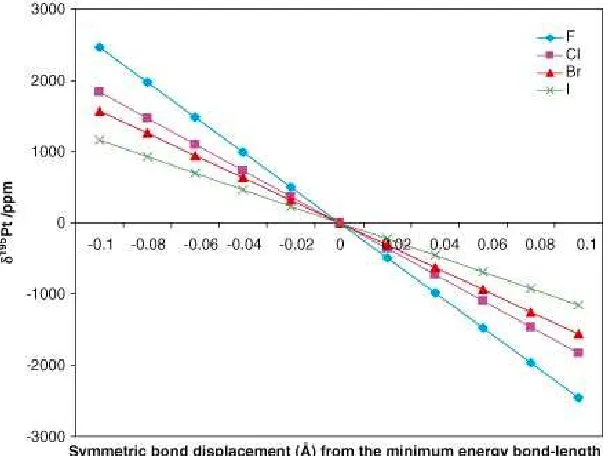
[image:22.595.149.453.217.445.2]currents within the electronic system. Such currents result in induced magnetic fields that modify the external field at the position of the spin magnetic moment. The resulting change of the local field (as the near degeneracy of energy levels is lifted) is the focus of nuclear magnetic resonance (NMR). The 195Pt nucleus is affected by factors such as platinum complex concentration, changes in bond-lengths4 (as shown in Fig. 1.2), ion-pairing effects5, temperature and the composition of the solvent.1c
Figure 1.2: Summary of the sensitivity ∂(δ195Pt)/∂(∆Pt X) of the total shielding tensor of the platinum nucleus for the [PtX6]2− complexes, where X = F, Cl, Br and I,
as a function of symmetrical bond displacements relative to the minimum energy value of the optimized octahedral complex in the gas phase. The minimum-energy bond lengths from DFT calculations were Pt F: 1.996 Å, Pt Cl: 2.400 Å, Pt Br: 2.555 Å and Pt I: 2.770 Å. Reprinted with permission from 4, © John Wiley and Sons.
3
complexes is OSO32- < OH2 < H2O < Cl2 < NO2 < Br2 < NH3 < SCN- < I- < thiourea <
Me2SO–S. For example: the complexes, cis-[Pt(15NH3)2(H2O)2],
cis-[Pt(15NH3)2(15NO)2] and cis-[Pt(15NH3)2(SCN)2]2- appear at -1593, -2214 and -3016
ppm, respectively.8 The chemical shifts for Pt(IV) complexes often appear at higher frequency compared to Pt(II) and Pt(0) complexes. For example, using [PtCl6]2- as our
reference, [PtCl4]2- = -1620; [PtBr6]2- = -1860 and [PtBr4]2- = -2690; [Pt(CN)6]2- =
-3866 and [Pt(CN)4]2- = -4746 ppm. Further, it is known that the Pt(IV) halides alone
span some 12500 ppm. For example, δ195Pt [PtF6]2- = 7326, δ195Pt [PtBr6]2- = -1860
and δ195Pt [PtI6]2- = -5120 ppm.1c 195Pt NMR properties of simple Pt(IV) halide
complexes have been studied by for example von Zelewsky,9 Mason,10 and Sadler11 where the utility of 195Pt NMR for their characterization is well illustrated. Notably, the work of Goodfellow et al. showed that the ten possible complexes [PtCl6−n(OH)n]2− could be identified in alkaline solution, based on their 195Pt NMR
chemical shifts, in addition to reporting the identification and 195Pt NMR assignment of some of the hydrolysis products of [PtCl6]2− in weakly acidic solutions (pH 1–3).12
1.2
Isotope Effects in Transition-Metal NMR
The isotope effects on chemical shifts of transition metal nuclei in diamagnetic complexes have been reported long before the age of high-resolution NMR experiments.13 These effects are very large compared to those for other nuclei, when comparing the ranges of chemical shifts encountered.14
McFarlane et al.13a illustrated the remarkable sensitivity of δ(183W) towards 13/12C isotopic substitution using 1H-(183W), 1H-(31P), and lH-(l83W,31P) nuclear magnetic double- and triple-resonance experiments when determining tungsten-183 chemical shifts and other parameters in tungsten(0) complexes with tertiaryphosphine, q-cyclopentadienyl ligands. Bendall et al. 13breported a study on 1/2H isotope shifts in
59
Co NMR spectra. An isotope shift of 5 ppm per deuterium atom has been observed for the 59Co resonance of tris(ethylenediamine)cobalt(III) chloride ([Co(en)3]Cl3) and
hexaamminecobalt(III) chloride([Co(NH3)6]Cl3) after exchange of hydrogen for
deuterium. Naumann et al. 13creported similar isotope effects (1H, 2H) on the 93Nb shielding of [Et4N][CpNb(X)(CO)3] (X = H, D). An isotope shift of 6 ppm per
4
C18O, 13CO, C18O, 1H- and 2H- substitution on the 51V NMR chemical shift of CpV(CO)4. A sizable isotope effect of 4.7 ppm is observed on going from
[CpV(CO)31H]- to [CpV(CO)32H]-. The mean isotope shift per 13CO amounts to 0.46
ppm. The isotope shift per C18O substitution was found to be 0.10 ppm. In a study of water exchange rates in tetraaquaplatinum(II) and trans-di-chloridobis-aquaplatinum(II) using H218O, Elding reported 16O/18O isotope effects induced in the 195
Pt NMR of several Pt(II) complexes,15 as well as in [PtCl(H2O)5]3+ ranging up to
1.0 ppm. Sadler et al.16 demonstrated that at relatively high magnetic fields, the 195Pt NMR resonance of the hexachloroplatinate(IV) anion could be resolved into a set of seven peaks ascribed to the [Pt35/37Cl6]2− species as a result of the natural 35Cl/37Cl
isotope distribution.
More Recently, Murray et al. demonstrated that in a 14.7 Tesla magnetic field, the highly-resolved 128.8 MHz 195Pt NMR resonances of [PtCl5(H2O)]− and
cis-[PtCl4(H2O)2] show well resolved isotope effects, which serve as unique
spectroscopic ‘fingerprints’ for the unambiguous identification of some of the aquated species derived from the hydrolysis of the [PtCl6]2− anion in acidic solution,
independent of the average chemical shift of these complexes.17 It was also shown that the 195Pt NMR peaks of [PtCl5(H2O)]− and cis-[PtCl4(H2O)2] complexes (see Fig. 1.3) under carefully controlled spectroscopic conditions are resolved not only according to the statistically expected isotopologues, but also in some cases due to the isotopomers possible for these species, depending on whether a 35Cl or 37Cl ion is
trans to the coordinated water molecule for each isotopologue in a given complex.
Isotopomers or isotopic isomers are isomers with isotopic atoms, having the same number of each isotope of each element but differing in their positions. Isotopologues are molecules that differ only in their isotopic composition. Simply, the isotopologue of a chemical species has at least one atom with a different number of neutrons than the parent.
5
Figure 1.3: Expanded 195Pt NMR spectra (●), showing the 35/37Cl isotope induced fine-structure for several species C–H from the [Pt35/37Cln(H2O)6−n]4−n (n = 2–4)
6
Figure 1.4: Expanded 195Pt NMR spectra (●), showing the 35/37Cl isotope induced fine-structure for species from the [Pt35/37Cln(OH)6−n]2− (n = 2–5) series; solid lines
[image:26.595.175.419.68.660.2]7
Expansion of the 195Pt NMR resonances is particularly interesting, since these all show well-resolved and remarkable fine-structure. Particularly interesting are the 195Pt NMR peaks of the cis/trans isomer pairs B&C in Fig. 1.2. Under these conditions intermolecular ligand exchange and/or intramolecular scrambling of [PtCln(H2O)6−n]4−n (n = 2–6) complexes at 293 K is slow on the NMR time scale,
resulting in each individual 195Pt resonance displaying well resolved peaks as a result of the 35/37Cl isotopic distribution for the [Pt35/37Cln(H2O)6−n]4−n (n = 2–6)
isotopologues and isotopomers, as reported by Murray et al.17 The statistical isotopologue distribution associated with each of the [Pt35/37Cln(H2O)6−n]4−n (n = 2–6)
species can be calculated using the equation17,
) ( ) ( ) ! ! /( ) )! (( 0 37 35
∑
+ = = =n n r nrn r Cl n Cl n
P α α …(1.1)
where P(n) is the statistical probability for an isotopologue at the fractional natural abundance (α) of 35Cl (0.7553) and 37Cl (0.2447), with n and r being the number of coordinated 35Cl and 37Cl ions respectively. Additionally, isotope effects were seen in solutions enriched in H218O, where due to rapid exchange between metal-coordinated
and solvent water 16O/18O splittings could be resolved.2
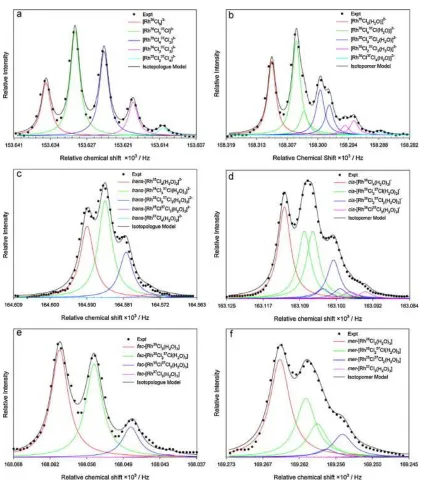
The distinctive fine-structure due to 35Cl/37Cl isotopologue and isotopomer effects is resolved at high magnetic fields for 103Rh NMR signals of the series of [RhCln(H2O)6−n]3−n (n = 3–6) complexes (see Fig. 1.5) in equilibrated hydrochloric
acid solutions, resulting in a unique NMR ‘finger-print’, with which it is possible to uniquely identify all chlorido containing Rh(III) complexes19. By this method the identity of the Rh(III) complex can readily be obtained from the fine-structure of the
103
Rh peaks, without reference to accurate 103Rh NMR chemical shifts. This is potentially a considerable advantage, given the absence of a convenient and universal reference compound for 103Rh NMR20, resulting in considerable experimental error in measuring δ(103Rh) chemical shifts, which can vary by as much as ±129 ppm for even the ‘simple’ [RhCl6]3− species21. Moreover, the relatively small δ(103Rh) difference of
66 ppm between two Rh(III) complex isomers such the trans-[RhCl2(H2O)4]+ and
cis-[RhCl2(H2O)4]+ cations, makes it virtually impossible to reliably distinguish between
such and other isomers in solution, on the basis of δ(103Rh) chemical shifts alone.
103
Rh NMR is a rapid means of unambiguously characterizing [RhCln(H2O)6−n]3−n
8
Figure 1.5: Experimental 103Rh spectra of [RhCln(H2O)6−n]3−n (n = 3–6) species
recorded at 292.1 K (symbols). The least-squares fits (solid lines) between experimental spectra of [RhCl6]3− (a), trans-[RhCl4(H2O)2]− (c) and
fac-[RhCl3(H2O)3] (e) and the isotopologue model; the least-squares fits between the
experimental spectra and the isotopologue model that includes isotopomers for the [RhCl5(H2O)]2−, cis-[RhCl4(H2O)2]− and mer-[RhCl3(H2O)3] species are denoted by
(b), (d) and (f), respectively. Reprinted with permission from 19, © Elsevier.
Interpretation of the origin of these isotope effects in the 195Pt NMR signals is achieved in the context of the elegant work of Jameson et al.22 whose calculation of the mean M–X bond displacements for octahedral MX6 molecules including [PtCl6]2−
[image:28.595.87.512.63.543.2]9
showed that the expected nuclear shielding changes in M (and where appropriate X) as a result of isotope replacement (and/or temperature effects) should be directly correlated to the mean M–L bond displacement. Consequently a direct proportionality between the isotope induced shielding of, in this case, 195Pt and the mass factor (m′-m)/m′ may be expected on 37Cl for 35Cl substitution. In general, as a heavier 37Cl− replaces a 35Cl− ion in the coordination sphere, increased shielding of the 195Pt is observed for a given isotopologue of a given species, as a result of some slight Pt–Cl bond contraction; the extent of this effect measured by ∆δ195Pt depends on the overall number of coordinated Cl− ions and the structure of the complex, but there appears to be no obvious/simple correlation between the magnitude of the ∆δ195Pt value and n in [PtCln(H2O)6−n]4−n (n = 2–5). It is noteworthy that the average chemical shift
difference per 37Cl i.e. between the individually resolved isotopologue resonances is only ∆δ195Pt = 0.2 ppm ∼ 29 Hz.
1.3
Calculation of Nuclear Shielding of Transition-Metals
Quantum-chemical computation of transition-metal chemical shifts is a stronghold of density-functional theory (DFT),23 and the advent of relativistic methods such as the zero-order regular approximation (ZORA) have made 195Pt NMR parameters amenable to computational study. 6, 24
Non-relativistic metal shift calculations are only sensible for the 3d series. Relativistic effects on absolute shieldings can be noticeable for the 4d and 5d series. In many cases, the influence of the exchange-correlation functional on the δ values
exceeds that of other sources, including relativity.
Hybrid functionals very often give results superior to those obtained with pure GGAs25, and the reasons for the different performance of the different families of functionals have been investigated by Schreckenbach26.
Computed metal chemical shifts are being used to assess newly developed density functionals 27. A sizeable set of transition metal shifts has now been computed at a very uniform level of theory (i.e. B3LYP for GGA geometries), with the more recent extensions of this set encompassing 99Ru28, 55Mn29, and 49Ti30.
10
shift range. The reasons for the deviations for δ(95Mo) have not been analyzed yet; in this case, pure GGA functionals perform much better 31.
δ(59Co) is well described for porphyrin and crown ether complexes with the B3LYP functional32. There have been attempts to compute metal chemical shifts using an ECP(see Section 2.3) on the metal in the NMR calculation; despite the lack of theoretical justification for such a procedure, reasonably good correlations between calculated and experimental δ(183W) and δ(99Ru) values have been obtained33. However, scaling factors on the order of 10-20 were necessary.
A combination of experimental and theoretical 103Rh chemical shifts have been used to discriminate between two coordination modes of a hemilabile ligand34. Model calculations have shown that in Rh complexes with bidentate ligands, δ(103Rh) is governed by the Rh–ligand bond distance and not by the bite angle, as previously reported in the literature35. Plausible structures for vanadate–peptide complexes have been supported by reasonably good accord between computed and reported δ(51V) data36. DFT-derived 57Fe chemical shifts have been used in the assessment of binding modes of CO, NO, and O2 ligands in iron–porphyrin complexes, which serve as heme
model compounds37. Following empirical precedence, theoretical metal shifts have been correlated with stabilities (i.e., computed reaction energies for ligand displacements)38 or with reactivities approximated by computed activation barriers for the key step in a catalytic cycle39. Even though limited to specific families of compounds, such NMR reactivity correlations could be useful in optimizing and designing new homogeneous catalytic systems. More recently, a computational protocol based on molecular dynamics simulations has been applied to model thermal and solvent effects (as discussed under Section 1.1) on transition metal chemical shifts40. Variations on the order of a few dozen ppm, that is, small effects for a transition metal nucleus, have been noted for aqueous inorganic vanadate complexes41 and for permanganate ion42. For δ(57Fe) of the highly charged [Fe(CN)6]4–, however,
much larger effects are found, exceeding 1000 ppm, due to the exceptional sensitivity of the iron shielding toward the metal–ligand bond distance, which is strongly affected by thermal averaging and by the interaction with the solvent43.
11
From the 5d series onwards, a proper treatment of relativistic effects (see Section 2.3) is also mandatory for the metal chemical shifts. When the leading terms, including spin–orbit coupling, are included, general trends in the shielding values can be described at the Hartree–Fock level44.
Methods and application of relativistic approaches to calculating nuclear shielding has been reviewed extensively.40, 45 Arcisauskaite et al.46 investigated the importance of relativistic effects on NMR shielding tensors and chemical shifts of linear HgX2
(X=Cl, Br, I,CH3) compounds using three different relativistic methods: the fully
relativistic four-component approach and the two-component approximations, linear response elimination of small component (LR-ESC), and ZORA. LR-ESC reproduces successfully the four-component results for the 13C isotropic shielding value in Hg(CH3)2 within 6 ppm but fails to reproduce the 199Hg shielding tensors and
chemical shifts. The latter is mainly due to an underestimation of the change in SO contribution. Even though ZORA underestimates the absolute (relative to the bare nucleus) Hg NMR shielding values by ~2100 ppm, the differences between 199Hg chemical shift values obtained using ZORA and the four-component approach without spin–density contribution to exchange-correlation are less than 60 ppm for all compounds using three different functionals, BP86, B3LYP, and PBE0. However, larger deviations (up to 366 ppm) occur for 199Hg chemical shifts in HgBr2 and HgI2
when ZORA results are compared with four-component calculations.46 Despite the new developments in four-component relativistic calculations of shielding described above, most relativistic shielding calculations are carried out with various two-component methods, DFT/ZORA being the most commonly used method. Nuclear magnetic shieldings on the heavy atom for the systems SnXH3 (X=H, F, Cl, Br, I),
SnXYH2 (X, Y=F, Cl, Br, I), and PbXH3 (X=H, F, Br, I) were calculated using linear
response elimination of small component method(LR-ESC) and compared to random phase approximation(RPA) calculations and then analyzed in order to determine the main trends and discuss the electronic origin of the shielding of two kinds of atoms involved in such systems: central and substituent atoms.47 DFT/ZORA calculations have been carried out with or without SO in a large number of systems, for example:
195
12
Heavy atom effects on light atoms have also been demonstrated theoretically for 17O in [UO2(OH)4]2–,52 13C in monohalo (F, Cl, Br, I) organic compounds,53 13C and 14N
shielding in 6-halo(Cl, Br, I) purines,54 29Si with Pd and Pt,55 13C in methyl hydride complexes of Rh and Ir,56 and 19F in uranium chlorofluorides.57
Temperature dependence and isotope shifts arise mainly from the change in the rovibrationally averaged geometry of the complex. Various approaches are available to account for the effect of rovibrational averaging. In general one needs a means of generating configurations over which the averages are taken and a means of generating the shielding for a given configuration.
Using zero-point vibrationally averaged structures, isotope effects on 59Co chemical shifts have been reproduced and rationalized computationally.58 In a cobaloxime58a and the hexamine cobalt(III) complex,58b the observed 1H/2H shifts on the order of ca. 50 ppm - 100 ppm could be traced back to small changes in the Co-N bonds, on the order of 0.001 Å- 0.006 Å, upon isotopic substitution. Because of their much smaller magnitude, typically 1 ppm or less,59 the abovementioned isotope effects on 195Pt or
103
Rh shifts pose a much bigger challenge to theory.
1.4
Aims and Objectives
This study aims to probe the origin of isotope effects on 195Pt and 103Rh NMR spectra, using zero-point corrections as a first step towards accurate modelling of these effects computationally.
This thesis is organized as follows: Chapter 2 discusses the fundamental principles and methods that are employed in this thesis. These include the chosen quantum-mechanical method, density functional theory (DFT) and its implementation in calculating NMR nuclear shielding. In addition, relativistic approximations are also discussed as it becomes important for heavier nuclei such as 195Pt and 103Rh.
Chapter 3 describes the particular computational protocol used in this study. In Chapter 4, a DFT study of the 35/37Cl and 16/18O induced isotope shifts in the 195Pt NMR spectra of some prototypical Pt(IV) chlorido/aqua complexes, [PtCl 6-n(H2O)n]n−2 (n=0-3) is presented. This is followed by Chapter 5 where the
computational protocol is extended to [Pt35/37Cl5(OH)]2− , cis-[Pt35/37Cl4(OH)2]2-,
13
16/18
OH isotopologues. In Chapter 6, the 35Cl/37Cl isotope shifts of Rh(III) aquo/chloride complexes Rh35Cln37Cl5-n(H2O)]2− (n=0-5), cis-[Rh35Cln37Cl(4-n)(H2O)2]
-(n=0-4), and fac-Rh35Cln37Cl(3-n)(H2O)3 (n=0-3) are calculated using our
14
Chapter 2
Theoretical Background
2.1 Many-particle quantum mechanics
The non-relativistic time-dependant Schrödinger equation describes how the wavefunction, Ψ, of a quantum particle changes with respect to time, t:
) , ( )
, (
t H t
t
i r = Ψ r
∂ Ψ ∂
h …(2.1)
where the Hamiltonian operator isa:
) , (
2 V t
H r
r+
∂ ∂ −
= …(2.2)
and V(r,t) is the potential both dependant on spatial coordinates, r and time t. The wavefunction describes the motion and distribution of quantum particles and contains everything that can be known about the system. The wavefunction by itself has no physical significance, instead the square of the modulus of the wavefunction, i.e. the probability density, yields the probability that the particle will be at r when multiplied with the volume element dr.
r r)2d
(
Ψ …(2.3)
When the time-independent potential operator, V(r), is used, the time-independent Schrödinger equation can be written as:
) ( )
(r ψ r
ψ E
H = …(2.4)
where E is the energy eigenvalue of the eigenfunction, ψ. This equation can in principle be solved to produce the ground and excited state wavefunctions for any quantum system with a time-independent potential.
15
For many-particle systems like an atom, however, the Schrödinger equation becomes more complex due to the interdepency of nuclear and atomic motion and becomes analytically insolvable as can be seen from the Hamiltonian of a system containing nuclei and electrons:
∑∑
∑
∑
∑
∑
< < + + − ∇ − ∇ − =i k k l kl
l k j i ij ik k k k k i i r Z Z r r Z m H 1 2 1 2
1 2 2
…(2.5)
where i and j are the indices of the electrons and k and l are the indices of the nuclei. The first and second terms of Eq. 2.5 describe the kinetic energy of the electrons and nuclei, the third term describes the potential energy between the electrons and nuclei, and the fourth and fifth terms describe the potential energy of electron-electron and nuclei-nuclei interactions. The Born-Oppenheimer approximation separates nuclear and electronic motion, which is partially feasible due to the fact that nuclei and electrons move on different timescales due to their large mass differences. Hence, the kinetic energy due to nuclear motion can be ignored and the electronic Schrödinger equation can be solved by only including the potential energy (for each set of nuclear positions):60
(
Helec +VNN)
Ψelec =EelecΨelec …(2.6)∑
∑∑
∑
< + − ∇ − = j i ik i k klk i i elec r r Z H 1 2 1 2 …(2.7)
∑
< = l k kl l k NN r Z Z V …(2.8)16
The nuclear kinetic energy which is ignored in the electronic Schrödinger equation can later be recovered by solving a nuclear Schrödinger equation:
nuc nuc k N k k E r V
m ψ = ψ
+ ∇ −
∑
( ) 2 1 2 …(2.9)where the electronic interaction enters as a potential V
( )
rN dependent on nuclearcoordinates. The electronic potential has to be approximated, usually as a harmonic
potential based on the electronic solution. This enables one to recover the zero-point
energy as well as temperature-dependent vibrational motion that can be used to
calculate energies, entropies and free energies at any temperature using the equations
of statistical mechanics. A more detailed description of the consequences of the
Born-Oppenheimer approximation and the quantum mechanical remedy thereof is discussed
in Section 2.4.
2.2 Solving the Schrödinger equation
2.2.1 The Variational Principle
Any many-body problem containing three or more interdependent particles is
analytically insolvable, hence, more approximations are made in order to perform
these computations.
The variational principle is most commonly used, stating that if a system with
Hamiltonian H is described by an allowed trial wavefunction ψtrial then the following equation holds: 0 * * E E d d H trial trial trial trial trial ≥ =
∫
∫
r r ψ ψ ψ ψ …(2.10)17
that the energy of the trial wavefunction will always be higher or equal to the real
energy of the real wavefunction. The exact wavefunction can thus be approached
either by trying all possible wavefunctions allowed by the number of particles or to
systematically improve the trial wavefunction until its energy cannot get lower.
2.2.2 Hartree-Fock theory
Even though the Born-Oppenheimer approximation and the variational principle
together provide a route towards finding the electronic wavefunction we cannot
search through all possible trial wavefunctions having the correct number of electrons
as there are simply too many possibilities and in fact we need a form for the
wavefunction on which the Hamiltonian can operate. However, approximating the
N-electron wavefunction as a linear combination of 1-electron wavefunctions
provides a convenient starting point. Such an allowed wavefunction is the Slater
determinant which is an antisymmetric product of 1-electron wavefunctions(i.e. that
SD
ψ = −ψSDT) which consequently obeys the Pauli exclusion principle i.e. that
electrons are indistinguishable and cannot be in the same quantum state:
) ( ) ( ) ( ) ( ) ( ) ( ) ( ) ( ) ( ! 1 2 1 2 2 2 2 1 1 1 2 1 1 N N N N N N SD N x x x x x x x x x φ φ φ φ φ φ φ φ φ ψ L M O M M L L
= …(2.11)
The φi
( )
x are the 1-electron wavefunctions, called spin orbitals i.e. products of both aspatial orbital and a spin function. The spin orbitals are functions of both spatial and
spin degrees of freedom, together denoted
( )
x .Now we can use the Born-Oppenheimer Hamiltonian and the variational principle to
minimise the wavefunction(Slater determinant) to yield the ground state wavefunction
and the ground state energy. When using atomic units the mass and charge of the
electron and Planck's constant turn out to be unity.
18 NN i j j i i j j j i i i i i SD NN elec SD
HF H V h V
E = ψ + ψ =
∑
φ φ +∑∑
φφ φ φ − φφ φ φ +2 1
…(2.12)
where we have introduced the Dirac short hand notation. The individual terms of eq.
2.12 are:
( )
x( )
x dxr Z h i k ik k i i
i φ φ φ
φ − ∇ −
=
∫
∗ 2∑
2 1
…(2.13)
( )
x x x2( ) ( )
x1 x1( ) ( )
x2 x2 x x2x d d
r d
d
r j i j j i
i i j j i j j i i 1 12 1 2 2 12 2 1 1 1 ) (
∫∫
∗ ∗∫∫
− = − φ φ φ φ φ φ φ φ φ φ φ φ φ φ …(2.14)Eq. 2.13 is an integral that describes the kinetic energy and the nucleus-electron
interaction and is a 1-electron equation. Eq. 2.14 shows two double integrals that
describe the electron-electron repulsion. The first term is the Coulomb integral (often
denotedJij) that represents the electrostatic repulsion of two smeared out charge
clouds while the second term is the exchange integral (often denotedKij ) that is hard
to interpret classically, but arises due to the antisymmetry of the Slater determinant
that was enforced.
As we have built up the many-electron wavefunction from 1-electron wavefunctions
(orbitals), our variational freedom now comes from varying the orbitals (with the
constraint that the orbitals must remain orthonormal) and thus we can minimise the
whole energy expression by choosing the best orbitals. This is achieved by solving the
Hartree-Fock equations61:
=
i
fφ ϵiφi …(2.15)
for each electron where ϵi are the eigenvalues to the Fock operator f which is defined
as: HF k ik k i V r Z
f =− ∇2 −
∑
+2 1
19
where VHF is the Hartree-Fock potential which is an average repulsive potential (defined by Coulomb and exchange operators, not shown) due to all the electrons
except for the one which is being solved. As the Fock operator both operates on the
orbitals and depends on the orbitals through the Fock potential, the
Hartree-Fock equations have to be solved self-consistently by first guessing the initial orbitals
and then iterating until the orbitals stop changing. Once self-consistent orbitals are
available, the Hartree-Fock energy equation (Eq. 2.12) gives the Hartree-Fock total
energy while the orbital energies can be interpreted as approximate ionisation
energies of electrons from the orbitals that they occupy.
2.2.3 Density functional theory
Density functional theory solves the Schrödinger equation by establishing the total
electron density as the quantity to derive the ground state energy from, instead of the
many-electron wavefunction.
The Born-Oppenheimer Hamiltonian (Eqs. 2.7 and 2.8) for any molecule is fully
determined by the number of electrons N and the electron-nucleus potential V (which
is specified by nuclear positions and nuclear charges) and leads to a unique ground
state Born-Oppenheimer energy and associated wavefunction of a molecule. DFT is a
method to circumvent calculating the complicated wavefunction. The electron
density, ρ
( )
r , can be defined as a multiple integral of the square of the wavefunctionover the spin coordinates of all electrons and over all but one spatial coordinate.61
( )
r Ν ...( )
r dsdx2...dxN 2∫ ∫
= ψ
ρ …(2.17)
It gives the probability that any of the N electrons of the system of any spin is found
within the volume element and is a simple function of the spatial coordinates. The
electron density is experimentally observable, from X-ray diffraction for instance.
This simple quantity turns out to contain all the necessary information: the number of
electrons, Ν , can be determined by integrating over ρ
( )
r ,and the nuclear positions20
the electron-nucleus potential v can be uniquely deduced from ρ
( )
r is the subject ofthe first Hohenberg-Kohn theorem.63
It should thus be possible to come up with an energy functional (a functional is a
special type of function whose argument is another function) whose argument is the
electron density and determines the ground state energy. The energy functional would
have to account for the electronic kinetic energy, the nucleus-electron interaction
energy and the electron-electron interaction energy (the trivial nucleus-nucleus
repulsion term is ignored in all following equations) in some way:
( )
[ ]
ρ r Τ[ ]
ρ( )
r ENe[ ]
ρ( )
r Eee[ ]
ρ( )
rΕ = + +
…(2.18)
where Τ
[ ]
ρ( )
r is the kinetic energy term, ENe[ ]
ρ( )
r is the electron-nucleus term and( )
[ ]
ρ ree
E is the electron-electron interaction term, all expressed in terms of ρ
( )
r . The( )
[ ]
ρ rNe
E term is easy to express as a functional of the density, but it is far from
obvious how to express Τ
[ ]
ρ( )
r and Eee[ ]
ρ( )
r in terms of ρ( )
rAnother problem concerns finding the ground state density with such an expression
instead of just any density. Luckily, the second Hohenberg-Kohn theorem63 provides
density functional theory with its own variational principle which states that any trial
density ρtrial
( )
r will always be higher in energy (or equal) than the real ρexact( )
r and thus Eq. 2.18 can simply be tried for a number of trial densities or somehowminimised by systematically improving the trial density.
A simple expression of the Τ
[ ]
ρ( )
r kinetic energy term has been the subject ofvarious attempts, some dating back to the early days of quantum mechanics, e.g. the
Thomas-Fermi model.64 In order to circumvent this problem some arguments from
Hartree-Fock theory can be borrowed. By considering a fictitious system of
interacting particles described by a Slater determinant of 1 electron orbitals, a
non-interacting trial density ρKS
( )
r can be constructed, as suggested by Kohn and Sham:65
( )
( )
dsi i KS
2
∑ ∫
= x
r φ
ρ
…(2.19)
21
By requiring ρKS
( )
r to be equal to ρ( )
r one can still work with the exact equations of DFT and Eq. 2.17 can be rewritten as:( )
[ ]
ρ r ΤKS[ ]
ρ( )
r ENe[ ]
ρ( )
r J[ ]
ρ( )
r EXC[ ]
ρ( )
rΕ = + + +
…(2.20)
where the kinetic energy term is defined as:
∑
∇ − = i i i KST ρ φ 2 φ
2 1 )] ( [ r …(2.21)
The electron-nucleus term is:
( )
[ ]
r Z( )
rr drE ik k k Ne 1 −
∑ ∫
− = ρ ρ …(2.22)and the Coulomb term is:
( )
[ ]
( ) ( )
21 2 1 r r r r
r 1 2 r d 1d
J ik
−
∫∫
= ρ ρ
ρ
…(2.23)
where we have split the previous Eee
[ ]
ρ( )
r term into a trivial Coulomb interactionterm J
[ ]
ρ( )
r (calculated as in Hartree-Fock theory) and a new EXC[ ]
ρ( )
r term. Whileit may not be obvious, no approximation has been made. The EXC
[ ]
ρ( )
r term, however, has become a rather complicated term, which must now account for acorrection to the kinetic energy [not accounted for by the TKS
[ ]
ρ( )
r term) as well as electron- electron repulsion not accounted for by the smeared charge cloudtermJ
[ ]
ρ( )
r . Assuming an expression for EXC[ ]
ρ( )
r can be given, we can next use the Hohenberg-Kohn variational principle to solve the Kohn-Sham single particleequations to minimise the density as it is now expressed in orbitals:
( ) ( )
= + ∇− 2 νeff r φi x
2 1
1 ϵiφi
( )
x…(2.24)
where the effective potential, νeff
( )
r contains the nucleus-electron, Coulomb and22
The Kohn-Sham DFT equations are very similar to the Hartree-Fock equations and
are also solved self-consistently and by the same type of computational techniques.
The main difference is the absence of a K exchange term (which we will come back
to) and the occurrence of an exchange-correlation term. The exchange-correlation
energy can be thought of as the mutual avoidance of electrons due to the "personal
space" (exchange-correlation hole) of each electron.
If an exact expression of the exchange-correlation term,EXC
[ ]
ρ( )
r , would be given, then solving the Kohn-Sham equations would lead to the exact solution to theBorn-Oppenheimer Schrödinger equation. There is, however, no way of knowing this exact
expression and educated guesses of its form must be used instead, which means that
in practice DFT is always an approximate theory that suffers from the fact that its
approximations are not easily systematically improvable unlike approximations based
on wavefunction theory (WFT).
Theoretical developments of density functional theory for the last decades have thus
been focused on "guessing" the exchange-correlation term, utilising various clues
about its nature. This involves finding forms for the exchange and correlation energy
that correctly describe the energy or density of model systems whose properties are
well or exactly known. One of these model systems is the uniform electron gas,
jellium, whose properties are well known from almost exact quantum Monte Carlo
calculations. The local density approximation (LDA) is a constituent of almost all
exchange-correlation functionals in common use, and it is partly based on deriving a
functional form (involvingρ
( )
r ) that describes the properties of jellium well.Different exchange and correlation functionals based on the LDA approximation have
been derived.66 It turns out that the LDA approximation results in very inaccurate
DFT energies when applied to molecules. In order to go beyond the LDA
approximation, one strategy is to use the gradient of ρ
( )
r as an ingredient inincreasingly complex formulas for exchange and correlation respectively. The
generalized gradient approximation (GGA) is the most successful gradient corrected
approximation to LDA which comes in numerous different varieties nowadays. A
common gradient corrected exchange functional is the one by Becke (B88 or B)67. It
is often combined with various different correlation functionals such as LYP68 and
![Figure 1.1: sample prepared from by oxidizing [PtCl195Pt NMR spectrum showing Pt(IV) aquo/chloride species present in 4]2- in HClO4 with NaClO3.2](https://thumb-us.123doks.com/thumbv2/123dok_us/8719044.384327/21.595.102.483.387.606/figure-prepared-oxidizing-spectrum-showing-chloride-species-present.webp)
![Figure 1.4: Expanded 195Pt NMR spectra (●), showing the 35/37Cl isotope induced fine-structure for species from the [Pt35/37Cln(OH)6−n]2− (n = 2–5) series; solid lines correspond to the non-linear least-squares fits of the isotopic model calculated from the statistically expected isotopologues, and where appropriate isotopomers, for each platinum complex.18](https://thumb-us.123doks.com/thumbv2/123dok_us/8719044.384327/26.595.175.419.68.660/expanded-structure-correspond-calculated-statistically-isotopologues-appropriate-isotopomers.webp)
![Table 3.1: Vibrationally averaged bond lengths at 0K for [PtCl6]2- calculated at various levels of theorya employing default grids and step sizes [in Å]](https://thumb-us.123doks.com/thumbv2/123dok_us/8719044.384327/60.595.42.558.143.665/vibrationally-averaged-lengths-calculated-various-theorya-employing-default.webp)
![Figure 4.3: Isotopomers of [PtCl5(H2O)]− (1), cis-PtCl4(H2O)2 (2), and fac-[PtCl3(H2O)3]+ (3), together with the labelling scheme adopted in the following figures; color code: 35Cl green, 37Cl purple](https://thumb-us.123doks.com/thumbv2/123dok_us/8719044.384327/73.595.174.421.115.520/figure-isotopomers-labelling-scheme-adopted-following-figures-purple.webp)

![Table 4.8: Breakdown of calculated total shielding constants σtot into their constituents for cis-[Pt35Cl4(H2O)2] isotopomers](https://thumb-us.123doks.com/thumbv2/123dok_us/8719044.384327/76.595.92.503.82.387/table-breakdown-calculated-total-shielding-constants-constituents-isotopomers.webp)
![Figure 4.8: Plot of difference between calculated σ values of [Pt35/37Cl5(H216O)]− and [Pt35/37Cl5(H218O)]− vs](https://thumb-us.123doks.com/thumbv2/123dok_us/8719044.384327/79.595.199.396.182.376/figure-plot-difference-calculated-values-pt-cl-pt.webp)
