https://www.scirp.org/journal/jss ISSN Online: 2327-5960
ISSN Print: 2327-5952
DOI: 10.4236/jss.2019.710032 Oct. 31, 2019 375 Open Journal of Social Sciences
An Empirical Approach and Implications for
Teachers to Begin Constructivist Teaching
Xiaohong Zhang
School of English and Cultural Studies, Shanghai Art and Design Academy, Shanghai, China
Abstract
This paper aims to explore teachers’ perceptions and views about the imple-mentation of constructivist teaching from an empirical research in a voca-tional college classroom. Constructivism and constructivist teaching pedago-gies are visited first to find the requirements as well as barriers for construc-tivist teachers. Both quantitative and qualitative data are collected from stu-dents surveyed with a questionnaire and teachers with interviews addressing the experiences and concerns of their teaching practice. Based on the data gathered, the teachers’ desired teaching model, along with students’ prospec-tive feedback to the implementation of constructivist teaching is fully ana-lyzed. By examining the students’ identified needs and the teachers’ percep-tions, it is concluded that students’ learning preferences links to constructivist ideas and teachers’ teaching practice needs reforming and changing in order to undertake constructivist teaching.
Keywords
Constructivist Teaching, Student and Teacher Perspective, Empirical Research
1. Introduction
Constructivism, an epistemology offering an explanation of the nature of know-ledge and how learners learn has been a key concept and gained increasingly in-fluential popularity in philosophy and education [1] ever since its emergence in the early 18th century [2]. Different branches emerged as its evolution, but grounding assumptions [3] are generally agreed upon: 1) all knowledge is con-structed and comes from constructivist activities in an individual’s brain as a result of his or her own life experience; 2) knowledge is context dependent, so learning should occur in contexts to which it is relevant; 3) Learning is mediated How to cite this paper: Zhang, X.H.
(2019) An Empirical Approach and Impli-cations for Teachers to Begin Constructivist Teaching. Open Journal of Social Sciences, 7, 375-386.
https://doi.org/10.4236/jss.2019.710032
DOI: 10.4236/jss.2019.710032 376 Open Journal of Social Sciences by tools and signs; 4) knowing how we know is the ultimate human accom-plishment.
Accordingly in the classroom, constructivist teaching requires a shift in teaching “from a telling-listening relationship to a complex and interactive rela-tionship where the students’ own effort to understand are the focal point.” [4]. Building upon this belief, constructivist teaching is viewed as a “progressive” learning-teaching approach [5], by which learners find opportunities to become aware of their experience, build upon it, extend it and in the process create new experiences which become part of what they know [6]. The main teaching prin-ciples summarized by Muijis [5] are as follows:
Learning is always an active process. Learning is about helping pupils con-struct their own meaning, not about getting the right answer, as pupils can be trained to get the right answer without actually understanding the concept. The construction of knowledge is not just an individual thing. Learning is
so-cially constructed through interaction with peers, teachers and parents. So, it’s best to construct the learning situation socially, by encouraging group work and discussion.
Learning is always contextualized. We learn best when new learning is expli-citly connected to what we already know.
Real in-depth learning means thoroughly constructing knowledge, by ex-ploring and revisiting material rather than quickly moving from topic to top-ic as in the direct instruction approach.
Teaching is about empowering the learner, and allowing the learner to dis-cover and reflect authentic learning and deeper understanding compared to the surface memorization that often characterizes other teaching approaches. It’s better to use hand-on and real-life materials rather than textbooks.
2. Theoretical Analysis of Constructivist Teaching
2.1. Comparison of Principles of Constructivist Teaching and Non-Constructivist Teachings
DOI:10.4236/jss.2019.710032 377 Open Journal of Social Sciences
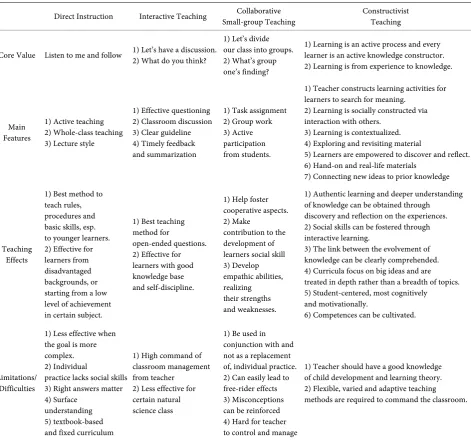
Table 1. A look at the difference between constructivist teaching and non-constructivist teachings.
Direct Instruction Interactive Teaching Small-group Teaching Collaborative Constructivist Teaching
Core Value Listen to me and follow 1) Let’s have a discussion. 2) What do you think?
1) Let’s divide our class into groups. 2) What’s group one’s finding?
1) Learning is an active process and every learner is an active knowledge constructor. 2) Learning is from experience to knowledge.
Main Features
1) Active teaching 2) Whole-class teaching 3) Lecture style
1) Effective questioning 2) Classroom discussion 3) Clear guideline 4) Timely feedback and summarization
1) Task assignment 2) Group work 3) Active participation from students.
1) Teacher constructs learning activities for learners to search for meaning.
2) Learning is socially constructed via interaction with others.
3) Learning is contextualized. 4) Exploring and revisiting material
5) Learners are empowered to discover and reflect. 6) Hand-on and real-life materials
7) Connecting new ideas to prior knowledge
Teaching Effects
1) Best method to teach rules, procedures and basic skills, esp. to younger learners. 2) Effective for learners from disadvantaged backgrounds, or starting from a low level of achievement in certain subject.
1) Best teaching method for open-ended questions. 2) Effective for learners with good knowledge base and self-discipline.
1) Help foster cooperative aspects. 2) Make
contribution to the development of learners social skill 3) Develop empathic abilities, realizing their strengths and weaknesses.
1) Authentic learning and deeper understanding of knowledge can be obtained through discovery and reflection on the experiences. 2) Social skills can be fostered through interactive learning.
3) The link between the evolvement of knowledge can be clearly comprehended. 4) Curricula focus on big ideas and are treated in depth rather than a breadth of topics. 5) Student-centered, most cognitively and motivationally.
6) Competences can be cultivated.
Limitations/ Difficulties
1) Less effective when the goal is more complex. 2) Individual
practice lacks social skills 3) Right answers matter 4) Surface
understanding 5) textbook-based and fixed curriculum
1) High command of classroom management from teacher
2) Less effective for certain natural science class
1) Be used in conjunction with and not as a replacement of, individual practice. 2) Can easily lead to free-rider effects 3) Misconceptions can be reinforced 4) Hard for teacher to control and manage
1) Teacher should have a good knowledge of child development and learning theory. 2) Flexible, varied and adaptive teaching methods are required to command the classroom.
(adapted from Mujis et al., 2005).
2.2. Constructivist Pedagogic Model
DOI: 10.4236/jss.2019.710032 378 Open Journal of Social Sciences Explanation - Elaboration - Evaluation.
Engagement, the starting phase of the model, is designed to boost learner’s at-tention, imagination and motivation in the introduction of a new topic [5]. With the deepening of students’ understanding and motivation over time, when the students feel puzzled and highly challenged in inquiring and leaning, the en-gagement will ebb to facilitate next phase-exploration. Exploration works as the key aspect of the constructivist teaching by allowing learners to develop their thinking and meaning-making via two important approaches: coaching and ref-lection. Explanation gives learners the opportunity to articulate their ideas, thoughts and findings, which are closely linked to the prior engagement and ex-ploration activities [11]. To enable them to express their deepened and shar-pened understanding, multi-leveled tasks should be designed from a simple causal talk to the presentation in a formal setting, or even to an open public de-bate. Noticeably, group work works best for the students to explain by providing a preferable environment with more chances to communicate. Elaboration, another key phase in constructivist teaching and learning, offers learners the opportunity to extend their findings to other specific contexts. The essential element in this phase is to supply learners with choices and options. Rather than the teacher-designed assignments and tasks, students are motivated to offer more projects to further their thinking by themselves. This will not only facili-tate their learning, but also bring more new learning. Evaluation, the final phase, refers to the formal assessment of students’ learning and understanding. And the criterion of this assessment phase is to see whether the learner have attained the abilities to make the transition from knowing to understanding, such as contex-tualizing the knowledge, explaining in one’s own words, generalizing into a broader context, justifying by offering evidence [12]. The result of the evaluation can be open or final, but the final phase can never be closing, because it marks a new loop of a deeper learning [5].
The Five Es Model can be applied in both individual lessons and seri-al-subjects, in both philosophical arts and technological science. As the oft-cited constructivist teaching practice, the model integrates aspects of five phases, and interestingly, each phase should be planned and implemented in a unit as a whole [11]. Constructivist teaching being as an progressive teaching approach with high achievement gains and teaching effectiveness, “many teachers are in favor of adopting constructivist instructional approaches but are unsure of where to begin” [6].
2.3. The Roles and Concerns of Teachers in Constructivist Teaching
tran-DOI:10.4236/jss.2019.710032 379 Open Journal of Social Sciences sition from transmitters of knowledge to facilitators of learning for the learner’s construction [13].
To realize the shift from the sage on the stage to the guide on the side, Petra-gila argues that in constructivist teaching, the teacher is best positioned “in the possibility of intervening the learning that is occurring, rather than being in charge of the act of learning” [14]. Besides, teachers are expected to build up a learning atmosphere as energizing, collaborative, immersive and informative as the life of student outside of 9:00-3:30 time slot [15]. Brooks and Brooks [16] suggest twelve strategies for teachers to exercise in order to move towards a more constructivist approach:
encourage and accept student autonomy and initiative;
use raw data and primary sources, along with manipulative, interactive, and physical materials;
allow student responses to drive lessons, shift instructional strategies, and al-ter content;
inquire about students’ understanding of concepts before sharing their own under standings of those concepts;
encourage students to engage in dialogue, both with the teacher and with one another;
encourage student inquiry by asking thoughtful, open-ended questions and encouraging students to ask questions of each other;
seek elaboration of students’ initial responses;
engage students in experiences that might engender contradictions to their initial hypotheses and then encourage discussion;
allow wait time after posing questions;
provide time for students to construct relationships and create metaphors. To be a constructivist teacher, a number of general factors have to be taken into account for the teaching effectiveness in general: 1) good subject knowledge; 2) good questioning skill; 3) an emphasis upon instruction; 4) a balance of grouping strategies; 5) clear objectives; 6) good time management; 7) effective planning; 8) good classroom organization; 9) effective use of teaching media. According to Chaille et al. [16] and Muijis [5], the roles of a teacher in a con-structivist classroom, should be a researcher, a question asker, a coach, a profes-sional team player, a presenter, an environment organizer, a facilitator, and an operator.
However, to teachers, a constructivist approach to teaching itself is viewed as “a challenge and a concept that is difficult to grasp in a short period of time” [13]. Dharmadasa summarizes challenges teachers face in constructivist class-room as much as follows:
DOI: 10.4236/jss.2019.710032 380 Open Journal of Social Sciences Teachers need to use outside resources and materials such as hands-on ob-jects, additional books, and computer programs and not rely solely on a textbook to enhance learners’ learning. So teachers should be provided with knowledge how, where and when to access to these resources.
The Constructivist approach to teaching and learning would hinder effective classroom management. The teachers are more concerned about assumed disciplinary problems and problems in classroom management than in creating supportive learning environments to learners. The classes, small in size, could promote effective teacher-learner interaction, but the ones of large number of students are very difficult to handle. The greatest challenge is to be prepared to ask probing questions that promote learners’ thinking to higher levels.
Taking all the concerns into consideration, we can find the comments made by Cey reasonable and sensible without much wonder. “When observing the ac-tivities and behaviors of a constructivist teacher on any given day, one would notice the distinctive resemblance to the bounce of a prairie coyote that is warily and shrewdly making its way around its environment in a non-linear, yet pur-poseful, prepared and productive fashion” [6].
3. Data Analysis and Findings
After a clear theoretical structure was made, first-hand data would be collected by using questionnaires and interviews. 24 questionnaires were distributed to a class of first year in a vocational college. The main concerns in the questionnaire are: what makes good learning, the sources of knowledge and skills, how to be-gin a class, the effectiveness of learning activities, roles a teacher plays in the class, and the students’ expectations of their ability. Besides, the main intervie-wees are one college teacher and one peer cohort student. To the peer student, a semi-structured interview was conducted under heading ‘standardized interview’ [17] at the end of the project. The main content is about their contrast and cor-responding experiences of the traditional and Constructivist teaching they have had in college, and any comment, suggestion or advice for teaching practice will be invited as well. To the college teacher, a semi-structured interview and indi-vidual interview was adopted under heading “non-standardized interview” at the beginning of the project. The main content will be about their knowledge, learning tips and application of teaching approach. Experience related to how to get students engaged in the teaching will be of highest attention.
3.1. Findings of the Data Collected from Questionnaire
ana-DOI:10.4236/jss.2019.710032 381 Open Journal of Social Sciences lyzed can be summarized as follows:
Teacher and teaching methods are regarded as very important factors in their learning, but they are not the sole source of knowledge. Individual expe-riences, interpersonal communication and reflection also generate and in-ternalize learning (see Table 2).
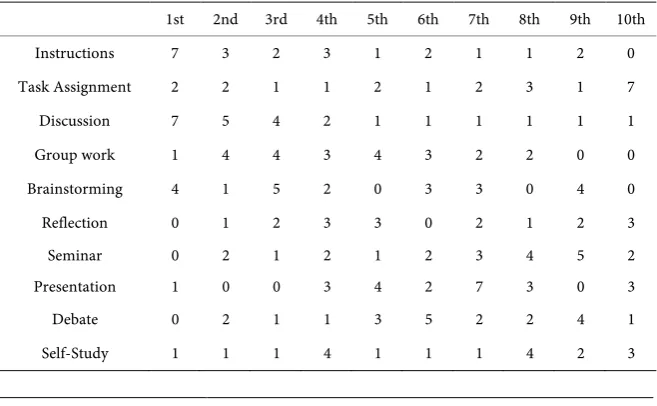
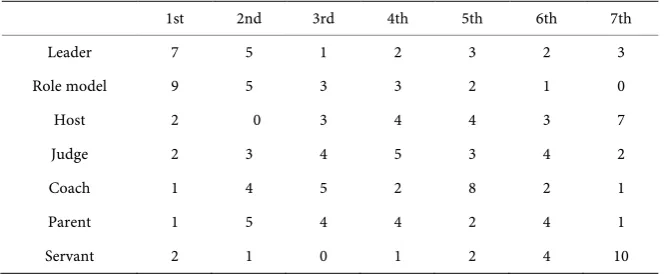
An interactive way is preferred to begin their class, and the direct or didactic way of knowledge impartment is of no interest at all. They expect themselves to gain communication skills, especially their speech-delivering ability. Class discussion and peer dialogue are very valuable to them, which can be inter-preted that they desire to share their understanding and will be more en-gaged if their opinions are valued and accepted. Therefore, they prefer their teachers not to give them direct answers to their puzzles; instead they prefer to find themselves in group discussion and literature reading (see Table 3). Teachers are more expected to play the role of a leader and role model in the
classroom with competencies such as empathy, motivation, flexibility and vi-sion (see Table 4).
[image:7.595.209.540.388.509.2]The data demonstrated that students’ preference over active learning while they are more passive in their learning at present. Constructivist teaching peda-gogies and models are feasible to them, because even though they know nothing
Table 2. Students’ preference ranking of sources of knowledge and skills.
1st 2nd 3rd 4th 5th 6th
books 2 2 7 3 2 5
life experience 12 7 3 1 0 1
reflection 4 4 2 5 4 3
crude data 1 3 2 6 6 6
communication 2 6 4 4 6 1
having class 2 1 4 4 6 7
Table 3. Students’ preferred learning activities.
1st 2nd 3rd 4th 5th 6th 7th 8th 9th 10th
Instructions 7 3 2 3 1 2 1 1 2 0
Task Assignment 2 2 1 1 2 1 2 3 1 7
Discussion 7 5 4 2 1 1 1 1 1 1
Group work 1 4 4 3 4 3 2 2 0 0
Brainstorming 4 1 5 2 0 3 3 0 4 0
Reflection 0 1 2 3 3 0 2 1 2 3
Seminar 0 2 1 2 1 2 3 4 5 2
Presentation 1 0 0 3 4 2 7 3 0 3
Debate 0 2 1 1 3 5 2 2 4 1
[image:7.595.210.539.539.742.2]DOI: 10.4236/jss.2019.710032 382 Open Journal of Social Sciences
Table 4. Students’ expectations for teachers in their learning.
1st 2nd 3rd 4th 5th 6th 7th
Leader 7 5 1 2 3 2 3
Role model 9 5 3 3 2 1 0
Host 2 0 3 4 4 3 7
Judge 2 3 4 5 3 4 2
Coach 1 4 5 2 8 2 1
Parent 1 5 4 4 2 4 1
Servant 2 1 0 1 2 4 10
about constructivist learning, their inclination to a more communicative and in-teractive way of learning than the surface memorization and the fixed traditional way of knowledge impartment, and their value of life experience to their know-ledge acquisition justify the fundamental principles of Constructivist teaching. On the other hand, their heavy reliance on teacher as their role model and leader in their learning, and their disinterest in reading, reflection and paper-based as-signment indicate their low initiative in both basic knowledge accumulation as well as in-depth thinking. Therefore, the barriers numerous predecessors en-countered emerge in the path to Constructivist teaching too.
3.2. Findings of the Data Collected from Interviews
“Knowledge is always gained through action and for action. From this starting point, to question the validity of social knowledge is to question, not how to de-velop a reflective science about action, but how to dede-velop genuinely well-informed action how to conduct an action science” [19]. From the data ga-thered from questionnaire and interview, we can have a big picture on both stu-dents’ and teachers’ side, which helps me move one step closer to begin con-structivist teaching
For students, their desired learning model is to be interactive and communic-ative: they can express their opinions and challenge teachers’ views; they can participate in group discussions, brainstorms; they can have more sources of knowledge and skills rather than solely textbooks; they can find answers them-selves instead of direct answers given by teachers. Their homework or assign-ment can be collective and interesting but not paper-based. Their teachers can be flexible, empathic, motivating and visionary as leaders and role models.
DOI:10.4236/jss.2019.710032 383 Open Journal of Social Sciences the teaching, ranging from creating friendly environment to get students in-volved into various learning activities, to provide more sources of knowledge and skills, to invite students’ understanding before sharing correct answer, to deepen students’ understanding by challenging peers’ or even teachers’ ideas, and finally to be able enough to control the teaching and learning process.
Moreover, two interviews, to some extent, do offer some hints to my questions mentioned above. To boost students’ autonomy and initiative in learning, group work with collective participation, especially initiated by the student leaders, is a good way. To deepen students’ thinking, preparing probing questions and de-signing task-based or project-based activities are two practical ways. To handle the balance between flexible learning and orderly classroom management, creating a supportive learning environment outweighs disciplinary issues, which can be tackled by teachers’ intentional interventions and students’ self-management in the learning community [20].
4. Conclusions and Implications
The gap between the dream and reality is quite obvious. Compared to construc-tivist teaching criteria [5], teaching of interviewees still falls into traditional cat-egory: the learning taking place in our classroom is not so active, for it seems not so successful in constructing knowledge rather than imparting knowledge; the interaction between students to teachers, students to peers do happen but not enough; the learning is more conceptual than contextual because of the limited learning materials and low connection between new and prior knowledge; chances are inadequately given to reflect or guide students how to reflect; stu-dents’ learning autonomy, to some extent, is admitted and valued, but not enough; the learning activities in class are not so diversified and effective; more collective group work should be encouraged to deepen their understanding and learning.
Although the research is based on a small sample, it helps inspire teachers how to start and then take small steps to begin constructivist teaching with some implications:
Teacher, as an important factor in students’ learning process, first should be aware of the roles he/she plays in knowledge construction. He/she is expected to support the learners’ understanding and learning instead of transmitting the information to the learners. Therefore, I should trust my students with more assurance that they can learn actively and effectively. To lower the concern of discipline, more chances should be supplied to engage them to discuss and share.
facili-DOI: 10.4236/jss.2019.710032 384 Open Journal of Social Sciences tates the happening of new learning.
Students’ learning autonomy should be highly considered and respected in constructivist learning. To do so, students’ interest, leadership, cooperation, team work, presentation and even questioning should be encouraged and in-vited. Way of boosting students’ learning can be borrowed, especially the students’ leadership.
Reflection as a useful tool to deepen thinking should be cultivated and taken habit both inside and outside the classroom. Teachers can lead students to reflect and showcase their reflection. If teachers can spare some time, maybe just five or ten minutes for them to think carefully and quietly what they have learnt and how they feel about it after their learning and encourage them to share their learning experience with each other, then a reflective summary can be assigned for revision.
Teaching materials can be multiple. Besides designated textbooks, hands-on materials are also very useful. Students’ experiences, ideas, inventions and predictions should be given considerable attention. I should offer more hands-on materials or real-life materials to evoke their interest and to deepen their thinking.
In terms of classroom management, constructivist teaching may cause tem-porary disorder, but in a long run, with the help of student leadership, it will be improved and solved. So disciplinary disorder is not that horrible and with guidance, good habits as well as supervision, it can be under control on the right track.
Cooperative teaching strategy should be adopted through students’ interac-tions and mutual respect, sharing ideas and learning tasks. Students’ sharing sometimes is more effective than direct instruction, so in my future teaching, cooperative learning can be more involved.
It is necessary for a teacher to pay special attention to the four emotional in-telligences, which students demand: vision, flexibility, motivation and empa-thy. Being constructivists, teachers’ vision is to strike the delicate balance between teaching for fact and skill acquisition and teaching for independent and expert thinking [21]. The calls for flexibility can be interpreted in three ways: 1) a highly adaptable and altered teaching style; 2) the differences or the gaps in the aspect of both academic abilities and learning methods be-tween individual learners; 3) varied resources of knowledge leads to varied and unfixed learning experiences. Built on the philosophy that every student is an active learner who constructs their knowledge on their experience, con-structivist teachers with motivation first view it their responsibility to build a good learning climate to motivate the students to achieve by learning. Em-pathy has two-fold implications to teachers: first, the teachers themselves should have the empathy for their students so as to teach effectively and af-fectively; second, teachers should teach this skill to the students.
DOI:10.4236/jss.2019.710032 385 Open Journal of Social Sciences to create a constructivist classroom that supports active learning is also a long-discussed issue. How to implement Five Es Model [10] successfully in Con-structivist teaching still demand specification in future teaching.
Beliefs are the bedrock and cornerstone at the heart of our actions [5]. Beliefs of a teacher are fundamental and instrumental in deciding teaching approaches, information related to the teaching tasks. To get prepared for Constructivist teaching, expertise, effort, commitment, competencies are required [6].
Conflicts of Interest
The author declares no conflicts of interest regarding the publication of this paper.
References
[1] Duffy, T.M. (2014) Constructivism: Implications for the Design and Delivery of In-struction. Journal of Education and Training Studies, 3.
[2] Vygotsky, L.S. (1978) Mind in Society. Harvard University Press, Cambridge, MA. [3] Abbdal-Haqq, I. (2018) Constructivism in Teacher Education: Considerations for
Those Who Would Link Practice to Theory. Clearinghouse on Teaching and Teacher Education, Washington DC.
[4] Prawatt, R.S. (2012) Instructors’ Beliefs about Teaching and Learning: A Construc-tivist Perspective. American Journal of Education, 100, 354-395.
https://doi.org/10.1086/444021
[5] Muijs, D. and Reynolds, D. (2015) Effective Teaching: Evidence and Practice. 3rd
Edition, SAGE Publications, London.
[6] Cey, T. (2011) Moving towards Constructivist Classrooms. University of Saskat-chewan, Saskatoon.
[7] Kim, J.S. (2015) The Effects of a Constructivist Teaching Approach on Student Academic Achievement, Self-Concept, and Learning Strategies. Asia Pacific Educa-tion Review, 6, 7-19. https://doi.org/10.1007/BF03024963
[8] Schreiber, L.M. and Valle, B.E. (2013) Social Constructivist Teaching Strategies in the Small Group Classroom. Small Group Research, No. 2, 1-17.
https://doi.org/10.1177/1046496413488422
[9] Baviskar, S.N., Hartle, R.T. and Whitney, T. (2009) Essential Criteria to Character-ize Constructivist Teaching: Derived from a Review of the Literature and Applied to Five Constructivist-Teaching Method Articles. International Journal of Science Education, 31, 541-550. https://doi.org/10.1080/09500690701731121
[10] Bailey, K.D. (2004) Methods of Social Research. 6th Edition, The Free Press, New York.
[11] Boddy, N., Watson, K. and Aubusson, P. (2003) A Trial of the Five Es: A Referent Model for Constructivist Teaching and Learning. Research in Science Education, 33, 27-42. https://doi.org/10.1023/A:1023606425452
[12] Lord, T.R. (1997) Comparing Traditional and Constructivist Teaching in College Biology. Innovative Higher Education, 21, 197-217.
https://doi.org/10.1007/BF01243716
Interna-DOI: 10.4236/jss.2019.710032 386 Open Journal of Social Sciences
tional, Baltimore, Maryland.
[14] Petraglia, J. (2008) The Real World on a Short Leash: The (Mis)application of Con-structivism to the Design of Educational Technology. ETR & D, 46, 53-65.
https://doi.org/10.1007/BF02299761
[15] Scott, D. and Morrison, M. (2005) Key Ideas in Educational Research. Continuum International Publishing Group, London.
[16] Chaille, C. and Britain, L. (2001) Young Child as a Scientist: A Constructive Ap-proach to Early Childhood Science Education. Harper Collins, New York.
[17] Flinders, D.J. (1997) Review of the Book InterView: An Introduction to Qualitative Research Interviewing. Evaluation and Program Planning, 20, 287-288.
https://doi.org/10.1016/S0149-7189(97)89858-8
[18] Piaget, J. (1976) To Understand Is to Invent: The Future of the Education. Penguin Books, New York.
[19] Torbert, W.R. (1981) Why Educational Research Has Been So Uneducational: The Case for a New Model of Social Science Based on Collaborative Inquiry. In: Reason, P. and Rowan, J., Eds., Human Inquiry, Wiley, New York, 141-152.
[20] Parsole, E. and Leedham, M. (2009) Coaching and Mentoring: Practical Conversa-tion to Improve Learning. 2nd EdiConversa-tion, Kogan Page, London and Philadelphia. [21] Hook, P. and Vass, A. (2006) Confident Classroom Leadership. David Fultion