O R I G I N A L A R T I C L E
Wound assessment tools and nurses’ needs: an evaluation
study
Sheila Greatrex-White1& Helen Moxey2
1 Faculty of Medicine and Health Sciences, School of Nursing, Midwifery and Physiotherapy, Queen’s Medical Centre, University of Nottingham, Nottingham, UK
2 Haematology and Oncology Day Treatment Unit, Churchill Hospital, Headington, Oxford, UK
Key words
Evaluation research; Nursing practice; Wound assessment tool; Wound management
Correspondence to
Dr S Greatrex-White PhD, RN
Faculty of Medicine and Health Sciences School of Nursing, Midwifery and Physiotherapy
B Floor, Room B62 Queen’s Medical Centre University of Nottingham Nottingham NG7 2HA UK
E-mail:
Greatrex-White S, Moxey H. Wound assessment tools and nurses’ needs: an evaluation study. Int Wound J 2013; doi: 10.1111/iwj.12100
Abstract
The purpose of this study was to ascertain how well different wound assessment tools meet the needs of nurses in carrying out general wound assessment and whether current tools are fit for purpose. The methodology employed was evaluation research. In order to conduct the evaluation, a literature review was undertaken to identify the criteria of an optimal wound assessment tool which would meet nurses’ needs. Several freely available wound assessment tools were selected based on predetermined inclusion and exclusion criteria and an audit tool was developed to evaluate the selected tools based on how well they met the criteria of the optimal wound assessment tool. The results provide a measure of how well the selected wound assessment tools meet the criteria of the optimal wound assessment tool. No tool was identified which fulfilled all the criteria, but two (the Applied Wound Management tool and the National Wound Assessment Form) met the most criteria of the optimal tool and were therefore considered to best meet nurses’ needs in wound assessment. The study provides a mechanism for the appraisal of wound assessment tools using a set of optimal criteria which could aid practitioners in their search for the best wound assessment tool.
Introduction
The challenging nature of wound healing has led to calls for practitioners worldwide to adopt a holistic and systematic approach to wound care (1–3). This should involve initial and ongoing wound assessments (2,4) and has several purposes. Specifically, it provides baseline information against which progress can be monitored (5), enables goal setting (2) and the correct selection of dressings (6,7). Poor assessment can lead to inappropriate wound management (3). It is therefore crucial that assessment is carried out according to the highest standards: if assessment is not performed correctly, subsequent wound care will suffer resulting in delayed healing and/or serious complications (4). Wound assessment is therefore central to good wound management and should be an integral part of wound care practice.
According to Turner (8), nurses should ask three questions following their assessment of a wound. First, ‘at what stage is this wound?’ Second, ‘what do I want this wound to do next?’ Third, ‘how can I achieve this objective without
damaging healthy tissue?’ Hence, it is important for nurses to be able to accurately establish the current con-dition of the wound, evaluate whether it is improving or deteriorating, and decide upon the most suitable treatment.
Key Messages
• wound assessment is central to good wound manage-ment and should be an integral part of wound care practice. A number of wound assessment tools have been developed.
• fourteen wound assessment tools were evaluated using an audit tool comprising a set of criteria for an optimal wound assessment tool.
• two wound assessment tools are identified, which best meet nurses’ needs.
Although this may initially appear relatively straightforward, in practice this is often not the case and there is recognition that in order to achieve optimal wound care, nurses require more support (9).
To compound the situation, it has been suggested that organisations are failing to provide nurses with clear care guidelines and referral pathways to follow and that a lack of agreed standards and support from healthcare providers is contributing to poor wound care (9). Wound assessment tools (WATs) have been developed to assist nurses in managing wounds, and many tools have been developed, but there is currently a lack of consensus as to which of these should be adopted to provide a consistent pathway for improved wound assessment.
In the UK, it is argued that getting wound care right will result in improved patient care and contribute towards meeting National Health Service (NHS) targets, both financially and in terms of quality of care (9,10). Delays in wound healing require more nursing time and additional resources. Surveys have shown that in the UK between 30–50% of hospital inpatients have wounds (11). Additionally, there are many patients requiring wound care in the community setting. Thus wound care has significant financial implications, both in terms of direct costs and staffing resources. Pressure ulcer care alone is estimated to cost around £1.2 billion a year (12), while surgical site infections are estimated to cost between £814 and £6626 per patient (13). These costs are likely to rise as the number of older people in the population continues to increase. Current economic pressures within the NHS, including the need to make £20 billion in efficiency savings by 2015 (14), means that treatments must be cost effective. Improvements in wound care which lead to faster wound healing; a reduction in complications and shorter patient stay will improve quality of care and result in reduced costs.
There are several possible reasons why nurses may find wound assessment and wound care difficult. First, wound healing is an incredibly complex process which challenges even experts (3). This particularly applies to chronic wounds in which the normal healing trajectory is not followed (15). Tissue viability nurses have a wealth of experience and knowledge in dealing with all types of wounds; however the majority of general nurses do not have this level of expertise (9). Ashton and Price (16) found that nurses lack knowledge of wound management and feel unprepared to carry out wound care, particularly when newly qualified. According to Timmons (12), this is partly attributable to poor education. Haramet al. (17) argue that inadequate teaching of wound care in undergraduate preregistration education leads to nurses adopting the practices that are prevalent in local clinical areas. Evidence-based practice requires that nursing practice is informed by up-to-date research (18,19). However, learning wound care ‘on the job’ is only likely to perpetuate practice based on ritual and personal preference.
Increased focus on wound management in nurse education might improve nurses’ theoretical understanding of wound healing, but according to Benner’s theory of novice and expert (20), knowledge takes time to develop. Thus, even if undergraduate preregistration education was improved, inexperienced nurses may still lack confidence and standards
of wound assessment and management may not be optimal. By providing a framework for inexperienced nurses to work from, WATs could lead to improvements in the standards of wound care that nurses are able to provide. However, such tools are only worthwhile if they meet the needs of the nurses using them, and result in enhanced wound care (21).
A literature search revealed that the majority of publications concerning wound care comprise discussion or opinion papers rather than empirical papers. (22–24). King argues that many research studies which have been carried out in the area of wound care are methodologically weak (25) and a systematic review found that many tools developed to measure changes in wound healing were inadequate in respect of reliability and validity (26). There is a dearth of studies evaluating whether WATs meet the needs of nurses in practice, and no studies were found which investigated whether the use of WATs actually improved wound care in practice. In the UK, we still do not know which tools nurses are using (if any), nor can it be said which tool or tools would be most beneficial for nurses to incorporate into their wound care practice.
The need for evidence-based practice exists as clearly in wound management as in other areas of nursing practice. Traditionally evidence has been sought from randomised con-trolled trials (RCTs), however, within the field of wound care, this type of evidence has been found to be lacking. According to Leaper (19), no systematic reviews have been carried out in the area of wound assessment and this has led to a reliance on expert opinion for guidance. Leaper acknowledges that while expert opinion has a place, wherever possible best prac-tice should be based on scientifically produced and evaluated evidence.
Purpose and study design
The purpose of this study was to ascertain whether selected WATs meet the needs of nurses in carrying out wound assessment and whether current tools are fit for purpose. We wanted to improve clinical practice and the quality of patient care by identifying best practice in relation to wound assessment. To do this the international nursing literature was reviewed to determine what nurses require of a WAT and what components the ideal WAT should contain. Characteristics of an optimal WAT were identified from the literature: these characteristics were then compared against those contained in existing WATs. Those WATs which met a greater number of the optimal criteria were considered more useful and fit for purpose than WATs which met few of the optimal criteria.
Methodology and methods
form of evaluation which is carried out for one user group (nurses in this instance), using their value criteria (WAT cri-teria developed from nursing literature), to enable them to make informed decisions (which WAT should be used). Action evaluation is not an in-depth or widely generalisable evalua-tion. A complex evaluation was not considered appropriate for this study because the aim was simply to determine whether nurses’ needs for wound assessment, as indicated in the cur-rent literature, are being met by selected WATs. To achieve this, the following aim and objectives were established.
Aim
The aim was to ascertain whether selected readily available WATs currently in existence meet the needs of nurses in carrying out general wound assessment, and whether current tools are fit for purpose.
Objectives
1. To identify from existing literature what nurses require from a WAT.
2. To establish criteria for an optimal WAT.
3. To ascertain to what extent currently available tools fulfil these criteria.
4. To determine which readily available tool is best fit for purpose.
5. To identify where further research is needed to assist nurses in providing best practice wound assessment and management.
Based on the above, the question asked was:
Do selected WATs meet the needs of nurses in carrying out best practice wound assessment?
Criteria selection for the optimal WAT
The criteria against which the WATs were evaluated were developed from the international literature on wound assess-ment. A search of electronic databases was carried out (EMBASE 1980–present and MEDLINE 1996–present) using the search terms ‘wound’ and ‘assessment’. Literature identified in the initial search was used to generate further search terms. These were: ‘wound healing’; ‘nurses needs for wound assessment’; ‘nurses use of WATs’; ‘nurse education and wound assessment’; ‘wound healing and exudate’; ‘wound healing and tissue type’; ‘wound assessment and dressings’; ‘wound management’.
Search results were analysed by both authors independently to identify common themes and factors which were relevant to promoting nurses’ needs for systematic wound assessment. Where criteria could not be agreed, a wound specialist was consulted before making a final decision. Criteria for inclusion in the optimal WAT were identified as follows:
Details and characteristics of the wound – In order to achieve holistic wound management, it is important for nurses to have access to basic background information
on the wound, including details of site, duration, and if known aetiology (30). This information helps nurses to understand the type of wound they are dealing with and to begin to formulate a plan of care. The initial wound assessment provides a baseline for subsequent assessments (31).
Patient details – At the most basic level, patient details are needed for identification purposes to match the patient to the wound assessment that has been done. Wound assessment is frequently talked about as a holis-tic assessment (30). In order for this to be true, wound assessment must consider factors about the patient’s condition other than the wound. Any comorbidities or patient factors which could affect healing should be recorded so these can be taken into account when plan-ning care (32).
Wound measurement – This helps nurses to identify whether a wound is healing or not (22,33). A reduction in wound size of more than 40% in the first 3 weeks indicates a wound is healing (34). Wound measurement is therefore a useful component of a WAT. Wound measurement carried out by nurses in their routine practice will almost inevitably lack precision. However, basic measurements should be able to identify a trend of healing or non healing. Wounds which fail to decrease in size are at risk of not healing and may require further investigation or intervention.
Tissue type – This is recognised as an indicator of stage of healing (33). Its inclusion in a WAT allows nurses to identify what stage of healing the wound is at in order to make decisions about treatment aims. Tissue types are usually described as necrotic, sloughy, granulating and epithelising (35).
Exudate– This is produced as a part of normal wound healing and is responsible for maintaining a moist wound bed which is considered necessary for healing. The volume and viscosity of exudate can indicate progress or deterioration in wound healing (36). While it is normal for wounds to produce haemoserous exudate during the healing process, an increase in exudate volume or viscosity may indicate infection or impending dehiscence.
Surrounding skin – Assessing the skin surrounding a wound forms an integral part of wound assessment. Surrounding tissue may provide the first indication of impending further tissue damage (1). Induration or cellulitis may indicate infection. Maceration of surrounding skin suggests wound exudate is not being managed effectively (37).
Pain – Assessment of pain is important for several reasons. First, pain is distressing for the patient and must be addressed to promote patient comfort (35). Second, an increase in pain may indicate infection (38). Third, pain may delay healing (30). Pain assessment is particularly important when dealing with chronic wounds.
longer be controlled by the body’s immune system (39). It is important for any WAT to include an assessment of signs of infection. Infection delays wound healing, and without recognition and appropriate treatment may have serious consequences for the patient (39). NICE reports that at least 5% of patients undergoing surgery develop a surgical site infection and that over a third of postop-erative deaths are related to surgical site infections (13). Wound infections can range from spontaneously resolv-ing wound discharge to life-threatenresolv-ing postoperative complications; they are associated with morbidity and extended hospital stay in addition to increased financial costs (13).
Documentation– This is necessary for recording and monitoring wound progress and for communication between professionals. Documentation is an important part of modern nursing practice. Nurses have a pro-fessional responsibility to maintain accurate records of care and to be able to justify their actions. Docu-ments such as, ‘Record keeping – guidance for nurses and midwives’ (40) outline the expectation that nurs-ing records should be clear, accurate and factual and should include details of assessments and reviews, so that information can be effectively communicated to colleagues. In an increasingly litigious society, nurs-ing records are the first source of evidence investigated if a complaint is made (3) and are considered legal documents.
Communication and continuity of care– A WAT should enable the nurse to establish how well the wound has progressed since it was last assessed, or whether in fact the wound has become static or deteriorated as this information will inform treatment decisions (41). A good WAT should make this information easily available to nurses encountering a wound for the first time. By facilitating continuity of care, the WAT will help nurses provide optimum wound management at all times.
Ease of use – In order for a WAT to be useful, it must be user friendly and quick and easy to use (37). A balance needs to be struck between including all the necessary information and producing a tool which is too detailed and which deters nurses from using it. A well-designed tool will however encourage nurses to document wound assessment more frequently (42).
Setting of goals for healing and planning care– Wound assessment is the first step in identifying appropriate treatment objectives in wound management (21). The next step is to use the information gathered during wound assessment to set these objectives and start planning for how to achieve them.
Monitoring of the healing process – The aim of treating most wounds is to heal the wound (43). For wounds which are not progressing, the nurse needs to identify possible barriers to healing and how these may be overcome (15).
Guiding practice – Many nurses, particularly inexperi-enced nurses, struggle when it comes to wound assess-ment. WATs have the potential to guide nurses both
through their assessment, and also in their decision making and care planning which follows assessment. In the ‘Best practice statement: optimising wound care’ (9), the authors propose the use of a care pathway for the patient with a wound. The pathway leads the clini-cian from assessment and diagnosis, to setting objec-tives and provision of care. A clinical pathway for wound care is also advocated by Barr and Cuzzell (43). In light of evidence suggesting nurses do not currently receive the necessary level of support in pro-viding wound care, it is suggested that a WAT could have the potential to lead nurses through this pathway.
WAT selection
The WATs to be evaluated were selected from tools readily available for nurses to use in their practice. A second search was carried out to find published and unpublished WATs. This included a search of the following electronic databases; MEDLINE (1996–present) and EMBASE (1980–present).
Search strategy
The search terms used were
1. Wound assessment tool.mp. 2. Wound assessment chart.mp. 3. Wound assessment form.mp. 4. Wound assessment scale.mp. 5. Wound scoring.mp.
6. Wound assessment.mp. 7. 1 or 2 or 3 or 4 or 5 or 6
This search resulted in 640 references from EMBASE and 241 from MEDLINE. Initially titles were scanned to determine relevance. If titles were relevant, the abstracts were read and if the article still seemed relevant the whole article was obtained. It is important to point out that a number of titles were unavailable thus limiting the number of tools included. Initially, we did not differentiate between WATs used for specific purposes/clinical conditions, but some were subsequently excluded on the basis of specialised wound types according to the exclusion criteria in Table 1.
An internet search (www.google.co.uk) was also carried out using the same terms. In addition to published WATs, this search also identified WATs used by UK NHS Trusts which were publically available on the internet. The reference lists from the literature were also scrutinised for references to additional WATs. The final number of included WATs was 14. Table 1 presents the inclusion/exclusion criteria and Table 2 summarises the WATs that were included in the action evaluation.
Audit tool development
Table 1Criteria for inclusion and exclusion of WATs
Inclusion criteria Exclusion criteria
Tools for adults’ wounds Tools for children’s wounds Generic tools and tools for
common wounds (including leg ulcers, pressure ulcers, general surgical wounds, traumatic wounds)
Tools for specialised wounds (e.g. malignant wounds, sternal wounds—postcardiac surgery)
Pen and paper tools Electronic tools
Tools written in English Tools written in languages other than English
Tools developed in last 15 years Tools older than 15 years Assessment tools for existing
wounds
Risk assessment tools Wound Measurement tools
WAT. These criteria were subdivided into a total of 35 relevant ‘indicators’. The audit tool required specific evidence from the WAT to determine whether the optimal criteria were met.
Results
[image:5.595.54.291.63.212.2]Overall performance of each included WAT
Figure 1 shows the number of criteria indicators met by each WAT. The number of indicators rather than parent criteria is used, because individual WATs may meet some indicators of a particular criterion but not others. For example the criterion ‘communication’ has three indicators. An individual WAT may meet one, two or all of these indicators.
Figure 1 lists the WATs in descending order (from left to right) according to the number of indicators they included. The closer the WAT is to the left side of thex-axis, the better it is considered to be in terms of meeting the needs of nurses in carrying out wound assessment. The audit results show that the Applied Wound Management (AWM) Tool meets the most criteria of the optimal WAT. This is closely followed by the National Wound Assessment Form (NWAF). The Sessing scale meets the least criteria of the optimal WAT.
Optimal WAT criteria met in sample WATs as a whole
Figure 1 shows how well the sample WATs (ranked from left to right) met the criteria for the optimal WAT as a whole. It does not give any information on how well individual criteria were met.
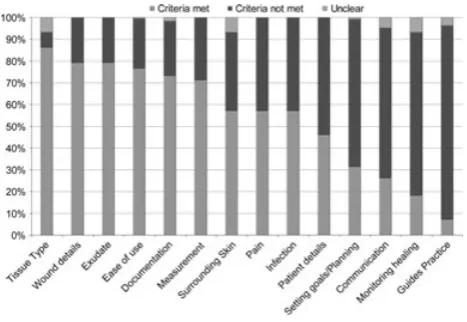
Figure 2 shows the percentage of criteria indicators which were met across the sample WATs. For each of the criteria it shows the percentage of the criteria indicators which were scored in the audit as ‘yes’ (i.e. meeting the criteria indicator), ‘no’ (i.e. not meeting the criteria indicator) or ‘unclear’. For example, 79% of the WATs was found to meet the criteria indicators for wound details, while the remaining 21% did not. In this graph the data from all the sample WATs has been added together to show how well each of the criteria of the optimal WAT were met by WATs in general.
Figure 2 shows the variation in how well the different criteria were met. Criteria such as wound details, tissue type and exudates were met in nearly 80% of WATs. However, the criteria of monitoring healing and guiding practice were met in less than 20% of the WATs. In most cases the criteria were scored as either met or unmet. There were only a few instances in which it was unclear whether the criteria indicators were present or not.
Criteria are ranked according to what percentage of WATs met each criterion. Those criteria occurring most often are closest to the left of the x-axis while those occurring less often are closer to the right. This is based on the percentage of criteria indicators which were scored as ‘yes’, that is, met. Figure 2 shows that some criteria such as tissue type, wound details and exudate were met well, whereas other criteria were poorly met by the WATs in the sample. The criteria which were met least often in the sample of WATs were: guiding practice, monitoring healing, communication and setting goals/planning.
Discussion
[image:5.595.52.544.524.715.2]The results of the action evaluation provide a measure of how well the included WATs performed against criteria of the
Table 2WATs included in the evaluation
WAT name Author Date
National Wound Assessment Form (NWAF) Fletcher 2010
Applied Wound Management (AWM) Grayet al. 2009
East Kent Hospitals NHS Trust Tissue Viability/Wound Assessment Chart
East Kent NHS Trust Current tool
T.I.M.E. Wound Assessment Tool Schulzet al. 2003
NATVNS Assessment Chart for Wound management The National Association of Tissue Viability Nurses, Scotland 2009 Nottingham University Hospitals NHS Trust Wound
Assessment Tool
Nottingham University Hospitals NHS Trust Current tool
Oxford Radcliffe Private Healthcare Wound Care Plan Oxford Radcliffe Private Healthcare 2008
Bates-Jenson Wound Assessment Tool Bates-Jenson, B 2001
Wound Assessment and Management System (WAMS) Saunders and Rowley 2004
Bolton Hospitals NHS Trust Wound Assessment Chart Bolton Primary Care NHS Trust and Bolton Hospitals NHS Trust 2008
Pressure Ulcer Scale for Healing (PUSH) National Pressure Ulcer Advisory Panel 1998
Leg Ulcer Measurement Tool (LUMT) Woodburyet al. 2004
Sussman Wound Healing Tool (SWHT) Sussman and Swanson 1997
Figure 1Number of indicators of the optimal WAT met, unmet or unclear for each WAT in the sample.
Figure 2Percentage of criteria indicators met/not met/unclear.
optimal WAT. The results identify which WATs performed well and which performed poorly. This can be used to help nurses decide which WATs to use in practice: WATs which score higher on the audit are proposed to better meet the needs of nurses in wound assessment. The WATs with the highest proportion of desirable criteria were found to be the AWM and the NWAF. These two WATs met 83% and 80% respectively of the criteria for the optimal WAT. On the basis of this evaluation, it can be recommended that either of these WATs be introduced into practice, if not already in use. In addition to identifying which WATs perform well, the process reveals which WATs performed poorly against the evaluation criteria. As far as we know, this is the first study to compare WATs in this way. No other studies identified in the literature review have compared a range of WATs for their suitability in helping nurses deliver high standards of wound assessment. Some studies have assessed the reliability of particular tools (26,44,45), but it is important to distinguish between a tool being reliable and it being useful or fit for purpose. This may be the first study to critically compare and evaluate a selected number of readily available WATS and to determine whether they meet the needs of nurses. The results could be used to assist nurses when selecting a WAT for use
in their area of practice. Importantly, if nurses are using a WAT that has not been included in this study, the audit tool described could be used to evaluate it for its suitability in their area of practice.
Although the study results demonstrate that some WATs performed much better than others, no included WAT met all of the criteria of the optimal WAT. Further analysis of the individual WATs was carried out to determine how each WAT performed against each of the criteria and this information is available on request from the authors. While the higher ranking WATs met more criteria indicators overall, some of these were deficient in certain areas by comparison with WATs that were generally ranked lower. For example, the NWAF which was ranked second did not score as well on ‘monitoring healing’ as the Sessing scale which came last. Most WATs scored poorly on ‘monitoring healing’, yet the Sessing scale which performed poorly across most criteria met 50% of the ‘monitoring healing’ criteria indicators.
The extent to which each of the criteria was met by the WATs ranged from 86% for ‘tissue type’ to 7% for ‘guiding practice’: the latter was met by only two WATs, namely the NWAF which was ranked second and the East Kent Hospitals Wound Assessment Chart which was ranked seventh. The NWAF scored against the ‘guiding practice’ criteria indicators because it suggests treatment objectives and lists possible dressings to select, while the East Kent Hospitals Wound Assessment Chart contains a link to a wound care formulary for dressing selection.
These examples show that overall rank does not necessarily predict performance against a particular criterion. This raises the question of whether overall performance is the most important consideration, and whether there are some criteria which are more important than others. The criteria for the optimal WAT were selected on the basis that they were included in the literature as being of equal importance in wound assessment, but they can be divided into two groups: basic criteria and advanced criteria. Basic criteria are the more obvious components of a WAT: easy to record and easy to assess in an audit. They represent the more apparent, objective aspects of wound assessment, for example, wound details, patient details, measurement, tissue type, exudate, surrounding skin, pain and infection. The advanced criteria comprise the more subjective components of a WAT and are often more difficult to assess in an audit. They represent the more abstract aspects of wound assessment, such as documentation, communication, ease of use, setting goals/planning care, monitoring healing and guiding practice. With the exception of ‘ease of use’ and ‘documentation’, the advanced criteria were not well represented in the WATs in this study. The reason for this is uncertain. It may be that these criteria have not previously been identified as important in wound assessment. We would argue that these criteria are equally important as the basic criteria which are more commonly included in WATs. It is the advanced criteria that add value to the wound assessment process by making it more useful and meaningful.
[image:6.595.52.286.262.423.2]This evaluation provides an important step in identifying and meeting nurses’ needs in wound assessment, but more work is required. The ‘Best practice statement’ (9) states that ‘wound management in the United Kingdom and Ireland is generally not organised or delivered in a uniform fashion against measureable standards of care and with clear referral pathways’. Nurses have been left to care for patients with wounds without national guidelines and consequently it is not known what the standard of wound assessment is. Neither do we know what nurses feel their needs are in carrying out wound assessment. In this evaluation nurses’ needs were identified from the literature review. However, there has not been a study which specifically asks nurses what they require in a WAT, how useful they find current WATs, and where they see scope for improvement. Neither is it known which WATs nurses are actually using in practice as there has been no research into this (3). In order to develop standardised treatment pathways for wound management, research is needed in order to identify what is currently happening in practice, which WATs are being used and how well they are meeting nurses’ needs. Despite the existence of dedicated wound journals, we currently do not possess basic information on what nurses require from WATs.
The lack of research to evaluate WATs in relation to nurses’ needs means that there is little previous work with which to compare this study. Fletcher recognised that there is inconsis-tency in wound assessment practice and that documentation of care is often poor. She suggests that a standardised WAT could improve care (46). Fletcher examined existing WATs in order to determine which factors to include in the development of a new WAT that could improve practice, culminating in the production of the NWAF which was ranked second in our evaluation. However, despite creating a high scoring tool, the methodology of Fletcher’s paper could be criticised in several areas. The NWAF was devised through discussion of previous WATs by a panel of experts and whilst the experts involved are likely to have possessed a wealth of experience in relation to wound assessment, no empirical work was carried out to support the contents of the tool.
In this action evaluation, the AWM scored highest out of all the WATs and is therefore recommended for use in clinical practice. Most of the tools included in this study, including the NWAF, consist of a WAT only, but the AWM WAT differs in that it is one part of a larger body of work under the name Applied Wound Management. The finding that the AWM WAT meets nurses needs, as they are cur-rently understood to be, provides support for this work. The Applied Wound Management framework was developed as part of the theory of wound bed preparation (WBP) in the management of chronic wounds healing by secondary inten-tion. It seeks to incorporate the principles of debridement, wound bioburden control, and exudate management (47) and attempts to create the right conditions in a wound to allow healing to take place (48). Applied Wound Management seeks to improve wound care by facilitating a systematic approach to the complex issue of wound assessment and manage-ment (4). It enables the implemanage-mentation of evidence based practice via the practical application of theory to everyday practice (49).
The AWM scored well across the majority of the criteria of the optimal WAT, but was not considered to meet the criteria indicators for guiding practice since it did not include any prompts of treatment objectives or links to sources of guidance for dressing selection. However, the WAT is just one of several AWM clinical tools: in addition there is a pocket guide, a wall chart, and a computer database (50). The wall chart suggests treatment objectives and treatment options for wounds at each stage of healing. If the wall chart is used in conjunction with the WAT the ability of AWM to meet nurses’ needs in wound assessment is further strengthened.
It has been argued that nurses, particularly inexperienced nurses, would benefit from a WAT which is capable of supporting them in carrying out wound assessment and that Applied Wound Management is one such adjunct to decision making (51). This is supported by Padmore, whose report found that Applied Wound Management was easy to use for inexperienced staff and acted as an aide memoir for experienced nurses (52).
Many nurses lack knowledge of wound management and wound assessment, and it has been suggested that a WAT could provide support for nurses in this area. This action evaluation supports the use of either the NWAF or AWM as a tool to facilitate wound assessment. Although both WATs scored well, the implementation of the NWAF would be more straightforward than the AWM. The NWAF is a standalone tool which is intuitive to use without any additional training. The AWM however, is part of a wider framework. It is necessary for practitioners to understand the WBP framework in order to use the AWM correctly. Padmore found the theory behind Applied Wound Management simple to teach to students at various levels (52). However, time must be invested in teaching students to ensure they are using Applied Wound Management to full effect. This raises the issue of whether education on Applied Wound Management should occur as part of preregistration training or as the continual professional development of qualified staff. Studies have found that postregistration training for nurses does improve wound care practice (53). Timmins provided training on AWM to nurses working on elderly care wards and implemented the AWM WAT and dressing choice chart (4). It was found that before training only 20% of the nurses selected the correct dressings whereas after Timmins’ intervention, this rose to 73%. This methodologically sound study shows not only that nurses’ baseline wound management is often poor, but that it can be significantly improved with appropriate intervention. Timmins concludes that a structured WAT can help improve nurses’ practice, but that this requires adequate educational support. Although this will inevitably involve financial investment, it is worth bearing in mind that the expenditure on dressings fell from £44,580 over the four months before the trial, to £35,816 during the four months of the trial.
Conclusions and recommendations
requirements of nurses. Those needs which remain unfulfilled are possibly some of the most important; in particular the need to be able to monitor healing and to guide nurses towards best practice. In order to maximise wound healing, nurses need to be able not just to record certain parameters in their wound assessment, but also to know what to do next. This is not to say that recording wound size, exudate, tissue type etc. is not important in wound assessment, but that the point of recording this is to give nurses information about the wound which they can use to plan care. This brings us back to the three questions that follow wound assessment: (i) at what stage is this wound? (ii) what do I want this wound to do next? (iii) how can I achieve this objective without damaging healthy tissue? (8). Wound assessment itself therefore is not the goal; rather it is the means to the end (21), which is to achieve optimal wound management. While much research is being carried out into developing sophisticated dressings, designed to interact with the wound bed and accelerate wound healing (54), these expensive dressings will be wasted if they are used incorrectly as a result of poor wound assessment and management.
This study has shown that of 14 selected WATs, the AWM and NWAF best meet nurses’ needs in carrying out wound assessment. It has also revealed that more research is needed to establish what is currently happening in practice, and what nurses believe their needs to be. We have suggested that a good WAT can help guide nurses towards best practice in wound management. However, a WAT can never be a substitute for clinical knowledge and expertise (51). It can provide a framework to structure assessment and an adjunct to decision making, but in order to provide the best quality wound care possible, nurses require educational support and clear guidelines for practice.
References
1. Bates-Jenson BM, Sussman C.Wound care: a collaborative practice manual for physical therapists and nurses. Gaithersburg, MD: Aspen Publishers, 2001.
2. Fletcher J. Wound assessment and the TIME framework.Br J Nurs
2007;16:462–466.
3. Russell L. The importance of wound documentation and classifica-tion. In: White R, editor.Trends in wound care. Bath: Mark Allen Publishing, 2002.
4. Timmins J. Can nurses’ knowledge of wound care be improved by a systematic approach to wound management?. In:Applied wound management part 3. Aberdeen: Wounds UK, 2009:14–17. 5. Collier M. The elements of wound assessment. Nurs Times
2003;99:48.
6. Bradbury S, Ivins N, Harding K. Case series evaluation of a silver non-adherent dressing.Wounds UK2011;7:12–19.
7. Lafferty B, Wood L, Davis P. Improved care and reduced costs with advanced wound dressings.Wounds UK2011;7:14–23.
8. Turner V. Standardisation of wound care.Nurs Stand1991;5:25–28. 9. Best practice statement: optimising wound care. Aberdeen: Wounds
UK, 2008.
10. Vowden K, Vowden P. The role of audit in demonstrating quality in tissue viability services.Wounds UK 2010;6:100–105.
11. Vowden K, Vowden P, Posnett J. The resource costs of wound care in Bradford and Airedale primary care trust in the UK.J Wound Care
2009;18:93–102.
12. Timmons J. Wound care education needs a boost.Br J Community Nurs2006;Suppl:S3.
13. National Institute for Health and Clinical Excellence. Clinical guideline 74; Surgical site infection: prevention and treatment of surgical site infection. London: RCOG Press, 2008.
14. Treasury HM.Spending review 2010. London: The Stationery Office, 2010.
15. Schultz GS, Sibbald RG, Falanga V, Ayello EA, Dowsett C, Harding K, Romanelli MR, Stacey MC, Teot L, Vanscheidt W. Wound bed preparation: a systematic approach to wound management.Wound Repair Regen2003;11(Suppl 1):1–28.
16. Ashton J, Price P. Survey comparing clinicians’ wound healing knowledge and practice.Br J Nurs2006;15(Suppl):18S–26S. 17. Haram R, Ribu E, Rustøen T. The views of district nurses on
their level of knowledge about the treatment of leg and foot ulcers.
J Wound Ostomy Continence Nurs 2003;30:25–32.
18. Barker J.Evidence-based practice for nurses. London: Sage, 2010. 19. Leaper D. Evidence-based wound care in the UK. Int Wound J
2009;6:89–91.
20. Benner P.From novice to expert: excellence and power in clinical nursing practice. New Jersey: Prentice Hall, 2001.
21. Flanagan M. A practical framework for wound assessment 2: methods.Br J Nurs1997;6:6–11.
22. Little C, McDonald J, Jenkins MG, McCarron P. An overview of techniques used to measure wound area and volume.J Wound Care
2009;18:250–253.
23. Vowden K. Wound management: the considerations involved in dressing selection.Nurse Prescribing2004;2:152–162.
24. Watret L. Wound bed preparation and the journey through TIME.Br J Community Nurs2004;9(9 Suppl):27–30.
25. King BM. Assessing nurses’ knowledge of wound management.
J Wound Care2000;9:343–346.
26. Pillen H, Miller M, Thomas J, Puckridge P, Sandison S, Spark J. Assessment of wound healing: validity, reliability, and sensitivity of available instruments.Wound Pract Res2009;17:208–217. 27. Kelly M. Qualitative evaluation research. In: Seale C, Gobo G,
Gubrium JF, Silverman D, editors. Qualitative research practice. London: Sage, 2004:463–477.
28. McKie L. Engagement and evaluation in qualitative inquiry. In: May T, editor. Qualitative research in action. London: Sage, 2002:261–285.
29. Ovretreit J.Action evaluation of health programmes and changes: a handbook for a user-focused approach. Abingdon: Radcliffe Medical Press, 2002.
30. Oldfield A. Assessing the: open surgical wound. Wound Essent
2010;5:48–56.
31. Davidson M. Sharpen your wound assessment skills: learn how impeccable assessment and documentation can help your patient heal.
Hosp Nurs2002;32:32hn1–32hn4.
32. Nazarko L. Wound care part two: carrying out a thorough assessment.
Nurs Residential Care2005;7:304–306.
33. Dowsett C. Using the TIME framework in wound bed preparation.
Br J Community Nurs2008;13:S15–S21.
34. Hanson D, Langemo D, Anderson J, Hunter S, Thompson P. Measuring wounds.Nursing2007;37:18–21.
35. Eagle M. Wound assessment: the patient and the wound.Wound Essent 2009;4:14–24.
36. Thompson G, Stephen-Haynes J. An overview of wound healing and exudates management.Br J Community Nurs2007;12:S22–S30. 37. Young T. Wound assessment and documentation. Pract Nurs
1997;8:27–30.
38. Young T. Assessment of wound pain: overview and a new initiative.
Br J Nurs2007;16:456–461.
39. Patel S. Understanding wound infection and colonisation.Wound Essent 2007;2:132–142.
41. Maylor ME. Problems identified in gaining non-expert consen-sus for a hypothetical wound assessment form. J Clin Nurs
2003;12:824–833.
42. Baranoski S, Ayello EA. Using a wound assessment form.Nursing
2005;35:14–15.
43. Barr JE, Cuzzell J. Wound care clinical pathway: a conceptual model.
Ostomy Wound Manage1996;42:18–25.
44. Santos VLCG, Sellmer D, Massulo MME. Inter rater reliability of pressure ulcer scale for healing (PUSH) in patients with chronic leg ulcers.Rev Latino Am Enfermagem2007;15:391–396.
45. Woodbury MG, Houghton PE, Campbell KE, Keast DH. Pressure ulcer assessment instruments: a critical appraisal. Ostomy Wound Manage1999;45:42–55.
46. Fletcher J. Development of a new wound assessment form.Wounds UK2010;6:92–99.
47. Gray D, White R, Cooper P, Kingsley A. Understanding applied wound management.Wounds UK2005;1:62–68.
48. Jones V. Wound bed preparation and its implication for practice: an educationalist’s viewpoint. In:Applied wound management part 1. Aberdeen: Wounds UK, 2004:4–8.
49. Cooper P, Gray D, Russell F, Stringfellow S, Timmons J, Bertram M, Duguid K, Pirie E, Quinn E. Applied wound management as an audit tool to inform practice.Wounds UK2010;6:66–74.
50. Gray D, McGuffog J, Cooper P, White R, Kingsley A. Applied wound management: clinical tools to facilitate implementation. In: Applied wound management part 2. Aberdeen: Wounds UK, 2006:25–30.
51. Gray D. Applied wound management; a new conceptual framework in wound management. In: Applied wound management part 1. Aberdeen: Wounds UK, 2004:3.
52. Padmore J. The introduction and evaluation of Applied Wound Management in nurse education. In:Applied wound management part 3. Aberdeen: Wounds UK, 2009:28–30.
53. Smith G, Greenwood M, Searle R. Ward nurses’ use of wound dressings before and after a bespoke education programme.J Wound Care 2010;19:396–402.