An Integrated Approach to a Combinatorial
Optimisation Problem
?J. Bowles[0000−0002−5918−9114] and M. B. Caminati[0000−0002−4529−5442]
School of Computer Science, University of St Andrews St Andrews KY16 9SX, United Kingdom
{jkfb|mbc8}@st-andrews.ac.uk
Abstract. We take inspiration from a problem from the healthcare domain, where patients with several chronic conditions follow different guidelines designed for the individual conditions, and where the aim is to find the best treatment plan for a patient that avoids adverse drug reactions, respects patient’s preferences and prioritises drug efficacy. Each chronic condition guideline can be abstractly described by a directed graph, where each node indicates a treatment step (e.g., a choice in medications or resources) and has a certain duration. The search for the best treatment path is seen as a combinatorial optimisation problem and we show how to select a path across the graphs constrained by a notion of resource compatibility. This notion takes into account interactions between any finite number of resources, and makes it possible to express non-monotonic interactions. Our formalisation also introduces a discrete temporal metric, so as to consider only simultaneous nodes in the optimi-sation process. We express the formal problem as an SMT problem and provide a correctness proof of the SMT code by exploiting the interplay between SMT solvers and the proof assistant Isabelle/HOL. The problem we consider combines aspects of optimal graph execution and resource allocation, showing how an SMT solver can be an alternative to other approaches which are well-researched in the corresponding domains.
1
Introduction
In complex systems it is common for processes to execute in parallel. The underlying composed behavioural model is complex and, unless strictly necessary, it is preferable to avoid computing it. We developed an approach to find optimal paths across multiple models denoting preferred scenarios of execution. The choice of a path across a model may be influenced by external factors, available resources and further constraints on such resources. Models are given as directed graphs, and the challenge is to find paths across all graphs satisfying not just all constraints but optimised against one or more arithmetic measures.
?
Our approach has been inspired by a problem in healthcare where patients with two or more ongoing chronic conditions, also known asmultimorbidity, do not receive adequate treatment. Typically patients follow treatment guidelines for individual conditions in isolation, and the presence of multimorbidity requires them to follow several guidelines simultaneously. However, there is a lack of guidance on how best to prioritise recommendations for multimorbidity [17]. Patients with multimorbidity are often required to take many medications for their conditions, which can cause adverse drug reactions often leading to unnecessary complications and hospitalisations [15]. It is also possible that taking several medications together decreases the effectiveness of the individual drugs when administered at the same time, or that a patient is intolerant to a combination of medications. In precision therapeutics, the aim is to tailor medical treatment to the individual characteristics of each patient which includes finding the right set of medications for patients with multimorbidities.
Besides the small example in Section2, where the healthcare setting is used for illustrative purposes, we abstract from the medical problem and terminology in this paper, and it suffices to understand each guideline as a directed graph whereby a patient may be at a given node at a particular moment in time, resources are (groups of) medications (aka drugs), and external factors can denote patient specific intolerances, and so on.
Resources have a known value of how effective they are individually for the purpose they are used for (e.g., metformin when used for treating diabetes), as well as a measure of conflict (interaction constraints) with others. Our aim is to find the optimal path across all graphs which maximises effectiveness and minimises conflicts. Such a path selects the drugs across multiple graphs that suit the patient best.
This paper is structured as follows. Section2motivates and describes the context of our approach in more detail. Related work is described in Section3. Section 4 describes the abstraction used for capturing guidelines as directed graphs, and how paths and interaction constraints are defined. Our translation to SMT (Satisfiability Modulo Theories) code is shown in Section 5and how verification is done is described in Section 6. This is followed by concluding remarks in Section7.
2
Problem motivation and informal description
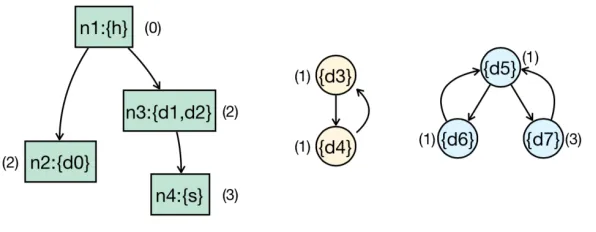
present. The left branch (withn2) models the non-surgical choice, here associated to the prescription of drug d0 (with no other choice available). The bracketed number besides each node represent its duration: for example, pre-surgical testing (node n3) lasts 2 days. Furthermore, this particular patient suffers from two
Fig. 1.A simple example problem
chronic conditions: C1 requires him to take drug d3 on even days and d4 on odd days (Fig. 1 middle), and C2 requires him to take drug d5 on even days followed by eitherd6 ord7on odd days wherebyd7 further delays the subsequent administering ofd5 by two days (Fig.1right).
Surgery is preferable, butd1 interacts negatively withd3 andd2withd4. It is known thatd6 is more effective thand7 when used for treatingC2. However,d7 can act as an inhibitor in the reaction betweend1andd3, mitigating the ensuing negative effects on the patient. In this fictitious example, we want to determine the best course of action in the hospitalisation of a patient with chronic conditions C1 andC2 taking into account drug efficacy and known drug interactions.
The simple example above expresses the family of problems we want to deal with. In what follows, we abstract away from the healthcare application domain expressed above in terms of directed graphs, one for each separate treatment a patient undergoes, and where each node is annotated with aduration and a potential choice ofresources. This makes it possible to reduce the problem to a path finding problem across several directed graphs, respecting constraints on interactions among several resources and their temporal overlapping. In other words, we want to find paths in given directed graphs (digraphs, [2,9]) such that:
P1 for each visited node a resource (e.g., in our context this can be a medication) is selected amongst a set of allowed ones for that node, and
P2 the interactions between selected resources are minimised and their individual effectiveness maximised in the obtained solution.
determines the required temporal distance between possibly interacting resources (e.g., two interacting resources happening at close temporal distance can be given more weight than the same interacting resources happening at distant times). The efficiency of modern SMT solvers makes them feasible to search for a solution satisfying the criteria above. However, only (P2) above makes use of the arithmetic capabilities of the solver, while we otherwise only made use of the basic SAT solver for the remaining computations in our previous work [5,6,7]. Given that SMT solvers are SAT solvers with awareness of additional facts (e.g., arithmetics), we wonder whether this can be used to better exploit SMT solvers capabilities. In our case, motivations for working in this direction include:
M1 Given that resource interactions are expressed by numerical functions having the resources as arguments, the current basic SAT implementation only allows us to consider binary interactions as opposed to interactions of an arbitrary number of resources.
The limitation to binary interactions arises because the arity of SMT functions is fixed, and more elaborated datatypes such as lists or function operators are not directly available. We will see in Section5 how this limitation can be worked around by the theory of Bit-Vectors through which the SMT-LIB standard [3] extends the basic domain of propositional logic in which a standard SAT solver operates. We use this theory to emulate a variadic function, i.e., a function taking a variable number of variables, thereby granting the possibility of expressing interactions between a variable number of resources. This makes it possible to express the particular case of non-monotonic interactions whereby adding a resource to, say, a pair of conflicting resources not necessarily exacerbates the conflict. The interest in this was illustrated in our healthcare example earlier, where drugd7inhibits an interaction between two other drugs.
M2 Expressing the problem of path finding in SAT terms leads to assertions rapidly increasing in complexity with the dimension of the given graphs, and hence unintelligible SAT code.
theory of Bit-Vectors allows us to find a workaround to this problem which, in our previous work, caused increased complexity in the produced SMT code.
Furthermore, we note that sorting path nodes by exploiting the natural number linear ordering allows us to restrict the scope of the sought solution. This is useful since in practice we are often only interested in considering a solution for future steps not too distant from the current one.
3
Related work and justification of an SMT approach
The problem we propose features (as we will more formally express in Section4) path finding across multiple directed (non necessarily acyclic) graphs, resources selection among sets of resources annotating each path-belonging node, overall optimisation of the selected resources under constraints of arbitrary arity, and a dependency of these constraints on the temporal separation of selected resources.
The fact that it combines traits of the distinct, widely explored problems incombinatorial optimisation (CO) which are mentioned above does not imply that the corresponding, well-explored solutions for these distinct problems can be easily combined to obtain a solution to the problem considered in this paper. For example, one could try to apply existing, well-known algorithms for the path-finding portion of our problem, and then hope to reduce the remaining portions of the problem to well-understood problems in CO, maybe by applying integer programming (IP), one of the domains of CO richest in methods and algorithms, to the sub-problem of resource subset selection. However, the problem of resources subset selection is not natively expressed in terms of integer variables and functions; and, more importantly, even if one finds a IP rendition of it, that rendition is bound to be, in general, non-linear, due to the fact that our notion of resource interactions aims by the design at dealing with the non-monotonic case (in more formal terms, the functionι we will introduce in (4) is completely arbitrary). This implies that we do not have direct access to the powerful and well-developed methods of integer linear programming (ILP), and have to deal with the more difficult approaches available in the less developed field of non-linear programming, where typically one has to resort to techniques (reconnecting the problem to special cases) such as continuous relaxation, branch and bound algorithms, approximation algorithms, ad-hoc heuristics, fractional programming [16,8,1]. All these approaches typically require significant amounts of work, add complexity to the solutions and require assumptions about the problem specification (for example, concavity/convexity requirements on the continuous relaxation’s feasible region).
the concepts of nodes (as activities) and resources featured in our problem, the focus about the constraints in resource scheduling is on the capacities of the resources and maybe (through the objective function) on temporal optimisations (e.g., minimising the number of late activities); in contrast, in our problem, the optimisation focuses on the mutual (and non necessarily binary) interaction of resources, as we will see in Section4(e.g. formula (8) featured there).
The considerations above about the difficulties we encountered in adapting existing techniques in the broad domain of combinatorial optimisation to the several facets of the problem at hand suggests that this problem presents some degree of hardness. This is confirmed by noting that the simpler problem of finding a path in a single graph with the additional constraint of the binary exclusion (e.g., on an either selected or unselected basis, as opposed to our problem featuring a score-based selection criterion) of given sets of node pairs is established to be NP-hard in [14].
Further justification for the adoption of SMT techniques is given by the fact that other authors also employ SAT or SMT solvers for simpler problems. SMT solvers are applied, in [11], to a particular optimal path selection problem in the semi-conductor manufacturing domain; besides the use of Bit-Vector capabilities of the SMT solver, there are little further similarities: the problem there can be described by only one graph, having one single cost annotation for each edge (we have multiple “costs” on each node). Work bearing some similarity with ours is in [19], presenting an graph-theoretical representation of a problem in computational task parallel scheduling, and also featuring a notion of temporal separation between nodes and of resources. Only one graph is needed to represent that problem, however, and the notion of conflict there is quite different from the one presented here. Besides the example above in clock routing, Bit-Vector capabilities of SMT solvers have been employed typically (but not only) to software and hardware validation as, for example, in [12], [13], [23]. This happened before and after the remarkable complexity of Bit-Vector reasoning was emphasised in [18], confirming the practical relevance and convenience of the theory nevertheless [10]. Our work provides a further witness of this phenomenon.
Our own recent works [5,6,7] propose the use of SMT solvers for finding optimal paths along processes executed in parallel, combined with the problem of picking resources at each selected path node under the constraint of mutual resource interaction. None of them can accommodate either cyclic graphs or interactions with arity greater than 2, which is a first contribution of the present paper; in those works, we expose the issue (largely under-explored in the current literature) of ascertaining the correctness of the SMT code we use, and provide a theorem-prover based solution. As a second contribution, we will show in Section6
expresses all the constraints and the optimality requirements for our problem as a single stack of SMT assertions, without splitting it into sub-problems.
4
Formal model of the problem and of its solution
In what follows, domP, ranP andP[X] will represent, respectively, the domain, range of a relation P, and the image through P of the set X ⊆domP, while 2Y will denote the power set of a setY. We are givennfinite, simple, directed
graphs G1, . . . , Gn; we assume their node sets to be mutually disjoint. Usually, the graphs will also be connected, but we will not assume that. Since each of the graphs Gi is simple, it can be thought of as a finite set of ordered pairs of nodes (j, k) (that is, the set representing the covering relation corresponding to Gi), each representing a directed edge from nodej to nodek. Therefore, we can define
G:= n
[
i=1 Gi,
and denote byV (G0) the set of nodes touched by any edge in G0⊆G, that is V : 2G→2domG∪ranG V(G0) := [
(v,v0)∈G0⊆G
{v, v0},
G, being a set of ordered pairs, can be regarded as the set-theoretical representa-tion of a relarepresenta-tion, and has, therefore, a domain and a range. The requirement for the node sets of distinct graphs to be disjoint can now be expressed as
∀j∈ {1, . . . , n}, j0∈ {1, . . . , n} \ {j}. V (Gj)∩V(Gj0) =∅.
We want to describe where a given agent, who is simultaneously executing all thengraphs, is located at a given time (this agent could, for instance, be a patient being followingnguidelines recommendations): the agent must start at a given node for each of the graphs, and go through the nodes of some path in each graph, spending, in each of these nodes, an amount of time which is given by a mapd:V (G)→N. The paths will be determined from constraints we will express later on (Section5); for the moment, we focus on how such a description can be achieved.
4.1 Paths calculation
A representation of an agent’s position could be achieved, for example, by n functions (one for each graph), each defined on N (we assume a discrete
at a given time, we introduce the auxiliary concept ofstage: rather than directly saying that the agent, at a given time and in a given graph, is at some node, we will split this piece of information into two functions: one expressing the stage of the solution path for graph j which the agent is at timet:
sj :N→N j= 1. . . n;
and a second one expressing the sorting of nodes belonging to the solution path for thej-th graph:
ηj :N→V (Gj) j= 1. . . n.
Thus, the description of the solution paths according to the notions of stage and of time are kept separated. The function relating them is
τj:N→N j= 1. . . n,
yielding, for each stage in the solution path of a given digraphj ∈ {1, . . . , n}, the time at which that stage starts.
Although these functions are formally defined on the wholeN, we will actually restrict their computation to given, finite natural intervals S and T of stages and times, respectively, so that the above families of functions are related by the following assertions:
∀j∈ {1, . . . , n}, t∈T.
sj(t+ 1) =
(
sj(t) ift+ 1< τj(1 +sj(t))
1 +sj(t) else.
(1)
∀j∈ {1, . . . , n}, i∈S.
τj(i+ 1) =τj(i) +d(ηj(i)). (2)
The role ofS andT is to put a bound on the scope of future evolution we want to follow. On one hand, this allows to reduce the search space for the SMT solver; on the other hand, the finiteness thus imposed does not prevent to consider theoretically infinite paths (e.g., when cycles are present in the graphs), reconciling their presence with the need of finite computations. One can therefore compute optimal executions for given (S1, T1), ending up in some configuration; then have another computational session starting from the reached configuration for some other (S2, T2), thus reaching another configuration, etc: although the single sessions involve finite objects, there is no bound on the number of the sessions. This implies that the computations given by (1) and (2) must assume some starting point; that is, at the smallest stage and time, the executing agent must be located in a given nodeηj for eachj∈ {1, . . . , n}:
∀j∈ {1, . . . , n}.
ηj(minS) =ηj
τj(minS) = minT
SinceSandT are not in general constant through any sequence of computational sessions, we had to define our maps (sj,τj,ηj, etc) on the wholeNrather than directly on the subsetsS andT; another reason for doing so is that SMT solvers do not directly provide support for partial functions.
Finally, we must impose that ηj actually describes a walk in the directed graph Gj:
∀j∈ {1, . . . , n}, i∈S. ηj(i+ 1)∈Gj[{ηj(i)}], (3)
which asks that thei+ 1-th node is a child (according to the digraphGj) of the i-th node in the path selected for the digraphGj. The notation using the square brackets was introduced at the very beginning of this section.
4.2 Interaction constraints
In Section 4.1, we have set up the problem of representing (through functionsη, τ, s) a path in eachGj, and of computing the representing functions. Here we add constraints regulating how the path in distinct digraphs interact, so as to select the paths solving the earlier points (P1) and (P2) in Section2.
We assume a finite set R of resources is given, together with maps rj : V (Gj)→2Rdescribing the subset of resources available to be chosen for a given node. We now want to solve the problem of picking, for each node appearing in the walks calculated in Section 4.1, resources allowed by the maps rj (see point (P1) in the list of Section2). Additionally, we want to do that such as to maximise the effectiveness of the picked resources along the executed path and to minimise the negative interactions between resources occurring at the same time in distinct simultaneous nodes (see point (P2) in the list of Section2). To achieve this, we must have a database map
ι: 2R→Z (4)
providing, for each possible combination of resources, their overall score, which is a numerical representation of how much each single resource in a given subset is effective and of how much different resources in the same subset possibly interact. Since it would be a computational waste to consider resources which cannot be prescribed in any possibly visited node, we add the constraint
R= [
X∈ranrj
j∈{1,...,n}
X, (5)
imposing that any resource must appear inS
(ranrj) for some digraphj. Now, the solution to the problem just introduced can be represented by maps
associating a stage number to the resource picked at that stage, for each digraph G1, . . . , Gn. The first requirement to be imposed onρis that the resource picked at any stage is in the permitted resources for the node corresponding to that stage:
∀j∈ {1, . . . , n}, i∈S. ρj(i)∈rj(ηj(i)), (6)
where, as explained in Section 4.1, we limit the stages we are looking at to a finite natural intervalS.
Finally, we need to optimise the interactions of resources happening at any same instant. To this end, we introduce a map∆ :N→2R,yielding for each time the subset of all the resources picked in all the nodes happening at the given time in the selected paths across all the digraphsG1, . . . , Gn. That is, we impose
∆(t) := [
j∈{1,...,n}
{ρj(sj(t))} (7)
for eachtinT, and then we require the SMT solver to maximise
X
t∈T
ι(∆(t)). (8)
5
SMT translation
This section presents the choices we made to represent the elements expressed mathematically in Section4in ways amenable to an SMT solver.
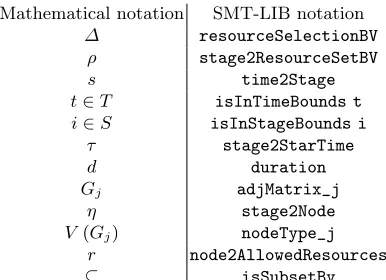
For each of the formulas introduced and motivated in that section, we will choose suitable SMT-LIB code to express it, and motivate our choice. The mathematical entities (functions, sets, etc.) used in that section will be given ASCII names in order for them to be invoked in SMT-LIB code: we will make clear which ASCII name corresponds to which mathematical object as soon as it is introduced in this section. However, for the reader’s convenience, table 1
summarises these correspondences.
A typical issue when translating into SMT code is to find a feasible repre-sentation, given the fact that SMT solvers are constrained to first-order logic together with a limited list of theories (e.g., integer arithmetics or Bit-Vectors). For example, sets are usually complicated to handle: while it is true that a subset of a given universe can be represented as a monadic boolean predicate over that universe, the problem is that predicates and relations are not themselves first-class objects in first-order logic. Therefore, quantifications, sets of sets, op-erations on sets and set-valued functions or relations are either not expressible or quickly become too complex, impacting both on performance and readability (and therefore reliability) of the code.
Mathematical notation SMT-LIB notation
∆ resourceSelectionBV ρ stage2ResourceSetBV
s time2Stage
t∈T isInTimeBounds t i∈S isInStageBounds i
τ stage2StarTime
d duration
Gj adjMatrix_j
η stage2Node
V(Gj) nodeType_j r node2AllowedResources
[image:11.612.211.404.114.254.2]⊆ isSubsetBv
Table 1.Correspondence between mathematical and SMT-LIB names
(declare−fun resourceSelectionBV (Int) (_ BitVec |R|) )
where|R| must be replaced by its actual numerical value, since the length of a Bit-Vector cannot be a variable in SMT. This is not a problem because our model considers a fixed, finite universe of available resources (see (5)). Now, the problem of a union set operation appearing in (7) is also solved, because we can express (7) as
Listing 1.1.Assertion for (7)
(assert (forall ( (t Int) ) (=> (isInTimeBounds t) (= ( resourceSelectionBV t) (bvor
(stage2ResourceSetBV1 (time2Stage1 t) ) . . .
(stage2ResourceSetBVn (time2Stagen t) ) ) ) ) ) )
wherestage2ResourceSetBV,time2Stagetake the place ofρands, respectively. Moreover,isInTimeBounds tis the first-order logic way of sayingt∈T, while bvor takes the bit-wise or of its Bit-Vector arguments (there can be any finite number of such arguments, as long as they are Bit-Vectors of the same length), effectively resulting in the union of the sets they represent. Representing an overall selection of resources at a given instant as Bit-Vector is a way of working around the limitation of fixed arity of SMT-LIB functions, in the sense that now we are allowed to specify an interaction between an arbitrary number of resourcesamong the |R|available ones by setting to one the corresponding bits in the resource selection Bit-Vector. Theoretically, the same could have been attained by describing such an interaction via a number-valued SMT function of
long as we add the specification thatstage2ResourceSetBV returns a singleton. In Bit-Vector terms, this means requiring that the returned Bit-Vector has exactly one bit set to 1, which can be achieved by the following assertions (one for each digraph):
Listing 1.2.Assertion imposing thatstage2ResourceSetBVjreturns a singleton
(assert (forall ( (i Int) ) (=> (isInStageBounds i)
(and (isPowerOfTwo (stage2ResourceSetBVj i) ) (not (= (_ bv0 |R|) (stage2ResourceSetBVj i) ) ) ) ) ) )
where, similarly to isInTimeBounds, isInStageBounds is the first-order logic way of requiringi∈S, andisPowerOfTwois defined as
(define−fun i s P o w e r O f T w o ( (x (_ BitVec |R|) ) ) Bool
(= (_ bv0 |R|) (bvand x (bvsub x (_ bv1 |R|) ) ) ) )
isPowerOfTwo works by taking the bitwise “and” of its argument and of its argument diminished by 1. It is easy to check that this yields 0 if and only if at most one bit of the argument (assumed to have length at least two) is 1.
The remaining constraints of Section4are more straightforward, with (1) translating to
Listing 1.3.Assertions for (1) (assert (forall ( (t Int) )
(=> (i s I n T i m e B o u n d s (+ 1 t) ) (= (time2Stagej (+ 1 t) )
(ite (< (+ 1 t)
(stage2StarTimej (+ 1 (time2Stagej t) ) ) ) (time2Stagej t) (+ 1 (time2Stagej t) ) ) ) ) ) )
and (2) to
(assert (forall ( (i Int) ) (=> (i s I n S t a g e B o u n d s (+ 1 i) ) (= (stage2StarTimej (+ 1 i) ) (+ (stage2StarTimej i)
(du rat ion _j (s t a g e 2 N o d e _ j i) ) ) ) ) ) )
Here,stage2StarTimeanddurationhave the roles ofτ and of d, respectively. Condition (3) again features a set-theoretical aspect (the membership relation
∈). Although in this case the formula would be simple enough to represent the relevant sets through predicates, we chose to keep using Bit-Vectors. One reason is that, by doing so, the set of nodes adjacent, in graph Gj, to a given node (appearing asGj(ηj(i)) in (3)) becomes exactly the row for that node of the adjacency matrix forGj, thus allowing us to use a well-known formalism. Therefore, we enumerate all the nodes of a given Gj through an SMT map nodeEnum_j, and represent the edges touching thek-th node as the k-th row of the adjacency matrix forGj, which is a Bit-Vector. In other words, Gj gets represented, in our SMT formalism, as a functionadjMatrix_j, of the form
(define−fun a d j M a t r i x _ j (no deT ype _j) (_ BitVec |V(Gj)|) . . . )
(assert (forall ( (i Int) ) (=> (i s I n S t a g e B o u n d s i) (= #b1
(e x t r a c t B i t _ j (− (no deE num _j (s t a g e 2 N o d e _ j (+ 1 i) ) ) 1 ) (a d j M a t r i x _ j (s t a g e 2 N o d e _ j i) ) ) ) ) ) )
wherestage2Node is the SMT name forη, andextractBit_j k vextracts the k+1-th rightmost bit of vas a 1-long Bit-Vector. I.e.,extractBit_j0vreturns the rightmost bit of v, extractBit_j1 v returns the bit on the left of the rightmost, and so on. This behaviour can be obtained as follows:
Listing 1.4.SMT function extracting thei-th bit from a Bit-Vector of fixed length (define−fun e x t r a c t B i t _ j ( (i Int)
(v (_ BitVec |V (Gj)|) ) )
(_ BitVec 1 )
( (_ extract 0 0 ) (bvlshr v ( (_ int2bv |V (Gj)|) i) ) ) )
which works by shifting the bits invright by kplaces, and then extracting the last bit. This is done via the SMT-LIB functions bvlshrandextract. It should be observed that one cannot directly useextractbecause its arguments must be constants. For similar reasons, we needed to define multiple copies of extractBit, one for each digraph, because in general the digraphs will have different numbers of nodes, while in SMT-LIB one cannot overload functions to operate on Bit-Vectors of different sizes.
Condition (6) can be easily translated into SMT-LIB thanks to the fact that we used Bit-Vectors to represent sets of resources:
Listing 1.5.Assertion for (6) (assert (forall ( (i Int) )
(=> (i s I n S t a g e B o u n d s i)
(is Sub set Bv (stage2ResourceSetBV j i)
(n o d e 2 A l l o w e d R e s o u r c e s _ j (s t a g e 2 N o d e _ j i) ) ) ) ) )
wherenode2AllowedResourcesis the SMT-LIB name ofr, and the auxiliary functionisSubsetBvencodes the relation⊆in terms of Bit-Vectors:
(define−fun i sSu bse tBv ( (x (_ BitVec |R|) ) (X (_ BitVec |R|) ) ) Bool
(= (bvand x (bvnot X) ) (_ bv0 |R|) ) )
Note that, referring to constraint (6), we are actually requiring that{ρj(i)} ⊆ rj(ηj(i)) in lieu ofρj(i)∈rj(ηj(i)).We can do this because we already imposed thatnode2AllowedResourcesreturns a singleton in the assertion above using isPowerOfTwo.
Listing 1.6.Assertions for Bit-Vectors-free solutions (assert (forall ( (t Int) (d r e s o u r c e S o r t) )
(=> (i s I n T i m e B o u n d s t) (= (r e s o u r c e S e l e c t i o n t d) (= #b1 (ex tra ctB it (− (r e s o u r c e E n u m d) 1 )
(resourceSelectionBV t) ) ) ) ) ) )
(assert (forall ( (g graphSort) (s Int) (d r e s o u r c e S o r t) ) (=> (i s I n S t a g e B o u n d s s) (= (s t a g e 2 R e s o u r c e S e t g s d) (= #b1 (ex tra ctB it (− (r e s o u r c e E n u m d) 1 )
(stage2ResourceSetBV g s) ) ) ) ) ) )
which must be preceded by the obvious declarations of the newly intro-duced functions resourceSelection and stage2ResourceSet, omitted here. extractBit is definied in a way analogous as that of the similar functions appearing in Listing1.4.
6
Verification
To achieve a way of formulating our problem as an SMT problem, we have split its description and that of the solution into several first-order functions (time2Stage, stage2Node,stage2Resource,node2AllowedResources, etc). While this device made it easier to formulate the assertions for the constraints exposed in Section4, one could wonder whether the SMT assertions faithfully reproduce the problem we started from. One way to gain confidence about this is to re-express those first-order functions inside a theorem prover and then to formally prove the correctness theorems one may want to secure. For example, it can be reassuring to show that, at each timet∈T, the selected resource for each graph is among the resources allowed for the node of that graph where the executing agent is at timet. We proved the following Isabelle theorem expressing this property (where Nrepresents the set of graph indices{1, . . . , n}):
Listing 1.7.A Isabelle/HOL correctness theorem
lemma assumes a s s e r t i o n U n i o n: ”∀ t ∈ T. r e s o u r c e S e l e c t i o n t =
Union {s t a g e 2 R e s o u r c e j (ti me2 Sta ge j t)| j. j ∈ N}”
and a s s e r t i o n A l l o w e d: ”∀ i ∈ S . ∀ j ∈ N.
s t a g e 2 R e s o u r c e j i ⊆ n o d e 2 A l l o w e d R e s o u r c e s j (st age 2No de j i) ”
and a s s e r t i o n S o m e R e s o u r c e: ”∀ i ∈ S. ∀ j∈ N. (s t a g e 2 R e s o u r c e j i) 6= {}”
and S t a g e I n B o u n d s:
”∀ t∈ T. ∀ j ∈ N. ti me2 Sta ge j t ∈ S”
and T i m e I n B o u n d s: ”tt ∈ T”
and ”J ∈ N” shows
” (n o d e 2 A l l o w e d R e s o u r c e s J (st age 2No de J (ti me2 Sta ge J tt) ) ) ∩
(r e s o u r c e S e l e c t i o n tt) 6= { }” .
allowed for the visited node at time tt and the set of all resources selected at that time is non-empty. Note that we cannot claim, in general, that this intersection is a singleton, because there could be resources allowed in more than one node at a given time. Before theshowkeyword, there are six assumptions (the hypotheses of the lemma), each corresponding to SMT-LIB code parts. Hypothesis assertionUnioncorresponds to assertion in listing 1.1, assertionAllowedto that in listing1.5,assertionSomeResourceis implied by assertion in listing1.2. The theorem says that, upon the further natural assumption thatS is given to be compatible withT,resourceSelectionindeed has the expected property.
The natural objection is that what we just proved applies to an Isabelle/HOL object, and that the mere fact that we christened it with the same name as the SMT object computed in Section5does not fix the problem that our proof applies to the former, not to the latter. This is because the hypotheses of the Isabelle/HOL theorem above suffer from the same problem: they apply to Isabelle/HOL objects which are totally unrelated to the homonymous SMT-LIB objects introduced and computed in Section5. The idea to overcome this issue is to formally prove that those hypotheses also apply to the SMT-LIB objects of that section. To do so, we will take advantage of the Isabelle in-built SMT-LIB generator provided by the Isabelle componentsledgehammer, originally intended to be used for automating theorem-proving purposes (a goal we are not interested in, in this paper).
6.1 First step: generating SMT-LIB code from theorem hypotheses
We start from re-expressing the theorem in Listing 1.7 without using set-theoretical concepts. This can be done by replacing sets by boolean predicates:
lemma fixes
r e s o u r c e S e l e c t i o n: : ” ’t => ’d => bool” and
n o d e 2 A l l o w e d R e s o u r c e s: : ” ( ’g => ’n => ’d => bool) ” and s t a g e 2 R e s o u r c e S e t: : ” ’g => ’s => ’d => bool” and
ti me2 Sta ge : : ” ’g => ’t => ’s”
assumes a s s e r t i o n U n i o n: ”∀ t d. (T t →
(r e s o u r c e S e l e c t i o n t d ↔
(∃ g. (N g & s t a g e 2 R e s o u r c e S e t g (ti me2 Sta ge g t) d) ) ) ) ”
and a s s e r t i o n A l l o w e d: ”∀ g s d.
(S s & N g & s t a g e 2 R e s o u r c e S e t g s d) → n o d e 2 A l l o w e d R e s o u r c e s g (st age 2No de g s) d”
and a s s e r t i o n S o m e R e s o u r c e: ”∀ s g. (S s & N g) →
(∃ d. (s t a g e 2 R e s o u r c e S e t g s d) ) ”
and ”∀t g. T t & N g → S (ti me2 Sta ge g t) ”
and ”T tt” and ”N gg”
shows ”∃ d. ( (r e s o u r c e S e l e c t i o n tt d) &
(n o d e 2 A l l o w e d R e s o u r c e s gg (st age 2No de gg (ti me2 Sta ge gg tt) ) d
) ) ”
new one. The reason for this translation is that this new version gets translated in computable SMT-LIB code, because it is expressed in first-order logic. To obtain this code, we simply prepend the proof of the new theorem with the line
s l e d g e h a m m e r run [provers=z3, minimize=false, timeout=1 ,
overlord=true, verbose=true] (assms)
This will result in automatically-generated SMT-LIB assertions, one for each hypothesis of the theorem.
6.2 Second step: linking generated SMT code to the existing code
We can now use the SMT solver to formally prove that the Isabelle-generated SMT assertions and the existing ones introduced in Section5are equivalent: this will imply that the correctness theorem also applies to the latter. To achieve this, we name the bodies of each assertion we are interested in: for example, let us call unionPredicateOriginal the conjunction of the predicates being asserted in Listings 1.1 and1.6, andunionPredicateIsabelle the predicate asserted by the code automatically generated from hypothesisassertionUnion in the theorem above. The following assertion returning unsatis a proof that the Isabelle-generated assertion, for which the formal theorem above holds, is equivalent to the corresponding ones introduced in Section5:
(assert(or(and u n i o n P r e d i c a t e I s a b e l l e(not u n i o n P r e d i c a t e O r i g i n a l) ) (and (not u n i o n P r e d i c a t e I s a b e l l e) u n i o n P r e d i c a t e O r i g i n a l) ) )
This gives a method of linking the Isabelle correctness theorem to the code from Section5, the one effectively used for actual computations.
This method is general and can be applied to whichever correctness theorem one could desire for their SMT code (which we already did, e.g., in [5,6,7]). One aspect of this generality is that the method is not limited to a pair of SMT assertion sets (such asunionPredicateOriginalandunionPredicateIsabelle above): one could refine her SMT code, for example to improve performance, in a third set of SMT assertions (let us call itunionPredicateOptimised, and then show, in the same manner as done with the assertion above, that it is also equivalent to the other two assertion sets. A typical application of this consists in replacing universal quantifiers over a finite set with separate assertions, one for each instantiation of the quantified variable, usually resulting in improved performance: this can be done, for example, with most of the occurrences of forallin Section5. In this particular case, the verification method ensures that the instantiation of the quantifying variable has been done correctly. We omit further details for space reasons, and further details can be found in [7].
7
Conclusions
efficacy) whilst minimising the value of resource interactions (e.g., an overall measure of the severity of drug interactions). A core feature of our approach is the possibility of enriching the constraint of interacting resources with the awareness of their temporal separation: this is represented by∆being a function of a discrete time argument. A novelty of our work is the function ι which captures interactions between an arbitrary number of resources, and can be used to represent non-monotonic interactions between resources. For instance, we can model the case where two drugs together are problematic, but adding a further drug reduces some of the effects of the drug interaction. Another novel aspect is the presence of the bounds represented bySandT which split hard computation into sessions of limited time and stage scopes, and where the output can be used as input for the next session. In turn, this capability has permitted us to remove the limitation of acyclic graphs, typically imposed in similar work. All these features give a more realistic framework for our original application domain in healthcare.
We presented a general technique to employ rigorous formal proofs in HOL to verify first-order SMT code, and applied it to prove a particular property of our SMT encoding. A current limitation is that, since first-order logic is used in our approach as a bridge between an SMT solver and a higher-order theorem prover, the verification possibilities brought by the latter must be limited to the aspects of the SMT code which are expressible in first-order logic. In particular, we cannot currently verify the optimality aspect of our code: the optimising feature [4] is a speciality of Z3 [20] not covered by the SMT-LIB standard [3]. However, we emphasise that this limitation has limited practical impact, because typically the SMT code executed in concrete problems features a vast majority of assertions in pure SMT (i.e., expressed in the SMT-LIB standard language), and one line of code adding the requirement for optimality. It is therefore usually clear that the optimality part is correct while, in contrast, the same cannot be guaranteed for the assertions in pure SMT. Future work will explore the development of support for parallel SMT solving (e.g., using theparallel.enableoption recently introduced in version 4.8.0 of the Z3 SMT solver).
References
1. Avriel, M., Diewert, W.E., Schaible, S., Zang, I.: Generalized concavity, vol. 63. Siam (2010)
2. Bang-Jensen, J., Gutin, G.Z.: Digraphs: theory, algorithms and applications. Springer Science & Business Media (Aug 2007)
3. Barrett, C., Stump, A., Tinelli, C.: The SMT-LIB standard: Version 2.0. In: Gupta, A., Kroening, D. (eds.) Proceedings of the 8th International Workshop on Satisfia-bility Modulo Theories (Edinburgh, UK). vol. 13, p. 14 (2010)
5. Bowles, J., Caminati, M.: Correct composition of dephased behavioural models. In: Proen¸ca, J., Lumpe, M. (eds.) Formal Aspects of Component Software (FACS 2017). LNCS, vol. 10487, pp. 233–250. Springer (2017)
6. Bowles, J., Caminati, M.: A flexible approach for finding optimal paths with minimal conflicts. In: International Conference on Formal Engineering Methods (ICFEM 2017). LNCS, vol. 10610, pp. 209–225. Springer (2017)
7. Bowles, J., Caminati, M.: Balancing prescriptions with constraint solvers. In: Li`o, P., Zuliani, P. (eds.) Automated Reasoning for Systems Biology and Medicine. Springer (2018), In print.
8. Burer, S., Letchford, A.N.: Non-convex mixed-integer nonlinear programming: A survey. Surveys in Operations Research and Management Science17(2), 97–106 (2012)
9. Chartrand, G., Lesniak, L., Zhang, P.: Graphs & digraphs. Chapman and Hall/CRC (2010)
10. Dershowitz, N., Nadel, A.: Is bit-vector reasoning as hard as nexptime in practice. In: 13th International Workshop on Satisfiability Modulo Theories. Citeseer (2015) 11. Erez, A., Nadel, A.: Finding bounded path in graph using smt for automatic clock routing. In: International Conference on Computer Aided Verification. pp. 20–36. Springer (2015)
12. Falke, S., Merz, F., Sinz, C.: Llbmc: improved bounded model checking of c programs using llvm. In: International Conference on Tools and Algorithms for the Construction and Analysis of Systems. pp. 623–626. Springer (2013)
13. Franz´en, A., Cimatti, A., Nadel, A., Sebastiani, R., Shalev, J.: Applying smt in symbolic execution of microcode. In: Proceedings of the 2010 Conference on Formal Methods in Computer-Aided Design. pp. 121–128. FMCAD Inc (2010)
14. Gabow, H.N., Maheshwari, S.N., Osterweil, L.J.: On two problems in the generation of program test paths. IEEE Transactions on Software Engineering (3), 227–231 (1976)
15. Government, S.: Polypharmacy Guidance (2nd Edition). Scottish Government Model of Care Polypharmacy Working Group (March 2015)
16. Hemmecke, R., K¨oppe, M., Lee, J., Weismantel, R.: Nonlinear integer programming. In: 50 Years of Integer Programming 1958-2008, pp. 561–618. Springer (2010) 17. Hughes, L., McMurdo, M.E.T., Guthrie, B.: Guidelines for people not for diseases:
the challenges of applying UK clinical guidelines to people with multimorbidity. Age and Ageing42, 62–69 (2013)
18. Kov´asznai, G., Fr¨ohlich, A., Biere, A.: On the complexity of fixed-size bit-vector logics with binary encoded bit-width. In: SMT@ IJCAR. pp. 44–56 (2012) 19. Lombardi, M., Milano, M., Benini, L.: Robust scheduling of task graphs under
execution time uncertainty. IEEE transactions on computers62(1), 98–111 (2013) 20. Moura, L.D., Bjørner, N.: Z3: An efficient smt solver. In: TACAS 2008. LNCS 4963,
vol. 4963, pp. 337–340. Springer (2008)
21. Nipkow, T., Paulson, L.C., Wenzel, M.: Isabelle/HOL: a proof assistant for higher-order logic. Springer-Verlag, London, UK (2002)
22. Rossi, F., Van Beek, P., Walsh, T.: Handbook of constraint programming. Elsevier (2006)