From Argumentation Mining to Stance Classification
Parinaz Sobhani1, Diana Inkpen1, Stan Matwin2
1School of Electrical Engineering and Computer Science, University of Ottawa 2 Faculty of Computer Science, Dalhousie University
2 Institute of Computer Science, Polish Academy of Sciences
[email protected], [email protected],[email protected]
Abstract
Argumentation mining and stance classifica-tion were recently introduced as interesting tasks in text mining. In this paper, a novel framework for argument tagging based on topic modeling is proposed. Unlike other ma-chine learning approaches for argument tag-ging which often require large set of labeled data, the proposed model is minimally super-vised and merely a one-to-one mapping be-tween the pre-defined argument set and the ex-tracted topics is required. These exex-tracted ar-guments are subsequently exploited for stance classification. Additionally, a manually-annotated corpus for stance classification and argument tagging of online news comments is introduced and made available. Experi-ments on our collected corpus demonstrate the benefits of using topic-modeling for argument tagging. We show that using Non-Negative Matrix Factorization instead of Latent Dirich-let Allocation achieves better results for argu-ment classification, close to the results of a su-pervised classifier. Furthermore, the statistical model that leverages automatically-extracted arguments as features for stance classification shows promising results.
1 Introduction
In the past, people were only the consumers of infor-mation on the web. With the advent of Web 2.0, new tools for producing User Generated Content (UGC) were provided. Consequently, huge amounts of text data is generate every day on the web. As the volume of this unstructured data increases, the request for automatically processing UGC grows significantly.
Moreover, this new source of information and opin-ions contains valuable feedback about products, ser-vices, policies, and news and can play an important role in decision making for marketers, politicians, policy makers and even for ordinary people.
So far, there has been a great effort toward sub-jectivity analysis of sentiment and opinion mining of reviews on concrete entities such as product or movies (Pang et al., 2002), (Dave et al., 2003), (Pang and Lee, 2005); however, this line of research does not fit online discussions opinion mining where comments not only contain the sentiment/stance of the commenter toward the target, but also convey personal beliefs about what is true or what action should be taken. This kind of subjectivity is called argumentation (Wilson and Wiebe, 2005). Argu-mentation analysis is more focused on the reason for author’s overall position.
Stance has been defined as the overall position to-ward an idea, object or proposition (Somasundaran and Wiebe, 2010). There has been growing inter-est in stance classification particularly for online de-bates (Walker et al., 2012a), (Hasan and Ng, 2013). To the best of our knowledge, our paper is the first work for stance classification of the news comments considering particular news as target to investigate the overall position toward it.
Argument tagging was first introduced as a task in (Boltuzic and ˇSnajder, 2014) in which the arguments were identified from a domain-dependent predefined list of arguments. An argument tag is a controversial aspect in the domain that is abstracted by a represen-tative phrase/sentence (Conrad et al., 2012).
In our paper, a new framework for argument
ging at document-level based on topic modeling, mainly Non-Negative Matrix Factorization, is pro-posed. The main advantage of this framework is that it is minimally supervised and no labeled data is re-quired.
The correlation between stance labels and argu-ment tags has been addressed in different studies (Boltuzic and ˇSnajder, 2014) (Hasan and Ng, 2014). In our research, a statistical model for stance clas-sification based on the extracted arguments is sug-gested, while in previous research stance labels were exploited for argument tagging.
Nowadays, several popular news websites like CNN and BBC allow their readers to express their opinion by commenting; these kinds of com-mentspheres can be considered as type of social me-dia. Consequently, visualizing and summarizing the content of these data can play a significant role in public opinion mining and decision making. Con-sidering the huge volume of the news comments that are generated every day, manual analysis of these data may be unfeasible. In our research, a corpus of news comments is collected and annotated and is made available to be deployed as a benchmark in this field1. Hence, it provides opportunities to
fur-ther investigate automatic analysis of such types of UGC.
2 Related Work
In (Somasundaran et al., 2007), two types of opin-ions are considered: sentiment and arguments. While sentiment mainly includes emotions, evalu-ations, feelings and stances, arguments are focused on convictions and persuasion.
Stance Classification One of the first works re-lated to stance classification is perspective identifi-cation (Lin et al., 2006), where this task was defined as subjective evaluation of points of view. Super-vised learning has been used in almost all of the cur-rent approaches for stance classification, in which a large set of data has been collected and annotated in order to be used as training data for classifiers. In (Somasundaran and Wiebe, 2010), a lexicon for detecting argument trigger expressions was created and subsequently leveraged to identify arguments. 1
https://github.com/parinaz1366/News-Comments-Breast-Cancer-Screening-v1
These extracted arguments together with sentiment expressions and their targets were employed in a supervised learner as features for stance classifica-tion. In (Anand et al., 2011), several features were deployed in their rule-based classifier, such as un-igrams, bun-igrams, punctuation marks, syntactic de-pendencies and the dialogic structure of the posts. The dialogic relations of agreement and disagree-ments between posts were exploited in (Walker et al., 2012b),(Ghosh et al., 2014), likewise; while in this paper our aim is to investigate stance without considering the conversational structure which is not always available.
Argument TaggingIn (Albert et al., 2011), argu-ment mining for reviews was introduced in order to extract the reasons for positive or negative opinions. Argumentation analysis can be applied at different text granularities. In (Conrad et al., 2012), a model for argument detection and tagging at sentence-level was suggested. In our research, argument tags were organized in a hierarchical structure inspired by a related field in political science “Arguing Dimen-sion” (Baumgartner et al., 2008). In (Hasan and Ng, 2014), a reason classifier for online ideologi-cal debates is proposed. In this method document-level reason classification is leveraged by aggregat-ing all sentence-level reasons of a post. Our pro-posed method tags arguments at document-level and unlike previous works is minimally supervised.
has also been extensively used for text clustering and topic modeling (Xu et al., 2003) (Shahnaz et al., 2006).
Online News Comment Analysis Automatic analysis of online news comments has been inves-tigated in (Potthast et al., 2012), (Tsagkias et al., 2010). In (Zhou et al., 2010), different feature sets for sentiment analysis of news comments were com-pared. In (Chardon et al., 2013), the effect of us-ing discourse structure for predictus-ing news reactions was explored. In (Zhang et al., 2012), a supervised method for predicting emotions toward news such as sadness, surprise, and anger was proposed. Our pa-per is the first work toward stance classification of news comments which is particularly different from sentiment and emotion classification as stance is not necessary expressed by affective words and deter-mining the polarity of the text is not sufficient since the system should detect favorability toward a spec-ified target that may be different from the opinion target.
3 Dataset
Important results of health-related studies, reported in the scientific medical journals, are often popular-ized and broadcasted by media. Such media stories are often followed by online discussions in the so-cial media. For our research, we chose to focus on a controversial study published in the British Med-ical Journal (BMJ) in February 2014, about breast cancer screening (Miller et al., 2014). Subsequently, a set of news articles that broadcasted or discussed about this study was selected and their correspond-ing comments were collected. There are two Ya-hoo news articles2, three CNN3and three New York
Times articles4.
2
1.http://news.yahoo.com/mammograms-not-reduce-breast-cancer-deaths-study-finds-001906555.html
2.https://news.yahoo.com/why-recent-mammography-study-deeply-flawed-op-ed-170524117.html
31.
http://www.cnn.com/2014/02/12/health/mammogram-screening-benefits/index.html
2.http://www.cnn.com/2014/02/19/opinion/welch-mammograms-canada/index.html
3.http://www.cnn.com/2014/03/18/opinion/sulik-spanier-mammograms/index.html
4
1.http://www.nytimes.com/2014/02/12/health/study-adds-new-doubts-about-value-of-mammograms.html,
2.http://www.nytimes.com/2014/02/15/opinion/why-Comments were harvested from news websites or their corresponding social media. CNN com-mentsphere is provided by DISQUS5. Only root
comments were kept and the rest (reply to the other comments) was discarded since they mostly contain user interactions and their opinion targets are not the study in which we are interested in for this research. A total number of 1063 posts were collected from all the sources and cleaned by removing HTML tags and links.
3.1 Annotation
Our annotation scheme consisted of two tasks: stance classification and argument tagging for each comment. For stance classification, we are inter-ested in the overall position of the commenter to-ward the target medical research that is the BMJ article about breast cancer screening (Miller et al., 2014). Two possible positions toward this health-related study were considered:
• For/Agree/Support: those comments that are supporting the target study by arguing its pros or showing positive sentiments toward the tar-get research or expressing their agreement. In other words, those commenters that react posi-tively to the target research study.
• Against/Disagree/Opposition: those comments that are opposing the target study by arguing its cons or showing negative sentiments toward the target research or expressing their disagree-ment. In other words, those commenters that react negatively to the target research study.
In addition to the overall stance (for or against), we are interested in the strength of the position of commenters toward the target research. Thus, the annotators had five options to choose from: “Strongly For”, “For”, “Other“, “Against”, and “Strongly Against”. Here, “Other” may correspond to neutral, ambiguous, or irrelevant comments. In opinion mining and sentiment analysis, it is essen-tial to recognize what the opinion is about, which is called “opinion target”. Irrelevant opinions may i-never-got-a-mammogram.html,
3.http://well.blogs.nytimes.com/2014/02/17/a-fresh-case-for-breast-self-exams/
not be directly related to our target study. In this case study, we are interested in comments for which their opinion target is mammography/ breast can-cer screening/the BMJ article. For instance, if the comment is about the reporter and the way she re-ports the research, it does not give us any informa-tion about the overall stance of the commenter to-ward the study. For some comments, it is impossi-ble to judge the overall stance of commenters due to the lack of evidence/information about his/her posi-tion. This may also be due to a mixture of “for” and “against” arguments without any clear overall posi-tion. The annotator has labeled such comments as “Other”, as they may be ambiguous or neutral.
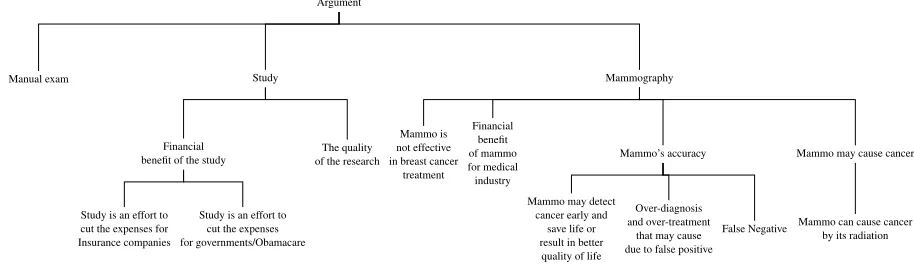
We are not only interested in the overall posi-tion of commenter, but also in the reasons behind it. Commenters usually back up their stances with ar-guments. Our second annotation task was argument tagging in which the annotator identified which ar-guments have been used in a comment, from a pre-defined list of arguments. These tags are organized in a hierarchical tree-structured order, as some of them may be related. This structure is represented in figure 1. The annotators were instructed to choose leaf arguments (the most specific one) rather than more general ones, when possible. Commenters may use more than one argument to support their po-sition. For this corpus, the annotators were asked to select at most two arguments based on the emphasis of the author on them. In other words, if the com-ment had more than two argucom-ments, the ones with more emphasis were selected (because more than two arguments appeared in very few comments in our corpus). The predefined list of arguments was manually extracted and the annotators had chosen appropriate tags from this list, for each post.
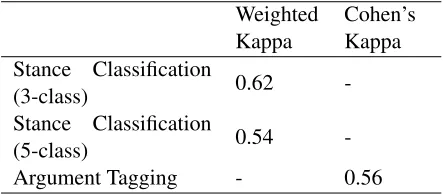
Inter-annotator Agreement Our annotation consisted of two separate tasks. For each task, a different numbers of annotators have been used and the annotation was evaluated independently. Stance annotation was carried out by three annotators. To measure inter-annotator agreement, the average of weighted Kappa between each pair of annotators was calculated. As the labels have ordinal value and Fleiss’ Kappa and Cohen’s Kappa are mainly designed for categorical data, we did not use them to assess stance classification annotation. The ma-jor difference between weighted Kappa and Cohen’s
Weighted
Kappa Cohen’sKappa Stance Classification
(3-class) 0.62
-Stance Classification
(5-class) 0.54
[image:4.612.316.538.60.157.2]-Argument Tagging - 0.56
Table 1: Inter-annotator agreement for argument tagging and stance classification
Kappa is that weighted Kappa considers the degree of disagreement.
One annotator labelled the arguments for each post. However, to evaluate the quality of annotation, a subset of our corpus (220 comments) were selected and independently annotated by the second annota-tor. The annotations were compared without con-sidering the hierarchical structure of the tags from figure 1. To measure inter-annotator agreement Co-hen’s Kappa was deployed. It is also possible to consider hierarchical structure of arguments and to calculate a weighted Kappa based on their distance in the tree.
Table 1 shows the inter-annotation agreement re-sults for both tasks. The agreements are in the range of reported agreement in similar tasks and for simi-lar data (Boltuzic and ˇSnajder, 2014) (Walker et al., 2012c). The values show the difficulty of the task, even for humans. Eventually, those comments for which at least two annotators agreed about the over-all position (stance label) were kept and the rest, labeled as “Other” were discarded, as they may be truly ambiguous.
3.2 Corpus Analysis
com-Argument
Mammography
Mammo may cause cancer
Mammo can cause cancer by its radiation Mammo’s accuracy
False Negative Over-diagnosis
and over-treatment that may cause due to false positive Mammo may detect
cancer early and save life or result in better quality of life Financial
benefit of mammo for medical industry Mammo is not effective in breast cancer
treatment Study
The quality of the research Financial
benefit of the study
Study is an effort to cut the expenses for governments/Obamacare Study is an effort to
cut the expenses for Insurance companies Manual exam
Figure 1: Hierarchical structure of arguments in our corpus
Strongly
For For Against StronglyAgainst
[image:5.612.76.533.67.200.2]Post 157 200 172 252
Table 2: Distribution of stance labels in the corpus
ments for which only one argument could be iden-tified by the annotators. Because there are not suf-ficient instances in the corpus for some of the tags, and the data would be too imbalanced, we decided to remove tags that have less than five percent rep-resentatives in the corpus and replace them with the “Other/None” label.
4 Proposed Framework
In this paper, a framework for argument tagging is introduced. The main advantage of this framework is that labeled data is not required. In this approach, NMF is first applied on unlabeled data to extract top-ics. Subsequently, data are clustered based on these topics. Each post may belong to that topic cluster if its probability of generating from that topic is more than a certain threshold. Later, these clusters are la-beled to match a predefined list of argument tags by an annotator. In summary, NMF can cluster com-ments based on their argucom-ments and these clusters can be labeled by considering top keywords of each cluster topic.
To label each cluster, the top keywords of that topic and the list of arguments were given to the annotators. An annotator who is relatively familiar with comments can easily match topics with argu-ments, for any domain. The suggested framework
for annotation is considerably less tedious and time consuming compared to annotating all posts one by one and leveraging them for training a supervised statistical learner. For our corpus, annotating all comments took 30 hour from for an annotator, while matching topics with argument tags took less than one hour. This illustrates the efficiency of the pro-posed framework.
In this framework, these extracted argument tags for each comment are subsequently leveraged for stance classification using an SVM classifier. Ex-ploiting argument tags for predicting stance is ben-eficial, as an argument is often used to back up a single stance, either for or against.
5 Experiments and Results
In this section, first, the experimental setting is re-viewed and the evaluation process and metrics are described. Subsequently, the results of applying our proposed framework on our corpus are presented for both argument tagging and stance classification. 5.1 Experimental Setup
After removing those arguments which did not have sufficient representatives, eight argument tags re-mained. We treated argument tagging as a multi-class multi-label multi-classification problem. Each post can have one or more of those eight labels or none of them.
Argument Strongly For For Against Strongly Against Total
Argument about the study 0 1 1 1 3
The quality of the study 5 7 35 43 90
Financial benefit of the study 0 0 4 6 10
Study is an effort to cut the expenses for
In-surance companies 0 2 22 26 50
Study is an effort to cut the expenses for
gov-ernments/Obamacare 0 2 26 41 69
Argument about the mammography 2 1 0 0 3
Mammo is not effective in breast cancer
treat-ment 5 9 1 2 17
Mammo may cause cancer 9 1 0 0 10
Mammo can cause cancer by its radiation 42 23 1 1 67
Mammo’s accuracy 2 7 0 2 11
Over-diagnosis and over-treatment that may
cause because of false positive 51 36 0 0 87
False Negative 13 17 1 0 31
Mammo may detect cancer early and save life
or result in better quality of life 0 8 63 175 246
Financial benefit of mammo
for medical industry 47 53 1 0 101
Argument about manual exam 20 29 10 9 68
Other/None 118 204 179 168 699
[image:6.612.74.549.59.395.2]Total 314 400 344 504 1562
Table 3: Distribution of argument tags for different stance labels in our corpus
terms that have been appeared in more than twenty percent of the documents.
For evaluation, separate test and training data were deployed. Data was randomly divided into test and training sets. Seventy percent of the data was used for training and the rest was used for test-ing. As mentioned earlier, for our proposed frame-work, the labels of training are not leveraged and topic models are applied on unlabeled training data. Like similar researches in text classification, preci-sion, recall and f1-score are used as evaluation met-rics.
5.2 Argumentation Mining Results
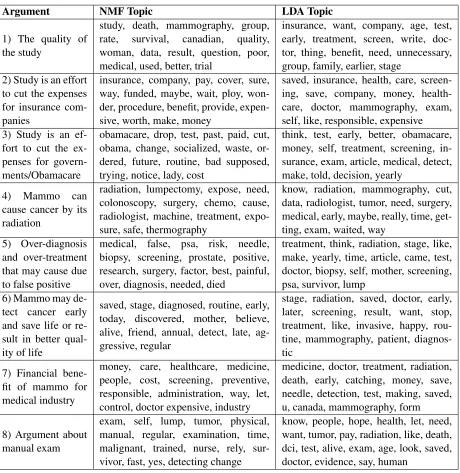
In this section, the results of applying our proposed framework are described and compared to a super-vised classifier that uses the same features (TF-IDF). As a supervised classifier, a linear multi-label Sup-port Vector Machine (SVM) is employed using the one-versus-all training scheme. Additionally, in our
framework instead of NMF, LDA was used for topic modeling and the results are compared between the two approaches.
Argument NMF Topic LDA Topic
1) The quality of the study
study, death, mammography, group, rate, survival, canadian, quality, woman, data, result, question, poor, medical, used, better, trial
insurance, want, company, age, test, early, treatment, screen, write, doc-tor, thing, benefit, need, unnecessary, group, family, earlier, stage
2) Study is an effort to cut the expenses for insurance com-panies
insurance, company, pay, cover, sure, way, funded, maybe, wait, ploy, won-der, procedure, benefit, provide, expen-sive, worth, make, money
saved, insurance, health, care, screen-ing, save, company, money, health-care, doctor, mammography, exam, self, like, responsible, expensive 3) Study is an
ef-fort to cut the ex-penses for govern-ments/Obamacare
obamacare, drop, test, past, paid, cut, obama, change, socialized, waste, or-dered, future, routine, bad supposed, trying, notice, lady, cost
think, test, early, better, obamacare, money, self, treatment, screening, in-surance, exam, article, medical, detect, make, told, decision, yearly
4) Mammo can cause cancer by its radiation
radiation, lumpectomy, expose, need, colonoscopy, surgery, chemo, cause, radiologist, machine, treatment, expo-sure, safe, thermography
know, radiation, mammography, cut, data, radiologist, tumor, need, surgery, medical, early, maybe, really, time, get-ting, exam, waited, way
5) Over-diagnosis and over-treatment that may cause due to false positive
medical, false, psa, risk, needle, biopsy, screening, prostate, positive, research, surgery, factor, best, painful, over, diagnosis, needed, died
treatment, think, radiation, stage, like, make, yearly, time, article, came, test, doctor, biopsy, self, mother, screening, psa, survivor, lump
6) Mammo may de-tect cancer early and save life or re-sult in better qual-ity of life
saved, stage, diagnosed, routine, early, today, discovered, mother, believe, alive, friend, annual, detect, late, ag-gressive, regular
stage, radiation, saved, doctor, early, later, screening, result, want, stop, treatment, like, invasive, happy, rou-tine, mammography, patient, diagnos-tic
7) Financial bene-fit of mammo for medical industry
money, care, healthcare, medicine, people, cost, screening, preventive, responsible, administration, way, let, control, doctor expensive, industry
medicine, doctor, treatment, radiation, death, early, catching, money, save, needle, detection, test, making, saved, u, canada, mammography, form
8) Argument about manual exam
exam, self, lump, tumor, physical, manual, regular, examination, time, malignant, trained, nurse, rely, sur-vivor, fast, yes, detecting change
[image:7.612.79.539.135.608.2]know, people, hope, health, let, need, want, tumor, pay, radiation, like, death, dci, test, alive, exam, age, look, saved, doctor, evidence, say, human
Precision Recall F1-score
Linear-SVM 0.76 0.33 0.43
Cluster-LDA 0.26 0.32 0.28
[image:8.612.72.297.154.211.2]Cluster-NMF 0.58 0.53 0.49
Table 5: Results of argument tagging on our corpus
Precision Recall F1-score
Baseline 0.16 0.40 0.23
TF-IDF 0.43 0.45 0.37
TF-IDF+Args 0.48 0.48 0.47
Table 6: Results of stance classification in the case of 4-classes (the strength and the overall stance)
Table 5 presents the precision, recall and f1-score of the argument tagging task on our corpus. Our model based on NMF outperforms the other two ap-proaches significantly in term of f1-score and recall, while it is considerably more efficient in terms of the required annotation.
5.3 Stance Classification Results
[image:8.612.327.534.165.304.2]For stance classification, the predicted argument tags from the previous section were leveraged for stance classification. Our proposed stance classifier deploys the same set of TF-IDF features; in addition, it uses the predicted argument tags as features and as a classification method, linear SVM is employed. These methods are compared with two other classi-fiers: a linear SVM with TF-IDF as features, and a simple majority class classifier as a baseline. The results are shown in two settings.
Table 6 presents the results of predicting both the stance and its strength (4-class), while table 7 shows the result of stance classification (for or against). Comments with the label of “Other” have been al-ready removed from data. In both settings, the per-formance is improved when adding the predicted ar-guments as features.
6 User Generated Content Visualization
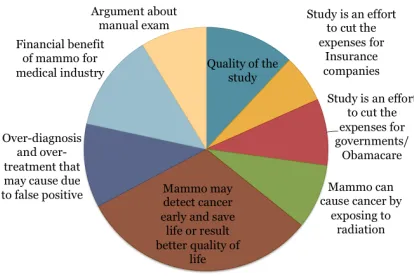
In this section, one of the applications of automatic analysis of news comments is illustrated. Following the extraction of arguments from news comments, they can be visualized. In figure 2, the distribution of main arguments in the corpus based on the
hu-Precision Recall F1-score
Baseline 0.32 0.56 0.41
TF-IDF 0.79 0.76 0.74
TF-IDF+Args 0.77 0.77 0.77
Table 7: Results of stance classification in the case of 2-classes
Figure 2: The summary of arguments based on annotated data
man annotation are represented, while in figure 3 the distribution based on the automatically-predicted ar-guments is demonstrated. The figures visualize the relative importance of the arguments. Such visu-alizations could be really useful to decision mak-ers, even if the arguments were automatically pre-dicted, therefore not all the predictions are correct, because their relative importance was correctly de-tected. Most importantly, the predictions can be ob-tained for any domain by using our method, without
[image:8.612.325.540.531.675.2]the need to label large amounts of data.
7 Discussion
In this section, we further investigate and analyze the results presented earlier. In the previous section, it was shown that using NMF for clustering com-ments based on their argucom-ments is significantly bet-ter than employing LDA. This can be observed in the extracted top keywords of the topics. NMF top-ics can be matched to the arguments considerably more easily. This is also supported by the evalu-ation results, as clustering based on NMF has sig-nificantly better precision, recall, and f1-score than clustering using LDA. We speculate that the reason for this is the shortness of the comments, since LDA normally works better for longer texts. The other reason may be the fact that all of these data are about the same general topic, breast cancer screening, and LDA cannot distinguish between subtopics (differ-ent argum(differ-ents).
Table 6 demonstrates that stance prediction is sig-nificantly improved by leveraging the predicted ar-gument tags. The reason for this can be simply ex-plained by referring to table 3. This table shows that most of the arguments have been leveraged mainly to back up a single stance. Hence, by predicting the correct argument, the stance can be guessed with high probability. The correlation between stance labels and argument tags has been also observed in (Boltuzic and ˇSnajder, 2014), but they have ex-ploited manually-annotated stance labels for argu-ment classification.
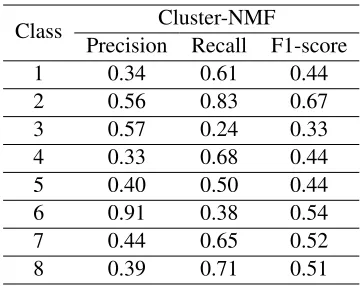
To explore in more details the results of our pro-posed framework, precision, recall and f1-score for each class (argument tag) is illustrated in table 8. Better precision is achieved for argument classes that are more explicitly expressed and similar sen-tences are used to convey them. The argument “Mammo may detect cancer early and save life or result in better quality of life” (class 6) has the best precision, as it is mostly expressed by sen-tences like “Mammography saved my/my mother/ my friend life”. On the contrary, our method has bet-ter recall for those arguments referred more implic-itly in the corpus. For instance, the argument class “Study is an effort to cut the expenses for govern-ments/Obamacare” (class 4) has low precision and
high recall, due to several posts such as “ Step in the direction of limited health care. You know, hope and change.” that implicitly express this argument. An-other reason for low precision of some classes, such as ”Argument about manual exam” (class 8), is that the corpus is imbalanced and they have less repre-sentative data compared to others.
Class Precision Recall F1-scoreCluster-NMF
1 0.34 0.61 0.44
2 0.56 0.83 0.67
3 0.57 0.24 0.33
4 0.33 0.68 0.44
5 0.40 0.50 0.44
6 0.91 0.38 0.54
7 0.44 0.65 0.52
[image:9.612.336.516.166.309.2]8 0.39 0.71 0.51
Table 8: The summary of the performance of proposed framework for each argument (the class numbers match argument tag numbers in table 4)
8 Conclusion and Future Work
Stance classification and argumentation mining were recently introduced as important tasks in opin-ion mining. There has been a growing interest in these fields, as they can be advantageous particu-larly for decision making. In this paper, a novel framework for argument tagging was proposed. In our approach, news comments were clustered based on their topics extracted by NMF. These clusters were subsequently labeled by considering the top keywords of each cluster.
Several lines of research can be investigated in the future. First, we plan to apply our framework on available datasets for argument tagging and stance classification of ideological debates. to study its per-formance in other domains. Furthermore, we intend to concentrate more on the hierarchical structure of the argument tags, by exploiting hierarchical topic modeling to extract arguments with different levels of abstractness. Another area that can be explored is automatic extraction of the set of argument tags, in a similar way to the automatic aspect extraction of product reviews.
Acknowledgments
This research was supported by the Natural Sci-ences and Engineering Research Council of Canada under the CREATE program, and of the Pol-ish National Scientific Centre NCN grant UMO-2013/09/B/ST6/01549. We thank Kenton White for motivating us to employ NMF for topic modeling. We thank our annotators Raluca Tanasescu and Nas-ren Musa Elsageyer.
References
Camille Albert, Leila Amgoud, Florence Dupin de Saint-Cyr, Patrick Saint-Dizier, and Charlotte Costedoat. 2011. Introducing argumention in opinion analysis: Language and reasoning challenges. Sentiment Analy-sis where AI meets Psychology (SAAIP), page 28. Pranav Anand, Marilyn Walker, Rob Abbott, Jean E Fox
Tree, Robeson Bowmani, and Michael Minor. 2011. Cats rule and dogs drool!: Classifying stance in on-line debate. In Proceedings of the 2nd workshop on computational approaches to subjectivity and senti-ment analysis, pages 1–9. Association for Computa-tional Linguistics.
Frank R Baumgartner, Suzanna L De Boef, and Amber E Boydstun. 2008. The decline of the death penalty and the discovery of innocence. Cambridge Univer-sity Press.
David M Blei, Andrew Y Ng, and Michael I Jordan. 2003. Latent dirichlet allocation. the Journal of ma-chine Learning research, 3:993–1022.
Filip Boltuzic and Jan ˇSnajder. 2014. Back up your stance: Recognizing arguments in online discussions. In Proceedings of the First Workshop on Argumenta-tion Mining, pages 49–58.
Baptiste Chardon, Farah Benamara, Yannick Mathieu, Vladimir Popescu, and Nicholas Asher. 2013. Mea-suring the effect of discourse structure on sentiment
analysis. InComputational Linguistics and Intelligent Text Processing, pages 25–37. Springer.
Alexander Conrad, Janyce Wiebe, et al. 2012. Recog-nizing arguing subjectivity and argument tags. In Pro-ceedings of the Workshop on Extra-Propositional As-pects of Meaning in Computational Linguistics, pages 80–88. Association for Computational Linguistics. Kushal Dave, Steve Lawrence, and David M Pennock.
2003. Mining the peanut gallery: Opinion extraction and semantic classification of product reviews. In Pro-ceedings of the 12th international conference on World Wide Web, pages 519–528. ACM.
Debanjan Ghosh, Smaranda Muresan, Nina Wacholder, Mark Aakhus, and Matthew Mitsui. 2014. Analyzing argumentative discourse units in online interactions. In Proceedings of the First Workshop on Argumenta-tion Mining, pages 39–48.
Kazi Saidul Hasan and Vincent Ng. 2013. Frame seman-tics for stance classification.CoNLL-2013, 124. Kazi Saidul Hasan and Vincent Ng. 2014. Why are you
taking this stance? identifying and classifying reasons in ideological debates. EMNLP 2014.
John Lawrence, Chris Reed, Colin Allen, Simon McAlis-ter, Andrew Ravenscroft, and David Bourget. 2014. Mining arguments from 19th century philosophical texts using topic based modelling. ACL 2014, page 79. Daniel D Lee and H Sebastian Seung. 2001. Algorithms for non-negative matrix factorization. In Advances in neural information processing systems, pages 556– 562.
Wei-Hao Lin, Theresa Wilson, Janyce Wiebe, and Alexander Hauptmann. 2006. Which side are you on? identifying perspectives at the document and sen-tence levels. InProceedings of the Tenth Conference on Computational Natural Language Learning, pages 109–116. Association for Computational Linguistics. Qiaozhu Mei, Xu Ling, Matthew Wondra, Hang Su, and
ChengXiang Zhai. 2007. Topic sentiment mixture: modeling facets and opinions in weblogs. In Pro-ceedings of the 16th international conference on World Wide Web, pages 171–180. ACM.
Anthony B Miller, Claus Wall, Cornelia J Baines, Ping Sun, Teresa To, Steven A Narod, et al. 2014. Twenty five year follow-up for breast cancer incidence and mortality of the canadian national breast screening study: randomised screening trial. Bmj, 348.
Bo Pang, Lillian Lee, and Shivakumar Vaithyanathan. 2002. Thumbs up?: sentiment classification using ma-chine learning techniques. InProceedings of the ACL-02 conference on Empirical methods in natural lan-guage processing-Volume 10, pages 79–86. Associa-tion for ComputaAssocia-tional Linguistics.
Martin Potthast, Benno Stein, Fabian Loose, and Stef-fen Becker. 2012. Information retrieval in the com-mentsphere.ACM Transactions on Intelligent Systems and Technology (TIST), 3(4):68.
Farial Shahnaz, Michael W Berry, V Paul Pauca, and Robert J Plemmons. 2006. Document clustering using nonnegative matrix factorization. Information Pro-cessing & Management, 42(2):373–386.
Swapna Somasundaran and Janyce Wiebe. 2010. Recog-nizing stances in ideological on-line debates. In Pro-ceedings of the NAACL HLT 2010 Workshop on Com-putational Approaches to Analysis and Generation of Emotion in Text, pages 116–124. Association for Com-putational Linguistics.
Swapna Somasundaran, Josef Ruppenhofer, and Janyce Wiebe. 2007. Detecting arguing and sentiment in meetings. InProceedings of the SIGdial Workshop on Discourse and Dialogue, volume 6.
Ivan Titov and Ryan McDonald. 2008a. Modeling on-line reviews with multi-grain topic models. In Pro-ceedings of the 17th international conference on World Wide Web, pages 111–120. ACM.
Ivan Titov and Ryan T McDonald. 2008b. A joint model of text and aspect ratings for sentiment summarization. InACL, volume 8, pages 308–316. Citeseer.
Manos Tsagkias, Wouter Weerkamp, and Maarten De Ri-jke. 2010. News comments: Exploring, modeling, and online prediction. Advances in Information Re-trieval, pages 191–203.
Marilyn A Walker, Pranav Anand, Rob Abbott, Jean E Fox Tree, Craig Martell, and Joseph King. 2012a. That is your evidence?: Classifying stance in on-line political debate. Decision Support Systems, 53(4):719–729.
Marilyn A Walker, Pranav Anand, Robert Abbott, and Ricky Grant. 2012b. Stance classification using dia-logic properties of persuasion. In Proceedings of the 2012 Conference of the North American Chapter of the Association for Computational Linguistics: Hu-man Language Technologies, pages 592–596. Associ-ation for ComputAssoci-ational Linguistics.
Marilyn A Walker, Jean E Fox Tree, Pranav Anand, Rob Abbott, and Joseph King. 2012c. A corpus for re-search on deliberation and debate. In LREC, pages 812–817.
Theresa Wilson and Janyce Wiebe. 2005. Annotating attributions and private states. InProceedings of the
Workshop on Frontiers in Corpus Annotations II: Pie in the Sky, pages 53–60. Association for Computa-tional Linguistics.
Wei Xu, Xin Liu, and Yihong Gong. 2003. Document clustering based on non-negative matrix factorization. InProceedings of the 26th annual international ACM SIGIR conference on Research and development in in-formaion retrieval, pages 267–273. ACM.
Ying Zhang, Yi Fang, Xiaojun Quan, Lin Dai, Luo Si, and Xiaojie Yuan. 2012. Emotion tagging for comments of online news by meta classification with heteroge-neous information sources. InProceedings of the 35th international ACM SIGIR conference on Research and development in information retrieval, pages 1059– 1060. ACM.