Proceedings of The 9th International Natural Language Generation conference, pages 51–60,
Infusing NLU into Automatic Question Generation
Karen Mazidi and Paul Tarau
Department of Computer Science and Engineering University of North Texas, Denton TX 76207 USA [email protected], [email protected]
Abstract
We present a fresh approach to automatic question generation that significantly in-creases the percentage of acceptable questions compared to prior state-of-the-art systems. In our evaluation of the top 20 questions, our sys-tem generated 71% more acceptable questions by informing the generation process with Nat-ural Language Understanding techniques. The system also introduces our DeconStructure al-gorithm which creates an intuitive and prac-tical structure for easily accessing sentence functional constituents in NLP applications.
1 Introduction
Question generation has been described as a dia-logue and discourse task, drawing on both Natu-ral Language Understanding and NatuNatu-ral Language Generation (Rus et al., 2012). However, cur-rent state-of-the-art question generation systems pay scant attention to the NLU aspect, an issue we ad-dress in this work. The question generator we present explores means of infusing NLU analysis (Allen, 1995) into the task of automatically gen-erating questions from expository text for educa-tional purposes. Ginzburg’s work on Questions Un-der Discussion (2012) frames discourse as a series of questions to be addressed. Expository text could be viewed from this perspective: it is a monologue from which the author hopes the reader would be able to answer a set of questions. Automatic ques-tion generaques-tion, then, could be viewed as a process of discovering unasked questions within the mono-logue.
2 Prior work in question generation
Pioneering work in QG dates back to Wolfe (1976) who not only demonstrated the feasibility of auto-matically generating questions from text but also that automatically generated questions could be as effective as human-authored questions (Wolfe, 1977). Question generation has received revived in-terest in recent years, spurred in part by a series of workshops on question generation, the last one of which occurred in 2010 (Boyer and Piwek, 2010).
2.1 Common approaches to QG
Apart from a few outliers in specialized domains with limited results, the majority of question gen-eration systems input a text source, parse the sen-tences, and transform sentences into questions. Two major design decisions are: (1) selecting a parser, and (2) deciding whether to use external templates or internal rules for sentence-to-question transfor-mation. In a recent survey of question genera-tion approaches for educagenera-tional applicagenera-tions, Le et al. (2014) observed that template-based approaches tended to perform better than systems that syntac-tically rearrange the source text. Our observation is that generating any question type is theoretically possible in any approach, but that some approaches make some types easier to generate than others.
Sentence ArgN Dep. Label Meaning
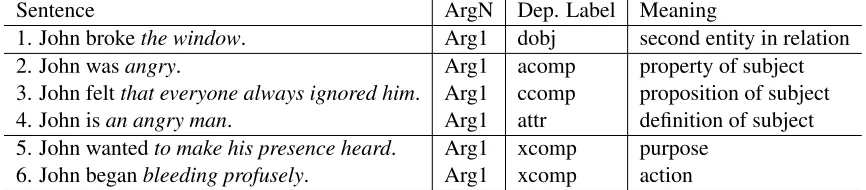
1. John brokethe window. Arg1 dobj second entity in relation 2. John wasangry. Arg1 acomp property of subject 3. John feltthat everyone always ignored him. Arg1 ccomp proposition of subject 4. John isan angry man. Arg1 attr definition of subject 5. John wantedto make his presence heard. Arg1 xcomp purpose
[image:2.612.70.503.73.168.2]6. John beganbleeding profusely. Arg1 xcomp action
Table 1:Arg1 versus Dependency Labels
that these purely syntactic approaches do not allow higher-level abstractions that may be possible with more semantically informed approaches.
An alternative to the phrase-structure parse is the SRL (semantic role label) parse which identifies for each predicate in a sentence, its associated argu-ments and modifiers, and specifies their semantic roles. A QG system can then extract arguments and modifiers for question construction (Mannem et al., 2010; Lindberg et al., 2013; Mazidi and Nielsen, 2014; Chali and Hasan, 2015). These systems are able to generate a wider variety of questions than the phrase structure approach and are not as closely bound to the sentence source text.
A third type of parse used in QG systems is the dependency parse, which connects words in a sen-tence in a graphical structure based on their gram-matical and functional relations. Although the SRL parse is sometimes referred to as a shallow seman-tic parse, certain dependency relations give greater insight into semantics than the SRL parse. The itali-cized portions of the sentences in Table 1 were all parsed as Arg1 by the SRL parser. In contrast, the labels provided by the dependency parser are quite varied, and provide opportunities to glean var-ied meanings from what is simplyArg1in the SRL parse. Although the dependency parse had been used as an ancilliary tool and for sentence simpli-fication, Mazidi et al. (2015) was the first to fully exploit dependency relations in question generation. Another recent innovative approach (Labutov et al., 2015) used crowd sourcing to develop QG tem-plates by leveraging the structure of their source data, Wikipedia. As an example, articles about per-sons have similar subsections such as Eary Life, In-fluences, and so forth, so that templates formed for one person should transfer reasonably well to oth-ers. It remains to be seen how this innovative but
source-specific approach would transfer to other text sources such as textbooks on a wide range of topics. Interestingly, the approach relies on the observation that expository text tends to be rather redundant in structure, an observation that has parallels with the observations we offer in this paper.
2.2 NLU: the missing piece of the puzzle
Most prior work in QG views a sentence as a string of constituents and proceeds to rearrange those con-stituents into as many questions as possible accord-ing to grammar rules. In contrast, the work we present here first classifies what a sentence is com-municating by examining the pattern of constituent arrangement. As described below, the identification of thissentence patternis key to determining what type of question should be asked about that sentence, as opposed to generating questions on every possi-ble sentence constituent. This sentence identifica-tion process is part of the DeconStructure algorithm.
3 DeconStructure algorithm
Token PSG SRL Dependency
1 The (S(NP* B-A0 det(algorithm-3,the-1)
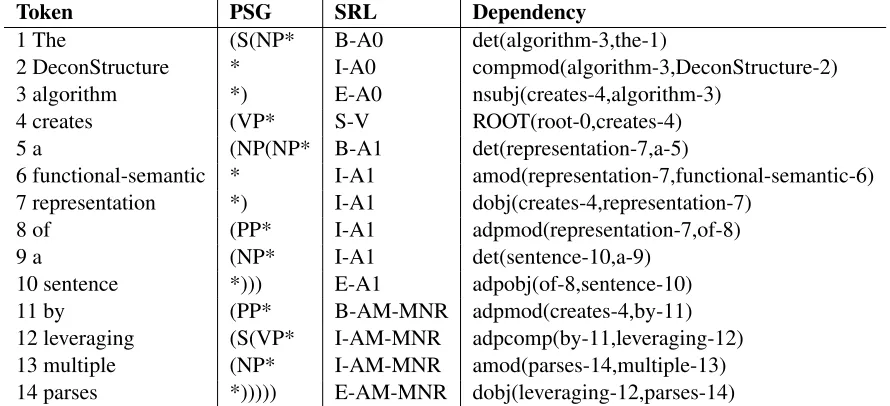
2 DeconStructure * I-A0 compmod(algorithm-3,DeconStructure-2) 3 algorithm *) E-A0 nsubj(creates-4,algorithm-3)
4 creates (VP* S-V ROOT(root-0,creates-4) 5 a (NP(NP* B-A1 det(representation-7,a-5)
6 functional-semantic * I-A1 amod(representation-7,functional-semantic-6) 7 representation *) I-A1 dobj(creates-4,representation-7)
8 of (PP* I-A1 adpmod(representation-7,of-8)
9 a (NP* I-A1 det(sentence-10,a-9)
[image:3.612.70.515.72.275.2]10 sentence *))) E-A1 adpobj(of-8,sentence-10) 11 by (PP* B-AM-MNR adpmod(creates-4,by-11) 12 leveraging (S(VP* I-AM-MNR adpcomp(by-11,leveraging-12) 13 multiple (NP* I-AM-MNR amod(parses-14,multiple-13) 14 parses *))))) E-AM-MNR dobj(leveraging-12,parses-14)
Table 2:Comparing Parser Outputs: Phrase Structure Grammar, Semantic Role Label, Dependency
Constituent Text Head Governor
predicate creates 4 0
subject the DeconStructure algorithm 3 4
dobj a functional-semantic representation of a sentence 7 4
MNR by leveraging multiple parses 11 4
Table 3:Front End DeconStructure for Sentence in Table 2
3.1 Theoretical Foundations
The Cambridge Grammar of the English Language (Huddleston et al., 2002) identifies three essential concepts in the analysis of sentences: (1) Sentences have parts, which may themselves have parts, (2) The parts of sentences belong to a limited range of types, and (3) The parts have specific roles or func-tions within the larger parts they belong to. Kroeger (2004) identifies three aspects of sentence structure: (1) argument structure, (2) constituent structure, and (3) functional structure. With these concepts in mind, the DeconStructure algorithm was designed with three desiderata: (1) Identify sentence con-stituents in a manner that is intuitive yet consistent with linguistic foundations, (2) Classify constituents from a set of types indicating the semantic function of constituents within sentences, and (3) Determine the sentence pattern: a sequence consisting of the root predicate, its complements and adjuncts.
3.2 Parser Comparisons
In prior work, we determined that no one parse tells us everything we would like to know about a
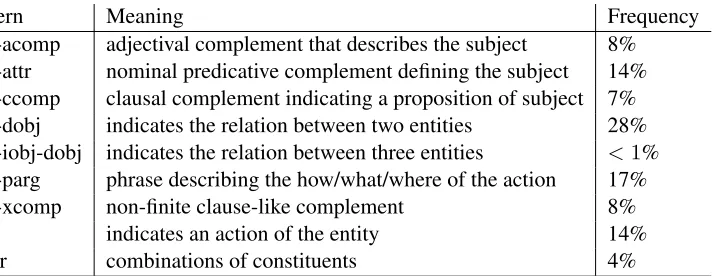
Pattern Meaning Frequency S-V-acomp adjectival complement that describes the subject 8% S-V-attr nominal predicative complement defining the subject 14% S-V-ccomp clausal complement indicating a proposition of subject 7% S-V-dobj indicates the relation between two entities 28% S-V-iobj-dobj indicates the relation between three entities <1% S-V-parg phrase describing the how/what/where of the action 17% S-V-xcomp non-finite clause-like complement 8%
S-V indicates an action of the entity 14%
[image:4.612.97.454.70.208.2]other combinations of constituents 4%
Table 4:Typical Sentence Pattern Distribution in Expository Text
3.3 Advantages of Multiple Parsers
The DeconStructure algorithm is encoded in a Python program that first parses sentences with Mi-crosoft Research’s SPLAT 1 (Quirk et al., 2012), which provides constituency parsing, dependency parsing using universal dependency labels (McDon-ald et al., 2013), semantic role labeling, tokenizing, POS tagging, lemmatization, and other NLP func-tions through a JSON (JavaScript Object Notation) request. It should be noted that the DeconStructure algorithm can be implemented with any parser that provides an SRL and dependency parse. Hence it does not require a custom parser as do other repre-sentations such as AMR (Banarescu et al., 2012).
The DeconStructure algorithm (see Algorithm 1) exploits synergies between the SRL and dependency parses. For example, a prepositional phrase that is dependent on the verb can be an argument or an ad-junct. Knowing what role the PP is playing is crucial for NLP applications but the dependency parse does not identify this information. However, the SRL will label PPs with numbered arguments if they are argu-ments of the verb. By checking if a PP dependent on a root verb is also a numbered argument in the SRL parse, the PP can be identified as an argument; otherwise it will be considered to be an adjunct.
Complements are words, phrases and clauses that complete the meaning of the verb, including the ob-jects of traditional grammar (Carnie, 2013; Huddle-ston et al., 2002). The universal dependency la-bel set has six distinct lala-bels that may be internal complements of the VP: direct object, indirect ob-ject, attr (attribute), acomp (adjectival complement),
1http://research.microsoft.com/en-us/projects/msrsplat/
ccomp (clausal complement) and xcomp (non-finite clause-like complement) (McDonald et al., 2013). Including the PP-argument and the case in which there are no internal VP arguments, this gives eight distinct patterns for major constituents in clauses. Table 4 provides pattern distribution data observed from collections of expository text. Table 7 provides sample sentences for each structure, along with gen-erated questions. Note that all modifiers and PP that are not core arguments are available in the Decon-Structure for placement in generated questions.
4 Question generation
As seen in Table 4, thesesentence patternsfall into a surprisingly small number of categories. For each sentence, the QG system classifies its sentence pat-tern prior to the question generation phase. The sentence pattern is key to determining what type of question should be asked about that sentence. This analysis was based on text extracted from open source textbooks as well as Wikipedia passages, where each text passage consisted of the text of one chapter section, or Wikipedia text of equivalent length. In order to identify patterns to be included in the QG system, the following criteria was used: (1) Does the sentence pattern occur frequently across passages in different domains? (2) Is the semantic information conveyed by the sentence pattern con-sistent across different instances? and (3) Does the sentence pattern identify important content in source sentences so that generated questions will be mean-ingful and not trivial?
proposition. The predicate determines the num-ber of participants, or arguments, that are allowed (Kroeger, 2005). In the S-V-iobj-dobj pattern, for example, there must be 3 entities identified in the sentence. The predicate is often the main verb but there are other constructions in which the predi-cate can be found in other syntactic predi-categories. The acompconstituent follows a copula verb which has negligible semantic content in this construction. The meaning is carried by theacomp, which may be an adjective or a noun. Linguists often used the term xcompto denote predicate complements of various syntactic categories (Kroeger, 2005). In contrast, the universal dependency relations divide the comple-ments intoacompfor AP,attrfor NP,ccompfor subordinate clauses, leavingxcompfor VP. It mat-ters what syntactic category a complement belongs to because this provides important semantic indica-tions of what the clause is saying. Take for instance a ccomp compared to a dobj. They differ syn-tactically in that theccompis a clause whereas the dobjis a phrase. Semantically, thedobjidentifies the second entity in the predicate relation whereas theccompcan be viewed as an independent propo-sition either indicated by or about the subject.
4.1 Templates and question generation
After a sentence object is created for each indepen-dent clause of each sentence via the DeconStructure algorithm, the sentence pattern is compared against approximately 60 templates. If a template matches the pattern, a question can be generated. Templates are designed to ask questions related to the major point of the sentence as identified in the pattern (see Table 7). Templates also contain filter conditions which are checked. Filter conditions may check for the presence or absence of particular verbs (partic-ularly be, do and have), whether the sentence is in active or passive voice, and other conditions that are documented in the template file. More information is available2for those interested in implementation details.
4.2 Ranking question importance
A question generation system can increase its util-ity by ranking the output questions in order to
iden-2http://www.karenmazidi.com/
Algorithm 1DeconStructure Algorithm S←set of parsed sentences
foreach sentence s∈Sdo
DIVIDEINDEPCLAUSES(s) foreach indepClause ic∈s:do
Step 1: Add predicate complex
ic[pred.label]←predicate icRoot = pred.index
Step 2: Add constituents
foreach dep∈dependenciesdo ifdep.gov == icRootthen
ic[const.label]←dp
Step 3: Add ArgMs to IC
foreach AM in ArgMs for icRootdo
ic[AM.label]←ArgM
Step 4: Determine pp type foreach pp in PPsdo
ifpp == ArgNthen
pp.label = ppArg
else
pp.label = ppMod
Step 5: Determine ic structure
Determine ic type (passive, active, ...) Classify ic pattern
Flag sentences with questionable parse
tify which questions are more likely to be accept-able. Heilman and Smith used a logistic regression question ranker which focused on linguistic quality. The ranker more than doubled the percentage of ac-ceptable questions in the top 20% of generated ques-tions, from 23% to 49% (2011). The logistic regres-sion approach has also attempted by others, but with less success. One system (Lindberg et al., 2013) was able to identify with 86% precision that a question was not acceptable; however, their annotator consid-ered 83% of the questions to be unacceptable ques-tions so the utility of the classifer is unclear.
Figure 1:Sample Amazon Mechanical Turk HIT (Human Intelligence Task).
a score based on the percentage of top TextRank words it contained, with a penalty for very short questions such as What is keyword? Our evalu-ation demonstrated that outputtingimportant ques-tions also increases their acceptability scores.
5 Evaluation
There is no standard way to evaluate automatically generated questions. Recent work in QG and other NLP applications favors evaluation by crowdsourc-ing which has proven to be both cost and time ef-ficient and to achieve results comparable to human evaluators (Snow et al., 2008; Heilman and Smith, 2010). We compared our system performance to the most-frequently cited prior question generation system by Heilman and Smith (2011). The eval-uation was conducted using Amazon’s Mechanical Turk Service. Workers were selected with at least 90% approval rating and who were located in the US and proficient in US English. To monitor quality, work was submitted in small batches, manually in-spected, and run through software to detect workers whose ratings did not correspond well with fellow workers. Each question was rated on a 1-5 scale by 4 workers. The four scores were averaged. Figure 1 shows a sample HIT. Agreement between each set of workers and the average had a Pearson’s correlation r=.71, showing high agreement.
5.1 Test data
Test data consists of 10 science and humanities pas-sages, one each from 10 open source textbooks from
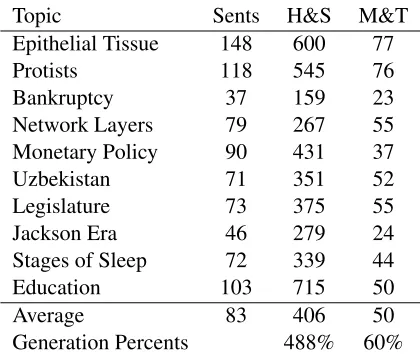
OpenStax and Saylor. All text sources are written at an early college reading level with an average of 83 sentences per passage. Each passage represents the text of one textbook chapter section, chosen at random. Table 5 lists the topics in the test data set, along with the number of sentences in each file and the number of questions generated by the Heilman & Smith system and our system. The H&S system takes an overgenerate-and-rank approach, generat-ing almost 5 questions per input sentence. In con-trast, our system generates an average closer to one question per every 2 input sentences by focusing on the important content in each sentence but not gen-erating questions when conditions are not favorable for generating a good question.
Table 5:Test Data and Questions Generated
Topic Sents H&S M&T Epithelial Tissue 148 600 77
Protists 118 545 76
Bankruptcy 37 159 23
Network Layers 79 267 55 Monetary Policy 90 431 37
Uzbekistan 71 351 52
Legislature 73 375 55
Jackson Era 46 279 24
Stages of Sleep 72 339 44
Education 103 715 50
Average 83 406 50
[image:6.612.313.523.526.704.2]5.2 Results
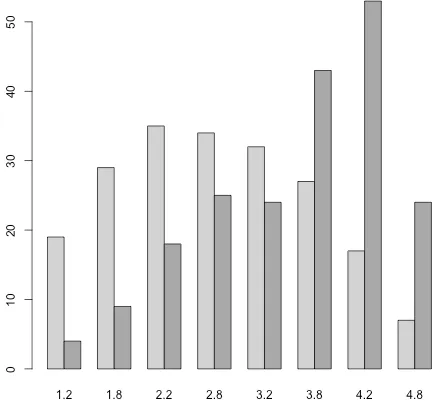
[image:7.612.318.537.90.292.2]The evaluation looked at the top 20 questions out-put from each system for each inout-put file, with each system performing its own internal ranking. Table 6 compares the average MTurk worker ratings for each file for the two systems. Our system had a higher rating for every topic. When averaging all 200 questions, the Heilman & Smith system had an average rating of 2.9. Our system had an average rating of 3.7. The results are statistically significant, p < 0.001, as determined by the Student’s t-Test. Figure 2 shows a side-by-side histogram of the score distributions between the two systems. The his-togram demonstrates that the majority of the Heil-man and Smith system questions are below the mid-point of 3.0 and that the majority of our questions are above this mid-point. Using>3.0as the acceptabil-ity threshold, 72% of our questions are acceptable whereas only 42% of the Heilman and Smith ques-tions pass this threshold. This is an increase in the acceptablity percentage of the top questions of 71%. Interestingly, the Heilman and Smith percentage of 42% found in our evaluation of their top 20 ques-tions is close to the 49% acceptable percentage they found in their analysis of the top 20percentof their generated questions.
Table 6:Average Scores for Top 20 Questions
Topic H&S M&T Epithelial Tissue 2.6 3.9
Protists 2.6 4.1
Bankruptcy 2.7 3.5 Network Layers 3.0 3.9 Monetary Policy 2.8 3.8 Uzbekistan 3.3 3.6 Legislature 3.0 3.1 Jackson Era 3.4 3.7 Stages of Sleep 3.0 4.0 Education 2.6 3.1
Average 2.9 3.7
5.3 Error analysis
Analysis of unacceptable questions revealed both sources of errors and areas for future work. Some errors are caused by idiomatic langauge. For exam-ple the sentence: Few members spend time in the
Figure 2:Score Distributions. Light:H&S, Dark:M&T
chamber other than when they are speaking or vot-ing,resulted in the generated question:What do few members spend? In this case time grammatically is the direct object which is why this question was generated, butspend timeis an idiom. One way to avoid generating this question would be to look for specific idiomatic phrases and rephrase them, essen-tially translating the idiomatic language into more direct language.
Another issue is that some templates work better with some topics other than others. For example, a template that matches the S-V-attr pattern isHow would you describesubject? which generated the question: How would you describe a gland? with the answer: a structure made up of one or more cells modified to synthesize and secrete chemical substances. However in another passage it generates the question:How would you describe the sea?from the sentence: The sea was once the fourth-largest body of water in the world. Techniques need to be employed to identify noun phrases that are suitable for definition questions, a task to be explored in fu-ture work.
[image:7.612.74.229.464.631.2]prepro-Pattern and Sample
1.S-V-acompAdjectival complement that describes the subject.
S: Brain waves during REM sleep appear similar to brain waves during wakefulness. Q: Indicate characteristics of brain waves during REM sleep.
2.S-V-attrNominal predicative complement following copula, often defining the subject. S: The entire eastern portion of the Aral sea has become a sand desert, complete with the deteriorating hulls of abandoned fishing vessels.
Q: How would you describe the entire eastern portion of the Aral sea?
3.S-V-ccompClausal complement indicates a proposition of or about the subject. S: Monetary policy should be countercyclical to counterbalance the business cycles of economic downturns and upswings.
Q: What evidence could support the notion that monetary policy should be countercyclical? 4.S-V-dobjIndicates the relation between two entities.
S: The early portion of stage 1 sleep produces alpha waves. Q: What does the early portion of stage 1 sleep produce?
5.S-V-iobj-dobjIndicates the relation between three entities. S: The Bill of Rights gave the new federal government greater legitimacy. Q: What gave the new federal government greater legitimacy?
6.S-V-ppargPrepositional phrase that is required to complete the meaning. S: REM sleep is characterized by darting movement of closed eyes.
Q: What is REM sleep characterized by?
7.S-V-xcompNon-finite clause-like complement.
S: Irrigation systems have been updated to reduce the loss of water. A: For what purpose have the irrigation systems been updated?
8.S-VMay contain phrases that are not considered arguments such as ArgMs.
S: The 1828 campaign was unique because of the party organization that promoted Jackson. Q: Why was the 1828 campaign unique?
Table 7:Sample Questions by Sentence Type
cessing unit removes most but not all references to figures and tables.
Yet another issue is with text that conveys a se-quence of events, in which case a given sentence in isolation may be vague. For example the sentence:
Political authority appeared to rest with the major-ity as never before, generated the question: What did political authority appear to do? This ques-tion is vague out of context. This problem suggests that certain topics require features not available in general-purpose question generators. And indeed, there is an inherent conflict in designing a general-purpose question generation system as opposed to one targeted for a specific topic or source text.
6 Discussion
The question generation system presented here in-troduced a fresh approach to question generation by
References
Husam Ali, Yllias Chali, and Sadid A Hasan. 2010. Automation of question generation from sentences. In Proceedings of QG2010: The Third Workshop on Question Generation, pages 58–67.
James Allen. 1995. Natural language understanding. The Benjamin/Cummings Publishing Company. Laura Banarescu, Claire Bonial, Shu Cai, Madalina
Georgescu, Kira Griffitt, Ulf Hermjakob, Kevin Knight, Philipp Koehn, Martha Palmer, and Nathan Schneider. 2012. Abstract meaning representation (amr) 1.0 specification. InParsing on Freebase from Question-Answer Pairs. In Proceedings of the 2013 Conference on Empirical Methods in Natural Lan-guage Processing. Seattle: ACL, pages 1533–1544. Kristy Elizabeth Boyer and Paul Piwek. 2010.
Proceed-ings. InProceedings of QG2010: The Third Workshop on Question Generation. Pittsburgh: questiongenera-tion. org.
Andrew Carnie. 2013. Syntax: A generative introduc-tion. John Wiley & Sons.
Yllias Chali and Sadid A Hasan. 2015. Towards topic-to-question generation. Computational Linguistics. D Gates. 2008. Generating look-back strategy questions
from expository texts. InThe Workshop on the Ques-tion GeneraQues-tion Shared Task and EvaluaQues-tion Chal-lenge, NSF, Arlington, VA. http://www. cs. memphis. edu/˜ vrus/questiongeneration//1-Gates-QG08. pdf. Jonathan Ginzburg. 2012. The interactive stance.
Ox-ford University Press.
Michael Heilman and Noah A Smith. 2010. Rating computer-generated questions with mechanical turk. InProceedings of the NAACL HLT 2010 Workshop on Creating Speech and Language Data with Amazon’s Mechanical Turk, pages 35–40. Association for Com-putational Linguistics.
Michael Heilman. 2011. Automatic factual question gen-eration from text. Ph.D. thesis, Carnegie Mellon Uni-versity.
Rodney Huddleston, Geoffrey K Pullum, et al. 2002. The cambridge grammar of english. Language. Cam-bridge: Cambridge University Press, pages 1–23. Paul Kroeger. 2004. Analyzing syntax: a
lexical-functional approach. Cambridge University Press. Paul R Kroeger. 2005. Analyzing grammar: An
intro-duction. Cambridge University Press.
Igor Labutov, Sumit Basu, and Lucy Vanderwende. 2015. Deep questions without deep understanding. In Pro-ceedings of the 53rd Annual Meeting of the Associa-tion for ComputaAssocia-tional Linguistics.
Nguyen-Thinh Le, Tomoko Kojiri, and Niels Pinkwart. 2014. Automatic question generation for educational
applications–the state of art. In Advanced Compu-tational Methods for Knowledge Engineering, pages 325–338. Springer.
David Lindberg, Fred Popowich, John Nesbit, and Phil Winne. 2013. Generating natural language questions to support learning on-line. In Proceedings of the 14th European Workshop on Natural Language Gen-eration.Association for Computational Linguistics. Ming Liu, Rafael A Calvo, and Vasile Rus. 2010.
Auto-matic question generation for literature review writing support. InIntelligent Tutoring Systems, pages 45–54. Springer.
Ming Liu, Rafael A Calvo, and Vasile Rus. 2012. G-asks: An intelligent automatic question generation system for academic writing support. Dialogue and Discourse: Special Issue on Question Generation, 3(2):101–124.
Prashanth Mannem, Rashmi Prasad, and Aravind Joshi. 2010. Question generation from paragraphs at upenn: Qgstec system description. InProceedings of QG2010: The Third Workshop on Question Genera-tion, pages 84–91.
Karen Mazidi and Rodney D Nielsen. 2014. Linguis-tic considerations in automaLinguis-tic question generation. In
Proceedings of the 52nd Annual Meeting of the Associ-ation for ComputAssoci-ational Linguistics. Baltimore, Mary-land: Association for Computational Linguistics. Karen Mazidi and Rodney D Nielsen. 2015. Leveraging
multiple views of text for automatic question genera-tion. InArtificial Intelligence in Education, Springer LNCS.
Ryan T McDonald, Joakim Nivre, Yvonne Quirmbach-Brundage, Yoav Goldberg, Dipanjan Das, Kuzman Ganchev, Keith B Hall, Slav Petrov, Hao Zhang, Oscar T¨ackstr¨om, et al. 2013. Universal dependency annota-tion for multilingual parsing. InACL (2), pages 92–97. Citeseer.
Rada Mihalcea and Paul Tarau. 2004. Textrank: Bring-ing order into texts. Association for Computational Linguistics.
Chris Quirk, Pallavi Choudhury, Jianfeng Gao, Hisami Suzuki, Kristina Toutanova, Michael Gamon, Wen-tau Yih, Lucy Vanderwende, and Colin Cherry. 2012. Msr splat, a language analysis toolkit. InProceedings of the 2012 Conference of the North American Chapter of the Association for Computational Linguistics: Hu-man Language Technologies: Demonstration Session, pages 21–24. Association for Computational Linguis-tics.
Vasile Rus, Zhiqiang Cai, and Arthur C Graesser. 2007. Experiments on generating questions about facts. In
Vasile Rus, Brendan Wyse, Paul Piwek, Mihai Lintean, Svetlana Stoyanchev, and Cristian Moldovan. 2012. A detailed account of the first question generation shared task evaluation challenge. Dialogue and Discourse, 3(2):177–204.
Rion Snow, Brendan O’Connor, Daniel Jurafsky, and An-drew Y Ng. 2008. Cheap and fast—but is it good?: evaluating non-expert annotations for natural language tasks. InProceedings of the conference on empirical methods in natural language processing, pages 254– 263. Association for Computational Linguistics. Lucy Vanderwende. 2008. The importance of being
im-portant: Question generation. InProceedings of the 1st Workshop on the Question Generation Shared Task Evaluation Challenge, Arlington, VA.
John H Wolfe. 1976. Automatic question genera-tion from text-an aid to independent study. In ACM SIGCUE Outlook, volume 10, pages 104–112. ACM. John H Wolfe. 1977. Reading retention as a function of
method for generating interspersed questions. Techni-cal report, DTIC Document.