Simple Semi-Supervised POS Tagging
Karl Stratos Michael Collins
Columbia University, New York, NY 10027, USA
{stratos, mcollins}@cs.columbia.edu
Abstract
We tackle the question: how much supervision is needed to achieve state-of-the-art perfor-mance in part-of-speech (POS) tagging, if we leverage lexical representations given by the model of Brown et al. (1992)? It has become a standard practice to use automatically in-duced “Brown clusters” in place of POS tags. We claim that the underlying sequence model for these clusters is particularly well-suited for capturing POS tags. We empirically demon-strate this claim by drastically reducing super-vision in POS tagging with these representa-tions. Using either the bit-string form given by the algorithm of Brown et al. (1992) or the (less well-known) embedding form given by the canonical correlation analysis algorithm of Stratos et al. (2014), we can obtain 93% tagging accuracy with just 400 labeledwords
and achieve state-of-the-art accuracy (>97%) with less than 1 percent of the original training data.
1 Introduction
While fully supervised POS tagging is largely con-sidered a solved problem today, this is hardly the case for unsupervised POS tagging. Despite much previous work (Smith and Eisner, 2005; Johnson, 2007; Toutanova and Johnson, 2007; Haghighi and Klein, 2006; Berg-Kirkpatrick et al., 2010), results on this task are complicated by varying assumptions and unclear evaluation metrics (Christodoulopoulos et al., 2010). Perhaps most importantly, they are not good enough to be practical. Even with indirect su-pervision, for example the prototype-driven method
of Haghighi and Klein (2006) which assumes a set of word examples for each tag type, the best per-position accuracy remains in the range of mid-70%. Recent work has taken a middle ground between fully supervised and unsupervised setups by exploit-ing existexploit-ing resources, for example by projectexploit-ing POS tags from a supervised language or using tag dictionaries (Das and Petrov, 2011; Li et al., 2012; T¨ackstr¨om et al., 2013).
In this work, we focus onminimizingthe amount of labeled data required to obtain a good POS tag-ger. The key to our approach is the use of lexical representations induced by the clustering model of Brown et al. (1992). We argue that this model is particularly appropriate for representing POS tags given their nearly deterministic nature (Section 2). This sheds light on why the representations derived under this model reveal the underlying POS tag in-formation of words.
We empirically demonstrate the validity of our observation by using these representations to dras-tically reduce the number of training examples re-quired for good POS tagging performance on En-glish, German, and Spanish newswire datasets. For instance, on the 12-tag English dataset, we ob-tain tagging accuracy of 93% with just 400 labeled words. We obtain tagging accuracy of 97.03% (about a half percent behind fully supervised mod-els) with just 0.74% of the original training data.
Our aim is orthogonal to the discussion in Man-ning (2011) who investigates what is needed to go beyond the current state-of-the-art POS tagging per-formance. Our focus is on reaching that perfor-mance with as little supervision as possible.
1
11
111
from
110
at
10
101
kept
100
set 0
01
011
Microsoft 010
Google 00
001
industry 000
community
community
industry
Microsoft
set
kept
at from
[image:2.612.93.537.57.219.2](a) (b)
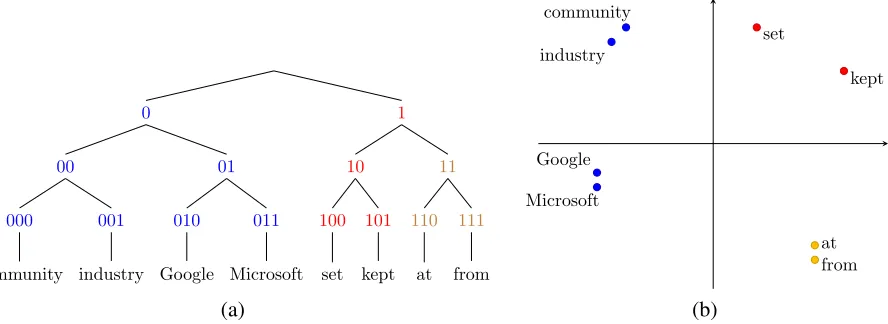
Figure 1: Two representational schemes under the Brown model. (a) Bit-string representations: the path from the root to a word is encoded as a bit-string. (b) CCA vector representations.
2 Motivation
2.1 POS tags are almost deterministic
Certain words are genuinely ambiguous (e.g., set
can be a verb or a noun): this was the motivation of the use of statistical models in the early days of computational linguistics (Church, 1988). However, it is also true that many words are deterministically mapped to correct POS tags (e.g., theis always a determiner). A simple experiment highlights this property. Let count(w, t) be the number of times wordwis tagged astin the training data (likewise, count(w)andcount(t)are counts of wordwand tag
t). Define a deterministic mappingf :w7→ tfrom words to tags as
f(w) =
arg maxtcount(w, t) ifcount(w)>0
arg maxtcount(t) otherwise
In our datasets, this na¨ıve procedure in fact yields reasonable tagging accuracies: 92.22% for coarse tags and 88.50% for fine-grained tags (averaged across three languages).
This observation suggests that the following re-stricted class of HMMs might be sufficient for mod-eling the characteristics of POS tags:
• π(t)is the prior probability of tag typet.
• t(t0|t) is the probability of transitioning from tag
typetto tag typet0.
• o(w|t) is the probability of emitting word typew
from tag typet.
• (Restriction) For each word type w, we have
o(w|t) > 0 only for a unique tag type t and
o(w|t0) = 0for all other tag typest0 6=t.
In other words, we assume that tag types partition word types while imposing a first-order sequence structure on tag types.
2.2 Brown et al. (1992) model
This class of restricted HMMs is precisely the model proposed by Brown et al. (1992)—henceforth the Brown model. A popular use of this model is ag-glomerative word clustering: the result is a hierar-chy over word types, such as the one shown in Fig-ure 1(a). In practice, each word type is represented as a bit-string indicating the path from the root. These bit-strings have been used as discrete (binary) features in various natural language tasks such as named-entity recognition (Miller et al., 2004) and dependency parsing (Koo et al., 2008).
By the above observation, we conjecture that the hidden states of the Brown model capture POS tags. Then the bit-string and embedding representations essentially “give away” the POS tag associated with a word. In experiments, we show that this is indeed the case and not far removed from the idealized il-lustration in Figure 1.
3 Method
In this section, we describe our tagging framework MINITAGGER, which is pleasantly simple but
sur-prisingly effective. It uses an off-the-shelf discrim-inative classifier to map a word’s context to a POS tag. Concretely, given a sentencexand a positioni
inx, we extract a feature vectorφ(x, i) ∈ Rd and train a multi-class classifier to mapφ(x, i)to a POS tag. To clarify, this isnot the the HMM model de-scribed in the previous section: the HMM model un-derlies Brown bit-strings and CCA embeddings.
This framework has compelling benefits. First, it allows for learning from partially labeled sentences since each word is an independent sample. Sec-ond, training and tagging can be very fast since they do not involve dynamic programming required for structured models. Third, arbitrary features can be easily and effectively incorporated. Finally, there are many well-oiled public implementations of dis-criminative classifiers such as support-vector ma-chines (SVMs), thus building an efficient and effec-tive MINITAGGERtakes only a minimal effort. 3.1 Feature templates
We use a baseline feature function basethat maps a sentence-position pair (x, i) to a a 0-1 vector base(x, i)indicating
• Identities ofxi−1, xi+1, xi, xi−2, xi+2
• Prefixes and suffixes ofxi up to length4
• Whether xi is capitalized, numeric, or non-alphanumeric
Let bit(x) be a binary vector indicating prefixes of the Brown bit-string corresponding to x.1 Let cca(x) ∈ Rm be an m-dimensional CCA embed-ding corresponembed-ding tox.
1Past work has used various complex schemes on which pre-fixes to use, e.g., see Koo et al. (2008). For simplicity, we use every prefix in this work.
φ(x, i) Definition
BASE base(x, i)
BIT base(x, i)⊕bit⊕(xbit(xi)
i−1)⊕bit(xi+1)
CCA
base(x,i) ||base(x,i)|| ⊕
cca(xi)
||cca(xi)||
⊕ cca(xi−1)
||cca(xi−1)||⊕
cca(xi+1)
[image:3.612.320.534.54.147.2]||cca(xi+1)||
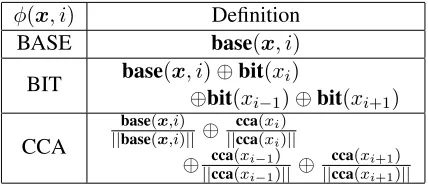
Table 1: Feature templates for MINITAGGER: ⊕is the
vector concatenation operation.
Table 1 shows the feature templates we use to obtain a vector representation of (x, i). ⊕ is the vector concatenation operation. BASE is a base-line template which uses only the spelling features of the current word and the identities of neighbor-ing words. BIT is the same as BASE but augmented with Brown bit-strings. CCA is the same as BASE but augmented with CCA embeddings with appro-priate normalization.
3.2 Sampling methods 3.2.1 Active learning
We also deploy active learning to find the most informative words for labeling in attempt to reduce the amount of training data. While there is a rich literature on this topic (see Settles (2010) for a sur-vey), we focus on a simple form of margin sampling in this work. Every time the model is allowed to have an additional label, it actively selects the word from a pool of unannotated words whose predicted tag is the least confident.
To be precise, lets(x, i, y)be the score of labely
for sentence-position pair(x, i). For example, a lin-ear SVM may defines(x, i, y) =w>
yφ(x, i)where wy is the model parameter andφ(x, i) is a feature template in Table 1. To obtainM labeled examples, we specify the initial seed sizek ≤M and the step sizeξ(for simplicity, assumeξdividesM−k) and proceed as follows:
1. Select the top k most frequent word types (a random occurrence of each type) for labeling.
2. For(M −k)/ξtimes:
NOUN VERB ADP ADJ ADV NUM
community Microsoft kept is from romantic boldly 1
enterprise AT&T made was between mystical selfishly 2
law Unocal invented were for macho frequently 3
anthem Chrysler squandered are [on heroic cynically 4
invader Hexcel lent had in straight-ahead wisely 6
pastime Tosco memorized becomes towards piquant clumsily 7
heritage Geico witnessed ‘s betwen cushy effectively 8
[image:4.612.80.532.53.178.2]curriculum Starwave enjoyed has betweeen ghoulish carefully 5
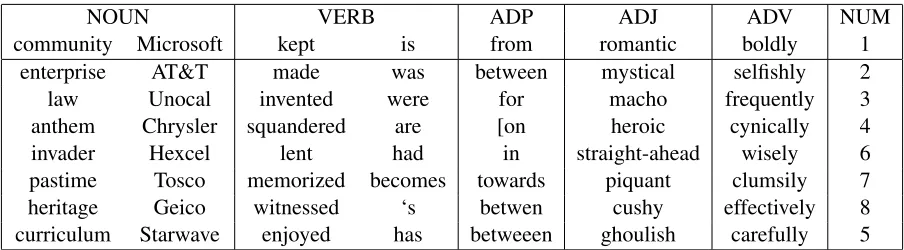
Table 2: Nearest neighbors of some example words along with their associated universal tags (measuring thel2distance
between CCA word vectors).
(b) Label ξ examples (x, i) with the small-est “confidence” values s(x, i, y1) −
s(x, i, y2)where
y1:= arg max
y s(x, i, y)
y2:= arg max
y6=y1
s(x, i, y)
During active learning, the model operates on unan-notated data provided that we supply labels for se-lected examples (we simulate this setting with la-beled data). Note that the selection of examples is inherently tied to the choice of features. Indeed, our experiments show that it is crucial to use lexical rep-resentations for active learning to work effectively.
Large values ofk andξ can be used to speed up active learning (possibly at the cost of performance loss). Since our focus is on maximizing performance with minimal supervision, we usek = ξ = 1. We leave the speed-performance tradeoff of active learn-ing for future work.
3.2.2 Random and frequent-word sampling In addition to active learning, we consider the fol-lowing methods for obtainingM labeled words.
• Random sampling: SelectM words uniformly at random (without replacement).
• Frequent-word sampling: Select random occur-rences of theM most frequent word types. Note that frequent-word sampling is optimal if there really is a deterministic mapping from word types to tag types. But since the assumption does not hold perfectly, it has severe limitations in practice.
We have found that frequent-word sampling outper-forms random sampling for small values ofM but starts to lag behind asMincreases.
4 Experiments
4.1 Setting
We experimented on 3 languages: English, German, and Spanish. For all these languages, we used the train/dev/test datasets of the universal treebank (Mc-Donald et al., 2013)—both the reduced tagset ver-sion, which we denote by EN12, GE12, and SP12, and the original tagset version, which we denote by EN45, GE16, and SP24. The number in the dataset name refers to the number of tag types in that dataset: e.g., EN45 is an English dataset with 45 possible tags.
For each language, we derived Brown represen-tations (by which we mean both the bit-string and embedding forms) from a corpus of unlabeled text. For English, we used a corpus of about 772 million words from various sources of (mostly newswire) text. For German and Spanish, we used the n-gram statistics in Google Ngram (Michel et al., 2011). The number of words was about 64 billion for Ger-man and 83 billion for Spanish.
# labels Sampling Features EN12 GE12 SP12 EN45 GE16 SP24 200 random BASE 74.52 72.91 77.47 70.00 60.39 67.01 frequent-word BASE 79.42 78.36 77.88 74.58 68.83 73.92 active BASE 66.67 71.00 69.90 61.05 61.01 64.60
BIT 88.53 81.71 85.18 79.89 71.18 81.39
CCA 89.34 81.30 87.63 81.68 76.60 86.54
400 random BASE 80.18 76.13 79.96 75.26 69.08 76.66 frequent-word BASE 85.44 82.69 79.93 82.07 75.68 80.44 active BASE 76.06 77.56 80.69 77.24 67.93 79.29
BIT 93.00 87.53 89.94 88.38 77.82 86.53
CCA 92.29 88.17 91.70 88.55 80.48 89.06
1000 random BASE 85.39 81.31 85.92 81.72 73.61 82.53 frequent-word BASE 89.94 85.04 88.93 87.53 79.31 85.93 active BASE 85.65 86.27 88.16 85.02 78.54 84.91
BIT 95.21 91.18 93.45 92.81 83.91 91.73
[image:5.612.119.490.53.249.2]CCA 95.03 92.48 94.37 92.22 84.40 91.97
Table 3: Dev performance of MINITAGGERwhen only 200, 400, and 1000 labeled words are used.
the closest in l2 distance) of some example words. We see that these embeddings are remarkably good at relating the POS tag information to Euclidean dis-tance, confirming our hypothesis in Section 2.
We built a MINITAGGERusing the liblinear
pack-age of Fan et al. (2008).2 We primarily compared
our model with conditional random fields (CRFs)
(Lafferty et al., 2001). We used the implementation of Okazaki (2007).
While we do not rigorously compare runtime per-formances in this work, we note that the computa-tional advantages of MINITAGGERare very useful in
practice. Training/tagging takes only a few seconds with baseline features; with more complex features such as word embeddings, it still takes much less time than what is required by a CRF (which takes
hours with baseline features).
4.2 Effect of Brown representations 4.2.1 With limited supervision
We first look at the effect of using Brown repre-sentations when only a limited amount of training data is available: a scenario in which the role of such lexical representations can be prominent. We select a subset of training data (by words) with vari-ous sampling schemes described in Section 3.2.
Fixed amount of data. Table 3 shows the
perfor-2Our code is available at: https://github.com/ karlstratos/minitagger.
100 200 300 400 500 600 700 800 900 1000 50
60 70 80 90
Number of labeled words
Dev
a
ccura
cy
random frequent-word active (baseline) active (bit-string)
active (CCA)
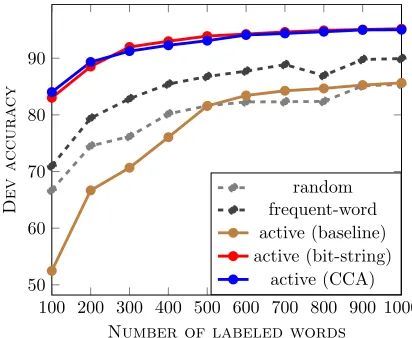
Figure 2: Dev performance of MINITAGGER with vary-ing amounts of supervision (on EN12).
mance on the development portion when MINITAG -GERis trained on 200, 400, and 1000 labeled words.
Active learning together with Brown representations gives dramatic improvement in accuracy when the amount of training data is limited. With 200 ran-domly sampled labels, the baseline model obtains an average accuracy of74.97% across EN12, GE12, and SP12. This improves to86.09% when labels are actively selected with CCA features. A striking re-sult is that we can obtain an accuracy of 93% with only 400 labeled words on the 12-tag English data.
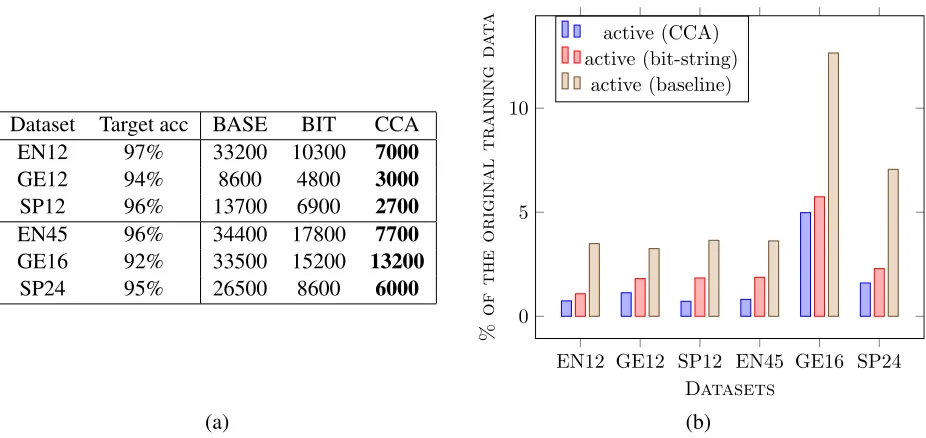
[image:5.612.321.527.291.460.2]Dataset Target acc BASE BIT CCA
EN12 97% 33200 10300 7000
GE12 94% 8600 4800 3000
SP12 96% 13700 6900 2700
EN45 96% 34400 17800 7700
GE16 92% 33500 15200 13200
SP24 95% 26500 8600 6000
EN12 GE12 SP12 EN45 GE16 SP24 0
5 10
Datasets
%
of
the
original
training
d
a
t
a
active (CCA) active (bit-string)
active (baseline)
(a) (b)
Table 4: (a) Smallest numbers of actively selected labels required by MINITAGGERto reach the target dev performance:
92–97%. The target performance is defined to be the accuracy of the fully supervised baseline rounded down to a whole number (Table 5). (b) As percentages of the original training data.
clear that active sampling with Brown bit-string or CCA embedding features outperforms others consis-tently and very significantly.
Fixed target accuracy. Table 4(a) shows the small-est numbers of labeled words required to achieve tar-get performance, where the tartar-get performance is de-fined to be the accuracy of the fully supervised base-line rounded down to a whole number (Table 5). We repeatedly increase the training size by 100 and re-port the first size that allows MINITAGGERto reach
the target accuracy. These numbers are presented as percentages of the size of the original training data in Table 4(b).
We see that active learning with lexical repre-sentations provides dramatic reduction in training data while maintaining good performance. In all cases, using CCA embeddings as features for ac-tive learning outperforms using Brown bit-strings, although sampling takes much longer with CCA em-beddings since there are many more non-zero fea-tures. MINITAGGER does almost as well as when
fully supervised with less than 1% of the training data on English: > 97% accuracy with 0.74% of the data on the 12-tag version, and>96%accuracy with 0.81% of the data on the 45-tag version.
4.2.2 With full supervision
We also examine the effect of Brown representa-tions in a fully supervised setting. Table 5 shows the performance of different tagging methods on the development portion when all training data is used. We see that Brown representations are helpful even under full supervision: MINITAGGER, a
sim-ple greedy model, outperforms CRFwhen equipped
with Brown representations.
Table 5 also shows the performance of MINITAG -GER and CRF on the test portion. For MINITAG -GER, we additionally consider a model trained only
on the actively selected samples with CCA features in Table 4 which are sufficient to reach state-of-the-art performance on the dev portion. As percent-ages of the original training data, these samples con-stitute 0.74% for EN12, 1.13% for GE12, 0.72% for SP12, 0.81% for EN45, 4.98% for GE16, and 1.60% for SP24—1.66% on average. The accuracy of MINITAGGER equipped with Brown
representa-tions is again generally higher than that of CRF.
Fur-thermore, MINITAGGER achieves competitive
[image:6.612.79.542.53.272.2]Eval Model Features Data EN12 GE12 SP12 EN45 GE16 SP24
dev MINI BASE all 97.42 94.91 96.75 96.51 92.44 95.42
BIT all 97.56 95.09 96.98 96.63 92.67 95.89
CCA all 97.67 94.94 97.12 96.81 92.81 95.99
CRF default all 97.37 94.56 96.59 96.59 91.76 95.61
test MINI CCA all 97.90 94.79 95.88 97.25 92.16 94.70
MINI CCA active 97.20(0.74) 94.09(1.13) 94.27(0.72) 96.43(0.81) 91.59(4.98) 93.06(1.60)
[image:7.612.75.539.54.146.2]CRF default all 97.54 94.33 94.88 97.03 91.12 93.48
Table 5: Performance of MINITAGGER (MINI in short) and CRF on the dev and test portions. The Data column
specifies the amount of training data: “all” means all training data is used, “active” means only the labeled examples actively selected (with the same CCA features) in Table 4 are used: the amount of actively selected examples as a percentage of the original training data is shown in parantheses.
5 Related work
We make a few remarks on related works not already discussed earlier. Our work extends a rich body of previous work on reducing annotation efforts with seed examples, unlabeled data, and training exam-ple selection (Yarowsky, 1995; Blum and Mitchell, 1998; Collins and Singer, 1999; Miller et al., 2004; Koo et al., 2008; Kim and Snyder, 2013). In partic-ular, Miller et al. (2004) investigate semi-supervised named-entity recognition based on Brown clusters and active learning. Koo et al. (2008) investi-gate semi-supervised dependency parsing based on Brown clusters.
The direction that Ringger et al. (2007) pursue is perhaps the most similar to ours. They attempt to reduce supervision required for high POS tagging performance based on active learning. But a critical difference is that they do not use word representa-tions: in contrast, word representations are central to our approach.
Another closely relevant work is the work of Gar-rette and Baldridge (2013) who aim to learn a good POS tagger from limited resources. Notably, they faithfully simulate tagging resource-poor languages with human annotators. Our contribution is differ-ent in several important ways. Most importantly, our results are much more striking in the aspect of minimizing supervision. We obtain > 90% accu-racy with a few hundred labeled words, whereas Garrette and Baldridge (2013) obtain 71-78%with 1,537-2,650 labeled words and tag dictionaries (i.e., the result of two hours of annotation efforts). They also do not make use of word representations which are the highlight of this work.
6 Conclusion
We have argued that that the sequence model of Brown et al. (1992), often used for deriving lexical representations, is particularly appropriate for cap-turing POS tags. We have demonstrated this claim by drastically reducing the amount of labeled data required for state-of-the-art POS tagging accuracy with word representations derived under the Brown model. Our simple framework MINITAGGERallows
one to learn a functioning POS tagger with merely a few hundred labeled tokens, or an accurate POS tagger with less than 1% of the normally considered amount of training data.
We focused on utilizing lexical representations in a greedy framework, which is well-suited for the per-position accuracy metric (which is the standard metric for POS tagging). However, the result may be quite different if other metric is chosen, for instance the per-sentence accuracy metric. Thus improving tagging performance under different metrics using lexical representations may be a fruitful direction.
While they are not considered in this work, lexical representationsnotderived under the Brown model such as the skip-gram model in the WORD2VEC package Mikolov et al. (2013) can certainly be used for the same task. It may be illuminating to compare such different representations.
References
Com-putational Linguistics, pages 582–590. Association for Computational Linguistics.
Avrim Blum and Tom Mitchell. 1998. Combining la-beled and unlala-beled data with co-training. In Proceed-ings of the eleventh annual conference on Computa-tional learning theory, pages 92–100. ACM.
Peter F Brown, Peter V Desouza, Robert L Mercer, Vin-cent J Della Pietra, and Jenifer C Lai. 1992. Class-based n-gram models of natural language. Computa-tional linguistics, 18(4):467–479.
Christos Christodoulopoulos, Sharon Goldwater, and Mark Steedman. 2010. Two decades of unsupervised pos induction: How far have we come? In Proceed-ings of the 2010 Conference on Empirical Methods in Natural Language Processing, pages 575–584. Asso-ciation for Computational Linguistics.
Kenneth Ward Church. 1988. A stochastic parts program and noun phrase parser for unrestricted text. In Pro-ceedings of the second conference on Applied natural language processing, pages 136–143. Association for Computational Linguistics.
Michael Collins and Yoram Singer. 1999. Unsupervised models for named entity classification. InProceedings of the joint SIGDAT conference on empirical methods in natural language processing and very large cor-pora, pages 100–110.
Dipanjan Das and Slav Petrov. 2011. Unsupervised part-of-speech tagging with bilingual graph-based pro-jections. In Proceedings of the 49th Annual Meet-ing of the Association for Computational LMeet-inguistics: Human Language Technologies-Volume 1, pages 600– 609. Association for Computational Linguistics. Rong-En Fan, Kai-Wei Chang, Cho-Jui Hsieh, Xiang-Rui
Wang, and Chih-Jen Lin. 2008. Liblinear: A library for large linear classification. The Journal of Machine Learning Research, 9:1871–1874.
Dan Garrette and Jason Baldridge. 2013. Learning a part-of-speech tagger from two hours of annotation. Aria Haghighi and Dan Klein. 2006. Prototype-driven
learning for sequence models. In Proceedings of the main conference on Human Language Technol-ogy Conference of the North American Chapter of the Association of Computational Linguistics, pages 320– 327. Association for Computational Linguistics. Harold Hotelling. 1936. Relations between two sets of
variates. Biometrika, 28(3/4):321–377.
Mark Johnson. 2007. Why doesn’t em find good hmm pos-taggers? InEMNLP-CoNLL, pages 296–305. Young-Bum Kim and Benjamin Snyder. 2013.
Opti-mal data set selection: An application to grapheme-to-phoneme conversion. InHLT-NAACL, pages 1196– 1205.
Terry Koo, Xavier Carreras, and Michael Collins. 2008. Simple semi-supervised dependency parsing.
John Lafferty, Andrew McCallum, and Fernando CN Pereira. 2001. Conditional random fields: Probabilis-tic models for segmenting and labeling sequence data. In Proceedings of the 18th International Conference on Machine Learning, pages 282–289.
Shen Li, Joao V Grac¸a, and Ben Taskar. 2012. Wiki-ly supervised part-of-speech tagging. InProceedings of the 2012 Joint Conference on Empirical Methods in Natural Language Processing and Computational Natural Language Learning, pages 1389–1398. Asso-ciation for Computational Linguistics.
P. Liang. 2005. Semi-supervised learning for natural language. Master’s thesis, Massachusetts Institute of Technology.
Christopher D Manning. 2011. Part-of-speech tagging from 97% to 100%: is it time for some linguistics? InComputational Linguistics and Intelligent Text Pro-cessing, pages 171–189. Springer.
Ryan T McDonald, Joakim Nivre, Yvonne Quirmbach-Brundage, Yoav Goldberg, Dipanjan Das, Kuzman Ganchev, Keith B Hall, Slav Petrov, Hao Zhang, Oscar T¨ackstr¨om, et al. 2013. Universal dependency annota-tion for multilingual parsing. InACL (2), pages 92–97. Jean-Baptiste Michel, Yuan Kui Shen, Aviva Presser Aiden, Adrian Veres, Matthew K Gray, Joseph P Pickett, Dale Hoiberg, Dan Clancy, Peter Norvig, Jon Orwant, et al. 2011. Quantitative analysis of culture using millions of digitized books. science, 331(6014):176–182.
Tomas Mikolov, Ilya Sutskever, Kai Chen, Greg S Cor-rado, and Jeff Dean. 2013. Distributed representations of words and phrases and their compositionality. In C.J.C. Burges, L. Bottou, M. Welling, Z. Ghahramani, and K.Q. Weinberger, editors,Advances in Neural In-formation Processing Systems 26, pages 3111–3119. Curran Associates, Inc.
Scott Miller, Jethran Guinness, and Alex Zamanian. 2004. Name tagging with word clusters and discrimi-native training. InHLT-NAACL, volume 4, pages 337– 342. Citeseer.
Naoaki Okazaki. 2007. Crfsuite: a fast implementation of conditional random fields (crfs).
Eric Ringger, Peter McClanahan, Robbie Haertel, George Busby, Marc Carmen, James Carroll, Kevin Seppi, and Deryle Lonsdale. 2007. Active learning for part-of-speech tagging: Accelerating corpus annotation. In
Proceedings of the Linguistic Annotation Workshop, pages 101–108. Association for Computational Lin-guistics.
Burr Settles. 2010. Active learning literature survey.
University of Wisconsin, Madison, 52:55–66.
InProceedings of the 43rd Annual Meeting on Associ-ation for ComputAssoci-ational Linguistics, pages 354–362. Association for Computational Linguistics.
Karl Stratos, Do-kyum Kim, Michael Collins, and Daniel Hsu. 2014. A spectral algorithm for learning class-basedn-gram models of natural language. In Proceed-ings of the thirtieth conference on Uncertainty in Arti-ficial Intelligence.
Oscar T¨ackstr¨om, Dipanjan Das, Slav Petrov, Ryan Mc-Donald, and Joakim Nivre. 2013. Token and type constraints for cross-lingual part-of-speech tagging.
Transactions of the Association for Computational Linguistics, 1:1–12.
Kristina Toutanova and Mark Johnson. 2007. A bayesian lda-based model for semi-supervised part-of-speech tagging. InAdvances in Neural Information Process-ing Systems, pages 1521–1528.