A Generative Model of Vector Space Semantics
Jacob Andreas Computer Laboratory University of Cambridge
Zoubin Ghahramani Department of Engineering
University of Cambridge [email protected]
Abstract
We present a novel compositional, gener-ative model for vector space representa-tions of meaning. This model reformulates earlier tensor-based approaches to vector space semantics as a top-down process, and provides efficient algorithms for trans-formation from natural language to vectors and from vectors to natural language. We describe procedures for estimating the pa-rameters of the model from positive exam-ples of similar phrases, and from distribu-tional representations, then use these pro-cedures to obtain similarity judgments for a set of adjective-noun pairs. The model’s estimation of the similarity of these pairs correlates well with human annotations, demonstrating a substantial improvement over several existing compositional ap-proaches in both settings.
1 Introduction
Vector-based word representations have gained enormous popularity in recent years as a basic tool for natural language processing. Various models of linguistic phenomena benefit from the ability to represent words as vectors, and vector space word representations allow many problems in NLP to be reformulated as standard machine learning tasks (Blei et al., 2003; Deerwester et al., 1990).
Most research to date has focused on only one means of obtaining vectorial representations of words: namely, by representing them distribution-ally. The meaning of a word is assumed to be fully specified by “the company it keeps” (Firth, 1957), and word co-occurrence (or occasionally term-document) matrices are taken to encode this context adequately. Distributional representations have been shown to work well for a variety of dif-ferent tasks (Sch¨utze and Pedersen, 1993; Baker and McCallum, 1998).
The problem becomes more complicated when we attempt represent larger linguistic structures— multiword constituents or entire sentences— within the same vector space model. The most ba-sic issue is one of sparsity: the larger a phrase, the less frequently we expect it to occur in a corpus, and the less data we will have from which to es-timate a distributional representation. To resolve this problem, recent work has focused on compo-sitionalvector space models of semantics. Based on the Fregean observation that the meaning of a sentence is composed from the individual mean-ings of its parts (Frege, 1892), research in com-positional distributional semantics focuses on de-scribing procedures for combining vectors for in-dividual words in order to obtain an appropriate representation of larger syntactic constituents.
But various aspects of this account remain un-satisfying. We have a continuous semantic space in which finitely many vectors are associated with words, but no way (other than crude approxima-tions like nearest-neighbor) to interpret the “mean-ing” of all the other points in the space. More gen-erally, it’s not clear that it even makes sense to talk about the meaning of sentences or large phrases in distributional terms, when there is no natural con-text to represent.
We can begin to address these concerns by turn-ing the conventional account of composition in vector space semantics on its head, and describ-ing a model for generatdescrib-ing language from vectors in semantic space. Our approach is still composi-tional, in the sense that a sentence’s meaning can be inferred from the meanings of its parts, but we relax the requirement that lexical items correspond to single vectors by allowing any vector. In the process, we acquire algorithms for both meaning inference and natural language generation.
Our contributions in this paper are as follows:
• A new generative, compositional model of
phrase meaning in vector space.
• A convex optimization procedure for map-ping words onto their vector representations.
• A training algorithm which requires only positive examples of phrases with the same meaning.
• Another training algorithm which requires only distributional representations of phrases.
• A set of preliminary experimental results in-dicating that the model performs well on real-world data in both training settings.
2 Model overview
2.1 Motivations
The most basic requirement for a vector space model of meaning is that whatever distance metric it is equipped with accurately model human judg-ments of semantic similarity. That is: sequences of words which are judged to “mean the same thing” should cluster close together in the seman-tic space, and totally unrelated sequences of words should be spread far apart.
Beyond this, of course, inference of vector space representations should be tractable: we re-quire efficient algorithms for analyzing natural language strings into their corresponding vectors, and for estimating the parameters of the model that does the mapping. For some tasks, it is also useful to have an algorithm for the opposite problem— given a vector in the semantic space, it should be possible to produce a natural-language string en-coding the meaning of that vector; and, in keep-ing with our earlier requirements, if we choose a vector close to the vector corresponding to a known string, the resulting interpretation should be judged by a human to mean the same thing, and perhaps with some probability be exactly the same.
It is these three requirements—the use of human similarity judgments as the measure of the seman-tic space’s quality, and the existence of efficient al-gorithms for both generation and inference—that motivate the remainder of this work.
We take as our starting point the general pro-gram of Coecke et al. (2010) which suggests that the task of analyzing into a vector space should be driven by syntax. In this framework, the com-positional process consists of repeatedly combin-ing vector space word representations accordcombin-ing to
linguistic rules, in a bottom-upprocess for trans-lating a natural language string to a vector in space.
But our requirement that all vectors be trans-latable into meanings—that we have both analy-sis and generation algorithms—suggests that we should take the opposite approach, working with a top downmodel of vector space semantics.
For simplicity, our initial presentation of this model, and the accompanying experiments, will be restricted to the case of adjective-noun pairs. Section 5 will then describe how this framework can be extended to full sentences.
2.2 Preliminaries
We want to specify a procedure for mapping a natural language noun-adjective pair (a, n) into a vector space which we will take to be Rp.
We assume that our input sentence has already been assigned a single CCGparse (Steedman and Baldridge, 2011), which for noun-adjective pairs has the form
blue orangutans
N/N N >
N
(1)
Here, the parser has assigned each token a cate-goryof the form N, N/N, etc. Categories are ei-thersimple, drawn from a set of base types (here just N for “noun”), or complex, formed by com-bining simple categories. A category of the form X/Y “looks right” for a category of the form Y, and can combine with other constituents by appli-cation (we write X/Y Y ⇒ X) or composition (X/Y Y/Z ⇒ X/Z) to form higher-level con-stituents.
To this model we add a vector space seman-tics. We begin with a brief review the work of Coecke et al. (2010). Having assigned simple cat-egories to vector spaces (in this case, N to Rp),
complex categories correspond to spaces of ten-sors. A category of the form X/Y is recursively associated with SX ⊗SY, where SX and SY are
the tensor spaces associated with the categoriesX andY respectively. So the space of adjectives (of type N/N) is justRq⊗Rq, understood as the set of
To turn this into a top-down process, we need to describe a procedure for splitting meanings and their associated categories.
2.3 Generation
Our goal in this subsection is to describe a proba-bilistic generative process by which a vector in a semantic space is realized in natural language.
Given a constituent of category X, and a corre-sponding vectorxresiding in someSX, we can
ei-ther generate a lexical item of the appropriate type or probabilistically draw a CCGderivation rooted in X, then independently generate the leaves. For noun-adjective pairs, this can only be done in one way, namely as in (1) (for a detailed account of generative models for CCGsee Hockenmaier and Steedman (2002)). We will assume that thisCCG derivation tree is observed, and concern ourselves with filling in the appropriate vectors and lexical items. This is a strong independence assumption! It effectively says “the grammatical realization of a concept is independent of its meaning”. We will return to it in Section 6.
The adjective-noun model has four groups of parameters: (1) a collectionΘN/N of weight
vec-tors θa for adjectives a, (2) a collection ΘN of
weight vectors θn for nouns n, (3) a collection
EN/Nof adjective matricesEafor adjectivesa, and
finally (4) a noise parameterσ2. For compactness of notation we will denote this complete set of pa-rametersΘ.
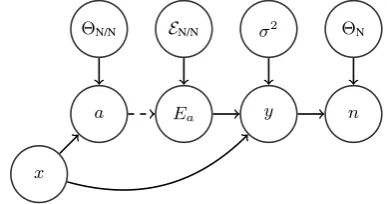
Now we can describe how to generate an adjective-noun pair from a vector x. The CCG derivation tells us to produce a noun and an ad-jective, and the type information further informs us that the adjective acts as a functor (here a ma-trix) and the noun as an argument. We begin by choosing an adjectiveaconditional onx. Having made our lexical choice, we deterministically se-lect the corresponding matrixEafromEN/N. Next
we noisily generate a new vector y = Eax+ε,
a vector in the same space as x, corresponding to the meaning ofxwithoutthe semantic content ofa. Finally, we select a nounn conditional on y, and output the noun-adjective pair (a, n). To use the previous example, supposex meansblue orangutans. First we choose an adjective a = “blue” (or with some probability “azure” or “ultra-marine”), and select a corresponding adjectiveEa.
Then the vectory=Eaxshould meanorangutan,
and when we generate a noun conditional onywe
should have n =“orangutan” (or perhaps “mon-key”, “primate”, etc.).
This process can be summarized with the graph-ical model in Figure 1. In particular, we draw a
ΘN/N
a
x
Ea y n
[image:3.595.318.512.128.230.2]EN/N σ2 ΘN
Figure 1: Graphical model of the generative pro-cess.
from a log-linear distribution over all words of the appropriate category, and use the corresponding Eawith Gaussian noise to mapxontoy:
p(a|x; ΘN/N) =
exp(θa>x)
P
θ0∈Θ
N/Nexp(θ
0>x) (2)
p(y|x, Ea;σ2) =N(Eax, σ2)(y) (3)
Last we choosenas
p(n|y; ΘN) =
exp(θ>ny)
P
θ0∈Θ
Nexp(θ
0>z) (4)
Some high-level intuition about this model: in the bottom-up account, operators (drawn from ten-sor spaces associated with complex categories) can be thought of as acting on simple objects and “adding” information to them. (Suppose, for ex-ample, that the dimensions of the vector space cor-respond to actual perceptual dimensions; in the bottom-up account the matrix corresponding to the adjective “red” should increase the component of an input vector that lies in dimension correspond-ing to redness.) In our account, by contrast, ma-trices remove information, and the “red” matrix should act to reduce the vector component corre-sponding to redness.
2.4 Analysis
Now we must solve the opposite problem: given an input pair(a, n), we wish to map it to an ap-propriate vector inRp. We assume, as before, that
we already have a CCGparse of the input. Then, analysis corresponds to solving the following op-timization problem:
arg min
x
By Bayes’ rule,
p(x|a, n;Θ)∝p(a, n|x;Θ)p(x)
so it suffices to minimize
−logp(x)−logp(a, n|x;Θ)
To find the single best complete derivation of an input pair (equivalent to the Viterbi parse tree in syntactic parsing), we can rewrite this as
arg min
x,y
−logp(x)−logp(a, b, y|x;Θ) (5)
where, as before,ycorresponds to the vector space semantics representation of the noun alone. We take our prior logp(x) to be a standard normal. We have:
−logp(a, n, y|x)
=−logp(a|x;Θ)−logp(y|a, x;Θ)
−logp(n|y;Θ)
∝ −θa>x+ log X
θ0∈Θ
N/N
expθ0>x
+ 1
σ2||Eax−y|| 2
−θ>ny+ log X
θ0∈Θ
N
expθ0>y
Observe that this probability is convex: it con-sists of a sum of linear terms, Euclidean norms, and log-normalizers, all convex functions. Conse-quently, Equation 5 can be solved exactly and ef-ficiently using standard convex optimization tools (Boyd and Vandenberghe, 2004).
3 Relation to existing work
The approach perhaps most closely related to the present work is the bottom-up account given by Coecke et al. (2010), which has already been dis-cussed in some detail in the preceding section. A regression-based training procedure for a similar model is given by Grefenstette et al. (2013). Other work which takes as its starting point the decision to endow some (or all) lexical items with matrix-like operator semantics include that of Socher et al. (2012) and Baroni and Zamparelli (2010). In-deed, it is possible to think of the model in Ba-roni and Zamparelli’s paper as corresponding to a training procedure for a special case of this model, in which the positions of both nouns and noun-adjective vectors are fixed in advance, and in
which no lexical generation step takes place. The adjective matrices learned in that paper correspond to the inverses of theE matrices used above.
Also relevant here is the work of Mitchell and Lapata (2008) and Zanzotto et al. (2010), which provide several alternative procedures for compos-ing distributional representations of words, and Wu et al. (2011), which describes a compositional vector space semantics with an integrated syntac-tic model. Our work differs from these approaches in requiring only positive examples for training, and in providing a mechanism for generation as well as parsing. Other generative work on vec-tor space semantics includes that of Hermann et al. (2012), which models the distribution of noun-noun compounds. This work differs from the model that paper in attempting to generate com-plete natural language strings, rather than simply recover distributional representations.
In training settings where we allow all posi-tional vectors to be free parameters, it’s possible to view this work as a kind of linear relational em-bedding (Paccanaro and Hinton, 2002). It differs from that work, obviously, in that we are interested in modeling natural language syntax and seman-tics rather than arbitrary hierarchical models, and provide a mechanism for realization of the embed-ded structures as natural language sentences.
4 Experiments
Since our goal is to ensure that the distance be-tween natural language expressions in the vector space correlates with human judgments of their relatedness, it makes sense to validate this model by measuring precisely that correlation. In the re-mainder of this section, we provide evidence of the usefulness of our approach by focusing on mea-surements of the similarity of adjective-noun pairs (ANs). We describe two different parameter esti-mation procedures for different kinds of training data.
4.1 Learning from matching pairs
We begin by training the model on matching pairs. In this setting, we start with a collec-tion N sets of up to M adjective-noun pairs (ai1, ni1),(ai2, ni2), . . . which mean the same
thing. We fix the vector space representationyi of
each nounni distributionally, as described below,
EN/N, and, for each group of adjective-noun pairs in the training set, a latent representationxi. The
fact that the vectors yi are tied to their
distribu-tional vectors does not mean we have committed to the distributional representation of the corre-sponding nouns! The final model represents lexi-cal choice only with the weight vectorsΘ—fixing the vectors just reduces the dimensionality of the parameter estimation problem and helps steer the training algorithm toward a good solution. The noise parameter then acts as a kind of slack vari-able, modeling the fact that there may be no pa-rameter setting which reproduces these fixed dis-tributional representations through exact linear op-erations alone.
We find a maximum-likelihood estimate for these parameters by minimizing
L(Θ, x) =−
N
X
i=1
M
X
i=1
logp(aij, nij|xi;Θ) (6)
The latent vectorsxiare initialized to one of their
corresponding nouns, adjective matricesEare ini-tialized to the identity. The components ofΘNare
initialized identically to the nouns they select, and the components ofΘN/Ninitialized randomly. We
additionally place anL2 regularization penalty on
the scoring vectors in bothΘ(to prevent weights from going to infinity) andE (to encourage adjec-tives to behave roughly like the identity). These penalties, as well as the noise parameter, are ini-tially set to0.1.
Note that the training objective, unlike the analysis objective, is non-convex. We use L-BFGS (Liu and Nocedal, 1989) on the likeli-hood function described above with ten such ran-dom restarts, and choose the parameter setting which assigns the best score to a held-out cross-validation set. Computation of the objective and its gradient at each step is linear in the number of training examples and quadratic in the dimension-ality of the vector space.
Final evaluation is performed by taking a set of pairs of ANs which have been assigned a similar-ity score from 1–6 by human annotators. For each pair, we map it into the vector space as described in Section 2.4 above. and finally compute the co-sine similarity of the two pair vectors. Perfor-mance is measured in the correlation (Spearman’s ρ) between these cosine similarity scores and the human similarity judgments.
4.1.1 Setup details
Noun vectors yi are estimated distributionally
from a corpus of approximately 10 million tokens of English-language Wikipedia data (Wikimedia Foundation, 2013). A training set of adjective-noun pairs are collected automatically from a col-lection of reference translations originally pre-pared for a machine translation task. For each foreign sentence we have four reference transla-tions produced by different translators. We as-sign POS tags to each reference (Loper and Bird, 2002) then add to the training data any adjec-tive that appears exactly once in multiple refer-ence translations, with all the nouns that follow it (e.g. “great success”, “great victory”, “great ac-complishment”). We then do the same for repeated nouns and the adjectives that precede them (e.g. “great success”, “huge success”, “tremendous suc-cess”). This approach is crude, and the data col-lected are noisy, featuring such “synonym pairs” as (“incomplete myths”, “incomplete autumns”) and (“similar training”, “province-level training”), as well as occasional pairs which are not adjective-noun pairs at all (e.g. “first parliamentary”). Nev-ertheless, as results below suggest, they appear to be good enough for purposes of learning an appro-priate representation.
For the experiments described in this section, we use 500 sets of such adjective-noun pairs, corresponding to 1104 total training examples. Testing data consists of the subset of entries in the dataset from (Mitchell and Lapata, 2010) for which both the adjective and noun appear at least once (not necessarily together) in the training set, a total of 396 pairs. None of the pairs in this test set appears in training. We additionally withhold from this set the ten pairs assigned a score of 6 (indicating exact similarity), setting these aside for cross-validation.
In addition to the model discussed in the first section of this paper (referred to here as “GEN”), we consider a model in which there is only one adjective matrix E used regardless of the lexical item (referred to as “GEN-1”).
The NP space is taken to be R20, and we
4.2 Learning from distributional representations
While the model does not require distributional representations of latent vectors, it’s useful to con-sider whether it can also provide a generative ana-log to recent models aimed explicitly at produc-ing vectorial representations of phrases given only distributional representations of their constituent words. To do this, we take as our training data a set of N single ANs, paired with a distributional representation of each AN. In the new model, the meaning vectorsx are no longer free parameters, but fully determined by these distributional repre-sentations. We must still obtain estimates for each ΘandEN/N, which we do by minimizing
L(Θ) =−
N
X
i=1
logp(ai,j, ni,j|xi;Θ) (7)
4.2.1 Experimental setup
Experimental setup is similar to the previous sec-tion; however, instead of same-meaning pairs col-lected from a reference corpus, our training data is a set of distributional vectors. We use the same noun vectors, and obtain these new latent pair vec-tors by estimating them in the same fashion from the same corpus.
In order to facilitate comparison with the other experiment, we collect all pairs(ai, ni) such that
both ai and ni appear in the training set used in
Section 4.1 (although, once again, not necessar-ily together). Initialization of Θ andE, regular-ization and noise parameters, as well as the cross-validation procedure, all proceed as in the previ-ous section. We also use the same restricted eval-uation set, again to allow the results of the two experiments to be compared. We evaluate by mea-suring the correlation of cosine similarities in the learned model with human similarity judgments, and as before consider a variant of the model in which a single adjective matrix is shared.
4.3 Results
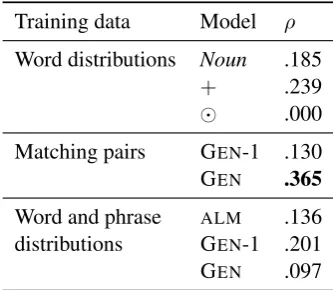
Experimental results are displayed in Table 1. For comparison, we also provide results for a base-line which uses a distributional representation of the noun only, the Adjective-Specific Linear Map (ALM) model of Baroni and Zamparelli (2010) and two vector-based compositional models discussed in (Mitchell and Lapata, 2008): , which takes the Hadamard (elementwise) product of the distri-butional representations of the adjective and noun,
and +, which adds the distributions. As before, we use SVD to project these distributional repre-sentations onto a 20-dimensional subspace.
We observe that in both matrix-based learn-ing settlearn-ings, the GEN model or its parameter-tied variant achieves the highest score (though the distributionally-trained GEN-1 doesn’t per-form as well as the summing approach). The pair-trained model performs best overall. All corre-lations except and the distributionally-trained GEN are statistically significant (p < 0.05), as are the differences in correlation between the matching-pairs-trained GEN and all other mod-els, and between the distributionally-trained GEN -1 and ALM. Readers familiar with other papers employing the similarity-judgment evaluation will note that scores here are uniformly lower than re-ported elsewhere; we attribute this to the compar-atively small training set (with hundreds, instead of thousands or tens of thousands of examples). This is particularly notable in the case of theALM model, which Baroni and Zamparelli report out-performs the noun baseline when given a training set of sufficient size.
Training data Model ρ
Word distributions Noun .185
+ .239
.000
[image:6.595.332.499.397.542.2]Matching pairs GEN-1 .130 GEN .365 Word and phrase ALM .136 distributions GEN-1 .201 GEN .097
Table 1: Results for the similarity judgment exper-iment.
Input Realization Training vector tyrannical principles (“basic principles”) fundamental principles
main principles Test vector economic development (“economic development”) economic development economic development Random vector vital turning
[image:7.595.324.500.81.137.2]further obligations bad negotiations
Figure 2: Generation examples using the GEN model trained with matching pairs.
development” back onto the correct lexical real-ization. Words generated from the random vector appear completely unrelated; this suggests that we are sampling a portion of the space which does not correspond to any well-defined concept.
4.4 Discussion
These experimental results demonstrate, first and foremost, the usefulness of a model that is not tied to distributional representations of meaning vec-tors: as the comparatively poor performance of the distribution-trained models shows, with only a small number of training examples it is better to let the model invent its own latent representations of the adjective-noun pairs.
It is somewhat surprising, in the experi-ments with distributional training data, that the single-adjective model outperforms the multiple-adjective model by so much. We hypothesize that this is due to a search error—the significantly ex-panded parameter space of the multiple-adjective model makes it considerably harder to estimate parameters; in the case of the distribution-only model it is evidently so hard the model is unable to identify an adequate solution even over multiple training runs.
5 Extending the model
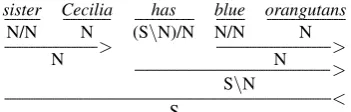
Having described and demonstrated the usefulness of this model for capturing noun-adjective similar-ity, we now describe how to extend it to capture arbitrary syntax. While appropriate experimental evaluation is reserved for future work, we outline the formal properties of the model here. We’ll take as our example the followingCCGderivation:
sister Cecilia has blue orangutans
N/N N (S\N)/N N/N N
> >
N N
> S\N
< S
Observe that “blue orangutans” is generated ac-cording to the noun-adjective model already de-scribed.
5.1 Generation
To handle general syntax, we must first extend the set EN/N of adjective matrices to sets EX for all functor categories X, and create an additional set of weight vectorsΘXfor every category X.
When describing how to generate one split in the CCG derivation (e.g. a constituent of type S into constituents of type NP and S\NP), we can identify three cases. The first, “fully-lexicalized” case is the one already described, and is the gen-erative process by which the a vector meaning blue orangutans is transformed into “blue” and “orangutans”, or sister Cecilia into “sister” and “Cecilia”. But how do we get from the top-level sentence meaning to a pair of vectors meaning sister Cecilia and has blue orangutans (an “un-lexicalized” split), and fromhas blue orangutans to the word “has” and a vector meaning blue orangutans(a “half-lexicalized” split)?
Unlexicalized split We have a vectorxwith cat-egory X, from which we wish to obtain a vectory with category Y, andzwith category Z. For this we further augment the setsE with matrices indexed by category rather than lexical item. Then we pro-ducey =EYx+ε,z =EZ+εwhere, as in the
previous case, ε is Gaussian noise with variance σ2. We then recursively generate subtrees fromy andz.
Half-lexicalized split This proceeds much as in the fully lexicalized case. We have a vectorxfrom which we wish to obtain a vectorywith category Y, and a lexical itemwwith category Z.
We choose w according to Equation 2, select a matrix Ew and produce y = Ewx +ε as
be-fore, and then recursively generate a subtree from y without immediately generating another lexical item fory.
5.2 Analysis
As before, it suffices to minimize
W = (w1, w2,· · · , wn) and a set of internal
vectors P. We select our prior p(x) exactly as before, and can definep(W, P|x)recursively. The fully-lexicalized case is exactly as above. For the remaining cases, we have:
Unlexicalized split Given a subsequence Wi:j = (wi,· · ·, wj), if theCCGparse splitsWi:j
into constituents Wi:k and Wk:j, with categories
Y and Z, we have:
−logp(Wi:j|x) =−logp(Wi:k, P|EYx)
−logp(Wk:j, P|EZx)
Half-lexicalized split If the parse splits Wi:j
into wi andWi+1:j with categories Y and Z, and
y ∈ P is the intermediate vector used at this step of the derivation, we have:
−logp(Wi:j, y|x)
=−logp(wi|x)−logp(y|x, wi)
−logp(Wi+1:j|y)
∝ −θwTix+ log X
w0∈L
Y
expθwT0x
+ 1
σ2||Ewix−y||
2
−logp(Wi+1:j, P|y)
Finally, observe that the complete expression of the log probability of any derivation is, as be-fore, a sum of linear and convex terms, so the optimization problem remains convex for general parse trees.
6 Future work
Various extensions to the model proposed in this paper are possible. The fact that relaxing the distributional requirement for phrases led to per-formance gains suggests that something similar might be gained from nouns. If a reliable train-ing procedure could be devised with noun vectors as free parameters, it might learn an even better model of phrase similarity—and, in the process, simultaneously perform unsupervised word sense disambiguation on the training corpus.
Unlike the work of Coecke et al. (2010), the structure of the types appearing in theCCG deriva-tions used here are neither necessary nor sufficient to specify the form of the matrices used in this paper. Instead, the function of the CCG deriva-tion is simply to determine which words should be assigned matrices, and which nouns. While
CCG provides a very natural way to do this, it is by no means the only way, and future work might focus on providing an analog using a differ-ent grammar—all we need is a binary-branching grammar with a natural functor-argument distinc-tion.
Finally, as mentioned in Section 2.3, we have made a significant independence assumption in re-quiring that the entire CCG derivation be gener-ated in advance. This assumption was necessary to ensure that the probability of a vector in mean-ing space given its natural language representation would be a convex program. We suspect, however, that it is possible to express a similar probabil-ity for an entire packed forest of derivations, and optimize it globally by means of a CKY-like dy-namic programming approach. This would make it possible to optimize simultaneously over all pos-sible derivations of a sentence, and allow positions in meaning space to influence the form of those derivations.
7 Conclusion
We have introduced a new model for vector space representations of word and phrase mean-ing, by providing an explicit probabilistic process by which natural language expressions are gener-ated from vectors in a continuous space of mean-ings. We’ve given efficient algorithms for both analysis into and generation out of this meaning space, and described two different training proce-dures for estimating the parameters of the model. Experimental results demonstrate that these al-gorithms are capable of modeling graded human judgments of phrase similarity given only positive examples of matching pairs, or distributional rep-resentations of pairs as training data; when trained in this fashion, the model outperforms several other compositional approaches to vector space semantics. We have concluded by suggesting how syntactic information might be more closely inte-grated into this model. While the results presented here are preliminary, we believe they present com-pelling evidence of representational power, and motivate further study of related models for this problem.
Acknowledgments
References
L Douglas Baker and Andrew Kachites McCallum. 1998. Distributional clustering of words for text classification. InProceedings of the 21st annual in-ternational ACM SIGIR conference on Research and development in information retrieval, pages 96–103. ACM.
Marco Baroni and Roberto Zamparelli. 2010. Nouns are vectors, adjectives are matrices: Representing adjective-noun constructions in semantic space. In
Proceedings of the 2010 Conference on Empirical Methods in Natural Language Processing, pages 1183–1193. Association for Computational Linguis-tics.
David M Blei, Andrew Y Ng, and Michael I Jordan. 2003. Latent dirichlet allocation. the Journal of Ma-chine Learning Research, 3:993–1022.
Stephen Boyd and Lieven Vandenberghe. 2004. Con-vex optimization. Cambridge university press.
Bob Coecke, Mehrnoosh Sadrzadeh, and Stephen Clark. 2010. Mathematical foundations for a com-positional distributional model of meaning. arXiv preprint arXiv:1003.4394.
Scott Deerwester, Susan T. Dumais, George W Fur-nas, Thomas K Landauer, and Richard Harshman. 1990. Indexing by latent semantic analysis. Jour-nal of the American society for information science, 41(6):391–407.
John Rupert Firth. 1957. A synopsis of linguistic the-ory, 1930-1955.
Gottlob Frege. 1892. Uber Sinn und Bedeutung.
Zeitschrift fur Philosophie und philosophische Kri-tik, pages 25–50. English Translation: em On Sense and Meaning, in Brian McGuinness (ed), em Frege: collected works, pp. 157–177, Basil Blackwell, Ox-ford.
Edward Grefenstette, Georgiana Dinu, Yao-Zhong Zhang, Mehrnoosh Sadrzadeh, and Marco Baroni. 2013. Multi-step regression learning for compo-sitional distributional semantics. Proceedings of the 10th International Conference on Computational Semantics (IWCS 2013).
Karl Moritz Hermann, Phil Blunsom, and Stephen Pul-man. 2012. An unsupervised ranking model for noun-noun compositionality. InProceedings of the First Joint Conference on Lexical and Computa-tional Semantics-Volume 1: Proceedings of the main conference and the shared task, and Volume 2: Pro-ceedings of the Sixth International Workshop on Se-mantic Evaluation, pages 132–141. Association for Computational Linguistics.
Julia Hockenmaier and Mark Steedman. 2002. Gen-erative models for statistical parsing with combina-tory categorial grammar. InProceedings of the 40th Annual Meeting on Association for Computational
Linguistics, pages 335–342. Association for Com-putational Linguistics.
Dong C Liu and Jorge Nocedal. 1989. On the limited memory bfgs method for large scale optimization.
Mathematical programming, 45(1-3):503–528.
Edward Loper and Steven Bird. 2002. Nltk: the nat-ural language toolkit. InProceedings of the ACL-02 Workshop on Effective tools and methodologies for teaching natural language processing and com-putational linguistics - Volume 1, ETMTNLP ’02, pages 63–70, Stroudsburg, PA, USA. Association for Computational Linguistics.
Jeff Mitchell and Mirella Lapata. 2008. Vector-based models of semantic composition. proceedings of ACL-08: HLT, pages 236–244.
Jeff Mitchell and Mirella Lapata. 2010. Composition in distributional models of semantics. Cognitive Sci-ence, 34(8):1388–1429.
Alberto Paccanaro and Jefferey Hinton. 2002. Learn-ing hierarchical structures with linear relational em-bedding. In Advances in Neural Information Pro-cessing Systems 14: Proceedings of the 2001 Neural Information Processing Systems (NIPS) Conference, volume 14, page 857. MIT Press.
Hinrich Sch¨utze and Jan Pedersen. 1993. A vector model for syntagmatic and paradigmatic relatedness.
Making sense of words, pages 104–113.
Richard Socher, Brody Huval, Christopher D Manning, and Andrew Y Ng. 2012. Semantic compositional-ity through recursive matrix-vector spaces. In Pro-ceedings of the 2012 Joint Conference on Empiri-cal Methods in Natural Language Processing and Computational Natural Language Learning, pages 1201–1211. Association for Computational Linguis-tics.
Mark Steedman and Jason Baldridge. 2011. Combi-natory categorial grammar. Non-Transformational Syntax Oxford: Blackwell, pages 181–224.
Wikimedia Foundation. 2013. Wikipedia. http://dumps.wikimedia.org/enwiki/. Accessed: 2013-04-20.
Stephen Wu, William Schuler, et al. 2011. Struc-tured composition of semantic vectors. In Proceed-ings of the Ninth International Conference on Com-putational Semantics (IWCS 2011), pages 295–304. Citeseer.