Textual Inference and Meaning Representation
in Human Robot Interaction
Emanuele Bastianelli1, Giuseppe Castellucci2, Danilo Croce3, Roberto Basili3 1DICII,2DIE,3DII
University of Roma, Tor Vergata 00133 Roma, Italy
{bastianelli,castellucci}@ing.uniroma2.it
{croce,basili}@info.uniroma2.it
Abstract
This paper provides a first investigation over existing textual inference paradigms in order to propose a generic framework able to capture major semantic aspects in Human Robot Interaction (HRI). We investigate the use of general semantic paradigms used in Natural Language Un-derstanding (NLU) tasks, such as Seman-tic Role Labeling, over typical robot com-mands. The semantic information ob-tained is then represented under the Ab-stract Meaning Representation. AMR is a general representation language useful to express different level of semantic infor-mation without a strong dependence to the syntactic structure of an underlying sen-tence. The final aim of this work is to find an effective synergy between HRI and NLU.
1 Introduction
As robots are being marketed for consumer appli-cations (viz. telepresence, cleaning or entertain-ment) natural language interaction is expected to make them more appealing and accessible to the end user. The latest technologies in speech recog-nition are available on cheap computing devices, thus enabling different levels of interaction. The first level needed in HRI is the command under-standing. This is a challenging task as it con-sists not only in understanding the utterance mean-ing, but also in translating it into the robot-specific command. In the recent years, works about the in-terpretation of natural language (NL) instructions in a specific environments, e.g. allowing a simu-lated robot to navigate to a specified location, has been oriented to cover a specific subset of the lan-guage (Kruijff et al., 2007; Bos and Oka, 2007). This led to very powerful and formalized systems
that are, at the same time, very specific and lim-ited in terms of expressiveness. In many NLP tasks where robustness is crucial, e.g. Question Answering as discussed in (Ferrucci et al., 2010), methods based on Statistical Learning (SL) the-ory have been used to overcome such issues in the support of complex Textual Inference tasks, as in (Chen and Mooney, 2011).
In this paper, instead of focusing on specific lan-guage understanding algorithms, we investigate the combination of state-of-the-art textual infer-ence technologies in order to design effective sys-tems for HRI. The final aim of this research is to propose a unifying framework able to capture semantic aspects as these are needed in the HRI area. We foster the idea that many problems tack-led and solved in Natural Language Processing, e.g. Semantic Role Labeling (SRL) (Palmer et al., 2010), can be taken into account for HRI. Exist-ing techniques can be used to automatically ac-quire useful semantic representations to interpret robot commands as investigated in (Thomas and Jenkins, 2012). Let us consider a domotic sce-nario where a robot receives vocal instructions, e.g. “take the book on the table”. We think that the command targeted by this utterance can be ex-pressed through the adoption of semantic roles as defined in existing lexical theories, as discussed in (Fillmore, 1985) or (Levin, 1993). Moreover, the generalization level offered by this representation can be improved to better reflect human instruc-tions with the environment where the robots are acting into. For example, we can extend the se-mantic roles in order to properly capture spatial as well as temporal expressions. These can be cru-cial for the robot to understand spatial relations be-tween objects in the space or temporal references that are necessary to correctly plan the intended action sequence.
(Fillmore, 1985) and Spatial Semantics (Zlatev, 2007). While the former aims at addressing the problem of scene and event understanding, the lat-ter specifically focuses on the spatial relations in-volved. It enables a planning and reasoning mod-ule to correctly disambiguate objects in the world the robot is acting into. We propose the use of a general structure to represent all the semantics we are interested in. In fact, a typical problem when working with different representations, is that they are totally independent each other. They are not designed to work together in a more general se-mantic framework. In order to do it, we investi-gate the use of a new and appealing representation formalism, i.e. Abstract Meaning Representation
(AMR) (Banarescu et al., 2013). It allows to ex-press semantics without imposing any strong bias to the original sentence or syntactic structure. The final instantiated AMR annotation could be easily mapped to the commands expressed in the robot language (e.g. the logic form), in a way similar to the one proposed in (Thomas and Jenkins, 2012).
In order to prove the effectiveness of the pro-posed idea, we evaluated existing natural language technologies not customized to the target HRI sce-nario. In the rest of the paper, in Section 2 different Natural Language Processing tasks are discussed with respect the HRI area. Finally, in Section 3 the conclusion and future works about a new robotic-centric corpus are derived.
2 From Human Voice to Robot Instructions through NLP
A complete NL processing chain for an agent act-ing in an environment (real or virtual) should be realized as follow: starting from an utterance, a textual representation is obtained from a generic Automatic Speech Recognizer (ASR) (e.g. the CMU Sphinx (Walker et al., 2004)); morpho-syntactic modules (e.g. Stanford CoreNLP (Klein and Manning, 2003)) are then applied; finally, the semantic information is extracted by semantic parsing processors. Starting from this last infor-mation, a specific mapping moduletranslates the so represented meaning of a sentence in the corre-sponding robot command.
In this section, different NLP semantic process-ing tasks useful for robot instructions understand-ing are described. An evaluation of each task is ad-dressed using20commands typical of an HRI sce-nario. They come from a larger corpus we are
la-beling to capture major semantic aspects for HRI. These sentences are manually annotated with re-spect to syntax, part-of-speech tags, parse trees and semantics, with respect to Frame Semantics (Fillmore, 1985) and Spatial Roles (Kordjamshidi et al., 2012). Annotations have been carried out by two of the authors, while conflicts have been resolved by a third one. In the following, a possi-ble NLU pipeline is discussed.
From Voice to Text. The first step in a robot in-struction understanding scenario is the automatic transcription of vocal commands. Transcriptions of the utterances are obtained by the audio signal processing performed by ASRs. The ASR engines are usually classified depending on the technique used to generate the Language Model. Two dif-ferent approaches can be followed for this pur-pose. The first one, which is called command-and-control and is used in the development of several vocal interfaces for commercial systems (i.e. telephone customer care, reservation sys-tems). It requires a grammar-based language spec-ification, typically through Context Free Gram-mars. The second approach, called free-form speech, relies directly on statistical techniques over very large corpora (millions of words), by computing probabilities of sequences of words. While in command-and-control engines it is possi-ble to enrich the grammar with higher-level infor-mation, such as attaching semantic information to each rule, in free-form speech engines an external and independent module to compute the desired representation is needed. The use of a grammar-based approach can simplify the semantic pars-ing process at the expense of coverage, i.e. the constraints imposed to the set of recognized lexi-cons and utterances. From this point of view, free-form speech systems cover a wider range of lin-guistic phenomena. For example, in the work of (Thomas and Jenkins, 2012) the official Google speech APIs of the Android environment is used as a free-form speech engine. AWord Error Rate
of24%is measured using the Google speech APIs over the 20 test robot commands. It is a promis-ing result, considerpromis-ing that very few sentences are pronounced by English native speakers.
that is the Stanford Core NLP platform1. It in-cludes tokenization, POS tagging, Named Entity Recognition as well as parsing and is mostly based on statistical, e.g. max-entropy, models for lan-guage processing. We want to evaluate the use of these tools to achieve a good command recogni-tion accuracy for a robot. Usually, in NLU mor-phosyntactic analysis can be crucial to provide features that words alone are not sufficient to ex-press. For example, the dependency parse tree of an utterance could be used in further processing, such as in SRL. We measured the quality of the Stanford parser in terms ofUnlabeled Attachment Score(UAS) andLabeled Attachment Score(LAS) on our 20 test utterances. The former aims at veri-fying the ability of an algorithm to identify a syn-tactic relation, while the latter aims at measuring the quality of the relation labeling. We report an accuracy of87%in UAS and83%of LAS. Modeling commands through Semantic Roles. An appropriate theory is necessary in order to cap-ture useful semantics for robot instructions. We ar-gue that Frame Semantics (Fillmore, 1985) could be a good choice to represent different aspects of a robot command. Frames are the main struc-ture used to represent and generalize events or ac-tions. They are micro-theories about real world situations (e.g. movement actions, such as
moving, events, such as natural phenomena, andproperties, such asbeing colored). Each frame provides its set of semantic roles, i.e. the different elements involved in the situation de-scribed by the frame (e.g. anAgent). FrameNet (Baker et al., 1998) is a semantic resource reflect-ing Fillmore’s Frame Semantics. In FrameNet lex-ical entries (such as verbs, nouns or adjectives) are linked toFrames, and the roles, expressing the par-ticipants in the underlying event, are mapped to
frame elements. FrameNet has produced an exten-sive collection of frames as well as a large scale annotated corpus. For example, for the sentence “take the book on the table” the following repre-sentation is produced: take[the book]T heme [on
the table]Source. In this structure, the different
as-pects of the TAKING event are highlighted, as the
roles THEMEand PLACE, suitable for further pro-cessing. Frame Semantics can provide a bridge between the linguistic information of a command and its inner robot representation.
We applied Babel, a general purpose SRL
sys-1
http://nlp.stanford.edu/software/corenlp.shtml
Precision Recall F1-Measure
FP 0.71 0.6 0.65
BD 0.81 0.70 0.75
[image:3.595.328.503.62.106.2]AC 0.58 0.50 0.54
Table 1: SRL measures on 20 robot commands.
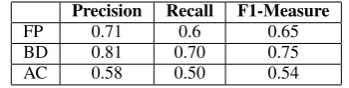
tem2 (Croce and Basili, 2011; Croce et al., 2012), to the test sentences. In table 1 results for three different sub-tasks of a SRL chain are reported. In particular, Precision, Recall and F1-Measure are shown for the tasks Frame Prediction (FP),
Boundary Detection(BD), andArgument Classi-fication (AC). The first one aims at determining the events evoked in a sentence. The second one is intended to identify the roles involved with re-spect to a frame. The last one is the task of assign-ing a label to each role. Performances are lower with respect to the state-of-the-art as, on the one hand, the adopted system was not trained to deal with domain specific phenomena, such as the verb
to be. On the other hand, the FP badly performed on spoken sentences with jargon expressions, such as “close the water”, consequently biasing the AC step.
Describing Robot Environment through Spa-tial Roles. One of the main functions of language is to communicate spatial relationships between objects in the world. Frame Semantics seems in-adequate to represent this information at the level of granularity needed by the grounding process of a robotic system. A more specific semantic theory seems thus required and its impact is investigated. Recently,Spatial Role Labeling(SpRL) (Kord-jamshidi et al., 2011) was defined as the problem of extracting generic spatial semantics from natu-ral language. The underlying theory is theholistic spatial semantic theory(Zlatev, 2007). It defines the basic concepts in the spatial domain of the nat-ural language that help to determine the location or trajectory of motion of a given referent in the dis-course. For example, a spatial utterance must ad-dress a TRAJECTOR, i.e. the entity whose location
is of relevance, or the LANDMARK, i.e. the refer-ence entity in relation to which the location of the trajectory of motion is specified. The SpRL task aims at extracting spatial semantic roles from sen-tences. Thus, in the sentence “take the book on the table”, a system should recognize that the prepo-sition “on” is the SPATIAL INDICATORof the re-lation between “book” and “table”, respectively
Precision Recall F1-Measure
SI 0.78 0.84 0.81
TR 0.80 0.61 0.70
[image:4.595.95.264.63.106.2]TD 0.75 0.75 0.75
Table 2: Spatial Role Labeling results.
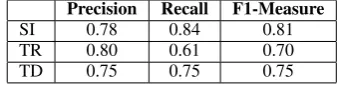
a TRAJECTOR and a LANDMARK. These infor-mation should help a robotic system to correctly determine which book has to be taken within the physical world, i.e. the one on the table. In table 2 we report performance measures in terms of Pre-cision, Recall and F1-Measure of a Spatial Role Labeler (Bastianelli et al., 2013). These results re-fer to the SPATIAL INDICATOR(SI), TRAJECTOR
(TR) and LANDMARK (LD) (Kordjamshidi et al., 2011) labeling on the 20 test sentences used above. Expressing Rich Semantic Information through AMR.In order to integrate the informa-tion conveyed by the Frame Semantics and the Spatial Semantics, we want to propose a repre-sentation flexible and as much as possible close to the domotic domain, i.e. the robot language. The Abstract Meaning Representation (AMR) (Banarescu et al., 2013) is a novel semantic representation language that allows to represent semantics in an abstract way, focusing on con-cepts, their instances and the relations among them. According to this notation, the meaning of a sentence is represented as a rooted, labeled (acyclic) graph, where the semantic structure is built in a recursive way. In AMR, sentences that have different syntactic structures but basically the same meaning are represented by the same structure. While the AMR proposed in (Banarescu et al., 2013) uses the PropBank frame sets (Palmer et al., 2010), we want to adopt it to embed the semantics coming both from Frame Semantics and Spatial Semantics. The command “take the book on the table” will be represented as follows:
(t/take−Taking
:Theme(b/book) :Source(t1/table) :location(o/on
:trajector(b)) :landmark(t1)))
Here,bookandtablerepresent concepts;band t1are the instances respectively related. Frame Semantics is represented by the instancetof the verbtake, evoking the frameTaking. In a similar way, the two semantic rolesThemeandSource are defined as the instancesb andt1. The spa-tial relationlocationis defined across the two
semantic roles, linking the b instance to the t1 through the prepositionon. This structure appears to be very agile for computing and for the HRI in-terface design. It can be seen as the abstraction step in the representation of meaning, used before the final translation into the logic-like formalism. This latter is closer to the robot representation, but more complex to manage. The tree-like structure of AMR makes it very easy to navigate, elaborate and visualize. Furthermore, many consolidated formalism can be derived from this one, as neo-davidsonian Discourse Representation Structures (Bos and Oka, 2007). While DRSs are closest to a possible representation of the world a robot might have, AMR offers a promising degree of abstrac-tion, especially because we want to follow a data-driven approach, without relying on too rigid rep-resentations or tools. It seems to embed in a logic-like formalism all the information needed for the symbol grounding process of a robot, such as re-lation between linguistic objects as well as roles. Actually, a mapping procedure to compile the final AMR representation is under development.
3 Conclusion and Future Work
References
Collin F. Baker, Charles J. Fillmore, and John B. Lowe. 1998. The berkeley framenet project. In Proceed-ings of the 36th Annual Meeting of the Associa-tion for ComputaAssocia-tional Linguistics and 17th International Conference on Computational Linguistics
-Volume 1, Association for Computational
Linguis-tics ’98, pages 86–90, Stroudsburg, PA, USA. Asso-ciation for Computational Linguistics.
Laura Banarescu, Claire Bonial, Shu Cai, Madalina Georgescu, Kira Griffitt, Ulf Hermjakob, Kevin Knight, Philipp Koehn, Martha Palmer, and Nathan Schneider. 2013. Abstract meaning representation for sembanking. InProceedings of the 7th Linguis-tic Annotation Workshop and Interoperability with Discourse, pages 178–186, Sofia, Bulgaria, August. Association for Computational Linguistics.
Emanuele Bastianelli, Danilo Croce, Daniele Nardi, and Roberto Basili. 2013. Unitor-hmm-tk: Struc-tured kernel-based learning for spatial role labeling.
In Proceedings of the 7th International Workshop
on Semantic Evaluation (SemEval-2013), Atlanta,
Georgia, USA, June.
Johan Bos and Tetsushi Oka. 2007. A spoken lan-guage interface with a mobile robot. Artificial Life and Robotics, 11(1):42–47.
David L. Chen and Raymond J. Mooney. 2011. Learn-ing to interpret natural language navigation instruc-tions from observainstruc-tions. InProceedings of the 25th AAAI Conference on Artificial Intelligence
(AAAI-2011), pages 859–865.
Danilo Croce and Roberto Basili. 2011. Structured learning for semantic role labeling. InAI*IA, pages 238–249.
Danilo Croce, Giuseppe Castellucci, and Emanuele Bastianelli. 2012. Structured learning for semantic role labeling. Intelligenza Artificiale, 6(2):163–176.
David Ferrucci, Eric Brown, Jennifer Chu-Carroll, James Fan, David Gondek, Aditya A. Kalyanpur, Adam Lally, J. William Murdock, Eric Nyberg, John Prager, Nico Schlaefer, and Chris Welty. 2010. Building Watson: An Overview of the DeepQA Project. AI Magazine, 31(3).
Charles J. Fillmore. 1985. Frames and the semantics of understanding. Quaderni di Semantica, 6(2):222– 254.
Dan Klein and Christopher D. Manning. 2003. Ac-curate unlexicalized parsing. In Proceedings of
ACL’03, pages 423–430.
Parisa Kordjamshidi, Martijn Van Otterlo, and Marie-Francine Moens. 2011. Spatial role labeling: Towards extraction of spatial relations from natu-ral language. ACM Trans. Speech Lang. Process., 8(3):4:1–4:36, December.
Parisa Kordjamshidi, Steven Bethard, and Marie-Francine Moens. 2012. SemEval-2012 task 3: Spa-tial role labeling. In *SEM 2012: The First Joint Conference on Lexical and Computational Seman-tics – Volume 1: Proceedings of the Main Confer-ence and the Shared Task, and Volume 2: Proceed-ings of the Sixth International Workshop on Seman-tic Evaluation (SemEval 2012),, pages 365–373. As-sociation for Computational Linguistics, June.
Geert-Jan M. Kruijff, Hendrik Zender, Patric Jensfelt, and Henrik I. Christensen. 2007. Situated dialogue and spatial organization: What, where. . . and why?
International Journal of Advanced Robotic Systems, 4(2).
Beth Levin. 1993. English Verb Classes and Alter-nations A Preliminary Investigation. University of Chicago Press, Chicago and London.
Martha Palmer, Daniel Gildea, and Nianwen Xue. 2010. Semantic Role Labeling. Synthesis Lectures on Human Language Technologies. Morgan & Clay-pool Publishers.
Brian J Thomas and Odest Chadwicke Jenkins. 2012. Roboframenet: Verb-centric semantics for actions in robot middleware. InRobotics and Automation
(ICRA), 2012 IEEE International Conference on,
pages 4750–4755. IEEE.
Willie Walker, Paul Lamere, Philip Kwok, Bhiksha Raj, Rita Singh, Evandro Gouvea, Peter Wolf, and Joe Woelfel. 2004. Sphinx-4: A flexible open source framework for speech recognition.