Automatic Chinese Confusion Words Extraction Using
Conditional Random Fields and the Web
Chun-Hung Wang Department of Computer
Science
National Tsing Hua University [email protected]
Jason S. Chang Department of Computer
Science
National Tsing Hua University [email protected]
Jian-Cheng Wu Department of Computer
Science
National Tsing Hua University [email protected]
Abstract
A ready set of commonly confused words plays an important role in spelling error detec-tion and correcdetec-tion in texts. In this paper, we present a system named ACE (Automatic Con-fusion words Extraction), which takes a Chi-nese word as input (e.g., “不脛而走”) and au-tomatically outputs its easily confused words (e.g., “不徑徑徑徑而走”, “不逕逕逕而走”). The purpose 逕 of ACE is similar to web-based set
expan-sion – the problem of finding all instances (e.g.
“Halloween”, “Thanksgiving Day”, “Inde-pendence Day”, etc.) of a set given a small number of class names (e.g. “holidays”). Un-like set expansion, our system is used to pro-duce commonly confused words of a given Chinese word. In brief, we use some hand-coded patterns to find a set of sentence frag-ments from search engine, and then assign an array of tags to each character in each sentence fragment. Finally, these tagged fragments are served as inputs to a pre-learned conditional random fields (CRFs) model. We present ex-periment results on 3,211 test cases, showing that our system can achieve 95.2% precision rate while maintaining 91.2% recall rate.
1 Introduction
Since many Chinese characters have similar forms and similar or identical pronunciation, im-properly used characters in Chinese texts are quite common. Previous works collected these hard-to-distinguish characters to form confusion sets (Ren et al., 1994). Confusion sets are pretty helpful for online detecting and correcting im-properly used Chinese characters in precision and speed. Zhang et al. (2000) build a confusion set based on a Chinese input method named Wubi. The basic assumption is that characters
that have similar input sequences must have sim-ilar forms. Therefore, by replacing one code in the input sequence of a certain character, the sys-tem could generate characters with similar forms. Lin et al. (2002) used the Cangjie input method to generate confusion sets under the same as-sumption in Zhang et al. Another approach is to manually edit the confusion set. Hung manually compiled 6,701 common errors from different sources (Hung and Wu, 2008). These common errors were collected from essays of junior high school students and were used in Chinese charac-ter error detection and correction.
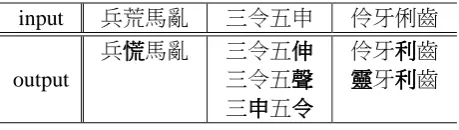
Since the cost of manual compilation is high, Chen et al. (2009) proposed an automatic method that can collect these common errors from a cor-pus. The idea is similar to template generation, which builds a question-answer system (Ravi-chandran and Hovy, 2001; Sung et al., 2008). The template generation method investigates a large corpus and mines possible question-answer pairs. In this paper, we present ACE system to automatically extract commonly confused words from the Web of a given word. Table 1 shows some examples of ACE’s input and output.
input 兵荒馬亂 三令五申 伶牙俐齒
output
兵慌慌慌慌馬亂 三令五伸伸伸伸 三令五聲聲聲聲 三申申申五令申 令令令
[image:1.595.301.531.594.659.2]伶牙利利利利齒 靈 靈 靈 靈牙利利利利齒
Table 1: Examples of ACE’s input and output.
This paper is organized as follows. Section 2 illustrates the architecture of ACE. Section 3 ex-plains the features we use for training model. Section 4 presents evaluation results. The last section summarizes this paper and describes our future work.
Figure 1: Flow chart of the ACE System.
2 System Architecture
ACE consists of two major components: the Fetcher and the Extractor. Given a Chinese word (assume it is correct), the Fetcher retrieves snip-pets from Google using hand-coded patterns, and then executes the pattern matching process to produce a set of sentence fragments. The Extrac-tor is responsible for assigning an array of tags to each character in every sentence fragment de-pends on its features. These tagged fragments are served as inputs to a pre-learned CRFs model (see Section 3) for extracting commonly con-fused words of the input word. In this section, we will describe the Fetcher and the Extractor in more detail.
2.1 The Fetcher
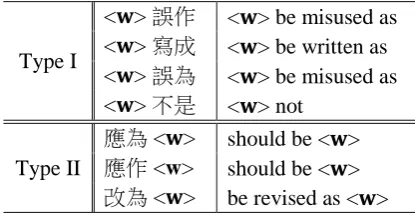
The Fetcher first constructs a few query strings by using the combination of input word and a set of pre-defined patterns. Table 2 shows our query strings and their English translations.
Type I
< > 誤作 < > be misused as < > 寫成 < > be written as < > 誤為 < > be misused as < > 不是 < > not
Type II
應為 < > should be < >
應作 <w> should be < >
改為 < > be revised as < >
Table 2: Type I and Type II query strings and their English translations. In each query string, < > is a placeholder for the input word.
There are two types of query strings: Type I are the ones that require the input word to pre-cede the pattern (e.g. “ 寫成”), and Type II are the opposite ones (e.g. “應作 ”). For every que-ry, the Fetcher retrieves several Web pages of results from Google where each page contains up to 100 snippets due to Google’s restriction. For
each snippet, the Fetcher removes its HTML tags and extracts sentence fragments which contain the input word and possibly contain incorrect words with the help of regular expression. These sentence fragments are inputs of the Extractor we will describe later. For Type I query results, sen-tence fragment is orderly composed by 0 to 6 characters (including Chinese characters, alpha-numeric symbols, punctuation marks, etc.), the input word, and 1 to characters where is the number of characters of the input word plus 14. For Type II query results, sentence fragment is orderly composed by 1 to characters, the input word, and 0 to 6 characters. Table 3 shows some examples of extracted sentence fragments of the input word “不脛而走”.
Type I
目。復原不脛而走不脛而走不脛而走不脛而走”誤作“不徑而走”('97
「不脛而走不脛而走不脛而走不脛而走」寫成「不徑而走」–Y Type II
“不徑而走”應為“不脛而走不脛而走不脛而走不脛而走”big
[image:2.595.304.529.288.375.2]月5日–不徑而走應作不脛而走不脛而走不脛而走不脛而走. 峻工
Table 3: Examples of sentence fragments of the input word “不脛而走”. For clarification purposes, we make the input word bold and italicize the pattern.
2.2 The Extractor
The Extractor first assigns an array of tags to each character in every sentence fragment de-rived from the Fetcher by its features. We may assign up to four tags to each character according to system configurations. Table 4 shows an ex-ample of fully tagged fragment. Tag I denotes that this character is in the instance of the input word or not. Tag II and Tag III are pronuncia-tion-related features, indicating pronunciation similarity between this character and any charac-ter of the input word. Tag IV is orthographic similarity between this character and any charac-ter of the input word. Meanings of tags and how to assign tags to characters will be detailed in Section 4.
After sentence fragments are tagged, these tagged fragments are served as inputs to a pre-learned CRFs model for labeling easily confused words of the input word. Finally, the Extractor combines these labeled characters into words, and then ranks these words based on frequency.
ACE outputs first few ranked words depend on system settings. Let a = 〈 , , … , 〉 be the set of ranked words and denotes the
[image:2.595.75.283.509.616.2]ACE outputs = 〈 , … , 〉where 1 ≤ ≤
and ≥ ∗ for each ∈ . The default value of is 0.3 and can be configured in the system. Some example inputs and outputs are listed in Table 1, and Section 6 shows more ex-amples.
characters Tag I Tag II Tag III Tag IV
“ N O O O
不 N Y Y Y
徑 N N N N
而 N Y Y Y
走 N Y Y Y
” N O O O
應 N O O O
為 N O O O
“ N O O O
不 Y Y Y Y
脛 Y Y Y Y
而 Y Y Y Y
走 Y Y Y Y
[image:3.595.64.291.160.378.2]” N O O O
Table 4: An example of fully tagged fragment.
3 Features Set
One property that makes feature based statistical models like CRFs so attractive is that they reduce the problem to finding an appropriate feature set. This section outlines the four main types of fea-tures used in our evaluations.
3.1 Base Feature
One of simplest and most obvious features is the character itself of sentence fragment. Another intuitive feature is that the character is included in the input word (tagged as “Y”) or not (tagged as “N”). More accurately, let = 〈 , , … , 〉
be a sequence of characters of sentence fragment. Let = 〈! , ! , … , !"〉 be a sequence of char-acters of the input word. ⊂ . For each ∈ , we tag as “Y” if ∈ , otherwise tag as “N”. In our experiments, we define the combina-tion of those two features as base feature.
3.2 Sound Feature
Liu (2009) previously showed that pronuncia-tion-related errors reach 79.88% among all types of incorrect writings in Chinese. This feature has three tag values: “Y”, “N”, and “O”. We contin-uously use notations of Section 4.1. Let $% = 〈&%', &%(, … , &%)〉 where &%* denotes the sound
of !. Let &+* denotes the sound of . For each
∈ , we tag as “Y” if ∈ , else tag as “N” if &+*∈ $%, otherwise tag as “O”.
We build up a look-up table for quickly access a character’s sound. Table 5 is the list of charac-ters grouped by sound. Note that characcharac-ters in the same group may have different tones. We will consider the feature of same sound and same tone in Section 4.3.
sound characters
suan 酸痠狻匴算蒜筭 wai 歪舀外
zai 哉災載宰仔崽縡在再載
Table 5: Characters grouped by sound.
3.3 Phonetic Alphabet Feature
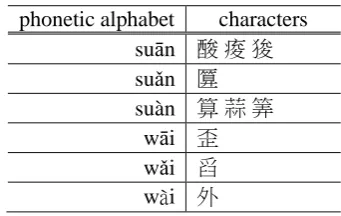
This feature differentiates two characters with same sound but different tone from each other. Let ,%= 〈ℎ%', ℎ%(, … , ℎ%)〉 where ℎ%* denotes the phonetic symbol of ! . Let ℎ+* denotes the phonetic symbol of . For each ∈ , we tag as “Y” if ∈ , else tag as “N” if ℎ+* ∈ ,%, otherwise tag as “O”. Table 6 is the list of characters grouped by phonetic alphabet.
phonetic alphabet characters suān 酸痠狻 suǎn 匴 suàn 算蒜筭
[image:3.595.328.499.428.536.2]wāi 歪 wǎi 舀 wài 外
Table 6: Characters grouped by phonetic alphabet.
3.4 Orthography Feature
In addition to pronunciation-related features, the model could also benefit from orthographical similarity features. We have collected a list of 12,460 Chinese characters accompanied by a group of orthographically similar characters for each from Academic Sinica of Taiwan1. Two characters are considered to be orthographically similar according to their forms. In this list, each character may have more than one similar char-acter. Let .%*= 〈/%*', /%*(, … , /%*0〉 be a set of orthographically similar characters of ! . Let
1% = 〈.%', .%(, … , .%)〉 be the collection of .%*.
For each ∈ , we tag as “Y” if ∈ , else tag as “N” if ∈ 1%, otherwise tag as “O”. Table 7 is the list of characters accompanied by their orthographically similar characters.
character similar characters
亨 烹哼脝京享
佐 仜左佈傞倥佑
別 捌咧唎喇
Table 7: Characters and their orthographically similar characters.
4 Experiments
In this section, we describe the details of CRFs model training and evaluation. Secondly, we will compare performance of ACE system with two manually compiled confusion sets which can be anonymously accessed online.
4.1 Model Training and Testing
We obtained data set from a document named Terms Unified Usage2 provided by National Sci-ence Council of Taiwan. This document contains 641 correct-and-incorrect word pairs. We ran-domly selected 577 of them for training and the rest for testing. For each word pair, we constructs query strings to retrieve sentence fragments by using the method described in Section 2.1, and then assigns tags to each character in every sen-tence fragment by using the method described in Section 2.2. In addition, we tagged target label (e.g. B-I, I-I, O) to each character for the purpose of training and evaluation.
There are 17,019 sentence fragments which containing 126,130 characters in training data, and 1,252 sentence fragments which containing 15,767 characters in testing data. Eight experi-ments were completed by different combinations of features. Detailed results are presented in table 7 (in next page). In Table 7, characters precision denotes number of correctly labeled characters divided by number of total characters in the test-ing data. Similarly, sentences precision denotes number of correctly labeled sentences (every character in sentence is correctly labeled) divided by number of total sentence. Since the output of ACE is a ranked list of extracted words, we set 0.3 to constant (see Section 2.2) to compute precision ratio, recall ratio, and F1 measure. More precisely, let:
2http://www.nsc.gov.tw/sd/uniword.htm
• {A}=incorrect words indicated in Terms Unified Usage
• {B}=incorrect words extracted by ACE Then, precision ratio P = |{A}∩{B}|/|{B}|*100%, recall ratio R = |{A}∩{B}|/|{A}|*100%, and F1 measure = 2*P*R/(P+R).
From the result, the CRFs model using the combination of sound and orthography features or using all features performs best, achieving F1 measure of 94.6%.
4.2 Comparisons to Manually Compiled Confusion Sets
We collected two manually compiled confusion sets for the purpose of comparisons. One is the Common Error in Chinese Writings3 (CECW) provided by Ministry of Education (MOE) of Taiwan, which containing 1,491 correct-and-incorrect word pairs. Another is the Commonly Misused Characters for Middle School Students4 (CMC), which containing 1,720 correct-and-incorrect word pairs. We feed these correct words to ACE system to evaluate the ability of automatic generation of confusion sets. We choose features combinations of “base + S + G” and set constant to 0.3. Table 8 summarizes the evaluation results, showing that given a Chinese word, ACE system has about 93% chance to produce same result with manually compiled confusion sets.
Precision Recall F1 measure
CECW 95.2% 91.2% 93.2%
[image:4.595.80.279.134.193.2]CMC 93.8% 92.0% 92.8%
Table 8: Evaluation results on two confusion sets.
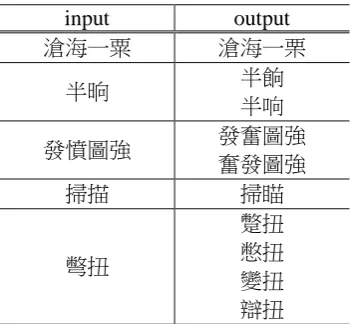
input output
滄海一粟 滄海一栗
半晌 半餉
半响
發憤圖強 發奮圖強
奮發圖強
掃描 掃瞄
彆扭
蹩扭 憋扭 變扭 辯扭
Table 9: Examples of ACE’s input and output.
3http://dict.revised.moe.edu.tw/htm/biansz/18a-1.htm
[image:4.595.338.514.548.710.2]Characters Precision
Sentences Precision
Extracted Words
Precision Recall F1 measure
base only 94.1% 66.1% 89.7% 73.2% 80.6%
base + Sound (S) 97.6% 83.0% 89.7% 77.3% 83.0%
base + Phonetic (P) 97.9% 85.7% 93.1% 87.5% 90.2%
base + Orthography (G) 97.9% 86.6% 89.7% 85.6% 87.6%
base + S + P 97.7% 84.1% 89.7% 89.3% 89.5%
base + S + G 98.8% 92.4% 96.6% 92.7% 94.6%
base + P + G 98.9% 92.8% 96.6% 89.3% 92.8%
base + S + P + G 98.8% 92.9% 96.6% 92.7% 94.6%
Table 7: Test results by different combinations of features.
5 Conclusions and Future Work
In this paper, we present the ACE system which takes a Chinese word as input and automatically outputs its easily confused words. Table 9 shows some real examples of ACE’s input and output. We have shown that a CRF-based model with pronunciation- and orthography-related features can achieve performance near that manually compiled confusion sets.
There are several future topics of research that we are currently considering. First, we plan to extend ACE system to support other languages, such as English and Japanese. Secondly, we will investigate another approach without the help of a pre-learned CRFs model. Third, we will look into automatic identification of possible words which can be easily misused as another one, so that we can generate confusion sets without any input. Lastly, we will apply our approach to an-other application, such as recognizing as many as entity pairs (e.g., <“Tokyo”, “Japan”>, <“Taipei”, “Taiwan”>, etc.) of a given semantic relation (e.g. “… is a city of …”).
References
Andrew McCallum and Wei Li. 2003. Early results for named entity recognition with conditional ran-dom fields, feature induction and web-enhanced lexicons. Proceedings of the Conference on
Natu-ral Language Learning, 188–191.
Chao-Lin Liu, Kan-Wen Tien, Min-Hua Lai, Yi-Hsuan Chuang, and Shih-Hung Wu. 2009. Phono-logical and logographic influences on errors in written Chinese words. Proceedings of the Seventh
Workshop on Asian Language Resources, the Forty Seventh Annual Meeting of the Association for Computational Linguistics, 84-91.
Cheng-Lung Sung, Cheng-Wei, Lee, Hsu0Chun Yen, and Wen-Lian Hsu. 2008. An Alignment-based
Surface Pattern for a Question Answering System.
IEEE International Conference on Information Re-use and Integration, 172-177.
Deepak Ravichandran and Eduard Hovy, E. 2001. Learning surface text patterns for a Question An-swering system. In Proceedings of the 40th Annual
Meeting on Association for Computational Lin-guistics, 41-47.
Fei Sha and Fernando Pereira. 2003. Shallow parsing with conditional random fields. In Proceedings of
the Human Language Technology and North Amer-ican Association for Computational Linguistics Conference, 134-141.
Fuji Ren, Hongchi Shi, and Qiang Zhou. 1994. A hy-brid approach to automatic Chinese text checking and error correction. In Proceedings of the ARPA
Work shop on Human Language Technology,
76-81.
John Lafferty, Andrew McCallum, and Fernando Pe-reira. 2001. Conditional random fields: Probabilis-tic models for segmenting and labeling sequence data. In Proceedings of the International
Confer-ence on Machine Learning.
Lei Zhang, Changning Huang, Ming Zhou, and Hai-hua Pan. 2000. Automatic detecting/correcting er-rors in Chinese text by an approximate word-matching algorithm. In Proceedings of the 38th
Annual Meeting on Association for Computational Linguistics, 248-254.
Ta-Hung Hung and Shih-Hung Wu. 2008. Chinese essay error detection and suggestion system.
Tai-wan E-Learning Forum.
Yih-Jeng Lin, Feng-Long Huang, and Ming-Shing Yu. 2002. A Chinese spelling error correction System. In Proceedings of the Seventh Conference on
Arti-ficial Intelligence and Applications (TAAI).
Yong-Zhi Chen, Shih-Hung Wu, Chia-Ching Lu, and Tsun Ku. 2009. Automatic template feneration for Chinese essay spelling error detecting system. The