Data Selection With Fewer Words
Amittai Axelrod University of Maryland
Xiaodong He Microsoft Research [email protected]
Philip Resnik University of Maryland
Mari Ostendorf University of Washington
Abstract
We present a method that improves data selection by combining a hybrid word/part-of-speech representation for corpora, with the idea of distinguishing between rare and frequent events. We validate our approach using data selection for machine translation, and show that it maintains or improves BLEU and TER translation scores while substantially im-proving vocabulary coverage and reducing data selection model size. Paradoxically, the coverage improvement is achieved by abstracting away over 97% of the total training corpus vocabulary using simple part-of-speech tags during the data selection process.
1 Introduction
Data selection uses a small set of domain-relevant data to select additional training items from a much larger, out-of-domain dataset. Its goal is to filter Big Data down to Good Data: finding the best, most relevant data to use to train a model for a particular task.
The prevalent data selection method, cross-entropy difference (Moore and Lewis, 2010), can produce domain-specific systems that are usually as good as or better than systems using all avail-able training data (Axelrod et al., 2011). The size of these domain-specific systems scales roughly linearly with the amount of selected data: a system trained on the most domain-relevant 10% of the full out-of-domain dataset will be only one tenth of the size of a system trained using all the avail-able data. This can be a large win in settings where training time matters, and also where compactness of the final system matters, e.g. running speech recognition or translation on mobile devices.
While data selection thus eliminates the need to train systems on the entire pool of available data,
the data selection process itself does not scale well (it still requires a language model built on the en-tire pool) and, more significantly, it comes at a cost: training on selected subsets leads to reduc-tions in vocabulary coverage compared to training on the full out-of-domain data pool. This coverage is important, because most NLP systems face the problem of handling words that were not seen in training the system, i.e. out-of-vocabulary (OOV) words. In automatic speech recognition (ASR), for example, OOV words pose a substantial problem, since the system will hallucinate a phonetically similar word in its vocabulary when an OOV word is encountered. In machine translation (MT), our focal application in this paper, OOVs can some-times be transliterated, but often they are ignored or passed through without translation, and gaps in vocabulary coverage can have a significant effect on MT performance (Daum´e III and Jagarlamudi, 2011; Irvine and Callison-burch, 2013).
We introduce a method that preserves the data selection benefit of reducing translation system size. Our method performs as well or better than the standard cross-entropy difference method, as measured by downstream MT results. To this we add the benefits of substantially improved lexical coverage, as well as lower memory requirements for the data selection model itself.
This improvement stems from constructing a hybrid representation of the text that abstracts away words that are infrequent in either of the in-domain and general corpora. They are replaced with their part-of-speech (POS) tags, permitting their n-gram statistics to be robustly aggregated: intuitively, if a domain-relevant sentence includes a rare word in some non-rare context (e.g. “An earthquake in Port-au-Prince”), then another sen-tence with the same context but a different rare word is probably also just as relevant (e.g. “An earthquake in Kodari”). While this method re-quires pre-processing the corpora to POS tag the
data, the idea should generalize to automatically-derived word classes.
We present results using data selection to train domain-relevant SMT systems, yielding favorable performance compared against the standard ap-proaches of Moore and Lewis (2010) and Axel-rod et al. (2011). Paradoxically, this is achieved by a selection process in which the specific lexical items for infrequent words – up to 97% of the total vocabulary – are replaced with POS tags.
2 Related Work
Data selection is a widely-used variant of domain adaptation that requires quantifying the relevance to the domain of the sentences in a pooled cor-pus of additional data. The pool is sorted by rel-evance score, the highest ranked portion is kept, and the rest discarded.This process – also known as “rank-and-select” in language modeling (Sethy et al., 2009) – identifies the subset of the data pool that is most like the in-domain corpus and keeps it for translation system training, in lieu of using the entire data pool. The resulting translation systems are more compact and cheaper to train and run than the full-corpus system. The catch, of course, is that any large data pool can be expected to con-tain sentences that are at best irrelevant to the do-main, and at worst detrimental: the goals of fi-delity (matching in-domain data as closely as pos-sible) and broad coverage are often at odds (Gasc´o et al., 2012). As a result, much work has focused on fidelity. Mirkin and Besacier (2014) survey the difficulties of increasing coverage while minimiz-ing impact on model performance.
We build on the standard approach for data se-lection in language modeling, which uses cross-entropy differenceas the similarity metric (Moore and Lewis, 2010). The Moore-Lewis procedure first trains an in-domain language model (LM) on the in-domain data, and another LM on the full pool of general data. It assigns to each full-pool sentencesacross-entropy difference score,
HLMIN(s)−HLMP OOL(s), (1)
where Hm(s) is the per-word cross entropy of s
according to language model m. Lower scores for cross-entropy difference indicate more relevant sentences, i.e. those that are most like the target domain and unlike the full pool average. In bilin-gual settings, thebilingual Moore-Lewiscriterion, introduced by Axelrod et al. (2011), combines the
cross-entropy difference scores from each side of the corpus; i.e. for sentence pairhs1, s2i:
(HLMIN1(s1)−HLMP OOL1(s1))
+(HLMIN2(s2)−HLMP OOL2(s2)) (2)
After sorting on the relevant criterion, the top-n
sentences (or sentence pairs) are added to the in-domain data to create the new, combined training set. Typically a range of values fornis considered, selecting thenthat performs best on held-out in-domain data.
While shown to be effective, however, word-based scores may not capture all facets of rele-vance. The strategy of a hybrid word/POS rep-resentation was first explored by Bulyko et al. (2003), who used class-dependent weights for mixing multi-source language models. The classes were a combination of the 100 most fre-quent words and POS tags. Bisazza and Fed-erico (2012) target in-domain coverage by using a hybrid word/POS representation to train an ad-ditional LM for decoding in an MT pipeline. Toral (2013) uses a hybrid word/class representation for data selection for language modeling; he replaces all named entities with their type (e.g. ’person’, ’organization’), and experiments with also lemma-tizing the remaining words.
3 Our Approach: Abstracting Away Words in the Long Tail
Our approach is motivated by the observation that domain mismatches can have a strong register component, and this comprises both lexical and syntactic differences. We are inspired, as well, by work in stylometry, observing that attempts to quantify differences between text datasets try to learn too much from the long tail (Koppel et al., 2003): most words occur very rarely, meaning that empirical statistics for them are probably overes-timating their seen contexts and underesoveres-timating unseen ones.
Relevance computation, sentence ranking and sub-set selection then proceed as usual according to the Moore-Lewis or bilingual Moore-Lewis criterion. As an example, consider again the phrases“an earthquake in Port-au-Prince” and “an earth-quake in Kodari”, and suppose that the words
an,in, andearthquakeare above-threshold in fre-quency. Our hybrid word/POS representation for both sentences would be the same: “an earth-quake in NNP”.
Our approach differs from the standard data selection method most significantly in its han-dling of rare words in frequent contexts. Consider a domain-specific n-gram context c that appears with a rare wordw. For example, in a hypothetical news domain, letc =“an earthquake in”, made up of common words, and letw=Port-au-Prince. Suppose that the in-domain corpus contains the phrase “an earthquake in Port-au-Prince” eight times. The wordwdoes not appear any other times in the in-domain corpus, and the wordw0 =
Ko-darinever appears at all.
Now suppose the out-of-domain pool corpus contains a sentence with “an earthquake in Ko-dari”. The standard Moore-Lewis method consid-ers Kodari to be an unknown word, and so only credits that pool sentence with matching the ele-ments ofc. In contrast, our method replaces both rare words w and w0 with their POS tag, NNP,
so that the pool sentence contains“an earthquake in NNP”. Our method thus credits c from the in-domain corpus, like Moore-Lewis, but wealso
credit the sentence with matching the 4-gram“an earthquake in NNP”, which appears eight times in the in-domain corpus. Despite not appearing in the pool corpus, the rare wordw from the in-domain corpus now provides us information about the relevance of pool sentences containing a syn-tactically similar rare wordw0that shares the same
contextc.
4 Experimentation
We evaluate our data selection approach in a real-istic small-in-domain-corpus setting, in two ways. First, as an intrinsic evaluation, we look at vo-cabulary coverage of the selected data relative to the in-domain training set, i.e. how many words from the in-domain corpus are out-of-vocabulary for selected data, since models trained on those data would not not be able to handle those words. Second, as an extrinsic evaluation, we use
statisti-cal machine translation as a downstream task.
4.1 Evaluation Framework
We define our in-domain corpus as the TED talk translations in the WIT3 TED Chinese-English corpus (Cettolo et al., 2012), a good example of a subdomain with little available training data. We used the IWSLT dev2010and test2010sets (also from WIT3) for tuning and evaluation. The larger pool from which we selected data was constructed from an aggregation of 47 LDC Chinese-English parallel datasets.1 Table 1 contains the corpus statistics for the task and pool bilingual corpora.
Vocab Vocab
Corpus Sentences (En) (Zh)
TED (task) 145,901 49,323 64,616
LDC (pool) 6,025,295 458,570 714,628
Table 1: Chinese-English Parallel Data.
We used the KenLM toolkit (Heafield, 2011) to build all language models used in this work (i.e., both for data selection and for the MT sys-tems used for extrinsic evaluation). In all cases the models were 4-gram LMs. We used the Stan-ford part-of-speech tagger (Toutanova et al., 2003) when constructing our hybrid representations, to generate the POS tags for each of the English and Chinese sides of the corpora.2
We consider three ways of applying data se-lection using the standard (fully lexicalized) cor-pus representation and our hybrid representa-tion. The first two use the monolingual Moore-Lewis method (Equation 1) to respectively com-pute relevance scores using the English (output) side and the Chinese (input) side of the parallel corpora. The third uses bilingual Moore-Lewis (Equation 2) to compute the bilingual score over both sides.
Each of these three variants produces a ver-sion of the full pool in which the sentences are ranked by relevance score, from lowest score 1Specifically: LDC2000T47 LDC2002T01 LDC2003E07 LDC2003T17 LDC2004E12 LDC2004T07 LDC2005T06 LDC2006T04 LDC2007E101 LDC2007T09 LDC2007T23 LDC2008E40 LDC2008E56 LDC2008T06 LDC2008T08 LDC2008T18 LDC2009E16 LDC2009E95 LDC2009T02 LDC2009T06 LDC2009T15 LDC2010T03 LDC2010T10 LDC2010T11 LDC2010T12 LDC2010T14 LDC2010T17 LDC2010T21 LDC2012T16 LDC2012T20 LDC2012T24 LDC2013E119 LDC2013E125 LDC2013E132 LDC2013E83 LDC2013T03 LDC2013T05 LDC2013T07 LDC2013T11 LDC2013T16 LDC2014E08 LDC2014E111 LDC2014E50 LDC2014E69 LDC2014E99 LDC2014T04 LDC2014T11.
2The Stanford NLP tools use the Penn tagsets, which
English Chinese
TED vocab 49,323 64,616
LDC vocab 458,570 714,628
Joint vocab 470,154 729,283
[image:4.595.314.520.64.132.2]LDC minus singletons 243,882 373,381 Baseline selection vocab 257,744 388,927 Table 2: Chinese and English vocabulary for the baseline selection process.
(most like) to highest score (least domain-like). For each of those ranked pools, we con-sider increasingly larger subsets of the data: the best n = 50K, the best n = 100K, and so on. The largest subset we consider consists of the best
n=4M sentence pairs out of the 6M available. 4.1.1 Cross-Entropy Difference Baseline In addition to comparing against a system trained on all the data, we compare against systems trained on data selected via the standard cross-entropy difference method. The joint vocabu-lary for the TED and LDC data is shown in Ta-ble 2. However, when training the language mod-els used for the baseline selection process, we first pruned the singletons from the LDC vocabulary. This step is not necessary, but provides a slightly stronger baseline. The rationale is that ignoring LDC singletons avoids reserving too much prob-ability mass for rare words outside of the domain of interest. Unlike the experimental systems be-low, pruning the lexicon simply ignores the words in the corpus and does not replace them with any-thing. This process removed 47% of the LDC vocabulary in each language. We then merged the remaining words from LDC with the complete TED lexicon. This produced a final vocabulary of 257,744 (En) and 388,927 (Zh) words for the base-line cross-entropy difference selection process, as shown in Table 2.
4.1.2 Hybrid Representation Systems
As our infrequent-word threshold (selected ahead of our experimentation), we retained words with a count of 10 or more in each corpus, and replaced all other words with their POS tags to create the hybrid corpus representation. The minimum count requirement reduced the vocabulary to 10,036 En-glish words and 11,440 Chinese words, as shown in Table 3. All other words were replaced, thus a minimum count of 10 in each corpus eliminates over 97% of the vocabulary in each language. We
English Chinese
Joint vocab 470,154 729,283
Vocab with count≥10 10,036 11,440
POS tags 42 35
Hybrid vocab 10,078 11,475
Table 3: Chinese and English vocabulary for the proposed selection process.
previously found that setting the threshold to 10 is slightly better than a minimum count of 20 (Axel-rod, 2014), and varying the threshold further is a topic for future work; see Section 5.
4.2 Results
4.2.1 Intrinsic Evaluation
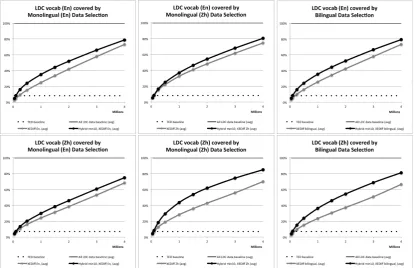
As noted, each of the bilingual Moore-Lewis method and our hybrid word/POS variation pro-duces a version of the additional training pool in which sentences are ranked by relevance. We then select increasingly larger slices of the data from 50k to 4M, as described in Section 4.1, and report results. As shown in Figures 1 and 2, the hybrid-selected models show consistently improved vo-cabulary coverage when compared head-to-head with models trained on data selected via a Moore-Lewis method, across all subsets. The only excep-tion is when examining the vocabulary coverage in one language while selecting data based on the other one (e.g. selecting data using the English half but measuring the TED vocabulary cover-age in Chinese), where our method provides only negligible improvement. Overall, the in-domain (TED) vocabulary coverage is up to 10% better with our proposed method, and the general-data (LDC) vocabulary coverage is up to 20% better.
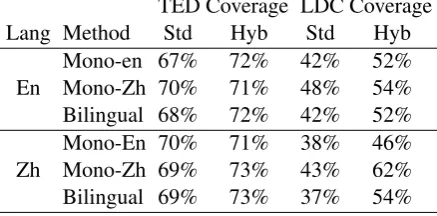
Table 4 illustrates what this looks like in more detail for a single slice containing the top 2M sen-tence pairs. The table shows how many more vo-cabulary items are covered by the 2M sentence slice selected using our hybrid representation (the
Hyb columns) than are covered by the best 2M sentences selected using the standard lexical rep-resentation (theStdcolumns).
[image:4.595.78.290.64.146.2]cross-entropy-TED Coverage LDC Coverage
Lang Method Std Hyb Std Hyb
En Mono-en 67%Mono-Zh 70% 72%71% 42%48% 52%54%
Bilingual 68% 72% 42% 52%
Zh Mono-En 70%Mono-Zh 69% 71%73% 38%43% 46%62%
Bilingual 69% 73% 37% 54%
Table 4: Vocabulary coverage comparison be-tween standard and hybrid-based data selection, for data-selected samples of 2M sentences.
based data selection one uses. The three ways are: monolingual Moore-Lewis for the English and Chinese sides of the parallel corpus (Mono-En
and Mono-Zh, respectively), as well as bilingual Moore-Lewis (Bilingual).
When selecting 2M sentences, Table 4 shows that the hybrid representation provides up to an ex-tra 4-5% in-domain vocabulary coverage in either language. Furthermore, the hybrid-based methods obtain up to 10% more general-domain vocabu-lary coverage for English, and up to 19% more Chinese general-domain vocabulary coverage. All improvements are absolute percentage increases.
Figure 2 shows that our hybrid method’s pool vocabulary coverage increases more rapidly than the baseline. The standard approach shows vo-cabulary coverage increasing more or less linearly with the amount of selection data. By contrast, our proposed method appears to asymptotically approach full in-domain vocabulary coverage, par-ticularly for Chinese. Similarly, Figure 1 shows that our hybrid method also increases more rapidly to asymptotically approach full in-domain vocab-ulary coverage as well.
4.2.2 Extrinsic Evaluation
Improved vocabulary coverage is a positive re-sult, but we are also interested in downstream ap-plication performance. Accordingly, we trained SMT systems using cdec (Dyer et al., 2010) on subsets of selected data. All SMT systems were tuned using MIRA (Chiang et al., 2008) on the dev2010 data from IWSLT (Federico et al., 2011), and then evaluated on the test2010 IWSLT test set using both BLEU (Papineni et al., 2002) and TER (Snover et al., 2006). To isolate the impact of the data selection method, we present results just using the selected data, without the combining with the in-domain data into a multi-model
[image:5.595.72.291.66.174.2]sys-tem. Note that the hybrid word/POS representa-tions were only used to compute the cross-entropy difference scores for determining sentences’ rele-vance; the MT systems themselves are trained us-ing the sentences containus-ing the original words.
Figure 3 shows our MT results using both BLEU and TER. The horizontal line is a static baseline that uses all the available training data without data selection. The dashed grey line is from systems trained on data selected via the standard Moore-Lewis cross-entropy-difference method, and the black line is from systems trained on data selected with our hybrid approach. To account for variability in MT tuning, each of the curves in Figure 3 is the average of three tun-ing/decoding runs.
In terms of system accuracy, our results con-firm prior work on data selection, demonstrating that in comparison to training using all available data, comparable or even better MT performance can be obtained using only a fraction of the out-of-domain data available.
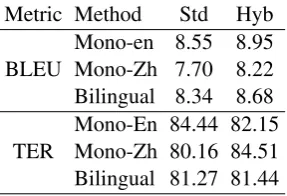
Table 5 shows SMT results for the same sub-set size of 2M sentences used for the coverage results in Table 4. Systems trained on data se-lected using the hybrid representation are up to +0.5 BLEU better, regardless of whether the se-lection process is monolingual or bilingual. In-deed, at least for BLEU, it appears that our hy-brid method may tend to converge to comparable performance more quickly, a possibility worthy of future experimentation.
The TER results are mixed for this data se-lection subset size. The MT evaluation scores are low in absolute terms, due to only using the general-domain data, yet are still not inconsistent with prior research done using this dataset (Fed-erico et al., 2011). Fluctuations in the perfor-mance curves are also consistent with prior work, as IWSLT scores are very jittery. We averaged results over three tuning runs, for stability. De-spite that, Figure 3 shows how high-variance TER scores are on this task.
4.2.3 Selection Model Size
re-Figure 1: Percentage of TED vocabulary covered vs. number of selected sentences by method.
[image:6.595.92.507.440.708.2]Figure 3: SMT system scores on the TED Zh-En test2010 set vs. number of selected sentences by method.
Metric Method Std Hyb
BLEU Mono-en 8.55 8.95Mono-Zh 7.70 8.22 Bilingual 8.34 8.68
TER Mono-En 84.44 82.15Mono-Zh 80.16 84.51 Bilingual 81.27 81.44
Table 5: SMT system score comparison between standard and hybrid-based data selection, for data-selected samples of 2M sentences.
duction in the memory requirements for the data selection process, which requires training a lan-guage model on the entire data pool. The bina-rized language model built using the standard data selection baseline on the full corpus of 6M sen-tences requires about 2GB, whereas the equiva-lent all-data LM for our approach is 25% smaller.3 This means that for any given amount of avail-able memory, the hybrid method can scale up data selection to a larger out-of-domain sentence pool. As a rough example, an 8GB desktop machine can be used to train an LM on 32M sentences using the hybrid representation rather than 24M using 3Our back-of-the-envelope estimates ignore the
in-domain LM, which is tiny in comparison.
the standard text; for a large-memory 128GB ma-chine, our method would allow us to increase the size of the corpus used to train the full-data LM from a maximum of 384M sentences to more than half a billion sentences.
5 Conclusions
[image:7.595.110.254.391.489.2]Acknowledgments
We gratefully thank the anonymous reviewers and Timo Baumann for their detailed feedback.
References
Axelrod, A. (2014). Data Selection for Statistical Machine Translation. PhD thesis, University of Washington.
Axelrod, A., He, X., and Gao, J. (2011). Domain Adaptation Via Pseudo In-Domain Data Selec-tion. EMNLP (Empirical Methods in Natural Language Processing).
Bisazza, A. and Federico, M. (2012). Cutting the Long Tail : Hybrid Language Models for Trans-lation Style Adaptation. EACL (European As-sociation for Computational Linguistics), pages 439–448.
Bulyko, I., Ostendorf, M., and Stolcke, A. (2003). Getting More Mileage From Web Text Sources For Conversational Speech Language Model-ing UsModel-ing Class-Dependent Mixtures. NAACL (North American Association for Computa-tional Linguistics).
Cettolo, M., Girardi, C., and Federico, M. (2012). WITˆ3 : Web Inventory of Transcribed and Translated Talks.EAMT (European Association for Machine Translation).
Chiang, D., Marton, Y., and Resnik, P. (2008). On-line large-margin training of syntactic and struc-tural translation features. EMNLP (Empirical Methods in Natural Language Processing). Daum´e III, H. and Jagarlamudi, J. (2011). Domain
Adaptation for Machine Translation by Mining Unseen Words University of Maryland. ACL (Association for Computational Linguistics). Dyer, C., Lopez, A., Ganitkevitch, J., Weese,
J., Ture, F., Blumson, P., Setiawan, H., Eidel-man, V., and Resnik, P. (2010). cdec: A De-coder, Alignment, and Learning Framework for Finite-State and Context-Free Translation Mod-els. ACL (Association for Computational Lin-guistics) Interactive Poster and Demonstration Sessions, (July):7–12.
Federico, M., Bentivogli, L., Paul, M., and St¨uker, S. (2011). Overview of the IWSLT 2011 Eval-uation Campaign. IWSLT (International Work-shop on Spoken Language Translation).
Gasc´o, G., Rocha, M.-A., Sanchis-Trilles, G., Andr´es-Ferrer, J., and Casacuberta, F. (2012).
Does More Data Always Yield Better Transla-tions? EACL (European Association for Com-putational Linguistics).
Heafield, K. (2011). KenLM : Faster and Smaller Language Model Queries. WMT (Workshop on Statistical Machine Translation).
Irvine, A. and Callison-burch, C. (2013). Combin-ing BilCombin-ingual and Comparable Corpora for Low Resource Machine Translation. WMT (Work-shop on Statistical Machine Translation). Koppel, M., Akiva, N., and Dagan, I. (2003).
A Corpus-Independent Feature Set for Style-Based Text Categorization. IJCAI Workshop on Computational Approaches to Style Analysis and Synthesis.
Mirkin, S. and Besacier, L. (2014). Data Selection for Compact Adapted SMT Models.AMTA (As-sociation for Machine Translation in the Amer-icas).
Moore, R. C. and Lewis, W. D. (2010). Intel-ligent Selection of Language Model Training Data.ACL (Association for Computational Lin-guistics).
Papineni, K., Roukos, S., Ward, T., and Zhu, W.-j. (2002). BLEU: a method for automatic evalu-ation of machine translevalu-ation. ACL (Association for Computational Linguistics).
Sethy, A., Georgiou, P. G., Ramabhadran, B., and Narayanan, S. S. (2009). An iterative rela-tive entropy minimization based data selection approach for n-gram model adaptation. IEEE Transactions on Audio, Speech, and Language Processing, 17(1):13–23.
Snover, M., Dorr, B., Schwartz, R., Micciulla, L., and Makhoul, J. (2006). A Study of Transla-tion Edit Rate with Targeted Human Annota-tion. AMTA (Association for Machine Trans-lation in the Americas), (August):223–231. Toral, A. (2013). Hybrid Selection of Language
Model Training Data Using Linguistic Informa-tion and Perplexity. Workshop on Hybrid Ap-proaches to Translation, pages 8–12.
Toutanova, K., Klein, D., Manning, C. D., and Singer, Y. (2003). Feature-Rich Part-of-Speech Tagging with a Cyclic Dependency Network.