LeBLEU: N-gram-based Translation Evaluation Score for
Morphologically Complex Languages
Sami Virpioja
Lingsoft, Inc. Helsinki, Finland
Stig-Arne Gr¨onroos
Aalto University
Dept. of Signal Processing and Acoustics [email protected]
Abstract
This paper describes the LeBLEU evalu-ation score for machine translevalu-ation, sub-mitted to WMT15 Metrics Shared Task. LeBLEU extends the popular BLEU score to consider fuzzy matches between word n-grams. While there are several variants of BLEU that allow to non-exact matches between words either by character-based distance measures or morphological pre-processing, none of them use fuzzy com-parison between longer chunks of text. The results on WMT data sets show that fuzzy n-gram matching improves correla-tions to human evaluation especially for highly compounding languages.
1 Introduction
The quality of machine translation has improved to the level that the translation hypotheses are useful starting points for human translators for almost any language pair. In the post-editing task, the ultimate way to evaluate the machine translation quality is to measure the editing time. Editing times are naturally related to the num-ber and types of the edits—and thus the numnum-ber of keystrokes (Frederking and Nirenburg, 1994)— the post-editor needs to get the final translation from the hypothesis. If we compare the raw trans-lation hypothesis and its post-edited version, an appropriate edit distance measure should correlate to the edit time. However, implementing such a measure is far from trivial.
In automatic speech recognition, common eval-uation measures are Word Error Rate (WER) and Letter Error Rate (LER) that are based on the Lev-enshtein edit distance (LevLev-enshtein, 1966). LER is more reasonable measure than WER for morpho-logically complex languages, in which the same word can occur in many inflected and derived
forms (Creutz et al., 2007). However, both give too high penalty for the variations in word order-ing, which are frequent in translations. Even in English, there are often at least two grammatically correct orders for a complex sentence. For lan-guages in which the grammatical roles are marked by morphology and not the word order, there may be many more options.
An edit distance measure suitable for machine translation would require move operations. How-ever, such measures are computationally very ex-pensive: finding the minimum edit distance with moves is NP-hard (Shapira and Storer, 2002), making it cumbersome for evaluation and unsuit-able for automatic tuning of the translation mod-els. Possible solutions include limiting the move operations or searching only for an approximate solution. For example, Translation Edit Rate (TER) by Snover et al. (2006) uses a shift oper-ation that moves a contiguous sequence of words to another location, as well as a greedy search al-gorithm to find the minimum distance. Stanford Probabilistic Edit Distance Evaluation (SPEDE) by Wang and Manning (2012) applies a proba-bilistic push-down automaton that captures non-nested, limited distance word swapping.
A different approach to avoid the requirement of exactly same word order in the hypothesis and reference translations is to concentrate on compar-ing only small parts of the full texts. For exam-ple, the popular BLEU metric by Papineni et al. (2002) considers only local ordering of words. To be precise, it calculates the geometric mean pre-cision of the n-grams of length between one and four. As high precision is easy to obtain by provid-ing a very short hypothesis translation, hypotheses that are shorter than the reference are penalized by a brevity penalty.
BLEU, TER and many other word-based meth-ods assume that a single word (or n-gram) is ei-ther correct or incorrect, nothing in between. This
is problematic for inflected or derived words (e.g. “translate” and “translated” are considered two different words) as well as compound words (e.g. “salt-and-pepper” vs. “salt and pepper”). This is a minor issue for English, but it makes the evalua-tion unreliable for many other languages. For ex-ample, in English–German translation, producing “Arbeits Geberverband” from “employers’ organi-zation” would give no hits if the reference had the compound “Arbeitgeberverband”.
A common approach to the problem of inflected word forms—as well as to the simpler issues of uppercase letters and punctuation characters—is preprocessing. For example, METEOR (Baner-jee and Lavie, 2005; Denkowski and Lavie, 2011) uses a stemmer. Popovi´c (2011) applies and com-bines BLEU-style scores based on part-of-speech (POS) tags as well as morphemes induced by the unsupervised method by Creutz and Lagus (2005). Also the AMBER score by Chen and Kuhn (2011) combines many BLEU variants, and in some vari-ants, the words are heuristically segmented.
Our approach is to extend the BLEU metric to work better on morphologically complex lan-guages without using any language-specific re-sources. Instead of giving one point for exactly same n-gram or zero points for any difference, we include “soft” or “fuzzy” hits for word n-grams based on letter edit distance. We call the score LeBLEU; this name can be interpreted either as “Letter-edit-BLEU” or “Levenshtein-BLEU”. Le-BLEU has two main parameters, n-gram length and fuzzy match threshold, that are easy to tune for different types of languages.1
There are at least three previous approaches that resemble LeBLEU in that they try not to over-penalize different word orderings and word forms, but do not require any preprocessing tools or re-sources. Denoual and Lepage (2005) simply use the standard BLEU score on the level of ters, treating word delimiters as any other charac-ters. In order to capture long enough sequences of text, they increase the maximum n-gram length to 18. Compared to word-based BLEU, their method does not increase the correlations to human evalu-ation in English.
Homola et al. (2009) propose a score that is a weighted combination of two measures: an align-ment score that applies letter edit distances
be-1In contrast, for example the AMBER score by Chen and Kuhn (2011) includes nearly 20 weight parameters.
tween the word forms and a structural score that measures the differences in word order. In con-trast to LeBLEU, it still strongly penalizes errors in compounding, as the alignment is word-to-word and fuzzy matches are accepted only if the LER between a pair of words is lower than 15%.
More recently, Libovick´y and Pecina (2014) have proposed “tolerant BLEU”, a variant of BLEU that similarly to LeBLEU finds fuzzy matches between hypothesis and reference words. Instead of Levenshtein edit distance, they apply a specific affix distance measure that requires an exact match in the middle of the words. More-over, they apply a more complex procedure, in which the words between the hypothesis and refer-ence are first aligned using the Munkres algorithm. Then the hypothesis words are replaced by the matched reference words while applying a penalty based on the affix distance, and finally standard BLEU calculations are performed on the modified hypothesis. Similarly to the method by Homola et al. (2009), there is no matching between word n-grams of different lengths.
2 Method
LeBLEU differs from the standard BLEU (Pap-ineni et al., 2002) in the following aspects (in the order of decreasing importance):
First, the matching of word n-grams is fuzzy: for a close match, the hits are increased according to a similarity score. The similarity score is one minus letter edit distance normalized by the length of the longer n-gram in characters. Even though we use the term “letter edit”, the calculations are based on all characters, including the spaces be-tween the words. If the similarity score is lower than the selected threshold parameterδ, the fuzzy match is ignored.
In contrast to standard BLEU, there is no need for lowercasing or even tokenization. For exam-ple, a punctuation character following a word is included in the n-gram as a part of the word. Thus, with a reasonably low threshold parameter, miss-ing the punctuation character will result only in a relative small decrease in the score.
Second, to facilitate the matching of compound words, the hypothesis n-grams are not matched only to reference grams of the same order, but n-grams of any order between one and2n, wheren
number of word tokens but the number of charac-ters in the data. By this, we try to avoid giving too much penalty for mistakes in compound words. Character-based penalty is also one of the penalty variants in AMBER (Chen and Kuhn, 2011).
Fourth, when calculating mean over the differ-ent n-gram orders, arithmetic mean is taken in-stead of geometric mean. That the arithmetic mean is often a better choice than the geometric mean has been noted also by Song et al. (2013).
2.1 Algorithm
Our algorithm for calculating the LeBLEU score consists of four phases: First, the hypothesis n-grams and their frequencies are collected. Sec-ond, hypothesis n-grams are matched to the refer-ence n-grams, collecting the normalized letter-edit scores. Third, the scores are summed up for each n-gram order and normalized by the total number of hypothesis n-grams. Finally, average precision over n-gram orders is calculated and multiplied by the brevity penalty.
Only the second phase differs significantly from calculating the standard BLEU score. It is also the most time-consuming part of the algorithm, so we will describe the implemented optimizations in more detail. We also discuss how further speed-up can be obtained by sampling the hypothesis n-grams in the first phase.
2.1.1 Calculating distances between n-grams As we need to compare all hypothesis n-grams (up ton) to all reference n-grams (up to2n), the worst-case complexity for the number of Levenshtein calculations isO(n2HR)for hypothesis sentence
of H words, reference sentence of R words and maximum n-gram ordern. We use several strate-gies to optimize this task without changing the re-sulting scores.
To calculate the Levenshtein distances, we use a modified version of python-Levenshtein, a Python extension module written in C.2 The number of
function calls from Python to C is minimized by passing in two lists of strings to compare: all ex-tracted n-grams from the hypothesis and reference. This strategy results in a large number of compar-isons, making it attractive to prune comparisons that will not affect the final score due to the thresh-old parameterδ.
2Our fork is available fromhttps://github.com/
Waino/python-Levenshtein.
Two lower bounds for Levenshtein distance were used for pruning. The first lower bound is given by the difference in lengths of the two strings: the number of letter edits is at least the ab-solute difference of the lengths. The second lower bound is the bag distance (Bartolini et al., 2002), which uses the difference between character his-tograms calculated from the compared strings. In addition to the lower bounds, we use early stop-ping of the dynamic programming algorithm for Levenshtein distance, if all possible paths have grown past the pruning threshold.
For each hypothesis n-gram, the pruning thresh-old is initially set to δ. As we are looking only for them-best matches (wheremis the number of times the hypothesis n-gram occurred in the sen-tence), we can constraint the threshold whenever better matches to the reference n-grams are found. For example, if the two best matches are required, a third score that is worse than the current second-best cannot affect the score. Keeping track of the desired number of best matches can be accom-plished using for example a heap data structure. However, most of the n-grams occur only once, in which case the heap degenerates into a single item. To simplify the implementation, we adjust the threshold only in this case.
2.1.2 Sampling of n-grams
Regardless of the optimizations above, the eval-uation speed may get impractically slow for very long sentences. In such cases, a suitable approxi-mation is to estimate the precision for only a sub-set of the hypothesis n-grams. If the sample size is limited to Ln-grams, the time complexity be-comes O(LnR). A sensible scheme is to select n-grams evenly from the hypothesis sentence. In practice, we exclude or include n-grams starting from every kth word for a suitable value of k.3
If the gaps are never longer than n −1 words, all words in the hypothesis will influence the re-sult. We set the maximum n-gram sample sizeL
to2000. Ifn = 4, this means that we use all n-grams if the number of words in the hypothesis
H ≤ 500. Some words in the hypothesis would be completely discarded only ifH >2000.
3 Experiments
We study the proposed evaluation score using the data sets from the shared tasks of the Workshops on Statistical Machine Translation (WMT). The data sets contain human evaluations for different machine translation systems and system combi-nation outputs. The translation hypotheses are ranked both in the level of segments (individual sentences) and systems. The translation hypothe-ses and references were used as inputs to the Le-BLEU score as such: no preprocessing was per-formed on the texts.
3.1 Parameter tuning
We tuned the two parameters of the evaluation score on the data sets published from the WMT 2013 and 2014 shared tasks (Mach´aˇcek and Bo-jar, 2013; Mach´aˇcek and BoBo-jar, 2014). We ran a grid search on the parameters for each language and level. We tested four values of the maximum n-gram length n (from 1 to 4) and six values of the fuzzy match thresholdδ(from0.2to0.8using step size0.1).
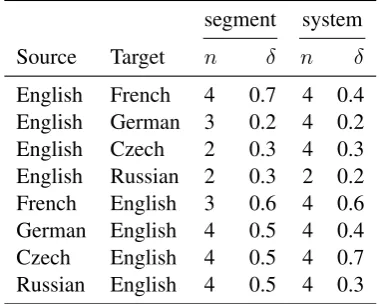
Our WMT 2015 submission includes two ver-sions regarding the method parameters: “default” and “optimized”. For the default submission, we selected the parameters based on the smallest rank sum over all languages, data sets (2013/2014) and levels of evaluation (system/segment). These pa-rameters, which we set as the default parameters for our implementation, aren= 4andδ= 0.4.
For the optimized submission, we took the pa-rameters with the best average correlation over WMT 2013 and 2014 data sets for each language pair and level of evaluation. The results are shown in Table 1. For the Finnish language that was not present in the 2013 and 2014 shared tasks, we took the best parameters for German, another lan-guage with complex morphology and long com-pound words.
3.2 Results for the WMT shared tasks
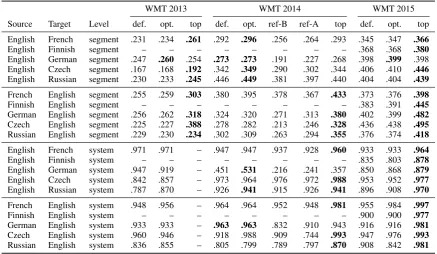
Table 2 shows the results from the WMT 2013, WMT 2014, and WMT 2015. Topline for system-level data of WMT 2013 is not included due to the use of Spearman’s rank correlation instead of Pearson’s product-moment correlation. Segment-level results of WMT 2013 are dominated by sin-gle submission, SIMPBLEU-RECALLby Song et
al. (2013). Considering morphologically com-plex languages, LeBLEU would have ranked first
segment system
Source Target n δ n δ
[image:4.595.321.511.66.218.2]English French 4 0.7 4 0.4 English German 3 0.2 4 0.2 English Czech 2 0.3 4 0.3 English Russian 2 0.3 2 0.2 French English 3 0.6 4 0.6 German English 4 0.5 4 0.4 Czech English 4 0.5 4 0.7 Russian English 4 0.5 4 0.3
Table 1: Results of parameter optimization for each language pair and level of evaluation (seg-ment or system).
in English–German and second in English–Czech and English–Russian. For translations to English, LeBLEU would have ranked in the top five among the 10 methods.
For WMT 2014 segment-level data, optimized LeBLEU provides the highest correlations for all language pairs from English. It also outperforms all the included methods for English–German and English–Russian level data. For system-level English–French, it would have ranked 5th. For system-level English–Czech, the optimized parameters yielded lower correlation than the de-fault ones, and neither come close to the topline. Somewhat surprisingly, LeBLEU provides the top correlation for system-level German–English and third best for system-level Czech–English transla-tions. For other system-level pairs to English, and all segment-level pairs to English, the correlations are reasonably high but quite far from the respec-tive toplines. We can also compare LeBLEU to two related methods, standard BLEU and AMBER (Chen and Kuhn, 2011). LeBLEU outperforms both in almost all tasks already with the default pa-rameters. The only exception is the system-level English–Czech task, in which BLEU provided a slightly higher correlation.
WMT 2013 WMT 2014 WMT 2015 Source Target Level def. opt. top def. opt. ref-B ref-A top def. opt. top English French segment .231 .234 .261 .292 .296 .256 .264 .293 .345 .347 .366
English Finnish segment – – – – – – – – .368 .368 .380
English German segment .247 .260 .254 .273 .273 .191 .227 .268 .398 .399 .398 English Czech segment .167 .168 .192 .342 .349 .290 .302 .344 .406 .410 .446 English Russian segment .230 .233 .245 .446 .449 .381 .397 .440 .404 .404 .439 French English segment .255 .259 .303 .380 .395 .378 .367 .433 .373 .376 .398
Finnish English segment – – – – – – – – .383 .391 .445
German English segment .256 .262 .318 .324 .320 .271 .313 .380 .402 .399 .482 Czech English segment .225 .227 .388 .278 .282 .213 .246 .328 .436 .438 .495 Russian English segment .229 .230 .234 .302 .309 .263 .294 .355 .376 .374 .418 English French system .971 .971 – .947 .947 .937 .928 .960 .933 .933 .964
English Finnish system – – – – – – – – .835 .803 .878
English German system .947 .919 – .451 .531 .216 .241 .357 .850 .868 .879 English Czech system .842 .857 – .973 .964 .976 .972 .988 .953 .952 .977 English Russian system .787 .870 – .926 .941 .915 .926 .941 .896 .908 .970 French English system .948 .956 – .964 .964 .952 .948 .981 .955 .984 .997
Finnish English system – – – – – – – – .900 .900 .977
[image:5.595.80.518.65.319.2]German English system .933 .933 – .963 .963 .832 .910 .943 .916 .916 .981 Czech English system .960 .946 – .918 .988 .909 .744 .993 .947 .976 .993 Russian English system .836 .855 – .805 .799 .789 .797 .870 .908 .842 .981
Table 2: Performance of LeBLEU in recent WMT metrics shared tasks. Pearson’s correlation coefficients (system-level data) and average Kendall’s tau correlation coefficients (segment-level data) for LeBLEU with default parameters (def.), LeBLEU with optimized parameters (opt.), and topline method for the shared task (top). For WMT 2014 data, also two reference methods are included: BLEU (ref-B) and AMBER (ref-A).
only 0.803 with the German-optimized parame-ters. The choice of German-based parameters was clearly unsuccessful, and the effect of optimiza-tion for evaluaoptimiza-tion in Finnish remains to be seen. On average, optimization based on WMT 2013 and 2014 data sets improved the performance.
Compared to other methods submitted to WMT 2015, LeBLEU outperformed others in segment-level English–German translation. It also ranked second in system-level English–German and third in segment-level English–French. Moreover, even though unoptimized for the task, it ranked third in segment-level and fourth in system-level English– Finnish evaluations.
4 Conclusions
We have described the LeBLEU evaluation score for machine translation. It is an extension of the popular BLEU evaluation metric, but much more suitable for evaluating machine translation to mor-phologically complex languages. The extension is conceptually simple and does not require any language-specific resources. Instead, morpholog-ical variants and mistakes in compound words are accepted by using fuzzy matching between
the word n-grams in the hypothesis and reference translations.
In the WMT15 shared task, LeBLEU provided high correlations to the human evaluations espe-cially when translating from English to a mor-phologically more complex language. In particu-lar, it outperformed other methods in the segment-level evaluation of English–German translation. The performance is equally good for WMT 2013 and 2014 data sets. This is remarkable especially as the method uses neither rule-based nor data-driven tools for morphological processing. As German is a highly compounding language, this indicates that the mistakes in compound words are frequently over-penalized by the current evalua-tion methods.
Implementation for the LeBLEU evaluation score is available from https://github.
com/Waino/LeBLEU.
Acknowledgments
References
Satanjeev Banerjee and Alon Lavie. 2005. METEOR: An automatic metric for MT evaluation with im-proved correlation with human judgments. In Pro-ceedings of the ACL Workshop on Intrinsic and Ex-trinsic Evaluation Measures for Machine Transla-tion and/or SummarizaTransla-tion, pages 65–72, Ann Ar-bor, Michigan, June. Association for Computational Linguistics.
Ilaria Bartolini, Paolo Ciaccia, and Marco Patella. 2002. String matching with metric trees using an approximate distance. InString processing and in-formation retrieval, pages 271–283. Springer. Boxing Chen and Roland Kuhn. 2011. AMBER: A
modified BLEU, enhanced ranking metric. In Pro-ceedings of the Sixth Workshop on Statistical Ma-chine Translation, pages 71–77, Edinburgh, Scot-land, July. Association for Computational Linguis-tics.
Mathias Creutz and Krista Lagus. 2005. Unsupervised morpheme segmentation and morphology induction from text corpora using Morfessor 1.0. Technical Report A81, Publications in Computer and Informa-tion Science, Helsinki University of Technology. Mathias Creutz, Teemu Hirsim¨aki, Mikko Kurimo,
Antti Puurula, Janne Pylkk¨onen, Vesa Siivola, Matti Varjokallio, Ebru Arisoy, Murat Sarac¸lar, and An-dreas Stolcke. 2007. Morph-based speech recog-nition and modeling of out-of-vocabulary words across languages. ACM Transactions on Speech and Language Processing, 5(1):3:1–3:29, December. Michael Denkowski and Alon Lavie. 2011. Meteor
1.3: Automatic metric for reliable optimization and evaluation of machine translation systems. In Pro-ceedings of the Sixth Workshop on Statistical Ma-chine Translation, pages 85–91, Edinburgh, Scot-land, July. Association for Computational Linguis-tics.
Etienne Denoual and Yves Lepage. 2005. BLEU in characters: towards automatic MT evaluation in lan-guages without word delimiters. InCompanion Vol-ume to the Proceedings of the Second International Joint Conference on Natural Language Processing, pages 81–86.
Robert Frederking and Sergei Nirenburg. 1994. Three heads are better than one. In Proceedings of the Fourth Conference on Applied Natural Language Processing, pages 95–100, Stuttgart, Germany, Oc-tober. Association for Computational Linguistics. Petr Homola, Vladislav Kuboˇn, and Pavel Pecina.
2009. A simple automatic MT evaluation metric. In
Proceedings of the Fourth Workshop on Statistical Machine Translation, pages 33–36, Athens, Greece, March. Association for Computational Linguistics. Vladimir I. Levenshtein. 1966. Binary codes capable
of correcting deletions, insertions and reversals. So-viet Physics Doklady, 10(8):707–710.
Jindˇrich Libovick´y and Pavel Pecina. 2014. Tolerant BLEU: a submission to the WMT14 metrics task. In Proceedings of the Ninth Workshop on Statisti-cal Machine Translation, pages 409–413, Baltimore, Maryland, USA, June. Association for Computa-tional Linguistics.
Matouˇs Mach´aˇcek and Ondˇrej Bojar. 2013. Results of the WMT13 metrics shared task. InProceedings of the Eighth Workshop on Statistical Machine Trans-lation, pages 45–51, Sofia, Bulgaria, August. Asso-ciation for Computational Linguistics.
Matouˇs Mach´aˇcek and Ondˇrej Bojar. 2014. Results of the WMT14 metrics shared task. InProceedings of the Ninth Workshop on Statistical Machine Trans-lation, pages 293–301, Baltimore, Maryland, USA, June. Association for Computational Linguistics. Kishore Papineni, Salim Roukos, Todd Ward, and
Wei-Jing Zhu. 2002. BLEU: a method for automatic evaluation of machine translation. In Proceedings of 40th Annual Meeting of the Association for Com-putational Linguistics, pages 311–318, Philadelphia, PA, USA, July. Association for Computational Lin-guistics.
Maja Popovi´c. 2011. Morphemes and POS tags for n-gram based evaluation metrics. InProceedings of the Sixth Workshop on Statistical Machine Transla-tion, pages 104–107, Edinburgh, Scotland, July. As-sociation for Computational Linguistics.
Dana Shapira and James A. Storer. 2002. Edit dis-tance with move operations. InProceedings of the 13th Annual Symposium on Computational Pattern Matching, pages 85–98.
Matthew Snover, Bonnie Dorr, Richard Schwartz, Lin-nea Micciulla, and John Makhoul. 2006. A study of translation edit rate with targeted human annotation. InProceedings of Association for Machine Transla-tion in the Americas, pages 223–231.
Xingyi Song, Trevor Cohn, and Lucia Specia. 2013. BLEU deconstructed: Designing a better MT evaluation metric, March. On-line: http: //staffwww.dcs.shef.ac.uk/people/ X.Song/song13deconstructed.pdf. Accessed Oct 2013.