Correlates of self-reported colorectal cancer screening
accuracy in a multi-specialty medical group practice
Arica White1, Sally W. Vernon1,2,Jan M. Eberth1,3, Jasmin A. Tiro4, Sharon P. Coan2, Peter N. Abotchie2, Anthony Greisinger5
1
School of Public Health, Division of Epidemiology, University of Texas Health Science Center, Houston, USA
2
School of Public Health, Division of Health Promotion and Behavioral Sciences, University of Texas Health Science Center, Houston, USA
3
Department of Biostatistics, University of Texas MD Anderson Cancer Center, Houston, USA
4
Department of Clinical Sciences, University of Texas Southwestern Medical Center, Dallas, USA
5
Kelsey Research Foundation, Houston, USA Email:[email protected]
Received 1 November 2012; revised 9 December 2012; accepted 19 December 2012
ABSTRACT
Purpose: We assessed whether accuracy of self-re- ported screening for colorectal cancer (CRC) varied by respondent characteristics or healthcare utiliza- tion. Methods: From 2005 to 2007, 857 respondents aged 51 - 74 were recruited from a multi-specialty medical group practice to answer a questionnaire about their CRC screening (CRCS) behaviors. Self- reports were compared with administrative and me- dical records to assess concordance, sensitivity, speci- ficity, and report-to-records ratios for overall CRCS (fecal occult blood test, sigmoidoscopy, and/or colo-
noscopy). Results: Concordance was good (0.8 to
<0.9) or fair (0.7 to <0.8) for most subgroups; re- spondents with >5 visits outside the clinic had poor (<0.7) concordance. Sensitivity estimates were mostly
excellent (0.9) or good but poor for respondents
whose healthcare provider did not advise a specific CRCS test. Specificity was poor for the following re- spondents: 65+ years, males, college graduates, family history of CRC, >5 visits outside of the clinic, or whose healthcare provider advised a specific CRCS test. Respondents 65+ years and with >5 outside visits over-reported CRCS. Conclusions: With few excep- tions, self-reports of CRCS in an insured population is reasonably accurate across subgroups. More work is needed to replicate these findings in diverse settings and populations to better understand subgroup dif- ferences and improve measures of CRCS.
Keywords:Colorectal Cancer; Screening; Correlates;
Self-Report; Accuracy
1. INTRODUCTION
Although colorectal cancer screening (CRCS) rates are
increasing [1], there is still room for improvement if we are to achieve Healthy People 2010 goals [2] and elimi- nate disparities. Monitoring adherence to guidelines en- ables us to assess progress towards meeting these goals and to identify screening disparities for population sub- groups [2]. Adherence to CRCS guidelines is often as- sessed using self-reported data, in part, because of the time, cost, and limited access to medical records [3]. In- creased reliance on self-reports underscores the need for accurate measures of adherence [3,4].
Although a number of studies have assessed agree- ment between self-reported CRCS and administrative data or medical records [5-19], fewer have examined sub group differences in accuracy [5,6,8-12,15,16,19], and most were limited to socio-demographic characteristics.
No studies have examined whether healthcare utiliza- tion factors, such as the number of visits to a healthcare provider, is associated with accuracy of self-reported CRCS. Identifying subgroup differences in the accuracy of self-reported CRCS may assist in the interpretation of prevalence estimates from survey data and the results of behavioral interventions. Understanding differences also may be useful in guiding clinical decision-making and improving patient-physician communication about CRCS. We used data from a randomized controlled trial de- signed to evaluate the reliability and validity of a stan- dardized self-report questionnaire of CRCS behaviors to examine whether the accuracy of self-report measures of CRCS behavior varied by respondent characteristics and healthcare utilization.
2. MATERIALS AND METHODS
2.1. Study Setting and Sample Selection
Institute (NCI) and the Centers for Disease Control and Prevention (CDC) [4,12], was evaluated for reliability and validity using three modes of survey administration mail, telephone, and face-to-face [13]. Study participants were men and women, 51 to 74 years old, who were pri- mary care patients for at least 5 years at a large multi- specialty medical group practice in Houston, Texas [13]. Patients with a prior history of CRC were excluded. From 2005 to 2007, 1004 patients were randomized to mail, telephone, or face- to-face mode of survey admini- stration. Of these, 857 completed a baseline survey and were included in this analysis. Additional details about recruitment, eligibility, study design and study proce- dures are described elsewhere [13]. The study protocol was approved by the University of Texas Health Science Center at Houston Committee for Protection of Human Subjects.
2.2. Measures
Adherence to CRCS guidelines was defined as: a fecal occult blood test (FOBT) within the past year, flexible sigmoidoscopy within the past 5 years, or colonoscopy within the past 5 years. For FOBT and sigmoidoscopy, these recommendations are the same as the American Cancer Society (ACS) guidelines in effect at the time of the study [20]. Instead of colonoscopy within the past 10 years per ACS guidelines, we restricted the measure to within the past 5 years to match our eligibility criteria. This ensured a sufficient number of patients and reduced the likelihood of receiving CRCS from an outside pro- vider.
Self-reports were compared to a combined database of administrative and medical records (referred to as the combined medical record). Type of tests and dates of each test were abstracted from the combined medical re- cord. Inter-rater agreement was assessed for three pairs of raters for 81 patients. For the most recent test within guidelines, agreement was 98% (kappa = 0.96). For all tests within the past 5 years, agreement was 91% (kappa = 0.89). If a patient reported a test from an outside pro- vider that was not recorded in the combined medical re- cord, we contacted the provider to confirm the report [13]. Of the 30 providers contacted, 23 provided the re- quested information, and this information was added to the database.
We assessed the following characteristics through the survey: age (categorized as 51 - 64, 65+); gender (male, female); race/ethnicity (non-Hispanic white, African Ame- rican, other); marital status (not married, married/ living with partner); education (<high school diploma/ General Equivalency Diploma (GED), some college, college+); family history of cancer (yes, no); number of physician visits in the past 5 years at the clinic (0 - 5, >5); number of physician visits in the past 5 years outside of the clinic
(0 - 5, >5); and whether their healthcare provider advised a specific CRC test (FOBT, sigmoidoscopy, colonoscopy). We included respondent characteristics, CRC history and healthcare provider advised a specific CRC test to com- pare our results with previous studies.
2.3. Data Analysis
We combined data from the three survey modes because there were no differences in validity estimates by mode [13]. We computed concordance (i.e., percentage agree- ment), sensitivity, specificity, and report-to-records ratio for any CRCS test (FOBT, sigmoidoscopy and/or colon- oscopy) by subgroup. Subgroups with less than 5 in a cell for their respective 2 2 tables were collapsed into an adjacent category if possible; those subgroups that could not be collapsed were excluded. Two-sided 95% confidence intervals were calculated for all measures. Analyses by each CRC test were attempted but yielded unstable estimates for multiple subgroups because cells (<5) could not be meaningfully collapsed.
Tisnado et al.’s [21] criteria for evaluating sensitivity and specificity of ambulatory care services were used to assess concordance, sensitivity, and specificity: >0.9 de- notes excellent agreement, >0.8 to <0.9 denotes good agreement, >0.7 to <0.8 denotes fair agreement and <0.7 denotes poor agreement. The report-to-records ratio is a measure of net bias in test reporting [22]. Values >1.0 indicate over-reporting, and values <1.0 indicate under- reporting; 95% confidence intervals were used to deter- mine the precision of over- or under-reporting. All data were analyzed using Microsoft Excel 2007 and Inter- cooled Stata version 9.0 (Stata Corporation College Sta- tion, TX).
3. RESULTS
Most respondents were 51 - 64 years old (81.2%), female (65.8%), married or living with a partner (74.2%), and college educated (54.6%); 59.4% were non-Hispanic white and 26.4% were African American. Approximately 11.3% had a family history of CRC. Most (93.2%) had a clinic visit within the last year, and 86.8% had more cli- nic visits within the past 5 years. Only 14.5% had more than 5 visits outside the clinic within the past 5 years. Most reported having had FOBT, sigmoidoscopy and/or colonoscopy in the past (61.5%).
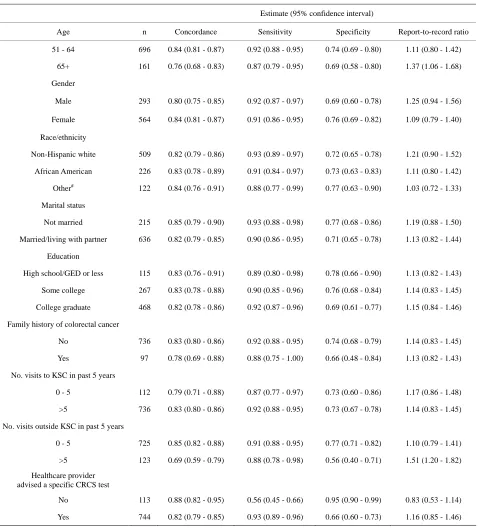
Table 1. Concordance, sensitivity, specificity, and report-to-records ratio comparing self-report of colorectal cancer screening within guidelines* to combined medical record (“gold standard”) by respondent characteristics.
Estimate (95% confidence interval)
Age n Concordance Sensitivity Specificity Report-to-record ratio
51 - 64 696 0.84 (0.81 - 0.87) 0.92 (0.88 - 0.95) 0.74 (0.69 - 0.80) 1.11 (0.80 - 1.42)
65+ 161 0.76 (0.68 - 0.83) 0.87 (0.79 - 0.95) 0.69 (0.58 - 0.80) 1.37 (1.06 - 1.68)
Gender
Male 293 0.80 (0.75 - 0.85) 0.92 (0.87 - 0.97) 0.69 (0.60 - 0.78) 1.25 (0.94 - 1.56)
Female 564 0.84 (0.81 - 0.87) 0.91 (0.86 - 0.95) 0.76 (0.69 - 0.82) 1.09 (0.79 - 1.40)
Race/ethnicity
Non-Hispanic white 509 0.82 (0.79 - 0.86) 0.93 (0.89 - 0.97) 0.72 (0.65 - 0.78) 1.21 (0.90 - 1.52)
African American 226 0.83 (0.78 - 0.89) 0.91 (0.84 - 0.97) 0.73 (0.63 - 0.83) 1.11 (0.80 - 1.42)
Other# 122 0.84 (0.76 - 0.91) 0.88 (0.77 - 0.99) 0.77 (0.63 - 0.90) 1.03 (0.72 - 1.33)
Marital status
Not married 215 0.85 (0.79 - 0.90) 0.93 (0.88 - 0.98) 0.77 (0.68 - 0.86) 1.19 (0.88 - 1.50)
Married/living with partner 636 0.82 (0.79 - 0.85) 0.90 (0.86 - 0.95) 0.71 (0.65 - 0.78) 1.13 (0.82 - 1.44)
Education
High school/GED or less 115 0.83 (0.76 - 0.91) 0.89 (0.80 - 0.98) 0.78 (0.66 - 0.90) 1.13 (0.82 - 1.43)
Some college 267 0.83 (0.78 - 0.88) 0.90 (0.85 - 0.96) 0.76 (0.68 - 0.84) 1.14 (0.83 - 1.45)
College graduate 468 0.82 (0.78 - 0.86) 0.92 (0.87 - 0.96) 0.69 (0.61 - 0.77) 1.15 (0.84 - 1.46)
Family history of colorectal cancer
No 736 0.83 (0.80 - 0.86) 0.92 (0.88 - 0.95) 0.74 (0.68 - 0.79) 1.14 (0.83 - 1.45)
Yes 97 0.78 (0.69 - 0.88) 0.88 (0.75 - 1.00) 0.66 (0.48 - 0.84) 1.13 (0.82 - 1.43)
No. visits to KSC in past 5 years
0 - 5 112 0.79 (0.71 - 0.88) 0.87 (0.77 - 0.97) 0.73 (0.60 - 0.86) 1.17 (0.86 - 1.48)
>5 736 0.83 (0.80 - 0.86) 0.92 (0.88 - 0.95) 0.73 (0.67 - 0.78) 1.14 (0.83 - 1.45)
No. visits outside KSC in past 5 years
0 - 5 725 0.85 (0.82 - 0.88) 0.91 (0.88 - 0.95) 0.77 (0.71 - 0.82) 1.10 (0.79 - 1.41)
>5 123 0.69 (0.59 - 0.79) 0.88 (0.78 - 0.98) 0.56 (0.40 - 0.71) 1.51 (1.20 - 1.82)
Healthcare provider advised a specific CRCS test
No 113 0.88 (0.82 - 0.95) 0.56 (0.45 - 0.66) 0.95 (0.90 - 0.99) 0.83 (0.53 - 1.14)
Yes 744 0.82 (0.79 - 0.85) 0.93 (0.89 - 0.96) 0.66 (0.60 - 0.73) 1.16 (0.85 - 1.46)
*
Adherence to guidelines is defined as any CRCS test within guidelines (annual fecal occult blood test, sigmoidoscopy within past 5 years, and/or colonoscopy within past 5 years). A concordance, sensitivity, or specificity of >0.9 denotes excellent agreement, >0.8 to <0.9 denotes good agreement, >0.7 to <0.8 denotes fair agreement and <0.7 denotes poor agreement (21). Missing values were excluded so totals may not add up to 857. GED = General Equivalency Diploma; KSC = Kelsey Seybold Clinic; CRCS = colorectal cancer screening; #Includes Hispanic, Asian/Pacific Islander, Native American and multi-racial groups.
trast, specificity estimates were mostly fair but were poor for several subgroups, including those aged 65 years and older, male, college graduates, positive family history of CRC, more than 5 visits to an outside provider in the past
4. DISCUSSION
Our finding that older patients over-reported any CRCS test within guidelines was similar to Partin et al.’s [12], suggesting that researchers and providers may need to rely on other sources of information to ascertain screen- ing history for this subgroup. Other published studies on correlates of accuracy of self-reported CRCS tests are limited primarily to socio-demographics and show little consistency in the validity measures reported [5,6,8-12, 19]. Six studies used one or more of the four validity measures as our study-concordance [8-12,19], sensitivity [8-10,12,19], specificity [8-10,12,19] and/or report-to- records ratio [12] to determine whether age [10-12], race/ ethnicity [8,9,11,12,19], sex [9,12], education [11,12], marital status [12] and family history of CRC [11,12] were associated with accuracy of self-reported FOBT [8- 11,19], sigmoidoscopy [8,9,19], colonoscopy [8,19] and/ or any CRCS [12]. Inconsistencies in findings among these studies [8-10,12,19] are likely due to variation in the populations studied, the time interval used to assess recall, and the CRCS guidelines used to measure validity which limited comparability of our findings to only one study [12]. Study samples included carpenters [10], pa- tients from health maintenance organizations [8,9], pri- mary care clinics [19] and users of the Veteran’s Admini- stration healthcare facilities [12]. The time interval used to compare self-reported CRCS behaviors with medical records also differed across studies, particularly for FOBT where the time intervals included one [10,12,19], two [9], and five years [8]. Only two studies [12,19] used evi- dence-based guidelines to assess validity of self-reported CRCS.
To our knowledge, this is the first study to examine whether accuracy of self-reported CRCS varied by health- care utilization. Patients who had more than 5 visits to an outside provider in the past 5 years may over-report CRCS. For patients who reported seeing outside provid- ers, we were able in most instances to contact those pro- viders and verify self-reports; however, patients may not have provided complete information about the medical care they received elsewhere which might explain why specificity and concordance were poor. Nevertheless, providers need to be diligent in taking medical histories among patients using multiple sources of medical care. Further, there is a need for better patient-provider com- munication about CRCS as evidenced by the low per- centage of respondents, without a provider advising a specific CRCS test, who correctly reported having any CRCS test when they had it (sensitivity) and low per- centage of respondents, whose provider advised a spe- cific CRCS test, that correctly reported not having any CRCS test and did not (specificity).
Strengths of our study include the use of a standard- ized questionnaire to ascertain self-reported screening,
inclusion of covariates that have not been examined pre- viously, a diverse sample with a large number of African Americans, a relatively stable patient population where almost all endoscopies were done on site, and follow-up with outside providers to verify self-reports in the few cases where CRCS was done elsewhere. Nevertheless, the generalizability of our findings is limited because our sample consisted of insured men and women receiving care primarily from one practice.
To our knowledge, this is the most comprehensive as- sessment to date of the accuracy of self-reported meas- ures of CRCS by respondent characteristics and health- care utilization factors. Our findings show that self-re- port of any CRCS test within guidelines, as measured by concordance, sensitivity, and report-to-records ratio, is reasonably accurate across subgroups. However, more research is needed to replicate these findings in diverse settings and populations to better understand subgroup differences and improve measures of CRC.
5. ACKNOWLEDGEMENTS
Grant support: PRC SIP 19-04 U48 DP000057 from the Centers for Disease Control and Prevention (S. W. Vernon and A. Greisinger). Pre- doctoral Fellowship (A. White, J. M. Eberth & P. N. Abotchie), Uni- versity of Texas School of Public Health Cancer Education and Career Development Program—National Cancer Institute/NIH Grant R25-CA- 57712. Post-doctoral Fellowship (J. M. Eberth), University of Texas MD Anderson Cancer Center Cancer—National Cancer Institute R25- CA-57730 and NIH P30-CA-016672.
The content is solely the responsibility of the authors and does not necessarily represent the official views of the Centers for Disease Con- trol and Prevention, National Cancer Institute or the National Institutes of Health.
REFERENCES
[1] Klabunde, C.N., Cronin, K.A., Breen, N., Waldron, W.R., Ambs, A.H. and Nadel, M.R. (2011) Trends in colorectal cancer test use among vulnerable populations in the United States.Cancer Epidemiology, Biomarkers & Pre- vention, 20, 1611-1621.
doi:10.1158/1055-9965.EPI-11-0220
[2] US Department of Health and Human Services, Office of Disease Prevention and Health Promotion (2011) Healthy people 2020. www.healthypeople.gov
[3] Nosowsky, R. and Giordano, T.J. (1996) The Health In- surance Portability and Accountability Act of 1996 (HI- PAA) privacy rule: Implications for clinical research.
Annual Review of Medicine, 57, 575-590.
doi:10.1146/annurev.med.57.121304.131257
[5] Baier, M., Calonge, N., Cutter, G., McClatchey, M., Scho- entgen, S., Hines, S., et al. (2000) Validity of self-re- ported colorectal cancer screening behavior. Cancer Epi- demiology, Biomarkers & Prevention, 9, 229-232.
[6] Brown, J.B. and Adams, M.E. (1992) Patients as reliable reporters of medical care process. Recall of ambulatory encounter events. Medical Care, 30, 400-411.
doi:10.1097/00005650-199205000-00003
[7] Gordon, N.P., Hiatt, R.A. and Lampert, D.I. (1993) Con- cordance of self-reported data and medical record audit for six cancer screening procedures. Journal of the Na- tional Cancer Institute, 85, 566-570.
doi:10.1093/jnci/85.7.566
[8] Hall, H.I., Van Den Eeden, S.K., Tolsma, D.D., Rardin, K., Thompson, T., Hughes Sinclair, A., et al. (2004) Test- ing for prostate and colorectal cancer: Comparison of self-report and medical record audit. Preventive Medicine, 39, 27-35. doi:10.1016/j.ypmed.2004.02.024
[9] Hiatt, R.A., Perez-Stable, E.J., Quesenberry Jr., C., Sa- bogal, F., Otero-Sabogal, R. and McPhee, S.J. (1995) Agreement between self-reported early cancer detection practices and medical audits among Hispanic and non- Hispanic white health plan members in northern Califor- nia. Preventive Medicine, 24, 278-285.
doi:10.1006/pmed.1995.1045
[10] Lipkus, I.M., Samsa, G.P., Dement, J., Skinner, C.S., Green, L.S., Pompeii, L., et al. (2003) Accuracy of self-reports of fecal occult blood tests and test results among individuals in the carpentry trade. Preventive Me- dicine, 37, 513-519. doi:10.1016/S0091-7435(03)00178-6
[11] Mandelson, M.T., LaCroix, A.Z., Anderson, L.A., Nadel, M.R. and Lee, N.C. (1999) Comparison of self-reported fecal occult blood testing with automated laboratory re- cords among older women in a health maintenance or- ganization. American Journal of Epidemiology, 150, 617- 621. doi:10.1093/oxfordjournals.aje.a010060
[12] Partin, M.R., Grill, J., Noorbaloochi, S., Powell, A.A., Burgess, D.J., Vernon, S.W., et al. (2008) Validation of self-reported colorectal cancer screening behavior from a mixed-mode survey of veterans. Cancer Epidemiology,
Biomarkers & Prevention, 17, 768-776.
doi:10.1158/1055-9965.EPI-07-0759
[13] Vernon, S.W., Tiro, J.A., Vojvodic, R.W., Coan, S., Dia- mond, P.M., Greisinger, A., et al. (2008) Reliability and validity of a questionnaire to measure colorectal cancer screening behaviors: does mode of survey administration matter? Cancer Epidemiology, Biomarkers & Prevention, 17, 758-767. doi:10.1158/1055-9965.EPI-07-2855
[14] Bastani, R., Glenn, B.A., Maxwell, A.E., Ganz, P.A., Mojica, C.M. and Chang, L.C. (2008) Validation of self- reported colorectal cancer (CRC) screening in a study of ethnically diverse first-degree relatives of CRC cases. Can- cer Epidemiology, Biomarkers & Prevention, 17, 791-798.
doi:10.1158/1055-9965.EPI-07-2625
[15] Rauscher, G.H., Johnson, T.P., Cho, Y.I. and Walk, J.A. (2008) Accuracy of self-reported cancer-screening histo- ries: A meta-analysis. Cancer Epidemiology, Biomarkers & Prevention, 17, 748-757.
doi:10.1158/1055-9965.EPI-07-2629
[16] Schenck, A.P., Klabunde, C.N., Warren, J.L., Peacock, S., Davis, W.W., Hawley, S.T., et al. (2008) Evaluation of claims, medical records, and self-report for measuring fecal occult blood testing among medicare enrollees in fee for service. Cancer Epidemiology, Biomarkers & Pre- vention, 17, 799-804.
doi:10.1158/1055-9965.EPI-07-2620
[17] Beebe, T.J., Jenkins, S.M., Anderson, K.J., Davern, M.E. and Rockwood, T.H. (2008) The effects of survey mode and asking about future intentions on self-reports of co- lorectal cancer screening. Cancer Epidemiology, Biomar- kers & Prevention, 17, 785-790.
doi:10.1158/1055-9965.EPI-07-2622
[18] Jones, R.M., Mongin, S.J., Lazovich, D., Church, T.R. and Yeazel, M.W. (2008) Validity of four self-reported colorectal cancer screening modalities in a general popu- lation: Differences over time and by intervention assign- ment. Cancer Epidemiology, Biomarkers & Prevention, 17, 777-784. doi:10.1158/1055-9965.EPI-07-0441
[19] Shokar, N.K., Vernon, S.W. and Carlson, C.A. (2011) Validity of self-reported colorectal cancer test use in dif- ferent racial/ethnic groups. Family Practice, 28, 683-688.
doi:10.1093/fampra/cmr026
[20] American Cancer Society (2008) Cancer facts and figures 2008. American Cancer Society, Atlanta.
[21] Tisnado, D.M., Adams, J.L., Liu, H., Damberg, C.L., Chen, W.P., Hu, F.A., et al. (2006) What is the concor- dance between the medical record and patient self-report as data sources for ambulatory care? Medical Care, 44, 132-140. doi:10.1097/01.mlr.0000196952.15921.bf