Feasibility of Leveraging Crowd Sourcing for the Creation of a Large
Scale Annotated Resource for Hindi English Code Switched Data: A Pilot
Annotation
Mona DiabCenter for Computational Learning Systems Columbia University, New York [email protected]
Ankit Kamboj
Computer Science Dept. Columbia University, New York
Abstract
Linguistic code switching (LCS) occurs when speakers mix multiple languages in the same speech utterance. We find LCS pervasively in bilingual communi-ties. LCS poses a serious challenge to Natural Language and Speech Process-ing. With the ubiquity of informal gen-res online, LCS is emerging as a very widespread phenomenon. This paper presents a first attempt at collecting and annotating a large repository of LCS data. We target Hindi English (Hinglish) LCS. We investigate the feasibility of leverag-ing crowd sourcleverag-ing as a means for anno-tating the data on the word level. This paper briefly explains the setup of the experiment and data collection. It also presents statistics representing agreements among annotators over different possible categories of Hinglish words and analyzes the confidence with which a code switched word can be annotated in the correct cate-gory by humans.
1 Introduction
Linguistic Code switching(LCS) is the term used to describe a common practice among bilingual speakers of a given language pair in which the speakers switch back and forth between their com-mon languages. This phenomenon is dominantly observed in inhabitants of countries like India where Hindi is a common first language (L1) and English acts as a second language (L2) among na-tive Hindi speakers. For example, the following Hindi sentence with code switches to English is a seamless example of North Indian conversation:
Uske communicationki wajah se hi project suc-cessfulhua hai. (Project has become successful because of his excellent communication.)LCS oc-curs both inter-sentential and intra-sentential.
LCS occurs in all genres of communication for such speakers, including spoken conversation, email, online chat rooms, blogs and newsgroups. Thus, it seriously impacts attempts to process these exchanges computationally, for the purposes of automatic translation, speech recognition, and information extraction, inter alia (Solorio and Liu, 2008a; Solorio and Liu, 2008b).
With increasing interest in LCS, there is need for large annotated LCS corpora which can sup-port the needs of computational as well as theo-retical research. This paper presents one experi-ment where a corpus of code switched sentences is annotated for identifying code switch points us-ing crowd sourcus-ing methods. The data collection serves as the first attempt at creating a reposi-tory for LCS data. Also the annotations of LCS points will shed light into the nature of this phe-nomenon and will be an initial building block for the development of interesting analytical and pre-dictive models for automatic LCS processing sys-tems. It is widely accepted that LCS actually fol-lows a certain pattern and that it does not occur randomly. Several studies in sociolinguistics and theoretical linguistics have investigated this issue however on a small scale (Poplack, 2001; Myers-Scotton, 1993).
2 Hindi and Hinglish
Hindi is the national language of India and na-tive language of many parts of the country. It has continuously been impacted by varied languages and dialects of the country, the most influential of which is English. English expanded its roots into India from the time Britain occupied the country. It was initially the language of the elite upper class but as the education system became widespread, English spread across the whole country. With the proliferation of scientific advancements in the En-glish speaking world and India’s race for technol-ogy acquisition, we note that English has almost
become an Indian language. In fact, Indians from different parts of India who speak mutually unin-telligible native Indian languages use English as the bridge language to communicate. The perva-siveness of English coupled with the Hindi edu-cation throughout the country led to rapid devel-opment ofHinglish, a term coined to describe the use of Hindi and English words in the same utter-ance, Hinglish LCS.1Since Hindi is a
morpholog-ically rich language, we even often observe LCS occurring on the morphological level. Hinglish has become a widespread phenomenon (as a lan-guage in and of itself even) used by Indians in dif-ferent parts of the world. It is obvious that the con-text switches from Hindi to English are very fre-quent and some words that are borrowed such as
Thank You,Please,Crazyare almost Hindi words, as they have become part of the Indian native lex-icon. One important reason that smooth switch can occur between Hindi and English is that words from any of these languages can fill the lexical gaps in the sentence of the other. It is important to point out that LCS is beyond nonce and borrow-ing, the phenomenon in Hinglish is that of signif-icant amounts of words and chunks are switched back and forth in the same utterance, it is not a matter of isolated borrowed words that are highly frequent in the Hindi lexicon.
Our paper attempts to describe an initial large scale collection of LCS data and annotate it on the word/token level. Several linguistic studies have investigated Hinglish on a theoretical level (Bhatt, 1997; Joshi, 1985) as well as socio-pragmatic level as in the work of Bhatt and Bolonyai (2008). The studies suggest that LCS occurs in a sys-tematic manner. However to our knowledge no large collection of LCS data for Hinglish exists, let alone detailed annotations for such a collection. Our initial attempt is to fill this gap such that it would be of utility to both the theoretical linguis-tics as well as the computational processing fields.
3 Corpus Collection
We needed content where the matrix language was Hindi with frequent code switches to En-glish. Modern Hindi novels are rich sources for such content as they use Hinglish frequently. The content of two sites: www.hindinovels.net and
www.abhivyakti-hindi.orgwere crawled using perl
1For the purposes of this paper, we are not interested in the inter sentential LCS.
scripts and broken into sentences to develop the corpus. Some Hindi sentences with no CS were mixed with these sentences to prepare an opti-mal blend of sentences for annotations. The final corpus consisted of 10500 sentences comprising 193285 tokens.
4 Experiment Setup
Amazon Mechanical Turk (AMT) is a market-place to host surveys whererequestershost some questions which are answered by workers, aka turkers. It has been widely accepted that the use of crowd sourcing techniques for the collection of data annotations is a worthwhile effort (Snow et al., 2008). The benefit of using crowd sourcing lies in a rapid collection cycle, sometimes at the expense of quality. Hence the challenge lies in designing and simplifying the task and presenting it to lay people in generic terms. But also setting performance metrics for accepting such annotations. We carried out our experiments on AMT where we asked the turkers to identify each word in a sentence as one of the following categories:2
1. Hindi-aaya(came),gaya(went),hum(we) 2. English- usual English words, for example,eat, grin, happy
3. Foreign Proper Name-John,Stella,IBM
4. Indian proper Name-Ramesh,Ganesh,Anjali
5. Unknown- Any word which can not be classi-fied into any of the above categories
The experiment was set up as a survey with three Hinglish sentences on one page. Each of such pages is termed a Human Intelligence Task (HIT) and a collection of HITs is termed a task on AMT. Our collection of 10500 sentences was di-vided into 7 tasks, each task containing 500 HITs with 3 sentences each. Each word in a sentence had a drop down list containing the above options associated with it, with the default option being Hindi. The AMT turkers then marked each word in the sentence as one of the options above. A minimum of two turkers were allowed to work on a single HIT or the same set of 3 sentences in order to allow overlap for agreements/disagreements on same set of words. Accordingly all the data was at
least doubly annotated.
A subset of HITs (10% of the corpus size) was gold annotated by a native bilingual speaker of Hindi and English. We designed the set up of the HITs such that for any given turker at least one sentence in a HIT overlapped with a gold an-notation. Then the turker whose sampled HIT annotations agreed with the gold annotation less than 95% were discarded. Initially, 136 ers submitted the results, out of which 85 turk-ers scored above the set 95% threshold. The HITs that were rejected were resubmitted to AMT for re-annotation. With resubmission results, 8 more turkers were added as they scored above the 95% threshold bringing the total number of turkers to 93. Accordingly, the overall data was annotated by 93 turkers, 10% of the overall 10500 sentences is three way annotated with gold annotation and by two turkers.
5 Experiment Results and Statistics
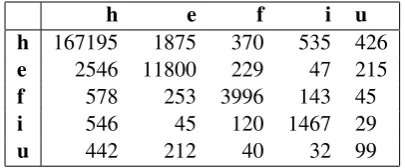
In this section we present detailed results on the collected annotations. We calculate inter-turker agreements based on how many times a turker agreed on a category within the same HIT with the other turkers who co-annotated the same HIT. The results for turkers were then aggregated to find the total number of agreements for each category. The resulting confusion matrix is shown in Table 1. The legend for the table is as follows:
h- Hindi e- English
f- Foreign Proper Name i- Indian Proper Name u- Unknown
Each cell of the confusion matrix corresponds to agreement counts for any turker aggregately with respective co-turkers.
The following detailed statistics show the per-centage classification agreement among the co-turkers in different categories for the majority an-notated class on the word level. As mentioned above, each HIT was annotated by two turkers. In our detailed statistics, we observe the num-ber of times two turkers agreed on a category la-bel per word in the same HIT. We report la-below the percentage of aggregate pairwise agreements
h e f i u
h 167195 1875 370 535 426
e 2546 11800 229 47 215
f 578 253 3996 143 45
i 546 45 120 1467 29
[image:3.595.315.518.62.146.2]u 442 212 40 32 99
Table 1: Confusion Matrix of the aggregate turk-ers’ annotations for the different categories
among the turkers for those categories. We re-port the results of the analysis by the majority class. Hence for those instances that are consid-ered Hindi across the HITs, 98.1% of the times, some two turkers agreed on a Hindi label.
All in all, the data had 193285 word instances, corresponding to 14658 word types, 88.16% word instances were considered Hindi by the majority of turkers, 7.67% instances were considered English by the majority of turkers, 2.59% words were considered Foreign Proper names, and 1.14% were considered Indian Proper names, finally 0.42% were considered Unknowns. The following statistics reflect the confusion on the majority label by aggregate pairs of turkers.
For majority class Hindi word instances (88.16% of the word instances):
Hindi- 98.1% English- 1.1%
Foreign Proper Name- 0.22% Indian Proper Name- 0.31% Unknown- 0.25%
Hence, turkers agreed 98.1% of the time that the label for these 88.16% of the word instances are Hindi, however, some set of the turker pairs con-fused 1.1% of this Hindi data set as English, while 0.25% of the time pairs of turkers considered these Hindi words as Unknown.
For majority class English word instances (7.67% of the word instances):
Hindi- 17.16% English- 79.53%
Foreign Proper Name- 1.54% Indian Proper Name- .32% Unknown- 1.45%
the label for these 7.67% of the word instances are English, however, some set of the turker pairs confused 17.16% of this English data set as Hindi, 1.54% as Foreign Proper Name, 0.32% as Indian Proper Name and 1.45% of the time pairs of turkers considered these English words as Unknown
For majority class Foreign Proper Name word instances (2.59% of the word instances):
Hindi- 11.52% English- 5.04%
Foreign Proper Name- 79.68% Indian Proper Name- 2.85% Unknown- .9%
The turkers agreed 79.68% of the time that the label for these 2.59% of the word instances are Foreign Proper Name, however, some set of the turker pairs confused 11.52% of this Foreign Proper Name data set as Hindi, 5.04% as English, 2.85% as Indian Proper Name and 0.9% of the time pairs of turkers considered these Foreign Proper Names as Unknown
For majority class Indian Proper Name word instances (1.14% of the word instances):
Hindi- 24.74% English- 2.04%
Foreign Proper Name- 5.44% Indian Proper Name- 66.47% Unknown- 1.31%
For majority class Unknown word instances (0.42% of the word instances):
Hindi- 53.58% English- 25.7%
Foreign Proper Name- 4.85% Indian Proper Name- 3.88% Unknown- 12%
The above statistics are the aggregated results, we note that the results for each of the 93 turk-ers taken individually, as compared to their respec-tive co-turkers follow the same trend as the aggre-gated results. For example, if we compare an in-dividual turker with co-turkers, majority of
agree-ments are Hindi-Hindi, English-English and so on. Similarly, disagreements are also proportionate to above statistics.
A detailed token level analysis also showed sim-ilar trends. We analyzed a sample of 1304 to-kens of which 1005 have a Hindi root and 245 are of English etymology. 27 tokens were For-eign Proper Names and 26 were Indian Proper Names. The turkers agreed 98.45% times that the tokens are Hindi over the total occurrences of sam-ple Hindi root tokens. They agreed 79.41% times that the token is English over tokens with English root, 75.74% times agreed that the token is For-eign Proper Name for ForFor-eign Proper Name to-kens. The turkers agreed 74.58% times that the token is an Indian Proper Name for Indian Proper Name tokens. The turkers were observed to con-fuse Hindi tokens and Indian Proper Name tokens as 22.63% times, i.e. they mutually agreed that the token is Hindi when it was in fact an Indian Proper Name.
We further analyze the agreement on a complete sentence level, where turkers agreed on the anno-tation for every token in the sentence, we found only 57 such sentence annotations.
6 Analysis of Results
As depicted by the above statistics, the largest per-centage of agreement was for the words marked in the Hindi category. There was about 98% agree-ment over such words which can be attributed to two reasons. Firstly, Hindi being the matrix lan-guage, a dominant part of words in the sentences were Hindi. Secondly, although there were very few instances where the turkers completely agreed on each word of a sentence, they had almost no confusion in identifying the Hindi words in a sen-tence.
indistinguishable as English words.
There was agreement for majority of Foreign and Indian Proper Names (79.68% and 66.47% re-spectively). The highest percentage of disagree-ments were observed when the co-turkers marked proper names as Hindi words. This may be at-tributed to the fact that capitalization does not ex-ist in the Hindi script for proper names, and they might be misconstrued as other parts of speech. For example, Pawan could be a name and could be used as a noun meaningairas well. Similarly,
Anant could be used as a name or an adjective meaningwith out an end.
The Unknown category showed some interest-ing results. The agreement over Unknown cate-gory was much less among turkers. Instead, ma-jority of co-turkers marked such words as Hindi words (53.58% times). After analysis, it was found that a major reason for this observation was because turkers were confused on morphologi-cally mixed words. For example, plural of com-pany after morphological adjustment becomes
companiyonin Hinglish. A turker was not able to classify such words distinctly since it is half Hindi and half English from his point of view. More-over, we believe that the fact that we have a default Hindi tag, could have contributed to the confusion. In our next iteration of annotation experiments, we will make sure to avoid a default tag.
If we consider the overall results, more than 90% of agreements were for Hindi words followed by English, Foreign Proper Name, Indian Proper Name and Unknown categories, in that order. This along with results for each of the individual cate-gories shows that the turkers have high confidence while marking the Hindi words. English words, foreign proper names and Indian proper names also show good confidence with agreement over majority of them. Majority of disagreements in different categories were classified as Hindi which shows the tendency of the turkers to mark the word, about which they are confused, as Hindi it-self, or simply leave it as default. Based on anal-ysis of results above in conjunction with the inter-turker and gold agreements, it can be affirmed with high confidence that apart from theUnknown cat-egory words, the turkers converge on the correct category significantly above chance indicating the feasibility of the approach.
7 Conclusion and Future Directions
In this paper we presented an initial attempt at building a large scale repository of manually anno-tated LCS data for Hinglish. We believe we have established that crowd sourcing is a good method for inducing such annotations. In the near future we plan on annotating more data. We plan on adding a new category label of mixed morphology. Finally, we intend to perform the same annotation task for other language pairs.
References
Aravind Joshi. 1985. Processing of sentences with in-trasential code switching. Natural Language Pars-ing: Psychological, Computational and Theoretical
Perspectives. Cambridge University Press,
Cam-bridge, UK.
Carol Myers-Scotton. 1993. Common and Un-common Ground: Social and Structural Factors in Codeswitching Language in Society, 22(4):475– 503.
Rakesh M. Bhatt. 1997. Code-switching, constraints, and optimal grammars. Lingua, 102(4):223–251.
Rakesh M. Bhatt and Agnes Bolonyai. 2008. Code-switching and optimal grammars . Proceedings from the Annual Meeting of the Chicago Linguistic Soci-ety, 44(2):109–122.
Rion Snow, Brendan O’Connor, Daniel Jurafsky and Andrew Ng. 2008. Cheap and fast but is it good? evaluating non-expert annotations for natural lan-guage tasks. Proceedings of the EMNLP 2008, Hon-olulu, Hawaii, 254–263.
S Poplack. 2001. Code-switching (Linguistic). N. Smelser and P. Baltes (eds.)International Encyclo-pedia of the Social and Behavioral Sciences, 2062– 2065.
Thamar Solorio and Yang Liu. 2008. Learning to Predict Code-Switching Points. Proceedings of the
EMNLP 2008, Honolulu, Hawaii, 973–981.
Thamar Solorio and Yang Liu. 2008. Part-of-Speech Tagging for English-Spanish Code-Switched Text. Proceedings of the EMNLP 2008, Honolulu,