Spanish NER with Word Representations and Conditional Random Fields
Jenny Copara1, Jose Ochoa1, Camilo Thorne2, Goran Glavaˇs2 1Universidad Cat´olica San Pablo, Arequipa, Peru
{jenny.copara,jeochoa}@ucsp.edu.pe
2Data & Web Science Group, Universit¨at Mannheim, Germany
{camilo,goran}@informatik.uni-mannheim.de
Abstract
Word Representations such as word em-beddings have been shown to signifi-cantly improve (semi-)supervised NER for the English language. In this work we investigate whether word representations can also boost (semi-)supervised NER in Spanish. To do so, we use word repre-sentations as additional features in a linear chain Conditional Random Field (CRF) classifier. Experimental results (82.44 F-score on the CoNLL-2002 corpus) show that our approach is comparable to some state-of-the-art Deep Learning approaches for Spanish, in particular when using cross-lingual Word Representations. Keywords. NER for Spanish, Word Rep-resentations, Conditional Random Fields.
1 Introduction
Supervised NER models require large amounts of (manually) labeled data to achieve good perfor-mance, data that often is hard to acquire or gen-erate. However, it is possible to take advantage of unlabeled data to learn word representations to enrich and boost supervised NER models learned over small gold standards.
In supervised NER the common practice has been to use domain-specific lexicon (list of words related with named entity types) (Carreras et al., 2002; Ratinov and Roth, 2009; Passos et al., 2014). More recently, it has been shown that su-pervised NER can be boosted via specific word features induced from very large unsupervised word representations (Turian et al., 2010), and in particular, from (i) very large word clusters (Brown et al., 1992; Liang, 2005), and (ii) very large word embeddings (Collobert and Weston, 2008; Mikolov et al., 2013a; Mikolov et al.,
2013b; dos Santos and Guimar˜aes, 2015). For En-glish NER, (Passos et al., 2014; Guo et al., 2014) show that (large) word embeddings yield better re-sults than clustering. However, when combined and fed as features to linear chain conditional ran-dom field (CRF) sequence classifiers, they yield models comparable to state-of-the-art deep learn-ing approaches, but with the added value of a very large coverage (Guo et al., 2014).
In this paper we investigate whether these tech-niques can be successfully applied to NER in Spanish. In order to do so, we follow Guo et al. (2014)’s approach combining probabilistic graph-ical models learned from the CoNLL 2002 corpus, with word representations learned from large un-labeled Spanish corpora, while exploring the op-timal setting and feature combinations that match state-of-the-art algorithms for NER in Spanish.
The paper is organized as follows. In Section 2, we provide a review of Spanish NER, and NER using word representations as features. Section 3 describes the structure of the word representations used. Section 4 shows our experimental setting and results. Section 5 presents our final remarks.
2 Related work 2.1 Spanish NER
The first results (CoNLL 2002 shared-task1) for
(supervised) Spanish NER were obtained by Car-reras et al. (2002) where a set of selected word features and lexicons (gazetteers) on an Adaboost learning model were used, obtaining an F-score of
81.39%. These results remained unbeaten until recently, and the spread of Deep Learning. The state-of-the-art algorithms for this task (currently achieving an F-score of85.77%) are mostly based on Deep Learning. Convolutional Neural Net-works with word and character embeddings (dos
1http://www.cnts.ua.ac.be/conll2002/ner/
Santos and Guimar˜aes, 2015), Recurrent Neural Networks (RNNs) with word and character em-beddings (Lample et al., 2016; Yang et al., 2016), and a character-based RNN with characters en-coded as bytes (Gillick et al., 2015).
2.2 Word Representations
Word Representations have been shown to sub-stantially improve several NLP tasks, among which NER for English and German (Faruqui and Pad´o, 2010).
There are two main approaches. One approach is to compute clusters (Brown et al., 1992; Liang, 2005) (Brown Clustering) from unlabeled data and using them as features in NLP models (including NER). Another approach transforms each word into a continuous real-valued vector (Collobert and Weston, 2008) of n dimensions also known as a “word embedding” (Mikolov et al., 2013a). With (Brown) clustering, words that appear in the same or a similar sentence context are assigned to the same cluster. Whereas in word embeddings similar words occur close to each other inRn(the inducedndimensional vector space).
Word Representations work better the more data they are fed. One way to achieve this is to input them cross-lingual datasets, provided they over-lap in vocabulary and domain. Cross-lingual Word Representations have been shown to improve sev-eral NLP tasks, such as model learning(Bhattarai, 2013; Yu et al., 2013a). This is because, among other things, they allow to extend the coverage of possibly limited (in the sense of small or sparsely annotated) resources through Word Representa-tions in other languages. For instance, using En-glish to enrich Chinese (Yu et al., 2013a), or learning a model in English to solve a Text Clas-sification task in German (also German-English, English-French and French-English) (Bhattarai, 2013).
3 Word Representations for Spanish NER
Brown clustering Brown clustering is a hierar-chical clustering of words that takes a sequence
w1, . . . , wnof words as input and returns a binary tree as output. The binary tree’s leaves are the in-put words. This clustering method is based on bi-gram language models (Brown et al., 1992; Liang, 2005).
Clustering embeddings A clustering method for embeddings based on k-means has been pro-posed in Yu et al. (2013b). Experiments have shown different numbers for k’s which contains different granularity information. The toolkit Sofia-ml (Sculley, 2010)2was used to do so.
Binarized embeddings The idea behind this method is to “reduce” continous word vectors ~w
in standard word embeddings, into discretebin(~w)
vectors, that however preserve the ordering or ranking of the embeddings. To do this, we need to compute two thresholds per dimension (upper and lower) across the whole vocabulary. For each di-mension (component)iof is computed themean
of positives values (Ci+, the upper threshold) and
negative values (Ci−, the lower one). Thereafter,
the following function is used over each compo-nentCij of vector ~wj:
φ(Cij) =
U+, ifCij ≥mean(Ci+), B−, ifCij ≤mean(Ci−),
0, otherwise.
Distributional Prototypes This approach is based on the idea that each entity class has a set of words more likely to belong to this class than the other words (i.e., Maria, Jose are more likely to be classified as a PERSON entity). Thus, it is useful to identify a group of words that represent each class (prototypes) and selectsome of themin order to use them as word features. In order to compute prototypes Guo et al. (2014) two steps are necessary:
1. Generate a prototype for each class of an annotated training corpus. This step relies on Normalized Pointwise Mutual Informa-tion (NPMI) (Bouma, 2009). Word-entity type relations can be modeled as a form of collocation. NPMI is a smoothed version of the Mutual Information measure typically used to detect word associations (Yang and Pedersen, 1997) and collocations. Given an annotated training corpus, the NPMI is com-puted between labelsland wordswusing the following two formulas:
λn(l, w) = −λln(l, wp(l, w) ), λ(l, w) = lnpp((l)l, wp(w)).
2. Map the prototypes to words in a (large) word embedding. In this step, given a group of totypes for each class, we find out which pro-totypes in our set are the mostsimilarto each word in the embeddings. Cosine similarity
is used to do so and those prototypes above a threshold of usually 0.5 are chosen as the prototype features of the word.
4 Experiments and Discussion
Unlike previous approaches, our work focuses on using word representations as features for super-vised NER for Spanish. We do it within a prob-abilistic grahical model framework: Conditional Random Fields (CRFs). CRFs allows us to inten-sively explore available resources (unlabeled data) within a simple graphical model setting (in con-trast to complex Deep Learning approaches). We trained our (enriched) model over the (Spanish) CoNLL 2002 corpus, and built our Word Rep-resentations over, on the one hand, the Spanish Billion Corpus, and on the other hand, English Wikipedia. For Spanish this is a novel approach. The experimental results show it achieves compet-itive performance w.r.t. the current (Deep learning-driven) state-of-the-art for Spanish NER, in partic-ular when usingcross-ormulti-lingualWord Rep-resentations.
4.1 NER Model
We used for our NER experiments a linear chain CRF sequence classifier, whose main properties we briefly recall (for a detailed description of this known model please refer to Sutton and McCal-lum (2012)). Linear chain CRFs are discrima-tive probabilistic graphical models that work by estimating the conditional probability of label se-quencetgiven word sequence (sentence)w:
p(t|w) = Z1 exp
X|t|
i=1 #(XF)
j=1
θjfj(ti1, ti,wi)
where Z is a normalization factor that sums the body (argument) of the exponential over all se-quences of labelst, thefjs are feature functions andwi is the word window observed at position
i of the input. The parameters θj of the model are estimated via so-called gradient minimization methods.
Our classifier relies on a set of standard baseline features, that we extend with additional features
w2 r2
t2
w1 t1
[image:3.595.323.508.59.137.2]r1
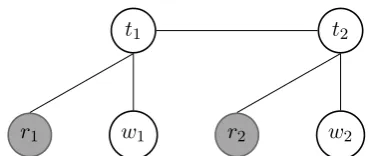
Figure 1: Linear chain-CRF with word representa-tions as features. The upper nodes are the label se-quences, the bottom white nodes are the word fea-tures in the model and the filled nodes are the word representations features included in our model.
based on word representations in order to take ad-vantage of unlabeled data, as depicted in Figure 1. The classifier was implemented usingCRFSuite
(Okazaki, 2007), due to its simplicity and the ease with which one can add extra features. Addition-ally, we experimented with the Stanford CRF clas-sifier for NER (Finkel et al., 2005), for comparison purposes.
4.2 Baseline Features
The baseline features were defined over a window of±2 tokens. The set of features for each word was:
• The word itself.
• Lower-case word.
• Part-of-speech tag.
• Capitalization pattern and type of character in the word.
• Characters type information: capitalized, digits, symbols, initial upper case letter, all characters are letters or digits.
• Prefixes and suffixes: four first or latter letters respectively.
• Digit length: whether the current token has 2 or 4 length.
• Digit combination: which digit combination the current token has (alphanumeric, slash, comma, period).
• Whether the current token has just uppercase letter and period mark or contains an upper-case, lowerupper-case, digit, alphanumeric, symbol character.
• Flags for initial letter capitalized, all letter capitalized, all lower case, all digits, all non-alphanumeric characters,
4.3 CoNLL 2002 Spanish Corpus
LOC MISC ORG PER 6 983 2 958 10 490 6 278
Table 1: Entities in CoNLL-2002 (Spanish).
standard for supervised NER algorithms used ever since: the CoNLL-2002 Spanish corpus. The CoNLL is tagged with four entities: PER-SON, ORGANIZATION, LOCATION, MISCEL-LANEOUS and nine classes: PER, I-PER, B-ORG, I-B-ORG, B-LOC, I-LOC, B-MISC, I-MISC and O. In this corpus there are 74 683 tokens and 11 755 sentences. Additional information about the entities in the corpus is shown in Table 1.
4.4 Word Representations
Spanish Dataset In order to compute our word representations (viz., the Brown clusters and word embeddings) a large amount of unlabeled data is required. To this end we relied on the Span-ish Billion Words (SBW) corpus and embed-dings (Cardellino, 2016). This dataset was gath-ered from several public domain resources 3 in
Spanish: e.g., a Spanish portion of SenSem, the Ancora Corpus, the Europarl and OPUS Project Corpora, the Tibidabo Treebank and IULA Spanish LSP Treebank and dumps from Span-ish Wikipedia, Wikisource and Wikibooks until September 2015 (Cardellino, 2016). The corpora cover 3 817 833uniquetokens, and the embed-dings 1 000 653uniquetokens with 300 dimen-sions per vector.
Cross-lingual Dataset Entity names tend to be very similar (often, identical) across languages and domains. This should imply that Word Repre-sentation approaches should gain in performance when cross- or multi-lingual datasets are used. To test this hypothesis, we used an English Wikipedia dump from 2012 preprocessed by Guo et al. (2014), who removed paragraphs that contained non-roman characters and lowercased words. Ad-ditionally they removed frequent words.
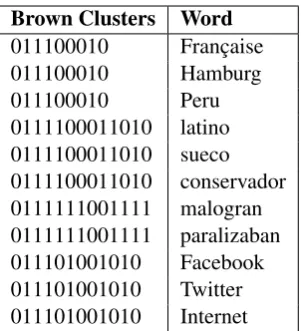
Brown clustering The numberk of word clus-ters for Brown clustering was fixed to 1000 follow-ing Turian et al. (2010). Sample Brown clusters are shown in Table 2. The cluster is used as fea-ture of each word in the annotated CoNLL 2002. As the reader can see Brown clustering tends to
3http://crscardellino.me/SBWCE/
[image:4.595.342.493.60.226.2]Brown Clusters Word 011100010 Franc¸aise 011100010 Hamburg 011100010 Peru 0111100011010 latino 0111100011010 sueco 0111100011010 conservador 0111111001111 malogran 0111111001111 paralizaban 011101001010 Facebook 011101001010 Twitter 011101001010 Internet
Table 2: Brown cluster computed from SBW.
Dimension Value Binarized
1 -0.008255 0
2 -0.013051 0
3 0.145529 U+
4 0.010853 0
... ... ...
295 0.050766 U+
296 -0.066613
B-297 0.073499 U+
298 -0.034749 0
299 -0.023611 0
[image:4.595.324.506.261.430.2]300 -0.025693 0
Table 3: Binarized embeddings from SBW for word “equipo”.
assign the entities to the same type to the same cluster.
Binarized Embeddings Table 3 shows a short view of word “equipo”. In the first column we can see each dimension of “equipo” and in the second its continuous value. The third column shows the binarized value. We used the binarized value as features for each observed word (all dimensions with a binarized value different to zero will be considered).
Clustering Embeddings For cluster embed-dings, 500, 1000, 1500, 2000 and 3000 clusters were computed, to model different levels of granu-larity (Guo et al., 2014). As features for each word
Granularity k
500 31
1000 978
1500 1317
2000 812
[image:5.595.312.524.61.297.2]3000 812
Table 4: Clustering embeddings from SBW for word “Maria”.
Class Prototypes
B-ORG EFE, Gobierno, PP, Ayuntamiento
I-ORG Nacional, Europea, Unidos, Civil I-MISC Campeones, Ambiente,
Ciudadana, Profesional B-MISC Liga, Copa, Juegos, Internet B-LOC Madrid, Barcelona, Badajoz,
Santander
I-LOC Janeiro, York, Denis, Aires B-PER Francisco, Juan, Fernando,
Manuel
I-PER Alvarez, Lozano, Bosque, Ibarra O que, el, en, y
Table 5: CoNLL-2002 Spanish Prototypes.
each granularity level.
Distributional Prototypes Regarding proto-types, we extracted, for each CoNLL BIO label
[image:5.595.130.233.62.145.2]40prototypes (the top most40w.r.t. NPMI). Table 5 shows the top four prototypes per en-tity class computed from CoNLL-2002 Spanish corpus (training subset). These prototypes are in-stances of each entity class even non-entity tag (O) and therefore they are compound by entities or en-tity parts (i.e.Buenos Airesis aLOCATIONso we see the wordAiresas prototype of I-LOC).
4.5 Results
In order to evaluate our models we used the
stan-dard conlleval4 script. Table 6 shows the
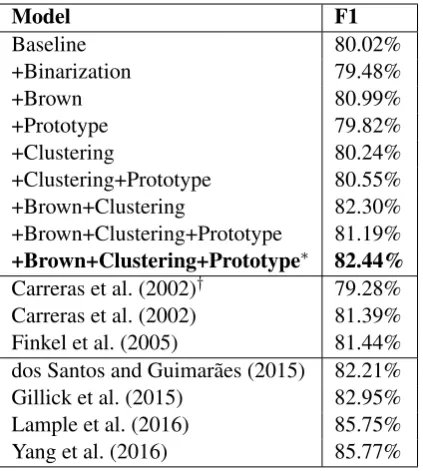
results achieved on CoNLL-2002 (Spanish), and compares them to Stanford and the state-of-the-art for Spanish NER. The Baseline achieved 80.02% of F-score.
It is worth nothing that Brown clustering im-proves the baseline. The same holds forClustered embeddings. By contrast, Binarization embed-dings does worse than the Baseline. This seems 4http://www.cnts.ua.ac.be/conll2000/chunking/conlleval.txt
Model F1
Baseline 80.02%
+Binarization 79.48%
+Brown 80.99%
+Prototype 79.82%
+Clustering 80.24%
+Clustering+Prototype 80.55%
+Brown+Clustering 82.30%
+Brown+Clustering+Prototype 81.19% +Brown+Clustering+Prototype∗ 82.44%
Carreras et al. (2002)† 79.28%
Carreras et al. (2002) 81.39% Finkel et al. (2005) 81.44% dos Santos and Guimar˜aes (2015) 82.21% Gillick et al. (2015) 82.95% Lample et al. (2016) 85.75%
Yang et al. (2016) 85.77%
∗Brown clusters from English resource †did not take into in account gazetteers
Table 6: CoNLL2002 Spanish Results. Top: re-sults obtained by us. Middle: rere-sults obtained with other CRF-based approaches. Down: current Deep Learning-based state-of-the-art for Spanish NER.
to be due to the fact that binarized embeddings by grouping vector components into a finite set of discrete values throw away information relevant for Spanish NER. The same goes forPrototypes, which when taken alone yield results also below theBaseline.
Combining the features, on the other hand, yields in all cases results above the baseline, as well as above Brown clustering and clustered em-beddings alone.
However, our best results were obtained by us-ing across-lingual combinationcombining Brown clusters computed from the English Wikipedia dump (2012) with clustered embeddings and pro-totypes computed from SBW. The reason Brown clusters are good in this task is due to the high level of overlap among entities in Spanish and En-glish. Put otherwise, many entities that share the same name and a similar context occur in texts from both languages, giving rise to features with higher predictive value.
4.6 Discussion
[image:5.595.81.284.184.386.2]knowl-edge Carreras et al. (2002) which turned out 81.39% F1-score (see Table 6). However, with-out gazetteers and external knowledge results go down to 79.28% (see Table 6).
It is worth noting that the knowledge injected to the previous learning model was supervised. We on the other hand have considered unsupervised
external knowledge, while significantly improving on those results. This is further substantiated by our exploring unsupervised features with the Stan-ford NER CRF model (Finkel et al., 2005). In this setting F-score of 81.44% was obtained, again above Carreras et al. (2002).
More importantly, our work shows that an glish resource (Brown clusters computed from En-glish Wikipedia) can be used to improve Spanish NER with Word Representations as(i)entities in Spanish and English are often identical, and (ii)
the resulting English Brown clusters for English entities correlate better with their entity types, giv-ing rise to a better model.
Another point to note is that while binariza-tion improves on English NER baselines Guo et al. (2014), the same does not work for Spanish. It seems that this approach adds instead noise to Spanish NER.
We also note thatword capitalizationhas a dis-tinct impact on our approach. With the following setting: English Brown clusters, Spanish cluster embeddings and lowercased Spanish prototypes we got 0.78% less F-score than with uppercased prototypes. This is because the lowercased pro-totypes will ignore the real context in which the entity appears (since a prototype is an instance of an entity class) and will be therefore mapped to the wrong word vector in the embedding (when com-puting cosine similarity).
Finally, when comparing our approach to the current state-of-the-art using Deep Learning meth-ods (dos Santos and Guimar˜aes, 2015; Gillick et al., 2015; Lample et al., 2016; Yang et al., 2016) (that extract features at the character, word and bytecode level to learn deep models), our work outperforms dos Santos and Guimar˜aes (2015) F-score and matches also Gillick et al. (2015).
5 Conclusions
This paper has explored unsupervised and mini-mally supervised features, based on cross-lingual Word Representations, within a CRF classification model for Spanish NER, trained over the
Span-ish CoNLL 2002 corpus, the SpanSpan-ish Billion Word Corpus and English Wikipedia (2012 dump). This is a novel approach for Spanish. Our experiments show competitive results when compared to the current state-of-the-art in Spanish NER, based on Deep Learning, while increasing the coverage of the model. In particular, we outmatcht dos Santos and Guimar˜aes (2015).
Cross-lingual Word Representations have a pos-itive impact on NER performance for Spanish. In the future, we would like to focus further on this aspect and consider more (large scale) cross-lingual datasets.
Acknowledgments
We thank Data and Web Science Group in particu-lar Heiner Stuckenschmidt and Simone Ponzetto for useful help. This work was supported by the Master Program in Computer Science of the Universidad Cat´olica San Pablo and the Peru-vian National Fund of Scientific and Technologi-cal Development through grant number 011-2013-FONDECYT.
References
Binod Bhattarai. 2013. Inducing cross-lingual word representations. Master’s thesis, Multimodal Com-puting and Interaction, Machine Learning for Nat-ural Language Processing. Universit¨at des Saarlan-des.
G. Bouma. 2009. Normalized (pointwise) mutual in-formation in collocation extraction. In C. Chiar-cos, E. de Castilho, and M. Stede, editors,Von der Form zur Bedeutung: Texte automatisch verarbeiten / From Form to Meaning: Processing Texts Auto-matically, Proceedings of the Biennial GSCL Con-ference 2009, pages 31–40, T¨ubingen. Gunter Narr Verlag.
Peter F. Brown, Peter V. deSouza, Robert L. Mer-cer, Vincent J. Della Pietra, and Jenifer C. Lai. 1992. Class-based n-gram models of natural lan-guage. Comput. Linguist., 18(4):467–479, Decem-ber.
Cristian Cardellino. 2016. Spanish Billion Words Cor-pus and Embeddings, March.
Xavier Carreras, Llu´ıs M`arques, and Llu´ıs Padr´o. 2002. Named entity extraction using adaboost. In Proceedings of CoNLL-2002, pages 167–170. Taipei, Taiwan.
neural networks with multitask learning. In Pro-ceedings of the 25th International Conference on Machine Learning, ICML ’08, pages 160–167, New York, NY, USA. ACM.
Cicero dos Santos and Victor Guimar˜aes. 2015. Boost-ing named entity recognition with neural character embeddings. InProceedings of the Fifth Named En-tity Workshop, pages 25–33, Beijing, China, July. Association for Computational Linguistics.
Manaal Faruqui and Sebastian Pad´o. 2010. Train-ing and evaluatTrain-ing a german named entity recog-nizer with semantic generalization. InProceedings of KONVENS 2010, Saarbr¨ucken, Germany.
Jenny Rose Finkel, Trond Grenager, and Christopher Manning. 2005. Incorporating non-local informa-tion into informainforma-tion extracinforma-tion systems by gibbs sampling. InProceedings of the 43rd Annual Meet-ing on Association for Computational LMeet-inguistics, ACL ’05, pages 363–370, Stroudsburg, PA, USA. Association for Computational Linguistics.
D. Gillick, C. Brunk, O. Vinyals, and A. Subramanya. 2015. Multilingual Language Processing From Bytes. ArXiv e-prints, November.
Jiang Guo, Wanxiang Che, Haifeng Wang, and Ting Liu. 2014. Revisiting embedding features for sim-ple semi-supervised learning. In Proceedings of the 2014 Conference on Empirical Methods in Nat-ural Language Processing (EMNLP), pages 110– 120, Doha, Qatar, October. Association for Compu-tational Linguistics.
Guillaume Lample, Miguel Ballesteros, Kazuya Kawakami, Sandeep Subramanian, and Chris Dyer. 2016. Neural architectures for named entity recog-nition. InIn proceedings of NAACL-HLT (NAACL 2016)., San Diego, US.
Percy Liang. 2005. Semi-supervised learning for natural language. Master’s thesis, Department of Electrical Engineering and Computer Science. Mas-sachusetts Institute of Technology.
Tomas Mikolov, Kai Chen, Greg Corrado, and Jeffrey Dean. 2013a. Efficient estimation of word represen-tations in vector space.CoRR, abs/1301.3781.
Tomas Mikolov, Ilya Sutskever, Kai Chen, Greg S. Corrado, and Jeff Dean. 2013b. Distributed rep-resentations of words and phrases and their compo-sitionality. In C.j.c. Burges, L. Bottou, M. Welling, Z. Ghahramani, and K.q. Weinberger, editors, Ad-vances in Neural Information Processing Systems 26, pages 3111–3119.
Naoaki Okazaki. 2007. Crfsuite: a fast implementa-tion of condiimplementa-tional random fields (crfs).
Alexandre Passos, Vineet Kumar, and Andrew McCal-lum. 2014. Lexicon infused phrase embeddings for
named entity resolution. InProceedings of the Eigh-teenth Conference on Computational Natural Lan-guage Learning, pages 78–86, Ann Arbor, Michi-gan, June. Association for Computational Linguis-tics.
Lev Ratinov and Dan Roth. 2009. Design challenges and misconceptions in named entity recognition. In
Proceedings of the Thirteenth Conference on Com-putational Natural Language Learning, CoNLL ’09, pages 147–155, Stroudsburg, PA, USA. Association for Computational Linguistics.
D. Sculley. 2010. Combined regression and ranking. In Proceedings of the 16th ACM SIGKDD Inter-national Conference on Knowledge Discovery and Data Mining, KDD ’10, pages 979–988, New York, NY, USA. ACM.
Charles Sutton and Andrew McCallum. 2012. An in-troduction to conditional random fields. Founda-tions and Trends in Machine Learning, 4(4):267– 373.
Erik F. Tjong Kim Sang. 2002. Introduction to the conll-2002 shared task: Language-independent named entity recognition. InProceedings of the 6th Conference on Natural Language Learning - Volume 20, COLING-02, pages 1–4, Stroudsburg, PA, USA. Association for Computational Linguistics.
Joseph Turian, Lev Ratinov, and Yoshua Bengio. 2010. Word representations: A simple and general method for semi-supervised learning. InProceedings of the 48th Annual Meeting of the Association for Com-putational Linguistics, ACL ’10, pages 384–394, Stroudsburg, PA, USA. Association for Computa-tional Linguistics.
Yiming Yang and Jan O. Pedersen. 1997. A compar-ative study on feature selection in text categoriza-tion. InProceedings of the Fourteenth International Conference on Machine Learning, ICML ’97, pages 412–420, San Francisco, CA, USA. Morgan Kauf-mann Publishers Inc.
Zhilin Yang, Ruslan Salakhutdinov, and William Co-hen. 2016. Multi-task cross-lingual sequence tag-ging from scratch. CoRR, abs/1603.06270.
Mo Yu, Tiejun Zhao, Yalong Bai, Hao Tian, and Di-anhai Yu. 2013a. Cross-lingual projections between languages from different families. InProceedings of the 51st Annual Meeting of the Association for Com-putational Linguistics (Volume 2: Short Papers), pages 312–317, Sofia, Bulgaria, August. Associa-tion for ComputaAssocia-tional Linguistics.